Key Takeaways
- A millet noodles, pasta and vermicelli manufacturing plant project report helps Indian entrepreneurs plan machinery, plant setup, investment and bank finance for millet-based convenience foods with structured technical and financial analysis.
- Ragi, bajra, jowar and small millets can be processed into noodles, pasta and vermicelli using adapted wheat-based technologies, but formulations, drying and quality control are more sensitive than conventional wheat products.
- Project economics depend heavily on raw material sourcing, product mix, capacity utilisation and distribution strategy rather than machinery alone.
- A bankable detailed project report must include plant cost, working capital, 7–10 year financial projections, DSCR, IRR, break-even and sensitivity analysis to satisfy Indian banks.
- Project Report Bank, led by CA Manish Gugliya, supports serious food processing investors with customised project reports and project finance advisory across India.
Introduction
India’s millet push-catalysed by the International Year of Millets 2023, rising health awareness and sustained government campaigns-has created measurable demand for value-added millet food products. Millet noodles and pasta meet rising consumer demand for gluten-free products, while millet vermicelli serves traditional recipe segments such as upma and kheer. This article outlines a millet noodles pasta and vermicelli manufacturing plant project report framework aimed at entrepreneurs planning organised manufacturing facilities, not home or cottage units.
Millets such as ragi (finger millet), bajra (pearl millet), jowar (sorghum) and small millets like foxtail, little millet and kodo millet can replace part of wheat flour or refined flour in instant noodles, dried pasta and vermicelli. However, millets lack gluten, which means formulation, extrusion and drying parameters require careful adjustment. Millet varieties include ragi, jowar, bajra and kodo millets for processing into finished convenience foods.
A small manual food unit processing a few hundred kilograms per day with basic equipment differs fundamentally from an industrial manufacturing plant handling 1–10 MT per day on automated lines with quality systems and organised distribution. A bankable detailed project report is essential for evaluating plant setup, raw materials, the manufacturing process, machinery selection, plant cost, working capital and financial feasibility before committing capital. Production typically takes 12 to 18 months to set up from project sanction to commercial operations.
Project Report Bank, led by CA Manish Gugliya, FCA, DISA (ICAI), provides professional DPR preparation and project finance advisory for millet-based food processing projects in India, drawing on more than 20 years of experience in industrial project reports and financial modelling.
Millet Noodles, Pasta and Vermicelli Manufacturing Industry Overview
Millet noodles, millet pasta and millet vermicelli represent an extension of India’s existing noodles and pasta markets, targeted at health-conscious and functional-food segments. India’s instant noodles market size exceeds ₹3,000 crore and the instant noodles market is growing at 10–12% annually. The global instant noodles market was valued at USD 60.33 billion in 2025 and is projected to reach USD 87.37 billion by 2034. Instant noodles account for a significant share of India’s packaged food industry, and urbanization and rising incomes drive demand further.
Target audiences include health-conscious consumers and institutional buyers. Market trends indicate a shift toward gluten-free and high-fiber foods. Distribution channels include e commerce platforms and traditional retail outlets, alongside cloud kitchens and HoReCa bulk supply.
Key commercial applications span:
- Retail packs for modern trade and general trade
- Institutional catering and school nutrition programmes
- Private-label manufacturing for D2C health brands
- Emerging export potential to Gulf, Africa and Indian diaspora markets
The competitive landscape includes large FMCG players dominating wheat noodles and pasta, alongside emerging niche health brands in millet noodles and vermicelli. Market-entry barriers include product development challenges, branding cost, required scale of the manufacturing plant, compliance certifications and distribution credit requirements.
Product Portfolio and Manufacturing Opportunities
A millet noodles, pasta and vermicelli project can be configured as a single-product plant or a multi-product facility. Product mix directly affects machinery selection, drying capacity and economics.
- Millet noodles: plain dried millet noodles, instant millet noodles (steamed and dried or fried noodles with seasoning sachets), multigrain millet noodles and ready-to-cook noodle blocks for B2B buyers. Instant noodles require refined palm oil or sunflower oil for frying where the fried format is adopted. Cup noodles represent a premium convenience format.
- Millet pasta: macaroni, penne, fusilli, shells and other shapes made with millet flour blends. Texture and cooking quality may require a portion of wheat semolina or functional starch unless fully gluten-free technology is adopted.
- Millet vermicelli: ragi vermicelli, bajra vermicelli, jowar vermicelli and multimillet vermicelli, suitable for upma, kheer and regional recipes.
Some SKUs are instant or quick-cooking (pre-steamed, thinner gauge), while others are conventional long-cook products-this choice influences drying regime and energy cost. True “gluten-free” claims require dedicated wheat-free lines, validated cleaning protocols and periodic lab testing. Packaging formats include pillow packs, jars and bulk bags. Promoters exploring related extrusion-based products may also refer to the millet-based extruded snacks manufacturing project for diversification opportunities.
Raw Materials and Ingredient Requirements
Raw material planning is critical because millet-based dough behaves differently from wheat-only systems, affecting yield, breakage and taste of finished noodles, pasta and vermicelli. Raw material sourcing strategies include direct tie-ups with local grain suppliers to ensure consistent quality and pricing.
Key millet flours include ragi flour (see ragi processing and flour manufacturing plant), bajra flour (see bajra processing and milling plant project report), jowar flour (see sorghum milling and flour processing plant), and foxtail, little millet and other small millet flours (see small millet processing plant project report).
Manufacturers must decide between procuring ready-made millet flour and setting up an integrated milling section. The integrated millet processing plant project report provides deeper upstream analysis for those considering backward integration.
Binding and functional ingredients include wheat flour or semolina (if not fully gluten-free), starch, hydrocolloids, salt, alkaline agents (for noodles) and permitted fortificants. Additional inputs for instant noodles include edible oil for frying, seasoning premix with dehydrated vegetables, spices and flavour enhancers, and eggs where formulations require them. Packaging raw materials encompass laminated pouches, cartons, corrugated boxes, BOPP or PET films and food-grade ink.
Quality parameters must meet FSSAI guidance on millets: moisture limits, microbial load, aflatoxin and pesticide residue control. Proper storage with humidity management and pest control is essential given seasonal millet procurement.
Millet Noodles, Pasta & Vermicelli Manufacturing Process
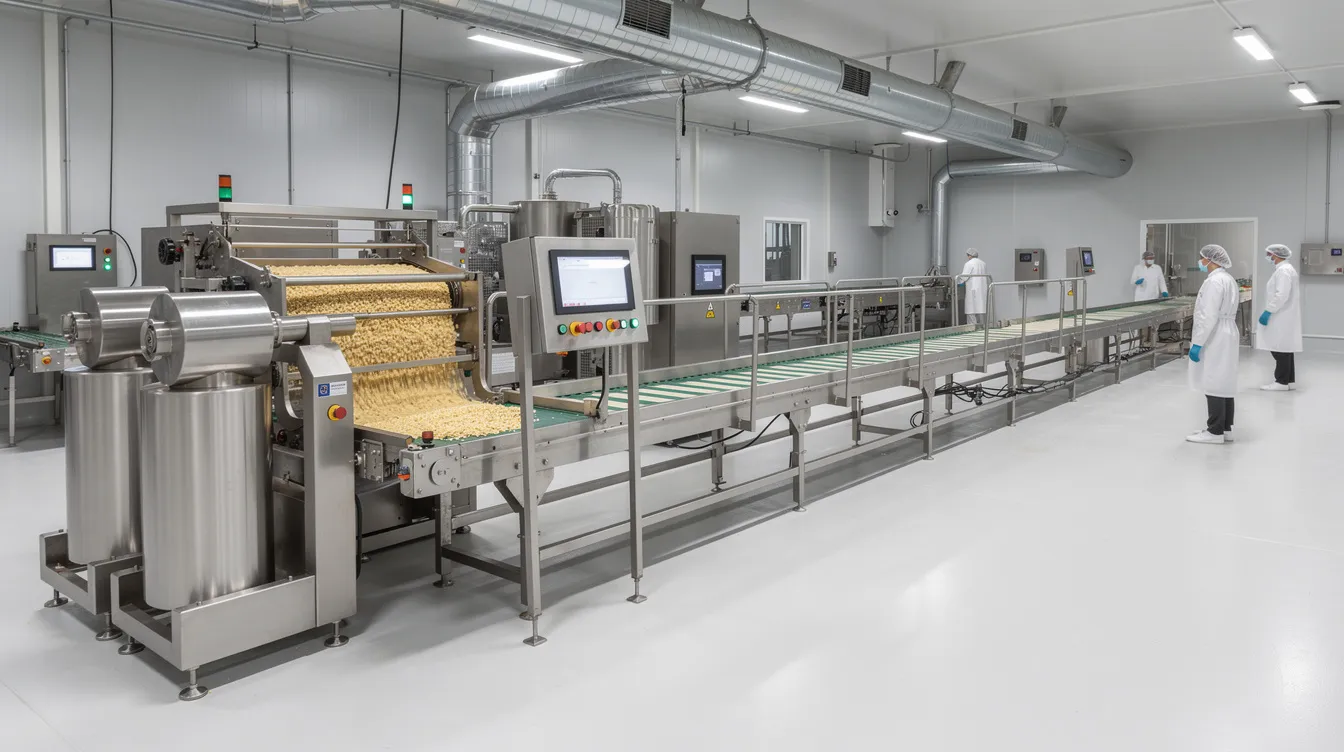
While core unit operations resemble conventional wheat products, process parameters for dough mixing, hydration, extrusion and drying must be tuned for millet-based formulations. Manufacturing processes for millet products involve milling, extrusion and drying as the three central operations. Safety protocols must be implemented throughout the manufacturing process.
Millet Noodles: Raw Material Receiving → Quality Testing → Flour Sieving → Ingredient Weighing → Mixing and Hydration → Dough Conditioning → Extrusion or Dough Sheeting and Cutting → Steaming or Cooking (for instant noodles) → Drying (hot air / frying / hybrid) → Cooling → Quality Inspection → Packaging → Finished Goods Storage
Millet Pasta: Raw Material Receiving → Flour Preparation → Ingredient Mixing → Dough Hydration and Resting → Extrusion Through Pasta Dies → Cutting and Shaping → Controlled Multi-Stage Drying → Cooling → Sorting → Packing → Dispatch
Millet Vermicelli: Flour Preparation → Sieving → Mixing and Dough Formation → Dough Conditioning → Extrusion Through Fine Dies → Cutting → Optional Steaming → Rack or Continuous Drying → Cooling → Quality Check → Packaging
IIMR research reports vermicelli yield of approximately 99% for millet-wheat blends with negligible by-product loss. FSSAI standards prescribe maximum moisture of 10% for fried noodles and 13% for non-fried variants. Promoters interested in related convenience food technologies may also review the instant millet porridge and upma mix manufacturing plant.
Plant and Machinery Requirements
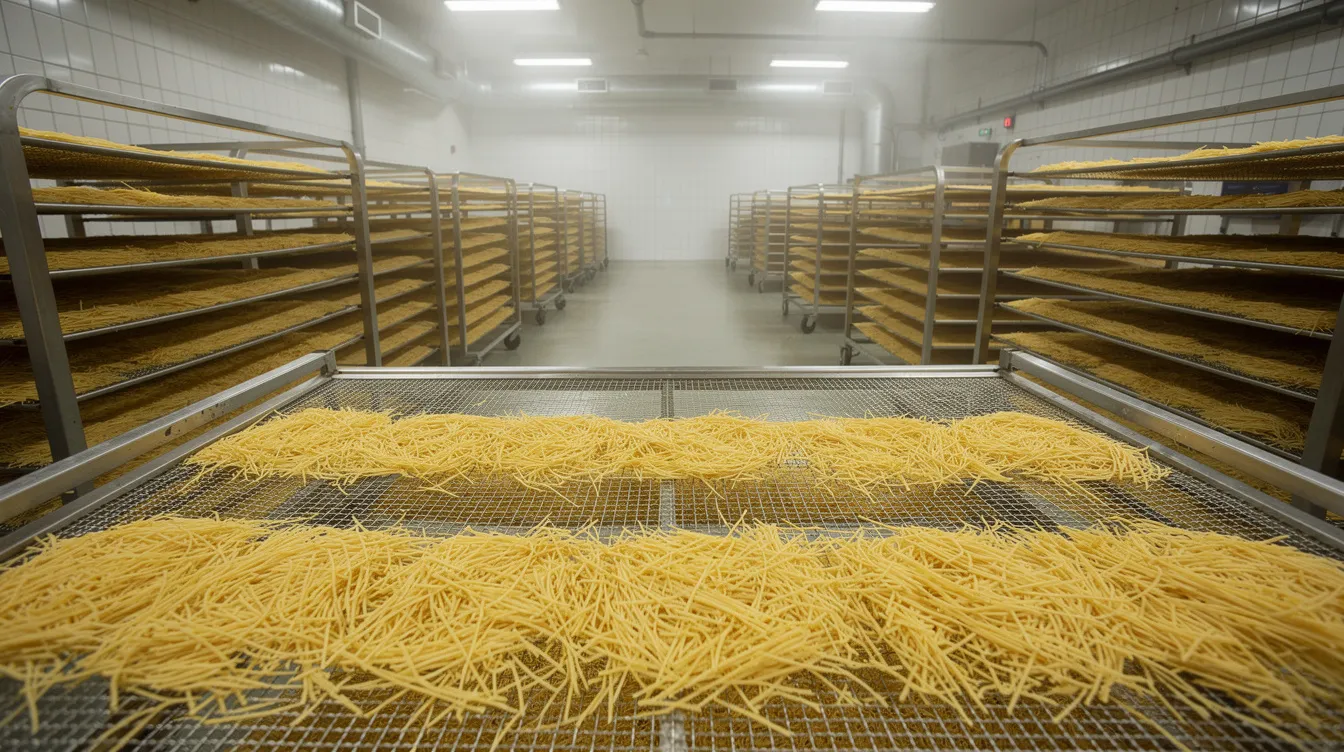
Machinery requirements depend on production capacity and process specifications. Essential equipment includes mixers, sheeting machines and dryers, along with extruders, steamers and packaging systems. The technology and automation level chosen will determine both capital expenditure and operating efficiency.
Key equipment groups:
| Equipment Category | Purpose | Applicable Products |
|---|---|---|
| Silos and storage bins | Raw material handling | All |
| Flour sieves and screening | Particle size control | All |
| Automatic weighing and dosing | Ingredient batching | All |
| Ribbon or planetary mixers | Dough mixing and hydration | All |
| Noodle sheeter and slitter | Sheet forming and cutting | Noodles |
| Pasta extruder with dies | Shape extrusion | Pasta, vermicelli |
| Steamer or fryer | Cooking or frying | Instant noodles |
| Continuous or tray dryers | Moisture removal | All |
| Cooling conveyors | Temperature reduction | All |
| Metal detectors, checkweighers | Quality and food safety | All |
| Form-fill-seal machines | Primary packaging | All |
| Boiler, compressors, panels | Utilities | All |
Indian-manufactured machinery offers cost advantages and local service support, while imported European lines provide higher automation, energy efficiency and recipe flexibility. Detailed capacity and price quotations should be sourced from machinery suppliers at the DPR stage. Maintenance planning, spare parts inventory and preventive schedules are essential to avoid drying bottlenecks.
Manufacturing Plant Capacity and Production Planning
Illustrative capacities of 500, 1,000, 2,000, 5,000 and 10,000 kg per day serve as reference points, not standard recommendations. Large-scale noodles manufacturing plants can produce 20,000 to 50,000 MT annually at full capacity. Installed capacity (rated output) differs from achievable capacity after accounting for downtime, changeovers, maintenance and demand patterns.
For example, an illustrative 1,000 kg/day unit working 25 days per month at 70% utilisation across a mix of millet noodles (50%), pasta (30%) and vermicelli (20%) would yield approximately 17.5 MT per month, with process losses of 2–5% depending on the product and millet content. Drying capacity is a common bottleneck and dryer sizing must be aligned with extruder and sheeter outputs to avoid WIP accumulation.
Product changeovers and cleaning-especially where both wheat-based and “gluten-free” labelled SKUs are produced-reduce effective daily output. Detailed production planning and monthly output schedules form part of the customised project report prepared by Project Report Bank.
Land, Building and Factory Layout
Land and building requirements depend on capacity, integration level and location. Plant layout should follow a hygienic workflow to prevent contamination, with separate zones for raw material storage, processing, drying and packaging. Environmental management addresses waste disposal and energy efficiency in production.
Functional areas include raw material store, milling or flour handling (if integrated), mixing and dough preparation hall, extrusion and sheeting zone, steaming and frying area, drying and cooling section, packing hall, finished goods warehouse, QC lab, utilities block and offices. Hygiene zoning requires demarcation between raw and finished goods areas, controlled personnel flow, change rooms, handwashing and sanitation facilities, and food safety-compliant surfaces.
Future expansion should be planned from the outset-leaving space for an additional dryer or extruder line, planned utility corridors and flexible warehouse areas. Compliance with local building bye-laws, Factory Act provisions, fire safety norms and environmental regulations is mandatory.
Millet Noodles, Pasta and Vermicelli Plant Setup Cost
Investment for a small semi-automatic unit ranges from ₹15 lakh to ₹75 lakh depending on capacity and product range. Medium plants of 2,000–5,000 kg per day with moderate automation may require multi-crore investment. Larger industrial facilities of 10,000 kg per day and above involve substantially higher capital.
Typical cost heads include land and site development, factory building and civil works, plant and machinery, electrical installations, utility requirements, QC laboratory, packaging equipment, installation and commissioning, preliminary and pre-operative expenses, interest during construction, contingencies and margin for working capital.
Cost allocation typically shows machinery and equipment commanding the largest share (40–50% of CapEx), followed by civil works (20–30%), with working capital margin, preliminary expenses and contingencies accounting for the balance. Project Report Bank prepares project-specific cost estimates based on capacity, location, machinery quotations and promoter preferences, aligned with bank appraisal norms.
Working Capital Requirements
Millet-based noodles manufacturing is inventory and credit intensive. Operational expenses include utilities, labor and raw materials on an ongoing basis.
Key working capital components:
- Raw material inventory (millet flours, wheat, salt, oil, seasonings, packaging): typically 30–60 days of stock
- Work-in-progress in mixing and drying sections: 1–2 days
- Finished goods in warehouse: 10–15 days
- Receivables from distributors and institutional customers: 30–60 days
- Less: creditor credit from suppliers: 15–30 days
Seasonal bulk purchase of millets versus monthly buying significantly affects working capital. In the full project report, detailed month-wise working capital assessment and CMA Data format are prepared for bank finance under the guidance of CA Manish Gugliya.
Manufacturing Cost and Production Economics
The cost structure of millet noodles, pasta and vermicelli differs from standard wheat products because of costlier millet raw materials and potentially higher drying energy. Wheat flour accounts for 60–70% of operating expenses in conventional noodle plants. Raw materials typically comprise 55–65% of ex-factory selling price. Total raw material costs significantly impact profitability margins. Operating costs are primarily driven by raw material consumption.
Major cost components per kg include millet and wheat flour blend, binding agents, seasoning (for instant noodles), edible oil (if fried), packaging materials, direct labour, power and fuel, maintenance, QA and depreciation. Variable costs dominate the cost structure, and capacity utilisation, wastage percentage, energy tariffs and packaging optimisation significantly influence unit cost, especially in initial years.
Noodles, pasta and vermicelli have different material and conversion cost profiles-instant noodles with seasoning and palm oil tend to have higher material cost per kg than plain dry pasta or vermicelli. Detailed product-wise costing and contribution analysis are modelled in the customised project report.
Revenue Model and Profitability
Revenue streams include branded retail sales, B2B bulk supplies to HoReCa and institutions, private-label manufacturing for organised retailers and D2C brands, and export contracts. Pricing tiers range from economy millet blends to premium whole wheat and wholegrain SKUs, fortified or organic products (with claims complying with FSSAI regulation), and bulk institutional or export prices.
Gross profit margins for noodles typically range between 30–40% at stabilised operations, though millet-based products may achieve higher margins with premium positioning or lower margins if competing on price. Break-even for a noodles manufacturing business typically ranges from 2 to 4 years depending on capacity utilisation ramp-up and distribution reach.
Financial projections provide a comprehensive view of ROI and profitability. Profitability is highly project-specific and depends on selling price realisation, distribution reach and cost control. The article does not promise specific profit percentages.
Financial Projections, DSCR, IRR and Break-Even Analysis
Banks and investors expect 7–10 year financial projections in a serious millet noodles pasta and vermicelli manufacturing plant project report, with linked P&L, balance sheet and cash flow projections forming the core financial statements. Financial modeling involves calculating working capital and operational costs alongside revenue assumptions. Investment analysis should cover return on investment and profitability metrics. Project financials should include break-even analysis and cash flow projections.
DSCR (Debt Service Coverage Ratio) measures cash available for debt servicing against repayment obligations. Indian lenders typically require DSCR above 1.25–1.30. Project IRR and equity IRR, NPV and payback period help promoters and investors judge commercial attractiveness. Financial projections should reflect realistic assumptions and market conditions.
Sensitivity analysis tests scenarios including higher millet flour prices, reduced selling prices, slower capacity ramp-up, higher power tariffs, increased interest rates and delayed receivables-examining their impact on DSCR and IRR. A project report for a manufacturing plant should cover financial analysis comprehensively to create defensible projections.
Bank Loan and Project Financing
Typical project finance structure combines promoter equity (20–30%), term loan for CapEx (70–80%) and working capital limits (cash credit or overdraft) for operations. Financial projections are essential for securing bank loans.
Banks examine technical feasibility, market justification, realistic financial projections, security and collateral coverage, DSCR, break-even and promoter profile. CMA Data summarises projected balance sheet, working capital, fund flow statement and ratios in formats recognised by Indian banks.
Project Report Bank supports clients through preparation of bankable DPR, CMA Data, term loan structuring, working capital assessment and assisting entrepreneurs in responding to bankers’ queries. Loan sanction ultimately depends on bank policy, security, promoter credentials and project viability.
Government Schemes and Subsidies
Millet-based noodles, pasta and vermicelli units may be eligible for certain central and state government schemes for food processing. Funding can be sourced from government schemes for food processing projects, though no subsidy is automatic.
- PM Formalisation of Micro Food Processing Enterprises (PMFME) supports micro food processing units with capital subsidy
- PMEGP offers up to ₹50 lakh project cost with 25% subsidy for eligible categories
- Mudra loans provide collateral-free funding up to ₹10 lakh for smaller units
- CGTMSE covers loans up to ₹2 crore without collateral
- State-specific food processing policies offer additional incentives in many states
Promoters must verify the latest scheme guidelines from official government websites at the time of DPR preparation, as eligibility, ceilings and application procedures change over time.
Licences, Registrations and Compliance
Millet noodles, pasta and vermicelli manufacturing is a regulated food processing activity. Statutory compliance includes FSSAI licensing and MSME registration as foundational requirements. FSSAI State Manufacturing Licence is mandatory for noodle producers. MSME registration is required for noodle manufacturing businesses. Factory Licence from the Labour Department is necessary for operations. Trade Licence from local municipal authority is needed for compliance. Barcode or GS1 registration is required for modern retail supply.
Additional registrations include GST registration, fire safety clearance, pollution control board consent (where applicable) and labour law registrations. Legal Metrology requirements for packaged foods cover net quantity declaration, MRP, batch coding, manufacturing date and best-before date. Quality control ensures adherence to food safety standards like HACCP and ISO 22000. Quality assurance systems are critical for maintaining product standards across all product lines.
Manufacturing Risks and Mitigation
Millet noodles, pasta and vermicelli projects face both general food processing industry risks and millet-specific challenges. Project reports should include sections on risk assessment and mitigation strategies.
- Supply risks: inconsistent millet flour quality, price volatility, seasonal availability, aflatoxin contamination
- Technical risks: poor texture, higher breakage during drying, moisture management errors, product innovation challenges with unfamiliar millet combinations
- Market risks: slow consumer acceptance, aggressive competition from established wheat-based brands requiring higher commerce and marketing spending, distributor credit defaults
- Regulatory risks: non-compliance with FSSAI or labelling rules leading to recalls
Mitigation strategies include diversified sourcing, long-term vendor contracts, robust quality systems, pilot-scale trials, phased market entry, strong cash-flow planning and periodic sensitivity analysis. Product development should involve systematic cook tests and consumer trials before scaling up production of any new device or form factor.
Integrated Millet Processing versus Standalone Finished Product Manufacturing
Promoters must choose between buying ready millet flours (Model A) and setting up an integrated facility combining millet cleaning, dehulling, milling and finished product manufacturing (Model B).
Model A (standalone) offers lower capital cost, simpler operations, easier scale-up and flexibility to switch between millet combinations. Model B (integrated) provides tighter raw material quality control, potential cost savings at scale and ability to sell surplus flour or by-products. Those exploring larger agro-processing investments may refer to the puffed millet and roasted millet processing project for by-product utilisation ideas.
Integration is generally more justified at medium-to-large scales or for promoters with strong backward linkages. Project Report Bank can model both options in separate scenarios within the DPR to help promoters compare IRR, DSCR and risk profiles.
Commercial Feasibility and Investment Decision
Commercial feasibility depends on triangulating technical feasibility, market feasibility and financial viability. Technical factors include suitability of selected technology for millet formulations, availability of skilled manpower, and compliance with food safety standards. Market factors include clarity of target segments, competitive mapping and realistic sales ramp-up. Financial feasibility requires robust projections stress-tested under adverse assumptions.
No millet noodles, pasta and vermicelli plant should be treated as “automatically profitable.” Each proposed plant in India requires a customised DPR and financial model before final investment decisions, considering the promoter’s world of experience, equity contribution and risk appetite.
Why a Detailed Project Report Is Essential
Creating a detailed project report requires technical feasibility and market analysis working together. An instant noodles manufacturing plant requires a detailed project report, and the same principle applies to all millet-based convenience foods. The DPR documents technical configuration, defines installed capacity and product mix, estimates plant cost and working capital, maps the implementation schedule and structures 7–10 year financial projections with DSCR and ratio analysis in formats acceptable to Indian banks. It also supports risk analysis and sensitivity tests, allowing the promoter to visualise impacts of key risks before investing.
Professional DPR and Financial Feasibility Advisory by Project Report Bank
CA Manish Gugliya, FCA, DISA (ICAI), brings more than 20 years of professional experience in industrial project reports, financial modelling, CMA Data and project finance advisory. As chartered accountants specialising in manufacturing and food processing projects, Project Report Bank provides professional project advisory services with customized analysis for entrepreneurs.
Services relevant to millet noodles, pasta and vermicelli projects include customised detailed project reports, bank finance DPR preparation, CMA Data for bank loans, 7–10 year financial projections, DSCR and IRR analysis, project cost and means-of-finance structuring, and investor-ready documentation.
Every millet noodles manufacturing plant project report is prepared based on proposed location, capacity, product portfolio, machinery preferences and financing structure shared by the promoter. Serious entrepreneurs and MSME manufacturers are invited to share key project details-proposed site, intended daily capacity, product mix, approximate investment budget and loan requirement-through ProjectReportBank.com for professional consultation.
Frequently Asked Questions
The following questions address practical doubts often raised by millet noodles, pasta and vermicelli project promoters beyond what is covered in the main sections.
How much investment is typically required for a millet noodles, pasta and vermicelli manufacturing plant in India?
Investment depends on capacity, automation level, integration with milling and location. A small semi-automatic unit may require ₹15–75 lakh, while medium plants of 2,000–5,000 kg per day typically involve multi-crore investment. The customised project report from Project Report Bank estimates project cost based on actual machinery quotations and civil cost benchmarks for the promoter’s chosen location.
Can millet noodles, pasta and vermicelli be produced on the same manufacturing line?
Some equipment such as mixers, silos and dryers can be shared, but noodles, pasta and vermicelli usually require dedicated extruders, dies or sheeting systems. Changeovers need proper cleaning, especially where gluten-free claims are made. The DPR evaluates whether a combined line or partially shared infrastructure is more economical for the promoter’s specific product mix.
What minimum capacity is generally considered commercially viable?
True commercial viability normally begins from capacities where fixed costs can be spread over adequate output-typically around 500–1,000 kg per day and above. However, the actual threshold varies by selling price, distribution reach and margin structure. Project Report Bank analyses promoter-specific assumptions to determine whether planned capacity can support bankable DSCR and acceptable IRR.
Is it mandatory to manufacture millet flour in-house?
Most new entrants prefer to buy millet flours from specialised mills to keep the project simpler in the initial phase. In-house milling is more suitable for larger agro-processing groups or when backward integration clearly improves economics. Upstream processing options are discussed in the integrated millet processing plant project report.
What information is required to prepare a bankable project report?
Typical inputs include proposed location and land status, planned capacity in kg per day, intended product mix between noodles, pasta and vermicelli, preferred machinery automation level, expected selling prices and target markets, approximate equity available and desired loan amount. With these details, Project Report Bank prepares a tailored DPR, financial model and CMA Data to support loan applications and investment decisions.