Key Takeaways
- A professional ragi processing plant project report is an essential planning document before committing capital, covering technical configuration, machinery selection, project cost, financial projections, and risk analysis for a commercial finger millet flour manufacturing facility.
- Commercial ragi flour manufacturing is a scalable agro-processing opportunity distinct from a generic flour mill, requiring specific cleaning, grading, milling, and packaging infrastructure with strict hygiene and quality control standards.
- Project viability depends on raw ragi procurement strategy, correct machinery sizing, realistic plant capacity planning (typically 5–50 TPD for commercial operations), disciplined working capital management, and achievable recovery assumptions.
- Project Report Bank, led by CA Manish Gugliya (FCA, DISA), prepares customised detailed project reports, financial models, and feasibility studies for ragi and millet processing projects across India.
- This article covers market opportunities, product mix, manufacturing process, machinery requirements, cost breakdown, project finance, government schemes, risk analysis, and DPR preparation structure.
Introduction – Ragi Processing and Flour Manufacturing Industry in India
Ragi, or finger millet, occupies a distinctive position in India’s food processing industry. Cultivated extensively in Karnataka, Andhra Pradesh, Tamil Nadu, Maharashtra, Odisha, and increasingly in parts of North India, ragi is valued for its exceptional nutritional benefits – high calcium content, dietary fiber, iron, and a low glycaemic index. Ragi processing is driven by rising demand for millets due to health benefits and government support, including the momentum generated by the International Year of Millets 2023 and ongoing campaigns promoting sustainable agriculture and millet consumption.
A commercial ragi processing plant encompasses cleaning, destoning, grading, milling, sieving, and packaging under controlled hygienic conditions – a fundamentally different operation from a household chakki or a basic flour mill handling wheat or rice. The distinction lies in equipment sophistication, dust management, product quality consistency, and the ability to serve institutional and retail markets with standardised specifications.
Before investing in any millet processing project, promoters must understand the technical feasibility, financial viability, and operational requirements. A ragi processing plant project report integrates these aspects into a structured document that helps the promoter make informed capital allocation decisions and supports bank loan applications and investor discussions. Industry trends – particularly the growing segment of health conscious consumers and gluten free product demand – make this an area worth serious evaluation, provided the planning is grounded in realistic assumptions rather than market enthusiasm alone.
Market Opportunities for Commercial Ragi Processing in India
The global millet market was valued at USD 13.93 billion in 2025, reflecting broad-based market growth across geographies and product categories. Within India, the local and national demand for ragi products includes flour, malt, and value-added food items, driven by dietary shifts among urban consumers and institutional nutrition programmes.
Key buyer segments include:
- Packaged atta brands adding millet flour to their product lines
- Health-food startups and bakery manufacturers seeking whole grain and gluten free ingredients
- Baby-food companies requiring fine, nutritious flours
- HoReCa and institutional buyers (hospitals, defence, school mid-day meal programmes)
- B2B ingredient users formulating multi-millet blends and breakfast cereals
A ragi processing plant project report should assess local and national demand trends, target demographics, and the competitive landscape. Market survey and marketing strategies are important for identifying customer segments for ragi products, and the choice between bulk B2B supply (25–50 kg sacks) and branded retail packs (500 g, 1 kg) directly influences margins, packaging costs, and working capital.
Export possibilities exist – Indian diaspora markets and health-food importers in developed countries – but these require quality certification, shelf-life validation, and compliance with destination-country food safety regulations. Market trends and product positioning ultimately shape capacity planning, quality systems, and the product mix documented in the ragi flour manufacturing plant project report.
Products Manufactured from a Ragi Processing Plant
A ragi facility can produce multiple SKUs depending on the machinery configuration and target markets. The finger millet processing plant project report must clearly define the proposed product mix since it affects machinery selection, capital cost, and revenue projections.
| Product | Process Route | Key Equipment | Typical End-Use | Value Addition Level |
|---|---|---|---|---|
| Cleaned & graded ragi | Cleaning, destoning, grading | Pre-cleaner, destoner, grader | Wholesale grain trade, further processing | Low |
| Whole ragi flour | Cleaning + milling + sieving + packing | Pulveriser, sifter, packer | Rotis, porridge, health food retail | Medium |
| Fine ragi flour | Milling + fine sieving/classification | Pin mill or fine pulveriser, plansifter | Bakery, infant food, RTC mixes | Medium–High |
| Roasted ragi flour | Roasting + milling + sieving | Roaster, pulveriser, sifter | Traditional porridges, instant mixes | Medium–High |
| Malted ragi flour | Steeping + germination + drying + roasting + milling | Germination trays, dryer, roaster, mill | Baby food, health drinks, malt beverages | High |
| Ragi grits/dalia | Coarse milling/cracking | Hammer mill with coarse screen | Upma, porridge, cereal blends | Medium |
| By-products (husk, bran) | Separation during dehulling/polishing | Dehuller, aspirator | Cattle feed, compost | Minimal |
Products like malted flour and roasted flour require additional processing stages, equipment, and capital investment beyond a conventional milling line. The project report should quantify expected revenue from each category and relate it to pricing assumptions.
Ragi Processing Plant Capacity Planning
Plant capacity in a millet flour context refers to tonnes per day (TPD) of raw grain input, not finished flour output. A millet processing facility can produce 10,000 to 20,000 MT annually at larger scales, and annual production capacity for millet processing plants ranges from 10,000 to 20,000 MT depending on configuration and shifts.
| Parameter | 5 TPD | 10 TPD | 20 TPD | 50 TPD |
|---|---|---|---|---|
| Raw ragi input (kg/day) | 5,000 | 10,000 | 20,000 | 50,000 |
| Operating days/year | 300 | 300 | 300 | 300 |
| Annual input (tonnes) | 1,500 | 3,000 | 6,000 | 15,000 |
| Illustrative flour recovery (%) | 70–75 | 70–75 | 72–76 | 72–76 |
| Approx. flour output (tonnes/year) | 1,050–1,125 | 2,100–2,250 | 4,320–4,560 | 10,800–11,400 |
| Typical buyer profile | Local trade, retail | Regional brands, B2B | Multi-channel, institutional | Contract manufacturing, export |
| Shift pattern | Single | Single/Double | Double | Double/Triple |
Running below rated capacity increases manufacturing cost per kg because fixed costs are spread over fewer units. Seasonal ragi procurement also influences inventory, storage infrastructure, and working capital requirements. Phased expansion – starting at 10 TPD with building and utility provisions for 20 TPD – is a practical strategy that should be reflected in the detailed project report.
Complete Ragi Processing and Flour Manufacturing Process
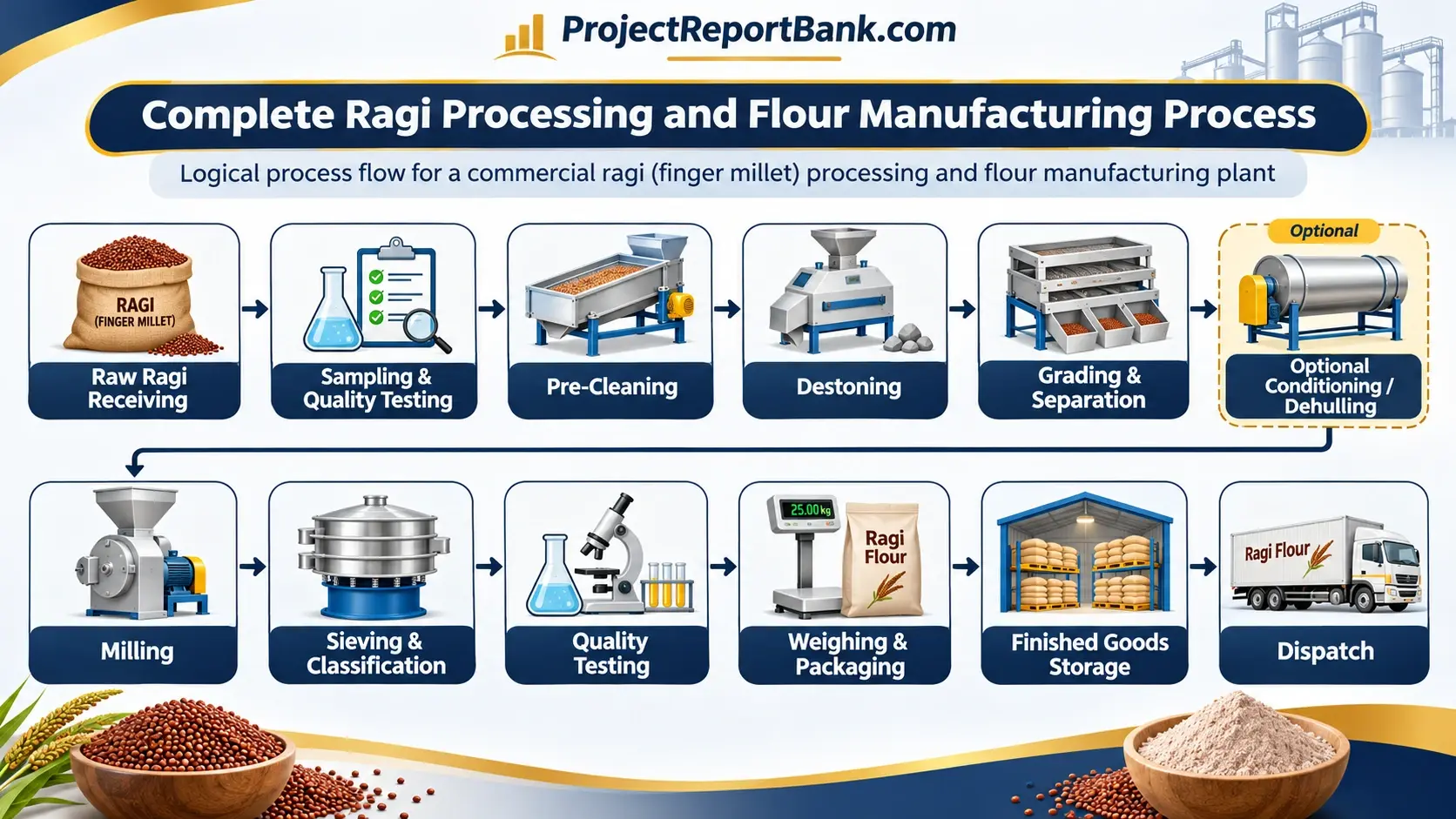
The manufacturing process follows a logical sequence: Raw Ragi Receiving → Sampling and Quality Testing → Pre-Cleaning → Destoning → Grading and Separation → Optional Conditioning/Dehulling → Milling → Sieving and Classification → Quality Testing → Weighing and Packaging → Finished Goods Storage → Dispatch.
At the receiving stage, incoming ragi is sampled for moisture content, foreign matter, damaged grains, and insect infestation. Pre-cleaning removes dust, straw, and chaff using vibro pre-cleaners and aspiration channels. Destoning machines separate stones and heavy impurities, while magnetic separators remove ferrous particles – essential steps for food safety and protecting downstream milling equipment.
Grading separates grains by size and density, ensuring uniform milling performance and consistent flour quality. For whole grain ragi flour, dehulling is typically not required, preserving the bran and fiber content. Where refined or specialised flours are needed, dehulling or polishing equipment is introduced.
The milling stage uses hammer mills or pulverisers – the choice of technology involves balancing fineness, throughput, energy efficiency, and heat build-up. Excessive heat during milling can cause nutrient degradation and off-flavours. Sieving through vibro sifters or plansifters classifies flour into fine, medium, or coarse fractions per buyer specifications.
Packaging in food-grade laminated pouches or HDPE bags with inner liners protects against moisture ingress and oxidation. Millet processing plants use packaging and sealing machines for finished products to ensure shelf-life integrity. The actual process design for each project is customised in the ragi processing plant project report based on raw material characteristics, target products, and budget.
Ragi Processing Plant Machinery and Equipment
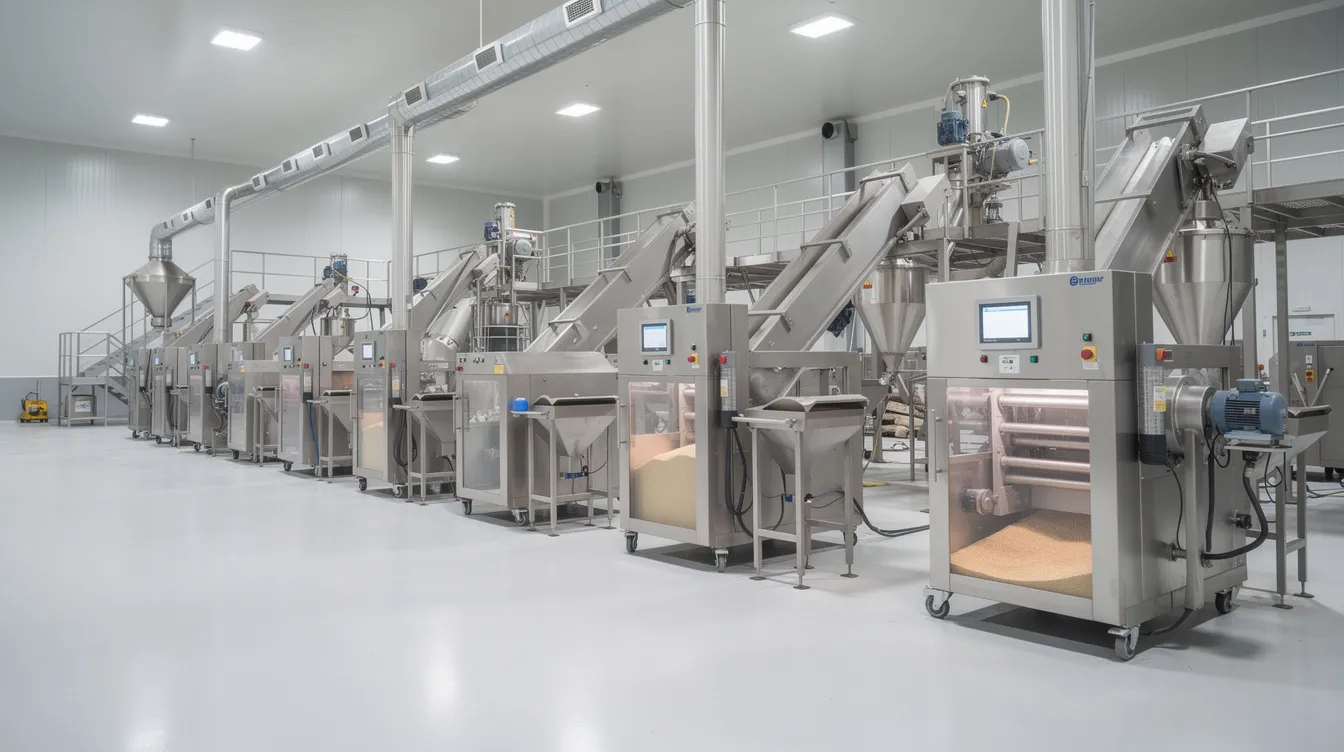
Ragi processing plant machinery and investment constitutes the core technical block of any project, and equipment costs represent a significant portion of capital expenditure. High-quality machinery is essential for efficient millet processing, and millet processing plants require grain cleaning and grading machines as foundational equipment.
| Equipment | Function | Capacity Range | Key Selection Criteria |
|---|---|---|---|
| Intake hopper & conveyor | Raw grain receiving and transfer | 2–50 TPD | Dust containment, feed rate |
| Storage silos/bins | Grain holding before processing | 2.5–50 tonnes | Aeration, moisture control |
| Vibro pre-cleaner | Removal of dust, straw, light impurities | 400–2,000 kg/hr | Screen mesh size, efficiency >90% |
| Destoner | Separation of stones, heavy particles | 500–2,000 kg/hr | Destoning efficiency ~90–92% |
| Grading machine | Size-based grain separation | 500–2,000 kg/hr | Adjustable screens |
| Magnetic separator | Ferrous metal removal | In-line | Gauss strength, food-grade |
| Dehulling machine (optional) | Husk removal for refined products | 100–500 kg/hr | Dehulling efficiency ~80–85% |
| Pulveriser/hammer mill | Milling ragi to flour | 200–1,000 kg/hr | Heat management, fineness control |
| Vibro sifter/plansifter | Flour particle classification | 300–1,500 kg/hr | Mesh options, throughput |
| Dust collection system | Airborne dust capture | Plant-matched | Cyclone + bag filter, fire safety |
| Weighing & packing machine | Auto-fill and seal packs | 500 g–50 kg range | Accuracy, speed, pack formats |
| Metal detector | Finished product safety screening | In-line | Sensitivity, FSSAI compliance |
| QC lab equipment | Moisture, particle size, microbial testing | – | Calibration, accuracy |
Equipment selection must comply with industry safety standards. Vendors should be evaluated on after-sales service, spares availability, and integration capability. The finger millet processing plant project report should include indicative quotations from shortlisted machinery suppliers to make cost estimation bankable.
Plant Layout, Building and Infrastructure Requirements
Plant layout considerations include proximity to raw material sources and infrastructure requirements. Site selection must ensure access to raw materials, and location planning for processing plants considers raw material availability and market access. A typical layout includes a raw material yard, pre-cleaning section, milling area, packaging room, finished goods warehouse, QC lab, utility zone, and administrative offices.
The plant layout should optimise workflow and minimise handling, with unidirectional material flow from raw to finished goods and segregation of dust-generating areas from clean packing zones. Indicative land requirements range from 2,000–4,000 sq ft for a 5–10 TPD unit to 8,000–20,000 sq ft for 20–50 TPD facilities, depending on storage needs and expansion provision.
Critical infrastructure includes adequate electrical supply, backup DG set, dust collection systems (cyclones and bag filters), compressed air lines, fire-fighting systems, and worker welfare facilities including washrooms, change rooms, and sanitisation stations.
Ragi Flour Manufacturing Plant Setup Cost in India
The millet processing plant setup cost includes capital investments across multiple heads. Capital investment depends on plant capacity, technology, and location.
| Investment Head | Description |
|---|---|
| Land & site development | Purchase/lease, levelling, fencing, roads |
| Factory building & civil works | Processing hall, storage, lab, office |
| Plant & machinery | Cleaning, milling, sieving, packaging lines |
| Material handling | Conveyors, elevators, bins |
| Electrical installation | Panels, wiring, transformer, DG set |
| Utilities & dust control | Cyclones, filters, compressed air, water |
| Laboratory & QC equipment | Moisture meters, sieves, testing kits |
| Installation & commissioning | Erection, trial runs, calibration |
| Preliminary & preoperative expenses | Licensing, professional fees, interest during construction |
| Contingency | Typically 5–10% of fixed cost |
| Working capital margin | Initial stock, operating expenses |
For reference, a NIFTEM-K model DPR for a 200 kg/hr ragi flour mill estimates total project cost at approximately ₹35.06 lakh, with plant and machinery at ₹23.10 lakh and working capital margin at ₹10.56 lakh. Medium-scale projects (20 TPD with advanced machinery and value-added lines) can range into several crores. The ragi flour mill project cost in India varies substantially based on automation level, product range, building quality, and land ownership. A customised project report from Project Report Bank will include plant-specific cost estimates rather than generic assumptions.
Raw Material Procurement and Inventory Planning
Ragi is procured from mandis, farmer producer organisations, aggregators, and direct farmer linkages in major producing states. Millet processing plants require reliable suppliers for raw materials, and DPRs assess raw material sourcing and supplier reliability as a critical planning element.
Key quality parameters include moisture content (ideally below 12–13% for safe storage), grain size uniformity, foreign matter percentage, damaged or discoloured grains, and aflatoxin risk. Procurement strategies should balance seasonal bulk buying (post-harvest, when prices are typically lower) against staggered purchases to manage price volatility and storage risk.
Physical storage requires proper godowns with pallets, fumigation as permitted by law, pest control, and FIFO inventory rotation. Raw materials account for 70–80% of operating expenses in a ragi processing plant, making procurement cost the single largest determinant of profitability. Price sensitivity must be modelled in the financial projections.
Ragi Processing Plant Production Economics
Production economics converts physical process parameters into rupee-per-kg cost analysis. Major cost components include raw ragi, cleaning losses, electricity, labor costs, packaging materials, repairs, and factory overheads.
| Cost Component | Illustrative Share of Total Cost |
|---|---|
| Raw ragi | 65–75% |
| Packaging materials | 5–8% |
| Power and fuel | 4–6% |
| Direct labour | 4–7% |
| Repairs & maintenance | 2–3% |
| Factory overheads & QC | 3–5% |
Utilities costs include electricity, water, and steam where applicable. Monthly electricity bills can range from ₹1–5 lakh depending on plant scale and operating hours. Labor costs for a small-scale plant may range from ₹2–10 lakh monthly based on headcount and location. Operating costs increase significantly by the fifth year of operations as production volumes ramp up.
Gross profit margins for millet processing range from 25–35%, though actual margins depend on capacity utilisation, recovery rates, product mix, and selling prices. The manufacturing cost per kg is computed by dividing total annual production cost by saleable flour output, adjusting for process losses.
Working Capital Requirements for Ragi Flour Manufacturing
Working capital represents funds locked in inventories, receivables, and routine operating expenses minus supplier credit.
| Component | Illustrative Holding Period |
|---|---|
| Raw ragi stock | 30–90 days (seasonal buying) |
| Packaging materials | 15–30 days |
| Finished goods stock | 15–30 days |
| Trade receivables | 15–45 days |
| Less: Supplier credit | 7–15 days |
The working capital cycle – cash → raw material → production → finished goods → sales → receivables → cash – determines the quantum of bank limits required. A longer cycle increases interest cost. B2B credit sales can create additional financing requirements that must be explicitly modelled. The ragi processing plant project report should present year-wise working capital assessment and resulting interest cost in projected financial statements.
Financial Projections and Profitability Analysis
Financial projections assess capital investment, operating costs, and demand outlook over the project’s economic life. Project financial projections typically cover cash flow, profitability, break-even point, and loan repayment analysis across a 7–10 year horizon.
A robust financial model includes assumptions on capacity utilisation (often 50–60% in Year 1, ramping to 80–90% by Year 3), recovery rates, raw material and selling prices, and operating costs. Financial projections include income, expenditures, and break-even points. The suggested break-even point for ragi processing plants typically targets capacity utilisation around 45%–50%.
Financial ratios such as debt service coverage ratio assess loan repayment capabilities. A comprehensive financial viability analysis includes ROI, IRR, and payback period assessments over five years. Financial projections in DPRs cover ROI and break-even analysis to provide lenders and investors with clear understanding of project economics.
Sensitivity analysis tests the impact of changes in raw ragi price (±10–20%), flour selling price, capacity utilisation, and energy costs on profitability and DSCR. For example, the KAMRIT mid-scale project reports EBITDA margins of approximately 16% and payback of 2.8–3.9 years under specific assumptions – figures that shift materially under different scenarios.
Project Report Bank prepares customised, bank-compatible financial projections with clearly documented assumptions for each ragi or millet processing project.
Bank Loan, Project Finance and DPR Requirements
Project reports serve as essential documents for securing bank loans and government subsidies. Banks evaluate ragi flour mill proposals on technical feasibility, promoter profile, financial viability, security, and repayment capacity.
A bankable ragi processing plant project report includes: promoter and company details, project description with technical configuration, market justification, detailed cost estimates with machinery quotations, means of finance showing promoter contribution and term loan, and comprehensive financial projections with DSCR analysis.
CMA Data – projected and past financial statements in a structured format – is typically required by banks for working capital and term loan assessment. The means of finance structure (equity, term loan, working capital limits) varies by bank norms, project size, and promoter strength.
CA Manish Gugliya and the Project Report Bank team assist with DPR preparation, financial projections, DSCR working, and coordination with lenders. Final loan sanction depends on the bank’s independent appraisal.
Government Schemes, Incentives and Regulatory Compliance
FSSAI registration is required for food safety compliance for food processing units in India. Statutory compliance requires local trade licenses and environmental clearances as applicable. A DPR outlines compliance with regulatory requirements relevant to the project.
Core requirements include:
- FSSAI licence or registration (depending on turnover)
- Factory licence under state rules
- State Pollution Control Board consent for air emissions from dust collectors
- Fire safety NOC and building approvals
- GST registration and proper classification of millet flour products
- Legal Metrology compliance for pre-packaged goods
- Udyam registration where eligible
The PM-FME scheme provides a credit-linked capital subsidy of 35% for eligible ragi processing project costs. Other schemes such as PMKSY or state industrial promotion policies may be relevant, but promoters must verify current operational status, eligibility criteria, and application periods from official sources before assuming any subsidy in their financial model.
Quality Control, Food Safety and Shelf-Life Management
Ragi flour, containing natural fats, is susceptible to rancidity if not processed and stored correctly. Quality assurance begins at raw material intake – testing for moisture, foreign matter, insect infestation, and microbial load – and extends through process controls including in-process sift checks, metal detection, temperature monitoring, and cleaning validation.
Packaging plays a crucial role in shelf-life: laminated moisture and oxygen barrier materials protect product quality during storage and transit. Shelf-life studies under defined conditions must be conducted before finalising “best before” dates. Storage in cool, dry, odour-free warehouses with FIFO/FEFO principles is essential.
Major Risks and Challenges in Ragi Processing Projects
| Risk / Challenge | Mitigation Strategy |
|---|---|
| Raw material price volatility | Seasonal procurement contracts, buffer stocks, price-linked selling |
| Supply inconsistency and quality variation | Multiple supplier relationships, stringent receiving inspection |
| Process losses exceeding assumptions | Machinery maintenance, operator training, process optimisation |
| Low capacity utilisation in early years | Phased investment, aggressive market development, contract manufacturing |
| Machinery breakdowns | Preventive maintenance schedules, spares inventory, vendor AMCs |
| Buyer concentration risk | Diversified customer base across B2B, retail, and institutional segments |
| Working capital pressure | Realistic inventory planning, negotiated credit terms, adequate bank limits |
| Food safety incidents | GMP/GHP implementation, regular audits, traceability systems |
| Competitive edge erosion from price pressure | Product differentiation, value-added SKUs, brand building |
A professionally prepared ragi processing plant project report should explicitly identify critical risks and build appropriate contingencies and sensitivity analysis.
Ragi Processing Plant vs Integrated Millet Processing Plant
| Parameter | Dedicated Ragi Plant | Integrated Millet Processing Plant |
|---|---|---|
| Product focus | Finger millet products only | Multiple millets (jowar, bajra, foxtail, small millets, ragi) |
| Raw material flexibility | Limited to ragi | Multiple grain types |
| Machinery configuration | Optimised for ragi characteristics | Shared and parallel lines for different grains |
| Capital cost level | Lower initial investment | Higher due to versatility |
| Operational complexity | Lower | Higher – changeovers, allergen management |
| Market positioning | Niche specialist | Broader product portfolio, pearl millet and other crops |
A dedicated ragi plant offers simpler operations and focused product quality optimisation. An integrated millet processing plant provides diversification benefits and better asset utilisation. Project Report Bank can help evaluate whether to start ragi-only with provision for future integration based on market response and business needs.
How to Prepare a Bankable Ragi Processing Plant DPR
A comprehensive ragi processing plant DPR covers technical, operational, and financial components. Key components of a project report include promoter details, project description, and manufacturing process. The project report typically includes an executive summary, technical plan, and financial projections. A detailed project report for a ragi processing plant requires technical feasibility and market analysis.
Standard contents include:
- Executive summary
- Promoter and company profile
- Industry and market overview with a DPR that includes market analysis and future demand projections
- Products and product mix – DPRs detail plant capacity and machinery requirements
- Manufacturing process and technology
- Machinery selection, specifications, and layout
- Project cost estimation and means of finance
- Raw material and procurement planning
- Production programme and capacity utilisation ramp-up
- Financial projections (P&L, cash flow, balance sheet, DSCR, IRR, NPV, break-even analysis)
- Working capital assessment
- Risk and sensitivity analysis
- Implementation schedule
A bank-finance DPR differs from a basic machinery cost estimate by providing full financial modelling and repayment analysis. An investor-ready feasibility report may additionally address valuation, scaling strategy, and exit potential.
Professional Ragi Processing Plant DPR and Financial Feasibility Services
Project Report Bank is a Chartered Accountant-led professional advisory platform specialising in detailed project reports, financial modelling, CMA Data, and project finance advisory for agro- and food-processing units in India.
For ragi and millet processing assignments, the firm’s approach includes initial discussion on capacity and location, data collection on promoter objectives, iterative cost estimation with machinery vendors, and development of a robust financial model. Key deliverables include a customised ragi processing plant project report, capacity-specific production schedules, working capital and DSCR analysis, and bank or investor-ready financial projections.
CA Manish Gugliya ensures that assumptions, project cost, and means of finance are realistic and aligned with bank norms – avoiding over-optimistic profitability claims that undermine credibility during appraisal.
Entrepreneurs, MSMEs, and food processors planning ragi or millet processing projects are invited to connect via the ProjectReportBank.com website or WhatsApp to discuss tailored DPR and feasibility study requirements for their specific business requirements and project planning needs.

Frequently Asked Questions
Below are practical queries that help promoters refine their millet processing project concept before commissioning a DPR.
What minimum capacity is practical for a commercial ragi flour mill in India?
While micro processing units of under 1 TPD exist, for a professionally run B2B or B2C operation, capacities of around 5–10 TPD are generally considered a sensible starting range, subject to local demand and supply conditions. Sub-1 TPD units function more as cottage or local retail businesses. Bank-financed industrial projects normally plan higher capacities to absorb fixed costs and achieve meaningful scale for investment opportunities.
Can the same plant process both ragi and wheat flour safely?
Technically, the same milling line can handle multiple grains. However, cross-contamination and allergen management must be addressed rigorously if gluten free claims are made for ragi flour. Options include separate dedicated lines, thorough cleaning protocols between product changeovers, and clear labelling declaring potential gluten presence. The compliance requirements for allergen management should be documented in the project report.
How long can ragi flour typically be stored without quality loss?
Shelf-life depends on moisture content, packaging quality, storage temperature, and fat oxidation rates. Under good conditions with appropriate moisture-barrier packaging, commercial ragi flour may be positioned with a “best before” period of several months, but the exact duration must be validated through stability studies. The DPR should budget for packaging and warehousing costs that support the target shelf-life.
Is organic ragi processing different from conventional processing?
The core cleaning and milling operations remain similar, but organic projects must use certified organic raw material, maintain strict segregation and traceability throughout the process, and comply with organic certification standards (such as NPOP or equivalent) for processing and labelling. Raw material costs and certification expenses are typically higher and should be built into cost and pricing assumptions within the feasibility study.
What kind of manpower is required for a 10–20 TPD ragi processing plant?
Typical roles include plant supervisor or manager, mill operators, helpers for bag handling and packing, electrician or maintenance technician, quality control staff, and basic administrative personnel. Total headcount depends on the automation level and number of operating shifts. Labor availability in the chosen location and related salary costs are incorporated in the DPR’s operating cost estimates and production economics sections.
Conclusion
Commercial ragi processing and flour manufacturing represents a meaningful investment opportunity within India’s expanding millet market and broader food processing industry. The convergence of consumer demand for nutritious, whole grain products, government promotion of millets, and growing institutional procurement creates favourable conditions for well-planned projects.
Success, however, depends on key factors: correct capacity planning matched to realistic demand, efficient machinery and layout, disciplined raw material procurement at competitive prices, strong quality control systems, and sound working capital and financial management. The difference between a viable project and a struggling one often lies not in the product but in the rigour of project planning and financial analysis.
A customised ragi processing plant project report – covering technical configuration, cost breakdown, financial projections, sensitivity analysis, and risk mitigation – is the essential starting point for any serious promoter. Project Report Bank provides professional DPR preparation, feasibility studies, financial modelling, and project finance advisory for ragi and integrated millet processing projects across India. Promoters planning such investments are welcome to connect through ProjectReportBank.com to discuss their specific requirements.