Key Takeaways
- Total ethanol plant land requirements in India typically range from about 8–12 acres for a compact 30 KLPD ethanol plant to 25–35 acres for a well-planned 200 KLPD first generation grain based distillery with DDGS processing and Zero Liquid Discharge systems.
- Land planning must address not only ethanol production plant buildings but also grain storage, DDGS drying, boiler and utilities, effluent treatment, ethanol tank farm, greenbelt (often around 33% of total plot), roads and statutory fire safety distances.
- No single statutory land area is mandated for a KLPD ethanol plant; banks and regulators expect technically sound layouts, adequate environmental infrastructure, and compliance with local development control rules.
- Mistakes in land selection and layout – congested sites, no expansion space, underestimated ZLD footprint – directly increase civil construction cost, project risk and can weaken DSCR in project finance appraisals.
- Engaging a professional DPR and project finance advisor before locking money into land and buildings helps integrate engineering assumptions with realistic project cost and financial projections.
Introduction: Why Land & Layout Come Before Machinery
For a grain based ethanol plant in India, land finalization should precede technical design to avoid costly delays. Ethanol production requires careful spatial planning for land use – far beyond the process block alone. Grain handling, DDGS processing, boiler infrastructure, ethanol tank farm, environmental systems and fire safety all dictate the actual land area a project needs.
Whether you are evaluating a 30, 60, 100 or 200 KLPD ethanol production plant for ethanol blending with petrol under the E20 programme, the total land area needed is influenced by production capacity and feedstock type. The global second generation ethanol market, valued at USD 16.72 billion in 2025 and projected to grow at 26.8% CAGR, underscores why India’s ethanol sector – including grain based distillery projects using first generation starch and sugar feedstocks, and emerging second generation processes using agricultural residues like corn stover and rice straw – is attracting serious capital investment.
From my experience preparing DPRs across multiple capacities, incorrect assumptions about ethanol plant land requirements are among the most common causes of cost overruns, redesign and financing delays.
Ethanol Plant Land Requirements in India – Key Determinants
Ethanol plant land requirements refer to the total industrial plot needed to house all buildings, utilities, roads, greenbelt and provision for future expansion – not merely the process equipment footprint.
Major factors determining land area for a KLPD grain based ethanol plant include:
- Installed capacity – 30, 60, 100 or 200 KLPD
- Feedstock choice – grain based (maize, broken rice, damaged food crops) vs molasses based vs multi-feedstock configurations using multiple feedstocks including sugarcane juice, B heavy molasses or sugarcane bagasse; ethanol production can also utilise non-food lignocellulosic biomass and cellulosic feedstocks in second generation processes
- DDGS and ZLD inclusion – a full DDGS dryer and Zero Liquid Discharge system add 15–25% to land requirements
- Storage strategy – vertical silos versus flat warehouses for raw materials; number of ethanol storage tanks
- Utilities and captive power – boiler, cooling towers, water treatment; utility costs typically comprise 25–35% of operational expenditures, and the infrastructure supporting them needs significant space
A greenbelt area of approximately 33% of the total plot is often mandated around ethanol facilities under environmental clearance conditions. Significant space is necessary for utilities and wastewater management – ethanol manufacturing generates high-strength effluent wastewater requiring dedicated treatment infrastructure.
Promoters should not assume identical ethanol distillery land requirements across states. Local planning authorities, industrial development corporations and state PCB norms materially influence minimum plot size and layout approvals.
Capacity-wise Land Requirements for 30–200 KLPD Ethanol Plants
The following acreage benchmarks are compiled from recent Indian grain based ethanol projects and published DPR data. These are planning estimates, not statutory requirements, and must be confirmed with detailed engineering for each site.
| Capacity | Indicative Land (Acres) | Core Process Area | Grain & DDGS Storage | Utilities & Environmental | Future Expansion Reserve |
|---|---|---|---|---|---|
| 30 KLPD | 8–12 | ~35–40% | ~15–20% | ~15–20% | ~10–15% |
| 60 KLPD | 12–18 | ~35–45% | ~20–25% | ~15–20% | ~10–15% |
| 100 KLPD | 15–22 | ~35–45% | ~20–25% | ~15–20% | ~10–15% |
| 200 KLPD | 25–35 | ~35–45% | ~20–25% | ~15–20% | ~10–15% |
A 100 KLPD grain based ethanol plant near Ahmedabad (GrainSpan EIA Report) required approximately 16 acres with 34.3% greenbelt, while a similar capacity project in Assam allocated around 20 acres. Land requirements scale non-linearly – a 200 KLPD distillery project needs substantially more space for grain silos, DDGS dryers, multiple boilers and a larger ZLD plant. For detailed capacity planning for 30 to 200 KLPD ethanol plants in India, the per-KLPD land is often higher at larger scales.
Planning for future expansion when establishing an ethanol plant is cost-effective – a 20 KLPD ethanol plant that aims for 60 or 100 KLPD should reserve space from day one.
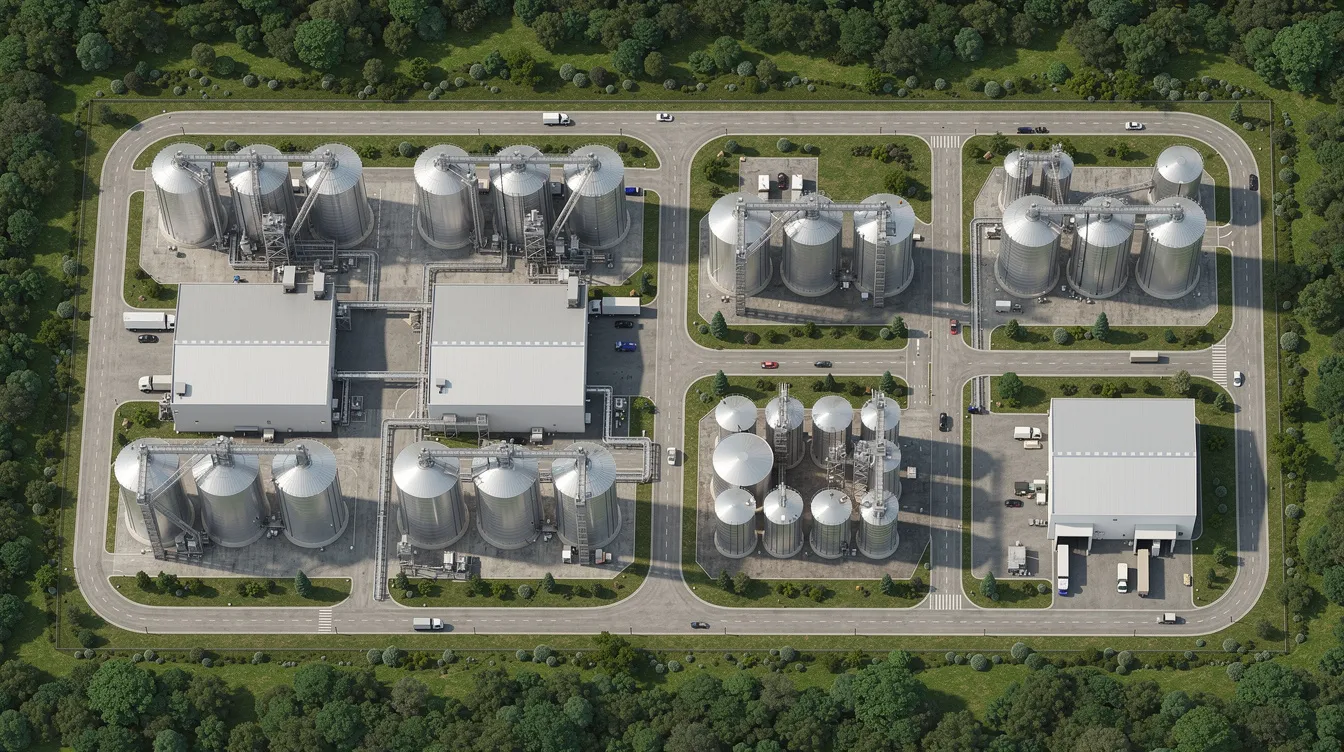
Typical Land Break-up Within a Grain-Based Ethanol Distillery Plot
Land allocation must account for storage, processing, and administrative functions. Indicative internal allocation within a grain based ethanol manufacturing plant:
- Core process buildings (grain handling, fermentation, distillation, DDGS, utilities): ~35–45%
- Storage zones (grain warehouses or silos, DDGS storage, ethanol tanks, fuel and chemical storage): ~20–25%
- Environmental and ZLD systems: ~10–15%
- Internal roads, truck parking, weighbridge and turning radius: ~10–15%
- Greenbelt, buffer and statutory setbacks: ~15–25%
For a 100 KLPD plant on approximately 16 acres, this might translate to roughly 6–7 acres for process buildings, 3–4 acres for storage, 2–3 acres for utilities and environmental infrastructure, and the balance for roads, greenbelt and expansion. Higher reliance on vertical silos for maize or broken rice can reduce land used for grain storage versus flat warehouses, but increases capex – a trade-off best analysed at DPR stage. Understanding ethanol plant raw material requirements and yield helps calibrate storage sizing against primary feedstock consumption rates.
Major Building Requirements in a Grain-Based Ethanol Plant
Ethanol distillery building requirements extend well beyond process blocks. Each structure must be designed for both process engineering and structural safety:
- Grain receiving and unloading – weighbridge, truck tippler, paved yard; high floor loading for heavy vehicles
- Raw material warehouses or steel grain silos – silos save footprint but cost more; warehouses need larger area but simpler civil work
- Grain cleaning, milling and slurry preparation – may be multi-storey for gravitational flow; heavy floor loads for milling equipment
- Liquefaction and saccharification – often integrated with grain preparation; needs elevated platforms and overhead piping
- Fermentation block – multiple fermenters sized by retention time and production capacity; yeast propagation; CO₂ venting systems
- Distillation and dehydration – tall columns for fuel ethanol and denatured ethanol production; molecular sieve units; strong foundations
- DDGS dryer, cooler and bagging zone – requires heat source, truck loading access and weather protection
- Boiler house and power generation – chimney height governed by air pollution norms; ash handling; fuel storage for coal, biomass or rice straw
- Water treatment, DM plant and cooling towers – ethanol production is water-intensive and requires reliable water sources
- ETP, MEE, RO and ZLD infrastructure – Zero Liquid Discharge systems are required for environmental compliance
- Ethanol storage tank farm – dyke walls, safety separation, PESO-compliant layout
- Administrative building, laboratory and control room – located away from hazardous or noisy areas
- Fire protection – hydrant network, fire water tanks, pump house, emergency assembly
Ethanol distillery machinery, equipment and cost selection defines building dimensions, foundation design and civil loading. Machinery costs represent the largest component of capital expenditure, but building design must accommodate maintenance access, crane beams and safe segregation of hazardous areas.
Ethanol Plant Master Layout & Process Flow-based Planning
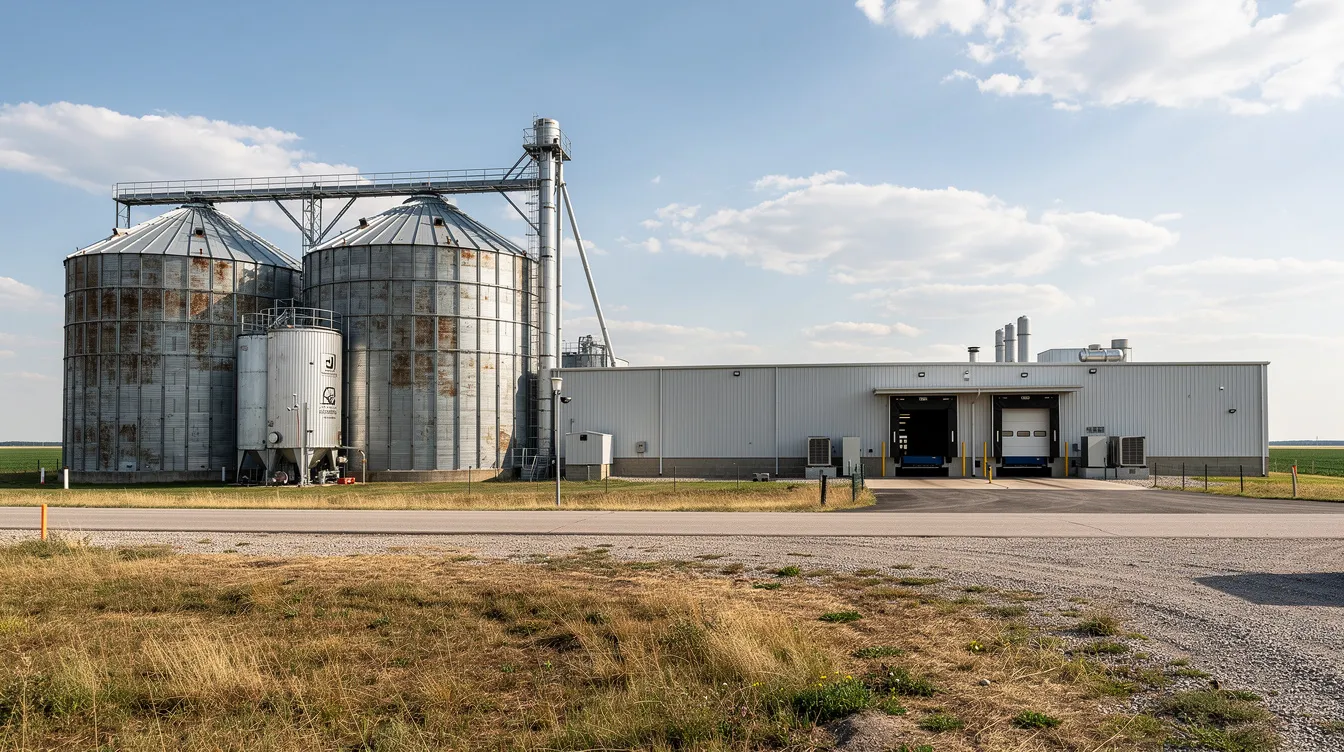
An efficient ethanol plant layout in India follows the natural grain-based ethanol manufacturing process and flow – grain in at one end, finished ethanol and DDGS out at the other, minimising cross-movement:
- Entry gate, security and weighbridge at the front boundary
- Grain unloading and storage near the gate to reduce internal truck movement
- Grain milling and slurry preparation next in sequence
- Fermentation block placed close to distillation to reduce pumping distances
- Distillation and dehydration positioned centrally with utility access – ethanol production technology including dry milling, fermentation and distillation determines exact sizing
- Boiler and power plant located downwind, close to process condensate
- DDGS dryer and storage adjacent to distillation for waste heat utilisation
- ETP and ZLD at lower elevation for gravity flow, away from the administrative zone
- Ethanol tank farm on a safer edge with controlled access and fire separation
Ethanol plants require heavy-duty access roads for logistics – internal roads must accommodate two-way truck and tanker movement with adequate turning radius. Clear corridors for pipe racks, cable trays and fire hydrant loops are essential in the distillery plant master layout. Modern plant control systems that store and access information on your device for process monitoring also need dedicated control room infrastructure.
Site Selection Criteria for Grain-Based Ethanol Distilleries in India
Choosing the right site often matters more than marginal machinery price differences. Feedstock logistic considerations impact the site size requirements, and proximity to agricultural supply influences spatial efficiency.
Key parameters for Indian conditions:
- Feedstock availability – assured grain supply (maize, broken rice, damaged grains) within 50–100 km; proximity to biomass surplus zones minimises logistics costs; Maharashtra offers strategic locations for ethanol plants due to agriculture and allows multiple feedstocks
- Connectivity – proximity to railheads and highways; proper planning for transport connectivity can significantly affect operating costs
- Water supply – reliable surface or canal water; groundwater permissions where borewells are planned
- Power and fuel – grid availability, substation distance, access to boiler fuel (coal, biomass, corn stover, sugarcane bagasse)
- Industrial zoning – ethanol plants must be sited on land officially zoned for industrial use; industrial-zoned land is required for ethanol plant establishment
- Sensitive receptors – safe distance from villages, schools and hospitals per MoEFCC norms
- Site conditions – elevation, flood risk, ideal soil bearing capacity; geotechnical testing is essential to ensure soil stability
Good site selection reduces transport cost per litre of ethanol, improves plant utilisation and supports stronger DSCR and IRR. For maize-centric projects, the maize-based ethanol plant project report provides specific catchment-area analysis guidance. Some state industrial development corporations offer ready plots in designated biofuels or food processing parks, simplifying environmental clearances.
Civil Construction, Infrastructure & Cost Considerations
Ethanol plant civil construction cost often forms 20–35% of total project cost for a grain based 60–200 KLPD plant. Operational costs account for 50–60% of total expenses during operations, but underestimating civil works during project setup distorts the total capex and bank finance planning.
| Component | Cost Considerations |
|---|---|
| Land acquisition or lease | Location, area, stamp duty, land registration and boundary development |
| Site development | Levelling, compound wall, storm-water drains, internal roads |
| Factory and process buildings | RCC vs pre-engineered structures, floor loading |
| Heavy equipment foundations | Soil conditions – black cotton soil vs hard strata significantly affects depth and cost |
| Storage infrastructure | Grain warehouses, silos, DDGS godowns, ethanol tank farm with dyke walls |
| Utilities | Boiler house, cooling towers, WTP, electrical substation |
| Environmental infrastructure | ETP, MEE, ZLD-related civil works |
| Safety infrastructure | Hydrant network, fire water tanks, pump house |
Capital expenditure for a second generation ethanol plant is substantial, and even first generation plants must budget 5–10% contingency on civil works. Understanding grain-based ethanol plant setup cost in India helps promoters see how land and building fit within the overall ethanol plant cost analysis.
Environmental Clearances, Fire Safety & Regulatory Space Requirements
Ethanol plants fall under high-impact heavy industrial classifications. Starting an ethanol plant requires multiple regulatory approvals, and zoning regulations may require environmental clearances:
- Land-use and building plan approval from local authority or industrial development corporation
- CTE and CTO from State Pollution Control Board
- Environmental Clearance from MoEFCC / SEIAA – completion of Environmental Impact Assessments is necessary before constructing ethanol manufacturing facilities; Environmental Clearance can take 4–6 months to obtain
- Factory Licence mandatory under the Factories Act
- Excise licence required for ethanol production and storage
- Fire department NOC – drives ethanol storage tank layout, requiring separation between tanks, dyke walls and access roads
- PESO approvals for ethanol storage facilities, as applicable
- Groundwater extraction permissions from CGWA or state authorities
- Biomass sustainability certification necessary for advanced biofuel registration
Environmental clearances typically mandate dedicated greenbelt, safe ETP distance from boundaries, and rainwater harvesting. Fire safety norms require minimum distances from buildings and dedicated fire water reserves. Promoters must verify latest state-specific notifications. My role as a project finance advisor is to integrate these compliance-related costs and spatial needs into early-stage DPR assumptions rather than leaving them as afterthoughts.
Impact of Land & Building Planning on Project Finance and Bank Appraisal
In bankable ethanol plant DPRs, land and building form a large fixed asset block that directly influences term loan size, security cover and DSCR. Gross profit margins for well-planned grain based ethanol plants typically range between 25–35%, with net profit margins projected between 10–20%, but these margins are achievable only when civil costs are realistically estimated.
Key finance aspects impacted by land and layout decisions:
- Project cost estimation – land cost, civil works, pre-operative expenses, interest during construction
- Means of finance – equity vs term loan, promoter contribution planning
- Depreciation – different tax shield rates on civil structures vs plant and machinery
- Working capital – storage capacity for grain and finished ethanol affects working capital needs
- Expansion potential – ability to scale from 60 to 100 or 200 KLPD without new land acquisition, improving long-term ROI
- Break-even – for ethanol plants typically ranges from 7 to 12 years, and inflated civil costs push this further out
Buying too small a plot can limit future expansion, complicate mortgage creation and inflate per-acre costs. Cost overruns from starting civil works before final engineering drawings weaken project viability ratios. For professional bank finance DPR and loan proposal support, early integration of layout and financial analysis is essential.
Common Mistakes in Ethanol Plant Land, Building & Layout Planning
Based on experience with multiple grain based ethanol projects and feasibility report reviews:
- Selecting land purely on low price – without verifying zoning, approach roads or utilities, only to discover the site needs expensive development or does not qualify for industrial use
- Underestimating ZLD footprint – some 100 KLPD plants discovered that MEE, RO and sludge handling needed 1.5–2 acres not planned in the original layout
- Ignoring expansion potential – initial land purchased for 60 KLPD with no space reserved for additional fermenters, columns and boilers at 120–200 KLPD
- Inadequate truck circulation – insufficient space for turning radius and dedicated ethanol tanker filling bays, causing daily operational bottlenecks
- Tank farm too close to process buildings – making fire NOC conditional or delayed, requiring redesign
- Finalising buildings before technology selection – resulting in misaligned foundations and expensive rework
- Unrealistic civil cost in DPR – showing artificially low figures to project attractive IRR, which banks then reject during financial analysis and detailed appraisal
For multi-feedstock ethanol distillery projects, additional buildings for molasses tanks or juice lines may be required, adding complexity. Lock land and layout only after coordinated input from technology supplier, structural consultant and project finance advisor.
Frequently Asked Questions on Ethanol Plant Land & Layout
Can I start with a 30 KLPD plant and expand to 60 or 100 KLPD on the same land?
Phased expansion is common, but only feasible when initial land selection and master layout reserve clear space for additional fermenters, columns, boilers and larger ZLD capacity. Infrastructure such as roads, tank farm, power distribution and water treatment should be designed from day one with the ultimate capacity vision. A plant setup conceived for just 30 KLPD on 8 acres may struggle to accommodate 100 KLPD without acquiring adjacent land.
Is leased industrial land acceptable for bank finance of an ethanol project?
Many banks accept long-term leasehold industrial land (typically 30–99 years) from government or industrial corporations as primary security. However, lease terms, transferability and mortgage rights must permit creation of charge in favour of lenders. Some sugar mills and oil marketing companies operate on such lease arrangements. The feasibility report should clearly document lease tenure and charge-creation provisions.
How does grain type (maize vs broken rice) affect building and land requirements?
Core process footprint remains similar, but maize-based plants may use taller steel silos and different pre-cleaning arrangements. For feedstock-specific storage and handling considerations, the broken rice and damaged foodgrain ethanol plant DPR provides relevant guidance. The primary feedstock choice also influences corn or grain procurement logistics and warehouse sizing.
When should I involve a DPR and project finance consultant in land planning?
Before final land purchase or long-term lease commitment. A professional ethanol plant feasibility study integrates capacity planning, layout assumptions, environmental and fire norms, and realistic project cost into one coherent bankable plan. Many promoters who have found this document useful still approach lenders with incomplete assumptions – resulting in delays that a structured project report could have prevented. India’s ethanol blended petrol programme demands projects that can withstand detailed bank scrutiny.
Are there separate land norms for molasses based and grain based ethanol plants?
There is no central statutory acreage norm by feedstock. Molasses based distilleries may need smaller grain-handling footprints but require adequate tankage for molasses. Sugar mills converting to ethanol may already have land. However, both configurations need similar space for utilities, ZLD and ethanol storage under environmental and fire safety conditions. Energy security objectives under the national policy on biofuels treat all feedstock categories – whether cellulosic ethanol from cellulosic feedstocks or grain based ethanol from corn and grains – as contributing to reduced oil imports and lower global warming impact, though no ratings yet establish a universal land standard per KLPD capacity.
At ProjectReportBank.com, the approach is to combine practical engineering understanding with structured financial analysis. Whether you are evaluating a distillery project for the central pool procurement programme or assessing ethanol plant feasibility for a private investor, realistic assumptions about land, building, civil cost and production capacity form the foundation of a defensible DPR.
For professional assistance with Detailed Project Reports, CMA Data, financial projections, KLPD ethanol plant cost estimation and bank finance proposals, connect with CA Manish Gugliya via WhatsApp or visit ProjectReportBank.com.
CA Manish Gugliya FCA, DISA (ICAI) More than 20 years of professional experience in project reports, financial projections, CMA Data, project finance and business advisory.