A millet based extruded snacks manufacturing plant project report is a comprehensive document that evaluates the technical, commercial and financial feasibility of converting millets such as ragi, jowar and bajra into value-added packaged snacks through industrial extrusion technology. In my experience preparing Detailed Project Reports for food processing projects across India, I have observed that promoters who invest time in rigorous project analysis before committing capital tend to make better investment decisions and face fewer surprises during implementation and operations. This article presents a structured overview of project planning considerations for entrepreneurs, investors and existing food processors evaluating millet extruded snacks manufacturing.
Key Takeaways
- A millet based extruded snacks manufacturing plant project report explains how to convert finger millet, pearl millet and sorghum into value-added extruded snacks – puffs, rings, sticks, cheese balls – using industrial extrusion technology under Indian conditions. Typical industrial capacities start from about 250 kg/hr and can go up to 1,000 kg/hr.
- Total project cost varies widely depending on automation grade, land, building, product range and brand plans. Indicative machinery cost alone ranges from approximately ₹1.25 crore to ₹1.57 crore for core extrusion lines of 150–350 kg/hr capacity, and full project costs are substantially higher. Final numbers require vendor quotations and site-specific assessment.
- The DPR must integrate technical design (process, plant layout, machinery), project cost, working capital assessment, DSCR, IRR and risk analysis to satisfy bank finance and investor expectations. Financial projections should cover a period of 5 to 7 years at minimum for reliability, though banks often require 7–10 year projections.
- In my experience, profitability depends more on capacity utilisation, product mix, marketing and distribution strategy than on machinery cost alone. Projects that over-invest in capacity without a corresponding sales infrastructure often struggle with debt service.
- Project Report Bank, led by CA Manish Gugliya, FCA, DISA (ICAI), prepares customised, bankable DPRs, CMA Data and financial models for millet snacks plants across India. Serious promoters planning industrial-scale investment can contact us for project-specific analysis.
Introduction to Millet-Based Extruded Snacks Manufacturing in India
Millet-based extruded snacks encompass a range of ready-to-eat packaged products – millet puff snacks, curls, rings, seasoned sticks, cheese balls and snack pellets – manufactured from traditional grains such as finger millet (ragi), pearl millet (bajra), sorghum (jowar), foxtail millet and barnyard millet, often blended with rice flour, corn grits or pulse proteins. These products are manufactured through an industrial extrusion process that combines raw material mixing, high-temperature cooking, shaping through dies and downstream operations including drying, seasoning and nitrogen-flushed packaging to deliver consistent taste, texture and shelf life.
The core technology – snack extrusion – is a continuous, controllable, high-throughput process that is fundamentally different from traditional millet puffing or roasting. While puffed millet products rely on batch-level heat expansion, industrial extrusion cooking combines mixing, shaping and texturising ingredients under precisely controlled temperature, pressure and moisture conditions, enabling large-scale production of uniform snacks. This distinction is important because the machinery, capital investment, operating cost and product development requirements for extrusion-based manufacturing are substantially different from those for simple puffing operations.
For existing grain and millet processors, extruded snacks represent a significant diversification opportunity – moving from primary processing into branded, value-added packaged food. An integrated millet processing plant that already handles cleaning, dehulling and milling can consider adding an extrusion line as a downstream value-addition project. However, whether the project is a standalone greenfield plant or an expansion of an existing facility, the fundamentals remain the same: a realistic DPR, sensitivity-tested financial projections, working-capital planning and DSCR analysis are essential before committing to plant and machinery orders.
Market Opportunity and Demand for Millet-Based Extruded Snacks
India’s packaged savoury snacks market is one of the largest and fastest-growing food categories in the country. In FY25, the savoury snacks market was estimated at approximately ₹890 billion, with organised players accounting for about 58% of the total. Industry projections suggest a CAGR of approximately 9–13% over the next several years, driven by urbanisation, rising disposable incomes, expansion of modern retail, and the rapid growth of e commerce and quick-commerce channels. The Indian extruded snacks market was valued at USD 547.89 million in 2024, reflecting a substantial and growing consumer base for this product category.
Within this broader market, millet-based products are carving out a meaningful niche. Market demand for health-conscious snacks drives the growth of millet based products, with industry reports indicating that millet snacks are growing at an annual rate of 18–22%. Over 600 new millet-based packaged foods were launched globally from 2022 to 2024, signalling strong innovation interest from food companies worldwide. Millets are rich in dietary fibre, aiding digestion, have a low glycemic index beneficial for diabetics, contain essential minerals like magnesium and phosphorus, are gluten free and suitable for gluten-intolerant individuals, and support heart health due to their high antioxidant content. These nutritional attributes provide a credible platform for product differentiation in a competitive snack market.
The target consumer base extends beyond niche health-food buyers. Millet extruded snacks can address youth looking for crunchy snacks, working professionals seeking convenient single-serve packs, schoolchildren consuming affordable ₹5–₹10 packs, and health-conscious families purchasing larger share-packs. Sales channels include traditional kirana distributors, modern trade chains, e commerce marketplaces, direct-to-consumer websites, institutional buyers such as canteens and airlines, and private-label contracts for retail chains.
However, this opportunity comes with competitive realities. Established national brands such as PepsiCo, ITC, Haldiram and Balaji Wafers already dominate the extruded snacks segment. Regional snack companies and startup health brands are also entering this space. Trade margins, retailer listing fees, advertising budgets and distribution infrastructure represent significant barriers to entry. Export potential exists in markets with Indian diaspora or growing health-food demand – GCC countries, the US and parts of Europe – but compliance with importing-country food and labelling regulations must be carefully evaluated as part of any export-oriented project plan.
Types of Millet-Based Extruded Snacks Manufactured
The product range in millet-based extruded snacks extends from simple salted puffs to complex multi-millet and protein-enriched formulations. The choice of products significantly influences formulation complexity, machinery requirements and capital cost. Extruded snacks can include millet, multigrain and protein-enriched options depending on the promoter’s market strategy.
| Product Type | Typical Raw Materials | Target Consumer | Price Positioning | Manufacturing Complexity |
|---|---|---|---|---|
| Ragi (finger millet) puffs | Ragi flour (40–60%), rice/corn flour, salt, oil | Health-conscious families | Mid-premium | Medium – ragi fibre affects expansion |
| Bajra (pearl millet) crunchy sticks | Bajra flour (30–50%), corn grits, spices | Mass market, youth | Mass | Medium – requires blending for texture |
| Jowar (sorghum) extruded puffs | Jowar flour (40–60%), rice flour, seasonings | Health-conscious consumers | Mid-premium | Medium – good expansion with blends |
| Multi-millet snack sticks and curls | Ragi + bajra + jowar blend, corn/rice flour | Premium health segment | Premium | Higher – multi-grain formulation trials needed |
| Millet–pulse protein snacks | Millet flour (30–40%), pulse flour, starches | Fitness and nutrition market, working professionals | Premium | High – twin-screw extruder preferred |
| Baked millet snacks | Millet flour, rice flour, minimal oil | Weight-conscious consumers | Premium | Medium-high – oven drying instead of frying |
| Fried millet-based extruded snacks | Millet flour, corn grits, frying oil | Mass market, youth | Mass | Medium – post-extrusion frying required |
| Seasoned curls, rings and cheese balls | Millet/corn blend, cheese seasoning, oil | Children, youth, families | Mass to mid | Medium – seasoning adhesion critical |
Pure millet formulations are often more difficult to expand uniformly than formulations blended with rice flour or corn grits. This is because millets have different starch composition (amylose-to-amylopectin ratios), higher fibre content and distinct gelation behaviour compared to corn or rice. Process trials are therefore mandatory before finalising any formulation for commercial production.
It is also important to distinguish direct-expanded extruded snacks (puffs, rings, curls that expand at the die exit) from pellet-based snacks (semi-finished pellets that are extruded and dried first, then later expanded by frying or hot air at separate facilities). Pellets are suitable for third-party snack expansion and are a separate business model. Additionally, millet-based breakfast cereals are one of the fastest-growing segments in the health food category, and health bars with foxtail millet target the fitness market – both representing related diversification options. Instant mixes for dosa and idli using millet flours are also in high demand in Indian retail.
For a comparison of extrusion-based products versus traditional puffing, promoters may refer to our Puffed Millet Processing Plant Project Report which covers non-extrusion puffing technology in detail.
What Is Snack Extrusion and How It Applies to Millet Snacks
Snack extrusion technology involves cooking and shaping food mixtures under controlled conditions. In technical terms, food extrusion is a continuous process involving conveying, mixing, cooking, shearing and shaping of moistened flour blends through a die under high temperature and pressure. As the material exits the die, the sudden pressure drop causes rapid moisture evaporation, creating the characteristic expansion that gives extruded snacks their light, crispy texture.
Key variables that determine product quality include feed particle size, feed moisture (typically conditioned to 14–18% before extrusion), barrel temperature profile across multiple zones (ranging from approximately 80°C to 180°C depending on formulation), screw speed, residence time, die geometry and cutter speed. Each of these parameters affects the degree of expansion, cell structure, crunchiness and overall texture of the final product.
Extrusion is particularly suitable for millet-based snacks because it can handle multigrain formulas, produce consistent product quality at scale, and allow rapid shape changes by simply replacing the die – enabling a single line to produce cheese balls, rings, sticks and katori-type products. However, extrusion conditions must be finalised through trials for each specific millet blend; there is no single “ideal” temperature or moisture set-point that works universally. Vendor support during commissioning and product development is critical.
For promoters interested in combining millet and pulse ingredients in high-protein snack formulations, our Value-Added Pulse Snacks Manufacturing Plant Project Report covers pulse-based extrusion technology and related diversification possibilities.
Millet-Based Extruded Snacks Manufacturing Process – Step-by-Step
The manufacturing process for millet-based extruded snacks follows a controlled sequence from raw millet procurement through to finished goods dispatch. The complete process flow is:
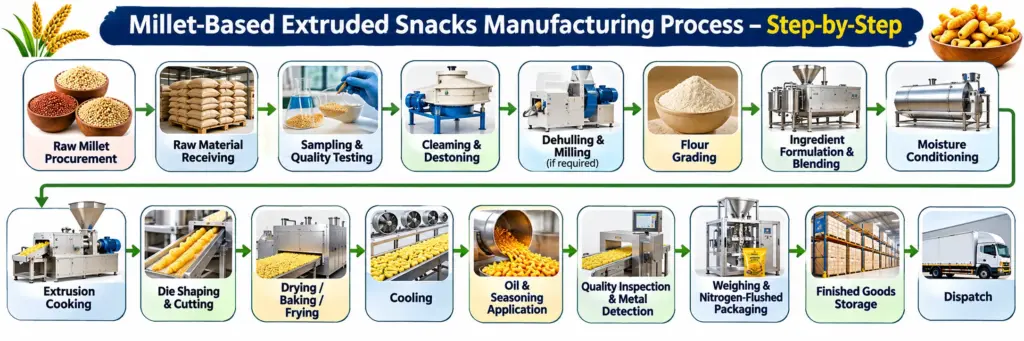
Raw Millet Procurement → Raw Material Receiving → Sampling and Quality Testing → Cleaning and Destoning → Dehulling and Milling (if required) → Flour Grading → Ingredient Formulation and Blending → Moisture Conditioning → Extrusion Cooking → Die Shaping and Cutting → Drying / Baking / Frying → Cooling → Oil and Seasoning Application → Quality Inspection and Metal Detection → Weighing and Nitrogen-Flushed Packaging → Finished Goods Storage → Dispatch
Cleaning, destoning, dehulling and milling: Incoming millets must be cleaned to remove stones, dust, metal particles and foreign matter. Depending on the millet type, dehulling may be required to remove the outer husk before milling into flour or grits of the required particle size. Promoters who plan to integrate primary millet processing on-site may refer to our detailed reports on ragi processing, bajra processing and sorghum milling for upstream technical details.
Ingredient formulation and blending: The formulation stage involves weighing and combining millet flour with other ingredients – rice flour, corn grits, pulse flours, starches, salt, spices and minor additives – in a ribbon blender or automated mixing system. This is where raw material mixing happens and where the cost and nutritional value of the product are largely determined. Formulation design requires balancing expansion characteristics, taste and cost. Promoters exploring premix and flour blending as a separate business can review our Specialty Flour Blending Plant Project Report.
Moisture conditioning and preconditioning: Before entering the extruder, the blended flour is preconditioned by adding water or steam to achieve the target feed moisture. Moisture control significantly affects the texture of extruded snacks – too little moisture results in poor expansion, while too much can cause a dense, gummy product. The preconditioner also raises the feed temperature, reducing the thermal load on the extruder barrel.
Extrusion cooking: The conditioned feed enters the extruder barrel, where rotating screws convey, compress, cook and shear the material through multiple temperature zones. Starch gelatinisation occurs inside the barrel, and as the cooked dough is forced through the die, rapid expansion produces the desired shape – whether curls, rings, sticks or cheese balls. The die geometry defines the shape, and a rotating cutter at the die face controls the length of each piece.
Downstream operations: After extrusion, the product may pass through a dryer, oven or fryer depending on whether it is a baked or fried product. Drying reduces moisture to achieve the target shelf life (typically below 3–4% moisture for crispy snacks). Cooling conveyors bring the product temperature down to prevent condensation inside packaging. Oil spraying and seasoning drum coating apply flavour – from simple salt and spice to cheese, masala or specialty seasonings. In-line quality checks, metal detection and form-fill-seal packaging with nitrogen flushing ensure product safety, crispness and extended shelf life.
Documented standard operating procedures, in-process quality checks and shelf-life studies are essential rather than relying solely on initial laboratory trials. Each batch should be traceable from raw material to finished dispatch.
Plant and Machinery Required for Millet Extruded Snacks Manufacturing
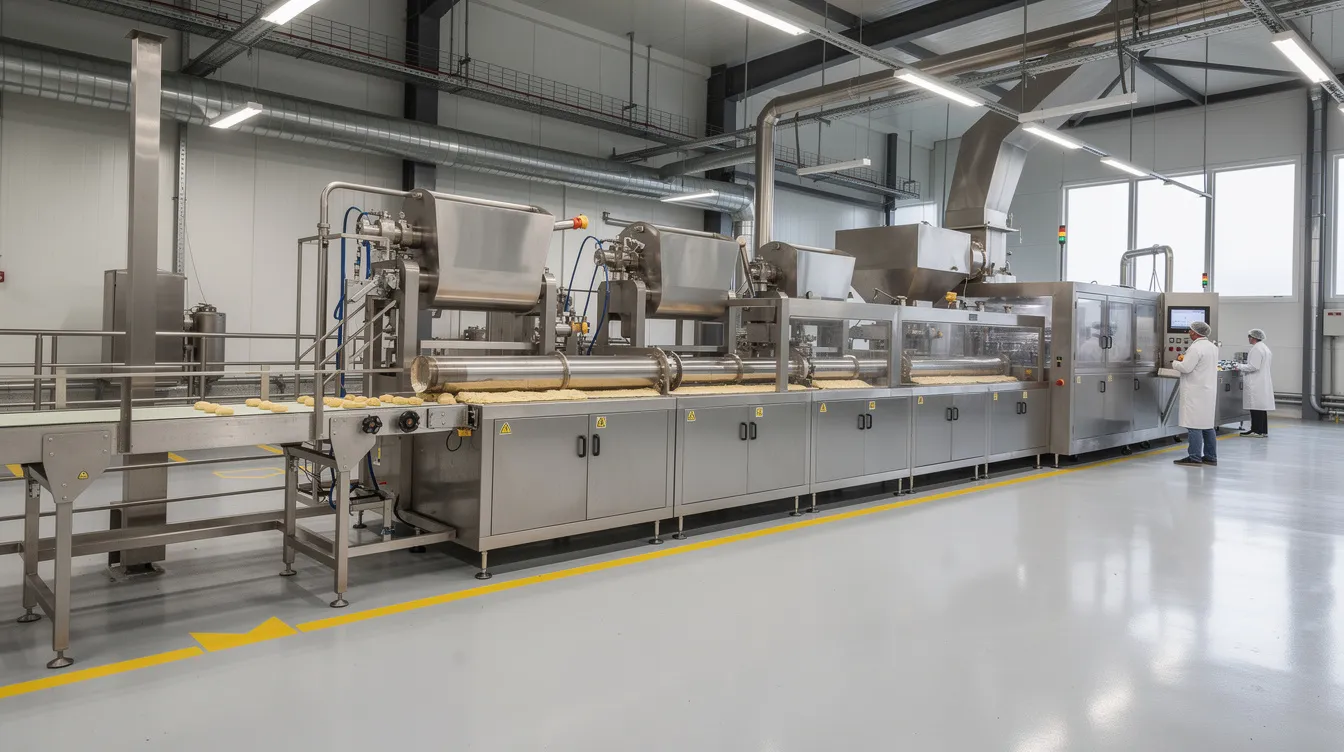
Machinery selection depends on production capacity (kg/hr), product range, level of automation and whether primary millet processing is integrated on site. Plant and machinery specifications are critical for project cost estimation, and the DPR must detail each equipment item with capacity, power rating and indicative cost.
The main equipment categories required include: grain cleaner, destoner, magnetic separator, dehuller, hammer mill or roller mill, sieves, flour storage bins, dosing feeders, ribbon blender, preconditioner, extruder (single-screw or twin-screw), die and cutter assembly, dryer or fryer, cooling conveyor, oil spray system, seasoning tumbler, bucket elevators, multihead weigher, vertical form-fill-seal (VFFS) machine with nitrogen flushing, metal detector, air compressor and electrical control panels.
| Configuration | Extruder Type | Indicative Capacity | Key Characteristics |
|---|---|---|---|
| Medium line | Single-screw extruder | 150–250 kg/hr | Lower capital cost, simpler operation, suitable for standard corn-millet blends; limited flexibility for high-fibre or high-protein formulations |
| Higher-end line | Twin-screw extruder | 200–500 kg/hr | Better mixing and feeding, handles multi-millet and pulse blends, more consistent product, higher investment and maintenance |
| Pellet line | Twin-screw (typically) | Variable | Produces semi-finished pellets for later frying or hot-air expansion; different business model from direct-expanded snacks |
Single-screw extruders are simpler than twin-screw extruders for processing standard formulations and cost less, but twin-screw machines offer significantly better flexibility for multi-millet, high-protein and high-fibre formulations. In the Indian context, several domestic manufacturers produce competent single-screw extruders, while twin-screw machines are available from both Indian and imported (European/Asian) sources. Trade-offs between capital cost, after-sales service, spares availability and technology sophistication should be evaluated without relying on unsupported claims about any vendor’s superiority.
Many extrusion equipment vendors offer common platforms that can also produce corn puffs, Kurkure-type snacks and breakfast cereals by changing dies and formulations. Promoters evaluating such multi-product lines may also find value in reviewing our Integrated Value-Added Rice Products Processing Plant Project Report for related cereal and puffed-product technologies.
According to the Ministry of Food Processing Industries (MoFPI), indicative machinery cost for a 150–200 kg/hr twin-screw extrusion line is approximately ₹1.25 crore for core equipment, while a 300–350 kg/hr line costs approximately ₹1.57 crore. These figures cover major processing machinery only and exclude building, utilities, packaging lines and installation costs.
Manufacturing Plant Capacity Planning (250 kg/hr, 500 kg/hr, 1,000 kg/hr)
Installed extrusion capacity is typically expressed in kg/hr of finished extruded snacks under standard formulations. Realistic capacity planning is central to any millet based extruded snacks manufacturing plant project report because it directly drives revenue projections, machinery sizing and financial viability. Annual production capacity for millet plants typically ranges from 2,000 to 5,000 MT depending on line size and utilisation.
| Parameter | Medium-Scale Plant | Industrial Plant | Large Automated Plant |
|---|---|---|---|
| Installed capacity | 250 kg/hr | 500 kg/hr | 1,000 kg/hr |
| Shifts per day | 1–2 (8 hrs each) | 2 (8 hrs each) | 2–3 (8 hrs each) |
| Operating days/year | 300 | 300 | 300 |
| Year 1 utilisation | 50–60% | 50–60% | 40–55% |
| Year 3 utilisation | 70–80% | 70–80% | 65–75% |
| Stabilised utilisation | 80–90% | 80–85% | 75–85% |
Illustrative calculation for the 500 kg/hr plant: 500 kg/hr × 16 hours/day (2 shifts) × 300 days/year × 75% utilisation = 1,800,000 kg/year, or approximately 1,800 tonnes/year. At higher utilisation levels, annual output can approach 2,400 tonnes. These are illustrative figures – actual production depends on product mix, changeover frequency, formulation trials and line stoppages.
A critical point often missed: the extruder is rarely the production bottleneck. Seasoning drums and packaging lines often limit output if they are undersized relative to the extruder. The DPR must size the entire line end-to-end, not only the extruder.
From a finance perspective, over-investing in a 1,000 kg/hr line when sales and marketing infrastructure cannot support that volume will depress capacity utilisation, margins and DSCR. Production capacity planning is crucial for financial and operational success. In my experience, newer entrants are generally better served starting with 250–500 kg/hr lines and planning for modular expansion.
Land, Building, Infrastructure and Plant Layout
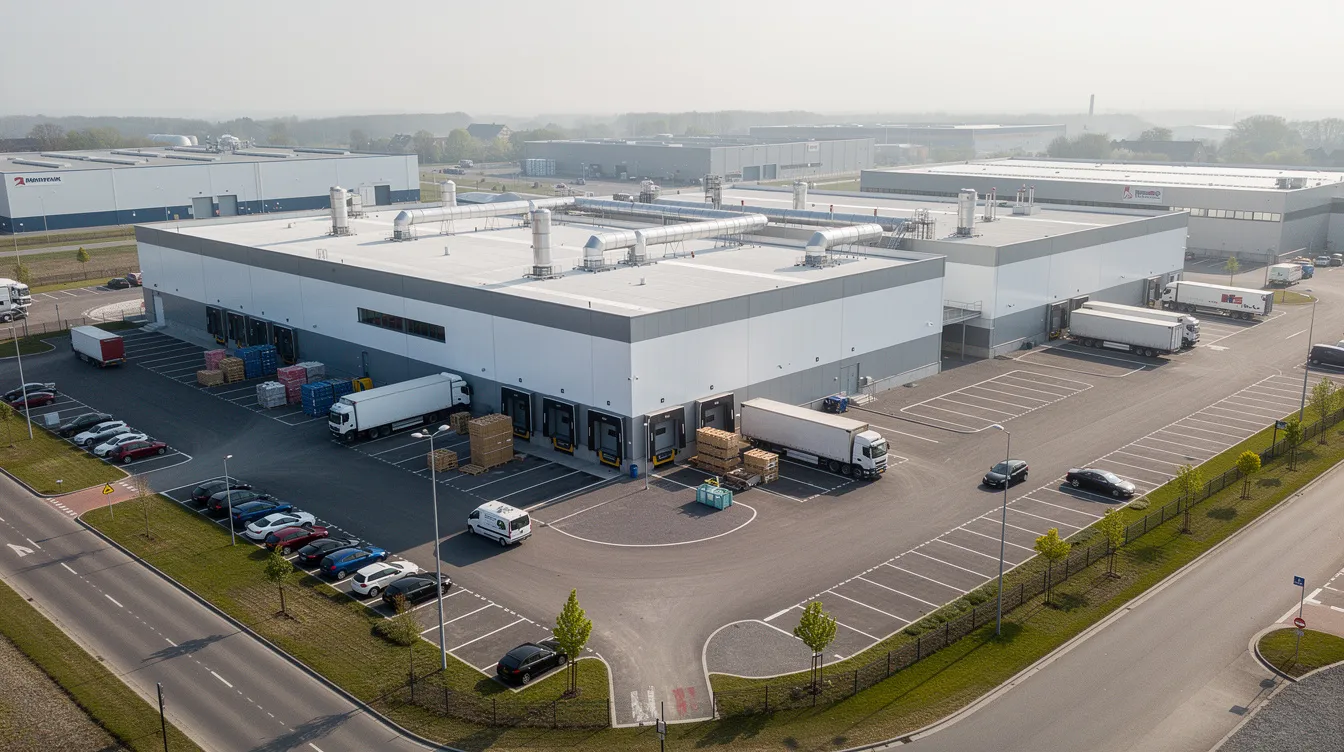
Land and building costs vary widely by state, industrial zone and proximity to urban markets. Good layout supports hygiene compliance, efficient material flow and future expansion potential.
Key functional areas to incorporate in the plant layout include:
- Raw material godown with dry, ventilated storage
- Grain cleaning and milling section (if integrated)
- Blending and extrusion production hall
- Drying, baking, frying and seasoning area
- Packaging hall with controlled environment
- Finished goods warehouse
- Quality control laboratory
- Utilities area (compressor, DG set, transformer, boiler)
- Staff amenities, canteen and administration block
Indicative built-up area requirements (approximate, subject to specific machinery and warehouse needs):
| Plant Size | Approximate Built-Up Area |
|---|---|
| 250 kg/hr | 5,000–8,000 sq. ft. |
| 500 kg/hr | 8,000–15,000 sq. ft. |
| 1,000 kg/hr | 15,000–25,000 sq. ft. |
Hygiene zoning principles require segregation of dusty milling operations from clean packaging areas, and linear material flow from receiving to dispatch to avoid cross-contamination. Infrastructure needs include RCC flooring suitable for heavy machines, adequate ceiling height (typically 4–6 metres in extrusion halls), food-grade wall finishes in production areas, proper drainage, ventilation and pest control measures.
Designing the layout with provisions for a second extrusion line, additional seasoning drums or extra packaging equipment supports future capacity expansion without disrupting ongoing operations.
Raw Materials and Packaging Requirements
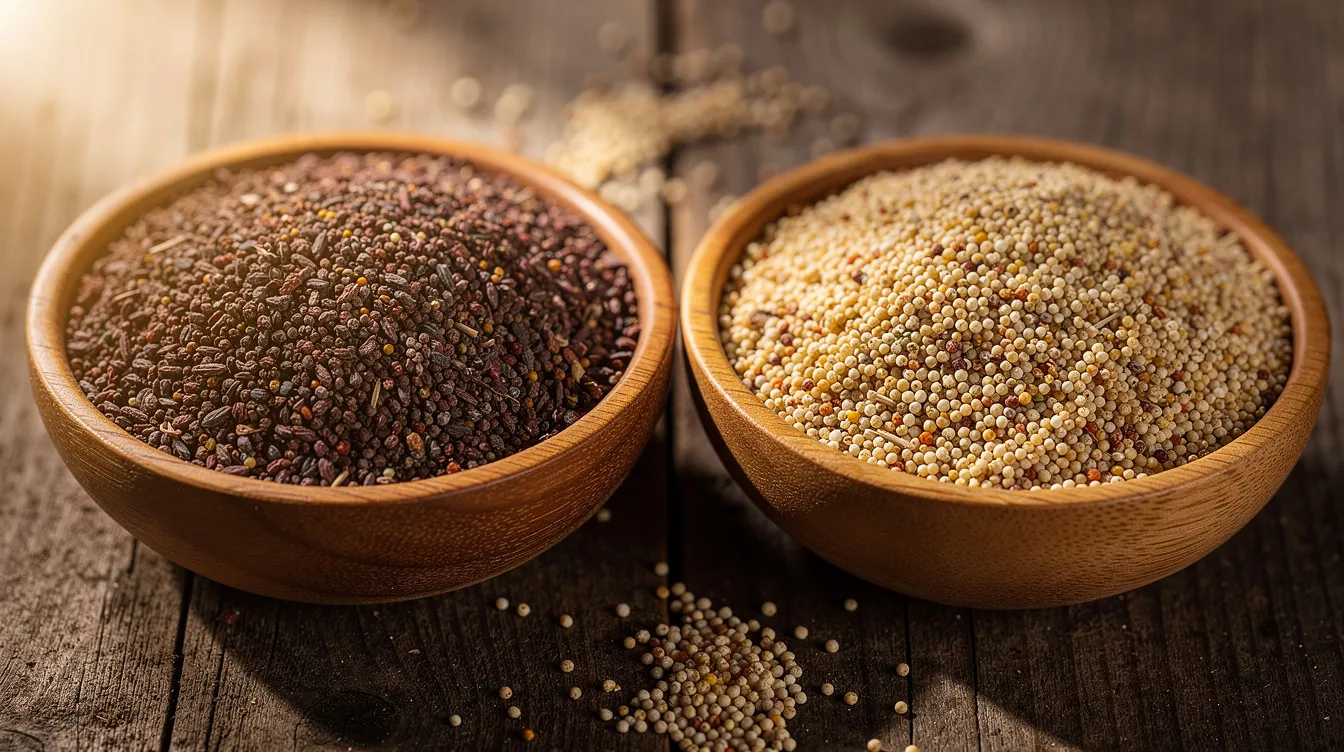
Core grain inputs include finger millet (ragi), pearl millet (bajra), sorghum (jowar) and optionally smaller millets such as foxtail millet, barnyard millet and kodo millet. Promoters evaluating integrated setups that combine primary millet processing with snack manufacturing can refer to our Small Millet Processing Plant Project Report for upstream processing details.
Key ingredients and their roles:
- Millet flours and grits – primary grain base; quality and particle size directly affect extrusion behaviour
- Rice flour, corn grits or other starch sources – improve expansion, lighten texture, reduce cost
- Pulse flours and plant protein concentrates – boost protein content for premium positioning
- Edible oil – used in seasoning application and, for fried products, in post-extrusion frying; a significant cost item subject to price volatility
- Salt, spices, masala blends and cheese seasonings – define flavour profile and consumer appeal
- Approved food additives and antioxidants for oil stability where applicable
Raw material sourcing impacts project viability and cost assessment significantly. As per available market data, wholesale prices for whole bajra are approximately ₹38–40/kg, jowar approximately ₹46/kg, and ragi approximately ₹55–56/kg. Millet flour prices range from ₹40 to ₹170/kg depending on type, processing level and organic or sprouted status. Raw material quality parameters important for extrusion include moisture content (ideally 12–14% for storage), particle-size distribution, foreign-matter limits and mycotoxin safety.
Packaging materials typically include laminated pouches (MET PET/LDPE or similar barrier films), stand-up zipper pouches for premium lines, bulk packs for institutions and master cartons for transport. Nitrogen flushing is standard practice to maintain crispness and extend shelf life.
Inventory and moisture management deserve attention: seasonal procurement of millets, dry and well-ventilated storage, palletisation, FIFO practices and regular moisture checks help avoid mould growth and raw material degradation. In many millet extruded snacks, the combined cost of ingredients and packaging forms the majority of per-kg production cost, so the DPR must model realistic formulation costs and pack sizes.
Millet Extruded Snacks Manufacturing Plant Setup Cost and Investment
The figures provided here are indicative for Indian conditions and for guidance only. Millet-based food plant setup costs range significantly based on capacity, automation, location and product complexity. Actual project cost requires vendor quotations, civil estimates and tax/duty analysis. A cost structure typically includes fixed capital and working capital components.
Major CAPEX heads include:
- Land and site development
- Factory building and civil works
- Primary processing equipment (cleaning, dehulling, milling)
- Extrusion line (preconditioner, extruder, die/cutter, dryer)
- Seasoning line (oil spray, tumbler)
- Packaging machinery (multihead weigher, VFFS, nitrogen flushing)
- Electrical installation and utilities
- Laboratory and QA/QC setup
- Installation, commissioning and training
- Pre-operative and preliminary expenses
- Contingency (typically 5–10% of hard costs)
- Margin money for working capital (shown separately from fixed assets)
| Cost Component | 250 kg/hr Plant (₹ Crore, approx.) | 500 kg/hr Plant (₹ Crore, approx.) | 1,000 kg/hr Plant (₹ Crore, approx.) |
|---|---|---|---|
| Land and site development | 0.30–0.80 | 0.50–1.20 | 0.80–2.00 |
| Building and civil works | 0.40–0.80 | 0.70–1.50 | 1.20–2.50 |
| Plant and machinery (all equipment) | 1.20–2.00 | 2.00–3.50 | 3.50–6.00 |
| Electricals and utilities | 0.15–0.30 | 0.25–0.50 | 0.40–0.80 |
| Lab, pre-operative, contingency | 0.15–0.30 | 0.25–0.50 | 0.40–0.80 |
| Margin money for working capital | 0.20–0.40 | 0.40–0.80 | 0.70–1.50 |
| Indicative total project cost | ₹2.5–4.5 crore | ₹4.0–8.0 crore | ₹7.0–13.5 crore |
These ranges are wide because investment varies with the level of automation (auto-dosing systems, PLC-SCADA control, automated seasoning and packing versus semi-automatic operations with higher labour but lower initial investment), land costs by state and the extent of primary processing integration.
From a project finance perspective, banks and investors scrutinise not only total project cost but also cost per installed kg/hr, projected sales turnover per crore of CAPEX and robustness of DSCR under conservative utilisation assumptions. In my experience as a DPR consultant, frozen assumptions or copied template investment numbers can mislead promoters. Each site requires a fresh cost build-up based on current quotations and local conditions.
Working Capital Requirements for Millet Snacks Manufacturing
Packaged snacks businesses often face significant working-capital needs because of distributor credit periods, inventory levels and marketing spends. Working capital is necessary to manage daily manufacturing operations – from procuring millets and seasonings to financing finished goods in transit and trade receivables.
Major current-asset components:
- Raw millet and other grain/pulse inventories (30–45 days stock)
- Seasonings, edible oil and minor ingredients (15–30 days)
- Packaging material stock – printed laminates and cartons (15–30 days)
- Work-in-progress (minimal for direct-expanded snacks, higher for pellet-based production)
- Finished goods inventory in factory and depot (15–30 days)
- Trade receivables from distributors and modern trade (30–60 days)
- Minimum cash and bank balances
Major current-liability components:
- Creditors for raw materials and packing materials (15–30 days)
- Outstanding wages and utilities
- Statutory dues and other short-term liabilities
Illustrative working capital calculation (500 kg/hr plant, base case):
| Component | Assumption | Approximate Amount (₹ Lakhs) |
|---|---|---|
| Raw material inventory | 30 days of consumption | 45–70 |
| Packaging material stock | 20 days | 20–35 |
| Finished goods inventory | 20 days of production cost | 35–55 |
| Trade receivables | 45 days of sales | 80–120 |
| Less: Trade creditors | 20 days | (25–40) |
| Net working capital gap | ₹155–240 lakhs |
Of this gap, bank working-capital limits (cash credit/overdraft) may finance 60–75%, with the remaining 25–40% covered by promoter’s margin money, as per typical CMA Data analysis norms. Aggressive brand-building or pan-India distribution usually increases working-capital requirements due to higher in-transit stock and extended credit to channel partners.
Operating Cost and Production Economics
Robust cost-sheet preparation is central to the millet based extruded snacks manufacturing plant project report. Assumptions must be product-specific – a plain salted bajra puff has very different economics from a premium multi-millet cheese ball with imported seasonings.
Illustrative per-kg cost breakup (seasoned millet puffs, medium-scale plant):
| Cost Head | Approximate ₹/kg of Finished Product |
|---|---|
| Millet flour and other cereals/pulses | 55–85 |
| Edible oil | 10–20 |
| Seasonings and minor ingredients | 12–25 |
| Packaging material | 25–45 |
| Power and fuel | 5–10 |
| Direct labour | 5–10 |
| Repairs and maintenance | 2–4 |
| Factory overheads and QA/QC | 4–8 |
| Freight and distribution | 8–15 |
| Selling and promotional expenses | 10–25 |
| Total operating cost | ₹136–247/kg |
Operating costs for millet-based plants are typically 60–70% raw material expenses (including ingredients, oil and packaging combined). Manufacturing cost (up to packed product ex-works) is a subset of total operating cost, which also includes selling, distribution and administrative overheads.
The impact of pack sizes is significant: smaller SKUs (₹5 and ₹10 packs) carry much higher per-kg packaging and trade margin costs compared to larger family packs or institutional packs. Similarly, own-brand distribution with heavy marketing entails substantially higher selling costs than B2B or private-label supply.
Gross profit margins for millet-based food products typically range from 40–50% at net selling price to the distributor, but this gross margin must absorb selling expenses, distribution costs, administrative overheads and finance charges before translating into net profit. Sensitivity of a few rupees per kg in ingredient or packaging cost can substantially affect EBITDA margins when producing several thousand kg per day, underscoring the need for disciplined procurement strategies.
Financial Projections and Project Profitability Analysis
Banks typically require financial projections for at least 7–10 years, while investors also evaluate IRR and payback period over the same horizon. Financial projections include ROI and profitability assessments that must be grounded in defensible operating assumptions.
Key elements in a projected P&L include sales volume assumptions by year (linked to capacity utilisation ramp-up), average net realisation per kg, cost of goods sold, gross contribution, operating expenses, EBITDA, depreciation, interest, tax and net profit. Cash-flow projections show how term-loan repayment, interest, any additional capital expenditure and working-capital changes are incorporated.
Break-even analysis is essential for assessing project viability. The break-even point is calculated as fixed costs divided by contribution per kg (net realisation minus variable cost per kg). For a typical medium-scale millet snacks plant, break-even capacity utilisation may fall in the range of 40–55% depending on the cost structure and selling price – but this figure varies significantly by product mix, pack sizes and pricing strategy.
Key evaluation metrics:
- DSCR (Debt Service Coverage Ratio) – indicates the capacity to service debt obligations. Banks typically expect average DSCR of 1.5–2.0× and minimum DSCR of at least 1.25× in any year. The ratio is calculated as net cash accruals (PAT + depreciation + interest) divided by (principal repayment + interest).
- Project IRR and equity IRR – internal rate of return on total project investment and on promoter’s equity respectively.
- Net Present Value (NPV) – at a discount rate reflecting the cost of capital.
- Payback period – time required to recover total project investment from cumulative net cash flows.
I recommend using three scenarios – conservative, base and optimistic – varying capacity utilisation, selling price and raw-material cost. In my experience, banks look closely at the downside case. A project that barely achieves 1.0× DSCR under conservative assumptions is unlikely to receive comfortable financing terms.
Bank Loan, CMA Data and Project Finance for Millet Extruded Snacks Plants
The typical means of finance structure for millet extruded snacks plants in India involves promoter equity (typically 20–30% of project cost) plus a bank term loan for fixed assets, and separate working-capital limits (cash credit/overdraft) for operations.
Banks expect a bankable DPR that includes technical details of machinery and capacity, realistic cost estimates backed by vendor quotations, market assessment, detailed financial projections including projected balance sheet, P&L, cash flows, DSCR analysis, and sensitivity testing. Detailed project documentation is essential for obtaining bank loans. The role of CMA Data is to present these projections in the prescribed banking format, linking the DPR financials to the bank’s credit appraisal framework.
Typical security and collateral structures involve primary charge on fixed assets and current assets financed by the bank, possible requirement of additional collateral property and personal guarantees from promoters. Terms vary by bank, scheme and the promoter’s credit profile.
Promoters should obtain quotation back-ups for all major machinery and civil work before finalising loan applications, and negotiate repayment schedules (tenor and moratorium period) aligned with the projected ramp-up period and DSCR comfort. Government subsidies like PMFME can provide capital support for micro food businesses, and other food processing and millet promotion schemes may be available from time to time, but promoters should verify the latest official guidelines and not base project feasibility solely on uncertain subsidies.
Licensing, Regulatory Compliance and Food Safety
Regulatory compliance is a non-negotiable part of any millet snacks manufacturing plant project and must be factored into timelines and cost estimates. Compliance with local regulations is necessary for food processing establishments, and statutory approvals are required to legally operate a food processing plant.
Key Indian registrations and licences potentially required:
- FSSAI Food Business Operator licence (central or state, based on capacity and turnover) – this is mandatory for food manufacturing
- GST registration is required for tax compliance in food processing
- Factory licence and approvals under state factories rules
- Pollution control board consents where applicable
- Fire and safety NOC
- Local municipal and building approvals
Packaged snack-specific requirements include Legal Metrology rules for net quantity declaration, labelling norms (ingredient list, nutritional table, FSSAI logo, veg/non-veg mark, batch number, MRP, best-before date), and shelf-life declaration.
Food safety management systems should be implemented progressively: basic hygiene practices and Good Manufacturing Practices (GMP) from day one, with possible adoption of HACCP or FSSC 22000 certification for plants targeting organised retail and exports.
Marketing claims like “high fibre”, “protein-rich” or “gluten free” must be substantiated by formulation analysis and, where required, laboratory testing. Being millet based alone does not automatically justify such claims – the specific formulation determines nutritional value.
Trademark registration protects brand names, and exporters need additional registrations such as IEC (Importer Exporter Code) and destination-market food approvals as applicable.
Business Risks and Sensitivity Analysis
A realistic millet based extruded snacks manufacturing plant project report must highlight risks rather than assuming linear success. SWOT analysis helps identify strengths and threats in market planning, and detailed risk assessment is essential for any serious investment decision.
Key risk categories and mitigation strategies:
| Risk | Impact | Mitigation |
|---|---|---|
| Raw millet and edible oil price volatility | Margin erosion | Multi-supplier sourcing, forward contracts, dynamic pricing |
| Inconsistent expansion and texture across batches | Product rejection, brand damage | Extensive pilot trials, documented SOPs, skilled operators |
| Machinery breakdowns and spare-parts delays | Production loss, missed delivery | Preventive maintenance, critical spare inventory, vendor AMC |
| High product rejects during new launches | Wastage cost, delayed market entry | Phased product rollouts, pilot batches before full production |
| Shelf-life failures (moisture ingress, packaging defects) | Product recalls, consumer complaints | Robust QA testing, proper packaging validation, nitrogen flushing |
| Competitive pricing pressure from large brands | Lower selling price, market share loss | Focused geography, product differentiation, cost discipline |
| High marketing and trade-promotion costs | Lower net margins | Phased distribution, digital-first marketing, private-label contracts |
| Working capital strain and collection delays | Cash-flow stress | Conservative debtor terms, credit insurance, adequate margin money |
| Lower-than-expected capacity utilisation in early years | Depressed DSCR, financial stress | Right-sized initial capacity, gradual expansion |
| Delayed or inadequate bank finance | Project implementation delays | Early DPR preparation, multiple bank approaches, adequate equity |
In financial modelling, these risks are incorporated via sensitivity tests on sales volume (±15–20%), selling price (±5–10%), raw-material cost (±10–20%) and interest rates (±1–2%). The resulting impact on DSCR and IRR under downside scenarios helps promoters plan adequate equity cushion and contingency reserves.
Feasibility of Setting Up a Millet-Based Extruded Snacks Plant
From a technical feasibility perspective, extrusion technology for millet snacks is well established globally, but successful implementation requires skilled operators, reliable local service support for extruders, stable power supply and the ability to control critical process parameters. Multi-millet and high-protein formulations demand twin-screw extruders and more sophisticated process control. In India, availability of trained operators varies by region, and promoters should budget for operator training and vendor-supported commissioning.
On the commercial side, local and regional demand for differentiated millet snacks is growing, but competition varies significantly by product type. Simple cheese balls and spicy rings face intense competition from established brands, while multi-millet healthy puffs may command premium pricing in select channels. The choice between own-brand development and contract or private-label manufacturing affects capital requirements, marketing expenditure and risk profile. Access to an existing distribution network or strong e commerce presence significantly improves commercial viability.
Financial feasibility hinges on whether projected EBITDA and cash flows adequately cover interest and principal repayments, deliver acceptable IRR and provide a buffer for investment overruns and slower-than-expected ramp-up. Project feasibility studies assess the economic viability before investment, and promoters should ensure the conservative scenario shows DSCR above 1.25× before committing to the project.
Regulatory feasibility requires FSSAI, factory, pollution and labelling compliance to be in place before commercial operations. Location-specific constraints such as industrial zoning regulations, water availability and effluent treatment requirements should be evaluated during site selection.
In my experience, projects are typically viable where promoters combine sound product concepts, realistic capacity planning, disciplined execution and adequate capital. Purely subsidy-driven or trend-driven projects without strong operational fundamentals may underperform expectations.
Why a Professional DPR Is Critical for Millet Snacks Projects
A Detailed Project Report in the context of a millet extruded snacks production plant is a structured document that evaluates the complete technical, commercial and financial feasibility of the proposed investment. Banks insist on a properly prepared DPR rather than a brief machinery quotation and rough estimate because the DPR provides the analytical foundation for credit appraisal. Detailed Project Reports evaluate technical feasibility and financial viability in an integrated manner, connecting machinery selection with capacity, capacity with revenue and revenue with debt-service capability.
Core components of a professional DPR include:
- Technical description of products and manufacturing process
- Capacity planning and plant layout
- Detailed machinery list and costing with vendor references
- Land and building estimates
- Market study and pricing strategy
- Project cost and means of finance
- 10-year financial projections (P&L, balance sheet, cash flows)
- Working-capital and DSCR analysis
- Break-even and sensitivity analysis
- Risk assessment and mitigation plan
The difference between a customised DPR based on project-specific assumptions and a generic downloadable project report is significant. Generic reports may not match the promoter’s location, capacity, product mix, formulation, distribution model or funding structure. Professional advisory services enhance the quality of Detailed Project Reports by ensuring internal consistency across cost, capacity, revenue and repayment schedules.
As a practising Chartered Accountant, I typically align DPR financials with bank appraisal norms, ensuring that every projection is traceable back to clearly identified operating assumptions. Serious promoters should involve both technical and financial experts early in the process so that equipment selection, plant size and financing structure are aligned from the outset.
Professional DPR and Financial Advisory Services by Project Report Bank
I am CA Manish Gugliya, FCA, DISA (ICAI), and I lead Project Report Bank – a professional project advisory and DPR preparation practice focused on manufacturing and food-processing projects across India. With over 20 years of professional experience, our work covers customised, bankable Detailed Project Reports, CMA Data, financial modelling, project feasibility studies and investor-ready documentation.
Services relevant to millet extruded snacks plants include:
- Bankable Detailed Project Reports tailored to specific capacity, product mix and site
- CMA Data preparation for working-capital limits
- Detailed financial projections and modelling including DSCR, IRR and NPV analysis
- Project feasibility and viability studies
- Means-of-finance planning and loan-structuring advice
- Investor-ready DPRs and fundraising support
- Expansion and diversification planning for existing food processors
We also prepare DPRs for related millet and specialty grain projects such as instant millet porridge and upma mix plants and quinoa, amaranth and buckwheat processing plants, demonstrating breadth of coverage across the millet based products and specialty grains industry.
We do not sell generic templates. Every DPR is prepared based on project-specific assumptions, promoter data and realistic market and cost benchmarks. If you are a serious entrepreneur, MSME or investor considering a millet based extruded snacks plant in India, I invite you to contact Project Report Bank through our website for a discussion on customised DPR and financial advisory support.
Frequently Asked Questions
The following FAQ section addresses additional questions that prospective promoters commonly raise about millet based extruded snacks plants, beyond the main article content.
What is a realistic starting capacity for a new millet extruded snacks plant in India?
Many serious new entrants start with a 250–500 kg/hr line, depending on their distribution strength, capital budget and product range. This translates to an annual production capacity of approximately 2,000–3,600 tonnes at reasonable utilisation levels. Plants of 1,000 kg/hr capacity are typically chosen by established snack players or those with strong marketing infrastructure and institutional tie-ups. Starting with a capacity that exceeds the promoter’s marketing reach is a common cause of poor DSCR in the early years.
Can the same extrusion line produce different shapes like rings, curls and cheese balls?
Most industrial extrusion lines can produce multiple shapes – rings, curls, katori, sticks and cheese balls – by changing the die and cutter assembly. However, formulations and process parameters (moisture, temperature, screw speed) often need adjustment for each shape, and frequent changeovers reduce effective capacity utilisation. Planning for a limited initial product range and expanding gradually is usually more practical than attempting to launch a large SKU portfolio from day one.
How long does it typically take to implement a millet extruded snacks project from concept to commissioning?
A typical timeline ranges from 8 to 14 months, covering DPR preparation, bank appraisal, financial closure, civil construction, machinery ordering and delivery, installation, commissioning and trial production. The actual duration depends on plant capacity, vendor lead times, speed of financial closure and regulatory approvals. Delays in bank finance or imported machinery procurement can extend timelines significantly.
Can one DPR support both bank finance and potential equity investors?
A well-prepared DPR with detailed technical description, robust financial modelling and risk analysis can support both bank-term loan appraisal and equity discussions. However, equity investors typically require additional focus on market opportunity, competitive positioning, scalability and valuation – areas that may be supplemented by a concise investor pitch deck derived from the DPR. The underlying financial data and assumptions should remain consistent across both documents.
What are the main manufacturing risks specific to millet-based extrusion?
The primary manufacturing risks include inconsistent expansion and texture due to variation in millet flour quality or moisture, higher product rejection during formulation trials, difficulty achieving the same crispness and taste profile as established corn-based snacks, and shelf-life challenges if packaging barrier properties or nitrogen flushing are inadequate. These risks can be mitigated through extensive pilot trials, documented SOPs, skilled operators, robust quality assurance and proper vendor support during commissioning.
Conclusion
Millet-based extruded snacks present a credible industrial opportunity in India, driven by growing consumer interest in health-oriented snacks, the nutritional value of traditional grains and expanding distribution channels. Success, however, depends on sound product selection, appropriate capacity planning, reliable making machines, disciplined financial planning and a realistic understanding of competitive dynamics in the food industry.
Project economics are ultimately driven by capacity utilisation, operating efficiency, working-capital management and distribution strategy – not just machinery price or projected selling price per kg. A plant that produces excellent snacks but cannot sell them profitably or service its debt is not a viable project, regardless of how attractive the market opportunity appears.
I would strongly encourage any serious entrepreneur or investor to prepare a project-specific, professionally validated millet based extruded snacks manufacturing plant project report before locking in investment decisions or applying for bank finance. If you are evaluating this opportunity, reach out to Project Report Bank for comprehensive DPR preparation, CMA Data, financial projections and project feasibility analysis. A well-structured DPR is not a formality – it is a financial roadmap for your proposed business.
CA Manish Gugliya FCA, DISA (ICAI) Project Report Bank Website: https://projectreportbank.com/