
Key Takeaways
- This article explains how to plan, design and finance an industrial barley pearling and milling plant in India, covering the technical process, machinery selection, project cost structure and financial feasibility analysis.
- Barley processing adds value through products such as pearled barley, barley flour, grits, flakes and bran, with applications across food processing, brewing, health foods, staple foods and animal feed segments.
- Land, plant layout, machinery configuration, capacity planning and quality control systems are critical for achieving stable extraction rates and consistent product quality.
- Project Report Bank, led by CA Manish Gugliya (FCA, DISA), prepares customised Detailed Project Reports, CMA data, financial models and bankable documents for barley processing projects.
- The article also covers regulatory approvals, project economics, operational risks and how to secure term loans and working capital from banks for a barley processing plant.
Introduction: Industrial Barley Pearling and Milling Plant Overview
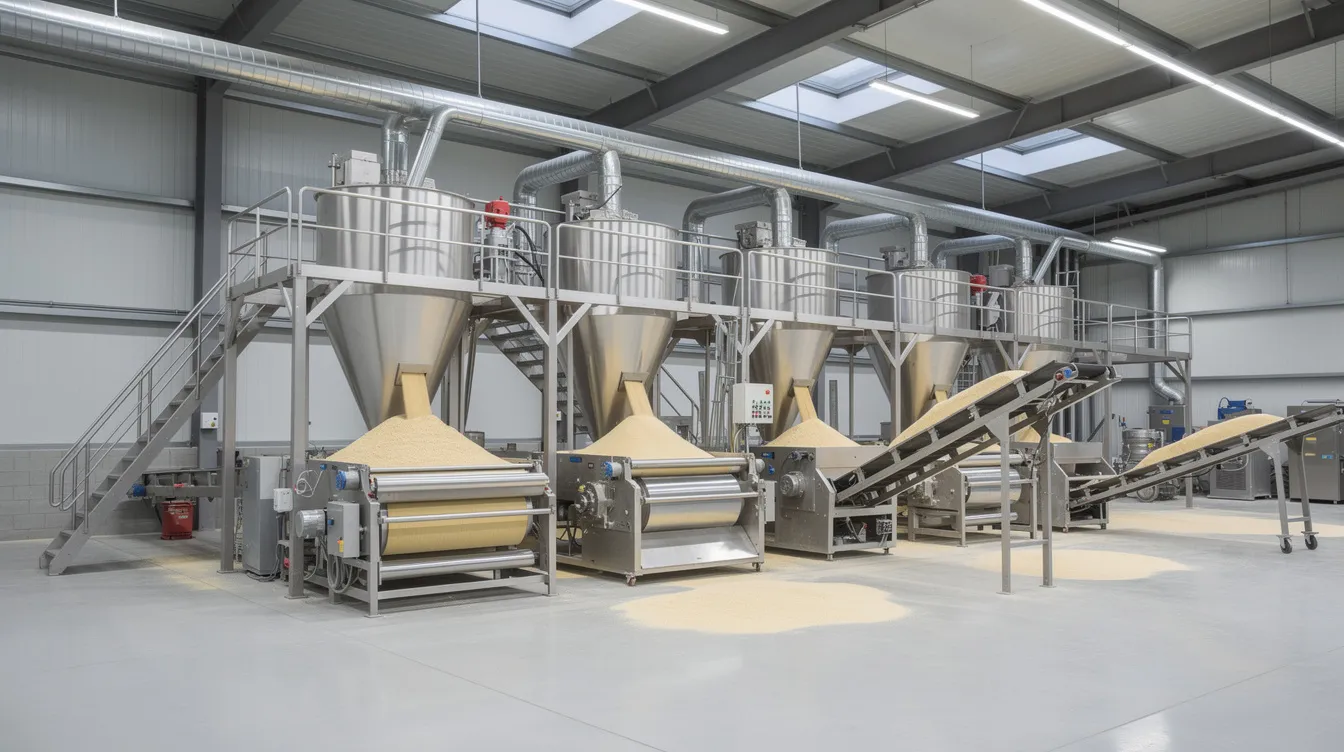
An industrial barley pearling and milling plant is a mechanised facility that receives raw barley grain and transforms it through cleaning, dehulling, pearling and milling into value-added products for the food manufacturing and barley industry. Processed barley – whether sold as pearled barley for soups and ready mixes, barley flour for baking and bread, grits for breakfast cereals, flakes for snacks, or bran for animal feed – commands significantly higher realisations than unprocessed grain.
India’s rising demand for functional grains, convenience foods and institutional supplies for breweries, distilleries, craft breweries, bakeries and poultry feed manufacturers makes barley processing a commercially viable opportunity. Machinery selection, processing capacity, product recovery and financial feasibility determine whether the project creates sustainable returns. This Industrial Barley Pearling and Milling Plant Project Report provides a practical roadmap for entrepreneurs and investors, reflecting Project Report Bank’s professional, finance-oriented approach to DPR preparation and bank finance documentation for agro-processing projects.
Barley Processing Industry in India: Context and Viability
India produced approximately 1.80 million metric tonnes of barley in 2025-26 from about 566,000 hectares, with Rajasthan contributing over 50 per cent of the national output, followed by Uttar Pradesh and Haryana. These states form the ideal raw material catchment for locating a barley processing plant. Procurement typically flows through mandis, FPOs, farmer cooperatives and long term contracts with malt houses.
The global barley market was valued at USD 25.0 billion in 2025, and market analysis must assess demand trends in food processing and brewing to position any new plant correctly. Key demand segments include the malting and brewing industry (estimated at 400,000–450,000 MT annually in India), food-grade uses such as barley flour and grits, the health-food space driven by consumers seeking beta-glucan rich cereals, and the feed sector. The MSP for barley in 2027-28 stands at ₹2,286 per quintal against a cost of production of approximately ₹1,447 per quintal, providing key insights into raw material economics.
Core commercial viability factors include local barley availability, logistics cost, target product mix, product recovery rates and the ability to secure offtake agreements with food manufacturers, breweries and feed mills.
Products of an Industrial Barley Pearling and Milling Plant
A well-designed barley processing plant can produce multiple product lines, improving revenue diversification and reducing market concentration risk. Principal products and their applications include:
- Pearled barley – bran and aleurone layers removed by abrasion; used in soups, risotto, health foods and ready mixes.
- Hulled barley – husk removed but bran largely intact; used in some food applications and feed formulations.
- Barley grits – coarsely milled kernels for breakfast cereals, crackers and ready mixes.
- Barley flour – finely ground via roller or hammer mills; used in multigrain atta blends, bread, baking and infant foods.
- Barley flakes – pearled barley steamed and rolled; used in cereals, snacks and health food products.
- Broken barley – fragments from pearling; used in feed and some food contexts.
- Barley bran – outer layers high in fibre; sold to feed manufacturers, poultry feed compounders and biomass users.
The technical difference between dehulling (removal of the inedible husk), pearling (abrasion-based removal of bran layers), polishing (surface finishing for appearance) and milling (size reduction into flour or grits) determines the product profile. Entrepreneurs exploring specialty grain value addition may also review projects such as the Small Millet Processing Plant Project Report for comparable product diversification strategies.
Manufacturing Process of Barley Pearling and Milling
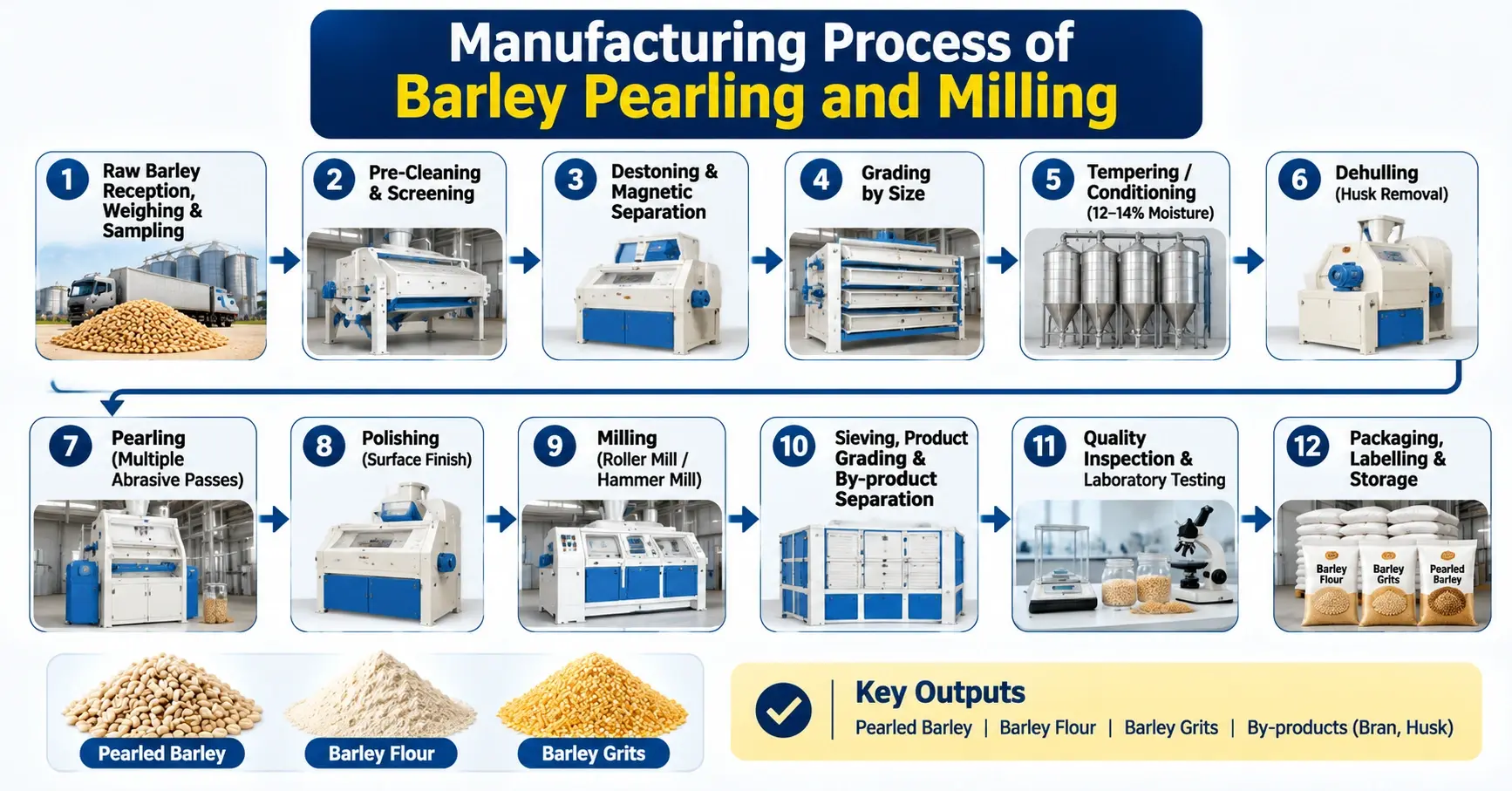
The barley processing line follows a logical sequence of stages from grain reception to packaging, with quality control integrated at every step. The principal unit operations are:
- Raw barley reception, weighing and sampling.
- Pre-cleaning and screening to remove large debris and fine dust.
- Destoning and magnetic separation to eliminate stones and ferrous metals.
- Grading by size for uniform downstream processing.
- Tempering or conditioning – adjusting moisture to approximately 12–14 per cent for optimal pearling efficiency.
- Dehulling to remove the tightly bound outer husk.
- Pearling through multiple abrasive passes to progressively remove bran and aleurone layers. Studies on Indian barley cultivars report flour extraction rates of 55–62 per cent depending on variety and moisture.
- Polishing for surface finish improvement.
- Milling via roller mills (for fine flour) or hammer mills (for coarser grits).
- Sieving, product grading and by-product separation using plansifters.
- Quality inspection and laboratory testing.
- Packaging, labelling and finished-product storage.
Barley cleaning equipment is essential for removing impurities at the front end, protecting downstream machinery and ensuring food safety. Plant layout should be designed for a hygienic workflow from cleaning to packaging. Modern automation – PLC-based controls, load sensors and flow monitoring – supports better throughput, reduced wastage and consistent product quality. Process design must align with desired capacity and product mix, similar to the approach described in the Integrated Millet Processing Plant Project Report.
Plant and Machinery Requirements for a Barley Pearling and Milling Unit
Machinery selection depends on plant capacity, target products, level of automation and desired energy efficiency. A full barley flour production line requires 12–15 machines, and the DPR should compare alternative configurations. Barley milling machines cost between $5,000 and $500,000 depending on scale, origin and technology. Key equipment groups include:
| Equipment | Function |
|---|---|
| Pre-cleaner and vibratory sieve | Removal of foreign matter, oversized and undersized particles |
| Destoner | Separation of stones by density |
| Magnetic separator | Removal of ferrous contaminants |
| Grain grader | Size classification for uniform processing |
| Dehulling machine | Husk removal |
| Abrasive pearler | Progressive bran removal via abrasive surfaces; higher whiteness, better surface finish |
| Friction pearler | Bran removal via rubbing; simpler, lower capital but less precise |
| Roller mill / Hammer mill | Size reduction to flour or grits |
| Plansifter | Classification of flour, grits, bran |
| Dust collection system | Air quality and explosion hazard control |
| Bucket elevators, screw conveyors | Internal material movement |
| Weighing and packing machines | Final product bagging |
Machinery specifications must include pre-cleaning and pearling equipment suited to the target product portfolio. Similar principles of equipment evaluation apply to projects covered in the Specialty Flour Plant Machinery and Equipment Cost guide. Reliable after-sales service, spares availability and ease of cleaning for food safety are as essential as the initial capital price when evaluating barley milling plant machinery.
Capacity Planning, Land, Building and Layout
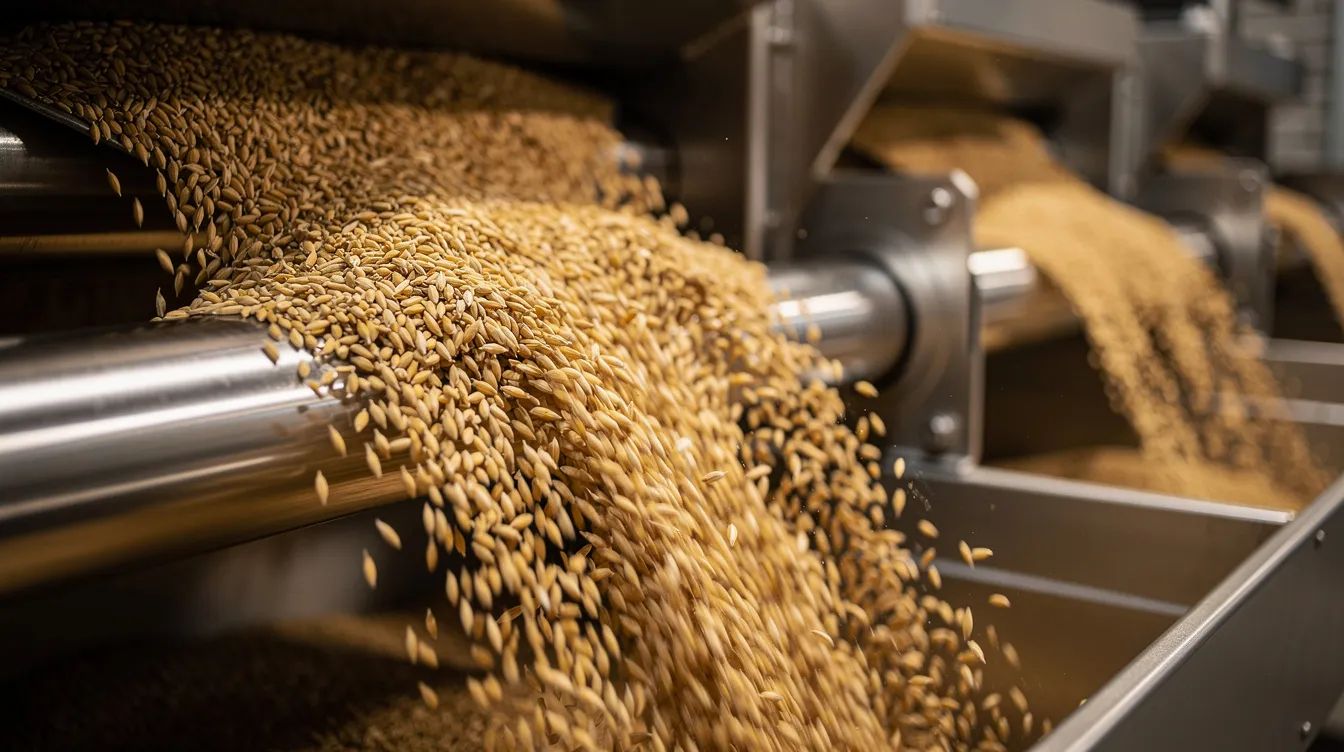
Annual production capacity for a barley processing plant is 30,000–75,000 quintals, and project capacity can be defined in metric tons per day. Small-scale mills typically process 1–5 tons of barley daily, medium-scale plants handle 40–80 TPD and larger industrial configurations exceed 100 TPD. Illustrative categories:
- Small: 20–30 TPD – suitable for niche and regional markets.
- Medium: 40–80 TPD – cost-effective scale for diversified product mix.
- Large: 100+ TPD – positioned for institutional supply, breweries and exports.
Planners should determine operating hours (single or double shift), project a capacity utilisation ramp-up over 3–5 years and identify bottlenecks in pearler or milling sections. Land requirements for a medium plant typically range from 2–3 acres, accommodating the raw material yard, processing hall, finished goods warehouse, utilities block, laboratory, administrative office and loading bays. The layout should ensure linear material flow, dedicated hygiene zoning for food-grade areas and clear access for maintenance, taking cues from layouts used in grain projects such as the Sorghum Milling Plant Project Report.
Raw Material, Utilities and Manpower Planning
Barley grain is the principal input, and raw material specifications include moisture content and foreign matter limits. Daily checks on barley moisture should confirm levels of 12–14 per cent for safe storage and stable pearling. Grain size uniformity, low stone content and absence of mycotoxin-affected grains are equally important. Procurement strategies include seasonal bulk buying at harvest, staggered purchases through the year and long term contracts with aggregators or suppliers. Raw barley procurement through reliable supply chains is comparable to the paddy sourcing approach outlined in the Paddy Procurement and Raw Material Planning for Rice Mill guide on Project Report Bank.
Major utility requirements include electricity for motors, compressors and plant lighting, limited water for sanitation, and compressed air for pneumatic valves and packing systems. Manpower structure scales with plant size and automation: a medium plant may require a plant manager, production supervisor, maintenance technician, quality control chemist, machine operators, helpers, packing staff and administrative personnel.
Investment, Project Cost and Operating Expenses
A realistic Industrial Barley Pearling and Milling Plant Project Report must capture both capital expenditure (CapEx) and operational expenditure clearly. Barley processing plant setup costs include capital and operating expenses across the following heads:
Capital expenditure components: land and site development, factory building, plant and machinery, electrical installation, material handling, laboratory equipment, packaging infrastructure, office furniture, preliminary and pre-operative expenses, consultancy fees, interest during construction and contingency.
Operating cost components: barley grain procurement, packaging materials, electricity, wages, repairs and maintenance, quality control consumables, transportation, insurance, administrative overheads and selling expenses.
Operating costs for barley processing are 80–84 per cent raw material expenses, making raw barley accounts the dominant cost driver. Medium-scale setups cost between $50,000 and $100,000 depending on configuration, automation and location. Financial projections should include capital and operational expenditure evaluations, and the distinction between fixed costs (salaries, depreciation, interest) and variable costs (grain, utilities, packing) directly affects break-even sales volume. Similar investment structuring logic applies to projects like the Wheat Flour Mill Project Report.
Market Opportunities, Quality Control and Regulatory Compliance
Demand-side opportunities grow across several segments: high-fibre barley products in the health-food segment driven by rising demand, barley grits and flakes for breakfast cereals, barley flour blends for multigrain atta, steady volumes from beer breweries and feed mills, and emerging use in crackers and baking applications. By-products like barley bran and screenings add revenue from the animal feed and poultry feed markets.
Quality testing of milled barley should occur every 2 hours during production, covering moisture, particle size, foreign matter and microbiological parameters. Quality control practices include incoming barley inspection, process monitoring at each stage of pearling and milling, sieve analysis and shelf-life testing. Transparency in testing protocols builds buyer confidence and supports food safety management.
Key regulatory requirements include FSSAI licence for food processing, GST registration, Udyam registration for eligible MSMEs, factory licence, Pollution Control Board consent where applicable, fire safety clearance, labour law compliance and electricity connection in the industrial tariff category. Statutory approvals are required for food safety and environmental compliance, and promoters should distinguish mandatory approvals from location-specific permissions.
Financial Feasibility, Bank Finance and Risk Management
Investors must evaluate financial feasibility through a structured DPR and financial model covering a 5–7 year horizon. A DPR includes market overview and unit operations alongside detailed financial projections. DPRs detail capital investments and operating expenses to present a complete picture of project economics.
Barley processing plants can achieve gross profit margins of 12–20 per cent, depending on product mix, scale, procurement efficiency and market positioning. Profitability metrics should include return on investment and break-even point assessments. Financial projections include ROI and profitability assessments alongside DSCR, IRR, NPV and projected cash flows. Sensitivity analysis should test the impact of changes in raw barley price (±10–20 per cent), extraction rate variations and power cost escalation.
CMA data for bank loan appraisal must include a projected balance sheet, profit and loss statements, fund flow, ratio analysis, working capital assessment and loan repayment schedule based on realistic assumptions.
Operational risks include machinery breakdown and dust explosion hazards, raw material price fluctuations, variation in product recovery, competition and customer concentration. Mitigants include diversified sourcing, preventive maintenance programmes, prudent working capital buffers and segment-wise market development. Project Report Bank does not guarantee finance but supports promoters by preparing technically sound, bankable documentation that addresses lender expectations.
Integrated Grain Processing Opportunities and Project Report Bank Services
An industrial barley processing plant can be conceptually integrated with other specialty grain processing lines in a common campus – sharing utilities, laboratories and administrative space while maintaining separate cleaning and milling sections. Entrepreneurs exploring multi-grain strategies may refer to Project Report Bank’s detailed content on Ragi Processing Plant and Bajra Processing Plant projects for comparable approaches to specialty grain value addition.
Project Report Bank offers a comprehensive suite of services for barley processing projects: customised Detailed Project Reports, feasibility studies, financial projections, project cost assessment, means of finance planning, CMA data for bank loans, DSCR and loan repayment analysis, working capital assessment and investor-ready documentation. CA Manish Gugliya and team follow a chartered accountant-led methodology, basing all assumptions on realistic capacity, operational expenditure and market conditions rather than generic templates. Each barley processing DPR is tailored to the client’s location, capacity, product mix and financing plan.
Serious promoters ready to expand into barley processing may contact Project Report Bank with basic project details – proposed location, capacity, product profile and estimated investment – for a customised proposal covering DPR preparation, bank finance support and financial modelling.
Frequently Asked Questions (FAQs)
What is the minimum practical capacity for an industrial barley pearling and milling plant in India?
Small-scale mills typically process 1–5 tons of barley daily, but commercial viability generally improves at 20–30 TPD and above, depending on local barley volumes, distance to markets and the level of automation. Annual production capacity for barley processing ranges from 30,000 to 75,000 quintals for medium to large operations. The ideal capacity should be determined through a customised feasibility study that accounts for raw material availability and target market size.
Can an existing rice or wheat flour mill be modified to process barley?
Modification is possible in some cases, but barley’s tightly bound husk requires dedicated dehulling and pearling equipment that rice or wheat lines typically do not include. Additional machinery such as abrasive pearlers, grain graders and appropriate dust collection systems would be needed. A separate cleaning and grading section is usually required to maintain food-grade barley quality without cross-contamination from other grains.
What is a typical implementation timeline for a greenfield barley processing project?
From concept to commercial production, a greenfield project may take 12–18 months, broken into phases: DPR preparation and bank sanction (2–4 months), procurement and civil works (4–6 months), machinery erection and electrical installation (3–4 months), and trial runs and stabilisation (1–2 months). Timelines vary based on project scale, land readiness and regulatory clearances.
Are there export possibilities for pearled barley and barley flour from India?
Export is feasible, particularly for food-grade pearled barley and barley flour, provided the plant meets international quality certifications (HACCP, ISO 22000), packaging norms and buyer specifications. Logistics, container availability and competitive pricing relative to established exporting nations are important considerations. Promoters should develop expertise in domestic markets before committing significant resources to export channels.
How often should financial projections be updated once the plant is operational?
It is advisable to revise the barley processing project’s financial model annually based on actual production data, cost changes, market realisations and any expansion plans. This practice helps identify deviations early, supports working capital management and strengthens the promoter’s position during bank reviews or fresh funding discussions.