For pulse traders, agro-processing companies, FPOs and investors considering a step beyond loose commodity trading, an integrated multi-pulse cleaning, grading and packing plant offers a structured path toward higher margins and consistent quality. India remains one of the largest producers and consumers of pulses, and the gap between ungraded mandi supply and what modern retail, institutional buyers and exporters demand is where this project finds its commercial logic. A Detailed Project Report (DPR) serves as a blueprint for technical feasibility and commercial viability of such projects, and this article explains the key dimensions that shape investment decisions, project configuration and bankability.
Key Takeaways
- This article covers the full DPR-level view of a multi-pulse cleaning, grading, colour sorting and packing plant in India, targeting 5–20 TPH capacities and investments of ₹5 crore and above.
- The focus is on whole-pulse cleaning and packaging-not dal milling. The plant handles chana, moong, urad, toor, masoor and similar pulses, removing broken grains, stones, foreign materials and other impurities through aspirators, destoners, indented cylinder separators and gravity separators.
- Readers will find practical guidance on machinery (including screw conveyor, bucket elevators, colour sorters and packing lines), project cost structure, working capital needs, profitability drivers and DSCR-focused financial projections.
- The article is written from the perspective of CA Manish Gugliya (Project Report Bank), explaining how to make the project bankable through a proper DPR, CMA Data and realistic assumptions.
- Practical coverage includes land and building requirements, plant layout, licences, bank finance options, sensitivity analysis and common mistakes to avoid before investing.
Integrated Multi-Pulse Cleaning, Grading & Packing Plant – Project Overview
A dal cleaning plant processes pulses to clean and grade them, but it is important to distinguish this from a conventional dal mill. A dal mill dehusks, splits and polishes pulses into finished dal. The plant discussed here receives whole raw pulses-typically arriving with admixture of dust, dirt, stones, immature seeds and broken grains-and subjects them to mechanical cleaning, size grading, density separation, optical colour sorting and packaging, without any milling or splitting operations.
Finished products include clean, size-graded and colour-sorted whole pulses packed in 25–50 kg bags for B2B buyers and 1–5 kg laminated pouches for retail brands, with optional private-label packing services. Target clients include wholesalers, institutional buyers (HORECA, canteens), brand owners, FPOs and exporters requiring consistent quality. For a detailed comparison with full-scale pulse processing, refer to the integrated dal milling and pulse processing plant project report.
| Parameter | Details |
|---|---|
| Location | India (state-neutral) |
| Capacity Options | 5 / 10 / 20 TPH |
| Input | Chana, moong, urad, toor, masoor, other pulses |
| Key Processes | Pre-cleaning, aspiration, destoning, grading, gravity separation, colour sorting, packing |
| Investment Band | ₹5–20 crore (varies by capacity) |
| Business Models | Own-stock trading, job work, contract packing, branded retail, hybrid |
Why Invest in a Multi-Pulse Cleaning, Grading & Packing Facility in India?
India produces approximately 14.5 million tonnes of pulses annually, with a significant share processed through dal mills and related units. Buyers across various industries increasingly demand uniform grade, lower foreign matter and consistent moisture-requirements that manual sorting cannot meet at scale. FSSAI regulations for raw unprocessed whole pulses allow a maximum of 3% foreign matter by weight, of which only 0.5% may be inorganic or animal-origin impurities. Meeting these standards consistently requires mechanised cleaning and grading.
A competitive landscape analysis helps understand existing processing plants and market dynamics. Market potential analysis includes demand and supply assessment of products in target markets. Current trends show equipment demand for pulses and oil seeds accounts for 25–30% of the grain and seed cleaning equipment market in India, driven by stricter quality norms, modern retail expansion and export requirements. Branded, FSSAI-compliant packaging allows higher realisation compared to trading unbranded loose material.
This kind of investment also complements other food processing and grain-handling infrastructure, conceptually similar to an integrated grain cleaning, grading, drying and storage plant.
Types of Pulses Processed and Product Mix
A multi-pulse unit must be configured to handle different sizes, shapes and flow properties across chana, moong, urad, toor and masoor, as well as regional pulses like matar, cowpea or horse gram. Pulse cleaning machines separate foreign materials from crops and each variety presents different cleaning challenges-chana has larger size and distinct shape compared to masoor, while urad may have more colour variation requiring optical sorting.
| Pulse Variety | Key Cleaning & Sorting Considerations | Typical Packaging Sizes | Primary Customers |
|---|---|---|---|
| Chana (Chickpea) | Large size grading, stone removal | 25–50 kg, 1–5 kg retail | Wholesale, retail, exporter |
| Moong (Green Gram) | Fine size, colour consistency | 25–50 kg, 500g–5 kg | Retail, institutional, export |
| Urad (Black Gram) | Colour sorting critical, broken grain separation | 25–50 kg, 1–5 kg | Wholesale, branded retail |
| Toor/Arhar | Density separation, moisture control | 25–50 kg, 1–5 kg | Wholesale, dal millers |
| Masoor (Lentil) | Small flat seeds, fine sieve settings | 25–50 kg, 500g–2 kg | Retail, export |
Some markets accept a higher share of broken grains at discount prices, while premium retail packs must keep damaged grains within narrow limits. The design of processing facilities must allow for flexibility to handle various sizes and grades of pulses.
Business Models for an Integrated Multi-Pulse Plant
The same plant can support multiple revenue models, and the choice of model directly drives working capital intensity, risk profile and profitability.
- Own-stock procurement and trading: Higher margin potential and stock appreciation, but requires heavy working capital, commodity price exposure and crop knowledge.
- Job-work cleaning and grading: Clients supply raw pulses; fixed per-MT processing charges; lower commodity risk but volume-dependent.
- Contract grading, sorting and packaging: Includes packing into brand-owner bags with separate tariffs for cleaning and packing; scalable alongside own-brand sales.
- Branded retail packaging: Higher realisation but longer receivable cycles, marketing spend and distributor margins.
- Bulk B2B and institutional supply: Consistent graded pulses for hotels, caterers, defence canteens and food manufacturers.
- Hybrid models: Own-stock trading in peak season combined with job work in lean months to sustain utilisation.
From a banker’s DSCR perspective, the hybrid model typically offers the most stable cash generation. For a deeper understanding of bulk vs. branded retail economics, refer to the article on bulk versus retail pulse packaging business model.
Multi-Pulse Cleaning, Grading & Packing Manufacturing Process
The process flow moves raw pulses from truck unloading through cleaning, grading, sorting and packing, with quality control protocols that include monitoring of moisture content and foreign matter in raw materials at each stage.
Process Sequence:
Raw Pulse Receipt → Sampling & Quality Inspection → Weighment → Pre-Cleaning (screen-based removal of oversized and undersized material) → Aspiration (air blast to remove light material and chaff) → Destoning (gravity selector cum destoner removes stones from pulses) → Size Grading (sieve and screen-based separation) → Gravity Separation (helps distinguish whole grains from broken ones by density) → Indented Cylinder Separation (length-based grading) → Optical Colour Sorting → Final Quality Testing → Weighing & Packing → Finished Goods Storage → Dispatch
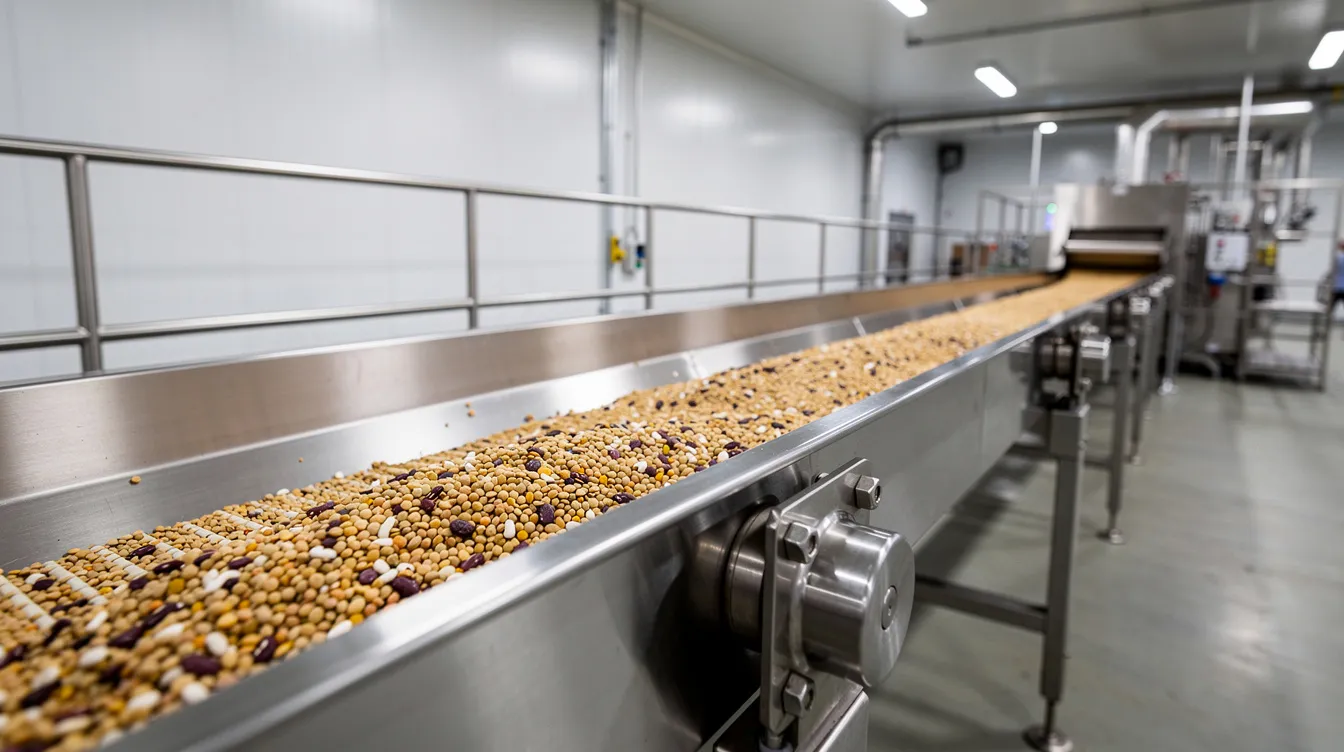
The plant uses a separation chamber with sieves and screens at multiple stages. Material is fed from one end of machines like the horizontal destoner and is discharged through the outlet after separation. Pulses cleaning machines separate foreign materials from pulses at various stages. Screw conveyor and bucket elevator systems transfer pulses between machines while minimising breakage.
Cleaning losses include dust, chaff, stones, shrivelled grains and broken grains. These by-products may have alternative sale value (e.g., broken grains sold at discount, stones discarded). Product changeover between different pulse varieties requires thorough cleaning of hoppers, screens and ducts to prevent cross-contamination-especially important for private-label and export contracts.
Plant Machinery and Equipment Requirements
Machinery configuration depends on capacity, range of pulses, expected impurity levels and target quality. The project report must include a detailed machinery list with specifications and estimated costs. Dust and noise control systems are important for health and safety compliance in processing projects.
| Machine/Section | Function | Capacity Range | Essential/Optional |
|---|---|---|---|
| Intake hopper and pit | Receive raw material | Matched to line | Essential |
| Pre-cleaner (3-screen) | Remove oversized/undersized matter | 5–20 TPH | Essential |
| Aspiration channel | Remove light impurities, chaff | 5–20 TPH | Essential |
| Destoner/Gravity Selector | Remove stones and heavy inert material | 5–20 TPH | Essential |
| Indented cylinder | Length-based separation | 3–10 TPH | Essential for premium |
| Gravity separator | Density separation of grains | 3–10 TPH | Recommended |
| Vibro separator | Three-dimensional motion cleaning | 3–10 TPH | Optional/upgradeable |
| Optical colour sorter | Reject discoloured/defective grains | 2–10 TPH | Essential for retail/export |
| Screw conveyor / Bucket elevator | Material transfer | Matched to line | Essential |
| Dust cyclone & bag filter | Dust collection (90% removal efficiency) | Plant-matched | Essential |
| Packing machine (bulk) | 25–50 kg bags | 200–600 bags/hr | Essential |
| FFS pouch machine (retail) | 500g–5 kg packs | 15–40 packs/min | Optional |
| Metal detector | Detect metallic contaminants | Inline | Essential for export |
| Air compressor | Pneumatic device for sorter and controls | Plant-matched | Essential |
| MCC panel with motor starters | Electrical control and motor management | Plant-matched | Essential |
The automatic pulses pre cleaner uses three screens for cleaning and the vibro separator facilitates three-dimensional motion for efficient separation. Dust collectors in the plant achieve 90% dust removal efficiency. Special machines like the pulses fine grading machine have a capacity of 4 TPH and pulses grading machines can process 4 tons per hour. Optical colour sorters start from ₹12–18 lakh for single-channel types and go up to ₹25–60 lakh for multi-channel configurations with NIR capability.
For a detailed discussion on colour sorting and packaging machinery, refer to pulse grading, colour sorting and packaging machinery, noting that polishing equipment discussed there applies to dal milling, not whole-pulse cleaning.
Plant Capacity Planning – 5 TPH, 10 TPH and 20 TPH
TPH ratings stated by machine suppliers are typically based on specific grains and impurity levels. Actual throughput varies by pulse type and input quality. Capacity utilization should be forecasted based on seasonal production patterns and market demand. Operational efficiency of pulse mill machinery is widely cited at 99% under optimal conditions, but effective throughput is lower after accounting for changeovers, maintenance and manual handling.
| Parameter | 5 TPH | 10 TPH | 20 TPH |
|---|---|---|---|
| Suitable for | MSME, FPO-led unit | Established trader/processor | Major trading house, corporate |
| Operating hours/day | 16 | 16 | 16–20 |
| Working days/year | 280–300 | 280–300 | 280–300 |
| Annual rated capacity (MT) | ~22,400–24,000 | ~44,800–48,000 | ~89,600–96,000 |
| Year 1 utilisation (typical) | 50–60% | 55–65% | 50–60% |
| Indicative machinery cost band | ₹1–2.5 crore | ₹2.5–5 crore | ₹5–10 crore |
| Approximate labour (2-shift) | 12–18 | 20–30 | 35–50 |
Constraints that may limit effective throughput include higher impurity loads, finer grading requirements, and moisture variation across seasonal crops including not just pulses but also cereals like wheat, rice, barley and maize, or seeds like soybean, which use similar machinery across various industries.
Land, Building, Warehouse and Plant Layout Requirements
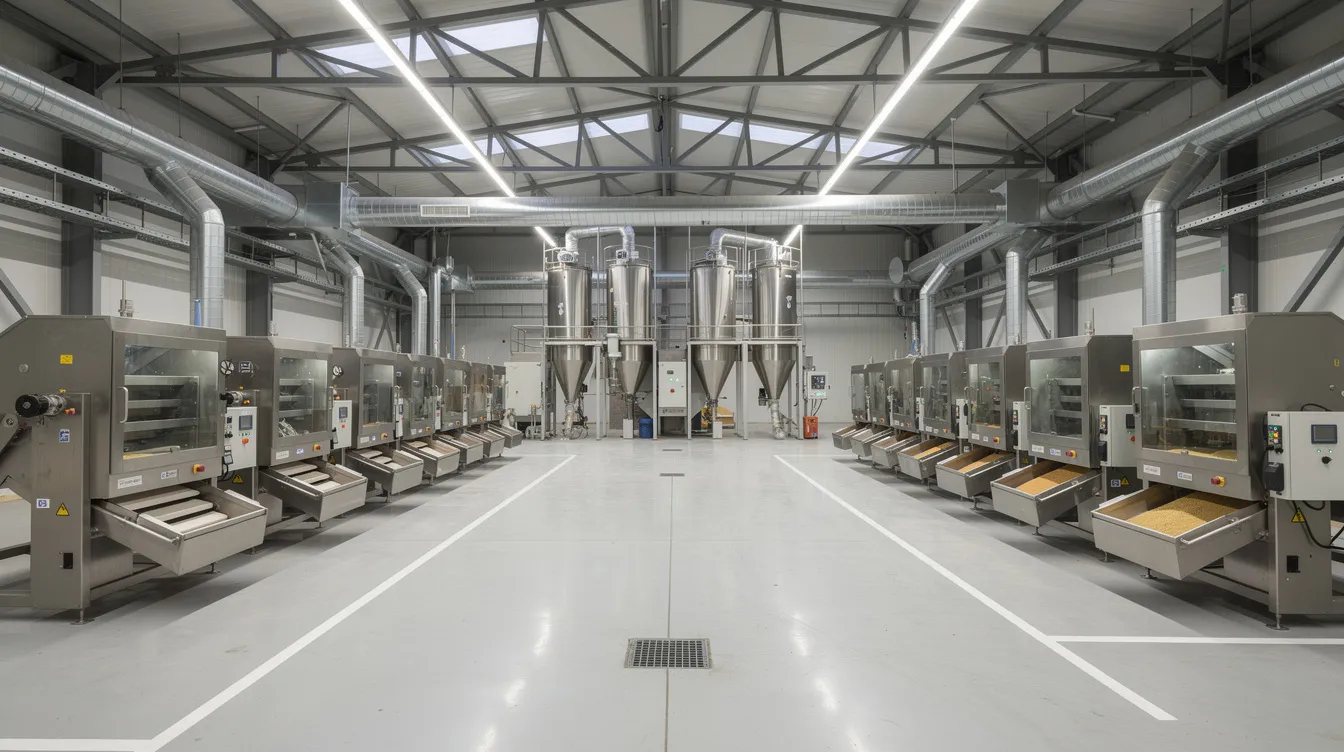
Pulse mill machinery requires 6,000 to 15,000+ sq. ft. of space, with larger units needing proportionately more. The plant typically requires 6,000 to 15,000+ sq. ft. of built-up area for the processing section alone, excluding warehousing, truck bays and office blocks.
Required structures include a machinery hall with adequate clear height, raw material warehouse, finished goods warehouse, packaging material store, quality lab, utility rooms and admin block. Handling and traffic flow should provide separate entry and exit routes for trucks, with a weighbridge, loading bays and turning radius. Hygiene design aspects include smooth cleanable floors, pest-proofing, controlled dust extraction, and segregation of the pre cleaning area from the packing area.
Structural provisions should account for foundations under heavy equipment such as destoners, gravity separators and the indented cylinder, with vibration isolation for high-speed equipment. Space should be reserved for future expansion-possibly adding dal milling, flour production or extended warehousing, similar to the infrastructure discussed in the integrated grain cleaning, grading, drying and storage plant article.
Multi-Pulse Cleaning Grading Packing Plant Project Cost in India
Total project cost varies by capacity, automation level, building type (RCC vs. PEB), location and whether land is already owned. Figures below are illustrative only and must be validated through supplier quotations.
| Investment Head | Illustrative Range (10 TPH) |
|---|---|
| Land & Site Development | ₹20–80 lakh |
| Building & Civil Works (including warehouses) | ₹1.5–3 crore |
| Plant & Machinery (cleaning, grading, sorting, packing) | ₹2.5–5 crore |
| Electrical & Utilities | ₹30–60 lakh |
| Lab Equipment, Furniture & Fixtures | ₹10–25 lakh |
| Preliminary & Pre-operative Expenses | ₹15–35 lakh |
| Contingency | ₹20–50 lakh |
| Margin for Working Capital | ₹50 lakh–1.5 crore |
| Total Indicative Project Cost | ₹5.5–11 crore |
Machinery typically accounts for 35–55% of total project cost depending on building and land infrastructure costs. Capital cost is funded mainly by term loan and promoter contribution, while working capital is separately financed through cash credit.
For financing logic applicable to processing plants, see project cost and means of finance for pulse processing plants, noting that machinery mix differs for a cleaning-and-packing-only unit compared to a full dal mill.
Working Capital Requirements and Inventory Planning
Detailed analysis of working capital is critical for managing seasonal raw material procurement. Working capital needs depend heavily on the chosen business model. An own-stock trading operation can require large seasonal stocks of pulses, while a pure job-work plant may operate with very limited raw material inventory.
Inventory categories include raw pulses (owned vs. customer-owned), cleaned-but-unpacked stock, finished packed pulses, by-products (screenings, broken grains) and packaging materials. Receivables behaviour varies: job-work fees typically carry 15–45 day credit, while branded retail sales through distributors may have longer credit periods.
| Working Capital Component | Holding Period (Days) | Remarks |
|---|---|---|
| Raw Pulse Stock (Own) | 30–60 | Seasonal; higher in procurement months |
| Packaging Materials | 15–30 | Bags, pouches, labels |
| Finished Goods | 7–15 | Depends on dispatch cycle |
| Receivables | 15–45 | Varies by customer type |
| Less: Trade Creditors | 15–30 | Supplier credit on purchases |
For stocking strategy, refer to raw pulse procurement, storage and inventory planning. Working capital financing principles are covered in the article on working capital assessment and cash credit financing.
Revenue Model, Processing Charges and Operating Expenses
Project analysis should separate processing income from commodity trading turnover. For job-work and contract cleaning, typical charges are quoted per MT for cleaning, grading, sorting and packing, with rates varying by region and service level. For own-stock trading, net processing margin must account for purchase cost, cleaning losses, quality adjustments and selling expenses. Branded retail requires deducting packing material cost, marketing spend, distributor margins and freight.
Energy consumption ranges from 100 to 250 kW depending on configuration and capacity. Major operating cost heads include raw materials (trading model), direct labour, power and fuel, repairs, packing materials, insurance, quality testing and selling overheads. Colour sorters, compressors and aspirators consume more power than screw conveyors or bucket elevators. Processing charges for cleaning and grading are widely competitive across mandi regions, making throughput volume a critical profitability driver.
Financial Projections, CMA Data and DSCR
Banks require 5–7 years of detailed financial projections, usually structured as CMA Data, for appraising term loan and working capital proposals. Technical specifications should cover operational workflows and financial metrics for a project. DPRs require a systematic evaluation of technical and financial parameters for project planning.
Core components of a bankable financial model include projected profit and loss statements, cash flow statements, and balance sheets for several years, along with working capital assessment, term loan repayment schedule and DSCR analysis. Central Bank of India’s food processing scheme requires a minimum DSCR of 1.25, current ratio of 1.10 and debt-equity ratio up to 4:1 for smaller projects.
Financial projections should include profit and loss statements, cash flow statements, and balance sheets for several years. CMA Data and projections represent professional estimates for decision-making and loan appraisal-they are not guaranteed results. For detailed modelling methodology, see financial projections, CMA Data and DSCR for pulse processing projects.
Profitability, ROI, IRR and Payback Period
Plant profitability depends on throughput, utilisation levels, service charges or trading margins, processing efficiency and operating discipline. Financial feasibility studies must assess break-even analysis, return on investment, and payback periods. Changes in grading standards-stricter removal of broken grains, discoloured kernels-and rejection ratios can significantly influence net margin per MT.
Finance cost, especially interest on term loan and working capital, materially affects returns. For agro-processing projects of this nature, lenders generally consider IRR in the range of 15–25% and payback periods of 4–7 years as reasonable, though these are indicative benchmarks only. The actual numbers depend entirely on the specific project configuration, business model and operating assumptions.
Feasibility Study and Sensitivity Analysis
Before committing crores of rupees, a structured feasibility study is essential. Key dimensions include market demand and competition mapping, raw material availability, customer access, logistics, power availability and regulatory environment-including fruits, vegetables, spices and other products that may compete for food processing infrastructure.
Sensitivity analysis tests how DSCR, IRR and payback change when core variables shift:
| Scenario | DSCR Impact | IRR Impact |
|---|---|---|
| Base case | 1.5–2.0 | 18–22% |
| –10% throughput | Declines by 0.2–0.4 | Declines 3–5% |
| –10% service charge | Declines by 0.15–0.3 | Declines 2–4% |
| +15% power tariff | Marginal decline | Marginal decline |
Major risks include commodity price volatility, customer concentration, machinery downtime (especially colour sorter), and inadequate working capital during lean production seasons. Operational efficiency depends on proper maintenance-poor upkeep can increase breakage and cleaning losses, leading to customer complaints and value-added products fetching lower realisation.
Licences, Registrations and Regulatory Requirements
Statutory approvals necessary for a project often include FSSAI registration and Pollution Control Board clearances. Entrepreneurs must verify current rules at implementation.
Mandatory: FSSAI licence or registration (depending on scale and turnover), GST registration, Udyam/MSME registration (if eligible), PAN and TAN.
Conditional/location-specific: Factory licence (based on worker count), State Pollution Control Board consent (dust and air emission controls using cyclones and filters), Legal Metrology compliance for pre-packaged commodities (weight declarations, MRP, batch details), fire safety NOC, municipal trade licence and building plan sanctions.
For a comprehensive checklist, refer to food processing plant licences and regulatory approvals.
Bank Loan and Project Finance Options
Project financing strategies include equity contributions and term loans to cover capital costs. A typical means of finance structure combines promoter equity (20–25%), term loan for fixed assets and separate cash credit or OD limits for working capital secured against stock and receivables.
Term loan tenure is usually 5–7 years with moratorium, at floating interest rates around 7.70–10% depending on scheme and bank. Banks assess drawing power on stock and receivables with a margin of approximately 20%. Key documents include detailed technical write-up, cost estimates, implementation schedule, projected financials and CMA Data, promoter profile, market analysis and risk mitigation strategies.
Schemes like the Agriculture Infrastructure Fund may provide subsidies of 25–35% on equipment cost for advanced cleaning machinery, though availability and conditions change over time and must be verified from official sources. A DPR prepared in PDF format suitable for bank submission is essential for any serious loan proposal.
Common Mistakes Investors Should Avoid
- Oversizing capacity: Jumping to 20 TPH without assured volumes creates chronic underutilisation and weak DSCR.
- Incorrect plant configuration: Purchasing dal milling or grinding and polishing machinery when the plan is only cleaning and packing wastes capital. Similarly, ignoring crucial items like the indented cylinder, gravity separator or adequate aspiration system compromises quality.
- Underestimating working capital: Focusing only on machinery cost and ignoring cash requirements for raw pulse inventory, packaging materials and receivables.
- Ignoring cleaning losses: Assuming zero or negligible process losses-dust, stones, broken grains-distorts profitability projections. These losses, while often small (1–5% by weight), are real and must be factored in.
- Weak procurement planning: Relying solely on spot mandi purchases without supplier relationships or storage infrastructure, resulting in inconsistent input quality.
- Inflated projections: Unsupported selling price or processing charge assumptions create projection–actual gaps and stress during loan repayment.
How CA Manish Gugliya Assists with Multi-Pulse Plant DPR and Bank Finance
As a practising Chartered Accountant with over 20 years of experience, I prepare customised Detailed Project Reports for multi-pulse cleaning, grading and packing plants tailored to the promoter’s location, capacity, business model and risk profile.
Professional services include project cost estimation, means of finance planning, comprehensive financial projections, CMA Data preparation, DSCR and ratio analysis, working capital assessment and bank loan proposal documentation. Advisory support extends to integration with other facilities such as dal milling, grain storage or flour milling by extending the financial model and DPR scope.
If you are considering this investment, share your proposed location, planned capacity, pulse varieties, estimated investment, land status and finance requirements via WhatsApp for a customised discussion.
Frequently Asked Questions
What is the typical implementation timeline for a multi-pulse cleaning, grading and packing plant?
Implementation schedules should outline project milestones from planning through to commercial production. Typical stages include project conception and DPR preparation (1–2 months), bank sanction (1–3 months), land and building development (3–6 months), machinery ordering and delivery (2–4 months), installation and trial runs (1–2 months) and commissioning. The overall timeline for a 10 TPH plant is usually 9–15 months from project approval to commercial operation, depending on readiness of land and building.
How many workers and technical staff are usually needed for a 10 TPH plant?
A 10 TPH plant running two shifts typically requires a plant manager, 2–3 supervisors, 6–8 machine operators (for pre-cleaner, destoner, indented cylinder, colour sorter and packing line), 4–6 helpers, 1–2 quality personnel, a storekeeper and 2–3 admin and accounts staff-approximately 20–28 people in total. The exact headcount depends on automation level and the extent of manual handling at receiving and dispatch.
Can the same plant process other food grains or seeds apart from pulses?
Many machines-pre-cleaner, destoner, gravity separator, indented cylinder-are common across grains, cereals and seeds. Technically, the same line can handle wheat, rice, barley, maize, soybean and other crops with suitable sieve and screen adjustments. However, the operation must account for washing or other cleaning procedures between product families, and food safety requirements may demand strict segregation when handling different commodities for different clients. Cross-contamination prevention is critical for export-grade or private-label contracts.
How should an entrepreneur choose between 5 TPH and 10 TPH capacity?
The decision should be based on assured volumes, existing trading turnover, access to raw material, available capital and risk appetite. A 5 TPH unit is suitable for regional MSMEs or FPO-led projects with moderate volumes, while 10 TPH suits established traders or processors at major mandi locations. Starting with a capacity that can be viably utilised within 2–3 years, while retaining space for future expansion, is generally more prudent than building an oversized plant that remains underutilised.
Is it necessary to include a colour sorter from day one?
Optical colour sorting is essential for retail brands, export and premium buyers who require high grading quality and uniform appearance. A unit focused exclusively on bulk B2B supply or job work for less demanding clients may start with mechanical cleaning and add colour sorting later. However, the financial trade-off should be evaluated: colour sorters carry a high capital cost (₹12–60 lakh) but can unlock access to premium customers and improve realisation per MT. A detailed projection in the DPR can help determine whether the investment is justified from day one.
Conclusion
A multi-pulse cleaning, grading and packing plant can be a commercially sound investment for traders, FPOs and agro-processing companies in India if designed with the right capacity, machinery mix and business model. The viability of the project depends not just on machinery but on realistic assumptions around throughput, processing charges, cleaning losses, working capital management and customer access.
Before committing to term loans and large working capital exposure, promoters should invest in a properly structured DPR with DSCR-focused financial modelling and professional risk assessment. The quality of the investment decision depends on the quality of the analysis behind it. For customised project planning, bank finance documentation and financial advisory, reach out to Project Report Bank for a professional discussion.
CA Manish Gugliya FCA, DISA (ICAI) www.projectreportbank.com