
Key Takeaways
An automatic pulse packing machine integrates weighing, pouch forming, filling, sealing and batch coding into a single production line. These machines handle filling capacities from 10 grams to 1000 grams per pouch and operate at speeds of 2,000 to 2,500 pouches per hour, depending on pack size and configuration.
- Fully automatic VFFS lines with multi head weigher systems are now standard for organised retail, private-label and export-grade pulse packaging in India.
- Investment in automatic pulse packing machinery ranges from approximately ₹2,25,000 for basic semi automatic units to ₹18,00,000 or more for high-speed multihead weigher lines (2025-2026 indicative range; obtain fresh supplier quotations before committing).
- Machinery selection must be driven by confirmed sales volume and distribution reach, not by the maximum speed printed on a supplier brochure.
- A professional DPR, CMA Data and integrated financial model are essential before finalising machinery procurement and approaching banks for term-loan or cash-credit facilities.
- This article is written from the perspective of CA Manish Gugliya (Project Report Bank), focusing on project feasibility, capacity planning, ROI and bank finance for pulse packing projects.
Introduction
Between 2015 and 2026, India’s packaged pulses market shifted from a loose, wholesale-driven trade to one where organised retail chains, modern kirana stores, e-commerce platforms and institutional buyers expect tamper-evident, accurately weighed, hygienically packed dal. Tata Sampann, for instance, reported FY25 revenue of ₹1,109 crore with 29% year-on-year growth; the brand rejects more than 70% of incoming pulses at its warehouses for failing internal quality standards.
This shift creates an opportunity for dal mill owners, pulse traders, food processors and new MSME investors. But the opportunity lies not in buying a machine; it lies in building a commercially viable packing operation with realistic demand estimates, appropriate capacity, controlled working capital and a defensible financial structure.
Four distinct models exist: (a) a loose dal mill selling to wholesalers, (b) a contract pouch packing unit serving third-party brands, (c) a private-label packing operation for retailers, and (d) an integrated cleaning, grading, colour sorting and packing plant. Readers considering integrated units will find useful context in the Integrated Multi-Pulse Cleaning, Grading and Packing Plant Project Report.
Who should consider investing? Dal mill owners seeking to move from commodity trading to branded sales; traders upgrading to packaged products for modern trade; existing food processors (rice, spices, grains) adding pulses to their product range; and investors evaluating MSME food-processing projects with bankable returns.
What Is an Automatic Pulse Packing Machine?
An automatic pulse packing machine is a production-line system that receives cleaned, graded pulses from upstream storage, weighs a target quantity, forms or feeds a pouch, fills it, seals the pouch, prints a batch code and passes the finished pack through a basic inspection (checkweigher or metal detector). Modern packing machines often use high-grade materials like stainless steel (SS 304) for all food-contact surfaces to maintain hygiene. The automation grade determines whether the system requires operator intervention at each cycle or runs continuously under PLC control.
The distinction between a semi automatic machine and a fully automatic dal packing machine is practical: semi automatic units need an operator to load pouches or trigger each fill cycle (8 to 18 packs per minute), while fully automatic systems use PLC and touch-screen interfaces, servo-driven film handling and continuous pouch forming via vertical form-fill-seal (VFFS) configuration. Automatic machines reduce labour requirements and packaging time compared to manual methods.
A VFFS pulse packaging machine draws packaging film from a roll, forms it into a tube around a collar, fills the tube with a measured quantity from a multi head weigher or linear head weigher, seals the top and bottom, and cuts the pouch free. Multihead weighers provide precise target weights for packaging pulses by combining outputs from 10 to 14 (or more) individual weigh buckets. These machines handle multiple package sizes, increasing operational flexibility across 500 g and 1 kg retail packs, 2 to 5 kg family packs, and 10 to 50 kg bulk bags for B2B supply. For details on upstream equipment, see Pulse Cleaning, Grading and Sorting Machinery: Equipment List, Specifications and Cost.
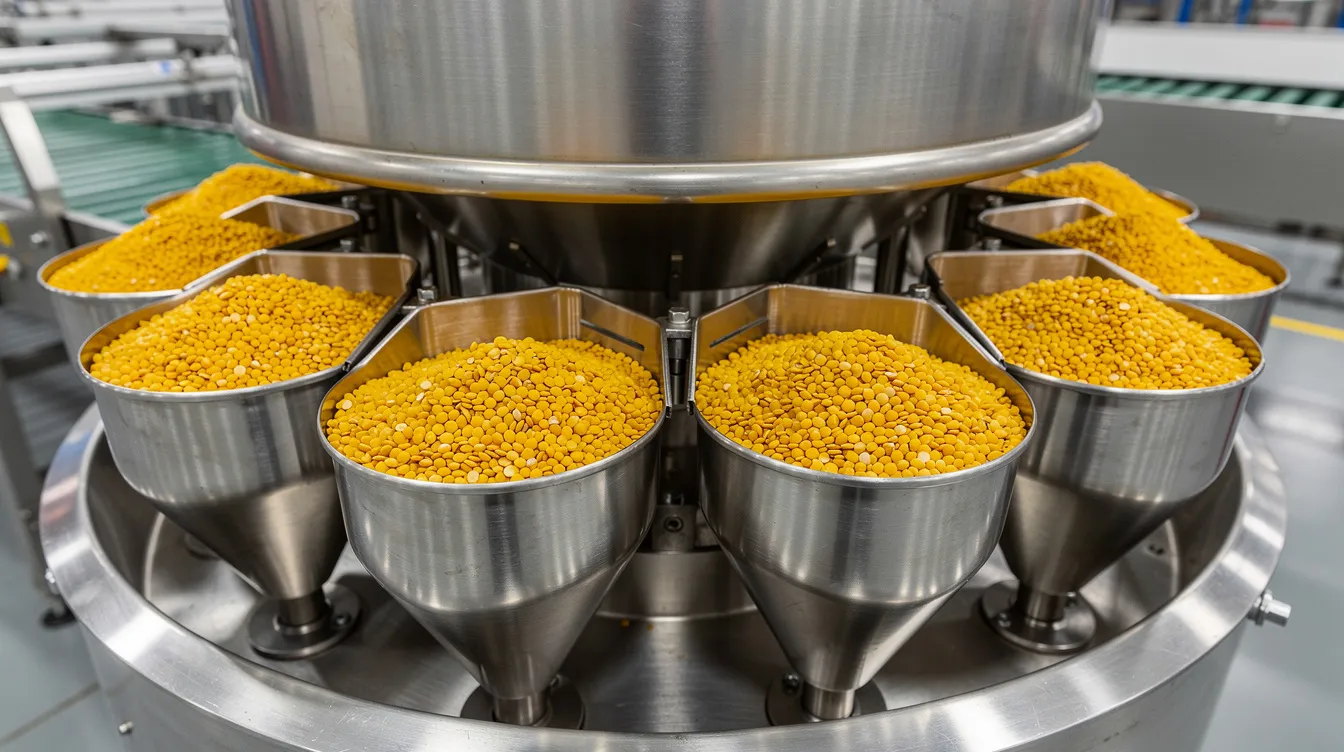
Types of Automatic Pulse Packing Machinery in India
Machinery selection ranges from low-cost semi automatic weighing and sealing units to high-speed VFFS lines with multihead weighers and integrated carton-packing systems. A variety of industries use automatic pulse packing machinery for diverse applications, including pulses, grains, granules, dry fruits, sugar, salt, tea, coffee, powders and even pharmaceuticals. The same collar-type VFFS platform is often adapted as a spices packing machine or rice packaging machine by adjusting the forming tube and weigher calibration.
- Semi automatic weighing and sealing machines: operator places pouch, triggers fill; 8 to 18 packs per minute; suitable for small MSME starters and kirana-focused brands.
- Collar-type fully automatic VFFS packing machine: forms pouch from roll stock, fills and seals continuously; 40 to 80+ packs per minute for retail dal sizes.
- Linear weigher based packing machines (2 to 4 head weigher): moderate speed (20 to 40 pouches per minute for 500 g to 1 kg packs); lower cost than multihead systems.
- Fully automatic multi head weigher VFFS machines (10 to 14+ heads): 60 to 150+ packs per minute depending on model and pack size; designed for large brands and export.
- Premade pouch filling and sealing machines: uses ready-made stand-up or zipper pouches; 10 to 40 packs per minute; suitable for premium branding and small-batch SKUs.
- Bulk bag (10 to 50 kg) filling and bag sewing machines: a few bags per minute; used by institutional suppliers and raw dal wholesalers.
- Integrated primary and secondary packaging lines: pouch packing followed by automatic carton packing and palletising.
Commercial machines can pack products such as pulses, grains and dried foods efficiently. Pulses packing machines are also suitable for packing grains and granules across different food categories.
| Machine Type | Operating Principle | Speed (packs/min) | Typical Pack Sizes | Automation Level | Business Scale |
|---|---|---|---|---|---|
| Semi automatic weighing + sealing | Operator-assisted fill and seal | 8-18 | 50 g to 1 kg | Semi automatic | Small starters, job-work |
| Collar-type VFFS | Roll-stock pouch forming, fill, seal | 40-80+ | 100 g to 5 kg | Fully automatic | Medium brands, private label |
| Linear weigher + VFFS | 2-4 head weigher, moderate accuracy | 20-40 | 500 g to 2 kg | Fully automatic | Growing brands |
| Multi head weigher VFFS | 10-14+ heads, high accuracy | 60-150+ | 100 g to 5 kg | Fully automatic | Large brands, export, modern trade |
| Premade pouch filler | Pre-made pouches, fill and seal | 10-40 | Stand-up, zipper | Semi or fully automatic | Premium branding |
| Bulk bag filling + sewing | Weigh, fill sack, sew | 2-5 bags | 10-50 kg | Semi or fully automatic | Wholesale, institutional |
Indicative Indian price bands (2025-2026, non-branded estimates): semi automatic units from approximately ₹1.45 lakh; fully automatic multihead weigher VFFS lines up to ₹25 lakh or more depending on configuration. Always obtain current quotations before finalising; latest price product details change with motor specifications, head weigher count and FFS film compatibility.
Pulse Packaging Formats and Pack Sizes
Pack sizes must reflect target market and distribution strategy. Under the Legal Metrology (Packaged Commodities) Rules, 2011, standard pre-packed quantities for pulses include 100 g, 200 g, 500 g, 1 kg, 2 kg, 5 kg and multiples of 5 kg thereafter.
- Standard Indian retail: 500 g and 1 kg pouches dominate kirana and modern trade shelves. Family packs: 2 kg and 5 kg for value-conscious customers. Institutional and HoReCa: 10 kg and 25 kg. Wholesale: 50 kg HDPE or PP woven bags.
- Pouch styles: pillow pouches (lowest cost per unit, highest speed), gusseted pouches (better shelf standing), stand-up pouches with zipper closure (premium positioning and resealability), laminated BOPP/PE pouches and paper-poly laminates.
- Cost versus shelf appeal: a basic pillow pouch in BOPP/PE laminate costs less per kg of product than a premium matt-finish stand-up pouch with zipper, but the latter commands higher retail price and brand recall.
- Barrier properties: moisture, oxygen and light barrier performance of the laminate affects shelf life. Automated pulse packing machines extend shelf life by removing oxygen from packages during the form-fill-seal cycle (gas flushing with nitrogen is an optional feature). Machines can seal bags up to 500 microns in thickness, accommodating both standard and heavy-duty laminates.
- Label compliance: FSSAI licence number, net quantity, MRP, month and year of packing, and manufacturer details must fit within the chosen pouch dimensions, alongside transparent windows for product visibility and branding area.
Machinery Specifications, Capacity and Selection Criteria
In DPRs and bankable project reports, the inputs that drive financial projections are packing speed (packs per minute), achievable capacity (kg per hour), weighing accuracy and changeover time between SKUs.
- Weighing system: cup fillers offer lowest cost but limited accuracy; linear weighers (2 to 4 heads) provide moderate precision; multi head weighers (10 to 14 heads) deliver accuracy within ±1% of target weight. PLC control is standard in modern packing machines for precision in dosing.
- Speed ranges: automatic pulses packing machines can produce 2,000 to 2,500 pouches per hour. Machines can operate at speeds of 16 to 50 pouches per minute depending on configuration and pack size. Filling speed of automatic dal packing machines is 2,000 to 2,500 pouches per hour.
- Machine power and utilities: connected electrical load typically ranges from 3 kW (small units) to 8+ kW (multihead VFFS lines), requiring three-phase supply. Compressed air at 6 to 8 bar is needed for pneumatic sealing and actuators.
- Machine weight and dimensions: dal packing machines typically weigh around 400 kg, with a width and length footprint of approximately 1,500 mm by 1,200 mm (varies by model and origin of manufacture; confirm with supplier for floor-loading and mezzanine planning).
- Compatible materials: most VFFS machines accept laminated roll stock in widths from 180 mm to 520 mm. Premade-pouch machines handle stand-up pouches of defined dimensions.
Worked capacity example: a machine running at 40 pouches per minute of 1 kg toor dal produces 40 kg per minute, or 2,400 kg per hour. Over an 8-hour shift at 70% utilisation (accounting for changeover, cleaning and minor stoppages), practical output is approximately 13.4 tonnes per day. Adjust this downward for a unit running only one shift with SKU changeovers. For capacity, land and building planning, refer to Pulse Cleaning and Packing Plant Capacity, Land, Building and Layout Requirements.
Changeover between SKUs (for example, switching from 500 g chana dal to 1 kg toor dal packing machine format) requires adjusting forming tubes, recalibrating the weigher and loading new packaging film. On machines with quick-change tooling, this takes 15 to 30 minutes; on basic machines, downtime can exceed an hour. Spares availability, delivery time for replacement sealing jaws, local service support in India and AMC cost should be verified before placing an order. A request callback to multiple suppliers and a request for their product brochure are standard steps during the quotation stage; always get best quote from at least three manufacturers.
Automatic Pulse Packing Process Flow
The packing sequence follows a defined path:
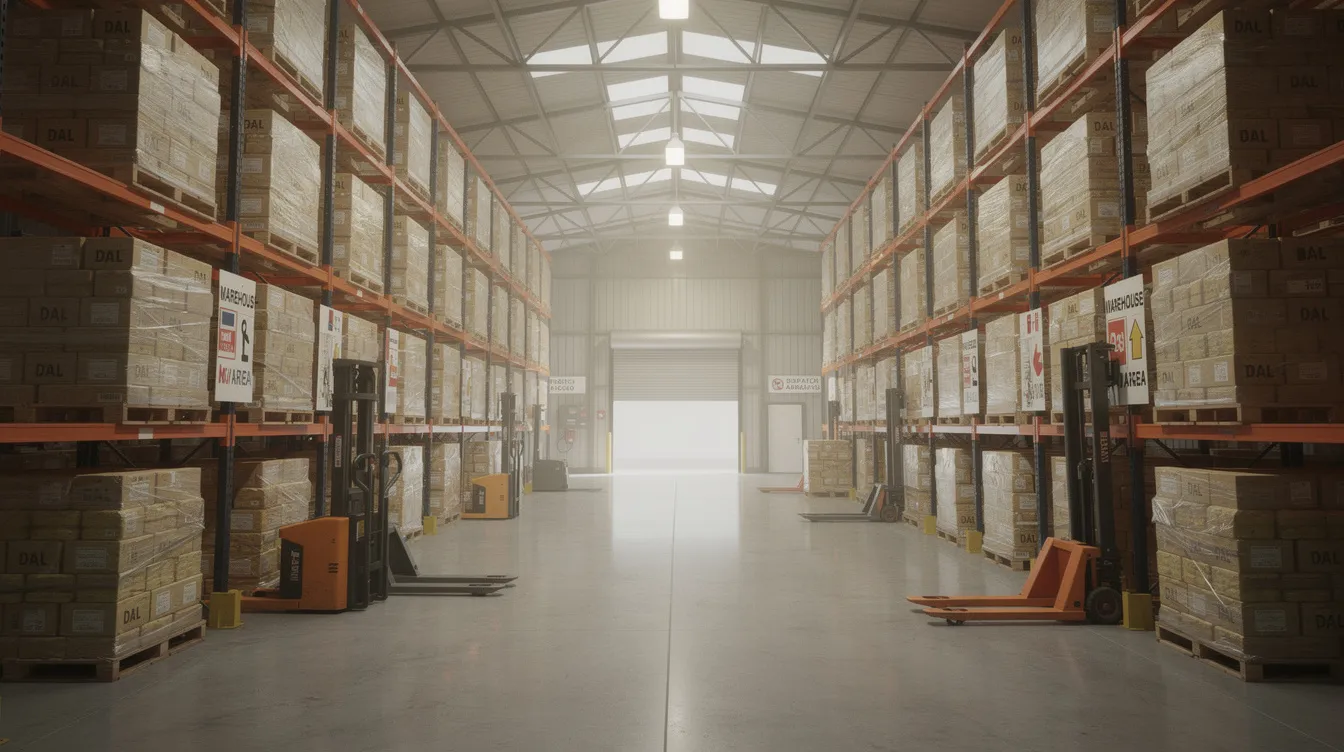
Cleaned and Graded Pulses → Intermediate Storage Hoppers → Vibratory Feeding → Automatic Weighing (Multi Head Weigher or Linear Weigher) → Pouch Forming (VFFS) or Pouch Feeding (Premade) → Filling → Sealing → Batch Coding (Inkjet/Thermal) → Metal Detection / Checkweighing → Secondary Packing (Corrugated Cartons or HDPE Outer Bags) → Finished Goods Warehouse → Dispatch
Cleaned and graded pulses are transferred from upstream processing (bucket elevators, screw conveyors) into buffer hoppers above the packing machine. Vibratory feeders and level sensors control product flow to the weigher. Dust extraction systems maintain hygiene and prevent accumulation on sealing surfaces. For the complete upstream process, see Pulse Cleaning, Grading, Sorting and Packing Process Flow.
Quality-control checks include weight sampling (every nth pouch on a separate checkweigher), seal-strength tests, drop tests and visual inspection of seal integrity. Batch coding with date, shift and lot number creates traceability records required for FSSAI compliance and modern-trade audits.
Automatic Pulse Packing Plant Setup Cost and Investment Framework
Precise figures depend on supplier quotations and project scope. The following framework covers major cost heads for a small to medium automatic packing unit as of 2025-2026.
- Packing machinery: automatic pulses packing machines cost around ₹3,10,000 for basic models. Prices for automatic packing machines range from ₹2,25,000 to ₹18,00,000 depending on automation grade, head weigher count, and throughput. High-capacity multihead VFFS lines with conveyors can cost ₹15 to 25 lakh. Automatic packing machines can handle filling capacities from 10 gms to 1000 gms. Automatic packing machines are suitable for various grains and pulses.
- Feeding equipment, conveyors, bucket elevators and intermediate hoppers: ₹2 to 5 lakh depending on height and material of construction.
- Compressors, metal detector, checkweigher, labellers: ₹2 to 6 lakh.
- Electricals, control panels, wiring, earthing and power backup: ₹1 to 3 lakh.
- Factory building modifications, RCC platform, mezzanine: 10 to 20% of machinery cost (often underestimated).
- Initial packing material inventory (printed roll stock, premade pouches, cartons): ₹2 to 5 lakh (depends on minimum order quantities from printers).
- Testing, QA and basic laboratory equipment: ₹0.5 to 1.5 lakh.
- Branding and packaging design (logo, pouch artwork, printing cylinders or digital plates): ₹0.5 to 2 lakh.
- Pre-operative expenses (DPR preparation, interest during construction, statutory fees): ₹1 to 3 lakh.
- Contingency provision: 5 to 10% of plant and machinery plus civil costs.
- Working capital margin: first operating cycle (raw material, packaging, receivables).
Under the CLCSS (Credit Linked Capital Subsidy Scheme), a 15% subsidy may be available for eligible form-fill-seal and weighing line investments in the ₹12 to 60 lakh range. For integrated plant cost breakdowns, see Pulse Cleaning, Grading and Packing Plant Setup Cost and Investment.
Branded Pulse Packing Business Models in India
Machine selection cannot be isolated from business strategy. Different models create different capital, marketing and working capital demands.
- Own-brand packaging of purchased cleaned pulses: a trader buys cleaned dal and packs under a registered brand. Lower capex (no cleaning/grading line), but full exposure to raw-material price volatility, branding costs and distribution channel margins. Semi automatic or linear weigher packing is often sufficient initially.
- Fully integrated plant (cleaning, grading, colour sorting and packing): higher capex, but better control over quality, certification and cost. Suitable for promoters targeting modern trade and export simultaneously.
- Contract or job-work pulse packing: the client supplies raw material and sometimes packaging film; the packer provides labour, machine and facilities. Lower raw-material risk, lower margin. A stepping stone for first-time entrepreneurs. Details in the Pulse Cleaning, Grading and Packing Job-Work Business Model and Project Report.
- Private-label for retail chains and e-commerce: demands speed, packaging consistency, barcode compliance and minimum order quantities. Fully automatic VFFS with multihead weigher is usually required.
- Institutional and HoReCa bulk packing: 10 to 50 kg sacks; lower packaging cost per kg but thin margins and high freight. Semi automatic bag-filling and sewing machines are adequate.
- Export-oriented packing: requires higher-barrier packaging, modified atmosphere options, ISO/HACCP certification and full traceability. Higher capex and working capital, but better margin per kg. See Export-Grade Pulse Cleaning, Colour Sorting and Packing Plant Project Report for export-specific project planning.
Branded Pulse Packing Business Profitability and Cost Structure
Profitability depends on raw pulse procurement cycles, competition from national brands, retailer margins, freight and marketing spend. No fixed-margin formula exists.
Major cost components per kg of branded dal:
- Raw pulses procurement: largest single cost (₹70 to ₹100+/kg depending on pulse type and season). Processing losses of 1 to 3% for cleaned pulses add to effective cost.
- Packaging material: ₹5 to ₹12/kg depending on pouch type and laminate quality.
- Direct and indirect labour: ₹3 to ₹6/kg at small to medium scale.
- Power, compressed air, consumables and maintenance: ₹1 to ₹3/kg.
- Freight, distribution and secondary packaging: ₹3 to ₹6/kg.
- Trade margins (distributor + retailer): ₹10 to ₹18/kg in modern trade; e-commerce commissions of 10 to 20%.
- Marketing, sampling, promotional schemes: variable; often underbudgeted.
Illustrative per-kg contribution (example only, not a guaranteed outcome): if branded toor dal retails at ₹130/kg in a Tier-2 city and the manufacturer’s realisation after trade margins is ₹110/kg, and total variable costs (raw material + packaging + labour + power + distribution) are approximately ₹98/kg, the contribution margin is ₹12/kg or roughly 9 to 10%. EBITDA after fixed costs (rent, salaries, AMC, insurance) will be lower. Break-even volume depends on fixed-cost base and capacity utilisation. For feasibility, ROI and IRR analysis of integrated projects, see Pulse Cleaning and Sorting Plant Feasibility Study, ROI, IRR and Bank Finance.
Working Capital Requirements for Pulse Packing Units
Working capital for a dal packaging machine project covers inventory of raw pulses, printed packaging material, finished goods, receivables, minus supplier credit.
- Raw pulses stock: 15 to 45 days of consumption, depending on procurement strategy and price volatility hedging.
- Packaging material: printed rolls and premade pouches often have minimum order quantities of 500 to 1,000 kg per SKU; carton stock adds further inventory.
- Finished goods: 5 to 15 days of production, depending on dispatch frequency.
- Receivables: modern trade typically demands 30 to 60 days credit; distributors may require 15 to 30 days; institutional buyers often pay against delivery or with 7-day terms.
- Supplier credit: raw-pulse suppliers may offer 7 to 15 days credit; packaging printers often require advance or cash on delivery for initial orders.
Contract packing units carry less working capital because the client provides raw material; the packer’s inventory exposure is limited to packaging consumables and labour receivables. Own-brand units face full raw-material and debtor risk.
Bank cash credit facilities are assessed based on drawing power calculated from stock and book debts, with typical margins of 25% on stock and 40% on receivables. Properly prepared CMA Data is essential for both term-loan and cash-credit proposals. Detailed treatment is available in Pulse Cleaning and Grading Plant Working Capital and Cash Credit Requirements.
Financial Projections, ROI, IRR and Bank Finance for Automatic Pulse Packing Projects
For term-loan appraisal, banks evaluate 5 to 7 year financial projections, DSCR (Debt Service Coverage Ratio), projected balance sheets and a realistic capacity utilisation ramp-up.
- Key projection assumptions: selling prices by SKU, raw-material costs by pulse type, capacity utilisation increasing from perhaps 50% in Year 1 to 75-80% by Year 3, credit terms by channel, interest rates and loan tenure.
- DSCR must demonstrate that annual cash available for debt servicing exceeds principal plus interest obligations. Most Indian banks expect DSCR above 1.25 to 1.50 for food-processing projects.
- ROI and IRR for pulse packing machinery investments are affected by brand-building expenditure in early years; short-term profitability may be compressed while distribution networks develop.
- Sensitivity analysis (for example, a 5% increase in raw-material prices or a 15% shortfall in utilisation) can materially alter IRR and payback period.
- Banks typically expect 25 to 35% promoter contribution (equity) for MSME packing projects; a debt-equity ratio of 1.5:1 to 2:1 is common.
A financial model that distinguishes machine-rated capacity from actual market demand is far more credible than one that assumes 90% utilisation from the first month. For detailed projection methodology, see Pulse Cleaning and Packing Plant Financial Projections, CMA Data and DSCR.
Licences, Registration and Compliance for Pulse Packaging in India
Requirements vary by scale, location and nature of operations. Verify with updated government notifications and professional advisors.
- FSSAI registration or licence: mandatory for food business operators packing pulses. Central licence applies above specified turnover and capacity thresholds; state licence or basic registration applies for smaller units.
- GST registration: mandatory for inter-state supply, e-commerce selling or where turnover exceeds the threshold applicable in the relevant state.
- Legal Metrology (Packaged Commodities) Rules, 2011: pre-packed pulses must carry net quantity declaration (in grams or kilograms), MRP, month and year of packing, and name and address of manufacturer or packer.
- FSSAI Packaging and Labelling Regulations: material safety for food-contact packaging, labelling declarations and recent amendments covering recycled plastics.
- Trademark registration: protect the brand name and logo before printing large quantities of packaging film.
- Other: factory or shop and establishment registration, pollution control NOC (for integrated plants), export registrations (IEC code) where applicable.
Common Investment Mistakes in Automatic Pulse Packing Projects
- Buying an oversized multi head weigher machine based only on supplier-quoted speed, without confirmed sales volume or distribution agreements to absorb the output.
- Selecting a pouch packing machine solely on lowest price without checking after-sales service network, spares availability in India and downtime impact on production and bank instalment servicing.
- Ignoring compatibility of packaging films with sealing jaws and not running pack-drop tests or seal-strength tests before placing large orders of printed rolls manufactured to specific film structure.
- Underestimating branding and working capital needs: promoters budget for machinery but not for distributor margins, BTL promotions, product videos, trade schemes and 30-60 day credit to modern trade and interested retail customers.
- Preparing financial projections designed to “fit” the desired loan amount instead of reflecting realistic ramp-up, seasonal demand patterns and delta between rated and achievable capacity.
How a Professional DPR Supports Investment Decisions
Project Report Bank is a professional project-finance advisory platform led by CA Manish Gugliya, not a machinery supplier or a leading manufacturer or exporter of equipment.
- A DPR compares alternative machine configurations (semi automatic vs fully automatic, linear vs multi head weigher) and quantifies their impact on production capacity, project cost and profitability.
- Project cost is structured across land, building, plant and machinery, utilities, pre-operative expenses and working capital to present a bankable means-of-finance plan.
- Technical assumptions (packs per minute, shifts, utilisation) are integrated with commercial assumptions (selling prices, margins, credit periods) to create defensible projections rather than optimistic numbers.
- CMA Data for term loan and cash credit, DSCR working, and loan repayment schedule are critical outputs used by banks during appraisal.
- A professional DPR improves the quality of decision-making and loan proposals. It does not guarantee sanction; bank appraisal and promoter credentials remain determining factors.
Frequently Asked Questions on Automatic Pulse Packing Machinery and Branded Dal Business
The following FAQs address the most common queries from entrepreneurs evaluating automatic pulse packing investments.
What capacity automatic pulse packing machine is suitable for a 1 to 2 tonne per day branded dal unit?
For 1 tonne per day of 1 kg packs over an 8-hour shift, you need approximately 1,000 pouches in 480 minutes, which is about 2.1 pouches per minute at 100% utilisation. At 70% utilisation, you would need a machine rated at approximately 3 pouches per minute. This is well within the range of even a basic semi automatic unit. A 2-tonne target at the same shift length and utilisation requires approximately 6 pouches per minute. A linear weigher based VFFS machine rated at 20 to 40 pouches per minute provides ample headroom for growth without purchasing an oversized multihead system. Multi head weigher VFFS becomes justified when daily output targets exceed 5 to 8 tonnes or when high accuracy across multiple SKUs is required.
Is a fully automatic multi head weigher mandatory to start a branded pulses business?
Not for initial volumes. A 2 to 4 head linear weigher or even a semi automatic cup-filler and sealing machine can handle early-stage branded dal packing at 8 to 30 pouches per minute. The trade-off is higher labour cost per pouch and lower weighing precision. Upgrading to a multi head weigher becomes justified when production exceeds the point where labour cost and weighing errors (over-fills and giveaway) exceed the annualised cost of the equipment upgrade.
How much working capital is typically required for a small automatic dal packing unit?
Working capital depends on the operating cycle. An own-brand unit holding 30 days of raw-pulse inventory, 15 days of packaging stock, 10 days of finished goods and offering 30 days of credit to distributors needs working capital equivalent to roughly 2 to 3 months of variable operating costs. Contract packing units require less because the client supplies raw material. Bank cash credit requires properly prepared CMA Data showing stock statements, drawing-power calculations and receivable ageing.
Can I start with job-work pulse packing before creating my own brand?
Job-work packing carries lower marketing spend and less raw-material inventory exposure. Margins are typically lower (a service fee per kg or per pouch rather than a product margin). The model works as a stepping stone: you build operational experience, understand machine pulses throughput and quote approx per-unit costs before committing to own-brand distribution and the associated working capital and marketing investment.
What support does Project Report Bank provide for automatic pulse packing projects?
Project Report Bank provides customised DPR preparation, financial projections, CMA Data for bank loans, project feasibility studies, loan proposal assistance and investor-ready documentation for automatic pulse packing and integrated pulse processing projects. Services are delivered under the professional oversight of CA Manish Gugliya. The platform does not sell machinery or create generic templates; each engagement is based on project-specific assumptions and commercially relevant analysis.
Conclusion and Professional Advisory
Selecting the right automatic pulse packing machine requires matching equipment capacity to realistic sales volume. An appropriately sized packing line, paired with a considered packaging format and a distribution strategy that reflects actual market reach, forms the foundation of a viable branded dal business.
Decisions on machinery, capacity, packaging and branding should be grounded in a professional financial model that tests assumptions under different scenarios. A DPR is not just a document for a bank; it is a tool for evaluating whether the project makes commercial sense before capital is committed.
CA Manish Gugliya | Manish Gugliya and Company
Professional assistance is available for Detailed Project Reports (DPR), CMA Data preparation, financial projections, project feasibility and bank finance proposal assistance for automatic pulse packing and integrated pulse processing projects.
Website: www.projectreportbank.com
Enquiries: Contact through the website’s WhatsApp facility.