
Pulse traders, dal mills, Farmer Producer Organisations and branded food companies across India increasingly need specialised facilities to clean, grade, sort and pack pulses before distribution. Instead of investing in their own plants, many prefer to outsource this work to dedicated service providers. This creates a commercially attractive opportunity for entrepreneurs willing to set up a pulse cleaning, grading and packing job-work plant that earns processing-service income without the risk of buying and selling pulses on own account.
This article, written from the professional perspective of CA Manish Gugliya, FCA, DISA (ICAI), examines the business model, project cost structure, machinery requirements, revenue mechanics, operating economics, regulatory compliance and financial projection framework for such a project in India. The scope is limited to cleaning, grading, sorting and packing job-work – not full dal milling, dehusking or splitting, which are covered separately on Project Report Bank.
Key Takeaways
- A pulse cleaning, grading and packing job-work business earns service income by processing customer-owned pulses. The plant does not buy or sell pulses, avoiding commodity price risk and large raw material inventories.
- For a commercial-scale 5 TPH plant including land, building, machinery, utilities, pre-operative expenses and working capital margin, indicative total project cost may range from approximately ₹5 crore to ₹8 crore or more, depending on location, automation level and civil construction specifications.
- Profitability is driven primarily by contracted annual throughput (MT per year), achievable job-work charges per MT, actual plant capacity utilisation and disciplined control over power, labour and maintenance costs. Healthy profit margins for pulses processing typically range between 8–12%.
- Written job-work agreements, customer-wise stock accounting, process-loss reconciliation systems and adequate insurance coverage are essential for operational and legal risk management.
- Promoters should prepare detailed financial projections, CMA Data and a bankable Detailed Project Report before approaching lenders. Project Report Bank, led by CA Manish Gugliya, Chartered Accountant, prepares customised DPRs, feasibility studies, financial models and CMA Data for pulse processing job-work projects across India.
Introduction: Why Pulse Cleaning, Grading & Packing Job-Work Is Attractive
The global pulses market was valued at USD 103.25 billion in 2025, and the pulses processing market is expected to reach USD 140.23 billion by 2034. India, one of the largest producers and consumers of pulses, accounts for a substantial share of this demand. As agriculture produces increasingly large volumes of crops like chana, tur, urad, masoor and moong, the need for efficient post-harvest cleaning, grading and packing has grown sharply.
Pulse cleaning involves preparing legumes from raw material into clean products ready for consumption, distribution or further processing. Traditionally, traders and dal mills managed this in-house. However, rising quality expectations from retail brands, exporters and institutional buyers, combined with the capital required for modern cleaning and sorting equipment, have created strong demand for outsourced processing services. Pulse jobs are critical for food supply chain efficiency and quality assurance, and dedicated job-work plants are well positioned to fill this gap.
A job-work model allows the plant operator to earn stable processing income without committing capital to purchase raw pulses. The customer retains ownership of the material throughout. This distinction fundamentally changes the risk profile, working capital requirement and financial structure of the business compared to an own-stock dal milling or pulse trading operation.
This article focuses on the commercial, financial and practical aspects of establishing a pulse cleaning, grading and packing job-work plant in India in 2026, providing the kind of financial analysis and project planning guidance that serious promoters and bankers expect to see before committing investment.
Understanding the Pulse Cleaning, Grading & Packing Job-Work Business Model
In Indian industry practice and under GST law, job-work refers to a processing arrangement where the principal (customer) supplies raw materials and the job-worker performs specified operations, returning the processed output. The job-worker charges a service fee but does not take ownership of the goods at any point.
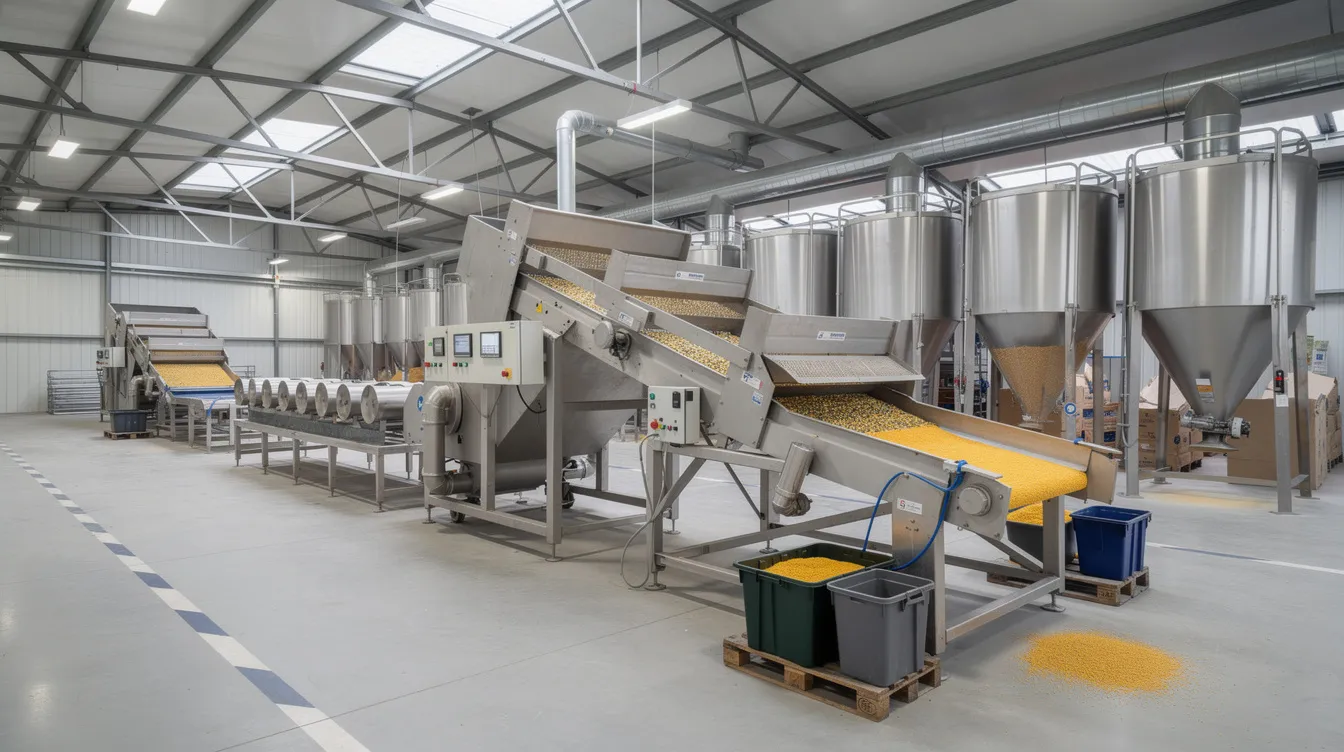
For a pulse cleaning, grading and packing plant operating on a job-work basis, the customer – whether a pulse trader, dal mill, FPO, cooperative, exporter or brand owner – delivers raw uncleaned pulses to the plant. The plant processes them through various unit operations such as pre-cleaning, destoning, size grading, aspiration, optional optical colour sorting and packing, then returns the cleaned and graded output along with rejects and by-products.
The typical workflow is:
- Receipt of raw pulses with gate entry, truck weighment and sampling
- Unloading into designated customer-wise storage bays
- Pre-cleaning and fine cleaning to remove dust, chaff and light debris
- Destoning to separate stones and heavy foreign materials
- Size grading through adjustable sieves or screening machines
- Optional gravity separation and optical colour sorting for premium grades
- Final weighment and quality check
- Packing into specified bag sizes (bulk or retail) with labelling
- Stock reconciliation – input weight versus output weight plus documented process loss
- Dispatch and job-work invoice generation
Job-work charges are usually quoted per kg, per quintal or per MT and vary depending on the scope of services. A basic cleaning charge will be lower than a comprehensive service that includes grading, colour sorting and retail packing.
Promoters must design robust systems for customer-wise stock accounting, batch identification, process loss tracking and weight reconciliation. Without these, disputes over shortages and quality become inevitable. The own-stock vs job-work dal milling comparison on Project Report Bank provides a deeper analysis of how these models differ when full dal milling operations are involved.
Comparison: Job-Work Cleaning Plant vs Own-Stock Pulse Processing
The commercial logic of a job-work-only plant is fundamentally different from an own-stock model where the processor buys raw pulses, processes them and sells finished products.
In own-stock pulse processing, raw uncleaned pulses account for 88–92% of operating expenses. The processor bears the entire commodity price risk, must fund large inventories, manage sales and marketing, and accept receivable risk from buyers. The potential upside is higher revenue per MT, but the capital requirement and working capital intensity are substantially greater.
In contrast, a job-work cleaning plant primarily funds its own fixed overheads – power, wages, maintenance and depreciation – plus receivables from service invoices. The risk shifts from commodity markets to operational efficiency and customer retention.
| Parameter | Job-Work Cleaning Plant | Own-Stock Pulse Processing |
|---|---|---|
| Investment in raw material | Nil (customer-owned) | Very high (80–92% of opex) |
| Working capital intensity | Low to moderate | High |
| Revenue per MT | Lower (service charge only) | Higher (product sale value) |
| Commodity price risk | Nil | Significant |
| Marketing and sales effort | Minimal (B2B service) | Substantial |
| Dependence on anchor customers | High | Moderate |
| Typical margin drivers | Utilisation, cost control | Purchase-sale spread, yield |
| Inventory and spoilage risk | Minimal | Significant |
Neither model is inherently superior. The right choice depends on the promoter’s capital, risk appetite, market access and operational expertise. Many businesses start with pure job-work to establish operational capability, then gradually add own-stock trading or processing as a secondary income stream.
Market Opportunities and Target Customers for Job-Work Services
Growth in India’s pulses processing industry is driven by several converging factors. Rising consumer preference for branded and packaged pulses, expansion of private label products in modern retail, stricter food safety expectations from institutional buyers, and increasing exports of cleaned and graded pulses all create demand for specialised cleaning and packing services.
Pulse processing jobs often involve cyclical work schedules based on harvest seasons. Tur and chana arrive in large volumes during rabi harvesting (February–April), while urad and moong peak during kharif (September–November). A well-located plant can handle steady volumes through the year if it serves customers dealing in multiple pulse types and maintains adequate storage.
Typical target customers include:
- Pulse traders operating in major mandis (Indore, Ujjain, Nagpur, Jaipur, Hyderabad, Gulbarga)
- Medium and large dal mills needing pre-cleaned input for their dehusking and splitting lines
- Farmer Producer Organisations and cooperatives aggregating pulses from farmers in the pulse belts of Madhya Pradesh, Rajasthan, Maharashtra, Karnataka and Telangana
- Exporters requiring export-grade cleaned and sorted pulses meeting international buyer specifications
- Private-label brands and institutional packers needing consistent quality retail packs
- Wholesalers supplying cleaned pulses to food service, hotels and government procurement agencies
To make a 5 TPH plant viable, anchor contracts of 10,000–20,000 MT per year are often needed. Without committed volumes, the plant risks idle capacity and fixed costs that cannot be recovered.
Location matters. Proximity to raw material supply, APMC markets, railheads and highway corridors reduces inbound and outbound logistics cost for customers. A plant in central Madhya Pradesh, for example, can serve the Indore–Ujjain trading cluster while drawing raw material from surrounding pulse-growing districts. Similarly, a facility near Latur or Nagpur in Maharashtra can access both domestic and export demand channels.
Scope of Services: Cleaning, Grading, Sorting and Packing Only
The core services offered by a pulse cleaning, grading and packing job-work plant are limited to post-harvest processing operations that do not alter the fundamental form of the pulse grain. Cleaning removes impurities like dust and stones from raw pulse lots. Grading sorts pulses by size, shape, color and density to meet quality standards expected by buyers. Packing transfers graded pulses into various packaging formats for distribution.
The typical unit operations include pre-cleaning, fine cleaning, destoning, aspiration (air separation), size grading through multi-sieve screeners, optional gravity separation for density-based sorting, and optical colour sorting for premium output. These are distinct from dehusking, splitting, polishing and dal milling, which involve converting whole pulses into dal and are separate services with different machinery, project cost and market dynamics.
Promoters can offer differentiated service levels to capture different customer segments:
- Basic cleaning only (pre-cleaning and destoning)
- Cleaning plus size grading
- Cleaning, grading and destoning with aspiration
- Premium cleaning with optical colour sorting
- Complete cleaning, sorting and packing in specified bag formats
The project scope chosen will directly influence machinery selection, total project cost, target market and achievable processing charges. A plant configured only for basic cleaning will cost significantly less but will also earn lower charges per MT than one offering optical sorting and retail packing.
Process Flow: From Raw Pulse Receipt to Packed Output
A clear understanding of the material flow helps bankers and investors evaluate the operational logic of the proposed project. The following stages represent a typical process in a pulse cleaning, grading and packing job-work facility:
- Gate entry and weighment: Incoming trucks are weighed on a weighbridge. Customer identity, pulse type and lot number are recorded.
- Sampling and inspection: Representative samples are drawn to assess incoming quality – moisture, foreign matter percentage, damaged grains.
- Unloading and storage: Raw pulses are unloaded into designated customer-wise storage bays. Proper lot segregation prevents stock mixing.
- Pre-cleaning: Removal of large debris, chaff, loose husks, string and other coarse impurities through scalpers and pre-cleaners.
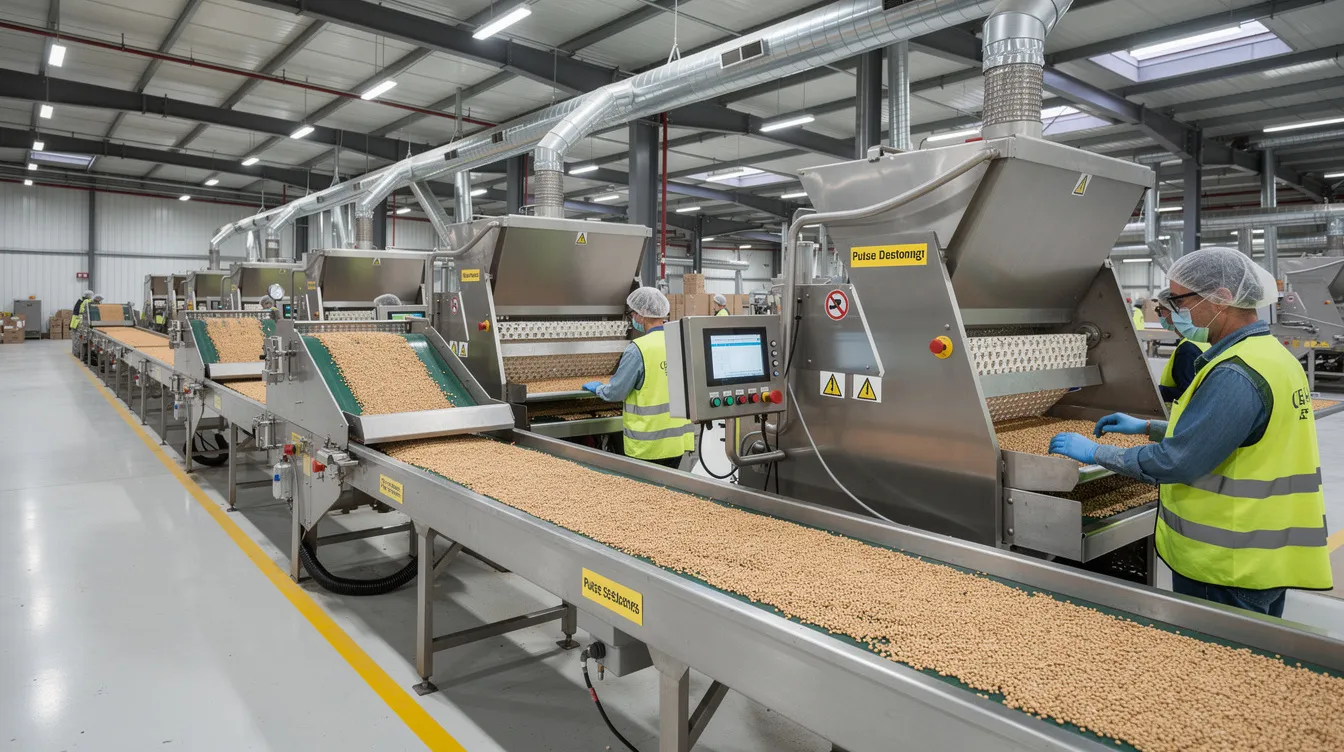
- Fine cleaning and aspiration: Pulses cleaning machines remove impurities from various pulses using advanced aspiration and screening technology, separating lighter foreign materials by air flow.
- Destoning: Vibratory destoners remove stones and heavy particles. Adjustable air flow and deck inclination allow calibration for different pulse types.
- Size grading: Multi-sieve graders separate pulses into size fractions. Sieve changes accommodate different pulses – from small masoor to large kabuli chana.
- Optional gravity separation: Separates immature, hollow or shrivelled grains based on density differences.
- Optional optical colour sorting: Camera-based sorters detect and reject discoloured, damaged or foreign grains at high speed.
- Metal detection (if required): Inline metal detectors identify ferrous and non-ferrous contaminants before packing.
- Weighment and packing: Cleaned and graded pulses are weighed and packed into bags of specified weight – 25 kg, 50 kg bulk bags or retail pouches of 500 g, 1 kg, 2 kg or 5 kg.
- Labelling and sealing: Bags are stitched, sealed or heat-sealed and labelled with customer branding, batch details and statutory information.
- Stock reconciliation: Total output weight plus documented rejects and process loss are reconciled against input weight. Discrepancies are investigated.
- Dispatch: Finished packed goods are loaded, weighed out and dispatched with a delivery challan. A job-work invoice is raised.
Customer-wise identification through tags, batch numbers or barcodes must be maintained at every stage. This is not merely good practice – it is essential for contractual accountability and dispute avoidance.
Plant Capacity Planning for Job-Work Pulse Processing
Production capacity planning is one of the most consequential decisions in a pulse cleaning, grading and packing project. Pulses processing plants can have an annual capacity of 50,000 MT or more at the higher end, but most MSME and mid-sized promoters evaluate facilities in the 2 TPH to 10 TPH range.
Plant capacity refers to the rated input throughput in tonnes per hour (TPH) of raw pulses. However, effective throughput is always lower than nameplate machine capacity due to planned downtime, changeovers between customers or pulse types, cleaning and maintenance breaks, and variations in raw material quality.
The following table illustrates how installed capacity translates into estimated annual throughput under realistic operating assumptions:
| Parameter | 2 TPH Plant | 5 TPH Plant | 10 TPH Plant |
|---|---|---|---|
| Installed capacity (TPH) | 2 | 5 | 10 |
| Operating hours per day | 16 | 16 | 16 |
| Operating days per year | 300 | 300 | 300 |
| Nameplate annual capacity (MT) | 9,600 | 24,000 | 48,000 |
| Assumed utilisation (%) | 65% | 65% | 65% |
| Effective annual throughput (MT) | 6,240 | 15,600 | 31,200 |
| Process loss at 5% (MT) | 312 | 780 | 1,560 |
| Net packed output (approx. MT) | 5,928 | 14,820 | 29,640 |
Utilisation of 65% is a reasonable assumption for a plant that has secured moderate anchor contracts but is still building its customer base. Higher utilisation (75–80%) is achievable with strong contracted volumes but should not be assumed in initial projections without supporting evidence.
Over-investing in capacity that remains underutilised is one of the most common causes of financial stress in processing businesses. The required capacity should be determined from realistic contracted volumes, not from an aspiration to have the largest plant in the region. Equally, an undersized plant may miss lucrative long-term contracts from large traders or exporters. The proposed processing facility should be sized to match verifiable demand, with room for phased expansion.
Selection of Pulses Processing Machinery and Equipment
Pulses processing machines are essential for cleaning, grading and milling operations, and they improve operational efficiency and product quality compared to manual methods. While many components overlap with a standard integrated multi-pulse cleaning, grading and packing plant, the configuration for a job-work facility must emphasise flexibility and quick changeovers between different pulse types and customer specifications.
Critical machinery includes:
- Pre-cleaners and scalpers: For initial removal of coarse impurities. Capacity must match or exceed downstream throughput.
- Vibratory destoners: For separating stones and heavy foreign matter. A 2 TPH destoner costs approximately ₹1.18 lakh, while a 4 TPH model from Cleanx Agro is priced around ₹3.25 lakh.
- Multi-sieve size graders: Adjustable sieve sets to handle different pulse sizes, from small masoor to large chickpeas.
- Aspiration systems: Air-separation units for removing light impurities and dust.
- Gravity separators (optional): For density-based sorting of mature versus immature grains.
- Optical colour sorters (optional but increasingly expected): For removing discoloured, damaged or foreign grains. Detailed guidance on colour sorter, grading and packaging machinery is available on Project Report Bank.
- Bucket elevators and conveyors: For material handling between process stages.
- Dust collection and extraction systems: Dust extraction systems are used to manage high dust levels during processing and are essential for worker safety and product quality.
- Weighing and bagging equipment: Semi-automatic or automatic bagging machines for bulk bags; vertical form-fill-seal machines for retail pouches.
- Stitching, sealing and labelling machines: For bag closure and statutory labelling.
- Electrical panels and motor control centres: Centralised power distribution.
Pulses cleaning machines utilise advanced aspiration and screening technology. They enhance product quality and market value of pulses, and they are essential in pulse processing plants and food industries. They also improve processing efficiency compared to manual methods.
For a 5 TPH plant, indicative machinery cost (cleaning, grading, sorting, conveyors, dust collection and packing equipment combined) may broadly range from ₹1.8 crore to ₹3.0 crore depending on the machine manufacturer, automation level, stainless steel construction, imported components and whether optical sorting is included. This is an indicative range – actual costs depend on specific quotations and technical specifications.
Key selection criteria include throughput rating, flexibility for different pulses, power consumption per TPH, ease of cleaning and changeover, after-sales support, availability of spares and the supplier’s track record. Gujarat and Maharashtra offer competitive pricing for locally manufactured equipment due to established industrial clusters.
Optional Optical Colour Sorting and Export-Grade Services
Automated sorting machines increase efficiency in pulse processing and are now expected by most export buyers and premium retail brands. Optical colour sorters use RGB or infrared cameras to detect and eject discoloured kernels, glass particles, plastics and foreign grains at speeds of several tonnes per hour.
Adding colour sorting capability increases both capital investment (₹40–120 lakh per unit depending on capacity and detection technology) and operating cost (maintenance, calibration, compressed air, spare parts and skilled operators). However, it also allows the plant to charge significantly higher job-work rates and access premium customer segments.
Typical use cases include removing damaged or discoloured grains from chickpeas, lentils, pigeon peas and other pulses destined for export or branded retail packs. For export-focused projects, promoters should study the export-grade pulse cleaning, colour sorting and packing plant project report to design plant specifications that meet international contamination and quality norms.
Maintenance and calibration of colour sorters require trained technicians. Downtime for calibration can reduce effective throughput. Promoters should factor realistic uptime assumptions – perhaps 85–90% of shifts – when projecting throughput for colour-sorted output.
Land, Building and Infrastructure Requirements
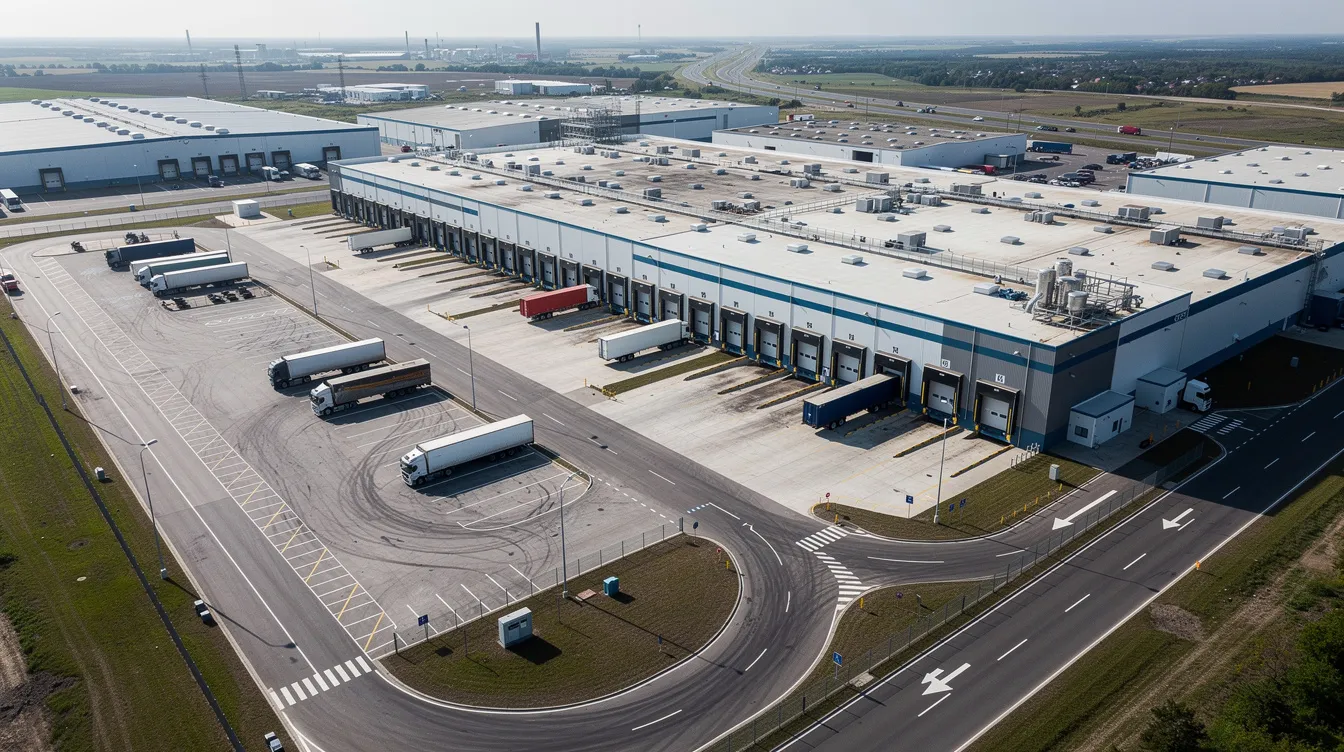
Site selection for a pulse cleaning and grading plant should prioritise proximity to raw material supply, APMC markets, transport corridors and availability of reliable power supply.
Typical land requirements vary by capacity:
| Component | 2 TPH Plant | 5 TPH Plant | 10 TPH Plant |
|---|---|---|---|
| Total plot area (approx.) | 1,500–2,500 sq m | 3,000–5,000 sq m | 5,000–8,000 sq m |
| Covered processing hall | 400–600 sq m | 800–1,200 sq m | 1,500–2,500 sq m |
| Raw material godown | 300–500 sq m | 600–1,000 sq m | 1,000–2,000 sq m |
| Finished goods warehouse | 200–400 sq m | 500–800 sq m | 800–1,500 sq m |
| QC lab, office, amenities | 80–120 sq m | 150–250 sq m | 250–400 sq m |
| Truck movement and loading | Adequate | Adequate | Adequate |
Major building and infrastructure requirements include:
- Industrial shed or RCC structure for the processing hall, with adequate height for bucket elevators and dust collection ducting
- Separate raw material storage and finished goods warehouse sections with customer-wise bay demarcation
- QC laboratory for incoming and outgoing quality checks
- Three-phase power connection with adequate sanctioned load (typically 100–250 kVA for a 5 TPH plant)
- DG backup for uninterrupted operations
- Dust-control and ventilation systems. Workers typically operate in industrial settings like mills and warehouses, so adequate ventilation is both a regulatory and a practical necessity
- Weighbridge access (owned or nearby public)
- Firefighting arrangements and fire-safety NOC
- Staff amenities, washrooms and drinking water
Personal protective equipment is necessary due to handling dust and heavy machinery. PPE procurement, training and compliance should be budgeted from the outset.
Raw Materials, Packaging Inputs and Other Consumables
Under the job-work model, the main raw materials – pulses such as chana, tur, urad, masoor, moong, peas and other edible seeds from leguminous plants – are supplied by customers and are not purchased by the plant. This eliminates the single largest cost component that makes own-stock processing capital-intensive.
For packaging, two approaches are common:
- The customer supplies all bags, labels and packing materials. The plant only fills, seals and dispatches.
- The plant procures packaging on behalf of customers and recovers the cost through the job-work invoice or a separate packing charge.
Common packaging formats include jute bags, HDPE woven bags (25–50 kg for wholesale), retail pouches (500 g, 1 kg, 2 kg, 5 kg) for branded distribution, and bulk PP bags for institutional customers.
Other consumables include stitching thread, label stickers or ink for printing, cleaning cloths, lubricants, minor spares and replacement sieves. While raw material inventory is minimal in this model, promoters must budget realistically for consumable and packing inventory within working capital planning.
Detailed Project Cost: Illustrative Investment Structure
The total investment for a commercial-scale pulse cleaning, grading and packing job-work plant depends on capacity, location, automation, building specification and whether land is purchased or leased. The following is a hypothetical project cost illustration for a 5 TPH plant, labelled as assumptions for planning purposes only.
| Cost Head | Estimated Amount (₹ Lakh) | % of Total |
|---|---|---|
| Land and land development | 80 | 14% |
| Factory building and civil works | 120 | 21% |
| Plant and machinery (installed) | 220 | 38% |
| Electrical installation | 25 | 4% |
| Material handling and utilities | 20 | 3% |
| QC lab and testing equipment | 8 | 1% |
| Office furniture and equipment | 7 | 1% |
| Vehicles (if any) | 15 | 3% |
| Preliminary and pre-operative expenses | 20 | 3% |
| Contingencies | 25 | 4% |
| Sub-total (fixed investment) | 540 | 93% |
| Margin for working capital | 40 | 7% |
| Total project cost | 580 | 100% |
This illustration assumes a total project cost of approximately ₹5.8 crore. Actual figures can vary significantly. In urban or peri-urban locations, land cost alone can be ₹1.5–3 crore. In rural industrial areas, it may be substantially lower. Similarly, plant and machinery cost depends on the machine manufacturer, automation level and whether optical colour sorting is included.
The NABARD case study on pulses processing economics documented small-scale unit machinery costs of approximately ₹8.50 lakh (pre-cleaner, destoner, grader and elevating system) for a much smaller capacity. Commercial-scale plants with 5 TPH throughput and modern automation require proportionately higher investment.
Means of finance for such a project typically comprise promoter contribution (25–35% of project cost) and a term loan from a bank or financial institution for the balance. The exact debt-equity structure should be determined based on the promoter’s resources and the project’s debt-servicing capacity.
Job-Work Processing Charges and Revenue Model
This section explains how a pulse processing job-work business generates its income. Revenue comes entirely from service charges levied on customers for cleaning, grading, sorting and packing their pulses. The plant does not earn any product sale margin.
Charges are typically structured per kg, per quintal (100 kg) or per MT, often with differentiated rates based on the scope of services and committed volume. The following is a hypothetical service and pricing matrix, clearly labelled as illustrative assumptions and not verified market rates:
| Service Level | Description | Illustrative Rate (₹/MT) |
|---|---|---|
| Basic cleaning | Pre-cleaning + destoning only | 600–900 |
| Cleaning + grading | Pre-cleaning + destoning + size grading | 900–1,300 |
| Cleaning + grading + aspiration | Full cleaning with air separation | 1,200–1,600 |
| Cleaning + grading + colour sorting | Adding optical sorting pass | 1,800–2,500 |
| Complete service with packing | Cleaning + grading + sorting + bulk packing | 2,000–3,000 |
| Premium export-grade service | Stringent sorting + retail/export packing | 2,500–3,500 |
Factors that influence achievable job-work charges include quality parameters required by the customer, product mix (difficult-to-clean pulses command higher rates), volume per customer, turnaround time commitments, local competition, plant reputation and the cost of power in the region.
Minimum monthly or annual guaranteed volumes from anchor customers allow slightly lower per-MT rates while still sustaining profitability through high utilisation. Conversely, spot or walk-in customers may be charged premium rates for smaller, non-committed quantities.
Operating Costs and Profitability Illustration
The financial viability of a pulse cleaning, grading and packing job-work plant depends on the relationship between processing volumes, service charges and operating costs. Pulse processing requires significant physical stamina due to labour-intensive tasks, especially at loading, unloading and packing stages, and labour cost is a meaningful component of operating expenses.
The following illustration assumes a 5 TPH plant operating at 65% utilisation with an average blended job-work charge of ₹1,800 per MT:
| Parameter | Annual Figure (₹ Lakh) |
|---|---|
| Effective annual throughput | 15,600 MT |
| Net packed output (after 5% process loss) | 14,820 MT |
| Annual job-work income | 281 |
| Power and fuel | 48 |
| Direct production wages | 36 |
| Staff salaries (supervisory, QC, admin) | 24 |
| Packaging consumables (if supplied by plant) | 18 |
| Repairs and maintenance | 12 |
| Insurance | 5 |
| Administration and miscellaneous | 10 |
| Total operating expenses | 153 |
| EBITDA | 128 |
| Depreciation (approx.) | 38 |
| Interest on term loan (approx.) | 30 |
| Profit before tax | 60 |
| Tax (approx. 25%) | 15 |
| Net profit after tax | 45 |
| Cash accruals (PAT + depreciation) | 83 |
Unit economics per MT processed:
| Metric | ₹ per MT |
|---|---|
| Average job-work income | 1,800 |
| Variable cost per MT (power, wages, consumables) | ~650 |
| Contribution per MT | ~1,150 |
| Break-even throughput (fixed costs / contribution per MT) | ~8,700 MT/year |
Gross profit margins for pulses processing typically range from 8–12%, and this illustration falls within that range at approximately 10.5% net margin on revenue at 65% utilisation.
Scenario comparison at different utilisation levels:
| Scenario | Utilisation | Annual MT | Revenue (₹ L) | EBITDA (₹ L) | Net Profit (₹ L) |
|---|---|---|---|---|---|
| Low | 50% | 12,000 | 216 | 80 | 15 |
| Base | 65% | 15,600 | 281 | 128 | 45 |
| High | 80% | 19,200 | 346 | 172 | 72 |
These are financial projections based on assumed rates and utilisation and cannot be treated as guaranteed returns. The sensitivity of profitability to utilisation is evident – at 50% utilisation, the project barely covers its obligations, while at 80% it generates comfortable surplus for debt servicing and reinvestment.
Working Capital Planning and Customer Stock Management
Although raw materials are customer-owned, the plant still needs working capital for wages, electricity bills, packing materials (if supplied by the plant), maintenance expenses and administrative overheads. Working capital requirement is lower than in own-stock models but is not negligible.
Typical credit-cycle structures in job-work include:
- Advance payment by customers before processing begins
- Partial advance plus 15–30 days credit after dispatch
- Fully post-supply billing with 30–60 days receivable period
Longer collection periods increase working capital needs. Promoters should negotiate favourable payment terms and budget for a receivable cycle of at least 30 days in their financial projections.
Customer-wise stock management requires systematic records:
- Gate entry register and goods receipt notes
- Bin cards or lot registers for raw storage
- Production issue slips and batch processing records
- Processed output and reject weight registers
- Dispatch records with reconciliation to input weights
- Monthly or batch-wise customer stock statements
ERP or tailored software solutions, even basic ones, help manage multiple customers’ stocks simultaneously and produce the reconciliation statements needed for both customer satisfaction and audit purposes.
Term-lenders and working-capital bankers will closely examine receivable cycles, stock-management systems and the adequacy of working capital while appraising finance proposals.
Job-Work Agreements and Risk Allocation
Clear written agreements with customers are critical. Without them, disputes over quality, shortages, damage and payment terms can escalate rapidly.
Key clauses that a well-drafted job-work agreement should cover:
- Ownership and title: Customer retains ownership of raw and processed pulses at all times.
- Scope of services: Precisely defined – cleaning only, cleaning and grading, complete service with packing, etc.
- Quality parameters: Input acceptance criteria, output quality specifications and rejection thresholds.
- Process loss norms: Acceptable percentage of process loss (dust, shrivelled grains, foreign matter removal) and responsibility for any shortfall beyond agreed norms.
- By-product and reject ownership: Whether the plant retains rejects or returns them to the customer.
- Packaging material responsibility: Who supplies bags, labels and packing materials.
- Transportation and insurance: Responsibility for transit risk, on-site storage insurance and goods-in-process coverage.
- Processing charges and escalation: Agreed rates, annual escalation mechanism, volume-based slabs.
- Minimum volume commitments: Guaranteed annual or monthly volumes and consequences if not met.
- Payment terms: Due dates, advance amounts, late-payment interest.
- Liability, dispute resolution and termination: Indemnities, arbitration clauses and notice periods.
Promoters should involve legal counsel along with their financial advisors to draft or vet standard agreements aligned with the plant’s risk appetite and the specific requirements of the customer base.
Quality Control, Food Safety and Traceability
Quality control checks are essential to meet safety standards in food processing industries. At a minimum, quality testing should be performed at receipt and at dispatch – checking moisture content, foreign matter percentage, damaged and discoloured grains and other acceptance parameters as agreed with each customer.
A basic lab setup for a pulse cleaning and grading plant includes precision weighing balances, sieve sets for manual cross-checks, moisture meters, sampling probes and simple magnification tools. This is not a sophisticated analytical laboratory but must be adequate to verify that incoming raw material meets contract specifications and that outgoing cleaned pulses meet agreed quality norms.
Food safety regulations like GMP ensure hygiene and prevent contamination. When handling edible pulses that will enter retail packs or institutional supply chains, the plant must maintain hygienic production conditions. FSSAI registration or licence (depending on turnover) is normally required for facilities handling food products, even in a job-work capacity.
Traceability is increasingly expected by premium customers. Each packed bag should be traceable back to the input lot and processing date through batch numbering and customer-wise lot identification. Consistent quality, low contamination and accurate weights help sustain long-term contracts and justify better job-work charges.
Licences, Registrations and Regulatory Compliance
Establishing a pulse cleaning, grading and packing plant in India requires several registrations and approvals, the specifics of which depend on the state, scale and exact nature of the business:
- Udyam Registration: For MSME classification and access to government schemes and incentives.
- GST Registration: Mandatory for taxable turnover above threshold limits. Job-work services for food, agriculture and grain processing attract GST at 5% under SAC 9988. The invoice must clearly show service charges, not the value of goods processed.
- FSSAI Licence: Required when handling food products for retail or institutional supply. The type of licence (registration vs state vs central) depends on annual turnover.
- Factory Registration: Under the Factories Act, if the unit employs specified minimum workers or uses power-driven machinery above defined thresholds.
- Labour and Employment Registrations: Under applicable central and state labour laws, provident fund, ESI etc. as applicable.
- State Pollution Control Board Consent: Consent to Establish (CTE) and Consent to Operate (CTO) for dust-emitting agro-processing units. Most states classify pulse cleaning plants as low-pollution (Green or Orange category).
- Fire Safety NOC: Local fire department clearance, especially for larger industrial buildings.
- Legal Metrology: When packing pulses in fixed-weight retail packs with MRP, compliance with Legal Metrology (Packaged Commodities) Rules is mandatory, including approved weighing equipment, pack declarations and labelling requirements.
GST treatment of job-work services should be handled carefully. Under GST, when raw material is supplied by the principal, the movement of goods is accompanied by delivery challans rather than tax invoices, and input tax credit provisions for the principal and the job-worker must be properly documented.
Promoters should consult their Chartered Accountant for up-to-date compliance, indirect tax and accounting guidance before commencing operations.
Financial Projections, CMA Data, DSCR and Bank Finance
Term-loan proposals for a pulse cleaning, grading and packing project are evaluated by banks using projected financial statements, DSCR analysis and CMA Data.
A typical financial projection set for 5–7 years includes:
- Projected income statement (profit and loss)
- Projected balance sheet
- Cash flow statement
- Loan repayment schedule with year-wise principal and interest
- Break-even analysis
- Sensitivity analysis under adverse scenarios
DSCR (Debt Service Coverage Ratio) measures the relationship between cash available for debt servicing – typically net profit after tax plus depreciation plus interest, divided by principal repayment plus interest in each year. Banks generally look for an average DSCR of 1.25–1.50 or higher, depending on the sector and the promoter’s profile.
CMA Data preparation involves estimating working capital requirements, current assets, current liabilities, drawing power and justification of limits for cash credit or overdraft facilities. Even though raw material inventory is minimal in a job-work model, receivables, consumable stocks and operating expenses create working capital needs that must be properly assessed and documented.
Project Report Bank, under CA Manish Gugliya, prepares customised DPRs, detailed financial projections and assists entrepreneurs in preparing CMA Data for bank appraisal. The dal mill financial projections, CMA Data and DSCR article provides deeper insight into typical formats and ratios applicable to agro-processing, though the focus there is on full dal milling rather than cleaning-and-packing-only job-work.
Promoters approaching banks should prepare a comprehensive document set including the DPR, CMA Data, promoter KYC and financial statements, machinery quotations, building estimates, land documents and any existing customer commitment letters.
Project Feasibility, Sensitivity Analysis and Key Risks
A feasibility study for a pulse cleaning, grading and packing job-work plant must evaluate technical, commercial and financial viability together. Technical feasibility concerns machinery suitability, production capacity, power availability and process design. Commercial feasibility concerns market demand, customer pipeline, contracted volumes and competitive positioning. Financial feasibility concerns project cost, funding structure, profitability, cash flow and DSCR.
Major risks include:
- Inadequate contracted volumes: Without committed anchor customers, the plant may operate well below break-even throughput.
- Aggressive pricing by competitors: Many small cleaning units operate in pulse belt regions. Intense price competition can erode margins.
- Underestimation of power and maintenance costs: Industrial electricity tariffs vary by state (typically ₹8–12 per unit plus demand charges). Machine breakdowns add unplanned expenses and reduce throughput.
- Machine downtime: Poor-quality machines or limited spares availability prolong downtime and hurt productivity. Long service life and reliability should be key criteria in machine selection.
- Quality disputes: Vague quality specifications in agreements lead to rejections, credit notes and customer attrition.
- Receivable delays: Extended collection periods strain cash flow, especially during lean processing months.
Sensitivity analysis should test the impact of adverse changes on key outcomes:
| Adverse Change | Impact on Annual Net Profit | Impact on DSCR |
|---|---|---|
| 15% lower annual throughput | Declines by ₹15–20 lakh | May fall below 1.2 |
| 10% lower average job-work rate | Declines by ₹12–15 lakh | Moderate reduction |
| 15% increase in power tariff | Declines by ₹5–7 lakh | Marginal reduction |
| Receivable period increases by 15 days | Cash flow strain; working capital gap | Indirect impact on DSCR |
| 20% lower throughput + 10% lower rate | Severe profit decline | May breach lender covenants |
Promoters should proceed with capital expenditure only after verifying that the project remains viable under conservative and stressed assumptions, not just optimistic ones. The net present value, internal rate of return and payback period should be examined across scenarios. A project where a modest decline in throughput or rates pushes DSCR below 1.0 is not adequately resilient.
Role of a Professional DPR in Pulse Processing Job-Work Projects
A Detailed Project Report for a pulse cleaning, grading and packing job-work project typically covers technical configuration, plant layout concept, capacity planning, project cost estimation, means of finance, financial projections, CMA Data and break-even analysis.
The importance of customising assumptions to local context cannot be overstated. Land cost in industrial zones varies enormously across states. Electricity tariffs differ. Wage levels for skilled and unskilled workers differ. Job-work rates achievable in Indore may not be the same as those in Gulbarga. Capacity utilisation ramp-up depends on the promoter’s existing market access and relationships.
Lenders expect a bankable project report with clear justifications for the proposed investment, realistic working capital assessment, defensible DSCR projections and a transparent break-even analysis. Generic templates rarely satisfy these requirements for projects in the ₹5–10 crore range or higher.
Project Report Bank prepares project-specific DPRs and viability reports for pulse cleaning, grading and packing job-work plants across different Indian states. Promoters benefit from professional financial analysis that helps align capacity with verifiable demand, structure the means of finance prudently and present a credible proposal to banks.
Quick Navigation – Related Pulse Processing & Finance Resources
- Integrated Multi-Pulse Cleaning, Grading & Packing Plant Project Report & DPR – for a broader pulses processing plant beyond pure job-work.
- Export-Grade Pulse Cleaning, Colour Sorting & Packing Plant Project Report – for export-oriented services and premium retail contracts.
- Dal Mill Colour Sorter, Grading, Polishing & Packaging Machinery – for equipment-level reference and vendor evaluation.
- Dal Mill Financial Projections, CMA Data & DSCR – for financial projection formats and DSCR analysis applicable to agro-processing bank loans.
- Dal Mill Project Report: Steps, Costs & Subsidies Guide – for promoters evaluating a full dal milling project as an alternative or complement to cleaning-only job-work.
Conclusion and Professional Advisory from CA Manish Gugliya
Pulse cleaning, grading and packing job-work can be a stable B2B service business in India if it is backed by assured contracted volumes, disciplined operations and sound financial planning. The business model avoids the commodity price risks and heavy raw material funding that characterise own-stock processing, but it introduces its own challenges – customer concentration, utilisation dependence and competitive pricing pressure.
Success in this business comes from efficient plant utilisation, strict cost control, robust customer agreements and conservative financial projections. Simply installing modern machinery does not create profitability. What matters is whether the plant processes enough volume at commercially viable charges to cover its fixed and variable costs, service its debt and generate a reasonable return for the promoter.
CA Manish Gugliya and Project Report Bank provide specialised advisory for pulse processing job-work projects, including customised DPR preparation, feasibility studies, financial modelling, CMA Data preparation and bank-loan documentation. Serious promoters evaluating a commercial-scale investment are encouraged to share their project details through the enquiry and WhatsApp options available on ProjectReportBank.com for customised professional support.
Professional financial analysis at the right stage helps avoid over-investment, align capacity with realistic demand and structure bank finance prudently – creating a foundation for long-term sustainability rather than short-term optimism.
CA Manish Gugliya FCA, DISA (ICAI) More than 20 years of professional experience in project reports, financial projections, CMA Data, project finance and business advisory.
Frequently Asked Questions (FAQ) – Pulse Cleaning, Grading & Packing Job-Work
What is the minimum practical plant capacity for a viable job-work-only project?
While very small plants of 1–1.5 TPH are technically possible and can be set up at relatively low cost, commercial viability for a pure job-work operation generally starts around 2 TPH and above. The reason is that fixed overheads – building, power connection, supervisory staff, insurance, depreciation – remain largely the same regardless of whether the plant processes 1 TPH or 2 TPH. At very low throughput, these fixed costs per MT become too high to sustain competitive job-work charges.
The choice should be guided by realistic contracted volumes, local competition and access to suitable industrial sheds or land, not merely by machinery affordability. A professional DPR can test whether projected throughput at different capacities can cover fixed costs and term-loan servicing, helping the promoter avoid committing capital to a plant that is too small to be profitable or too large to be utilised.
Can I start with job-work and later add full dal milling on the same site?
Many promoters plan phased expansion – first establishing cleaning and packing job-work operations to generate revenue and build customer relationships, then adding dehusking, splitting and polishing machinery in a second phase to offer full dal milling services. This is a commercially sensible approach, provided the initial plant layout allows for expansion space, additional power load and separate material flows to avoid contamination between whole-pulse cleaning and dal milling operations.
Financial projections should treat each phase separately. Over-leveraging in the initial phase by borrowing against future dal milling revenue creates unnecessary risk. The first phase should be independently viable before committing capital to expansion. The Tur Dal Mill Project Report on Project Report Bank provides context on full dal milling project economics for promoters evaluating the second phase.
Is it better to own the land and building or to operate from a leased industrial shed?
Both approaches have merits. Owning land increases total project cost and upfront promoter contribution but adds collateral value that strengthens the bank-finance proposal. Leasing reduces initial investment significantly and allows the promoter to test the business before committing to land purchase, but introduces rental obligations, renewal risk and potentially less favourable treatment by lenders who prefer tangible collateral.
In locations where industrial land prices are very high – such as near major cities – a leased-premises model may be the only practical option for many MSME promoters. Banks can still support such projects if the business case is strong and the promoter profile is credible. It is often useful to structure the DPR in two variants (owned vs leased) so that promoters and bankers can evaluate both options side by side.
How soon can a new pulse cleaning job-work plant generally reach stable capacity utilisation?
Capacity utilisation typically ramps up over 2–3 years as the plant builds customer relationships, establishes a quality reputation and improves operational efficiency. Conservative assumptions for financial projections might use 40–50% utilisation in year 1, 60–70% in year 2 and stabilisation at 70–80% from year 3 onward, depending on the strength of contracted volumes.
Actual ramp-up depends heavily on anchor customer commitments secured before commissioning, marketing efforts, competitive intensity in the region and reliability of machinery. Plants that commission without any firm customer commitments often take longer to achieve viable utilisation and face greater financial stress in the initial years.
When should I involve a Chartered Accountant for this project?
Ideally, a Chartered Accountant should be involved as early as possible – even before finalising machinery quotations or signing land agreements. Early involvement allows the CA to align technical choices with financial capacity and banking requirements, assess whether the proposed project cost is realistic, evaluate the means of finance, estimate DSCR and advise on promoter contribution planning.
Engaging a CA after machinery has been ordered and construction has started limits the scope for financial optimisation and may result in a DPR that is prepared as a post-facto justification rather than a genuine decision-making tool. Project Report Bank, led by CA Manish Gugliya, supports promoters from the concept stage through DPR preparation, CMA Data assistance and bank-loan discussions, helping ensure that financial planning informs investment decisions rather than following them.