
Key Takeaways
- Existing besan plants (5–100 TPD) across India should evaluate modernisation when breakdowns, high power consumption per tonne, inconsistent product quality or packaging bottlenecks begin eroding margins.
- Every machinery upgrade or automation step must be supported by a professionally prepared Detailed Project Report with realistic financial projections, DSCR analysis and payback assessment-not ad-hoc equipment purchases.
- Practical modernisation covers cleaning, grinding, sieving, dust collection and packaging upgrades, with PLC–SCADA automation scaled to the plant’s capacity and financial position.
- A typical 20 TPD to 40 TPD brownfield expansion may require ₹1.0–1.8 crore in capital expenditure, with incremental ROI achievable within 3–5 years at realistic utilisation.
- Project Report Bank, led by CA Manish Gugliya, provides customised DPRs, CMA data and project finance advisory specifically for besan plant modernisation projects across India.
Introduction: Why Existing Besan Plants Are Modernising in India
India’s gram flour market is valued at approximately ₹32,000 crore, with branded packaged besan growing at 12–15% annually. Households remain the core consumers, but institutional demand from namkeen manufacturers, HoReCa and ready-mix producers is expanding rapidly. Besan demand is consistent and non-seasonal year-round, making it a relatively stable processing business.
Yet roughly 70% of the market is still served by unorganised local mills operating with older equipment, manual processes and limited quality control. These legacy besan manufacturing plants face rising labour costs, inconsistent fineness, energy wastage, dust pollution, unplanned downtime and inability to fulfil bulk institutional orders.
Many MSME owners who already operate a besan mill, flour mill or dal mill are now considering brownfield expansion rather than starting a greenfield unit. The critical point is this: modernisation and automation must be treated as an investment decision, supported by a structured business plan, DPR, CMA data and bank finance planning-not as a series of disconnected machinery purchases.
This article is written from my practical perspective as a Chartered Accountant advising on financial viability, project economics and bank-ready documentation for besan plant modernisation projects.
What Is Besan Plant Modernisation?
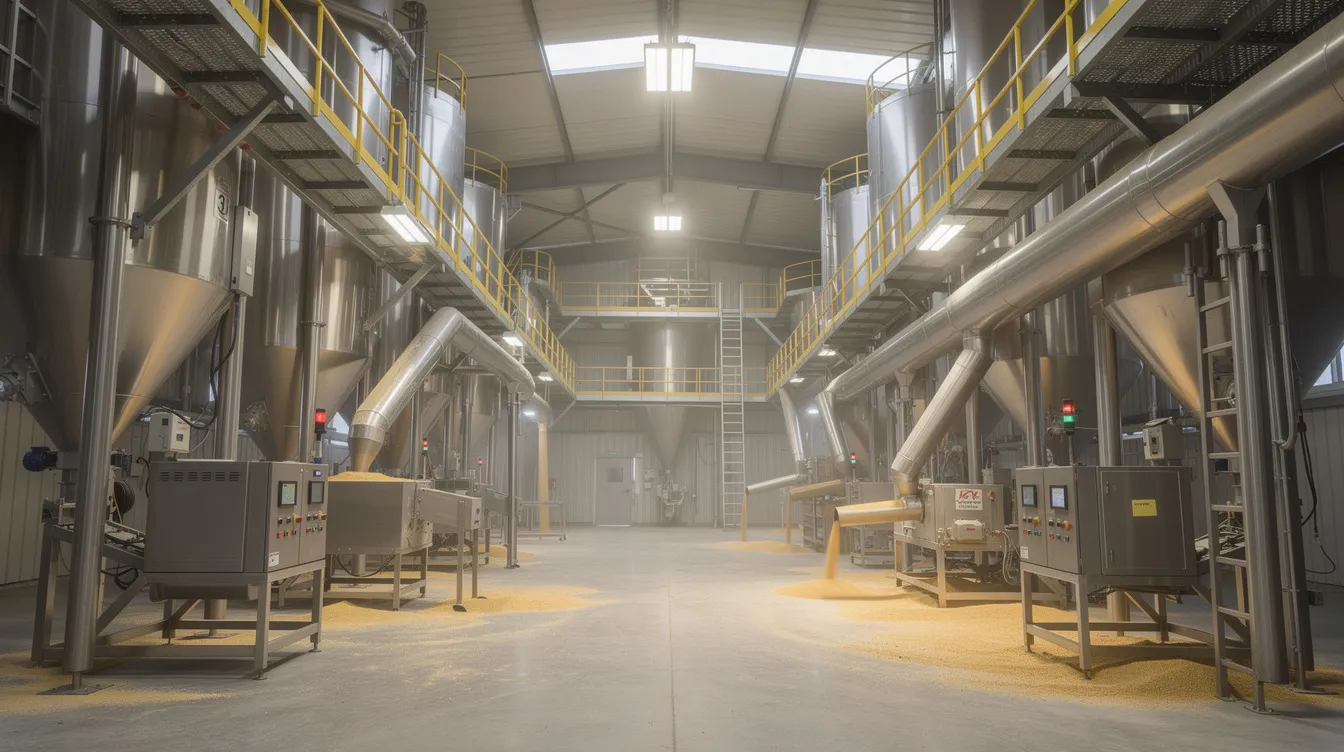
Besan plant modernisation means systematically upgrading the process flow, equipment, automation level and quality systems of an existing plant-not simply bolting on another pulveriser. A besan plant requires a dal mill for dehusking and cleaning before flour mills grind split chana into besan powder. Modernising a besan processing plant enhances efficiency and hygiene across this entire chain.
It is important to distinguish between different project types, because banks, subsidy schemes and term-loan products often differentiate between them:
| Type of Project | Typical Objective | Scope | Impact | Key Financial Consideration |
|---|---|---|---|---|
| Machinery Replacement | Restore original capacity | Like-for-like swap | Maintains output | Revenue expense vs. capitalisation |
| Modernisation | Improve efficiency, quality | Upgraded equipment, controls | 10–20% yield/power gain | Incremental EBITDA vs. capex |
| Brownfield Expansion | Increase production capacity | Additional machinery, civil works | Double or more output | Full project cost, working capital |
| Process Automation | Reduce labour, improve consistency | PLC, SCADA, VFDs, auto-packing | Lower cost per kg | ROI on automation investment |
| Greenfield Plant | New manufacturing business | Complete new facility | New revenue stream | Full DPR, means of finance |
Integrating besan production with related dal mill operations can reduce handling losses and logistics cost, which is why many modernisation projects address the entire processing line.
When Should an Existing Besan Plant Be Modernised?
Timing matters. Upgrading too late erodes market share; premature automation can strain cash flow and DSCR. Measurable indicators that suggest the need for modernisation include:
- Spares and maintenance cost exceeding 8–10% of machinery value annually
- Power consumption above 22–25 kWh per tonne of finished besan
- Saleable recovery below 95–96% of chana dal input
- Customer rejections due to inconsistent fineness or colour
- Manual bagging creating bottlenecks above 20 TPD output
- Chronic inability to serve institutional or branded orders
Before committing capital, establish a baseline performance sheet for the existing besan mill plant: current TPD, shift pattern, yield percentage, power per tonne, labour cost per kg, rejection rate and maintenance downtime. Capture 6–12 months of real data and compare against industry benchmarks for recovery and process losses. Quality indicators for food processing include yield and energy consumption metrics-these form the foundation of any modernisation justification.
Besan Plant Capacity Expansion Planning
Most brownfield projects fall into brackets: 5→10 TPD, 10→20 TPD, 20→50 TPD and 50→100 TPD. Capacity may refer to chana dal input or finished besan output-a 20 TPD besan output plant typically processes about 22–23 TPD of chana dal, since a besan plant typically requires 1.1–1.15 kg chana per kg besan.
| Parameter | Existing Plant | Expanded Plant (Year 1) | Expanded Plant (Year 3) |
|---|---|---|---|
| Installed Capacity (TPD, besan output) | 20 | 40 | 40 |
| Capacity Utilisation | 70% | 55% | 80% |
| Annual Production (300 days) | 4,200 tonnes | 6,600 tonnes | 9,600 tonnes |
| Daily Chana Dal Requirement | ~15.4 tonnes | ~24.2 tonnes | ~35.2 tonnes |
Evaluate plant bottlenecks systematically: grinding mills at peak load, undersized rotary sifters, manual bagging queues, limited storage, inadequate dust collection or single-point power constraints. Refer to the detailed methodology on besan plant capacity planning for TPD, shift planning and capacity utilisation curves.
Machinery Required for Besan Plant Modernisation
The main equipment groups requiring upgradation in a typical besan manufacturing plant include:
- Cleaning and grading: Modern besan processing requires effective cleaning and grading to avoid impurities. Optical color sorters improve the uniformity of chana dal before milling. Inline magnetic separators enhance product safety in food processing.
- Grinding: Flour mills grind split chana into besan powder. Modern air-classifying mills offer precise particle-size distribution. High-speed grinding raises flour temperature, but modern air-cooled grinding systems preserve besan quality by controlling heat.
- Sieving: Rotary sifters separate fine besan from coarse particles, enabling different grades for snacks, sweets and general cooking.
- Material handling: Bucket elevators transport grain and flour between processes. Pneumatic conveying systems ensure a dust-free environment in food processing.
- Packaging: Packaging machines fill besan into 250g to 50kg packs depending on market requirements.
The decision between replacing only the grinding section versus refurbishing the entire production line depends on the plant’s specific requirements and financial capacity. In a professional DPR, we prepare a detailed existing-vs-proposed machinery chart with capacities, motor loads and estimated costs backed by supplier quotations.
Automation Opportunities in Besan Manufacturing Plants
Automation levels for besan plants range from basic motor control panels to PLC-based process control and full SCADA-enabled centralised monitoring. Automated monitoring facilitates real-time adjustments to milling and packaging operations, while VFD-based motor control improves energy efficiency.
For a 10 TPD plant, semi-automatic packaging and basic controls often provide better ROI than full SCADA integration. A 50–100 TPD automatic besan manufacturing plant benefits from full line automation including automatic material feeding, recipe-based batching, centralised data logging and intelligent packaging lines.
However, the financial viability of any automation must be proven through incremental savings in labour, rejections, energy or additional throughput compared with the extra capital cost and depreciation. Over-automation without commercial justification is a common and expensive mistake.
Besan Plant Modernisation Cost in India
All cost figures below are illustrative planning assumptions. A 500 kg/day besan plant requires ₹20–45 lakh investment at the micro-scale. For a mid-sized brownfield expansion (20 TPD to 40 TPD), an indicative project cost structure may look like this:
| Component | ₹ Lakh (Illustrative) |
|---|---|
| Machinery (pulverisers, sifters, classifiers) | 55–75 |
| Installation and erection | 8–12 |
| Electrical panels, VFDs, wiring | 10–15 |
| PLC/SCADA automation | 8–12 |
| Dust collection and filtration | 6–10 |
| Civil and structural modifications | 12–18 |
| Utilities augmentation | 4–6 |
| Packaging line (semi-auto/auto) | 10–18 |
| Contingencies (~5%) | 6–8 |
| Margin for incremental working capital | 15–25 |
| Total Indicative Project Cost | 134–199 |
Actual budgets must be based on supplier quotations and a customised DPR. The distinction between replacement expenditure, incremental capacity investment and total project cost matters significantly for depreciation, bank appraisal and subsidy calculations. See the detailed breakdown at besan manufacturing project cost and means of finance.
Land, Building and Layout Modifications
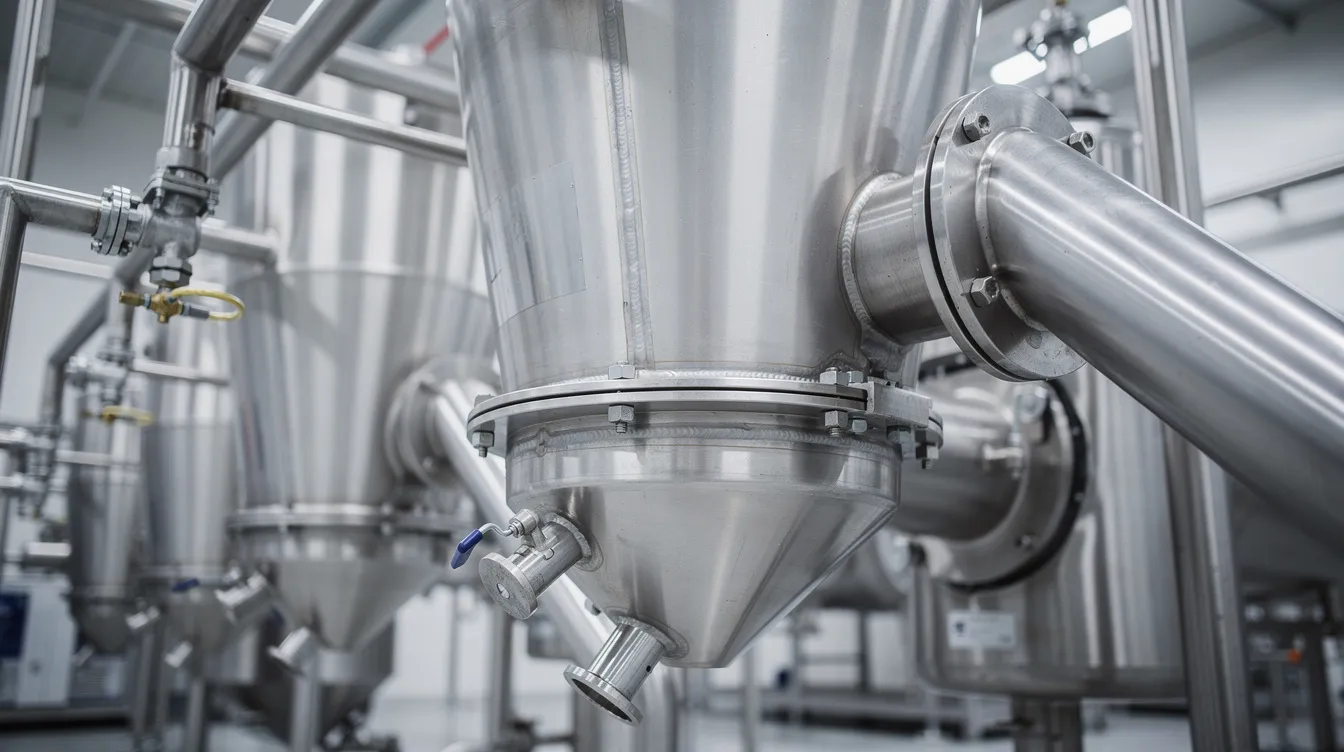
Many besan plants operate from old industrial sheds where layout was never designed for higher capacities. Common brownfield modifications include adding mezzanine floors for silos, strengthening foundations, rerouting conveyors, separating raw material and finished goods zones and creating dust-controlled grinding areas. Food safety systems should be proactively integrated into processing designs-smooth floor finishes, washable walls and pest-control-friendly design help meet modern FSSAI expectations. Legal compliance includes obtaining necessary licenses and permits before expanding operations. For space planning guidance, see besan plant land requirement, building and factory layout.
Power Requirement, Dust Collection and Utility Upgrades
Capacity expansion typically pushes connected electrical load from ~50 kW to 150–250 kW or more. Energy efficiency in flour milling can be improved through high-efficiency motors and VFDs, potentially reducing kWh per tonne by 15–25%.
Gram flour milling generates substantial fine organic dust, making dust extraction critical. Implementing centralized negative-pressure dust collection reduces explosion risks while improving worker safety and reducing product loss. A basic pre- and post-modernisation energy analysis-kWh per tonne, power factor, maximum demand-should form part of every modernisation DPR. Detailed utility-planning frameworks are available at besan plant power requirement, dust collection and utilities.
Production Recovery, Yield and Quality Improvement
Recovery from well-equipped besan plants reaches approximately 98% of chana dal input, with only ~2% lost to dust and burning. Upgrading cleaning, grinding and sieving systems improves particle-size distribution, colour consistency and shelf life-critical for producing high quality besan and premium quality besan suitable for export markets and institutional customers.
Consider the financial impact: if a 40 TPD plant operating 300 days improves saleable recovery by just 1 percentage point (from 96% to 97%), the additional annual output is approximately 120 tonnes. At a conservative contribution margin of ₹15/kg, this translates to ₹18 lakh per year in incremental gross margin-often enough to justify the cleaning and sieving upgradation cost within 12–18 months. For detailed benchmarks, refer to besan quality parameters.
Raw Material Procurement and Inventory Planning After Expansion
Expanding from 20 TPD to 40 TPD roughly doubles chana dal procurement volume. A plant processing 40 TPD of finished besan needs approximately 44 tonnes of chana dal daily. This fundamentally changes procurement strategy, storage needs and working capital exposure.
Strategies include long-term arrangements with aggregators, seasonal stocking during harvest months and maintaining adequate but not excessive inventory to balance price-volatility risk against interest burden. Market research is essential to assess demand and competition before committing to expanded procurement. For detailed supply-chain planning, see chana dal procurement and inventory planning for besan.
Packaging Automation and Product Diversification
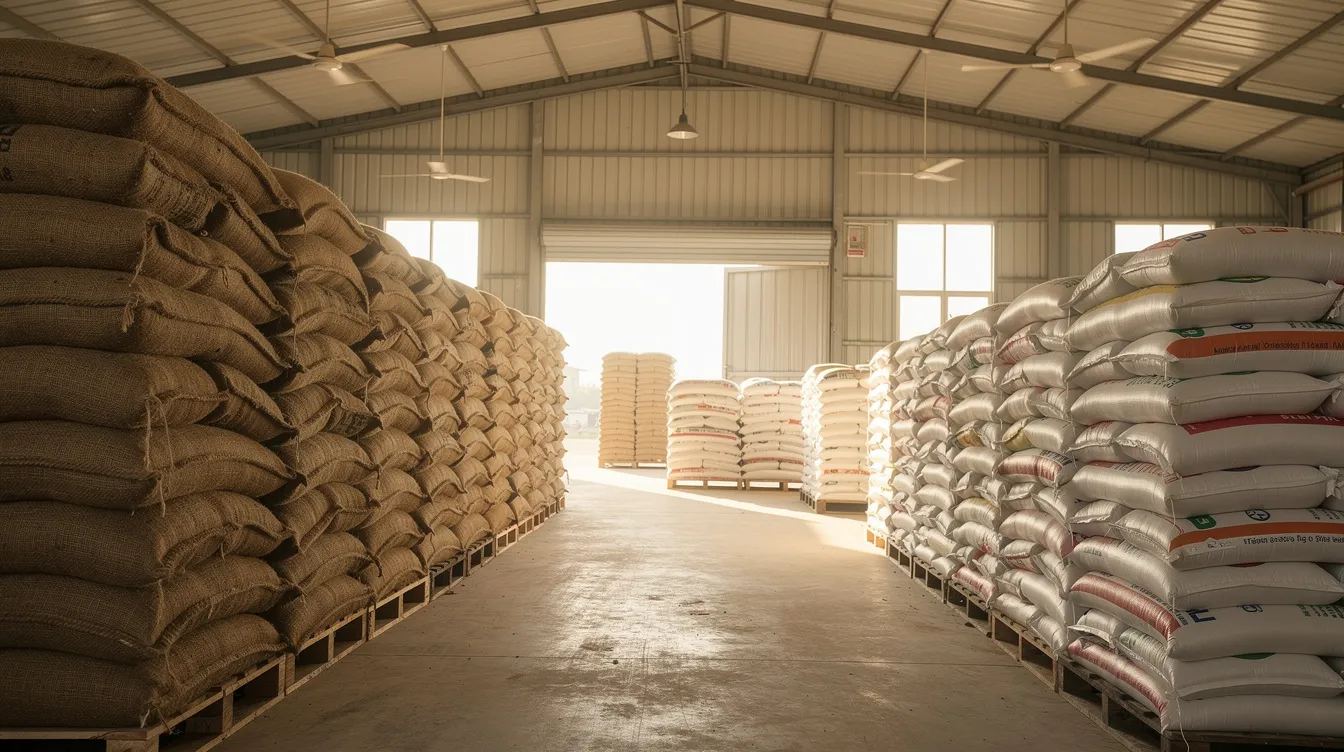
Modern besan plants rarely supply only loose bulk flour. They serve institutional, private-label and retail segments requiring different packaging formats. Automated packaging with nitrogen flushing extends product shelf life, an increasingly important requirement for branded and export-ready besan products.
Semi-automatic and automatic form-fill-seal machines handle 500 g, 1 kg and 5 kg consumer packs, while semi-auto weigh-fillers serve 25–50 kg bulk bags. Packaging speed and changeover time directly influence achievable daily output capacity, especially above 20–30 TPD. For detailed comparison of bulk, retail and private-label strategies, see besan and pulse flour packaging models.
Working Capital Requirements for Capacity Expansion
Modernisation does not only require term-loan funding; it also increases ongoing working capital for raw materials, consumables, labour and finished-goods inventory. Banks generally assess drawing power based on stock and receivables. CMA data is mandatory for loans above ₹10 lakh.
An illustrative incremental working capital calculation: if chana dal inventory increases by 15 days’ consumption at the expanded scale, and finished goods holding adds 7 days, the additional working capital requirement may range from ₹15–25 lakh depending on scale and credit terms. Align production ramp-up with working capital availability-a modernised plant cannot run at planned capacity without adequate funds. See besan manufacturing working capital and cash credit for structured assessment methods.
Financial Projections for Besan Plant Modernisation
Any serious automation or expansion decision must be evaluated through 5–7 year financial projections comparing a “without-project” base case with a “with-modernisation” scenario. Financial projections include P&L, Balance Sheet, and Cash Flow statements. Banks expect realistic capacity ramp-up in financial projections-not 90% utilisation from day one.
The projection model should reflect improvements from modernisation: higher saleable yield, lower kWh per tonne, reduced labour per shift and possible improvement in average realisation through better product quality and consistency. At Project Report Bank, we prepare customised projection models for each client’s plant configuration. See besan plant financial projections, CMA data and DSCR.
ROI, IRR and Payback Analysis of Modernisation
For modernisation projects, we analyse incremental cash flows-additional profit and cost savings compared with the no-investment scenario-rather than wrongly dividing the entire existing business profit by new capital expenditure.
For a 20→40 TPD expansion with ~₹1.5 crore capex, if incremental annual EBITDA stabilises at ₹40–50 lakh by Year 3, simple payback falls in the 3–4 year range. Banks require DSCR ≥ 1.25 for loan approval over the full tenure. Front-loaded repayment schedules or over-optimistic utilisation can make an otherwise sound project appear risky. For scenario analysis and sensitivity testing, see besan plant ROI, IRR, payback and sensitivity analysis.
Production Cost per Kg Before and After Automation
| Cost Component (per kg besan) | Before Modernisation | After Modernisation |
|---|---|---|
| Raw material (chana dal) | ₹78 | ₹76 (better yield) |
| Power | ₹2.50 | ₹1.80 |
| Labour | ₹2.00 | ₹1.30 |
| Packaging | ₹1.20 | ₹1.50 (retail packs) |
| Repairs & maintenance | ₹1.00 | ₹0.60 |
| Factory overhead | ₹1.80 | ₹1.50 |
| Depreciation | ₹1.50 | ₹2.80 |
| Total | ₹88.00 | ₹85.50 |
Lower variable costs per kg can offset higher depreciation from new machinery, but improved plant-level profitability also depends on market pricing power. Automation alone cannot guarantee higher selling prices or assured volumes. A well-structured business plan is crucial for a successful startup or expansion. Detailed cost structures are available at besan production cost per kg and profit margin in India.
Feasibility Study for Besan Plant Expansion
Three pillars must be positive for a bankable project: market feasibility (local demand, competition, institutional tie-ups), technical feasibility (land, power, layout, machinery compatibility) and financial feasibility (project cost, projected profitability, DSCR, break-even utilisation).
The risks of overexpansion without confirmed demand are real. A plant engineered and equipped for 50 TPD but running at 30% utilisation will struggle with high fixed costs. Independent assessment before committing capital is essential-see besan manufacturing feasibility study and project viability.
Bank Finance for Besan Plant Modernisation and Expansion
Banks generally view brownfield besan plant modernisation favourably when supported by proven track record, realistic projections and adequate security. Typical financing involves term loans for machinery and civil works, plus enhancement of existing cash-credit limits. Banks require a structured project report for loan applications.
Besan manufacturing qualifies for 15–35% capital subsidy under PMEGP, though eligibility and guidelines change periodically and must be verified from official notifications. DSCR must be ≥ 1.25 for loan approval. A bank-ready DPR includes CMA data and financial projections covering 5–7 years. Promoter contribution is typically 20–25% of total project cost.
Detailed Project Report for Besan Plant Modernisation
A professional DPR serves as both a management-decision tool and a bank-appraisal document. Major components include: promoter background, existing plant profile, proposed modernisation plan, machinery list with quotations, project cost, means of finance, implementation schedule, 5–7 year financial projections, CMA data, DSCR analysis, break-even calculation, ROI, IRR and sensitivity analysis.
The DPR should clearly separate base-business performance from incremental impact of the modernisation, enabling lenders to see how additional cash flows will service the new term loan. At Project Report Bank, all DPRs for besan plant modernisation are prepared on a customised basis under professional guidance, avoiding generic templates and unrealistic projections. While a detailed project report template can be generated in under 10 minutes, a bankable modernisation DPR requires thorough analysis of existing operations, proposed improvements and realistic financial modelling.
Common Mistakes in Besan Plant Expansion Planning
- Increasing installed capacity without confirmed market demand or supply contracts
- Copying another plant’s machinery list without process-flow analysis for your specific requirements
- Ignoring limitations of existing electrical infrastructure and dust collection
- Under-sizing packaging-line capacity relative to expanded grinding output
- Not providing adequately for incremental working capital
- Assuming automation will automatically halve labour costs without data-backed justification
- Over-estimating achievable utilisation in the first 2–3 years
- Failing to perform sensitivity analysis for chana dal price swings and lower-than-expected output capacity
Promoters should use their CA and technical consultants as a cross-check before signing machinery purchase orders-particularly for medium and large modernisation projects where the financial consequences of incorrect assumptions are significant.
Practical Case Study – Modernising a 20 TPD Besan Manufacturing Plant (Illustrative)
All figures below are assumptions for explanation only.
An existing 20 TPD besan manufacturing plant in central India, operating since 2014, faces constraints: older pulverisers with frequent downtime, manual bagging, limited packaging formats, power consumption of ~24 kWh/tonne and growing institutional demand it cannot serve. The promoter plans expansion to 40 TPD with improved automation.
Proposed plan: Add high-efficiency impact pulverisers with air-cooled grinding, air classifiers, upgraded sifters, pneumatic conveying, automatic weighing-filling machines, improved dust collection and PLC-based motor-control panels. Reuse existing cleaning and storage infrastructure where serviceable.
Indicative project cost: ~₹1.50 crore (machinery ₹70L, installation ₹10L, electrical/automation ₹22L, civil ₹15L, dust collection ₹8L, contingency ₹5L, WC margin ₹20L). Means of finance: promoter contribution ₹40L, term loan ₹110L.
Projected outcomes by Year 3: Annual besan production ~9,600 tonnes (80% utilisation), incremental EBITDA ~₹45 lakh, DSCR ~1.35, simple payback ~3.5 years. Sensitivity: if utilisation drops to 60% or chana dal prices rise 10%, DSCR falls to ~1.15–1.20, highlighting the need for conservative planning. The besan manufacturing business remains a profitable venture when capacity utilisation and procurement are managed well.
Implementation Roadmap for Besan Plant Modernisation
| Phase | Activity | Indicative Timeline |
|---|---|---|
| 1 | Existing plant performance audit and data collection | Month 1–2 |
| 2 | Market and demand assessment | Month 2–3 |
| 3 | Capacity planning, technology selection, supplier shortlisting | Month 3–4 |
| 4 | Quotations, preliminary layouts, machinery finalisation | Month 4–5 |
| 5 | DPR preparation, financial feasibility, CMA data | Month 5–6 |
| 6 | Bank discussions, loan sanction, documentation | Month 6–8 |
| 7 | Civil works, utility modifications | Month 8–10 |
| 8 | Machinery installation and commissioning | Month 10–13 |
| 9 | Trial production, automation fine-tuning | Month 13–14 |
| 10 | Post-modernisation monitoring vs. DPR assumptions | Month 14–20 |
Timelines depend on project scope, supplier commitments and regulatory approvals. In states like Uttar Pradesh, Madhya Pradesh and Rajasthan where besan manufacturing is concentrated, local infrastructure and suppliers can significantly influence the schedule.
About the Author – CA Manish Gugliya
CA Manish Gugliya, FCA, DISA (ICAI), is a practising Chartered Accountant since 2006 and founder of Manish Gugliya & Company, Chartered Accountants, Ratlam, Madhya Pradesh. He advises businesses on Detailed Project Reports, financial feasibility studies, project finance, CMA data, financial modelling and bank loan proposals. His professional approach emphasises realistic assumptions, financial viability, repayment capacity and practical project implementation.
Planning to Modernise or Expand Your Besan Manufacturing Plant?
If you are considering a capacity expansion, automation upgrade, machinery modernisation or additional bank finance for your existing besan plant, a professionally prepared Detailed Project Report can help assess the investment, financial viability and funding requirements.
CA Manish Gugliya & Company provides professional assistance in:
- Bank Finance DPR and Loan Proposal Assistance
- Financial Projections and CMA Data
- Project Feasibility and Viability Assessment
- Expansion Financial Modelling
- ROI, IRR and DSCR Assessment
- Project Finance Documentation
Bank Finance DPR & Loan Proposal Assistance: Starting from ₹25,000.
Fees depend on project complexity and scope.
Contact through WhatsApp: Visit www.projectreportbank.com for professional enquiries.
We do not guarantee bank loan approval or project profitability. Our role is to prepare realistic, professionally analysed proposals that help you and your lender make informed decisions.
Frequently Asked Questions
These FAQs address common queries from existing besan plant owners planning modernisation, expansion, automation or bank finance in India. Answers are concise for quick reference.
What is the typical cost of modernising a besan plant in India?
Modernisation cost varies widely based on capacity, existing machinery condition, automation level and civil modifications. Small upgrades for a 5–10 TPD plant may cost ₹15–40 lakh in machinery alone. A comprehensive 20→40 TPD expansion with automation, dust collection and packaging can range from ₹1.0–2.0 crore including working capital margin. These are planning estimates only-actual budgets must be based on supplier quotations and a customised project report.
Can an existing semi-automatic besan plant be converted into a fully automatic unit?
In most cases, yes. Cleaning, grinding, sieving and packaging sections can be progressively automated using elevators, pneumatic conveying, PLC controls and automatic packing machines with innovative machinery. Complete conversion depends on building layout, headroom, structural strength and available utilities. Conversion is usually done phase-wise to avoid extended production shutdowns and manage cash flow.
How does besan plant modernisation affect project finance and DSCR?
Modernisation increases term-loan size and depreciation, but when planned properly it also raises EBITDA through higher volume, lower cost per kg and better recovery. Banks analyse the incremental DSCR over the loan tenure. A well-structured DPR with conservative utilisation and realistic margins can demonstrate acceptable DSCR (targeted above 1.25–1.30), improving loan-sanction prospects and establishing the food processing industry credentials of the manufacturing unit.
What support does Project Report Bank provide for besan plant modernisation projects?
Project Report Bank, led by CA Manish Gugliya, prepares customised DPRs, financial projections, CMA data and DSCR analysis for besan plant modernisation, expansion and automation. We assist with project-cost structuring, means of finance, working-capital assessment and bank-ready documentation. The company does not guarantee loan approval or project profitability but focuses on realistic, professionally analysed proposals tailored to each client’s plant configuration and industry context.
Is automation financially viable for a 10 TPD besan manufacturing plant?
For a 10 TPD plant, selective automation-such as semi-automatic packaging with low maintenance requirements, better dust collection and basic motor control with high efficiency drives-often provides better ROI than full PLC-SCADA integration. Financial viability depends on labour cost in the region, product quality requirements, production process complexity, working hours and growth plans. This should be evaluated through a tailored feasibility study and projected cash-flow analysis before committing capital.