
Key Takeaways
- Besan and pulse flour packaging strategy directly drives margins, working capital requirements and bankability – it is not merely a product-presentation decision.
- Entrepreneurs can operate as an integrated besan mill plus packaging unit or as a standalone packing operation purchasing ready gram flour and other pulse flours from suppliers.
- Bulk, retail and private-label packaging models have very different investment levels, packaging costs per kg, marketing spends and risk profiles, and the model with the highest selling price does not necessarily generate the highest operating cash flow.
- A realistic packaging project must be built on detailed financial projections, capacity planning and CMA Data – not only on assumed selling prices or theoretical throughput.
- Project Report Bank, led by CA Manish Gugliya, provides customised DPRs and bank-finance documentation for besan and pulse flour packaging projects across India.
Introduction: Why Besan & Pulse Flour Packaging Strategy Matters
The choice of packaging material impacts both shelf life and product integrity for besan, gram flour and pulse flours. Yet most entrepreneurs I work with treat packaging as an afterthought – something decided after the besan mill is designed and machinery is ordered. That approach frequently creates problems: mismatched packing capacity, excessive working capital locked in printed pouches, or selling prices that cannot absorb the cost of retail-grade laminates.
Consider a practical example. A typical besan manufacturer in 2026 can sell the same product in 25 kg woven sacks to namkeen factories in Indore, in 1 kg printed pouches to retailers in Delhi, or through private-label contracts for e-commerce brands. The flour inside may be identical, but the packaging format changes per-kg packaging cost from roughly ₹1–3 in bulk to ₹6–10 in retail, changes pricing power, changes retailer margins, changes inventory risk and changes the entire cash-flow cycle.
The “best” besan packaging model must therefore be judged on net realisation after trade discounts, conversion cost, marketing expenses, credit period and capacity utilisation – not just on invoice price. In the sections that follow, I compare these models and show how a Detailed Project Report, financial projections and CMA Data help evaluate a packaging-focused besan or pulse flour project.
Understanding the Besan and Pulse Flour Packaging Business
The scope of this article covers packaging of chana besan (gram flour), moong flour, urad flour, masoor flour and yellow pea flour, plus multigrain mixes used by snack manufacturers, mithai shops and households across India. Besan production involves cleaning, grinding and packaging processes, and the packaging section must be planned as carefully as the grinding section.
Chana besan remains the dominant product, used extensively for cuisines, snacks, bhujia and traditional mithai. Moong and urad flours find steady demand for dosa, idli and vada mixes – entrepreneurs interested in this variety can refer to the Moong & Urad Flour Manufacturing Project Report for detailed project economics. Masoor and pea flour are increasingly used in bakery blends and gluten-reduced formulations, covered in the Masoor & Pea Flour Manufacturing Project Report. Multigrain and specialty pulse mixes cater to health-focused brands offering premium products through online marketplaces.
A critical distinction exists between integrated besan mill plus packaging plants that control the full production process – dal cleaning, grinding, sieving, packing – and standalone packaging units that buy finished gram flour or pulse flour in bulk from manufacturers and focus solely on brand, packaging and distribution. Both models are commercially viable, but their investment profiles, quality risks and margins differ substantially.
For either model, supplier qualification matters. Consistency in moisture and mesh size must be verified before flour reaches the packing section. Under FSSAI standards, besan moisture must not exceed 12.0% on mass basis, and industry best practice recommends packing at approximately 10% moisture for longer shelf life. High moisture content can cause flour to spoil quickly during storage. Traceability from raw material lot to finished pouch through batch coding is essential, and repacking permissions under FSSAI must be clearly understood. The packaging section should remain physically separated, dust-controlled and compliant with hygiene norms – as discussed in our besan mill project report.
Three Major Packaging Business Models
The three main models – bulk packaging, branded retail packaging and private-label or contract packaging – are not mutually exclusive. Many successful units operate a mix, starting with bulk supply to build volume and cash flow, then adding retail or private-label lines as the business matures. Each model has distinct customers, packaging formats, operational requirements and financial implications.
Bulk Besan and Pulse Flour Packaging
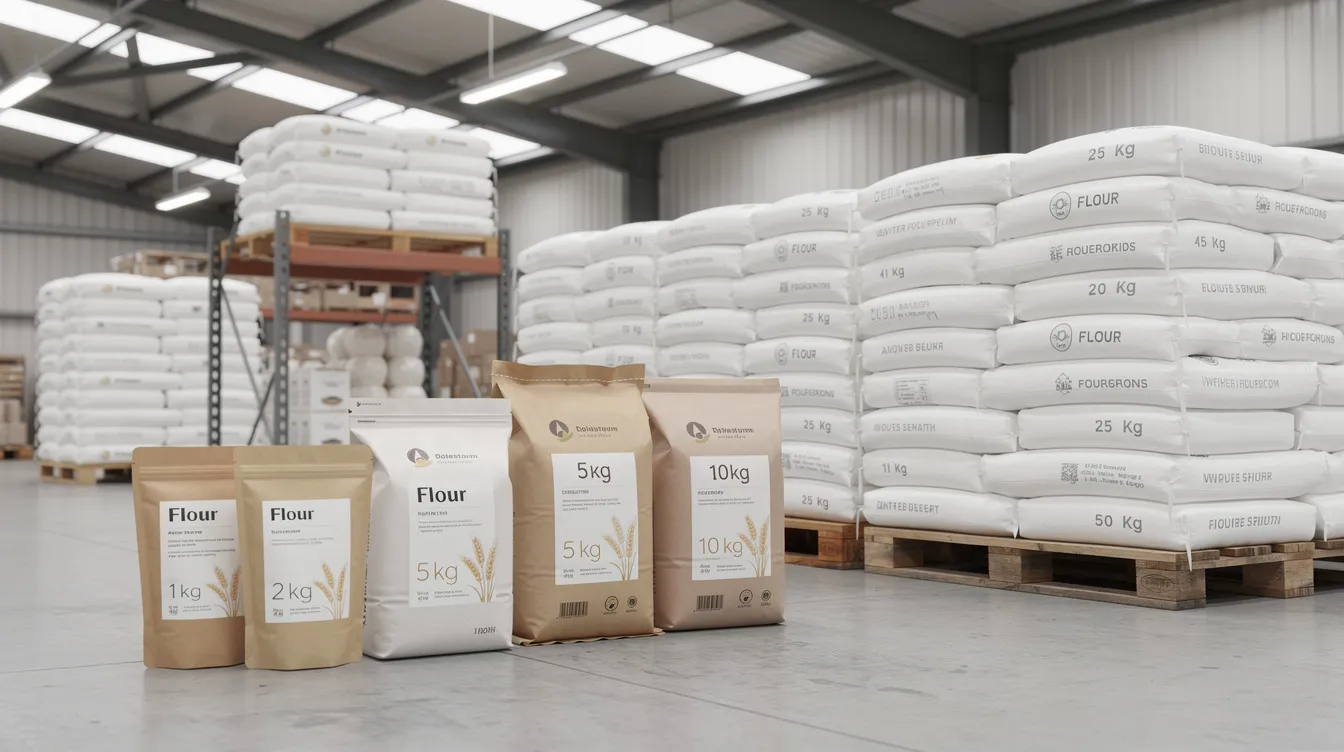
Bulk packaging serves institutional buyers: namkeen plants in cities like Rajkot, Gujarat and Indore, snack manufacturers, mithai factories, HORECA suppliers, large wholesalers and commercial kitchens buying 10 kg, 20 kg, 25 kg or 50 kg sacks.
Common bulk formats include HDPE woven sacks with inner LDPE liner, BOPP laminated woven bags, or multiwall paper sacks. Woven polypropylene sacks are used for bulk flour packaging and have high durability, making them suitable for rough handling in transit. Some modern units also use 10–15 kg bags for commercial kitchens that prefer smaller handling sizes.
Bulk bagging machinery typically involves semi-automatic bag filling with electronic weighers, bag-closing systems (stitching or heat-sealing for the inner liner) and basic conveyors for bag movement.
Advantages:
- Lower packaging cost per kg (approximately ₹1–3)
- Simpler branding needs – minimal printing on sacks
- Direct B2B relationships with fewer customers
- Lower marketing and trade-promotion costs
Limitations:
- Lower selling price per kg versus retail
- Dependence on a limited number of large buyers
- Need for consistent quality to meet tight specifications of snack manufacturers
Retail Besan and Pulse Flour Packaging
Retail formats include 200 g, 500 g, 1 kg, 2 kg and 5 kg pouches. Besan packaging pouches can be sealed in sizes from 500 g to 50 kg, but consumer retail concentrates on the smaller formats. Multi-layer flexible plastic pouches offer high moisture and oxygen barriers, making them the industry standard for retail flour products. Printed laminated besan packaging pouches are widely available, and besan packaging pouches use 100% food grade material to meet regulatory requirements.
Polyethylene bags are commonly used for affordable retail packaging, while premium SKUs may use stand-up pouches with zipper closures. Typical laminate structures include PET + PE or PET + LDPE combinations. Branding, product photography, nutrition tables, FSSAI licence numbers, manufacturing dates, batch numbers, MRP and contact details must all appear on the pack.
Commercially, retail packaging demands retailer margins (often 12–15%), distributor commissions (5–8%), barcode compliance, GST-compliant invoicing, and management of returns from modern trade channels for near-expiry or damaged pouches.
Retail packaging usually offers higher gross realisation per kg than bulk, but the higher packaging material cost, marketing spend and working-capital lock-in due to multiple SKUs and printed pouch inventory must be carefully evaluated. For understanding how production capacity interacts with packing speeds, refer to the discussion on besan plant capacity planning.
Private-Label and Contract Packaging Models
Two distinct arrangements exist here. Private-label manufacturing means you produce and pack besan and pulse flour that will be sold under another company’s brand – for retail chains, e-commerce players or regional brands. Contract packaging or job work means you only perform packaging or repacking based on material supplied by the brand owner, charging a conversion fee per kg or per pouch.
In a typical private-label arrangement, the brand owner finalises artwork, quality standards and pack sizes. The packager may procure packaging material and sometimes flour, or may receive both from the brand owner and provide only labour plus machinery. Minimum order quantity for besan pouches is typically 1,000 pieces of printed film per SKU, and some film suppliers require 300–500 kg of film per design.
Advantages:
- Better utilisation of packaging machines and lines
- Predictable margins per kg from fixed conversion charges
- Lower own-brand marketing expenditure
Limitations:
- Limited control over selling price and consumer relationship
- Risk of volume loss if one or two anchor clients shift to another contract packer
- Rights over the brand remain with the client, not with you
The distinction matters for financial planning: private-label manufacturing involves procurement risk and inventory ownership, while pure contract packing is closer to a service model with lower capital exposure but also lower per-kg revenue.
Bulk vs Retail vs Private-Label: Business Model Comparison
The highest invoice value per kg – usually retail – may not generate the highest operating cash flow once packaging, promotion, trade margins and credit terms are accounted for. The following table provides an illustrative comparison. All figures are planning assumptions, not market quotations.
| Parameter | Bulk | Retail (Own Brand) | Private Label |
|---|---|---|---|
| Target customers | Namkeen units, wholesalers, HORECA | Kirana stores, supermarkets, online | Retail chains, e-commerce brands |
| Typical pack sizes | 25 kg, 50 kg | 500 g, 1 kg, 2 kg | 500 g, 1 kg (client-specified) |
| Packaging cost per kg (approx.) | ₹1–3 | ₹6–10 | ₹5–8 |
| Selling price range (ex-factory, excl. GST) | ₹100–108/kg | ₹118–140/kg net realisation | ₹108–120/kg |
| Gross contribution potential | Lower per kg, higher volume | Higher per kg, lower volume initially | Moderate per kg, stable volumes |
| Marketing/trade promotion | Low | High | Low to moderate |
| Distribution complexity | Simple – direct dispatch | Complex – distributors, retailers | Moderate – dispatch to client warehouses |
| Working capital cycle | 20–30 days | 60–90 days | 30–45 days |
| Machinery investment | Low | Medium to high | Medium |
| Brand ownership | Your brand or unbranded | Your brand | Client’s brand |
| Key risks | Buyer concentration, price pressure | High marketing spend, returns | Client dependency, volume withdrawal |
For a detailed feasibility comparison of besan models, refer to the Besan Manufacturing Feasibility Study & Project Viability analysis.
Which model suits whom:
- Mills with strong B2B connections and existing reach to snack manufacturers should prioritise bulk and selective private-label.
- Entrepreneur-led brands with marketing capability and distributors should explore own-brand retail.
- Plants with strong process capability but limited marketing bandwidth should consider private-label and contract packaging for established brands.
Packaging Materials and Technology for Besan & Pulse Flours
Laminated packaging often includes multiple layers to enhance barrier performance – a typical retail besan pouch may use 12 micron PET as the outer layer bonded to 50–60 micron LDPE as the sealant layer. High-barrier films ensure low moisture vapour transmission rates for flour preservation, which is critical because moisture barriers prevent clumping and microbial growth in flour products. Pulse flours can develop rancidity and spoilage in humid conditions, making barrier performance especially important for products like moong or urad flour.
Strong seals are necessary to avoid leakage or spoilage during transport. Seal integrity matters not just for consumer experience but for avoiding costly returns and wastage.
For bulk packaging, woven PP sacks with LDPE liners are standard for 25–50 kg packs. Kraft paper bags can feature compostable liners to enhance moisture resistance, though paper packaging can be sustainable but may require a barrier to prevent moisture ingress. Glass containers allow for long-term storage of flours with high freshness retention, but are rarely used commercially for besan due to weight and cost. Recyclability of packaging can vary significantly based on local collection systems, which is worth considering if targeting sustainability-conscious private-label clients.
When to consider premium packaging:
- Export markets requiring extended shelf life – nitrogen flushing may be justified
- E-commerce channels where transit damage risk is high – stand-up pouches with zipper
- Health-mix or multigrain products commanding premium MRP
When standard laminates suffice:
- Domestic retail distribution with normal shelf-life expectations
- Bulk institutional supply where aesthetics are secondary to cost and durability
Besan and Pulse Flour Packaging Machinery
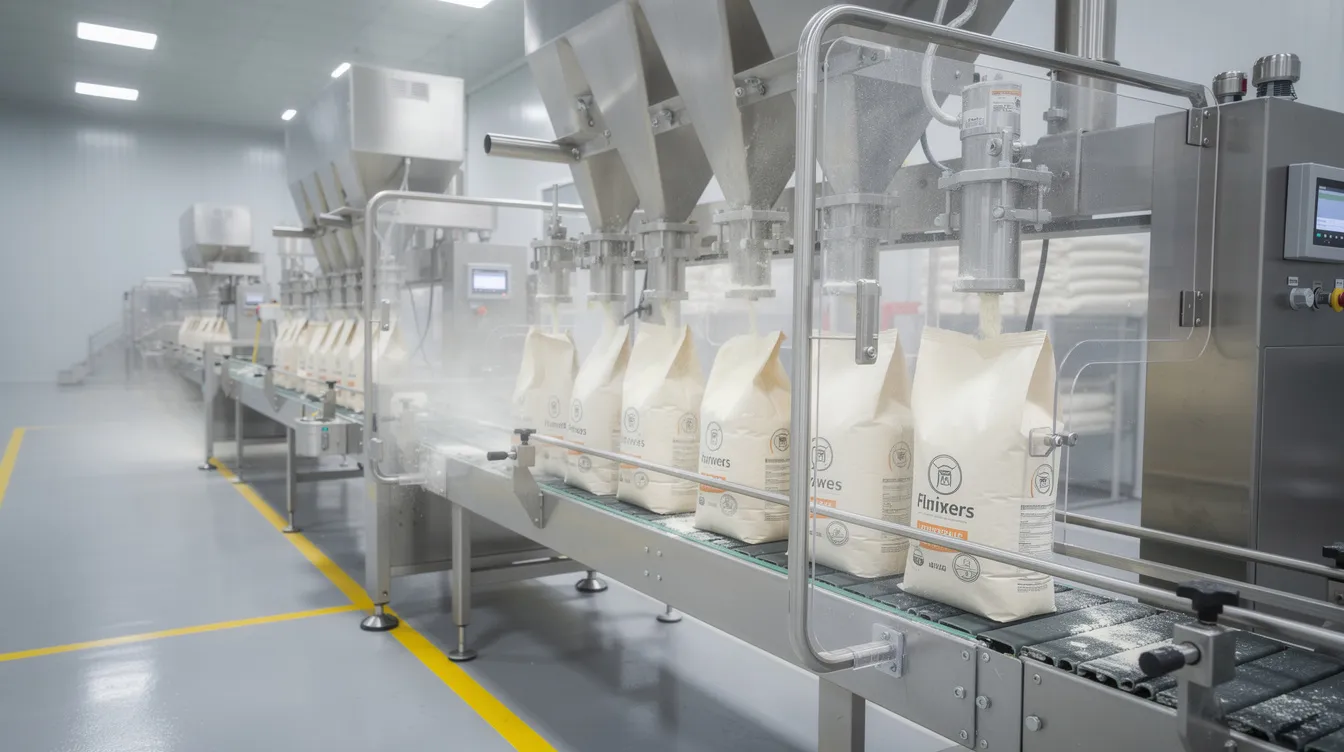
The packaging room in a besan mill or standalone unit typically includes product feeding, weighing, filling, sealing, coding and secondary packing, supported by dust control and conveyors. Besan mills require reliable machinery for effective processing across the entire chain. Grinding machines include impact pulverisers and air classifier mills for the milling section, while the packing section requires its own specialised equipment. Aatomize offers besan plant setups from 100 kg/hr to 5 TPH, and Aatomize machines ensure consistent mesh sizes from 30 to 200 mesh – this consistency at the grinding stage directly affects packaging line performance.
Key machinery types include automatic form-fill-seal machines for 200 g–5 kg pouches, auger fillers designed for fine powders like gram flour, semi-automatic fillers for startups, bulk bagging machines for 10–50 kg sacks, metal detectors, checkweighers, batch coding units and carton-sealing equipment. Dust extraction systems are essential – refer to the discussion on besan plant power requirements and dust collection for planning details. It is essential to invest in high-quality machinery for efficient operations and consistent output.
| Line Type | Indicative Throughput | Automation | Operators/Shift | Utility Needs | Suitable Formats | Investment Band |
|---|---|---|---|---|---|---|
| Semi-auto pouch filling | 200–400 kg/hr | Low | 3–4 | 2–3 kW, no compressed air | Retail (1–5 kg) | Low (₹1.5–4.5 lakh) |
| Fully automatic FFS | 800–2,400 kg/hr | High | 1–2 | 5–8 kW, compressed air | Retail (200 g–5 kg) | Medium-High (₹6–12.5 lakh) |
| Bulk bagging (25–50 kg) | 500–1,500 kg/hr | Medium | 2–3 | 3–5 kW | Bulk only | Low-Medium (₹3–10 lakh) |
| Mixed-format line | Variable | Medium | 3–5 | 5–10 kW | Both retail and bulk | Medium (₹8–15 lakh) |
Actual machinery prices depend on make, specifications and vendor. Project reports should treat these figures as planning assumptions, not confirmed quotations.
Packaging Plant Capacity Planning
Packaging capacity is typically measured in pouches per minute or bags per hour, converting to kg/hour based on pack size. A line running 40 pouches per minute of 1 kg besan for 8 effective hours per shift gives approximately 19,200 kg/day after accounting for stoppages and changeovers.
A bulk-focused line filling 25 kg sacks at 10 bags per minute produces roughly 12,000 kg/hour – significantly higher throughput per operator. A mixed operation doing 1 kg packs in the morning shift and 500 g packs in the evening shift will lose 5–15% of effective output to changeover time for size and film adjustments.
Critical capacity planning points:
- Match milling output with packing capacity; a bottleneck at the packing stage causes stock build-up and delayed dispatch
- Plan for future automation upgrades if sales shift from bulk to retail
- Factor changeover losses into financial projections, not just theoretical maximum output
Besan Packaging Cost per Kg in India: A Practical Framework
“Besan packaging cost per kg” should be understood as having distinct components: primary packaging (pouch or sack), secondary packaging (cartons, outer bags), direct labour and power, and overheads including maintenance, quality tests and wastage.
The step-by-step framework is straightforward: identify the pack size, calculate packaging material consumption per kg, add conversion costs (operators, helpers, power), add quality rejection and maintenance allowances, and allocate freight where relevant.
Hathi Brand offers besan pouches at ₹190 per kilogram of film material, which is broadly representative of the market. Laminate prices range from approximately ₹150/kg for simpler structures to ₹245/kg for heavier LDPE-PP laminates.
| Cost Component | Bulk (25 kg Sack) | Retail (1 kg Pouch) | Premium Stand-Up (500 g, Private Label) |
|---|---|---|---|
| Primary material per pack | ₹18–25 | ₹7–9 | ₹6–8 |
| Primary material per kg | ₹0.70–1.00 | ₹7.00–9.00 | ₹12.00–16.00 |
| Secondary packaging per kg | ₹0.30–0.50 | ₹1.00–1.50 | ₹1.50–2.00 |
| Labour + power per kg | ₹0.30–0.50 | ₹0.80–1.20 | ₹1.00–1.50 |
| Total packaging cost per kg | ₹1.30–2.00 | ₹8.80–11.70 | ₹14.50–19.50 |
All figures are approximate 2026 planning examples, not current market quotations, and exclude GST. For how packaging cost fits within the full production cost structure, refer to the Besan Production Cost per Kg, Selling Price & Profit Margin analysis.
Important reminders:
- Distinguish “packaging cost” from full “ex-factory cost” which includes raw material, grinding, overheads and margins
- Do not promise a fixed profit per kg – it varies by scale, materials, region and selling model
Project Cost and Investment Requirements
Project cost differs significantly across packaging models. A small semi-automatic bulk packaging line within an existing besan mill may require ₹5–10 lakh in additional machinery. A new retail-focused packaging unit with multiple FFS machines needs ₹25–60 lakh in packaging equipment alone. A dedicated private-label facility serving 2–3 anchor clients falls somewhere between. An integrated besan mill plus packaging plant can range from ₹20–37 lakh for a semi-automatic 500 kg/day unit to ₹72 lakh–₹1.3 crore for a 2,000 kg/day automated plant.
Key cost heads include plant and machinery, building modifications (separate packaging room, epoxy floors), electrical systems and compressors, quality control equipment including moisture analysers, pre-operative expenses and initial working capital margin.
| Parameter | Bulk Only | Retail Focused | Private Label | Integrated Mill + Pack |
|---|---|---|---|---|
| Machinery investment | Low | Medium-High | Medium | High |
| Building modification | Minimal | Moderate (cleanroom standard) | Moderate | Significant |
| Branding/launch expenses | Negligible | High | Low | Medium-High |
| Dependence on upstream milling | Full (purchase flour) | Full or partial | Full or partial | None (own grinding) |
Similar principles of means of finance apply to packaging-heavy projects as to milling projects – balancing term loan, promoter contribution and working capital limits. The project cost and means of finance framework provides useful reference.
Not every packaging entrepreneur must invest in a besan mill. Many profitable units operate with outsourced flour under strict quality contracts. Investment planning should also factor in potential future automation as demand scales.
Working Capital Requirements for Different Packaging Models
Packaging businesses carry working capital in flour inventory (either own-manufactured or purchased), printed pouch and roll stock across multiple SKUs, finished goods in the distribution chain, and debtors from retailers, wholesalers and private-label clients. It is essential to establish strong supply chains for sourcing chickpeas and raw materials – disruptions directly inflate working capital.
- Bulk: Lower SKU count, simpler inventory, usually 20–30 day credit cycle but high exposure to a few large buyers
- Retail: More SKUs and printed materials, 60–90 day effective credit cycle via distributors and modern trade, higher finished-goods inventory
- Private label: Better order visibility, sometimes advance payments or 30–45 day credit, but high dependence on particular clients
Illustrative example for a small retail-focused unit (2,000 kg/day):
| Working Capital Component | Days | Approximate Amount |
|---|---|---|
| Raw flour inventory | 30 days | ₹5.3 lakh |
| Printed pouches & rolls | 15 days buffer | ₹2.5 lakh |
| Finished goods | 10 days | ₹3.2 lakh |
| Debtors/receivables | 45 days | ₹9.5 lakh |
| Total (less creditors) | ₹18–20 lakh approx. |
These are planning assumptions. Refer to Besan Manufacturing Working Capital & Cash Credit for deeper explanation of CC limits and bank documentation requirements.
Key working capital risks:
- Over-ordering printed materials for SKUs that may not scale
- Negotiating unfavourable credit terms with pouch suppliers or distributors
Profitability Analysis – Bulk vs Retail vs Private Label
From a Chartered Accountant’s perspective, each model must be evaluated via contribution per kg, not only by gross selling price. Here is an illustrative comparison based on hypothetical 2026 planning assumptions for a mid-scale unit with chana dal at ₹88/kg and a 71% recovery rate (approximately ₹124/kg flour cost).
| Parameter | Bulk (25 kg) | Retail (1 kg, Own Brand) | Private Label (1 kg) |
|---|---|---|---|
| Selling price per kg (excl. GST) | ₹105 | ₹160 MRP → ₹118 net realisation | ₹112 |
| Less: raw flour cost | ₹124 | ₹124 | ₹124 |
| Less: packaging cost per kg | ₹2 | ₹9 | ₹7 |
| Less: distribution/marketing | ₹1 | ₹8 | ₹2 |
| Contribution per kg | -₹22 | -₹23 | -₹21 |
Wait – these numbers reveal a critical reality. When raw chana dal is at ₹88/kg with 71% recovery, the flour cost itself is approximately ₹124/kg, which leaves very thin or negative contributions unless selling prices are significantly higher. This illustrates why raw material price sensitivity is the single most important variable. When dal prices are lower – say ₹55–65/kg – manufacturing cost drops to approximately ₹77–92/kg, and all three models become profitable. The retail model then shows the highest absolute contribution, but requires significantly more marketing capital.
Sensitivity illustration: If laminated pouch prices increase by 10% (from ₹190/kg to ₹210/kg), retail packaging cost per kg rises by approximately ₹0.70–₹1.00 – a material squeeze on already thin margins. For structured sensitivity analysis and downside scenario planning, refer to the Besan Plant ROI, IRR, Payback & Sensitivity Analysis.
Financial Projections, CMA Data and DSCR for Packaging Projects
Banks and investors evaluate besan and pulse flour packaging proposals through projected profit and loss accounts, balance sheets, cash-flow statements, term-loan repayment schedules and DSCR analysis. Different packaging models change revenue mix, gross margins, marketing spends and working-capital needs – all of which must be captured in a structured financial model and CMA Data before approaching banks.
Refer to Besan Plant Financial Projections, CMA Data & DSCR for the approach used to build realistic projections.
- CMA Data reflects management assumptions – it is not a guarantee of profits
- DSCR should be tested under conservative sales and higher-cost scenarios
- Lenders examine capacity utilisation ramp-up carefully, especially for new retail brands
- Customer concentration risk is scrutinised heavily in private-label models
FSSAI, Legal Metrology, Labelling and Packaging Compliance
Besan, gram flour and pulse flours are regulated food products under FSSAI, and packaged commodities rules under Legal Metrology apply to MRP packs. Packaging must comply with food safety regulations to prevent harmful substance migration from packaging material to food. Ensure compliance with local food safety regulations at every step.
Key compliance areas:
- Valid FSSAI registration or licence for manufacturing or repacking
- Hygienic facility design, pest control and documented food-safety practices
- Use of food-grade packaging materials confirmed via supplier declarations
Legal Metrology requirements for retail packs:
- Declaration of net quantity in metric units
- Name and address of manufacturer/packer
- Month and year of packing
- MRP inclusive of all taxes
- Consumer helpline details
In private-label and job-work arrangements, there must be clarity about which entity appears as “manufacturer” or “packer” on the pack, and both parties must understand their responsibilities in case of quality complaints. Readers should verify latest requirements from FSSAI and relevant state-specific circulars.
Market Strategy and Sales Channels
Conduct market research to assess demand for besan and pulse flours before finalising packaging formats and channel strategy. Key channels include traditional distributors and wholesalers, modern retail chains, online marketplaces, institutional and HORECA buyers, and private-label relationships.
Channel choice directly affects packaging decisions: modern retail demands premium-looking pouches and strong outer cartons, e-commerce may favour re-sealable pouches to minimise transit damage, and institutional buyers prioritise cost per kg over aesthetics.
- Trade promotion schemes are essential for launching a new retail besan brand
- Consistent supply and accurate fill weights matter most for B2B snack manufacturers
- Cross-selling moong, urad, masoor and multigrain flours becomes feasible once a brand has established reach with retailers and distributors
A serious investor should match chosen sales channels with plant capacity, marketing budget and risk appetite before finalising the DPR.
Major Risks and Sensitivity Analysis
Key risks specific to besan and pulse flour packaging include volatility in raw flour prices, increases in laminated film and sack prices, retail product returns due to moisture ingress or infestation, lower-than-expected sales leading to underutilised packaging lines, and delayed payments from new market customers.
Quality risks are particularly concerning: poor sealing causing leakage and infestation, or inconsistent moisture content leading to caking or off-flavours. Maintaining besan quality parameters through regular testing is the primary mitigation technique.
Sensitivity scenarios to model:
- Test impact of 5–10% higher packaging material cost on EBITDA
- Evaluate DSCR if capacity utilisation is 60% instead of 80% in initial years
- Model the effect of a key private-label customer withdrawing 40% of contracted volume
Choosing the Right Packaging Model for Your Project
There is no universal answer. The correct model depends on existing infrastructure, marketing strength, access to anchor customers and available equity for branding and working capital. Choose a site near chickpea suppliers for your mill if you are planning an integrated operation – raw material logistics significantly affect delivered cost.
Decision framework:
- If you have a running besan mill and strong B2B snack relationships, prioritise bulk and some private-label
- If you have marketing expertise, a retail network and brand-building capacity, explore own-brand retail
- If you have strong process capability but limited marketing bandwidth, start with private-label and contract packaging for established brands
Plant layout, dust control and packaging-room design should be aligned with the chosen mix of pack sizes – the besan plant land and building layout discussion covers broader infrastructure planning.
Why a Professional DPR Matters for Besan Packaging Projects
A Detailed Project Report for a besan and pulse flour packaging project should cover market positioning and packaging model selection, technical configuration, detailed project cost, means of finance, implementation schedule and multi-year financial projections including break-even and DSCR analysis.
A generic project profile cannot capture local raw-material procurement realities, specific product mix decisions (besan vs moong vs masoor), or selected target channels and their impact on packaging formats and margins. Project Report Bank prepares bespoke DPRs that integrate production and packaging capacity planning with upstream procurement planning.
A tailored DPR improves discussions with machinery suppliers, supports transparent communication with bankers and investors, and reduces the risk of over- or under-investing in packaging automation.
Professional DPR & Financial Advisory by CA Manish Gugliya
I am CA Manish Gugliya, FCA, DISA (ICAI), a practising Chartered Accountant since 2006, leading Manish Gugliya & Company, Chartered Accountants, from Ratlam, Madhya Pradesh. Through ProjectReportBank.com, I provide services online across India.
Core services for besan and pulse flour packaging entrepreneurs:
- Customised DPR preparation for integrated besan mills and standalone packaging units
- Financial projections, detailed cost sheets and CMA Data for bank term loans and cash credit
- Project feasibility and viability analysis covering different packaging models
- Working capital planning and assessment of DSCR, ROI and IRR
Professional DPR and bank-finance proposal assistance typically starts around ₹25,000 for smaller projects, with scope and fees adjusted based on complexity.
If you are planning a besan or pulse flour packaging project – whether bulk, retail, private-label or integrated – you are welcome to share basic project details (location, capacity, packaging model, existing besan mill or new setup) via WhatsApp through the Project Report Bank website for an initial discussion.
Frequently Asked Questions
Which besan packaging model is most profitable for a new entrant?
Profitability depends on local demand, competition, marketing ability and working-capital capacity rather than on format alone. Bulk supply may offer lower margins per kg but is simpler to start with. Retail offers higher potential margins but demands significant brand investment. Private-label can provide stable conversion income if anchor clients are secured early. A customised DPR helps quantify which model works best for your specific situation.
Can I start a besan and pulse flour packaging unit without owning a flour mill?
Yes. Many successful Indian entrepreneurs operate purely as packers, purchasing besan and pulse flours from established mills under strict quality agreements. Feasibility depends on reliable suppliers who can provide consistent moisture levels and mesh sizes, adequate packaging capacity, and either branding capability or committed private-label contracts. A company focused on packaging can avoid the capital cost of milling equipment entirely, but must manage procurement quality carefully.
What is the approximate packaging cost per kg for a 1 kg retail besan pouch?
Based on 2026 planning assumptions, total packaging cost for a 1 kg retail pouch – including primary laminate, secondary carton, labour, power, quality testing and wastage – typically falls in the range of ₹8.80–11.70 per kg. This varies with laminate type, printing quality, automation level and scale. These are illustrative figures, not quotations.
What licences are required for a besan packaging unit in India?
Typical requirements include FSSAI registration or licence (depending on turnover), entity registration (proprietorship, partnership, company or LLP), GST registration where applicable, factory licence or trade licence depending on state regulations, and Legal Metrology compliance for MRP packs. Private-label and contract packers must ensure that labelling clearly identifies the manufacturer or packer. Verify current norms with local authorities or a professional advisor.
Can banks finance a project focused mainly on besan and pulse flour packaging?
Banks commonly finance such projects provided there is a well-prepared DPR with realistic financial projections, adequate promoter contribution, proper collateral and regulatory compliance. The DPR should demonstrate healthy DSCR under conservative assumptions and clearly explain the target market and packaging model. Project Report Bank assists promoters with documentation, CMA Data and projections to support bank appraisal – though no loan approval can be guaranteed.
Conclusion
Choosing between bulk, retail and private-label packaging for besan and pulse flours is fundamentally a financial strategy decision. It involves trade-offs between margins, investment size, working capital commitment and commercial risk. The industry in India is shifting toward packaged products – the packaged gram-flour segment is growing at approximately 15.3% CAGR versus around 3.8% for unpackaged besan – but capturing that growth requires the right combination of capacity, packaging format, target customers, machinery and realistic demand assessment.
Packaging technology, materials and machines must be aligned with the chosen model and actual market access, not just with theoretical throughput. A 40-pouch-per-minute FFS line adds no value if the brand has not yet established distribution to produce enough orders to keep it running.
Serious promoters should base their investment on a customised DPR, robust financial modelling and sensitivity analysis before committing capital to machinery or branding. At Project Report Bank, we work to make sure the numbers tell a defensible business story – one that you can confidently present to a banker, an investor or your own board.