Key Takeaways
- A cheese processing plant is an integrated production line covering milk reception through cold storage; it is not a single cheese making machine. Cheese production involves mechanical, thermal and biological processes at different stages.
- Cheese plant machinery and equipment cost in India ranges from tens of lakh rupees for a small semi automatic unit to several crore for an automatic cheese production line. All figures are indicative only.
- Capacity (milk handled per day), cheese varieties (mozzarella, cheddar, processed cheese) and automation level are the three main drivers of machinery investment.
- Basic quotations from cheese making machine manufacturers usually exclude utilities, installation, civil work and working capital, so they differ from total Cheese Manufacturing Plant Setup Cost in India.
- Promoters should obtain written supplier quotations, prepare a realistic DPR, and align machinery selection with bank finance, DSCR and long-term profitability rather than the lowest price alone.
Introduction: Role of Cheese Plant Machinery & Equipment in Project Cost
Machinery selection is the most capital-intensive and technically critical decision in any cheese processing plant DPR in India. A cheese processing plant is a full integrated line: milk reception, pasteurisation, cheese vats, curd formation, cutting, whey drainage, moulding, pressing, brining, ripening, cutting, packaging, CIP and cold storage. No single machine handles the entire operation.
Promoters routinely ask: “Which machines are required?”, “How much will they cost in India?”, “Should I buy manual or automatic cheese production equipment?” This article addresses each question from a project-finance perspective.
The same milk-handling capacity can carry very different cheese plant machinery cost depending on the product mix (mozzarella vs cheddar vs processed cheese), automation level, hygiene standards and packaging format. Machinery cost is only one component of total project setup cost; land, building and working capital are covered separately in the linked article above.
Understanding a Cheese Manufacturing Plant Process Flow
Milk becomes the final product cheese through a defined sequence. Cheese production plants use specialized stainless steel machinery for each processing stage, and understanding the flow helps map equipment at every stage for a technically sound DPR.
Key steps in order:
- Milk reception and testing
- Fat/SNF standardisation
- Pasteurisation
- Cooling and culture addition
- Coagulation in a cheese vat
- Curd cutting and curd formation
- Cooking and agitation
- Whey drainage
- Moulding and pressing
- Salting or brining
- Ripening/ageing
- Cutting and packaging
- Refrigerated storage
Process parameters differ for mozzarella (requires hot-water stretching of curd), cheddar (extended cheddaring and ageing), and processed cheese (melting and emulsifying existing cheese). For integrated dairy projects combining fluid milk, paneer and cheese, the Integrated Dairy Processing Plant Project Report provides the broader dairy context.
Complete List of Cheese Plant Machinery & Equipment by Processing Stage
A bankable DPR must show equipment stage-wise, not as one lump-sum item. Each stage below covers purpose, typical capacity range, whether the machine is essential or optional, and key features affecting price. Only major equipment is listed; small accessories and fittings also add to installed machinery cost and must appear in supplier BOQs.
Milk Reception, Storage and Pasteurisation Machinery
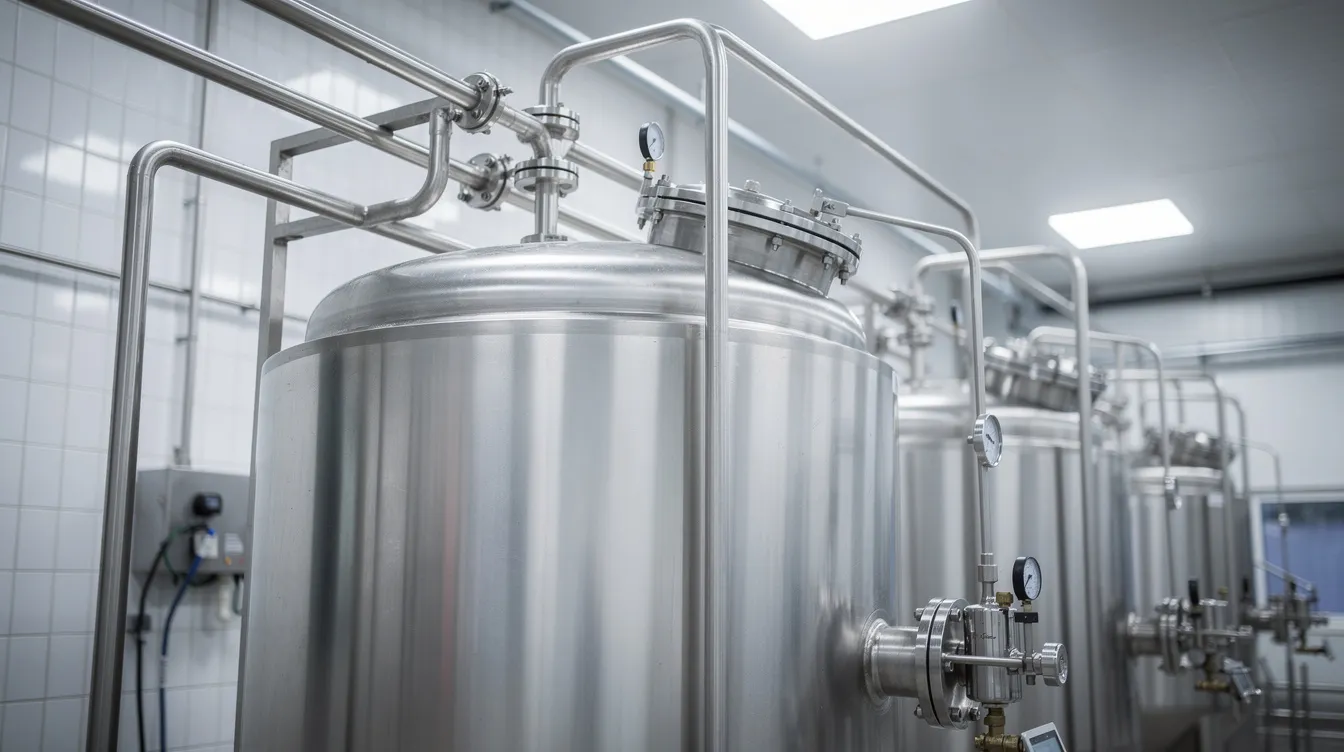
Equipment must be constructed from food-grade corrosion-resistant materials. Industrial cheese processing machines are made from 304 or 316 stainless steel to maintain hygiene. Core machines in this stage:
- Milk reception tank (SS 304, insulated, with level indicators)
- Weighing scale or inline milk metering system
- Unloading pump (sanitary, SS)
- Milk filter or clarifier
- Raw milk storage tank or bulk milk cooler (chilling to below 4 °C)
- Basic laboratory instruments: lactometer, fat testing equipment, pH meter
- Cream separator for standardisation
- Batch pasteuriser (cost effective for plants up to approximately 5,000 L/day) or continuous plate heat exchanger for higher throughput
- Balance tank and pasteurised milk buffer storage
Key features that affect price include machine body material grade (SS 304 vs SS 316), insulation quality, easy cleaning design with CIP ports, and automatic temperature control. Core milk-processing equipment cost should be evaluated alongside Dairy Processing Plant Machinery and Equipment Cost, which covers integrated dairy machinery; this article stays focused on cheese-line equipment.
Cheese Vat and Coagulation Equipment
The cheese vat is the heart of cheese making, where pasteurised milk, starter culture and rennet combine to produce curd with the desired structure. Equipment should provide accurate control of temperature, agitation and moisture. Open cheese vats suit small artisan-style plants, while enclosed automated vats with jacketed heating, variable-speed drives and PLC controls serve medium and large operations.
Vat capacity (500 L, 1,000 L, 5,000 L or larger) must align with daily milk volume, batch cycles and expected cheese yield. High-capacity machines can handle batch sizes up to 10,000 liters. Selection points include internal mirror polish, slope for drainage, easy operation and whether controls are manual, semi automatic or PLC-based. Cheese vat machine prices in India vary widely; supplier listings show small vats from approximately ₹1.50 lakh to ₹5.40 lakh, while large automated vats cost several times more.
Curd Cutting, Cooking and Whey Drainage Equipment
Controlled curd cutting produces uniform grain size, directly affecting moisture, texture and yield. Curd knives, horizontal and vertical cutters, or automatic cutting frames handle this task. Cooking and agitation via steam jacket or hot-water heating, with simple or PLC-based controls, follow cutting.
Key whey drainage and curd handling equipment includes drainage tables, draining vats, perforated conveyors, cheddaring equipment (for cheddar), curd milling machines, and salting/mixing units. Cheese production requires strict hygiene to maintain product quality; hygienic whey collection in SS tanks with sanitary pumps matters for both regulatory compliance and possible whey utilisation. Many small plants begin with manual curd cutting and simple draining tables, upgrading to semi automatic equipment as capacity and labour costs rise.
Cheese Moulding, Pressing, Brining and Ripening Equipment
After whey drainage, curds are moulded into shape using moulds or hoops (plastic or SS), pre-pressing tables and, for block cheeses, automatic block-forming systems. Pressing equipment ranges from manual lever presses for very small plants to pneumatic and hydraulic cheese presses for commercial operations that need consistent weight, shape and moisture control.
Brine tanks are used for controlled salt absorption in cheese making. Brining systems include circulation, filtration, and cooling equipment. Dry-salting tables and salt-dosing systems serve varieties that use direct salting.
Climate-controlled environments ensure proper aging of cheese. Ripening chambers require insulated rooms, refrigeration, humidity control, air circulation, ripening racks and temperature/humidity monitoring with data logging. Ripening rooms and cold storage are substantial cost components often missing from basic “cheese making machine” quotations but are essential to total cheese plant machinery and equipment cost.
Cheese Cutting, Slicing and Packaging Machinery
Finished cheese blocks must be converted into marketable packs. Typical machines include block-cutting, portioning, cheese slicing and shredding machines (for pizza cheese). Packaging options range from vacuum packaging machines (vacuum packaging helps prevent contamination and moisture loss during cheese distribution) to thermoforming, pouch-packing (vertical FFS) and modified-atmosphere packaging for export.
Supporting devices: metal detector, checkweigher, labelling and coding machines, carton-sealing equipment. Food safety audits and large buyers increasingly require metal detection. Pack format (200 g retail vs 2 kg HoReCa blocks) directly influences machinery cost and working-capital requirements in the DPR.
Special Machinery for Mozzarella and Processed Cheese
Mozzarella and processed cheese require additional equipment beyond standard cheese vats and presses. Cheese processing systems can be customized to specific production needs.
For mozzarella (a pasta filata cheese): curd stretching and cooking machine, mozzarella forming machine, cooling/hardening tank, dedicated brining systems, and vacuum packaging. The stretching process uses hot water to produce the characteristic elastic texture. Mozzarella machinery is offered in range from approximately 200 to 1,000 kg/h by Indian and imported suppliers.
For processed cheese manufacturing: cheese grinder, blending and mixing systems, steam-jacketed kettles, vacuum cooker or emulsification systems, and filling/sealing equipment for tins, cups or slice packs. Natural cheese production (milk to cheese via coagulation and ripening) differs from processed cheese (melting and emulsifying existing cheese); one line cannot handle both without additional machinery. Utility loads (steam, power, refrigeration) for these specialised lines must be factored into plant design.
Utilities, CIP Systems and Hygiene-Related Equipment
Many quotations show only core process machines. Banks and investors look at complete installed machinery cost including utilities and hygiene systems. Cheese processing consumes significant water, steam and electricity.
Essential utility systems: boiler, hot-water generator, refrigeration and chilling plant, air compressor, water-treatment plant, electrical control panels, DG set, material-handling equipment, cold-room systems and whey storage tanks. For detailed utility sizing, the article on Dairy Plant Utilities provides a comprehensive perspective.
CIP systems are essential for hygienic production and minimizing downtime in cheese processing plants. Cleaning-in-place systems enable effective cleaning of processing equipment. Automated sanitation systems circulate detergents and sanitizing solutions without dismantling equipment. CIP setups include tanks for caustic and acid, hot-water circulation, return pumps and manual or automatic control panels.
Stainless steel is used for hygiene in cheese equipment. Sanitary welding, cleanable design and avoidance of dead pockets matter for food safety compliance. ETP cost and laboratory QC equipment must be budgeted separately.
Capacity-wise Machinery Configuration and Installation Cost Concepts
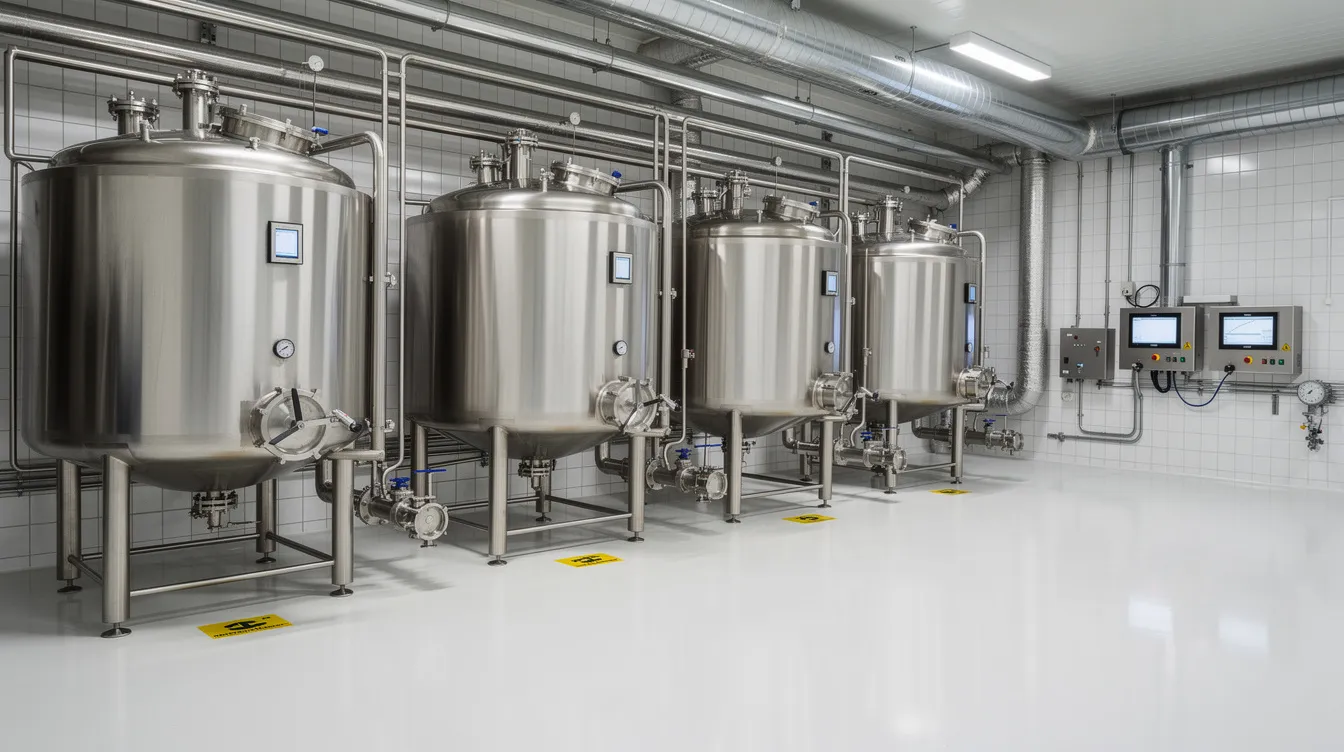
Machinery configuration and cost differ for a 1,000 L/day artisan unit, a 10,000 L/day MSME plant and a 50,000 L/day large automatic cheese factory. For capacity planning guidance, see Dairy Plant Capacity Planning. Flexible and modular systems allow scalability in cheese production; modular cheese making equipment allows for gradual expansion.
| Parameter | Small (1,000-2,500 L/day) | Medium (5,000-20,000 L/day) | Large (50,000+ L/day) |
|---|---|---|---|
| Pasteurisation | Batch | Continuous PHE | Continuous PHE |
| Cheese vat | Single, manual/semi auto | Multiple vats, PLC | Multiple large auto vats |
| Pressing | Manual/lever | Hydraulic | Automatic block-forming |
| Packaging | Manual pouch sealing | Semi auto vacuum | Automatic slice/MAP line |
| Automation | Low | Medium | High (SCADA) |
Industrial cheese processing machines support high-volume production. These systems can handle capacities up to 10,000 liters per day at medium scale; large plants handle multiples of that. Cheese yield varies with milk composition, variety and moisture content; no fixed recovery ratio should be assumed.
Terminology for investors: basic machinery price (ex-works) differs from delivered cost (including GST, freight), installed cost (erection, piping, commissioning) and total plant and machinery cost. The article on Dairy Plant Project Cost and Means of Finance explains how machinery cost fits into total project cost.
Indicative Cheese Plant Machinery Cost in India
All machinery cost figures below are indicative and based on typical Indian market conditions. They are not supplier quotations. Promoters must obtain current written quotations before submitting any DPR to a bank.
| Machinery Group | Small Plant (₹ lakh) | Medium Plant (₹ lakh) | Large Plant (₹ lakh) |
|---|---|---|---|
| Core milk-processing equipment | 25-60 | 75-200 | 200-500+ |
| Cheese vats and curd processing | 5-25 | 25-80 | 100-300+ |
| Pressing and brining | 5-20 | 20-80 | 100-200+ |
| Ripening rooms and refrigeration | 5-20 | 20-80 | 100-200+ |
| Cutting and packaging | 5-15 | 15-60 | 100+ |
| CIP and QC lab | 3-10 | 10-30 | 30-80+ |
| Utilities and support systems | 10-30 | 30-100 | 100+ |
A PMFME project report for a small unit handling approximately 1,000 L/day showed core machinery cost at about ₹23 lakh, constituting roughly 68-70% of fixed capital. Total cost of ownership includes installation costs, energy consumption and maintenance requirements. Main cost drivers include capacity, number and size of cheese vats, automation level, need for mozzarella or processed cheese machinery, and pack formats. Expenses excluded from many quotations: interconnecting pipelines, electrical cabling beyond machine terminals, civil foundations, utility connections and ETP.
Indian vs Imported Cheese Plant Machinery & Automation Levels
Both Indian and imported cheese plant equipment can meet technical requirements if properly specified. Neither category is automatically superior.
| Factor | Made in India | Imported |
|---|---|---|
| Initial investment | Lower | Higher |
| Customisation for Indian needs | Easier | Limited |
| Spare-parts availability | Faster | Longer lead time |
| After-sales service | Accessible across cities | May need expert visits |
| Documentation and training | Variable | Usually detailed |
Automatic cheese processing plants improve productivity and efficiency. Automatic cheese making systems use programmable logic controllers that automate mixing and heating processes. Modern systems ensure consistent product quality through digital controls, and automatic systems use energy-efficient motors to save energy. Automated systems improve hygiene by reducing manual handling.
Over-automation is financially inefficient for small cheese processing plants. Under-automation causes quality variation and labour problems at larger scale. Capacity-appropriate automation delivers the best return on investing.
Selecting the Right Cheese Plant Machinery for a Bankable Project
A practical selection framework from a project-finance perspective:
- Decide the product mix (mozzarella, cheddar, processed cheese, etc.)
- Estimate milk input and targeted cheese output per day
- Decide number of production batches
- Finalise pack sizes and distribution channels (retail vs HoReCa)
- Draw a process-flow diagram mapping machinery at each stage
- Calculate utility loads (steam, power, refrigeration, compressed air)
- Decide automation level based on capacity and budget
- Evaluate hygiene and cleanability (equipment must meet local and international food safety standards; cheese production equipment must comply with FDA and ISO standards)
- Check after-sales service, spare-parts support and expertise of suppliers
- Compare quotations on a like-for-like basis: same capacity, material of construction and automation scope
Layout and expansion considerations are discussed in Dairy Plant Land, Building and Infrastructure Requirements. Installed machinery cost has direct implications for depreciation, interest, working capital and DSCR calculations.
Machinery Quotations, DPR Presentation and Bank Finance
Banks expect a detailed machinery list with supplier quotations when assessing term-loan proposals for cheese processing plants. Each quotation should specify:
- Machine name, model and rated capacity
- Material of construction and material grade
- Motor rating, steam, water, refrigeration and air requirements
- Automation level and control-panel specifications
- Included accessories vs exclusions
- Warranty, performance guarantee and delivery period
- Installation, commissioning and training scope
Present machinery cost in the DPR as: basic price, GST, freight and insurance, installation and commissioning, electrical integration, pre-operative expenses and contingency. Financial projections are estimates based on assumptions, not “certified” outcomes. Related topics are covered in Dairy Processing Plant Bank Loan and Project Finance and Dairy Project Term Loan Assessment. Whether the proposed investment is commercially justified is analysed through Dairy Processing Plant Feasibility and Project Viability.
The lowest machinery price does not equal the lowest life-cycle cost; energy consumption, downtime, spare-parts cost and impact on product consistency and customer satisfaction must all be weighed.
Common Machinery-Planning Mistakes in Cheese Processing Plants
- Selecting machines before finalising cheese varieties and specific requirements
- Comparing quotations with different scopes (manual cheese vat vs automatic vat)
- Ignoring cheese yield calculations and batch cycle duration
- Undersizing refrigeration and ripening rooms
- Omitting whey handling and ETP from the budget
- Choosing packaging machinery that does not match the marketing plan
- Treating supplier quotations as all-inclusive when they exclude utilities and installation
- Assuming rated capacity equals reliable daily output
- Not verifying that electrical connected load, boiler capacity and refrigeration tonnage derived from quotations are realistically factored into utility design
- Failing to plan expansion bays in the building layout for future vats or packaging lines
Most of these mistakes can be avoided by integrating technical, financial and layout planning at the DPR stage itself, with reviews from both dairy engineers and finance professionals.
Practical Advisory from CA Manish Gugliya
From my project-finance practice since 2006, I have seen that correct cheese plant machinery configuration directly affects capital cost, operating margin, break-even point and term-loan repayment capacity. Four pieces of practical advice I offer clients consistently:
- Finalise the product mix before freezing machinery; a last-minute addition of mozzarella or processed cheese can redesign the entire plant.
- Never prepare a DPR without at least budgetary quotations from reliable cheese making machine manufacturers.
- Keep room in layout and utilities for a second cheese vat or additional packaging line; expansion costs far less when designed in from day one.
- Treat CIP, QC lab, ripening rooms and an efficient hygienic environment as essential, not optional, line items.
As a Chartered Accountant and project consultant, I help promoters interpret machinery quotations, test different capacity and automation scenarios, and structure bankable financial projections and CMA data. I encourage every promoter to engage both a technically competent dairy engineer and a finance professional early to avoid costly rework in cheese plant machinery planning.
Frequently Asked Questions
These answers are concise and indicative. Promoters should seek customised professional advice for specific projects and bank-loan applications.
What machinery is required for a basic cheese processing plant?
Core categories include milk reception and chilling, standardisation and pasteurisation equipment, cheese vats for coagulation, curd cutting and cooking tools, whey drainage tables/vats, moulds and presses, brining tanks, ripening/cold rooms, basic cutting and packaging equipment, CIP setup and essential utilities. Mozzarella or processed cheese variants need additional specialised machinery such as stretching machines or emulsification cookers.
How much does Cheese Plant Machinery & Equipment cost in India?
A small commercial cheese unit (around 1,000-2,500 L/day) may require plant and machinery in the range of ₹50 lakh to ₹1.50 crore depending on product type and automation. A medium automatic cheese production line handling 5,000-20,000 L/day can cross ₹2-5 crore. Prices depend on capacity, variety, automation, Indian vs imported equipment, stainless-steel grade and installation scope. Current supplier quotations are essential before any DPR submission.
What is the typical price range of a cheese vat machine in India?
Small manual cheese vats (a few hundred litres) may cost from approximately ₹1.50 lakh, while large automatic jacketed cheese vats of several thousand litres with PLC controls, designed for high capacity, cost several times more. These are order-of-magnitude comments only; promoters must obtain written quotations specifying capacity, material, automation and accessories.
Can one cheese production line handle multiple cheese varieties?
Many plants produce more than one variety on the same basic line by adjusting cultures, rennet dosage, curd cutting regime, cooking parameters, pressing and ripening conditions. Products like mozzarella and processed cheese require additional dedicated machinery. Proper batch scheduling, CIP protocols and process documentation are necessary to avoid cross-contamination and to meet food safety requirements.
Does a bank require machinery quotations for sanctioning a cheese plant loan?
Most banks and financial institutions require at least budgetary machinery quotations, especially when plant and machinery form the major part of term-loan utilisation. Attaching clear quotations from manufactured and reliable suppliers, a detailed machinery list and realistic cost estimations in the DPR improves proposal credibility and helps in term-loan assessment and DSCR analysis. A practising Chartered Accountant can assist in structuring this documentation for submission. For a customised cheese manufacturing plant project report, CMA data, financial projections and bank-finance planning, contact CA Manish Gugliya through ProjectReportBank.
Continue Exploring Our Cheese Project Guides
Explore all 17 guides covering cheese plant setup, products, financial planning, feasibility, bank loans and DPR preparation.