
Key Takeaways
- A cheddar cheese manufacturing plant in India is both capital and working-capital intensive due to high daily milk procurement, specialised cheese-making and pressing equipment, and a ripening cycle that can lock inventory for 2–12 months before any revenue is realised.
- Plant capacity must be planned around assured milk supply, expected cheese yield (typically 10–11% under Indian conditions), adequate cold storage for maturation, and confirmed market off-take from QSRs, HoReCa buyers and food processors.
- The industrial cheddar cheese manufacturing process involves standardised milk, controlled fermentation with starter cultures, cheddaring, pressing, vacuum packing and ripening under strict temperature and humidity conditions.
- Project viability depends on realistic cheddar cheese production cost estimates, a bankable DPR with income and expenditure projections, adequate working capital and prudent use of term loans and subsidies.
- CA Manish Gugliya and ProjectReportBank.com assist entrepreneurs in preparing customised Cheddar Cheese Manufacturing Plant project reports, financial projections, CMA Data and bank-loan documentation.
Introduction: Cheddar Cheese Manufacturing Opportunity in India
Cheddar cheese demand in India has expanded sharply since 2018, driven by quick-service restaurants, pizza and burger chains, frozen-snack manufacturers, hotels, cloud kitchens and modern retail. The increasing demand for natural cheese over simple processed cheese slices has created genuine investment opportunities for dairy companies and MSME promoters willing to invest in cheese production infrastructure.
However, cheddar cheese manufacturing is far more complex than making fresh paneer or simple cheese. It requires precise milk standardisation, controlled fermentation, a dedicated cheddaring step, hydraulic pressing, vacuum packaging, and temperature- and humidity-controlled ripening rooms for months. Milk quality, microbial control, starter cultures, pH monitoring, moisture and salt levels must all be managed consistently in an industrial cheese manufacturing plant. Unlike short-cycle dairy products, cheddar ties up working capital in maturing inventory for months.
This article serves as a complete roadmap-covering plant setup, the cheddar cheese manufacturing process, machinery requirements, project cost, working capital, bank finance and feasibility-written from my perspective as a practising Chartered Accountant and project finance consultant with over 20 years of experience in DPR preparation and food-processing project appraisal.
What Is Cheddar Cheese? (and How It Differs from Other Cheeses)
Cheddar cheese is a firm, natural cow-milk cheese distinguished by its smooth body, characteristic flavour and a specific cheddaring step during production. It differs fundamentally from products made in a processed cheese manufacturing plant, where melting salts, emulsifiers and blended dairy ingredients are used. Natural cheddar relies on milk, cultures, rennet, salt and time.
Cheddar categories include mild (aged roughly 2–3 months), medium (4–6 months), mature (9–12 months) and extra-mature (12–18+ months). Flavour sharpness and price generally increase with age. Commercial formats range from 20 kg vacuum-packed blocks and 5 kg loaves to 200–500 g retail blocks, sliced cheese, shredded and grated cheddar-each requiring different packaging requirements and often additional cutting or shredding equipment.
Compared to a mozzarella cheese manufacturing plant, where mozzarella is a fresh, stretched-curd cheese with very short maturation, cheddar is a ripened, non-stretched cheese with significantly longer inventory holding. Typical culinary applications include pizza cheese blends, burgers, sandwiches, bakery fillings, sauces, frozen foods and institutional packs for HoReCa and food processors.
Market Potential for Cheddar Cheese in India
The Indian cheese market was valued at approximately USD 1,869 million in 2025 and is expected to grow at a CAGR of around 10.3% through 2031, according to Ken Research. For context, the global cheese market was valued at USD 98.0 billion in 2025, underscoring the total size of the opportunity worldwide.
Market segmentation in India spans bulk 10–20 kg cheddar blocks for QSRs and food-service distributors, B2B supplies to food-processing companies, and branded retail packs sold through supermarkets and e-commerce. Industry trends point toward import-substitution potential: domestic cheddar can replace imported blocks if quality standards, microbiological parameters and consistency match institutional buyers’ specifications. Export possibilities to Middle East and South Asian markets also exist, subject to destination-country certifications and cold-chain logistics.
Key players like Parag Milk Foods have committed ₹105 crore of capex in 2026 to double cheese capacity to 120 MT/day, reflecting confidence in future growth. Promoters should evaluate regional milk availability, competition from existing cheese plants and strength of cold-chain infrastructure before finalising capacity.
Cheddar Cheese Manufacturing Plant Capacity Planning
Plant capacity is usually expressed in litres of milk processed per day, kg or tonnes of cheddar cheese produced per day, or annual installed production capacity. Large-scale cheddar cheese plants can produce 90 to 110 tonnes daily, consuming approximately 900,000 litres of milk. Annual production capacity for cheese plants ranges from 5,000 to 10,000 MT at the industrial level.
Cheese yield depends on fat content and SNF of milk, process control, target moisture and manufacturing losses-so output cannot be safely estimated using a single fixed conversion ratio. Factors affecting capacity include assured milk procurement, seasonal variation in milk composition, number and size of cheese vats, production shifts, automation level and the expected maturation period.
Adequate ripening-room and cold-storage capacity to hold 2–12 months of production is essential. As an illustrative example: a plant handling 20,000 L/day of milk with fat at approximately 4.2% and SNF at 8.5–8.8% may yield roughly 10.5–11%, translating to approximately 2,100–2,200 kg of cheddar daily. Over 300 working days, this gives an indicative annual output of around 630–660 MT. These figures are illustrative and depend entirely on yield assumptions and process efficiency.
Raw Materials and Quality Requirements
The raw material requirements for a cheddar cheese plant include:
- Fresh cow milk (or standardised milk) as the primary input
- Starter cultures (mesophilic strains such as Lactococcus lactis)
- Rennet or approved microbial coagulant
- Salt, calcium chloride (where required) and food-grade colour (if used)
- Potable water meeting quality standards
Consumables include cleaning and sanitation chemicals, vacuum pouches, multilayer films, corrugated cartons, labels and pallets. Raw milk is tested for quality and antibiotics at reception, along with fat, SNF, acidity, total plate count and adulteration. Poor-quality milk directly affects cheddar texture, shelf life and yield. Long-term supply agreements with cooperatives or chilling centres help ensure consistency, provided robust testing and rejection criteria are maintained.
Cheddar Cheese Manufacturing Process (Step-by-Step)
The industrial cheddar cheese manufacturing process involves various unit operations that must be carefully sequenced and monitored.
Milk reception and standardisation. Fresh milk is received, filtered and chilled. It is then standardised to achieve the desired protein-to-fat ratio-typically a casein-to-fat ratio of around 0.65–0.75 in Indian practice. The milk is heated to destroy harmful bacteria during pasteurisation, commonly at 72°C for 15 seconds (HTST), and then cooled to inoculation temperature (approximately 30–33°C).
Culture addition and coagulation. Starter cultures convert lactose into lactic acid, acidifying the milk over roughly one hour. Rennet is added to coagulate the milk into a firm gel, with setting typically at 32°C for 30–60 minutes.
Curd cutting and cooking. Curds are cut into small cubes using curd knives to separate the liquid whey. The curds are then gently heated while being stirred-cooking temperature reaches about 38–40°C over 30–45 minutes to expel moisture without matting.
Whey separation and cheddaring. The whey is drained away from the curds. The curds are pressed into large slabs during cheddaring-the defining step that develops cheddar’s characteristic texture and flavor. Slabs are stacked, turned every 15 minutes and monitored for pH (target approximately 5.3–5.5) until the desired acidity is reached.
Milling, salting and pressing. Curds are milled into smaller pieces before salting. Salt is added to stop acid production and enhance flavor, typically at around 2% dry salt. Salted curds are pressed into molds to form solid blocks-commonly 20 kg blocks using hydraulic or pneumatic presses-then vacuum packed and coded.
Maturation and dispatch. Blocks enter ripening chambers for controlled aging. All process parameters-time, temperature, pH, moisture and salt-should be finalised with an experienced dairy technologist and equipment supplier before commercial start-up.
Indicative Cheddar Cheese Process Flow
The various unit operations in a cheddar cheese production line can be summarised as follows:
Milk Reception → Testing → Standardisation → Pasteurisation → Culture Addition → Coagulation → Curd Cutting → Cooking and Stirring → Whey Drainage → Cheddaring → Milling → Salting → Moulding → Pressing → Vacuum Packaging → Maturation → Cold Storage → Cutting / Shredding → Dispatch
Smaller plants may combine certain unit operations, while larger automated facilities have dedicated equipment for each step.
Machinery and Equipment for a Cheddar Cheese Manufacturing Plant
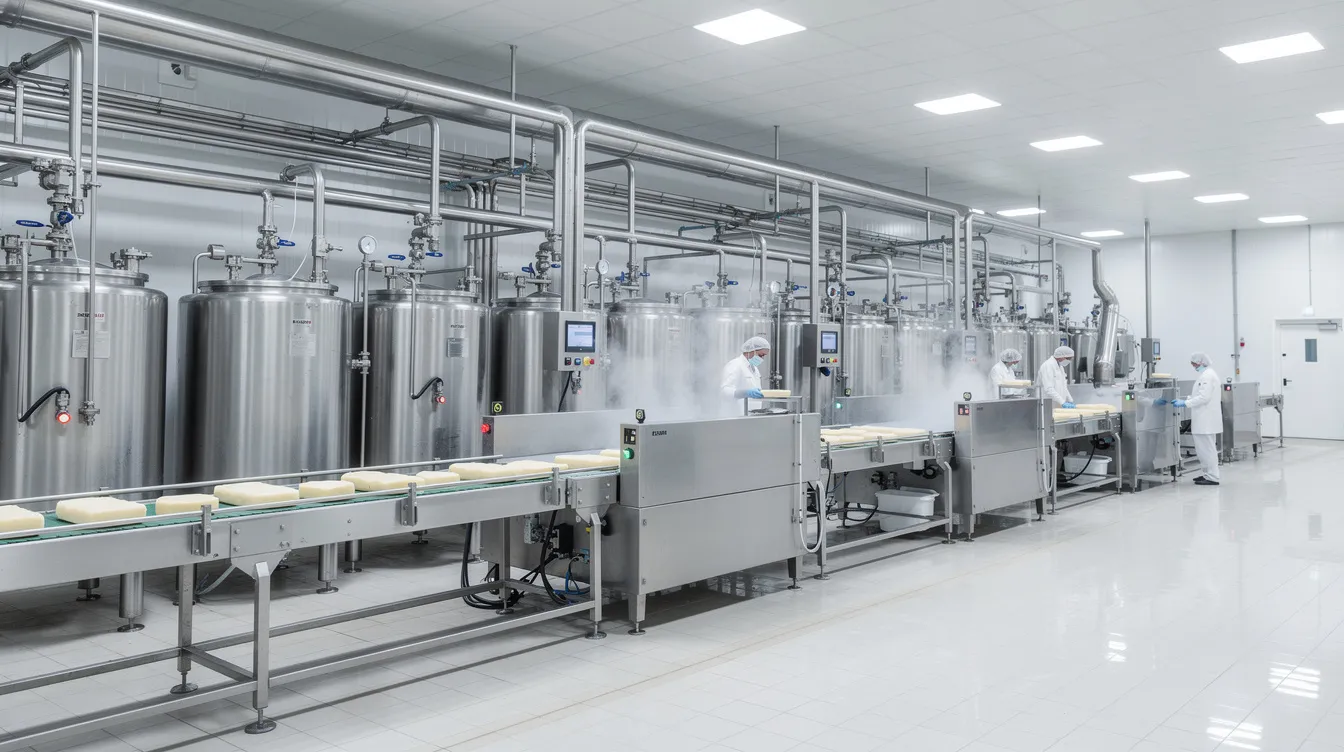
Cheddar cheese plant machinery spans milk-handling equipment, cheese vats, cheddaring systems, presses, packaging machines, ripening rooms and utilities. Machinery requirements and specifications vary by capacity, automation level and final product format.
Key equipment includes:
- Milk reception dock, weigh bowl, filters, storage tanks, chillers
- Cream separator, pasteuriser (HTST or batch), standardisation tanks
- Cheese-making vats with agitation and heating-each Tetra Tebel OST cheese vat holds approximately 22,500 litres, while modern cheese production lines can handle batch sizes up to 10,000 litres
- Curd knives, whey drainage system, cheddaring tables or mechanised cheddaring and salting belts
- Curd mill, salting and mixing equipment, cheese moulds
- Hydraulic or pneumatic cheese press; Alfa Laval cheese blockformers can produce 750 kg per hour for high-capacity plants
- Vacuum-packaging machines, block cutting and portioning units, slicers, shredders and labelling equipment
Industrial cheese processing machines are made from 304 or 316 stainless steel to meet food-safety and hygiene standards. Support systems include ripening chambers, cold rooms, refrigeration plant, CIP system, boiler, compressed-air system, water-treatment plant, laboratory equipment, whey handling system and effluent-treatment plant.
Promoters should obtain updated quotations for capacity-wise machinery configuration; a helpful reference is the detailed breakdown of cheese plant machinery and equipment cost.
Land, Building and Infrastructure Layout
Land required for a cheddar cheese manufacturing plant depends on capacity-a small plant may need roughly half to one acre, while larger integrated plants require significantly more. Key building zones include milk reception and chilling area, processing hall with cheese vats, cheddaring and pressing section, packaging room, ripening chambers, finished-goods cold store, laboratory, utilities block and administrative office.
Hygienic zoning is critical: separate raw and pasteurised milk areas, controlled personnel movement, washable floors and walls, adequate drainage and pest-control measures. A designated area for whey collection, effluent-treatment plant and treated-water discharge must comply with local regulations.
Utilities Requirement and Energy Considerations
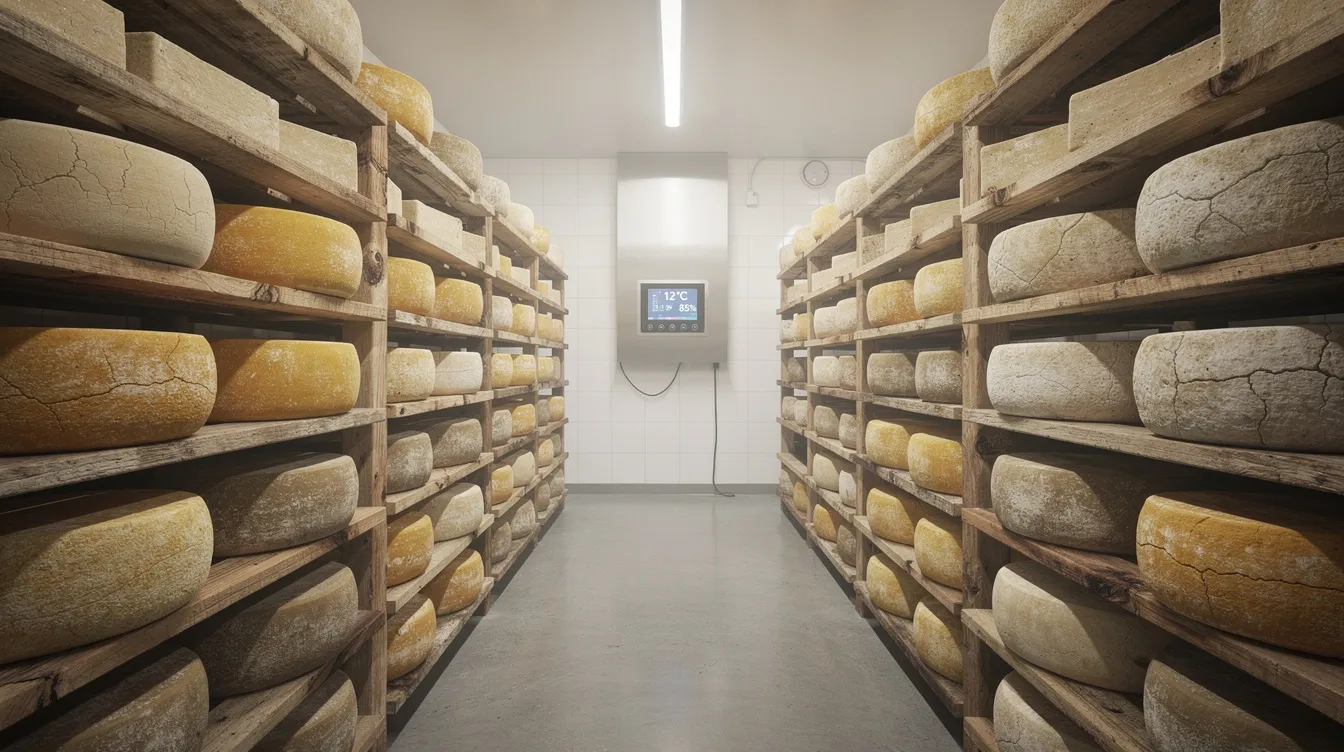
Major utility requirements include electricity, steam, hot water, chilled water, refrigeration for ripening rooms and cold rooms, compressed air, potable and process water, and backup power for critical loads. Cheddar cheese ripening chambers operate at controlled temperature and humidity for several months, making refrigeration and insulation design a key long-term operating-cost factor.
DPR preparation should include approximate utility load estimates-connected kW, TR of refrigeration, boiler capacity in kg/hr-based on machinery vendor data. Online temperature and humidity monitoring in ripening rooms is essential, and preventive maintenance programmes help avoid costly product losses.
Ripening, Maturation and Inventory Management
Cheddar cheese requires controlled maturation to develop flavour, texture and sliceability. Aging takes place in temperature-controlled environments, typically at 4–12°C with controlled relative humidity (around 65%). Cheddar cheese can be aged for a few months to several years-mild cheddar matures in about 2–3 months, mature variants in 9–12 months, and extra-mature potentially 18+ months. During aging, enzymes and bacteria break down proteins and fats, developing the characteristic sharp flavour profile.
Product coding, batch identification and FIFO stock rotation are necessary to manage multiple maturation batches. In financial terms, holding large volumes of cheese in maturation ties up working capital-milk cost, processing cost, packaging and overheads-for extended periods before sale. Risk-mitigation measures include insurance coverage, backup refrigeration, temperature-deviation alarms and documented handling procedures.
Whey Management and By-Product Utilisation
Whey is a significant by-product of cheddar cheese production, containing lactose, whey proteins and minerals. After whey separation during the cheese-making process, practical options include selling liquid whey for animal feed, producing whey-based beverages, or supplying to plants manufacturing whey protein concentrate. Commercial viability depends on local demand, logistics, and additional equipment investment. Where no viable commercial option exists, proper effluent treatment and disposal is mandatory.
Cheddar Cheese Plant Setup Cost in India (CAPEX Structure)
Cheddar cheese plant investment cost varies widely depending on capacity (e.g., 5,000 L/day versus 50,000 L/day), automation level, ripening capacity, building specifications and location. Capital expenditure includes machinery costs and land development expenses, along with:
- Site development, factory building and civil works
- Process and cheese-making machinery, cheddaring and pressing systems
- Ripening rooms, cold storage and refrigeration plant
- Laboratory and quality-control equipment, ETP, electrical installations
- Office infrastructure, technical consultancy, preliminary and pre-operative expenses including interest during construction
- Contingency provision for price escalations and unforeseen expenses
As a reference, small PMFME-scheme cheese units have been set up at around ₹33–35 lakh, while large-scale integrated dairy-cheese plants with capacities of 50,000–100,000 LPD have capital investments in the range of ₹60–104 crore. These are indicative figures-entrepreneurs must obtain up-to-date quotations and local construction estimates. For a broader cost-structure understanding, promoters can refer to the detailed guide on cheese manufacturing plant setup cost in India.
Working Capital Requirement for a Cheddar Cheese Manufacturing Business
Working capital is critical for cheddar cheese manufacturing because of high daily milk purchases and the long period between production and sales realisation. Key components include raw-material inventory, work-in-process, the large volume of cheese in ripening rooms, finished-goods stock, trade receivables and minimum cash balances.
Operating expenses to be covered include wages, electricity, refrigeration power, repairs, quality-control costs, marketing and transportation requirements. Supplier credit terms and institutional buyer payment cycles significantly influence net working-capital needs. A realistic assessment-including the full value of maturing inventory-is essential when negotiating cash-credit limits or working-capital term loans with banks.
Revenue Model and Product Mix Options
Revenue streams for a cheddar cheese plant typically include bulk blocks sold to QSRs and B2B customers, institutional packs for hotels and caterers, retail packs under own brand, co-packing or private-label production, and limited realisation from whey by-products where feasible.
Bulk block sales carry lower margins but higher volumes and simpler packaging requirements. Value-added sliced or shredded cheddar earns better realisation per kg but involves higher packaging, marketing and distribution costs. The pricing mechanism and capacity planning should align with the intended product mix to avoid bottlenecks in any single operation.
Operating Cost and Profitability Drivers
Operating costs are primarily driven by raw material consumption, especially milk. Milk accounts for 70–80% of cheese plant operating expenses, making procurement price and cheese yield the most critical profitability drivers.
Other variable costs include starter cultures, rennet, salt, direct labour, electricity and refrigeration, boiler fuel, packaging material and quality-control expenses. Overheads cover administration, sales and marketing, cold-chain logistics, insurance and regulatory compliance. Cheese plant gross profit margins typically range from 30–40%, but a ₹1/litre change in milk price or a 0.5% shift in process yield can materially alter EBITDA. Price trends in both raw milk and finished cheese should be monitored closely.
Financial Projections and Viability Assessment
A cheddar cheese plant DPR normally contains 5–10 year financial projections covering projected production and sales, revenue, raw-material consumption, employee cost, utilities, manufacturing overheads, projected profit and loss account, cash-flow statement and projected balance sheet. Financial analysis includes break-even analysis, DSCR, IRR, expected ROI, net present value, payback period and sensitivity analysis on milk prices, selling prices and capacity utilisation.
Profit projections and a loss account must be internally consistent and supported by market assessment, machinery quotations, milk procurement plans and promoter inputs. A practising Chartered Accountant can prepare and refine CMA Data and financial projections, but actual results depend on market conditions and promoter execution.
Means of Finance and Bank Loan for a Cheddar Cheese Plant
Project funding typically combines promoter’s equity contribution, bank term loan for fixed assets and working-capital limits. Additional components may include unsecured promoter loans and eligible government subsidy or capital assistance schemes.
Banks assess promoters’ background and experience, net worth, credit history, milk procurement strategy, market linkage, plant capacity, machinery quotations, project-cost break-up, DSCR, security, collateral and statutory approvals. No professional can guarantee loan sanction or subsidy approval, but a well-prepared Cheddar Cheese Manufacturing Plant Project Report with realistic capital costs and capital investments significantly reduces queries during appraisal and improves clarity.
Licences and Statutory Approvals Required in India
Key regulatory procedures and key certifications required depend on state, capacity and product range. Common registrations include:
- Business constitution, PAN, GST and Udyam registration
- FSSAI licence for cheddar cheese manufacturing
- Factory licence, consent to establish and operate from State Pollution Control Board, fire-safety clearance
- Boiler registration, electrical safety clearances, ESI and EPF registrations
- Legal Metrology compliance for packaged retail products, trademark registration
- Import Export Code (IEC) if exports or machinery imports are planned
Regulatory compliance requirements should be verified with competent authorities and professional advisers before plant setup.
DPR and Project Report for a Cheddar Cheese Manufacturing Plant
Banks expect a detailed, bankable DPR-not a generic template. Key contents include promoter profile, industry overview and cheddar cheese market in India analysis, detailed description of the manufacturing process and plant layout, capacity planning, raw-material and milk procurement plan, list of machinery and utilities, human resource requirements, and implementation schedule.
Financial components cover project economics including detailed project-cost estimate, means of finance, working-capital assessment, projected financial statements, break-even analysis, DSCR, IRR and sensitivity analysis. ProjectReportBank.com prepares customised Cheddar Cheese Manufacturing Plant project reports and DPRs based on real quotations and promoter inputs, not generic templates.
Risk Factors and Feasibility Considerations
Cheddar cheese projects can be viable when executed well, but risk factors deserve careful evaluation:
- Seasonal milk availability and price volatility
- Inconsistent milk quality leading to lower-than-expected cheese yield
- Microbial contamination causing batch rejection
- Refrigeration or power failures affecting ripening stock
- Long inventory holding periods tying up capital
- Dependence on a few large institutional buyers, price competition and delayed receivables
Mitigation strategies include diversified milk procurement, preventive maintenance with backup power, HACCP implementation, adequate insurance, phased capacity expansion and conservative financial projections with stress testing. Promoters may begin with a moderate-capacity plant and expand after achieving stable supply and assured off-take-a key success factor for long term success in the dairy industry.
Frequently Asked Questions (FAQs)
The following addresses key questions commonly raised by entrepreneurs planning a cheddar cheese manufacturing plant in India.
How much does it cost to establish a cheddar cheese manufacturing plant in India?
Project cost varies significantly with capacity, automation, ripening infrastructure and location. A small unit under schemes like PMFME may start at around ₹30–35 lakh, while a medium-to-large cheddar cheese processing plant handling 20,000–50,000 L/day milk can require multi-crore investment. Detailed costing should be developed in a customised project report using current quotations and local construction rates.
How much milk is needed to produce one kilogram of cheddar cheese?
The milk-to-cheese ratio depends on milk fat content, SNF, process control and target moisture. Under typical Indian plant conditions with milk at roughly 4.2% fat and 8.5–8.8% SNF, yield is approximately 10–11%, meaning roughly 9–10 litres of milk per kg of final product. Promoters should base projections on yield assumptions agreed with their dairy technologist, not a single fixed thumb rule.
How long does cheddar cheese take to mature?
Mild cheddar typically matures in about 2–3 months under controlled conditions. Mature cheddar may need 9–12 months, while extra-mature variants can require 18 months or more. Longer maturation increases working-capital requirements but can command higher selling prices if market demand exists for aged cheddar.
What is the difference between cheddar, mozzarella and processed cheese?
Cheddar is a firm, ripened cheese produced through cheddaring and long maturation. Mozzarella is a fresh, stretched-curd cheese with very short holding time. Processed cheese is made by blending natural cheese with emulsifying salts and other ingredients. Each category needs different process parameters, machinery and inventory cycles, and must be reflected in the respective project reports and financial projections.
Can a bank loan be obtained for a cheddar cheese manufacturing project?
Yes, banks and financial institutions regularly finance food-processing projects including cheese plants. However, sanction depends on promoter net worth, experience, credit history, market linkage, project feasibility, DSCR and collateral adequacy. A professionally prepared DPR with realistic projections and supporting documents strengthens the application but does not guarantee approval.
Conclusion and Professional Assistance
A cheddar cheese manufacturing plant can be a viable value-added dairy venture in India when supported by reliable milk procurement, appropriate technology, sound process control, properly designed ripening rooms and disciplined cold-chain management. Market growth driven by QSRs, food processors, modern retail and import substitution creates genuine investment opportunities for well-prepared promoters.
Success depends on realistic assessment of cheddar cheese production cost, adequate working capital for maturing inventory, strong quality systems, assured market linkages and prudent financial planning with conservative projections. Every project is unique-and the DPR must reflect actual capacity, quotations, location and the promoter’s specific market strategy.
I assist entrepreneurs, dairies and MSME promoters through ProjectReportBank.com in preparing customised Cheddar Cheese Manufacturing Plant DPRs, project reports, CMA Data, financial projections, feasibility studies and bank-loan documentation. No guarantee is given regarding finance, subsidy, profitability or approvals-but a well-prepared project report is the foundation of every successful venture.
Continue Exploring Our Cheese Project Guides
Explore all 17 guides covering cheese plant setup, products, financial planning, feasibility, bank loans and DPR preparation.