Key Takeaways
- A processed cheese manufacturing plant is a conversion facility that transforms natural cheese into value-added products such as blocks, slices, spreads and portions through controlled heating, emulsification and forming – an operation fundamentally different from setting up a generic cheese factory that produces natural cheese from milk.
- Project cost and profitability in India depend primarily on the landed cost of natural cheese, selected plant capacity (commonly 2–10 TPD for new entrants), level of automation on the processed cheese production line and the chosen product mix of blocks, slices and spreads.
- A bankable processed cheese plant DPR must include a location-specific market study, technical configuration with supplier quotations, detailed project cost, means of finance, working-capital assessment, projected financials with DSCR, and risk analysis – all tailored to the specific promoter and site.
- Multiple licences and registrations – especially an FSSAI licence, Factory Licence, Pollution Control consent, fire-safety NOC and municipal approvals – along with a robust food-safety system are mandatory before commercial production can begin.
- Promoters seeking professional support can engage CA Manish Gugliya, FCA, through ProjectReportBank.com for customised DPR preparation, CMA data, financial projections and structured guidance for processed cheese project finance and bank-loan proposals.
Introduction to Processed Cheese Manufacturing Plant
A processed cheese manufacturing plant produces a range of value-added dairy products by blending one or more natural cheeses with dairy ingredients, water, emulsifying salts and other permitted additives, then cooking and forming the mixture into stable, consumer-ready formats. If you are evaluating this business in India – whether for blocks, individually wrapped slices, spreadable tubs or portion-packed triangles – this article covers the practical aspects of project cost, manufacturing process, machinery, licensing and financial planning you need to understand before committing capital.
Processed cheese is commercially important because cheese processing extends product shelf life and improves quality consistency compared with many natural cheese formats. It offers uniform melt, convenient portion sizes and predictable behaviour in cooking – qualities that matter to households, hotels, restaurants, cafés (HORECA), quick-service restaurant (QSR) chains, bakeries, snack manufacturers and institutional caterers. Cheese processing plants improve productivity and efficiency for dairy businesses looking to move up the value chain from commodity milk to branded consumer products.
Unlike a general cheese production unit that starts with raw milk and goes through coagulation, curd handling, pressing and ripening, a processed cheese factory is essentially a conversion plant. It relies heavily on the procurement of quality natural cheese as its primary input and on precise process control during emulsification, cooking and packaging. This distinction has significant implications for project planning, raw-material sourcing and working-capital management.
This article is written from the professional perspective of CA Manish Gugliya, FCA, an experienced project-finance and DPR consultant associated with ProjectReportBank.com. The guidance here is designed to help entrepreneurs, dairy companies and investors prepare a realistic project report and financial model for a processed cheese manufacturing business in India. All cost figures, capacities and financial parameters discussed are indicative and must be verified from current supplier quotations and official sources before investment decisions.
What Is Processed Cheese? Definition, Composition and Comparison
Processed cheese is a homogeneous dairy product made by melting and emulsifying one or more natural cheeses with water, dairy fats, milk solids, emulsifying salts and permitted seasonings under controlled heat and shear. The result is a stable, smooth product with a predictable texture and melt profile – something natural cheese, with its inherent variability from batch to batch, cannot always guarantee.
Processed cheese contains natural cheese as the main ingredient. It is not made directly from milk. Instead, it takes already-manufactured cheese – typically cheddar or other hard and semi-hard varieties – and converts it into a new product through a secondary manufacturing process. The whole process is fundamentally about transforming the protein-fat-moisture matrix of natural cheese into a stable emulsion that can be formed into blocks, slices or spreads.
Key Compositional Elements
- Processed cheese typically contains 30–45% fat by total solids, with FSSAI standards specifying minimum fat on a dry-matter basis (around 40% for plain processed cheese blocks).
- Maximum moisture for processed cheese blocks is generally 47% by mass. For processed cheese spreads, revised FSSAI standards allow moisture up to 60%.
- The pH of processed cheese should be in the range of 5.4–5.9 for quality. pH directly affects texture, meltability and shelf life – lower pH produces a firmer, less meltable product.
- Whey protein is often included to enhance protein content in processed cheese, along with milk powder and milk protein concentrates.
- Unlike cheese analogues, where milk fat may be partly or fully replaced by vegetable fat, genuine processed cheese under Indian food standards must use dairy milk fat and dairy protein.
Role of Emulsifying Salts
Emulsifying salts – typically sodium phosphates, citrates and polyphosphates – play a crucial role in processed cheese manufacturing. They solubilise casein, bind fat, stabilise the oil-in-water emulsion and enable the smooth texture and uniform melt that consumers expect. Without these emulsifying agents, the cheese would separate into an oily, grainy mass during cooking. The combination of heat, shear, and emulsifying salts transforms cheese proteins, stabilising fat and water into a cohesive product.
How Processed Cheese Differs from Natural Cheese Making
The distinction between primary cheese manufacturing and secondary processed cheese manufacturing is fundamental:
- In natural cheese making, milk is standardised and pasteurised. Starter cultures and rennet are added. Curds are formed by adding rennet to milk at approximately 30°C. The curds are then cut into small grains to facilitate whey expulsion, and whey is drained from the curds during the cheesemaking process. The cheese is pressed, salted and aged – sometimes for weeks to years – to develop flavour and texture. This coagulation process takes place in a cheese vat and involves managing non starter bacteria and starter cultures carefully.
- In processed cheese manufacturing, the starting point is already-made natural cheese. There is no curd setting, no pressing, no ripening. The operation involves grinding, blending, cooking, emulsifying and forming. The skill lies in formulation, batch standardisation and process control rather than in microbiology and ageing.
Comparison Table: Types of Cheese
| Parameter | Natural Cheese (e.g., Cheddar) | Processed Cheese | Mozzarella | Cheese Spread |
|---|---|---|---|---|
| Main Input | Milk → curd → cheese | Natural cheese + emulsifiers + dairy ingredients | Mozzarella-style curd, stretched (pasta filata) | Natural cheese + water + stabilisers |
| Manufacturing Route | Coagulation, pressing, ripening | Grinding, melting, emulsification, forming | Stretching in hot water, moulding | Similar to processed cheese, higher moisture |
| Moisture Range | ~35–40% | Up to ~47% (blocks), ~60% (spreads) | ~50–60% (high-moisture types) | ~55–65% |
| Fat Content (dry basis) | High, varies by type | Min ~40% (blocks) | Varies by format | Similar or slightly lower |
| Melt Behaviour | Natural melt, may oil off | Uniform, stable melt | Stretchy, pulling threads | Melts readily, less structure |
| Typical Uses | Table cheese, cooking, gratins | Burgers, sandwiches, toast, sauces | Pizza, pasta, salads | Spreading, dips, cooking |
| FSSAI Category | Cheese (1.6.2) | Processed Cheese (1.6.4) | Mozzarella Cheese standards | Processed Cheese Spreads |
If your interest is specifically in pizza-style cheese, you may want to review our guide on Mozzarella Cheese Manufacturing Plant, which covers the pasta filata process and related equipment in detail.
Processed Cheese Product Range and Formats
The product mix you choose for your processed cheese production plant will directly shape your machinery selection, packaging lines, plant layout and working-capital requirement. Trying to launch every possible format simultaneously is a common mistake; a well-designed processed cheese business plan should define a focused initial product mix with clear market demand.
Major Product Categories
- Processed cheese blocks – typically 200 g, 400 g, 500 g and 1 kg retail packs, plus 2.5 kg and 5 kg institutional packs
- Individually wrapped cheese slices – the dominant retail format in India, used for burgers, sandwiches and toast
- Processed cheese spreads in tubs or cups – 100 g to 500 g, growing rapidly in value terms
- Portion-packed triangles or chiplets – convenient single-serve formats
- Cheese cubes – snacking and salad applications
- Cheese sauce base – for food service and QSR back-kitchens
- Flavoured variants – chilli, herbs, garlic, peri-peri and other new flavors that target younger consumers
- Institutional bulk packs – 5 kg or 10 kg blocks for QSR chains and food manufacturers
Types of processed cheese such as spreads, blocks and slices each demand different hot-filling temperatures, forming equipment and cooling regimes. A slice-forming line with individual wrapping is a fundamentally different machine from a cup-filling and sealing line for cheese spreads. Cream cheese, cottage cheese and soft cheeses fall under separate categories and require distinct manufacturing routes – they should not be confused with processed cheese.
Institutional bulk packs can provide large volumes at lower per-kg margins, while retail slices and spread products typically command better realisation but carry higher packaging, marketing and distribution costs. Your DPR should model these differences explicitly.
Market Potential for Processed Cheese in India
Demand Drivers Specific to Processed Cheese
The cheese market is driven by rising consumer demand for dairy products, urbanisation, westernised food habits and the expansion of organised food-service channels. In India, processed cheese remains the most popular cheese type by volume, led by slices and blocks for home and QSR usage.
The overall India cheese market was valued at approximately INR 88.9 billion in 2023 and is projected to reach INR 512.1 billion by 2032, according to IMARC Group. Within this, the processed cheese segment (including spreadable and other formats) accounted for an estimated INR 41,524 million in 2023. Spreadable processed cheese is reported to be the fastest-growing sub-segment by value CAGR.
For global context, the global cheese market was valued at USD 98.0 billion in 2025 and is expected to reach USD 153.08 billion by 2034, underlining the structural growth trend in cheese demand worldwide.
Key Customer Segments
- Household retail buyers purchasing slices, spreads and blocks through modern trade and e-commerce
- Hotels, restaurants and cafés requiring blocks, sauce bases and bulk packs
- QSR chains needing burger cheese slices and pizza-topping cheese in consistent quality
- Bakeries and snack manufacturers using cheese as a filling, topping or ingredient
- Food-processing companies sourcing processed cheese for ready-to-eat and frozen foods
- Private-label buyers and contract-manufacturing clients from large retail chains
What a Feasibility Study Should Cover
A processed cheese plant feasibility study should include region-wise cheese demand assessment, competitor mapping (identifying key players in your target geography), pricing analysis for each product format, identification of institutional buyers or private-label opportunities near the proposed plant location, and assessment of cold-chain infrastructure for distribution. Industry trends such as the expansion of QSR chains post-2020 and the competitive landscape among existing brands should inform your market assumptions.
Processed Cheese Manufacturing Process: Step-By-Step Explanation
The manufacturing process for processed cheese is a controlled conversion operation. Here is a simplified flow:
Natural cheese reception → chilled storage → trimming and grinding → batch formulation → addition of water, dairy ingredients and emulsifying salts → cooking and emulsification → homogenisation / vacuum treatment → hot filling / forming → cooling → packaging and sealing → metal detection and inspection → cold storage → dispatch
Main Stages Explained
1. Selection and Inspection of Natural Cheese Incoming natural cheese lots (typically cheddar or blends of hard cheese and semi-hard cheese) are inspected for moisture, fat content, pH, flavour profile and microbiological quality. Young cheese and mature cheese are selected in ratios that will achieve the desired taste and texture in the final product.
2. Cleaning, Trimming and Preparation Surface mould, rind and any damaged portions are trimmed. The cheese blocks are then cut, shredded or fed into a cheese grinder to produce uniform particles that melt evenly during cooking.
3. Formulation and Batch Standardisation Each batch is formulated to achieve target moisture, fat (dry basis), salt and pH values. Water is added to balance moisture in processed cheese. Additional ingredients – butter, cream, skimmed milk powder, whey proteins, emulsifying salts, common salt, permitted stabilisers and flavourings – are weighed and staged for addition. This step is where the formulation expertise of the process technologist is most critical.
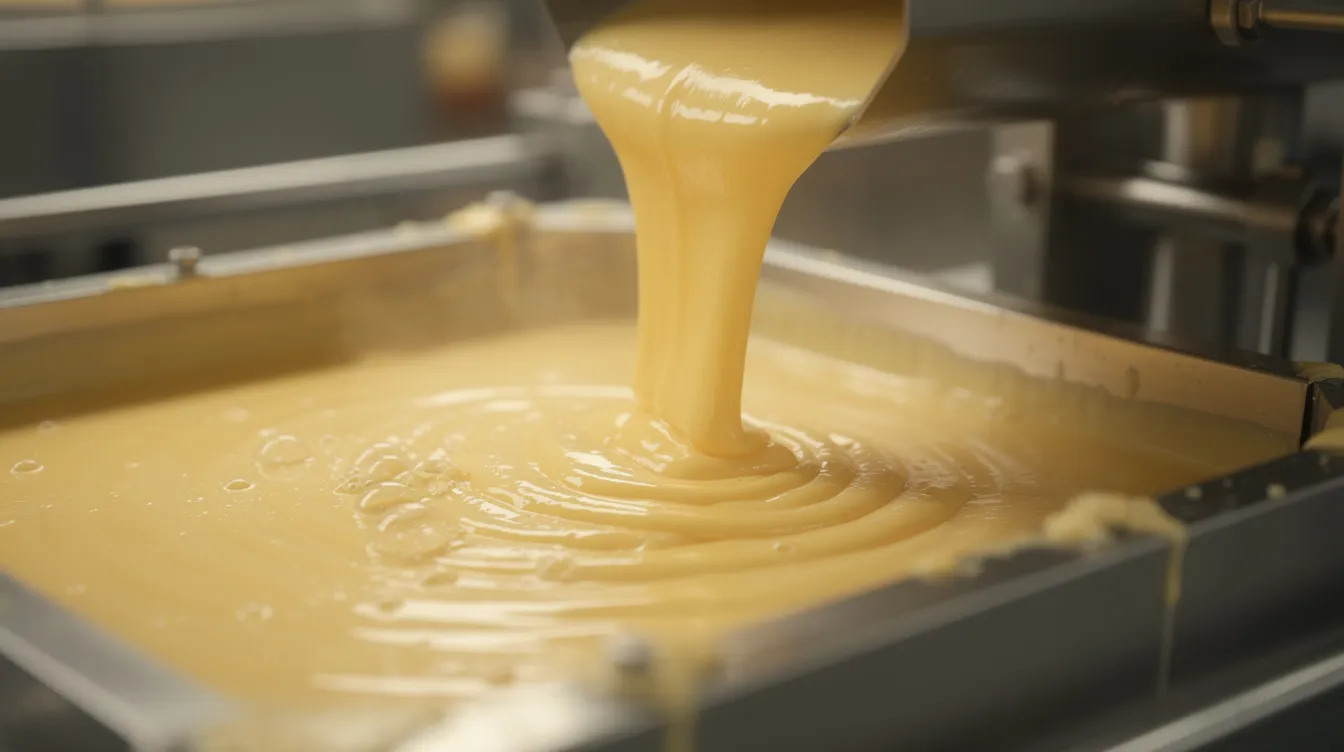
4. Cooking and Emulsification The blended ingredients are loaded into a processed cheese cooker – typically a steam-jacketed kettle with high-shear mixing blades. The production process involves heating to high temperatures for pasteurisation, generally in the range of 75–90°C depending on the product type. The combination of heat, shear, and emulsifying salts transforms the casein network, dispersing fat uniformly and creating a smooth, stable emulsion. Cooking time, temperature and mixer speed are carefully controlled – these parameters must be maintained at the same temperature and shear for each batch to ensure consistency.
5. Homogenisation and Vacuum Deaeration Where required, the hot cheese mass passes through an in-line homogeniser for finer particle distribution. Vacuum deaeration removes trapped air, which prevents oxidation and improves the appearance and shelf life of the final product.
6. Hot Filling and Forming The molten cheese is transferred to filling and forming equipment while still hot. Depending on the product:
- Blocks are poured into moulds or formed on a continuous moulding line
- Slices are formed on a slice-forming and wrapping line, each slice individually wrapped in aluminium laminate foil
- Spreads are hot-filled into tubs or cups and sealed
- Portions or chiplets are filled using body-and-lid foil combinations
7. Cooling Rapid cooling during the packaging of processed cheese helps develop its final texture. Blocks may pass through a cooling tunnel or cooling room; slices and cups are cooled on conveyors before being cartoned.
8. Packaging, Inspection and Cold Storage Sealed products pass through metal detectors and check-weighers. Batch codes, MRP and manufacturing dates are printed. Finished goods are moved to cold storage at approximately 1–8°C. Shelf life for processed cheese slices stored at +4°C can be up to 9 months; cheese spreads typically have a shelf life of around 6 months under refrigeration.
Important Note on Process Differentiation
The steps above describe how existing natural cheese is converted into processed cheese. This is fundamentally different from cheese production starting from milk reception, where milk is standardised, pasteurised and subjected to the coagulation process using starter cultures and rennet in a cheese vat. If you are planning an integrated unit that also produces its own natural cheese from milk, you will need to plan both the primary cheese making and the secondary processing sections separately. Readers evaluating a broader cheese factory setup may find our guide on Cheese Manufacturing Plant Setup Cost in India useful for understanding the upstream investment.
Raw Materials and Consumables for Processed Cheese Production
Natural cheese – typically cheddar or a blend with other cheese types – is the prime raw material for any processed cheese manufacturing unit. The quality, maturity and fat content of the incoming cheese largely determine the flavour and functional performance of the output. For integrated dairies, surplus or downgraded (but safe) cheese lots can be a cost effective source of input.
Core Dairy Ingredients
- Natural cheese blocks or trimmings (cheddar, Gouda or semi-hard cheese varieties)
- Butter, anhydrous milk fat or cream for fat standardisation
- Skimmed milk powder or whole milk powder for milk solids adjustment
- Whey powder or whey protein concentrates – whey proteins contribute to protein content and functional properties
- Milk protein concentrates, where specific texture targets demand it
Functional and Additive Ingredients
- Emulsifying salts (sodium phosphates, sodium citrates, polyphosphates) – key materials for emulsion stability
- Common salt (dry salt or brine)
- Permitted stabilisers and thickeners (e.g., carrageenan, guar gum where allowed)
- Approved preservatives, colours and flavours as per FSSAI norms
- Herbs, spices and seasonings for flavoured variants
Process Inputs and Packaging Materials
- Potable process water
- Aluminium laminate films or foils for slice wrapping
- Thermoformable films for portion packs
- Multilayer tubs or cups with sealing lids for spreads
- Corrugated cartons, labels, shrink-wrap for secondary packaging
All raw materials, additional ingredients and packaging must comply with the Food Safety and Standards (Food Products Standards and Food Additives) Regulations. Promoters must verify current FSSAI processed cheese standards – including revised amendments – before finalising recipes and sourcing. The legal requirements for labelling, allergen declaration and additive limits are strictly enforced.
Plant Capacity, Scalability and Capacity Planning
Processed cheese plant capacity is typically expressed in kg/hour of cooker output, tonnes per day (TPD) or tonnes per annum (TPA). The capacity must be matched with realistic market access, assured raw-material supply and available working capital – not simply chosen based on the largest machine a supplier offers.
Typical Indian Configurations
| Scale | Indicative Capacity | Target Market | Typical Automation Level |
|---|---|---|---|
| Small | 0.5–1.0 TPD | Local retail, regional institutions | Semi-automatic, single cooker |
| Medium | 2–5 TPD | Multi-state distribution, QSR supply, private label | Semi to fully automatic, multiple lines |
| Large | 10 TPD and above | National brands, large-scale QSR and export | Fully automated, continuous cookers, high-speed packaging |
Note: These figures are indicative. Actual capacity depends on machinery configuration, product mix and operating hours.
Annual production capacity for cheese plants generally ranges from 5,000 to 10,000 MT for medium-to-large industrial setups. Smaller MSME-scale units may target 500–2,000 MT per annum initially.
Key Factors in Capacity Selection
- Assured supply of natural cheese – whether from an own cheese plant or external purchase
- Desired product mix (block-only plants need simpler equipment than block + slice + spread plants)
- Confirmed or expected institutional orders and contracts
- Realistic initial capacity utilisation – 40–60% in Year 1 is common practice for new units
- Packaging line speeds, which often become the bottleneck rather than the cooker itself
- Cold-chain availability and distribution reach from the proposed location
Phased expansion – starting with a semi-automatic block line and reserving space for future slice or cup-filling equipment – is often more prudent than investing heavily in a large capacity without confirmed demand. This is an important factor in both business objectives and financial planning.
Machinery and Processing Equipment for a Processed Cheese Production Line
A processed cheese production plant requires specialised cheese processing equipment designed for grinding, cooking, emulsification and precise hot-filling. This goes well beyond the basic cheese making machine used for curd production in a natural cheese plant. The level of advanced machinery you select directly determines your product quality, consistency and per-unit cost.
Major Process Machines
- Cheese cutting and shredding machine – to reduce incoming cheese blocks into uniform pieces
- Cheese grinder – for fine particle size reduction before cooking
- Batch weighing and formulation system – scales, hoppers and dosing equipment for precise ingredient addition
- Processed cheese cooker – steam-jacketed kettle or scraped-surface cooker with high-shear mixer blades; this is the heart of the production line
- Emulsification equipment – integrated with the cooker or as a separate unit for high-shear mixing
- In-line homogeniser – for finer fat dispersion, especially in spreads
- Vacuum deaerator – removes air to prevent oxidation and textural defects
Downstream and Packaging Equipment
- Block moulding and de-moulding equipment – for 200 g to 5 kg cheese block formats
- Slice forming and individual wrapping line (IWS) – for individually wrapped slices
- Cube cutting machine – for snack-sized cubes
- Cup/tub filling and sealing machine – for cheese spreads
- Flow-wrap machines – for portion packs
- Cooling conveyor or cooling tunnel – for rapid cooling after forming
Support Systems and Utilities
- Stainless steel transfer pumps and hygienic pipelines
- CIP (clean-in-place) system for automated cleaning and sanitation
- Boiler or steam generator
- Refrigeration system and cold room for finished goods
- Compressed-air system
- Water-treatment plant
- Effluent treatment plant (ETP)
- Metal detector and check-weigher
- Inkjet coder, labelling machine and secondary packing line
- Quality-control laboratory equipment
Plant infrastructure includes specific equipment like pasteurizers (if integrating natural cheese production upstream), cheese vats (for the same reason), and cooling systems for cold storage. For a pure processed cheese conversion unit, the cooker, emulsifier, forming lines and cold room are the critical capital items.
Semi-Automatic vs Fully Automated Lines
A basic semi-automatic plant involves manual batching, a single-batch cooker, manual mould filling and simpler packaging – suitable for small-scale entry. A fully automated processed cheese production line with PLC controls, automatic ingredient dosing, continuous cookers, automated slice forming and high-speed wrapping lines demands significantly higher investment but delivers much higher throughput and consistency. This difference has a major impact on the processed cheese plant machinery cost.
Cheese making machine manufacturers in India and internationally offer equipment across this spectrum. Imported continuous cooking and emulsification units cost more and may involve import duty and forex risk. Readers looking for a detailed breakdown of equipment costs should review our guide on Cheese Plant Machinery and Equipment Cost.
Explore Related Cheese Manufacturing Guides
For broader planning on cheese-plant investment, machinery and related dairy projects, these guides may be useful:
- Cheese Manufacturing Plant Setup Cost in India
- Cheese Plant Machinery and Equipment Cost
- Mozzarella Cheese Manufacturing Plant
Land, Building and Layout Planning for a Processed Cheese Factory Setup
A typical small-to-medium processed cheese manufacturing plant in India may require, indicatively, 8,000–20,000 sq ft of built-up area. This depends on the installed capacity, number of production lines, extent of cold storage and space reserved for future expansion.
Functional Areas
- Raw cheese reception and inspection zone with weighbridge or receiving dock
- Chilled storage for natural cheese and perishable dairy ingredients
- Dry-ingredient store (emulsifying salts, milk powder, packaging materials)
- Grinding and preparation room
- Cooking and emulsification hall – the core processing area
- Hot-filling, forming and packaging hall
- Cooling room or tunnel area
- Finished-goods cold room (maintained at 1–8°C)
- Packaging-material storage area
Supporting Spaces
- A dedicated quality control laboratory for routine testing of incoming raw materials, in-process checks and finished-product analysis
- Utility room housing boiler, refrigeration compressors, electrical panels and compressed-air system
- Maintenance workshop
- Staff change rooms and hygiene facilities (hand-wash stations, sanitiser dispensers)
- Administrative office
- ETP and waste-handling area
Layout Principles
A one-directional flow in the plant layout prevents cross-contamination during processing. Raw cheese should enter from one end, move through preparation, cooking, filling, packaging and cold storage in a logical sequence, and finished goods should exit from a separate dispatch point. Walls and floors in processing areas should be smooth, washable and resistant to dairy acids. Drainage must be adequate, pest-control measures must be designed in, and there should be clear separation between raw and finished-product zones.
The DPR should contain a preliminary plant layout (block diagram) demonstrating logical material and personnel movement. Bank appraisers and technical experts routinely review this layout during project evaluation.
Utilities and Infrastructure Requirements
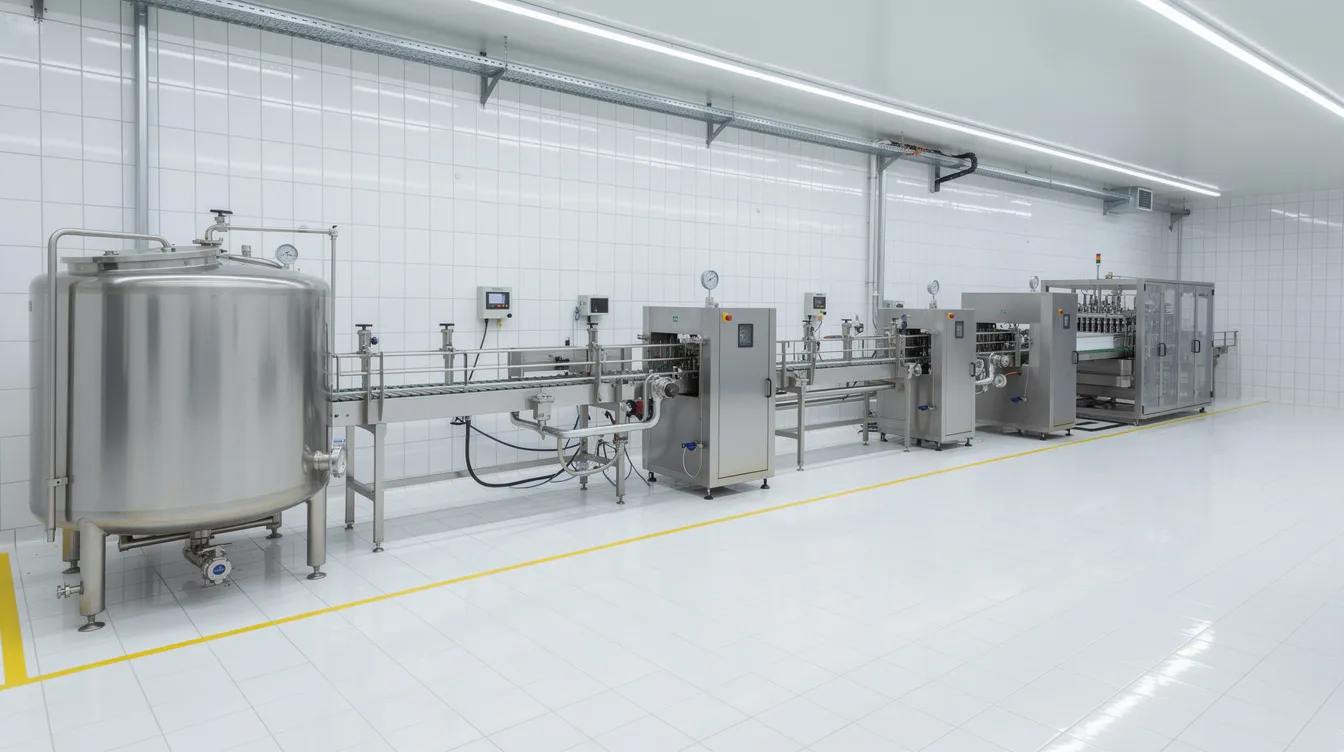
Utilities represent a major determinant of both capital cost and operating cost in a processed cheese manufacturing project. Steam for cooking and CIP, refrigeration for cold storage, and electricity for drives and controls are the three heaviest demands.
Key Utilities
- Electric power – for cooker drives, mixer motors, refrigeration compressors, conveyors, packaging lines, lighting and controls
- Steam – for jacketed cookers, CIP systems and general heating; typically generated by a diesel, gas or biomass-fired boiler
- Chilled water – for cooling conveyors and process cooling
- Potable process water – used in formulation and cleaning; must meet drinking-water standards
- Compressed air – for pneumatic valves, actuators and packaging machines
- Refrigeration – for cold rooms (finished goods and raw cheese storage) and, in some climates, for air-conditioning the processing hall
- Ventilation and HVAC – to control ambient temperature and humidity in processing areas
Sizing and Backup
Utility sizing depends on installed capacity (kg/hour), automation level, daily operating hours, extent of cold-chain integration and local climate conditions. Indicative load calculations should be prepared at the DPR stage with input from machinery suppliers. A DG set or other backup power source is advisable in many Indian locations, especially where voltage fluctuations could interrupt cooking batches or damage refrigeration compressors.
Environmental Compliance
Whey management is critical in cheese manufacturing due to high-strength wastewater generation – even in a processed cheese unit, wash water from CIP cycles and cleaning can contain dairy solids. An ETP designed for dairy effluent, proper solid-waste disposal and adherence to state pollution-control norms are mandatory. Easy operation and maintenance of the ETP should be factored into the design.
Processed Cheese Plant Setup Cost in India: Project Cost Structure
Project cost for a processed cheese manufacturing plant in India is highly project-specific. It depends on the selected capacity, level of automation, whether machinery is imported or indigenous, land price at the chosen location and the product range you intend to manufacture.
Key Cost Heads
- Land and site development
- Building and civil works (processing hall, cold rooms, utilities, office)
- Main processed cheese cookers and production-line machinery
- Packaging machinery – block moulds, slice lines, cup fillers, secondary packing
- Cold storage and refrigeration equipment
- Boiler and utility systems
- Electrical installations and DG set
- Laboratory and quality-control equipment
- Furniture, office equipment and IT
- Pre-operative and preliminary expenses (consultancy fees, trial runs, travel)
- Technical installation and commissioning charges
- Contingency provision (typically 5–10% of project cost)
- Margin money for working capital
Indicative Benchmarks
As an illustrative reference, a DPR prepared by EIRI Consultancy for a 12 TPD processed cheese plant estimated total capital investment at approximately Rs 19.21 crore, including plant and machinery at around Rs 3.05 crore and land and building at about Rs 4.61 crore. This is a medium-scale, multi-format facility.
For a smaller semi-automatic block-cheese unit of 1–2 TPD, the investment can be substantially lower – potentially in the range of Rs 2–5 crore depending on land cost, building specification and equipment sourcing. Fully automated slice and portion lines with imported equipment can push the machinery cost alone well beyond Rs 5–8 crore for medium-capacity plants.
Important: GST, freight, unloading, foundation work and utility piping costs are often excluded from base machinery quotations. These must be added separately when preparing the processed cheese plant project cost estimate. Readers who are at the generic planning stage and want to understand how cheese-factory investment works across formats should also review the guide on Cheese Manufacturing Plant Setup Cost in India.
Means of Finance and Processed Cheese Project Finance
The typical funding mix for a processed cheese manufacturing project in India includes:
- Promoter’s equity contribution (commonly 25–35% of total project cost, depending on lender norms)
- Bank term loan for the balance capital expenditure
- Working-capital limits (cash credit, overdraft) from the same or a different banking institution
- Unsecured loans from promoters or associates, subject to the lender’s acceptance and subordination requirements
The optimal debt-equity ratio, term-loan tenure (typically 5–8 years with a moratorium of 6–18 months), and interest rate depend on the project size, promoter’s financial background, collateral offered, projected DSCR and the bank’s prevailing policy at the time of appraisal.
Government schemes such as CGTMSE for collateral-free loans to MSMEs, or state-level industrial incentives, may be applicable in certain situations. However, no guarantees of subsidy or scheme approval should be assumed – eligibility must be checked case by case.
A processed cheese plant bank loan proposal should be supported by a well-structured DPR, CMA data, projected financial statements, promoter KYC documents and collateral details. CA Manish Gugliya’s role is to assist in preparing and structuring these financial documents – not to “certify” profitability or guarantee sanction.
Working Capital Requirement and Cycle in Processed Cheese Manufacturing
Working capital in a processed cheese manufacturing business ties up primarily in natural cheese inventory, other dairy inputs, packaging materials, finished-goods stock, receivables from distributors and ongoing utility and salary payments. Natural cheese, being the principal raw material, often needs to be procured in large volumes and stored under refrigeration, creating a significant inventory holding cost.
Working-Capital Cycle
The standard formula is:
Raw-material holding period + Work-in-process days + Finished-goods holding period + Receivable period – Supplier credit period
Each component should be estimated realistically for the DPR:
- Natural cheese inventory may need 2–4 weeks of holding, depending on procurement frequency and supplier location
- Packaging materials (foils, films, cups) are often bought in bulk, adding further inventory days
- Finished-goods stock in cold storage depends on despatch frequency and distribution reach
- Receivables from modern retail chains and QSR clients can stretch to 30–60 days or longer
- Supplier credit on cheese and dairy ingredients may be limited (15–30 days)
Milk accounts for 70–80% of total operating expenses in cheese plants – and since processed cheese uses natural cheese as its input, the cost of that natural cheese (which itself was made from milk) dominates the operating-cost structure. Supplying to large institutional buyers can improve volumes but often lengthens the receivable period and may require higher inventory levels, thus increasing the working-capital requirement.
Margin money for working capital is part of the total project cost and must be clearly reflected in the processed cheese plant project report submitted to banks. The EIRI DPR example cited earlier estimated working capital for one month at approximately Rs 10.63 crore for a 12 TPD facility, illustrating how capital-intensive the operating cycle can be.
Revenue Model and Processed Cheese Manufacturing Profitability Drivers
Revenue streams for a processed cheese factory can include retail products under own brand, institutional bulk supplies, private-label manufacturing for retail chains and contract manufacturing for larger dairy brands.
SKU-Level Revenue Planning
Different SKUs carry different price realisations and margins. A 200 g retail block, a 10-slice consumer pack, a 400 g spread tub and a 5 kg institutional block will each have distinct selling prices, packaging costs and distribution margins. Your DPR should model a realistic product mix and pricing strategy rather than assuming a single average price per kg for all output.
For perspective, typical MRP for processed cheese spreads in India is around Rs 99 for a 150 g pack – roughly Rs 660 per kg at retail. Block cheese for institutional use trades at significantly lower per-kg realisations. Revenue modelling must capture these differences.
Key Profitability Drivers
- Landed cost of natural cheese and dairy ingredients – the single largest cost element
- Product formulations and yield (output kg per kg of input)
- Capacity utilisation ramp-up over the first 2–3 years
- Energy cost per kg of output (steam, electricity, refrigeration)
- Wastage and rework levels – emulsion failures, packaging rejects
- Packaging cost per unit – varies widely between block wrap and individual slice foil
- Distribution margins, trade schemes and credit terms to channel partners
- Cold-chain logistics cost – transport, warehousing and last-mile delivery
Gross profit margins for cheese manufacturing typically range between 30–40%, but actual margins are highly project-specific. It is inappropriate to promise a fixed margin for all projects. Profitability projections must be built from project-specific assumptions about input costs, product mix, utilisation and market prices.
Processed cheese often allows better value-addition on surplus cheese or downgraded (but safe) cheese lots, improving utilisation for integrated dairies. Standalone conversion units, however, must manage procurement risk carefully through supply contracts and diversified sourcing.
Financial Projections, Ratios and Bank Appraisal Perspective
Any serious processed cheese manufacturing project must be accompanied by detailed 5–7 year financial projections. Banks and financial institutions evaluate these projections to assess repayment capacity and project viability.
Required Financial Statements and Calculations
- Projected profit and loss account (year-wise)
- Projected balance sheet
- Cash-flow statement and fund-flow statement
- Term-loan repayment schedule with interest calculation
- Depreciation schedule (as per Companies Act / Income Tax Act)
- Working-capital assessment (Nayak Committee / Turnover method or other applicable norms)
- Break-even analysis (volume and value)
- DSCR – year-wise and average over the loan tenure
- Internal rate of return (IRR) and payback period
- Current ratio and debt-equity ratio at steady state
- Financial analysis including sensitivity scenarios
All projections should be backed by clearly stated assumptions on capacity utilisation ramp-up (e.g., 50% in Year 1, 70% in Year 2, 85% from Year 3), selling prices, raw-material cost escalation, operating expenses, working-capital cycle and applicable tax rates. A financial model that does not disclose its assumptions is of limited value to a bank appraiser.
CA Manish Gugliya assists clients in building consistent financial models, preparing CMA data for banks and stress-testing assumptions. This does not mean assuring any particular financial outcome – the projections reflect the promoter’s plan, evaluated against reasonable market and cost parameters.
Projections must be periodically revisited after commencement of operations to compare actuals against the DPR and to take corrective business decisions where variances emerge.
Break-Even Analysis and Sensitivity Scenarios
Break-even analysis identifies the output or sales level at which total revenue equals total cost. For a processed cheese manufacturing unit with significant fixed costs – machinery depreciation, salaries, cold-storage running costs and loan interest – understanding the break-even point is essential for both the promoter and the lender.
Conceptually: Break-even volume = Fixed costs ÷ Contribution per unit
Higher contribution – achieved through better pricing, lower input costs or improved yield – reduces the break-even volume. The EIRI DPR example cited a break-even point of approximately 22% of installed capacity for a 12 TPD plant, indicating strong contribution margins at the assumed selling prices.
Sensitivity Scenarios
At a minimum, three scenarios should be presented:
| Scenario | Key Assumptions |
|---|---|
| Base Case | Expected capacity utilisation ramp-up, current cheese prices, planned selling prices |
| Optimistic Case | Faster market penetration, slightly higher selling prices, better capacity utilisation |
| Stress Case | 10–15% increase in natural cheese cost, 5–10% reduction in selling price, slower capacity utilisation ramp-up |
Variables to Sensitise
- Natural cheese procurement cost
- Selling price per kg (across product formats)
- Capacity utilisation ramp-up timeline
- Packaging material cost
- Power and fuel rates
- Wage inflation
- Interest rate on term loan
- Receivable period from institutional buyers
Banks appreciate DPRs that openly present such sensitivities. They demonstrate that the promoter understands the risk landscape and has evaluated repayment capacity under different conditions – not just the best-case scenario.
Licences, Registrations and Approvals in India
A processed cheese manufacturing plant in India is a regulated food-processing unit. Multiple approvals are needed before commercial operations, and specific requirements vary by state. Promoters must verify current rules from official sources.
Core Business Registrations
- Constitution of the business entity – proprietorship, partnership, LLP or private limited company
- PAN and TAN
- GST registration
- Udyam registration for MSME (if the unit qualifies by investment and turnover thresholds)
- Import Export Code (IEC), if the unit plans to export
Technical and Local Approvals
- FSSAI central licence (mandatory for food manufacturing units above specified turnover thresholds) – this is the most critical approval for a processed cheese manufacturing licence in India
- Factory Licence under the Factories Act (applicable based on number of workers and use of power)
- Consent to establish and consent to operate from the State Pollution Control Board
- Fire-safety NOC from the fire department
- Trade licence and shops-and-establishment registration from the local municipal authority
- Legal Metrology registration for packaged-commodity compliance (net weight, labelling)
Additional Approvals
- Boiler registration if a steam boiler is installed
- Electricity-connection sanction for the required connected load
- Groundwater extraction permission, if applicable
- Trademark registration for the brand name
- Labour-law registrations – EPF, ESI, minimum wages compliance
Promoters must check the latest requirements, forms and fee structures from the respective state departments, FSSAI portal and pollution-control boards before filing applications. Rules and fee structures can change, and non-compliance can result in operational disruption, penalties or product seizure.
Quality Control, Product Testing and Food Safety Systems
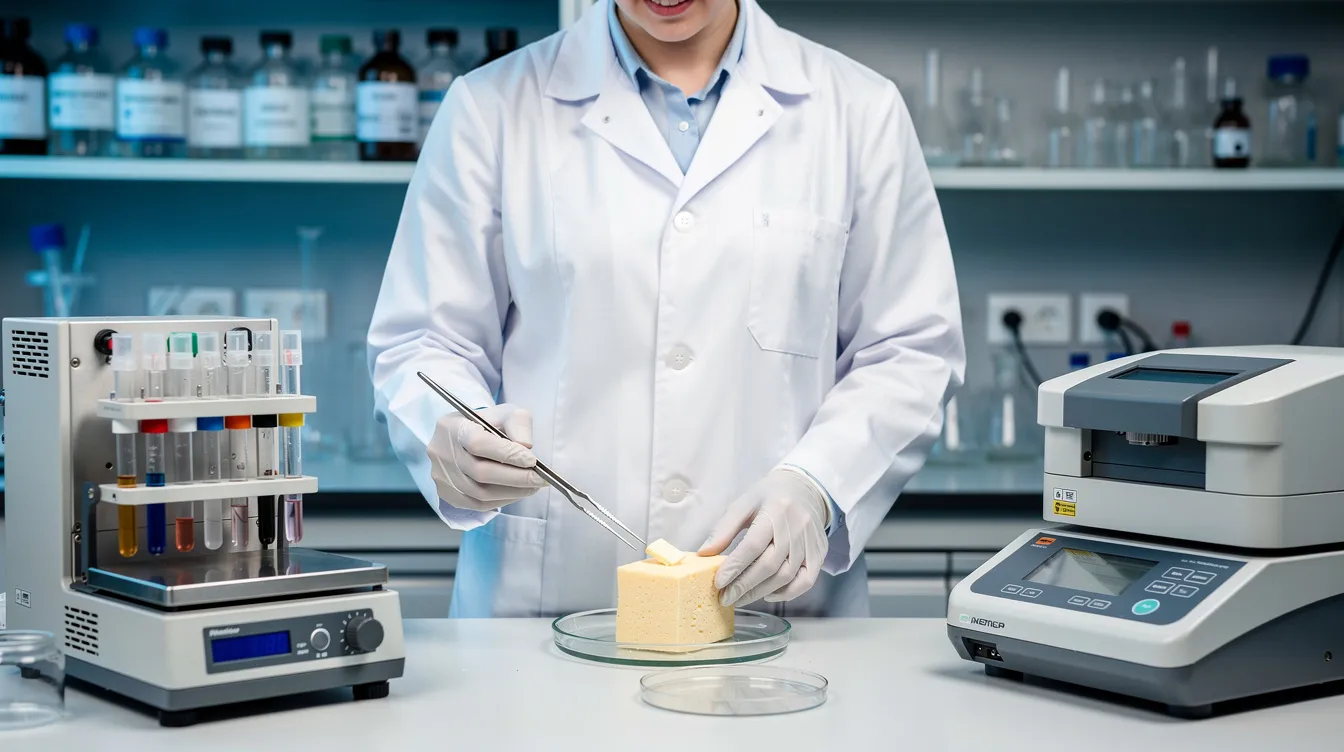
Processed cheese is a ready-to-eat dairy product with a relatively long shelf life, which makes consistent quality control and a documented food-safety management system non-negotiable. HACCP plans are essential for monitoring food safety risks in cheese production, and many buyers – especially QSR chains and modern retailers – require ISO 22000 or equivalent certification.
Incoming Material Testing
- Sensory evaluation and microbiological checks on every lot of natural cheese received
- Verification of fat content and moisture against supplier certificates and FSSAI limits
- Checking emulsifying salts and other ingredients for food-grade compliance and shelf life
- Testing potable water quality at defined frequencies
In-Process and Finished-Product Parameters
- Moisture content (max 47% for blocks, 60% for spreads as per current FSSAI norms)
- Fat in dry matter (min 40% for plain processed cheese)
- Salt content
- pH – target range of 5.4–5.9 for processed cheese; actual target depends on product type
- Texture, meltability, sliceability and emulsion stability (no oiling-off)
- Flavour and taste profile – sensory evaluation by trained panel
- Microbiological counts – total plate count, coliforms, yeast and mould, pathogens as specified
- Net weight (check-weigher verification)
- Packaging seal integrity (leak testing, visual inspection)
- Periodic shelf-life studies under recommended storage conditions to validate label claims
Quality control in cheese manufacturing includes monitoring milk quality (for upstream natural cheese production) and the final product’s safety. Processed cheese is subject to strict food safety and construction standards during manufacturing. Batch coding, traceability from raw cheese lot to finished batches, allergen management (especially where herbs, spices or seasonings are used) and sanitation SOPs must be documented and followed rigorously. GMP and GHP are baseline expectations.
Major Operational and Business Risks with Mitigation Measures
Every processed cheese manufacturing project faces technical, commercial and regulatory risks. A good DPR should acknowledge each risk and propose practical mitigation.
| Risk | Practical Mitigation |
|---|---|
| Raw-material price fluctuation – natural cheese prices can be volatile depending on milk supply seasons | Long-term supply contracts with multiple cheese suppliers; maintain safety stock; model conservative cost assumptions in DPR |
| Inconsistent natural cheese quality – moisture, fat, pH or flavour variation between lots | Rigorous incoming QC testing; define acceptance specifications; blend multiple lots to standardise |
| Product separation or oiling-off – emulsion instability during or after cooking | Engage experienced process technologists; validate formulations through pilot runs; source quality emulsifying salts; maintain strict temperature and mixing protocols |
| Texture inconsistency – batch-to-batch variation in firmness, spread or slice characteristics | Standardise formulation and process parameters; use automated controls where feasible; conduct regular sensory evaluation |
| Packaging failure – seal leaks, foil corrosion, incorrect labelling | Select quality packaging materials; calibrate sealing machines regularly; implement 100% seal-integrity checks |
| Cold-chain breakdown – power failure, transport delays, warehouse temperature excursion | Install backup power; use temperature-logging devices in transit; audit cold-chain partners regularly |
| Low capacity utilisation – demand not materialising as projected | Start conservatively; build institutional orders before commissioning; phase capacity expansion |
| Slow distributor or institutional payments – stretching receivable cycle | Diversify customer base; set credit limits; enforce payment terms; maintain adequate working-capital limits |
| Regulatory non-compliance – FSSAI, labelling, pollution norms | Appoint a compliance officer; track regulatory updates; maintain documentation for audits |
| Product recall risk – contamination, allergen mislabelling | Implement full traceability; consider product-liability and recall insurance; follow HACCP protocols strictly |
| Competition from established brands – Amul, Britannia, D’Lecta and others with strong distribution | Differentiate through niche products, local distribution strength, private-label partnerships or institutional focus |
Financial risks such as interest-rate increases or rupee depreciation (if importing machinery) should be addressed through conservative assumptions and adequate contingency provision in the project cost. For larger plants or brands, product-liability and recall insurance options should be evaluated.
Processed Cheese Plant DPR and Bank-Ready Project Report
A processed cheese plant DPR is a detailed, bank-ready document tailored to a specific location, capacity and promoter. It is fundamentally different from a generic downloadable project profile, which cannot account for the specific requirements of your site, your market, your machinery selection or your financial profile.
Standard Components of a Bankable DPR
Market and Technical Sections:
- Promoter profile, experience and financial credentials
- Industry overview and market assessment – region-wise demand, competitive landscape, pricing analysis
- Detailed description of the proposed processed cheese product range
- Manufacturing process flow with control parameters
- Machinery selection with itemised quotations from suppliers
- Proposed installed capacity and phased ramp-up plan
- Plant layout concept with material and personnel flow
- Utilities sizing and manpower plan
- Implementation schedule (Gantt chart or milestone table)
Financial Sections:
- Item-wise project-cost estimate
- Means of finance – equity, term loan, working-capital limits, other sources
- Working-capital assessment
- Projected P&L, balance sheet, cash flow for 5–7 years
- Break-even analysis (volume and value)
- DSCR and interest-coverage calculations
- Sensitivity analysis under multiple scenarios
- Security and collateral details
Statutory and Risk Sections:
- Status of licences and approvals (obtained, applied, planned)
- Environmental and food-safety compliance plan
- Key project risks with mitigation strategies
A customised DPR aligned with actual quotations, realistic market assumptions and the promoter’s specific circumstances has a materially better chance of progressing through a bank’s appraisal process than a template document.
Role of CA Manish Gugliya and ProjectReportBank.com in Processed Cheese Projects
CA Manish Gugliya, FCA, is an experienced project-finance and DPR consultant who has worked extensively with MSME and manufacturing projects across India, including dairy processing units and processed cheese ventures.
Key Services
- Customised processed cheese manufacturing plant project report preparation
- Structuring project cost and means of finance to align with bank norms
- Preparation and review of financial projections, CMA data and fund-flow statements
- DSCR and break-even analysis
- Sensitivity and scenario modelling
- Guidance in presenting the proposal to banks, NBFCs or investors
- Coordination with machinery suppliers for realistic quotations and checking duty, tax and installation cost impacts
- Aligning assumptions with market realities rather than offering optimistic or unrealistic numbers
CA Manish Gugliya and ProjectReportBank.com do not guarantee loan sanction, subsidy approval or any specific financial outcome. The role is to provide professional documentation and advisory support to strengthen the promoter’s case. Serious promoters should consider a customised engagement rather than relying only on template project reports.
Frequently Asked Questions on Processed Cheese Manufacturing Plant
How is processed cheese different from natural cheese, mozzarella and cheese analogues?
Natural cheese is made directly from milk through coagulation, curd handling, pressing and ripening. A processed cheese manufacturing plant, on the other hand, takes already-made natural cheese and converts it into a different product through grinding, blending, cooking with emulsifying salts and forming. Mozzarella is produced through a specific pasta filata (stretching) process and has distinct functional properties like stretch and pull. Cheese analogues replace some or all dairy fat with vegetable fat and fall under a separate regulatory category. Understanding these differences is essential for choosing the right manufacturing route and equipment.
What is the minimum viable capacity for a first-time entrepreneur?
A small processed cheese unit producing 500 kg to 1 tonne per day with a semi-automatic cooker and basic block-moulding equipment can serve as a viable entry point. This requires significantly less capital than a fully automated slice line. However, even at this scale, you need assured natural cheese supply, cold-chain infrastructure and a clear market for your output. Scaling up can happen in phases as demand confirms.
Can an existing dairy plant retrofit a processed cheese line?
Yes, this is common practice. If the dairy plant already has utilities (steam, refrigeration, cold storage, water treatment) and hygienic infrastructure, adding a processed cheese cooker and filling line can be relatively cost effective compared with a greenfield setup. The key additions are the processed cheese cooker, emulsification system, downstream forming and packaging equipment and potentially an upgraded cold room. The existing QC lab and utility infrastructure can often be shared.
What is the typical implementation timeline from sanction to commissioning?
For a medium-scale processed cheese manufacturing plant, the timeline from financial closure to commercial production is typically 10–18 months. This includes civil construction (4–6 months), machinery procurement and installation (3–6 months, longer if importing), trial runs and commissioning (1–2 months) and obtaining final operational licences (concurrent with construction). Delays are common due to civil-work issues, machinery delivery schedules and regulatory processing times. The DPR should include a realistic implementation schedule.
Is cold storage mandatory for a processed cheese unit?
Yes. Processed cheese is a perishable dairy product that must be stored and distributed under refrigerated conditions – typically at 1–8°C. Cold storage is required for both raw-material holding (incoming natural cheese) and finished-goods storage. Without reliable cold-chain infrastructure, product quality will deteriorate rapidly, and shelf life claims on packaging cannot be honoured. Budget for cold rooms, refrigerated transport and temperature-monitoring systems from the outset.
Conclusion and Professional Call to Action
The success of a processed cheese manufacturing venture depends on getting several critical elements right: appropriate product selection, assured and consistent natural cheese sourcing, correctly sized plant capacity and machinery, strict process and quality control, robust cold-chain logistics, adequate working capital and realistic financial projections.
Planning a processed cheese manufacturing plant requires a well-researched DPR, honest financial modelling and careful evaluation of both technical and commercial feasibility. The difference between a project that secures bank finance and one that stalls often comes down to the quality and specificity of the project report.
Approach the project step by step: start with a thorough market study, move to technology and machinery selection, plan your licences, prepare a detailed project-cost estimate, structure your means of finance, get the DPR prepared by a qualified professional and then proceed with implementation scheduling.
If you are an entrepreneur, dairy company or investor evaluating a processed cheese project in India, you are welcome to contact CA Manish Gugliya through ProjectReportBank.com for customised project reports, financial models, CMA data and bank-finance DPRs tailored to your specific location, capacity and business objectives.
Disclaimer: All costs, capacities, profitability estimates and regulatory requirements discussed in this article are indicative. They can vary significantly by location, scale, technology, product mix, lender policy and time. Readers must independently verify all figures from current official and commercial sources – including machinery suppliers, FSSAI, state regulatory authorities and lending institutions – before making any investment decisions.
Additional FAQs
How many staff are typically needed to operate a processed cheese plant?
A small semi-automatic unit (0.5–1 TPD) may need 15–25 people including production operators, packaging staff, QC personnel, utility operators, store-keepers and administrative staff. A medium-scale automated plant (3–5 TPD) may require 40–80 people depending on the number of shifts, product lines and extent of automation. Skilled process technologists who understand emulsification, batch formulation and food safety are essential – they are harder to recruit and should be hired early. Training requirements for operators include equipment handling, hygiene protocols, batch record-keeping and emergency response.
Should a new entrepreneur start with their own brand or focus on private-label manufacturing?
This depends on your capital, distribution capability and risk appetite. Building your own brand requires investment in packaging design, trade marketing, distributor networks and consumer awareness – which takes time and working capital. Private-label or contract manufacturing for established retailers, QSR chains or larger dairy brands can generate volume and cash flow from Day 1 with lower marketing risk. Many successful processed cheese businesses start with a mix: institutional and private-label volumes to cover fixed costs, with a phased launch of their own retail brand as production stabilises and market understanding deepens.
Can the same production line handle both processed cheese blocks and spreads without contamination risk?
The same processed cheese cooker can generally be used for both blocks and spreads, since the core cooking and emulsification step is similar. However, downstream forming and filling equipment is different – blocks require moulds while spreads need cup-filling and sealing machines. Between product changeovers, thorough CIP cleaning and flushing of pipelines is essential to prevent cross-contamination (especially if one product has flavouring or allergens that the other does not). Proper scheduling of production batches – running plain products before flavoured ones – is common practice to minimise cleaning cycles and contamination risk.
Is there export potential for processed cheese manufactured in India?
India’s processed cheese export volumes are currently modest compared to domestic consumption. However, there is growing demand in neighbouring South Asian and Middle Eastern markets for competitively priced processed cheese, particularly slices and spreads. Export requires an IEC code, compliance with the importing country’s food-safety standards (which may differ from FSSAI), appropriate shelf-stable packaging for longer transit times and cold-chain logistics to the port. Any export plan should be discussed with an export consultant and factored into the DPR only if confirmed orders or realistic market access exists – speculative export projections weaken rather than strengthen a bank proposal.
What is the role of sensory evaluation in processed cheese quality?
Sensory evaluation is an important factor in maintaining product consistency and consumer acceptance. Trained panellists assess colour, aroma, taste, texture, meltability and mouthfeel of each batch against defined standards. Sensory checks complement laboratory testing (moisture, fat, pH, microbiology) and help catch subtle quality issues – such as off-flavours from poor-quality incoming cheese or textural defects from process deviations – that instruments alone may not flag. Establishing a small sensory panel and maintaining reference samples is advisable even for a new unit.
Continue Exploring Our Cheese Project Guides
Explore all 17 guides covering cheese plant setup, products, financial planning, feasibility, bank loans and DPR preparation.