Key Takeaways
- This article explains how to plan and evaluate a commercial puffed and roasted millet ingredient processing plant in India, covering machinery requirements, capital investment, production economics, working capital and financial feasibility for bank finance.
- The project is positioned as a B2B millet ingredient business supplying breakfast cereals, snack manufacturers, nutrition bar producers and health-food companies – not a small home-scale or cottage operation.
- Millet varieties behave differently under puffing and roasting; process parameters, machinery selection and product yields must be validated through trials before finalising plant design or investment.
- All cost and capacity figures used in this article are indicative assumptions for illustration purposes only. A customised Detailed Project Report is essential before committing capital or approaching banks.
- CA Manish Gugliya and Project Report Bank provide professional DPR, CMA Data and project finance advisory for serious investors and MSME manufacturers planning millet processing units across India.
Introduction – Puffed Millet and Roasted Millet Ingredient Processing Industry in India
Puffed millet and roasted millet are industrially processed intermediate ingredients used in the food manufacturing supply chain. Puffed millet refers to whole millet grains subjected to high-temperature, short-time heat treatment that causes rapid internal moisture vaporisation and physical expansion – producing a lightweight, crispy, low-density product. Roasted millet involves controlled dry-heat treatment at moderate temperatures over longer durations, developing flavour, reducing moisture and improving shelf life without significant volumetric expansion. These are distinct from extruded millet products, which use milled millet flours or grits processed under mechanical shear and heat through an extruder die to create shaped cereal or snack pieces.
These ingredients serve as inputs for breakfast cereals, granola mixes, nutrition and health bars, instant mixes, millet based snack formulations and ready to eat cereal products. The food processing industry increasingly sources standardised puffed and roasted millet ingredients from dedicated processing plants rather than relying on informal, unorganised supply chains.
Following the International Year of Millets, government initiatives promoting millets, and rising consumer demand for gluten free and millet based food products, the organised food industry has accelerated procurement of processed millet ingredients. The millet market is projected to reach USD 19.70 billion by 2034, underscoring significant investment opportunities in the processing industry. A Detailed Project Report serves as a complete technical and financial blueprint for any serious promoter considering this space. Without a structured puffed millet processing plant project report, feasibility study and financial model, the risk of misallocated capital and machinery mismatch increases substantially.
Market Opportunities for Puffed and Roasted Millet Ingredients
Puffed and roasted millet ingredients are intermediate products in the food processing chain. Large and mid-sized food companies prefer reliable B2B ingredient suppliers who can deliver consistent quality, documented specifications and food safety compliance at contracted volumes. Market analysis is crucial for proving demand for millets and healthy snacks before committing to plant investment.
Key demand segments include breakfast cereal manufacturers requiring puffed ragi or jowar as cereal inclusions, ready to eat and extruded snack companies sourcing roasted millet bases, nutrition bar producers needing crunchy millet inclusions, millet based food brands expanding product lines, instant-mix producers formulating ready to cook porridges and baby foods, and export-oriented ingredient traders serving international markets in Europe, North America and Asia–Pacific. Promoters planning downstream value addition should also review the Instant Millet Porridge and Upma Mix Manufacturing Plant Project Report to understand how roasted and puffed ingredients feed into convenience food formulations.
Supplying bulk ingredients involves lower marketing costs but a higher technical entry barrier – industrial buyers demand precise moisture levels, bulk density ranges, puffing ratios, microbiological limits and shelf-life guarantees. Vendor approval typically involves factory audits, technical sample evaluation, trial batches and annual rate contracts. This purchasing behaviour favours organised, well-documented processing units over informal operators.
Types of Millet Suitable for Puffing and Roasting
India grows several millet species, but each behaves differently under puffing and roasting. One process line and parameter set cannot be assumed optimal for all millet grains. Certain small millets require more rigorous millet cleaning and dehulling before thermal processing – aspects covered in detail in the Small Millet Processing Plant Project Report.
| Millet Variety | Grain Characteristics | Puffing / Roasting Suitability | Main Processing Challenges |
|---|---|---|---|
| Finger millet (ragi) | Very small kernel, moderate hardness, thick pericarp | Popping yield lower (20–35%); roasting easier with good flavour | Breakage-prone; uniform moisture difficult; dehusking adds cost |
| Pearl millet (bajra) | Larger kernel, harder pericarp in some genotypes | Good puffing via salt-popping at ~260°C; high expansion in select genotypes | Energy-intensive; colour control important |
| Sorghum (jowar) | Moderate to large kernel; tannin presence in some varieties | Better suited to roasting; puffing yields lower than bajra | Pigmented pericarp causes colour variation |
| Foxtail millet | Small to medium kernel, moderate hardness | Roasting works well; puffing less studied | Moisture sensitivity; tends to lose crispness |
| Little millet | Very small, delicate kernels | Roasting more feasible; puffing yields low | Fragility; high handling losses |
| Kodo millet | Small, variable kernel size; high fibre | Popping yield decreases with increasing moisture; best at 230–250°C | Kernel size variation leads to uneven puffing |
| Barnyard millet | Medium, lighter kernel | Hot-air puffing optimised at 250–320°C; expansion ratio ~2.27, puffing ~72.6% | Above ~320°C risk of burning; balancing feed rate critical |
Niche varieties such as proso millet have emerging demand in health-food markets but limited standardised processing data. Promoters working with ragi, bajra or jowar should review the dedicated primary processing articles – Ragi Processing Plant Project Report, Bajra Processing Plant Project Report and Sorghum Milling Plant Project Report – to understand how puffed and roasted ingredient plants can integrate with basic dehulling and milling operations.
Product Portfolio and Revenue Opportunities
A commercial puffing and roasting plant rarely survives on a single SKU. Planning for a diversified product portfolio – whole puffed ragi, puffed jowar, roasted bajra kernels, roasted millet flour, puffed millet powder for nutrition bars, multi-grain roasted blends and custom-formulated ingredients – improves capacity utilisation and revenue stability. The same raw millet grains can move through different value ladders: cleaned grain, puffed grain, roasted flour or blended functional ingredient, each with different conversion costs and margins.
B2B packing formats typically include 10–25 kg multilayer laminate bags and 500–1,000 kg bulk bags, often with nitrogen flushing. Contract manufacturing or toll processing for brands that outsource puffing and roasting can further stabilise plant utilisation.
Puffed Millet and Roasted Millet Manufacturing Process
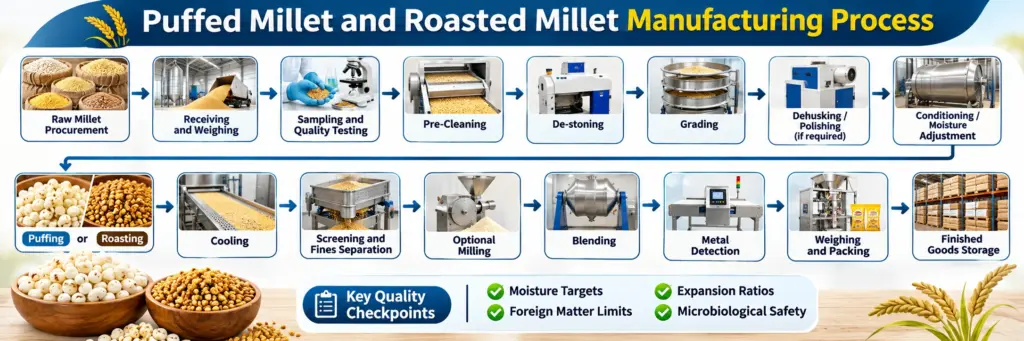
The manufacturing process for puffed and roasted millet ingredients follows this sequence: Raw Millet Procurement → Receiving and Weighing → Sampling and Quality Testing → Pre-Cleaning → De-stoning → Grading → Dehusking/Polishing (if required) → Conditioning/Moisture Adjustment → Puffing or Roasting → Cooling → Screening and Fines Separation → Optional Milling → Blending → Metal Detection → Weighing and Packing → Finished Goods Storage. The puffing process includes steps such as cleaning, conditioning, thermal treatment and post-process cooling and separation. Each stage has specific quality checkpoints – moisture targets, foreign matter limits, expansion ratios and microbiological safety.
Industrial Millet Puffing Process
Grain conditioning brings raw millet moisture to the target range, typically around 8–12% dry basis depending on the variety. Conditioned grains are fed into the puffing unit where they encounter rapid high-temperature exposure – hot-air puffing of barnyard millet, for example, is optimised at 250–320°C with feed rates of 4,000–10,000 g/hr, achieving final moisture of approximately 4.8% dry basis. Grains that are too dry burn; grains that are too wet collapse without adequate expansion.
Puffing performance is evaluated by expansion ratio, percentage of unpuffed kernels, breakage, colour and sensory attributes. Immediate post-puffing cooling is essential to prevent moisture migration and texture collapse.
| Puffing System | Batch Size / Throughput | Process Control | Hygiene Level | Export Suitability |
|---|---|---|---|---|
| Traditional sand/salt roaster | Small batches | Manual, variable | Low–moderate | Limited |
| Rotary gas-fired puffing machine | Medium | Semi-automatic | Moderate | Possible with upgrades |
| Hot-air continuous puffing unit | Higher throughput | PLC-controlled | High | Suitable |
Industrial Millet Roasting Process
Roasting is a controlled dry-heat treatment that develops flavour, reduces moisture and can improve digestibility, distinct from puffing. Rotary drum or continuous band roasters feed grains through a heated chamber where internal flights ensure uniform grain movement. Key variables include inlet grain moisture, roasting temperature (often 110–180°C depending on product), residence time and cooling speed.
Over-roasting leads to off-flavours, nutrient degradation and potential acrylamide concerns – requiring periodic validation by accredited laboratories. Rapid cooling on perforated conveyors, aspiration of chaff and sieving to remove broken kernels follow roasting. Roasted product may be packed as kernels or routed to a mill for flour production.
Extrusion-Based Millet Puffing
Extrusion-based puffing uses milled millet flours or grits processed through single-screw or twin-screw extruders under heat, moisture and mechanical shear. This technology produces shaped breakfast cereals, crunchy inclusions and direct-expanded snacks – often multi-ingredient recipes, not 100% millet products. Extrusion projects require additional pre- and post-processing units (mixers, dryers, coating systems) and therefore differ in layout, energy requirements and investment from simpler puffing or roasting units. Promoters considering extrusion should plan a separate, more advanced feasibility study.
Plant and Machinery Requirements
Machine selection must align with target products, daily capacity, hygiene requirements and buyer specifications. High-quality machinery is essential for millet processing operations, and machinery costs represent the largest portion of capital expenditure in most millet processing plant setups.
Key equipment includes: raw material intake systems, cleaning and grading machines (pre-cleaner, aspirator, destoner, magnetic separator), dehuller, conditioning unit, industrial puffing machine, roaster, cooling conveyors, screening and sieving units, hammer or pin mill, ribbon mixer for blends, packing machines, metal detector and dust-collection systems. As per MoFPI draft cost norms, a millet roaster of 100–150 kg/hr capacity is costed at approximately ₹25 lakh, while packaging machines for 50–500 g pouches range from ₹9–13 lakh.
Continuous lines are more suitable when capacities exceed 2,000–5,000 kg/day. Machinery supplier evaluation should insist on pre-order trials, documented performance guarantees limited to mechanical capacity, after-sales service and availability of critical spares.
Plant Capacity Planning
Realistic capacity planning distinguishes between installed raw-material throughput and saleable finished-product output. Process losses from unpuffed kernels, breakage, fines and moisture evaporation mean that 1,000 kg of raw millet input may yield only 700–900 kg of finished product depending on process and variety.
| Capacity Option (Finished Product/Day) | Approximate Raw Input/Day | Annual Output (300 days) | Remarks |
|---|---|---|---|
| 500 kg | 600–700 kg | 150 MT | Entry-level; single shift |
| 1,000 kg | 1,200–1,400 kg | 300 MT | Practical commercial benchmark |
| 2,000 kg | 2,400–2,800 kg | 600 MT | Two-shift or larger line |
| 5,000 kg | 6,000–7,000 kg | 1,500 MT | Multi-line, continuous systems |
The proposed processing facility may target a capacity of 10,000–20,000 MT annually at full scale, achievable through multi-shift operations and phased expansion. Common bottlenecks include mismatch between puffing line capacity and packing speed, or limited cooling area. Designing building and utilities for future expansion while initially installing lower-capacity machinery reduces initial risk and should be planned upfront in the DPR.
Land, Building and Factory Layout
Location factors include proximity to millet-growing regions, reliable power and fuel access, and logistics connectivity to food industry clusters. Functional areas required: raw millet godown for raw material storage, cleaning and grading block, conditioning area, puffing and roasting hall with high ceilings and ventilation, cooling and sieving zone, milling and blending room, packing room, finished-goods warehouse, QC laboratory, utilities area and administration.
Hygienic material flow should be unidirectional from raw material intake to finished goods, with separation of raw and packed zones. For a 1,000–2,000 kg/day plant, indicative built-up area may range from 4,000 to 8,000 square feet depending on layout and future expansion provisions. Larger plants managing seasonal bulk procurement may evaluate integrated grain-storage options covered in the Industrial Grain Storage Silos Project Report.
Puffed Millet Processing Plant Project Cost and Investment
The millet processing plant setup cost includes capital investments across land, building, plant and machinery, utilities, pre-operative expenses and margin money for working capital. A project report should include a detailed project cost table and means of finance. Financial analysis in a DPR includes total project cost, profitability statements and break-even analysis.
| Cost Component | Indicative Range (₹ Lakh) | Remarks |
|---|---|---|
| Land and site development | 10–40 | Location-dependent |
| Building and civil works | 25–60 | Based on area and finish |
| Plant and machinery | 40–120 | Largest CAPEX component |
| Electricals and utilities | 8–20 | Power distribution, LPG/PNG |
| Material handling | 5–12 | Conveyors, elevators |
| Lab and testing equipment | 3–8 | QC instruments |
| Installation and commissioning | 5–12 | Erection, trials |
| Preliminary and pre-operative expenses | 5–15 | Professional, regulatory fees |
| Contingencies | 5–10 | 5–10% of above |
| Margin money for working capital | 8–20 | Bank requirement |
Actual project costs must be derived through customised vendor quotations and engineering estimates. The numbers above are illustrative assumptions for a medium-scale plant.
Raw Material Requirements and Procurement Strategy
Consistent raw millet quality is the backbone of uniform puffing and roasting performance. Raw material sourcing strategies include procurement of clean grains with specified moisture content requirements – typically 8–12% dry basis for puffing applications. Key raw materials include Indian millets such as ragi from Karnataka and Tamil Nadu, bajra from Rajasthan and Gujarat, jowar from Maharashtra and Karnataka, and small millets from tribal belts.
Purchase contracts should specify moisture percentage, foreign matter limits, broken grain limits, insect infestation status and grain size uniformity. Procurement models range from local mandi purchases to direct farmer or FPO tie-ups. Storage practices must follow first-in-first-out principles with periodic moisture checks to prevent quality deterioration.
Production Cost and Operating Economics
Operating economics are dominated by raw millet cost, energy, labour, packing materials and overheads. Raw millet grains account for 70–80% of operating expenses in most product configurations. Gross profit margins for millet processing range between 25–35%, depending on product mix, buyer pricing and operational efficiency.
| Cost Element | Indicative Share of Total |
|---|---|
| Raw millet (adjusted for process loss) | 60–75% |
| Fuel and power | 8–12% |
| Direct labour | 5–8% |
| Packing material | 4–6% |
| Repairs, maintenance, overheads | 4–8% |
| Quality control | 1–2% |
By-product utilisation – converting fines or broken puffed grains into flour or lower-priced blends – can improve overall value recovery. Operating costs are projected to increase significantly by year five due to input price escalation, making sensitivity analysis on fuel, grain prices and packing costs essential components of professional financial modelling.
Working Capital Requirements
The operating cycle for a millet ingredient plant runs from purchase of raw millet to collection of receivables from B2B buyers, typically involving 30–90 days of credit depending on negotiation strength. Working capital components include raw material inventory (2–4 weeks of consumption), finished-goods buffer stock, trade receivables and cash operating expenses, offset by trade payables to suppliers.
Even though physical processing time is short, B2B credit terms and raw-material stocking needs can result in working capital limits that are substantial relative to fixed-asset investment. Banks typically fund a portion of this gap through cash-credit limits, with promoters contributing margin money as part of total project cost.
Financial Projections and Profitability
Any serious roasted millet processing plant project report or puffed millet processing plant project report must be supported by 7–10 year financial projections with logical assumptions. Financial projections for DPRs must be realistic and cover cash flow and profitability for several years. Financial projections include income and expenditure estimates, projected balance sheets and fund-flow statements.
The Executive Summary provides a snapshot of the project including total cost and projected revenue. Capacity utilisation is generally built up from lower levels – perhaps 50–60% in Year 1 – to 80–90% over 3–5 years. Key financial indicators such as Debt Service Coverage Ratio must be included in DPRs, alongside IRR, NPV and payback period. The break-even point indicates when a project starts making a profit and is a standard component of bankable financial analysis.
Sensitivity analysis should test the impact of raw-material cost increases (+5–10%), selling price reductions (–5%), lower capacity utilisation and higher fuel consumption on DSCR and IRR, demonstrating why conservative planning is essential.
Bank Loan, Term Loan and Project Finance
A typical funding structure combines promoter equity (generally 20–35% of project cost, depending on bank policy) with term loans for fixed assets and working-capital limits for operations. DPRs are used for applying for bank loans and government schemes. Banks evaluate DPRs to assess technical feasibility and financial viability before sanctioning finance.
Documents forming a bankable DPR package include: detailed technical write-up, project cost estimates, projected financials, CMA Data, DSCR analysis and promoter financial background. While government schemes and interest subsidies under MoFPI or state policies may be available from time to time, eligibility must be verified against current official notifications – no automatic entitlement should be assumed.
Licences, Registrations and Regulatory Compliance
Statutory approvals required include FSSAI registration and GST registration, along with Udyam registration for MSME units, factory registration, building plan approvals and fire-safety NOC based on state regulations. Pollution-control consent from the State Pollution Control Board is typically required, with dust and noise control in the roasting and puffing section being key considerations.
Food-safety and labelling requirements under FSSAI demand correct ingredient declaration, allergen information and best-before dates consistent with validated shelf life. Optional certifications such as ISO 22000, HACCP and FSSC 22000 enhance buyer confidence and support export market access.
Quality Control and Food Safety
A comprehensive quality control system is necessary for production in any B2B millet ingredient plant. Raw-material checks cover moisture, foreign matter, broken grains, mycotoxins and microbiological parameters. In-process controls monitor conditioning moisture, puffing and roasting temperatures, expansion ratios, roasting colour uniformity and metal detection.
Finished-product testing includes moisture content verification for shelf stability, bulk density measurement, sensory evaluation and periodic shelf-life studies. Documented SOPs, batch coding and traceability systems are increasingly demanded by large FMCG buyers and are prerequisites for export-grade operations.
Major Project Risks and Mitigation
Risk analysis identifies operational risks and backup plans for production. Key risks and mitigation strategies include:
| Risk Category | Specific Risk | Mitigation |
|---|---|---|
| Raw material | Price spikes, quality variation | Diversified sourcing, inventory buffers, FPO tie-ups |
| Technology | Poor puffing yield, machinery mismatch | Pilot trials, third-party technical evaluation |
| Market | Buyer concentration, contract discontinuation | Diversified customer base and product range |
| Financial | Inadequate working capital, DSCR pressure | Conservative projections, contingency buffers |
| Regulatory | Food safety non-compliance | Preventive controls, internal audits, HACCP implementation |
Technical and Financial Feasibility of the Project
A puffed and roasted millet plant feasibility study involves coordinated evaluation of market demand, technical process viability, raw-material security and financial sustainability. Technical checkpoints include confirmed B2B buyer interest, validated puffing and roasting parameters for targeted millet varieties, proven machinery performance from trials and availability of trained manpower.
Financial checkpoints include competitive estimated cost per kg versus prevailing market prices, adequate EBITDA margins under conservative assumptions, satisfactory projected DSCR and IRR, and a payback period acceptable to both promoters and lenders. Multiple scenarios – base, optimistic and stressed – should demonstrate that the project remains viable under moderate stress.
How CA Manish Gugliya and Project Report Bank Can Assist with DPR and Project Finance
Project Report Bank is a Chartered Accountant-led professional advisory platform specialising in DPR preparation, project feasibility, financial modelling and bank-finance documentation. Customer profiles for DPRs include MSME owners and project promoters planning manufacturing and food processing projects across India. CA Manish Gugliya brings more than 20 years of experience in project finance advisory, integrating technical trial feedback, vendor discussions and buyer interactions with rigorous financial modelling.
Services relevant to millet roasting and puffing plant machinery projects include customised Detailed Project Reports, project-cost estimation, projected financial statements, working-capital assessment, DSCR and IRR analysis, CMA Data preparation and bankable loan proposal documentation. All DPRs are customised to the promoter’s proposed capacity, location, product mix and buyer strategy – generic templates cannot substitute for lender-ready, project-specific analysis.
Serious entrepreneurs, MSMEs and investors are invited to visit ProjectReportBank.com and send a WhatsApp enquiry through the website to discuss their proposed millet puffing and roasting projects.
Frequently Asked Questions
The following questions address practical concerns commonly raised by promoters considering puffed and roasted millet ingredient projects. Answers are general in nature; project-specific clarifications should be sought through a customised DPR and professional consultation.
What is a practical minimum capacity for a commercial puffed and roasted millet plant?
Very small scales below a few hundred kg per day of finished product may struggle to cover fixed costs when supplying B2B buyers. Capacities in the 500–1,000 kg/day finished-product range are often considered an initial practical benchmark, subject to market access, raw-material availability and financeability. Capacity should be chosen based on realistic demand assessment and financial modelling rather than arbitrary rules, and Project Report Bank can simulate different capacity scenarios in the DPR.
Can puffing and roasting operations be combined in the same plant layout?
It is common to have both puffing and roasting equipment in the same facility, sharing common upstream cleaning, grading and conditioning infrastructure while maintaining separate, clearly identified process lines. The decision to invest in both together depends on target product portfolio, capital investment budget and buyer requirements. Some promoters start with roasting only and later add puffing lines, or vice versa.
How long does it typically take from project conception to commercial production?
The timeline from feasibility study and DPR preparation through bank appraisal, civil construction, machinery delivery, installation, commissioning, trial runs and buyer product approvals typically spans several months – often 9 to 18 months depending on project complexity. Timelines depend on promoter decisiveness, bank processes, machinery lead times and statutory approvals. An experienced advisor can help streamline sequencing and documentation.
Is millet ingredient manufacturing suitable for diversification from an existing grain or flour mill?
Existing grain or millet processing units can diversify into puffed and roasted ingredients by adding dedicated puffing and roasting lines, cooling, sieving and packing facilities, while upgrading hygiene and quality systems to meet B2B food industry standards. Promoters of such units should review related articles like the Integrated Millet Processing Plant Project Report and then commission an integrated DPR covering both existing and proposed facilities.
Do I need separate DPRs if I plan to produce both consumer snack products and bulk ingredients?
From a banking and investor perspective, it is preferable to have a unified DPR that clearly differentiates B2B ingredient sales from B2C branded product sales within the same project, including separate costing and margin analysis. Project Report Bank can structure the DPR to show phased expansion – Stage 1 as a B2B puffed and roasted ingredient supplier, and Stage 2 as a branded product line – helping lenders understand risk and capital requirements at each step.
Conclusion
Puffed and roasted millet ingredients sit at the intersection of rising health conscious consumer demand, the naturally gluten free nature of millets, sustainable agriculture priorities and India’s position among the leading producers in global millet cultivation. The food industry is moving through a profound transformation, and millet based products represent one of the most dynamic segments driving industry trends and growth drivers in food processing.
Technical success requires careful choice of millet varieties and products, robust process design, appropriate plant setup capacity, disciplined raw material procurement and strong quality systems. Financial feasibility hinges on realistic project costing, accurate operating-cost estimation, adequate working capital and conservative financial projections – all captured in a professional, lender-ready DPR.
Serious entrepreneurs, MSMEs and investors planning a puffed millet manufacturing plant or roasted millet processing plant are encouraged to connect with Project Report Bank for customised DPR preparation, financial modelling and project-finance advisory before committing capital. Related millet processing project reports – including the Integrated Millet Processing Plant Project Report, Small Millet Processing Plant Project Report and Bajra Processing Plant Project Report – are available for further reference on ProjectReportBank.com.