
Whey is the liquid stream generated when milk is coagulated and curd is separated during the manufacture of cheese, paneer, chhana, casein and certain fermented dairy products. This liquid is not dairy wastewater. It contains commercially recoverable proteins, lactose, minerals, amino acids and other milk solids that an industrial whey processing plant can convert into whey powder, whey protein concentrate, whey protein isolate, demineralised whey powder, lactose, permeate powder and other dairy ingredients. The whey processing plant manufacturing process is not identical for every product; it depends on the type and composition of raw whey, the target product, plant capacity, market demand and the selected technology. This article explains the general process, the separate production routes for major whey products, the machinery involved and the practical considerations for setting up a whey processing project in India.
Key Takeaways
- A whey processing plant converts perishable liquid whey into shelf-stable ingredients through a controlled sequence of reception, clarification, fat separation, heat treatment, membrane filtration, evaporation, crystallisation, spray drying, fluid-bed cooling and packaging.
- Liquid whey from cheese, paneer and chhana manufacture is a valuable raw material containing proteins (including all nine essential amino acids), lactose, minerals and other milk solids; it should be treated as an industrial input, not effluent.
- Whey powder, whey protein concentrate and whey protein isolate follow different processing routes. WPC production relies on ultrafiltration and diafiltration, while WPI demands additional purification to achieve over 90% protein content by dry weight. These cannot be treated as a single manufacturing process.
- The final whey processing plant flow chart, equipment selection and operating parameters must always be validated by a qualified dairy technologist, process engineer and technology supplier before investment decisions.
- DPR preparation, project finance, CMA Data and feasibility studies require integration of technical process design, capacity planning, quality control systems and realistic financial assumptions supported by vendor quotations.
Understanding Whey as an Industrial Raw Material in India
Whey is the liquid that remains after milk is coagulated and curd is separated in dairy manufacturing. In India, this separation occurs during the production of cheese, paneer, chhana, casein and several fermented products. The curd carries away most of the casein protein and fat, but the liquid whey retains a substantial portion of the original milk solids. Liquid whey contains approximately 94% water along with lactose, proteins and minerals. By volume, whey comprises 80-90% of the total volume of milk entering the coagulation process.
During industrial cheese production process, rennet or acid is used to coagulate casein in cheese milk, and the resulting curd is separated from the liquid whey. This whey still holds roughly 45-60% of the original milk solids, primarily in the form of whey proteins (beta-lactoglobulin, alpha-lactalbumin), lactose, water-soluble minerals and trace fat.
The type of whey depends on the coagulation method. Sweet whey originates from rennet-coagulated cheeses and has a relatively higher pH (around 6.3-6.5), lower acidity and a milder flavour. Acid whey results from acid-coagulated products such as paneer, chhana, cottage cheese and certain soft cheese varieties; it has a lower pH, higher acidity and a greater mineral load. Casein whey, generated during casein protein isolation, often carries very high mineral content. These differences in acidity, mineral content and degree of protein denaturation directly affect downstream processing: membrane filtration performance, evaporation behaviour, spray drying efficiency and the protein concentration achievable in the final product.
Before selecting any whey processing technology, laboratory analysis of incoming raw liquid whey is essential. Tests for pH, total solids, protein, fat, lactose, ash, mineral content and microbial load help the process engineer determine the correct membrane settings, evaporation parameters, drying conditions and product specifications. Rapid collection, cooling to below 10 degrees Celsius and hygienic handling of liquid whey after generation reduce bacterial growth, proteolysis and lactic acid development, protecting both downstream membranes and product quality.
Products Manufactured from Whey and Their Basic Characteristics
A modern whey processing line can be configured to produce multiple value-added products rather than simply dispose of liquid whey. The main products and by-products include:
- Liquid concentrated whey (for use in liquid form or as animal feed)
- Sweet whey powder (produced from cheese whey with pH 6.3-6.5; used in bakery, confectionery, food applications)
- Acid whey powder (results from cottage cheese or paneer production; lower pH, sharper flavour; used in animal feed or specific food ingredient applications)
- Demineralised whey powder (mineral content reduced by 30% to 90% through demineralisation processes; used in high quality infant formula, infant nutrition and specialised food applications)
- Delactosed whey powder (reduced lactose levels for lactose-intolerant users or specific food formulations)
- Whey protein concentrate (WPC) with protein content typically ranging from 35% to 80% on dry solids basis
- Whey protein isolate (WPI) with over 90% protein content by dry weight
- Whey permeate powder (predominantly lactose and minerals, dried after removal of proteins)
- Food-grade lactose (crystallised and purified for lactose manufacture, pharmaceutical and food industry use)
- Recovered whey cream (a by product of fat separation, used for butter, ghee or other dairy processing)
- Process water recovered through reverse osmosis or other membrane systems
Three points deserve emphasis:
- “Whey powder” and “whey protein powders” are not interchangeable. Ordinary whey powder contains protein, lactose and minerals in proportions close to the original whey. WPC and WPI are produced by selectively removing lactose, minerals and water to increase protein concentration.
- Whey protein concentrate is produced through membrane filtration (primarily ultrafiltration), which removes part of the lactose, minerals and water so that the whey retentate becomes richer in protein. WPC contains 35% to 80% protein depending on the grade.
- Whey protein isolate requires additional purification steps to achieve very high protein concentration (over 90% protein by dry weight), with very low residual lactose and fat content.
Whey protein contains all nine essential amino acids. It supports muscle protein synthesis due to its high leucine content, can reduce appetite and support weight management, and promotes a healthy gut microbiome. These functional properties and nutritional value make whey protein products central to sports nutrition, clinical nutrition, muscle recovery supplements, and protein powder formulations. Product specifications (target protein levels, ash, lactose, fat content, microbiological standards) dictate the detailed manufacturing process, machinery configuration and quality control plan.
Overview of the Whey Processing Plant Manufacturing Process
The whey processing plant manufacturing process converts perishable liquid whey into shelf-stable ingredients using a series of controlled processing stages. The general industrial whey processing process includes reception, clarification, whey cream separation, heat treatment, membrane filtration, evaporation, crystallisation, spray drying, fluid-bed cooling and packaging. The production process includes separation, concentration, purification and drying steps, each designed to progressively transform raw materials into finished whey products.
Each plant’s final whey processing process flow diagram is customised based on the source of whey (cheese, paneer, chhana, casein), desired products (whey powder, WPC, WPI, lactose, permeate powder), required protein concentration, plant capacity and technology provider. All process designs and whey processing plant configurations must be validated by qualified dairy technologists and equipment suppliers before investment decisions or DPR finalisation. The following sections explain each major processing stage in detail.
General Whey Processing Plant Flow Chart
Raw Whey Generation → Hygienic Collection & Reception → Screening / Straining → Clarification (Curd Fines Removal) → Whey Cream / Fat Separation → Pasteurisation or Heat Treatment → Cooling & Intermediate Storage → Product-Specific Pretreatment → Membrane Filtration or Direct Concentration → Evaporation → Crystallisation (where required) → Spray Drying → Fluid-Bed Drying & Cooling → Sieving → Packaging → Finished-Product Storage
This is a conceptual whey processing plant flow chart and may not contain all optional or product-specific operations required for every installation. After the common pretreatment stages, the process branches into separate routes:
- Whey powder manufacture (direct concentration and drying)
- WPC manufacturing process (ultrafiltration, diafiltration, then concentration and drying)
- WPI manufacturing process (advanced membrane purification, then concentration and drying)
- Whey permeate processing and lactose recovery (concentration of UF permeate, crystallisation, drying)
- Liquid whey concentration or other specialty products
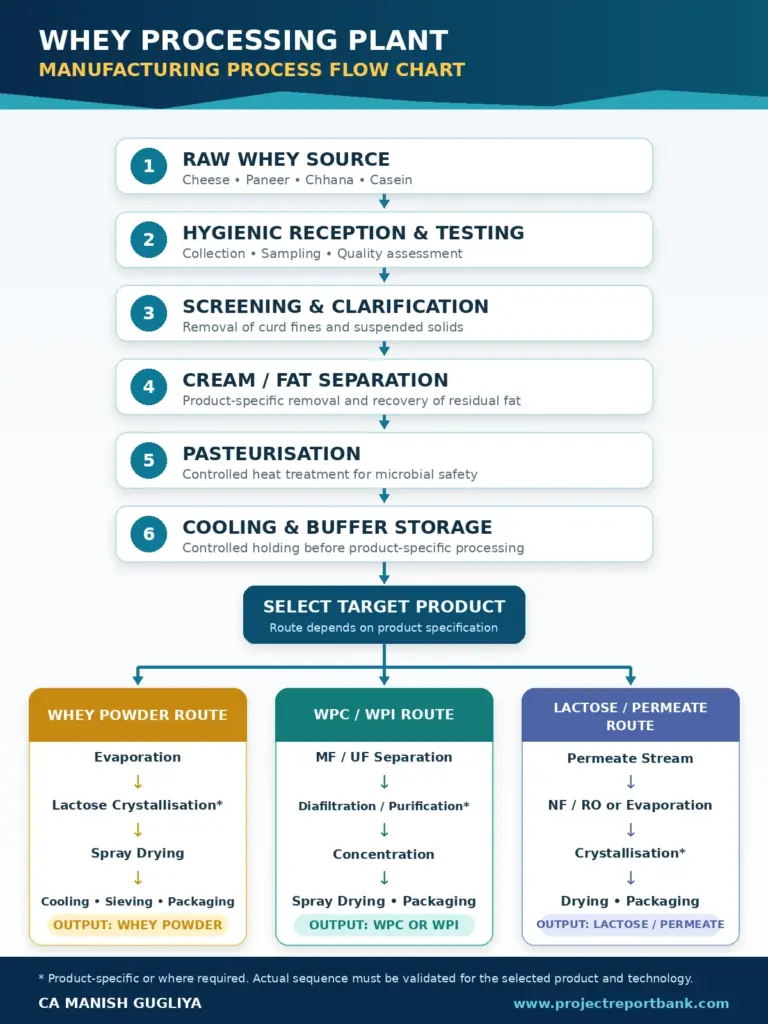
The final detailed whey processing plant flow chart for a DPR must be generated by the technology provider after finalising the product mix and plant capacity.
Step-by-Step Whey Collection and Reception
Efficient whey collection and reception are fundamental whey processing steps that directly influence microbial quality and subsequent yields. Whey is collected continuously from cheese, paneer, chhana or casein production lines through sanitary pipelines that transfer liquid whey to reception tanks. Open channels and unnecessary aeration should be avoided, as they increase microbial contamination and accelerate quality deterioration.
Reception and balance tanks smooth flow variations between the source process and the downstream whey processing line. At reception, systematic sampling is required for quick tests: pH, acidity, temperature, appearance and basic microbiological checks. Recording date, time, source product (e.g. cheddar-type cheese, paneer), batch number and approximate whey volume for each lot ensures traceability and supports quality systems required for regulatory compliance.
Screening, Clarification and Removal of Curd Fines
Raw whey often contains suspended curd particles, cheese fines and other solid impurities. These must be removed before sensitive stages like membrane filtration and plate heat exchangers. Inline strainers, vibrating screens or clarifier-type separators are used for whey screening and clarification, with the focus on protecting downstream equipment and maintaining process efficiency.
Recovered curd fines and solids can often be directed back into processed-cheese production or animal feed, improving overall solids recovery from the cheese making or paneer manufacturing process. Smooth, well-clarified whey improves membrane life, reduces fouling in evaporators and improves the stability of the final whey powder or whey concentrate.
Whey Cream Separation and Fat Management
Some whey streams still contain residual butterfat, which affects protein powder quality, foaming and shelf life if not properly controlled. Centrifugal cream separators can remove whey fat, generating a whey cream by product that may be used for butter, ghee or fat standardisation in other dairy products.
Excessive fat reduces membrane filtration efficiency, complicates spray drying and may cause lump formation or oxidation in finished powder form products. Whether whey cream separation is essential depends on the raw material composition and final product specifications; strict low-fat limits for WPI demand thorough fat removal, while standard whey powder production may tolerate broader limits.
Pasteurisation and Heat Treatment of Whey
Whey is clarified and pasteurised to improve microbiological safety before further processing. The objective of whey pasteurisation is reducing pathogenic and spoilage microorganisms, stabilising the liquid whey stream and protecting the safety of all downstream whey products. Common equipment includes plate or tubular heat exchangers, regenerative pasteurisers and associated control systems.
Over-heating can denature whey proteins, affecting solubility and functional properties such as foaming and gelation. A dairy technologist must select and validate the appropriate heat treatment regime. Some specialty ingredients (e.g. native whey products for clinical nutrition or infant formula applications) may require tailored heat profiles, and operating parameters should always be confirmed with the technology provider.
Cooling and Intermediate Storage Before Further Processing
Rapid cooling of pasteurised whey to an appropriate holding temperature reduces microbial growth and chemical changes before membrane filtration or evaporation. Insulated, agitated storage tanks with level indicators, temperature monitoring and hygienic design (conical bottoms, CIP spray balls, proper venting) are used for intermediate storage.
Holding times should be minimised and must be aligned with whey generation patterns and the downstream capacity of the whey processing line. Balanced intermediate-storage capacity is important but cannot compensate for consistently undersized filtration or drying capacity.
Pretreatment and Feed Standardisation
Depending on the product mix and raw whey properties, additional pretreatment steps may be needed before membranes or evaporators. These may include pH adjustment (within food-safety limits), fine clarification, additional fat removal, partial demineralisation or pre-concentration of dry solids.
Such standardisation helps provide more uniform feed for membrane filtration, improves product consistency and reduces process upsets in evaporation and spray drying. Not every whey processing plant will adopt every pretreatment option; these are product- and technology-provider-specific choices.
Membrane Filtration Technologies in Whey Processing
Membrane systems play a central role in the modern industrial whey processing process, especially for WPC and WPI manufacturing processes. Membrane filtration techniques like ultrafiltration separate proteins from lactose and minerals, creating two streams: the retentate (protein-rich) and the permeate (water, lactose and mineral-rich). Both streams must be planned for as products or managed as effluent.
Membrane selection and configuration (microfiltration, ultrafiltration, nanofiltration, reverse osmosis, diafiltration) is highly project-specific and must be engineered by experienced suppliers based on whey composition, target products and plant capacity.
Microfiltration of Whey
Microfiltration is generally used to remove very fine suspended matter, residual fat globules or selected microorganisms from liquid whey. Microfiltration removes remaining fats and bacteria from whey, which is especially important in whey protein isolate production where purity requirements are stringent.
It may serve as pretreatment to protect downstream UF membranes or as part of an advanced purification route for specialised whey protein ingredients. Cleaner feed produced by microfiltration improves plant hygiene, membrane life and final product clarity.
Ultrafiltration and Diafiltration for Protein Concentration
Ultrafiltration retains larger protein molecules and allows smaller molecules (water, lactose, part of the minerals) to pass through into the permeate. This makes ultrafiltration central to the whey protein manufacturing process. Ultrafiltration can concentrate whey protein to 35-80% protein content, depending on the membrane system, concentration factor and whether diafiltration is employed.
The diafiltration process involves the addition of high-quality process water to the retentate during UF. Diafiltration adds water during ultrafiltration to increase protein purity by washing out lactose and residual minerals. This step is essential when producing higher-grade WPC or preparing feed for WPI manufacture. Feed-water quality, hygienic system design and appropriate permeate handling for environmental compliance are all critical considerations.
Nanofiltration and Reverse Osmosis in Whey Processing
Nanofiltration can be used for partial demineralisation and concentration of whey or permeate by letting some salts and water pass while retaining larger solutes. Demineralisation can reduce mineral content by 30% to 90%, depending on the process design and the number of stages employed.
Reverse osmosis in whey processing is primarily used to remove water from whey or permeate, thereby pre-concentrating solids and reducing the evaporation load. In some designs, RO permeate (water) can be further treated for reuse as process water or CIP rinse water, provided it meets relevant quality standards. Selection between NF and RO depends on target products (e.g. demineralised whey powder, lactose, permeate powder) and must be engineered case by case.
Comparison Table of Key Membrane Operations
| Membrane Step | Main Components Retained | Main Components in Permeate | Typical Role in Whey Processing |
|---|---|---|---|
| Microfiltration | Fat globules, fine particles, some microorganisms | Clarified whey with proteins, lactose, minerals | Pretreatment, fat removal, hygiene improvement |
| Ultrafiltration | Whey proteins | Water, lactose, part of minerals | Protein concentration for WPC/WPI production |
| Nanofiltration | Lactose, part of minerals | Water, selected small ions | Partial demineralisation, permeate concentration |
| Reverse Osmosis | Almost all dissolved solids | Primarily water | Pre-concentration, water recovery |
Actual performance values depend on whey composition, temperature, membrane type and system design. Specific pore sizes, transmembrane pressures and recovery percentages will be provided by the membrane supplier based on project-specific requirements.
Whey Powder Manufacturing Process Route
The whey powder manufacturing process focuses on converting clarified whey (sweet or acid) into a free-flowing powder that still contains protein, lactose and minerals in proportions broadly reflecting the original whey composition.
Clarified Whey → Fat Separation (where required) → Heat Treatment → Pre-Concentration (RO or partial evaporation) → Evaporation → Lactose Crystallisation (where required) → Spray Drying → Fluid-Bed Drying & Cooling → Sieving → Packaging
Evaporation is almost always used to concentrate liquid whey before spray drying. This reduces the volume of water that must be removed by the dryer, lowers energy demand and helps protect powder quality. Whey is typically spray-dried after concentration to form whey powder.
In suitable sweet whey powder processes, lactose crystallisation is performed before drying. Concentrated whey is cooled under controlled conditions with agitation and seed crystal addition. This converts amorphous lactose into crystalline form, reducing stickiness and hygroscopic behaviour in the finished powder and improving storage stability.
Key quality aspects include moisture levels control, bulk density, solubility, limiting heat damage and managing mineral-related flavour. Sweet whey powder generally has a milder, slightly sweet taste. Acid whey powder, produced from cottage cheese or paneer whey, tends to have a salty taste or salty flavour, sharper acidity and is often directed to animal feed or specific food applications. Whey powder production costs are influenced by raw material prices and energy consumption.
Whey Protein Concentrate (WPC) Manufacturing Process
The WPC manufacturing process aims to increase protein concentration by selectively removing part of the water, lactose and minerals through ultrafiltration and diafiltration.
Clarified & Pretreated Whey → Ultrafiltration → Diafiltration (where required) → WPC Retentate → Evaporation or Further Concentration → Spray Drying → Cooling & Sieving → Packaging
The ultrafiltration retentate becomes the main product stream for whey protein concentrate, while the permeate contains lactose, minerals and water and must be captured as a by-product stream or sent for whey permeate processing. Whey protein concentrate typically contains 34% to 80% protein on a dry basis, while higher grades (often marketed as WPC-80) contain 70-80% protein by dry weight. Different WPC grades require different membrane designs, concentration levels and diafiltration strategies, to be confirmed with the technology provider.
Careful microbial control, protein functionality management and gentle thermal treatment are essential to support end-use in sports nutrition, bakery, dairy beverages and specialised food industry applications. Complete proteins with a full amino acid profile and good functional properties (foaming, emulsification, gelation) are preserved when heat exposure and shear are carefully managed.
Whey Protein Isolate (WPI) Manufacturing Process
The WPI manufacturing process requires higher protein purity than WPC, demanding additional separation and more stringent quality control. Whey protein isolate WPI contains over 90% protein content by dry weight, with very low residual lactose, fat and mineral content.
A WPI route may build upon WPC production, using further membrane steps (additional ultrafiltration, diafiltration, microfiltration) or other suitable technologies to remove more lactose, fat and minerals. Some technology providers may also use ion exchange, ion exchange resins or chromatographic methods; ion exchange processes can achieve very high protein purity. The route must not be portrayed as identical for every plant.
High-Quality Whey or WPC Feed → Advanced Membrane and/or Other Purification → High-Protein Retentate → Concentration (Evaporation/RO) → Spray Drying → Powder Cooling & Sieving → Packaging
WPI applications in sports nutrition, clinical nutrition and high-protein products require tighter control on amino acid profile, solubility, essential amino acids content and microbiological parameters. Whey protein isolate production costs 30% to 50% more than WPC due to the additional purification stages, higher membrane replacement costs and more rigorous quality control. This demands sophisticated laboratory facilities and in-process testing, including protein content verification at multiple stages.
Whey Permeate Processing and Lactose Recovery
Permeate produced during WPC or WPI manufacture is rich in lactose, dissolved minerals and water. It should be treated as a potential product stream rather than only as effluent. Processing options include further concentration of permeate by nanofiltration or reverse osmosis, followed by evaporation, lactose crystallisation, separation of lactose crystals, and drying of lactose or permeate powder.
UF Permeate → NF/RO Concentration →
- Option A: Evaporation → Lactose Crystallisation → Separation → Lactose Drying → Lactose Product (for lactose manufacture, pharmaceutical, infant formula or food ingredient use)
- Option B: Evaporation → Spray Drying → Whey Permeate Powder
Mother liquor and remaining high-strength streams may still require effluent treatment, but effective permeate utilisation reduces overall organic load and improves project economics. Research has demonstrated lactose recovery yields of approximately 87-90% using integrated NF, RO and drying systems applied to UF permeate.
Evaporation and Concentration of Whey Streams
Evaporation is a core step in the whey manufacturing process, used to remove water before spray drying. Evaporation concentrates the protein-rich liquid by removing excess water at low temperatures, which reduces dryer load and energy consumption. Multiple-effect or other energy-efficient evaporator systems are standard for concentrating whey, WPC retentate or permeate.
Feed viscosity, risk of lactose crystallisation during evaporation, protein content and thermal sensitivity all influence the selection of evaporator type and operating strategy. Evaporator design and capacity must be matched to membrane throughput and dryer capacity to avoid bottlenecks or product damage.
Lactose Crystallisation in Whey Processing
Controlled lactose crystallisation is important in whey powder manufacturing and in dedicated lactose recovery processes. It reduces stickiness, caking and hygroscopic behaviour in finished powders. Crystallisation tanks are used where concentrated whey or permeate is cooled under controlled conditions with agitation to promote the formation of lactose crystals. Flash cooled or gradually cooled approaches may be employed depending on the product.
Process parameters such as seeding, cooling rate and holding time must be specified by the technology supplier based on target product and plant design. Partial crystallisation is used in sweet whey powder manufacture, while more intensive crystallisation is used when producing separate lactose as a stand-alone ingredient.
Spray Drying, Fluid-Bed Drying and Powder Handling
The whey spray drying process involves atomising concentrated whey or WPC/WPI liquid into fine droplets that contact a controlled stream of hot air, rapidly removing moisture to produce powder. Spray dryer design (tower type, nozzle or rotary atomisers, air-flow pattern, heat-recovery features) must be engineered by a specialist supplier and tailored to the product mix. Milk powders and whey protein powders each have specific drying requirements.
Subsequent fluid-bed drying and cooling adjusts final moisture levels and reduces powder temperature, improving shelf life and preventing caking or protein damage. Powder handling includes gentle conveying, dust control, sieving, metal detection and hygienic packaging in bags, drums or retail packs, with attention to moisture barriers and oxygen exposure. The finished whey protein powder is packed under strict hygienic conditions to prevent contamination.
Safety considerations include dust-explosion risk, proper ventilation and fire-protection systems, especially important for high-capacity spray drying lines.
Machinery and Equipment Used in a Whey Processing Plant
The following table summarises the main whey processing equipment required at each stage of the whey processing line. Specific models, capacities and specifications must be obtained from machinery suppliers based on project requirements.
| Processing Stage | Main Equipment | Purpose | Essential / Product-Specific |
|---|---|---|---|
| Whey Reception & Storage | SS insulated tanks, chilling systems | Store raw whey, smooth flow | Essential |
| Balance Tanks | Buffer/intermediate tanks | Match flow between stages | Essential |
| Screening & Straining | Inline strainers, vibrating screens | Remove curd fines, solids | Essential |
| Clarification | Clarifier / centrifugal separator | Remove fine solids, residual fat | Essential |
| Cream Separation | Centrifugal cream separator | Remove whey fat | Product-specific |
| Heat Treatment | Plate/tubular heat exchangers | Pasteurisation, microbial control | Essential |
| Membrane Filtration | UF, MF, NF, RO skid modules | Protein concentration, demineralisation | Product-specific config |
| Diafiltration | Diafiltration loop on UF system | Increase protein purity | Product-specific (WPC/WPI) |
| Demineralisation | NF systems, ion exchange units | Mineral/ash reduction | Product-specific |
| Evaporation | Multiple-effect/falling-film evaporators | Concentrate before drying | Essential for powders |
| Crystallisation | Cooling crystallisers with agitation | Lactose crystallisation | Product-specific |
| Spray Drying | Spray dryer tower, atomisers, cyclones | Convert liquid to powder | Essential for powders |
| Fluid-Bed Drying/Cooling | Vibrating fluid beds | Final moisture/temp control | Essential for powders |
| Powder Recovery | Cyclone separators, bag filters | Recover fine powder, dust control | Essential |
| Sieving | Vibratory sieves | Remove oversized particles | Essential |
| Packaging | Bag fillers, sealers, gas flush | Pack finished product | Essential |
| CIP System | CIP skid, chemical dosing | Clean equipment in place | Essential |
| Refrigeration | Chillers, chilled water system | Cooling at multiple stages | Essential |
| Steam/Hot Water | Boiler, steam distribution | Heating, pasteurisation, evaporation | Essential |
| Air Compression | Air compressors | Instrumentation, atomisation | Essential |
| Water Treatment | RO, filtration systems | Process water, CIP water | Essential |
| Laboratory | Analytical instruments, micro lab | Quality control, testing | Essential |
| Effluent Treatment | ETP (primary, secondary, tertiary) | Treat wastewater to norms | Essential |
For detailed cost guidance, promoters should refer to whey processing plant machinery and equipment cost. Plant promoters must obtain vendor quotations and technical offers from machinery suppliers before finalising DPR budgets, as costs vary widely with capacity, automation level and the intended whey protein product portfolio.
Process Integration with Existing Dairy and Cheese Plants
Locating a whey processing plant adjacent to or within an existing dairy or cheese complex offers several advantages: minimal holding time for liquid whey, reduced transport cost, shared utilities and laboratory facilities, and better control over raw-whey quality. Cow’s milk or buffalo milk processed into cheese or paneer generates whey that can be transferred directly to the whey line through sanitary pipelines.
The capacity of cheese manufacturing or paneer production lines must be balanced with whey processing equipment so that peak-season whey volumes can be processed without excessive delays. Common utilities such as steam, chilled water, compressed air, boiler house, water treatment and a common CIP system can be shared, helping reduce both capital and operating expenditure. For readers evaluating larger dairy complex projects, an integrated dairy processing plant project report can provide a structured framework.
Planning should account for long-term milk procurement trends, product mix evolution (e.g. future expansion from whey powder to WPC or WPI) and seasonal variation in cheese production.
CIP Systems and Hygienic Whey Processing Plant Design
Clean-in-place (CIP) is a critical component of whey processing quality control. CIP systems ensure hygienic cleaning of tanks, pipelines, membranes, heat exchangers, evaporators and spray dryers without dismantling equipment. Separate CIP programmes are required for membranes (which need mild caustic/acid cycles), high-temperature equipment, and powder handling sections, as specified by equipment suppliers.
Hygienic plant design requires food-grade stainless steel (SS-304, SS-316 where required), sanitary welding, no dead legs or stagnant areas, self-draining lines and proper slope towards drains. Zoning is essential: separating wet-production areas, dry-powder handling areas, packaging zones and utility areas minimises cross-contamination, dust and moisture issues.
Documented sanitation procedures, validation of CIP parameters and regular verification form part of the plant’s food-safety management system. Personnel and material movement must be controlled across zones to maintain product quality and regulatory compliance.
Utility Requirements for Whey Processing Plants
Utility planning is a core part of whey processing plant design, influencing both capital cost and operating cost. Main utilities include:
- Electrical power (for motors, pumps, membranes, controls)
- Steam and hot water (for pasteurisation, evaporation, CIP)
- Process water (for membranes, diafiltration, cleaning)
- Chilled water and refrigeration (for cooling at multiple stages)
- Compressed air (for instrumentation, atomisation)
- Drying air (heated, filtered and conditioned for spray dryers)
- CIP chemicals and dosing systems
- Effluent treatment and water recovery systems
Generic consumption figures should not be assumed. The project team must derive utility loads from final equipment selections, operating hours and vendor data. Backup arrangements (generators, standby chillers) are necessary for critical operations where interruption could damage product or compromise food safety.
Quality Control, Food Safety and Regulatory Compliance
Robust quality control across raw materials, in-process streams and finished powders is essential for both domestic and export markets in India. Quality control plans should align with HACCP principles, FSSAI requirements and any customer-specific or export standards.
Raw Whey Testing Parameters
Key tests for incoming liquid whey include: acidity or pH, total solids, protein, fat, lactose (where required), ash and mineral content, microbial quality (total plate count, coliforms, spoilage organisms) and visual checks for foreign matter. These parameters influence selection of membrane settings, evaporation load and suitability for different products. For instance, whey intended for high quality infant formula or infant nutrition products will require stricter testing than whey directed to animal feed.
In-Process Monitoring and Control
Monitoring includes clarification efficiency (sediment or turbidity checks), pasteurisation controls (time-temperature charts), membrane performance (flux, pressure drop, protein leakage) and evaporator concentration levels. Checks on lactose crystallisation behaviour, spray dryer outlet moisture levels, powder temperature and basic microbiological sampling at critical control points are required. Quality control includes testing for protein content and microbiological safety at each stage.
Finished-Product Testing and Release
Typical finished-product tests include protein content, moisture, fat, lactose, ash, solubility, bulk density and microbiological profiles. Packaging integrity, label accuracy and sensory assessment (for flavour, colour, absence of off-odours) are also important before product release. Batch testing verifies protein levels and allergen declarations in whey products, since milk proteins are a listed allergen. Traceability, batch coding, retention samples and documentation of deviations and corrective actions must be maintained as part of the quality systems.
Environmental Management and Whey-Processing Effluent Treatment
Whey and permeate streams have a high organic load (lactose, residual proteins, lactic acid) and cannot be discharged untreated without causing serious environmental impact. Process design should prioritise maximum product recovery (powder, lactose, permeate powder) before effluent treatment to reduce ETP size and operating cost.
Segregation of high-strength streams (whey losses, CIP first rinses, mother liquor from crystallisation) from relatively diluted wastewater (floor washings, cooling-water blowdown) optimises effluent-treatment design. The ETP for a whey plant typically includes suitable primary, secondary and, where required, tertiary treatment steps whose design must be based on actual wastewater analyses and regulatory norms. Water recovery and reuse must respect food-safety and environmental regulations applicable in the project’s state.
Factors Influencing Whey Processing Technology and Process Selection
Key factors that shape the selection of whey processing technology include:
- Type of whey (sweet whey, acid whey, paneer/chhana whey, rennet casein whey) and its composition
- Daily and seasonal whey availability
- Targeted product portfolio and required protein concentration
- Customer quality expectations, including export ambitions and standards for infant formula or clinical nutrition
- Availability of skilled manpower (dairy technologists, membrane specialists, spray dryer operators)
- Local service support for membranes, spray dryers and digestive enzymes or specialised components
- Utility reliability (power, steam, water)
- Environmental norms and effluent disposal requirements
- Capital budget, acceptable operating cost, automation level and future capacity expansion plans
There is no one-size-fits-all whey processing technology. Final selection must come from a combination of laboratory trials, pilot runs and vendor discussions. Sweet whey and acid whey behave differently through every stage; even mineral acid versus lactic acid coagulation affects downstream processing choices.
Capacity Planning and Line Balancing in Whey Plants
Whey-generation capacity from the associated dairy or cheese plant drives all subsequent design decisions and must be realistically estimated from milk procurement plans and product mix. The capacity of reception, storage, membrane filtration, evaporation and drying systems must be balanced so that none becomes a bottleneck at peak production.
Relying excessively on intermediate chilled storage of concentrated whey or liquid whey can lead to quality deterioration and should not substitute for adequate installed process capacity. Promoters should request a detailed capacity statement and mass-balance summary from the technology provider as part of the technical offer. Dryer capacity alone should not be treated as the total plant capacity; membrane throughput and evaporator sizing are equally determinative.
Setting Up a Whey Processing Plant in India
From a project advisory perspective, a whey plant must be evaluated not only on technology but also on assured whey availability, market demand and financial feasibility. The whey protein market in India continues to grow across sports nutrition, food applications, milk powders and infant nutrition segments.
Key planning steps include:
- Identify and evaluate long-term liquid whey sources (from cheese production, paneer manufacturing or casein operations)
- Conduct raw-whey testing to understand composition and suitability
- Select core product mix (whey powder, WPC, WPI, lactose, permeate powder)
- Undertake market and competitor analysis
- Obtain multiple technology and machinery quotations
- Assess land, building, utility infrastructure and staffing requirements
- Secure statutory approvals (FSSAI licence, pollution-control clearances, factory licence and other local permissions)
- Plan trial production and product validation before full commercial launch
- Recruit dairy technologists and trained operators for further processing and quality management
- Prepare working-capital planning and implementation schedules
For readers seeking cost and budgeting insights, a detailed guide on whey processing plant setup cost in India covers capital estimation and investment planning. Initial investment for a whey processing plant is significant, and operating expenses are driven by raw whey costs and energy consumption.
Role of the Whey Processing Plant Flow Chart in DPR and Project Finance
A clear whey processing plant flow chart and material balance are central to any detailed project report (DPR) and bank appraisal. The flow chart supports:
- Machinery selection and sizing
- Capacity calculations and material balance
- Utility estimation (steam, power, water, refrigeration)
- Building-layout planning
- Identification of by-products and their commercial potential
- Effluent load estimation and ETP design
- Quality-control planning and laboratory requirements
- Capital-cost assessment and working-capital estimation
- Implementation planning and project scheduling
Lenders and investors typically review the whey processing process flow diagram to understand technology sophistication, scalability and risk factors before sanctioning term loans. The flow charts in this article are conceptual only. Final project-specific diagrams must be prepared jointly by the promoter’s technical team and the selected machinery supplier.
Financial and DPR Perspective by CA Manish Gugliya
As a practising Chartered Accountant with more than 20 years of experience in DPR preparation, CMA Data and project finance advisory for MSMEs, I have observed that a financially viable whey processing project requires realistic alignment between several interconnected variables: assured raw-whey availability, actual plant capacity, expected product recovery, product mix, selling-price assumptions, operating costs and loan-repayment capacity.
A distinction must be clearly understood between three cost concepts: machinery cost (the price quoted by equipment suppliers), installed project cost (which adds installation, utilities, piping, electricals, civil work) and total project cost (which further includes pre-operative expenses, margin money for working capital, contingencies and interest during construction). These are different numbers, and treating only machinery cost as total project cost is a common and costly error.
Technical assumptions on yields, recovery, product mix and membrane performance must be backed by written inputs from the technology provider. Financial projections should not be based on optimistic, unverified numbers. CMA Data and projections are prepared on the basis of information provided by promoters and technical experts; they are not “certified” guarantees of future results. I assist with DPR, CMA Data, financial projections and bank-finance planning. Technical process design and validation remain the responsibility of qualified dairy technologists and process engineers.
Common Mistakes Observed in Whey Processing Projects
Frequent technical errors include:
- Assuming all whey types behave the same through membrane filtration and drying
- Finalising whey processing equipment before deciding the target whey protein product
- Confusing whey powder with WPC or WPI in project planning and marketing
- Underestimating membrane cleaning and replacement requirements
- Ignoring whey permeate utilisation, increasing both effluent load and lost revenue
Process-integration issues include mismatched capacities between membrane systems, evaporators and spray dryers, inadequate chilled storage, and imbalance between whey generation and processing capacity.
Design shortcomings such as neglecting powder handling and packaging requirements, inadequate focus on CIP and hygienic zoning, and insufficient provision for effluent treatment and sludge handling are also common.
Financial-planning gaps include using assumed yields without vendor validation, estimating only machinery prices and treating them as total project cost, ignoring working capital, and underestimating steam, refrigeration and power requirements. Promoters should involve both technical and financial advisors at an early stage to avoid these pitfalls.
Conclusion
A well-designed whey processing plant manufacturing process can transform what was once treated as dairy effluent into a range of value-added ingredients: whey powder, WPC, WPI, lactose and permeate powder. Selection of process routes (membrane filtration, evaporation, crystallisation, spray drying) must depend on the source and quality of liquid whey, desired protein concentration, market requirements and available whey processing technology.
The whey processing plant flow chart is the backbone for equipment selection, capacity planning, utility sizing, quality-control design and DPR preparation. Both technical assumptions and financial projections must be validated before committing capital. Collaboration between dairy technologists, process engineers, Chartered Accountants and machinery suppliers is essential for success.
Indian entrepreneurs, dairy companies and investors should treat whey processing as a strategic, professionally planned investment rather than a peripheral add-on to cheese or paneer operations.
Frequently Asked Questions
What is the manufacturing process in a whey processing plant?
The manufacturing process in a whey processing plant involves a series of controlled stages: liquid whey collection and reception, screening and clarification, fat separation, pasteurisation, cooling and intermediate storage, membrane filtration (where applicable for WPC or WPI), evaporation to concentrate solids, crystallisation (where required), spray drying, fluid-bed cooling and final packaging. The exact steps differ depending on whether the target product is whey powder, WPC, WPI, lactose or permeate powder. Each route requires specific membrane configurations, concentration parameters and drying conditions that must be designed by a qualified technology provider.
What is the basic whey processing plant flow chart?
The most common route (e.g. for whey powder) follows this sequence: Raw Whey → Collection & Reception → Screening → Clarification → Fat Separation → Pasteurisation → Cooling → Pre-Concentration → Evaporation → Crystallisation (where required) → Spray Drying → Fluid-Bed Cooling → Sieving → Packaging. After pretreatment, the line can branch into WPC production (via ultrafiltration), WPI production (via advanced purification) or permeate processing (via NF/RO concentration and lactose crystallisation), depending on the chosen product mix.
How is liquid whey converted into whey powder?
Clarified and pasteurised liquid whey is first concentrated by evaporation to increase total solids. In sweet whey processing, controlled lactose crystallisation may be performed to reduce stickiness and improve storage stability. The concentrated whey is then atomised and dried in a spray dryer, followed by fluid-bed drying and cooling to bring the powder to target moisture levels. The free-flowing whey powder is sieved, checked for quality and packed into bags or containers under hygienic conditions.
What is the difference between whey powder, WPC and WPI?
Whey powder is the dried form of whole whey, containing protein, lactose, minerals and residual fat in proportions broadly reflecting the original whey. Whey protein concentrate (WPC) is produced by membrane filtration (ultrafiltration and diafiltration) to selectively remove lactose, minerals and water; WPC contains 35% to 80% protein on a dry basis depending on the grade. Whey protein isolate (WPI) undergoes further purification to achieve over 90% protein content by dry weight, with very low lactose and fat, and is used in sports nutrition, clinical nutrition, muscle recovery products and high-protein food applications. WPI production costs 30% to 50% more than WPC due to the additional processing complexity.
Which membrane technologies are commonly used in whey processing?
The four main membrane technologies used are microfiltration (removal of fine particles, fat and bacteria), ultrafiltration (retention of whey proteins while allowing lactose and minerals to pass), nanofiltration (partial demineralisation and concentration; demineralised whey powder can have mineral content reduced by 30% to 90%) and reverse osmosis (water removal for pre-concentration). Diafiltration, which involves adding process water during ultrafiltration to wash out more lactose and minerals, is also used when higher protein purity is required. Detailed membrane selection and sizing must be done case by case by qualified suppliers based on whey composition and target products.