Key Takeaways
- Lactose manufacturing converts low-value whey or whey permeate from a dairy plant into high-value food-grade, edible and pharmaceutical-grade lactose, creating an integrated revenue stream for dairy processors and improving complete whey utilization.
- A Lactose Manufacturing Plant Project Report (DPR) must cover technical process design, capital expenditure, operating cost structure, profitability, DSCR and loan-repayment capacity before committing to investment. An effective project report for a lactose manufacturing plant is essential for attracting investors and securing finance.
- Land, civil work, membrane systems, evaporators, crystallisers, dryers and utilities form the bulk of project cost. Machinery prices vary widely by capacity, automation and integration level, so generic figures should not be treated as final estimates.
- Profitability depends heavily on whey availability, lactose recovery rate, energy efficiency, product grade, market contracts and adequate working capital limits from banks. Lactose manufacturing offers gross profit margins of 22–30% under favourable conditions.
- CA Manish Gugliya (ProjectReportBank.com) does not supply machinery but prepares customised bankable DPRs, CMA Data, financial projections and loan documentation support for lactose projects in India.
Commercial Opportunity of Lactose Manufacturing from Whey
Indian dairies process millions of litres of raw milk daily. As global dairy processing continues to expand and milk production grows, cheese and casein production generate large volumes of whey – a by-product that many operations still treat as a low-value effluent. Whey is a by-product of cheese or casein manufacturing, yet it contains roughly 4.5–5% lactose, a naturally occurring disaccharide carbohydrate with significant commercial value. Converting this whey into lactose enables efficient utilization of dairy by-products, reduces effluent load and generates a new revenue stream for the dairy business.
An integrated dairy processing plant or milk processing plant can first recover proteins through a Whey Protein Concentrate manufacturing plant or a Whey Protein Isolate manufacturing plant, and then route the lactose-rich permeate for further processing into commercial lactose powder. This approach maximises value addition from every litre of whey.
Lactose serves as a key ingredient in pharmaceutical tablets and infant formula. It is also used by biscuit and bakery manufacturers, confectionery makers, and producers of flavored milk and milk powder. Pharmaceutical manufacturing units rely on lactose as a bulking excipient, while infant nutrition companies use it as the primary carbohydrate source in their formulations. Research has examined lactose’s interactions with other nutrients and confirmed that it supports intestinal development in neonates and aids calcium and mineral absorption – highlighting its alternative biological functions beyond simple energy provision.
A professionally prepared Lactose Manufacturing Plant Project Report helps assess the technical configuration, capital investment, operating margins, break-even point and bank-loan repayment capacity before a single rupee is committed. This article is written from the practical perspective of CA Manish Gugliya, FCA, DISA (ICAI), drawing on over two decades of Indian project finance and DPR preparation experience.
Lactose Manufacturing Industry Overview
Lactose is the “milk sugar” naturally present in the milk of all mammals. Commercially, it is recovered from sweet whey or whey permeate generated during cheese, casein or dairy processing. As global milk production increases and dairy entrepreneurs seek higher margins, the global lactose industry has emerged as a significant value-addition segment within the broader dairy industry.
The production process typically begins after upstream protein separation. Pasteurized milk is used to process milk into cheese; the resulting whey undergoes membrane filtration to remove proteins, yielding a permeate rich in lactose and minerals. This permeate is the primary feedstock for lactose manufacturing.
Key distinctions between grades:
- Food-grade lactose: Purity ≥ 99% dry basis, moderate microbiological limits, suitable for bakery, confectionery and processed foods.
- Edible/refined lactose: Higher purity (≥ 99.5%), tighter protein and ash limits, used in milk products and infant formula.
- Pharmaceutical-grade lactose: Purity ≥ 98–99.8% per pharmacopeial monographs, stringent microbiological limits (TAMC < 100 cfu/g), validated manufacturing process, GMP documentation – demanded for pharmaceutical and food applications.
Major industrial applications include infant formula (where lactose contributes the primary carbohydrate), bakery and confectionery, pharmaceutical tablets and capsules, fermentation substrates in biotechnology, and animal feed formulations where lactose serves as an energy source. High purity lactose grades with consistent crystals, low moisture and low bioburden are critical for global pharma buyers and infant nutrition companies with strict specifications. Lactose derivatives also find niche applications where specific functional properties are required.
Market Potential for Lactose in India
The global lactose market was valued at USD 2.80 billion in 2025 and is projected to reach USD 4.73 billion by 2034, exhibiting a CAGR of approximately 6.0% from 2026 to 2034. The global lactose market includes segments such as pharmaceuticals, infant formula, food and animal feed. Rising global demand for infant formula supports lactose consumption growth, while increasing production of tablets drives lactose demand in pharmaceuticals.
In India, the pharmaceutical-grade lactose market generated approximately USD 190.3 million in revenue in 2025, forecast to reach USD 324 million by 2033 at a CAGR of about 6.9%. Consumer demand from food-processing companies, stable demand from pharma excipient buyers, and rising milk consumption collectively create a strong domestic market. Investment in lactose production technologies is expected to grow as dairy entrepreneurs recognise the import-substitution potential.
Market analysis includes competitor analysis and understanding target segments to ascertain demand. India currently imports substantial quantities of lactose; APEDA data indicates imports may approach 80,000 metric tonnes in 2025. A competitive domestic lactose industry can replace a significant portion of these imports if quality and consistency are maintained. Export potential also exists for refined lactose, though competition from established global suppliers in Europe, New Zealand and the US remains strong. Long-term supply contracts with large institutional buyers stabilise revenue and improve bankability of the Lactose Manufacturing Plant DPR.
Raw Materials and Consumables for Lactose Manufacturing
The key raw materials for lactose manufacturing are sweet whey, deproteinised whey, whey permeate and, in some configurations, demineralised whey permeate. The composition of incoming whey – its lactose percentage, protein content, minerals and acidity – strongly influences recovery rate, energy use and achievable product grade. Raw material consumption patterns and seasonal variations must be studied carefully during DPR preparation.
Key consumables include:
- Process water and softened water
- Membrane filtration consumables (UF/NF/RO cartridges, membranes, anti-scalants)
- Ion-exchange resins for demineralisation (where required)
- Cleaning chemicals for CIP (caustic, acid)
- Packaging materials (multiwall paper bags, FIBC bags, HDPE liners)
Co-locating the lactose manufacturing plant near a large integrated dairy plant, cheese factory or whey processing unit ensures continuous whey-permeate supply and helps minimize distribution costs and transportation costs. Long-term supply contracts with dairy farms are critical to ensure sustainable whey supply. Even a small dairy plant producing cheese can supply whey if volumes are aggregated. Raw material storage facilities must handle perishable liquid whey with refrigeration to prevent spoilage.
When the lactose unit is part of a larger dairy processing unit, a transfer-pricing policy between divisions is essential for correct cost accounting in the project report.
Lactose Manufacturing Process and Flow Description
The lactose manufacturing process is a series of controlled steps. Marketable lactose powder is never produced merely by drying raw whey – it requires concentration, crystallisation, separation and refining. Lactose is commonly recovered through clarification, concentration, crystallization, separation and drying. Lactose production involves whey collection, crystallization and drying as its core stages.
The technical steps in sequence:
- Receipt and quality testing of whey or whey permeate
- Clarification and removal of suspended solids
- Protein removal (residual, if upstream separation is incomplete)
- Membrane concentration (UF/NF/RO)
- Demineralisation (ion-exchange or electrodialysis, where required for high purity specialty lactose or pharma grades)
- Multi-effect evaporation to increase solids concentration
- Controlled lactose crystallisation (temperature, seeding, cooling profile)
- Crystal separation by decanter centrifuge
- Crystal washing and purification
- Drying (fluid-bed, rotary or spray dryer depending on grade)
- Milling and particle-size control
- Sieving and classification
- Quality testing
- Hygienic packing and storage
Process Flow:
Whey / Whey Permeate → Clarification → UF / NF / RO Concentration → Demineralisation (if required) → Evaporation → Cooling & Controlled Crystallisation → Crystal Separation & Washing → Drying → Milling & Sieving → Quality Control → Packing & Storage
Efficient lactose recovery usually comes from a lactose-rich permeate stream obtained after upstream protein separation; understanding the whey processing plant manufacturing process and flow chart is essential context. Operating parameters such as crystallisation temperature, cooling rate, seeding and residence time influence crystal size distribution and purity, which directly affect suitability for food-grade and pharmaceutical grade lactose production.
Plant Capacity, Product Mix and Material-Balance Planning
Plant capacity selection should follow a material-balance study based on actual whey or permeate availability, lactose content in the feed, anticipated recovery percentage and planned operating days per year. The production capacity of a lactose plant is often expressed in tonnes per day or tonnes per annum.
Key factors influencing capacity:
- Daily volume and seasonal variation in milk supply and cheese/whey production
- Target product grade (food vs pharmaceutical)
- Drying and packing capacity
- Production capacity utilization targets during ramp-up
Lactose manufacturing plants typically have an annual production capacity ranging from 10,000 to 30,000 MT, though actual sizing must be project-specific. A lactose manufacturing facility can produce 10,000–30,000 MT annually depending on scale. Planning the product mix – basic food-grade lactose, refined lactose, lactose monohydrate, pharmaceutical excipient grades and customised particle-size grades – is a central part of the bankable DPR and influences every downstream financial projection.
Machinery and Equipment for a Lactose Manufacturing Plant
Plant and machinery represent the largest component of capital expenditure. Choosing the right technology for production affects product quality, energy consumption and maintenance requirements. Lactose production utilizes various equipment such as evaporators, crystallizers and centrifuges. High-quality machinery is essential for lactose manufacturing efficiency.
Principal equipment and purposes:
- Whey reception and balance tanks
- Clarifier and separators
- Ultrafiltration, nanofiltration and RO membrane systems
- Demineralisation system (ion-exchange or electrodialysis)
- Multiple-effect evaporator
- Crystallisation tanks with controlled cooling
- Decanter centrifuge for crystal separation
- Crystal washing system
- Fluid-bed or spray dryer adapted for lactose
- Milling and sieving machines
- Automated packaging systems
- CIP (clean-in-place) system
- Refrigeration, boiler and steam systems
- Water-treatment plant, laboratory instruments, effluent-treatment plant
Advanced integrated systems may share membrane units, evaporators and dryers with upstream whey units; for detailed equipment considerations, refer to whey processing plant machinery and equipment cost. Computerized process control systems and hygienic design using food-grade stainless steel are critical, especially for pharmaceutical grade lactose production. Machinery prices vary widely; promoters should obtain updated supplier quotations rather than relying on generic figures.
Land, Building and Plant Layout Considerations
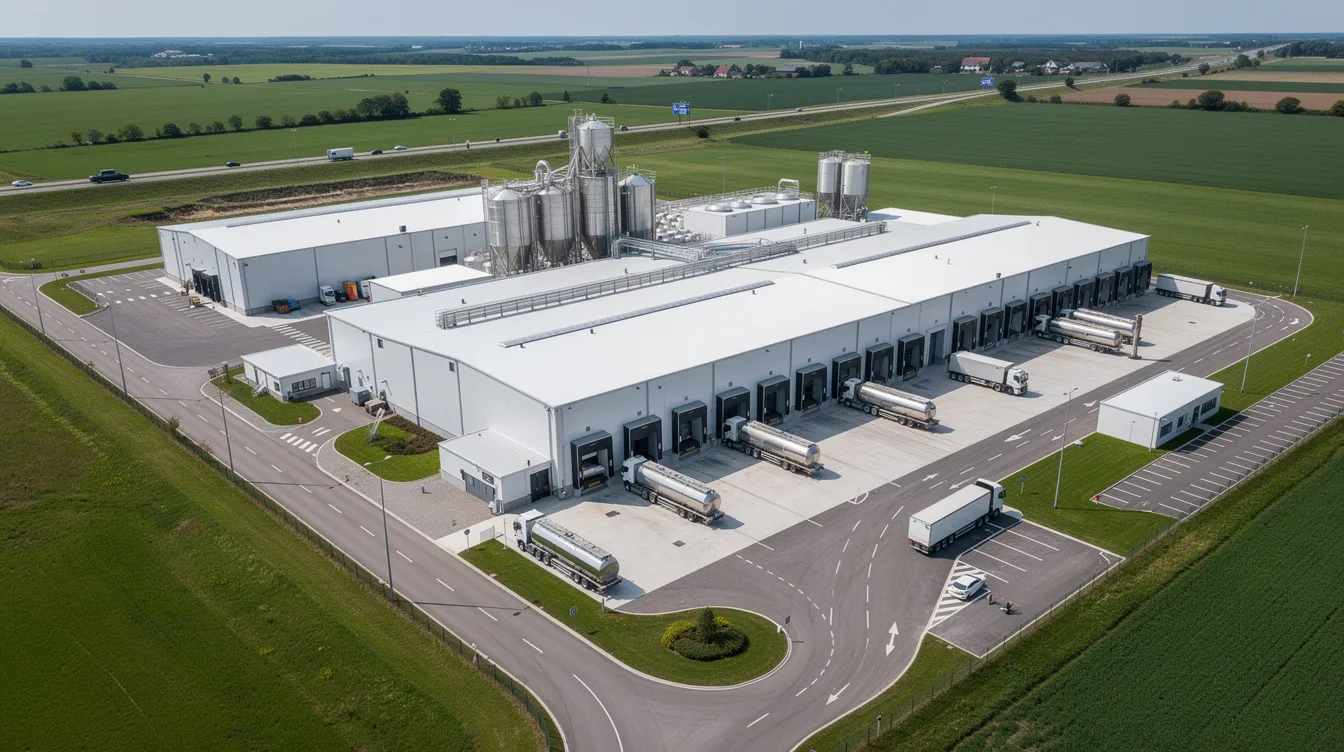
A typical lactose manufacturing plant in India requires segregated zones: wet processing, evaporation and crystallisation, powder handling and packaging, warehouses, utilities and administration. The layout of the plant should ensure logical material flow and prevent contamination.
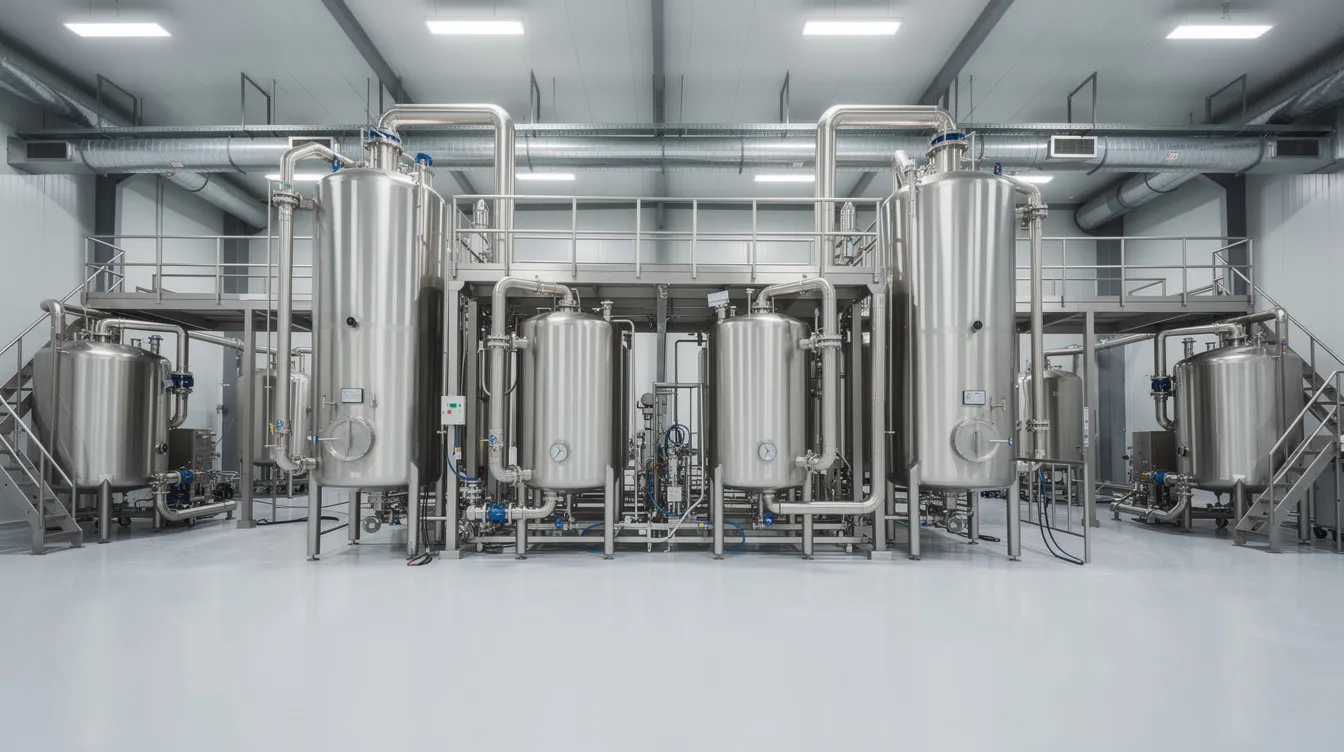
Functional areas include whey reception and raw material storage, membrane and wet-processing hall, evaporator and crystalliser section, dryer and powder-handling room, hygienic packing room (positive-pressure, controlled dust), finished-goods warehouse, quality-control laboratory, utility block (boiler, refrigeration, air compressors), water-treatment plant, effluent treatment systems and administrative block.
Unidirectional material flow from raw whey to packed lactose with separate entry and exit for personnel minimises contamination risk. The DPR should include a conceptual layout drawing and zoning description for factory licence, pollution-control approval and lender appraisal. Adequate height for evaporators, space for future capacity expansion and safe vehicle circulation must be planned upfront.
Utility Requirements and Energy Planning
Utilities such as steam, electricity and water are critical for dairy processing operations and form a major part of operating expenses for any processing plant. Evaporation, crystallisation and drying stages are energy-intensive; small improvements in steam economy and heat recovery can significantly improve lactose manufacturing plant profitability.
Key utilities include electrical power for pumps, drives and centrifuges; steam and fuel for evaporation and drying; chilled water and refrigeration for crystallisation; compressed air; process water; and CIP chemicals. Backup power (DG sets) is necessary for critical controls and refrigeration where grid reliability is poor. An effluent treatment plant must handle high-BOD and high-COD permeate streams, CIP discharges and wash water in compliance with State Pollution Control Board norms. Effluent treatment plants are necessary due to the high BOD and COD levels in wastewater from whey processing.
Quality Control and Product Standards
Lactose buyers – especially pharma and infant formula companies – require strict quality control, full traceability and batch documentation. Pharmaceutical-grade lactose requires stringent quality standards and microbiological limits. Effective cleaning and sanitation processes are vital in dairy manufacturing to maintain product quality. Heat treatment steps during processing help kill harmful bacteria and reduce bioburden.
Core quality testing parameters:
- Lactose purity, moisture, ash and mineral content
- Residual protein, colour and appearance
- Microbiological counts (TPC, coliforms, yeasts, moulds)
- Particle-size distribution, bulk density, solubility
- Heavy metals and contaminants (where applicable)
Training needs for personnel should cover quality control compliance for food or pharmaceutical grade standards. Pharmaceutical grade lactose production demands tighter limits, validated cleaning, GMP documentation and sometimes customer QA audits. An in-house laboratory equipped with wet-chemistry, microbiology and physical-testing instruments is essential, and its cost must be included in the project report. The DPR should outline applicable reference standards – pharmacopeial monographs for pharma grades and ADPI specifications for food-grade lactose – to ensure consistent production quality.
Licences and Regulatory Approvals in India
Regulatory clearances are necessary for factory operation, food safety and environmental compliance. Requirements differ by state, capacity, product grade and site conditions, and must be verified with local authorities. Compliance with food safety regulations such as FSSAI or FDA is essential for lactose manufacturers.
Typical registrations include:
- Legal constitution, PAN, Udyam Registration, GST registration
- FSSAI licence for food-grade operations
- Factory licence under the Factories Act
- State Pollution Control Board Consent to Establish and Consent to Operate
- Fire-safety NOC, boiler registration, electrical approvals
- Labour-law registrations (ESI, EPF where applicable)
- Legal Metrology registration for packed products
- Environmental compliance certifications per environmental regulations
Exports may require Import Export Code and APEDA registration; pharma customers may trigger additional GMP and audit requirements. Promoters may also check with the state animal husbandry department for applicable dairy-sector registrations. The project report should include an implementation schedule allowing sufficient time for statutory approvals. Do not commence civil work without verifying zoning and environmental norms for the specific location.
Lactose Manufacturing Plant Project Cost Structure
Lactose manufacturing plant setup costs include capital investments and operating expenses. The project cost in a Lactose Production Plant Project Report is grouped under several heads.
| Cost Head | Indicative Share of Total Project Cost |
|---|---|
| Land and site development | 5–10% |
| Factory building and civil construction | 12–18% |
| Plant and machinery (membranes, evaporators, crystallisers, dryers, packing) | 40–50% |
| Utilities (boiler, refrigeration, transformer, DG set) | 8–12% |
| Electrical installations | 3–5% |
| Laboratory and ETP | 2–4% |
| Pre-operative expenses (IDC, trial runs, consultancy) | 4–7% |
| Contingency and margin money for working capital | 5–8% |
Assumptions: Mid-size industrial-scale lactose plant in India with annual production capacity of approximately 10,000–15,000 MT. Figures are indicative only and must be recalculated based on actual quotations, location and scope.
Margin money for working capital is treated as part of total project cost for term-loan appraisal in Indian banking practice. If the lactose unit is integrated with a new or existing whey facility, total investment changes significantly; for context, see whey processing plant setup cost in India.
Means of Finance and Capital Structure Planning
Banks in India typically expect a balanced mix of promoter’s equity and term loan for a capital-intensive lactose manufacturing plant investment. Standard means of finance components include promoter’s contribution (share capital and internal accruals), term loan from banks, unsecured loans from promoters (if acceptable to lender), government subsidy where eligible and working-capital limits.
The debt–equity ratio, repayment tenure and moratorium must align with projected cash flows and the plant’s stabilisation period. Schemes such as the Dairy Entrepreneurship Development Scheme or other dairy-ingredient support programmes may sometimes support integrated dairy projects, but eligibility must be verified with NABARD or the concerned department at the time of planning. The Lactose Plant Means of Finance in the DPR is a proposed structure and does not constitute a sanction or guarantee.
Operating Cost and Cost of Production
Operating expenses (OPEX) include all recurring costs and strongly influence the lactose manufacturing profit margin. Raw materials account for 55–65% of total operating expenses in lactose production. Operating costs for a lactose plant include utilities, labor and maintenance.
| Operating Cost Head | Indicative Share of Annual OPEX |
|---|---|
| Whey/permeate cost or transfer price | 45–55% |
| Process chemicals, membranes and consumables | 5–8% |
| Power and electricity | 8–12% |
| Steam and fuel | 6–10% |
| Labour and supervisory staff | 5–8% |
| Packaging materials | 3–5% |
| Repairs, maintenance and insurance | 3–5% |
| QC, administration, selling and distribution costs | 4–7% |
Illustrative for a stabilised year at ~75% capacity utilisation. Actual figures depend on state electricity tariff, fuel price, labour cost and membrane life for the chosen location.
In an integrated dairy business, the valuation of whey or permeate supplied to the lactose unit (internal transfer pricing) significantly affects calculated profitability and must be defined clearly. Accurate OPEX estimation requires actual utility tariff quotes, raw material consumption data and local cost inputs.
Revenue Model, Product Pricing and Lactose Manufacturing Profitability
Revenue streams may include food-grade lactose powder, refined lactose, pharmaceutical-grade lactose (subject to compliance), specific particle-size grades and potential sale of co-products such as mother liquor for fermentation. Lactose is used as a pharmaceutical excipient in tablets, serves as the primary carbohydrate in infant formula, is utilized in food products like bakery and confectionery, is an energy source in animal feed formulations and is applied as a fermentation substrate in biotechnology.
Market dynamics for lactose include supply-demand analysis, pricing and customer requirements. Selling prices vary by grade, purity, packaging size and institutional contracts.
| Illustrative Profitability Statement | Stabilised Year (₹ Lakhs) |
|---|---|
| Production capacity utilisation | 80% |
| Net sales revenue | 5,000–7,500 |
| Raw material and processing cost | 2,800–4,200 |
| Power and fuel | 500–900 |
| Employee cost | 250–400 |
| Other operating expenses | 300–500 |
| EBITDA | 1,100–2,250 |
| Interest | 200–400 |
| Depreciation | 250–450 |
| Profit before tax | 650–1,400 |
| Break-even point (% of capacity) | 45–55% |
Figures are illustrative for a 10,000–15,000 MT/year plant. Gross profit margins for lactose manufacturing typically range from 22–30%. All projections must be stress-tested.
Key risk factors in lactose production include whey supply fluctuations and market price volatility. Financial projections should include capital and operational expenditures along with break-even analysis.
Working-Capital Requirement for a Lactose Plant
Working capital is the fund locked in inventory, receivables and operating expenses after adjusting for supplier credit. Components relevant to lactose manufacturing include raw-material and consumable stock, packaging inventory, work-in-process, finished-goods inventory, receivables from institutional buyers and minimum cash balance.
Credit periods demanded by multinational food and pharma buyers can extend the receivables cycle, increasing working-capital needs. Inadequate working-capital limits can restrict production capacity utilization even when the plant is technically sound. The DPR and CMA Data should include bank-format working-capital assessment based on holding days, receivable days and creditor days.
Financial Projections in a Bankable Lactose Manufacturing Plant DPR
Lenders expect a complete financial model for at least 7–10 years for an industrial-scale Lactose Manufacturing Plant DPR. Projected statements include Profit and Loss account, Balance Sheet, Cash-Flow Statement, Fund-Flow Statement, working-capital assessment, term-loan repayment schedule, interest and depreciation schedules and tax estimates.
Analytical outputs required: DSCR calculation, ROI, IRR, payback period, break-even analysis, key financial ratios and cash flow projection. Projections are based on explicit assumptions regarding capacity ramp-up, selling prices, raw material cost, utility tariffs and finance terms and must be clearly documented. Projections are estimates and not a forecast guaranteed by CA Manish Gugliya or ProjectReportBank.com.
DSCR, Loan Repayment Capacity, ROI and IRR
DSCR (Debt Service Coverage Ratio) measures the ratio between cash available for debt service and term-loan obligations in a given period. Banks examine both average and minimum DSCR across the projection period to judge repayment comfort.
- Repayment schedule (tenor, EMI vs structured instalments) and moratorium period influence DSCR values
- Lower-than-planned capacity utilisation or selling-price pressure can reduce DSCR below lender thresholds
- ROI measures overall return on total investment; IRR measures the discount rate at which net present value of project cash flows equals zero
For example, a 10% reduction in selling price might reduce DSCR from 1.80 to 1.35, while a 15% increase in power cost could compress IRR by 2–3 percentage points. Good ROI and IRR values are meaningful only when assumptions about whey availability, recovery rate, energy cost and selling price are realistic and validated by market feedback.
Sensitivity Analysis and Project Risk Assessment
Sensitivity analysis is crucial for capital-intensive projects to test how profits and DSCR behave under adverse scenarios.
| Adverse Scenario | Impact on EBITDA | Impact on DSCR | Impact on IRR |
|---|---|---|---|
| Capacity utilisation -15% | Moderate decline | Declines | Declines |
| Selling price -10% | Significant decline | Falls below comfort | Declines materially |
| Power and fuel cost +15% | Moderate decline | Marginal decline | Marginal decline |
| Lactose recovery -5% | Moderate decline | Declines | Declines |
| Working-capital cycle +30 days | Marginal impact on EBITDA | Stressed | Marginal |
Plant-specific risks include membrane fouling and replacement, dryer downtime, product-quality rejections, seasonal whey availability and dependency on a limited number of buyers. A robust feasibility study must identify risks and propose mitigation plans such as multiple supply sources, diversified customer base, preventive maintenance and adequate insurance.
Bank Loan Appraisal and Term-Loan Assessment
Banks appraise lactose manufacturing plant bank loan proposals based on promoter strength, project viability, security and compliance with internal credit policies. Appraisal focus areas include promoter background and net worth, technical experience, raw-material tie-ups, machinery quotations, project cost and means of finance, profitability, DSCR, collateral and statutory approvals.
A well-prepared DPR and CMA Data package supports faster appraisal but cannot guarantee sanction. Banks may insist on equity infusion before term-loan disbursement and structure repayment to match expected cash accruals. Promoters should engage with their bank early to understand documentation, margin and security requirements for lactose plant project finance.
Information Required to Prepare a Customised Lactose Manufacturing Plant DPR
Every lactose project is unique. A consultant like CA Manish Gugliya will typically require:
- Proposed state and district, land status
- Planned plant capacity (TPD/TPA) and target product grades
- Available whey/permeate source, composition and integration with existing dairy or whey unit
- Preferred process route and technology partner, machinery quotations
- Utility tariffs (power, fuel, water), manpower structure
- Expected selling prices, main customer segments, implementation timeline
- Promoter profile, banking relationships, available collateral, expected debt–equity ratio
- Interest in any government scheme such as the Dairy Entrepreneurship Development Scheme
The more accurate the input data, the more realistic the financial projections and feasibility conclusions.
Role of a Professional Project Consultant and CA Manish Gugliya’s Services
CA Manish Gugliya, FCA, DISA (ICAI), is a practising Chartered Accountant with over two decades of experience in DPR preparation, project finance, CMA Data and MSME advisory. He does not supply machinery.
Services for lactose projects include preparation of customised Lactose Manufacturing Plant Project Report, formulation of project cost and means of finance, multi-year financial projections and financial model for bank finance, working-capital assessment and CMA Data, DSCR and repayment-capacity analysis, break-even, ROI and IRR calculations, sensitivity analysis, scenario planning and documentation support for bank-loan proposals.
Selection and procurement of machinery remain the responsibility of the promoter in consultation with technical vendors. Dairy entrepreneurs and established dairy companies can approach ProjectReportBank.com for tailored feasibility studies covering lactose manufacturing, whey-processing integration and other dairy ingredients projects.
Related and Integrated Dairy-Ingredient Projects
Lactose manufacturing is often part of a broader dairy ingredients manufacturing plant that may also produce whey powder, WPC, WPI and other value-added dairy products. As global dairy processing continues to evolve, complete whey utilization has become a strategic priority. Promoters exploring alternative options may also consider a whey powder manufacturing plant project report as a related pathway for monetising whey.
An integrated whey processing plant can start with WPC/WPI production and later add lactose recovery, improving overall plant economics. Each configuration has different capital intensity, technical complexity and market profile – and therefore requires a separate feasibility study. Consider a milk processing plant setup that accounts for long-term expansion when planning civil layout and utility sizing at the initial stage. Whether the goal is to process milk into cheese, produce milk products or recover high-purity lactose, planning for integration upfront saves capital later.
Conclusion and Practical Next Steps
Lactose manufacturing plants convert whey or whey permeate from a dairy processing plant into high-value lactose for food and pharma industries, significantly improving overall profitability when designed and operated correctly. The lactose market presents a strong commercial opportunity, but success depends on consistent raw-material supply, appropriate technology to ensure consistent production quality, energy-efficient design, product quality, assured offtake arrangements and robust working-capital support.
Commission a professional feasibility study and bankable DPR before committing to land purchase and machinery orders. This prevents underestimation of costs and overestimation of profits.
Entrepreneurs, dairy companies and investors planning a lactose manufacturing facility can obtain a customised Lactose Manufacturing Plant Project Report, financial projections, CMA Data preparation, sensitivity analysis and bank-finance documentation support from CA Manish Gugliya through www.projectreportbank.com.
Disclaimer: All process descriptions in this article are general. Any cost, profitability or financial illustrations are indicative only and must be recalculated for the actual plant capacity, location, technology, machinery quotations, financing terms and prevailing market conditions. No guarantee of profitability, subsidy eligibility, finance approval or regulatory clearance is implied.
Frequently Asked Questions (FAQs)
The following answers address common practical queries that dairy entrepreneurs and promoters often raise when planning a lactose project.
What is a Lactose Manufacturing Plant Project Report and how is it different from a basic quotation?
A Project Report or DPR is a comprehensive document covering technical process description, machinery list, plant layout concept, project cost, means of finance, projected financials, DSCR, ROI/IRR and risk analysis. A supplier quotation covers only machinery price and basic specifications. Banks rely on a properly structured DPR – not only vendor quotations – for term-loan appraisal and internal credit approvals.
How long does it typically take to commission an industrial lactose manufacturing plant in India?
Realistic timelines include 2–3 months for detailed planning, DPR and finance tie-up; 3–6 months for civil construction; 4–8 months for ordering, fabricating, delivering and installing major equipment; plus time for trial runs and stabilisation. Many steps can overlap with efficient project management, but local approvals, import lead times and utility connections can extend the schedule.
Can an existing dairy or cheese plant retrofit a lactose unit, or is a greenfield site necessary?
Many lactose projects globally are brownfield integrations with existing dairies, cheese factories or whey-processing plants, provided space, utilities and effluent-handling capacity can be expanded. A preliminary site and utility assessment along with a tailored DPR is essential to decide whether retrofitting or a greenfield plant is more viable.
Do I need separate approvals if I target pharmaceutical-grade lactose instead of only food-grade?
Beyond general FSSAI and factory licences, producing pharmaceutical-grade lactose requires stricter GMP-aligned practices, enhanced documentation, validation protocols and often customer-specific audits. The exact regulatory pathway depends on whether the promoter plans to supply domestic or export pharma markets, and must be mapped carefully during project planning.
Does a project report guarantee bank-loan approval?
No. A well-prepared DPR and CMA Data package strengthens the promoter’s application and supports faster appraisal, but final loan-approval decisions always rest with the respective banks and financial institutions based on their internal credit policies, security assessment and risk appetite.