Key Takeaways
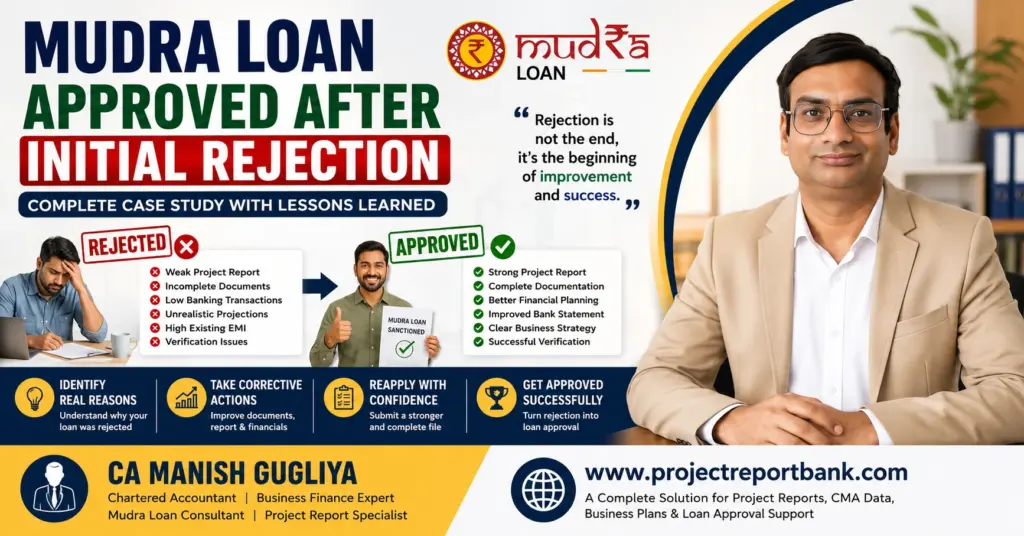
- A mudra loan can absolutely be approved after an initial rejection if you identify and correct the real reasons behind the bank’s decision.
- This article walks through a realistic case study: a Kishore mudra loan of ₹4.80 lakh was first rejected, then approved at ₹4.50 lakh after the applicant improved his project report, documents, banking habits, and CIBIL score over about 4 months.
- Incomplete or mismatched documents cause most mudra loan rejections, not personal bias from branch managers.
- Core message from CA Manish Gugliya: “Rejection is feedback, not a final decision.” A structured reapplication built on corrections can succeed.
Introduction: Mudra Loan Approved After Rejection – Is It Really Possible?
Many applicants believe that once a bank rejects their mudra loan application under Pradhan Mantri Mudra Yojana, the door is permanently closed. That belief is wrong. In my 20+ years of practice as CA Manish Gugliya, helping small and micro businesses with MSME funding, project reports, CMA Data, and banking documentation, I have seen dozens of cases where a mudra loan approved after rejection became a reality – once the applicant understood what went wrong and fixed it.
Mudra loans are available up to ₹20 lakh and fall into four categories: Shishu (up to ₹50,000), Kishore (up to ₹5 lakh), Tarun (up to ₹10 lakh), and Tarun Plus (up to ₹20 lakh). They are collateral free and government backed, yet most banks still apply rigorous credit and documentation checks. Mudra loans are offered through various lending institutions including banks and NBFCs (non banking financial companies), and each lender applies its own internal risk assessment.
In this article, you will get a complete case study of a mudra loan rejected then approved, practical checklists, banking insights, and an FAQ section – all based on real-life style cases handled in 2024–2025.
Table of Contents
Case Study Snapshot: Business Profile & First Mudra Loan Application
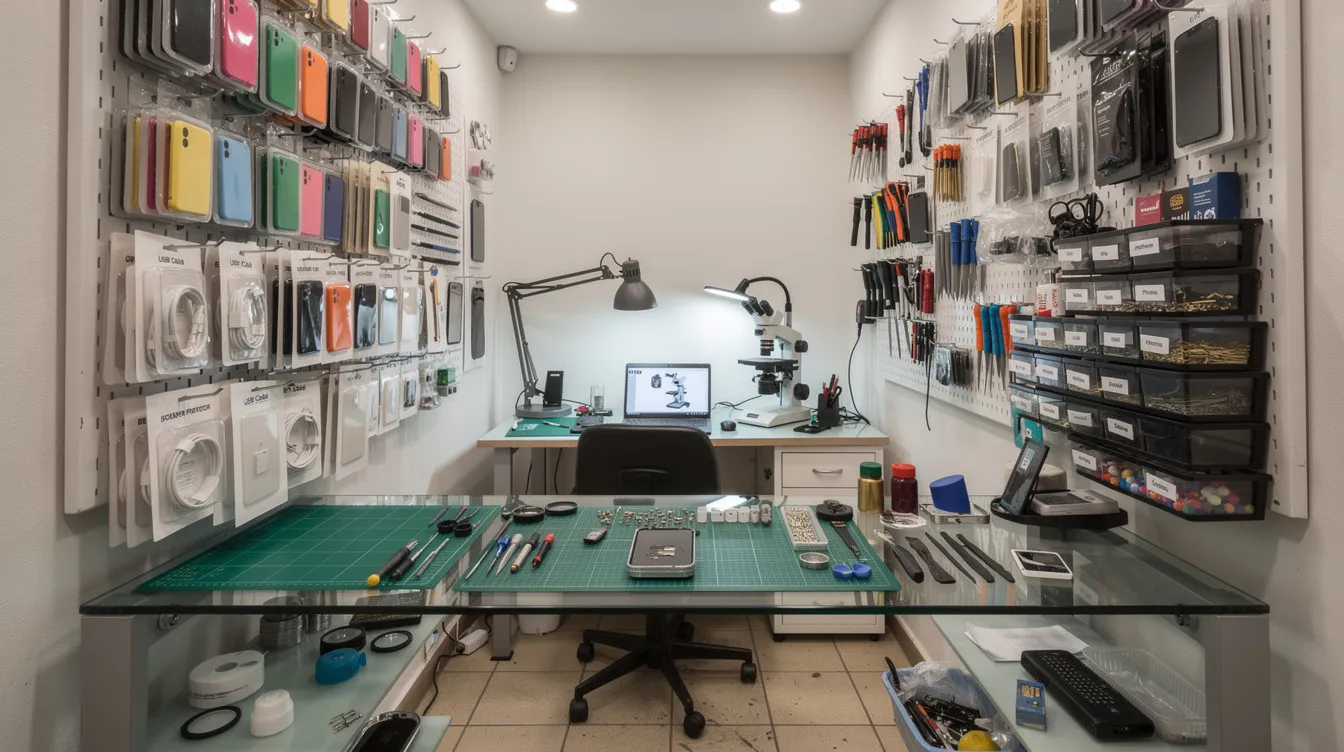
Meet Rajesh Verma, age 32, from Jaipur, Rajasthan. In late 2024, Rajesh ran a small mobile repair and accessories shop for about 18 months, earning a modest monthly turnover of around ₹2.5–3 lakh. He wanted to expand into a multi-brand service centre in a busier market area and decided to apply for a Kishore mudra loan.
He approached a major PSU bank branch in Jaipur and requested a loan amount of ₹4,80,000. The purpose: buying advanced repair tools, display racks, initial stock of branded accessories, and renovating a rented shop.
His initial financial position was shaky in ways he did not recognise:
- He used a savings account instead of a current account for most business transactions
- No formal project report or simple business plan was prepared before visiting the bank
- A small two-wheeler loan was running with some delayed EMIs during COVID in 2021
- His CIBIL score sat at approximately 655
Rajesh assumed the mudra scheme meant easy, guaranteed money. He treated the application as a simple formality.
Why Was the Mudra Loan Initially Rejected? (Practical Bank-Level Reasons)
Banks reject mudra loan applications based on internal credit appraisal, not randomly. After high NPA experience between 2020–2023, most banks became stricter. Common reasons for mudra loan rejection include low credit score and weak business plan – and Rajesh’s file triggered multiple red flags:
- Weak project report: A copy-paste project report downloaded from the internet with unrealistic sales projections and no proper working capital calculation
- Low banking activity: Most business done in cash, low average balance in savings account, no current account in the business name – banks interpret this as high-risk, cash-dependent income
- CIBIL concerns: Score around 655, with earlier delayed EMIs and one bounced cheque. A CIBIL score below 650 may lead to outright rejection; 655 sits in the danger zone
- Documentation gaps: No Udyam Registration, rental agreement not properly stamped, mismatch between Aadhaar address and shop address – a different address on key documents raises verification doubts
- Poor bank interview: Rajesh could not clearly explain margins, monthly cash flow, or his business model to the credit officer
The formal rejection letter arrived about 18 days later with generic language: “proposal not found viable / repayment capacity not satisfactory.” Lack of proof of business operations and incomplete or mismatched documents caused the rejection, though the letter did not spell this out clearly.
Statistically, about 99.5% of mudra loan applications are rejected, making thorough preparation essential rather than optional.
Finding the Real Rejection Reasons: From Frustration to Analysis
Rajesh’s first reaction was frustration. He assumed “banks always reject Mudra loans” and the system was biased. But instead of giving up, he decided to find the actual reason for rejection.
Here is what he did:
- Visited the bank branch again, politely requested a meeting with the branch manager instead of arguing at the counter
- Asked for specific observations beyond the standard rejection note – lenders are required to send an adverse action notice detailing rejection reasons, and banks must provide a reason for rejection of mudra loan applications
- Took notes on points mentioned: “cash-based business,” “no Udyam,” “weak financials,” “vague projections”
He then consulted a local CA (my role in this story) to review the rejection and existing documents. During this review, we discovered additional problems not clearly stated by the bank:
- Project cost split between term loan and working capital was not justified
- Existing two-wheeler loan EMI was not properly disclosed in the application
- Old bank statements (ending 3 months before application date) gave an incomplete picture
The key learning: you must decode the bank’s concerns into actionable points. Assumptions like “manager was biased” do not help your reapplication.
Corrective Actions Before Reapplying: Turning Rejection into a Roadmap
Rather than rushing into another application, Rajesh prepared a 60–75 day action plan to fix each issue. Applications can be improved after rejection by addressing identified deficiencies. Here is the high-level checklist:
- Engaged a CA to prepare a fresh, customised project report and CMA Data for a revised Kishore mudra loan amount of ₹4,50,000 (reduced from ₹4,80,000 to strengthen DSCR)
- Opened a proper current account in the business name in January 2025, routing maximum sales and purchases through banking channels for 2–3 months
- Cleared overdue EMIs on the two-wheeler loan and ensured no cheque returns or ECS bounces – applicants must not have a history of loan defaults
- Applied for Udyam Registration with the correct business activity code and updated business address proof
- Got a fresh, properly stamped rental agreement for the shop and aligned Aadhaar address with current residence
- Filed a simple ITR-4 for FY 2023–24 reflecting realistic profit from business instead of “zero income”
Registering on the Udyam portal improves approval chances, and this step alone resolved one of the bank’s key objections.
Upgrading the Project Report: From Copy-Paste File to Bankable Business Plan
In mudra loan applications, especially kishore and tarun loans, the project report is often the single biggest hidden reason for rejection. A basic business plan is required for Kishore and Tarun category loans, but it must be credible. A detailed project report can increase the chances of loan approval dramatically.
Here is what the revised report included:
- Realistic sales projections based on past 12 months’ actual turnover plus modest 15–20% growth after expansion – not 3x overnight
- Proper working capital calculation: 30–45 days of accessory stock, supplier credit terms, and minimum cash in hand, supported by quotations dated February–March 2025
- DSCR recalculated to remain above 1.5 by adjusting loan amount, tenure (48–60 months), and own capital contribution of ₹1,20,000
- Break-even analysis showing at what monthly revenue the fixed costs and EMI would be covered
- Clear split between term loan (machinery, renovation, initial stock) and working capital (day-to-day purchases)
Industry-specific assumptions were used: gross profit margins on accessories at 25–30% and repair services at 40–50%. Banks appreciate transparent, conservative projections far more than aggressive numbers. A clear business plan built on real data converts a weak file into a bankable proposal.
Improving Banking Habits & CIBIL Score Before Second Mudra Loan Attempt
No matter how strong a project report is, poor banking discipline and weak credit history can still derail mudra loan approval. CIBIL score is not mandatory but preferred for mudra loans – and in practice, a CIBIL score above 700 significantly improves approval chances.
Banking improvements (January–April 2025):
- Shifted customer payments to UPI and bank transfers, generating 35–40 regular transactions per month in the current account instead of mostly cash sales
- Maintained minimum average balance above ₹25,000
- Avoided any cheque returns or “insufficient funds” charges – these are carefully watched by credit officers
CIBIL-related actions:
- Pulled latest CIBIL report, found one old closed credit card entry incorrectly reported, and corrected it through the dispute process
- Paid off the two-wheeler loan 3 months early, improving CIBIL score from ~655 to around 705 by April 2025
- Avoided applying at multiple banks simultaneously to prevent unnecessary hard enquiries on the cibil report
Low or no CIBIL score is a common rejection reason, and these measures directly addressed the bank’s doubts about repayment capacity.
Strengthening Documentation & Business Proof for Reapplication
In my experience as a CA, incomplete or mismatched documents are behind a large share of mudra loan rejection cases, even when business viability is actually strong. Missing or incorrect documentation is a common cause of loan rejection, and mismatched documents lead to automatic rejection.
Key corrections before the second application:
- Udyam Registration obtained with correct NIC code – Udyam Registration is recommended for mudra loan applications and serves as standard business proof
- Updated rental agreement signed for 3 years with landlord PAN and property details; rent receipts for 6 months included
- KYC alignment: Aadhaar, PAN, and bank KYC all reflecting the same name spelling and current residential address
- Bank statements from the last 12 months (savings) and 6 months (current account) taken just a week before reapplying – bank statements must reflect regular business transactions to support loan applications
- ITR for FY 2023–24 showing business turnover consistent with banking transaction history
- Valid quotations from vendors with GSTIN, dated within 60–90 days of application
These documents gave the bank concrete proof of business activity, eliminating the need for repeated clarifications.
Fresh Interaction with the Bank & Timeline from Rejection to Final Approval
Rajesh approached the same bank branch in April 2025, this time with a proper file – covering letter, revised project report, Udyam certificate, updated KYC, and fresh bank statements. His attitude was calmer and more professional.
The interaction changed completely:
- Opened with a one-page summary of business model, loan amount (₹4,50,000), own contribution (₹1,20,000), and proposed repayment plan
- Answered the credit officer’s questions using numbers from the project report
- Clarified earlier CIBIL issues with evidence of cleared loans and improved score
The bank conducted standard verifications: site visit to the shop, phone verification of landlord, and cross-checking of ITR and Udyam data. Follow up weekly after submitting your mudra loan application – Rajesh followed up politely each week, which kept his file active.
| Date | Milestone |
|---|---|
| 10 Nov 2024 | First application submitted |
| 28 Nov 2024 | Rejection communicated |
| Dec 2024 – Mar 2025 | Corrections: Udyam, banking improvements, ITR filing |
| 5 Apr 2025 | Reapplication with revised project report |
| 18 Apr 2025 | Site visit & verification |
| 26 Apr 2025 | Sanction letter issued |
| 30 Apr 2025 | Mudra loan disbursement to current account |
Mudra loan processing time is typically 7 to 30 working days. This time, the same bank that rejected the proposal approved a better-structured application.
Final Mudra Loan Approval: Sanction Terms & Bank’s Key Observations
The loan was sanctioned under the mudra scheme as a Kishore loan in late April 2025 – about 5 months after the first rejection. Approval of fresh applications may occur if prior issues have been resolved, and this case proved it.
Sanction details:
- Sanctioned amount: ₹4,50,000 (reduced from ₹4,80,000 based on revised DSCR)
- Structure: ~85% as term loan for renovation, machinery, and stock; ~15% as working capital
- Tenure: 60 months with straight EMI from first month
- Interest rate: approximately 11–13% p.a.
Points the bank appreciated:
- Improved CIBIL score above 700 and closure of previous loan
- Clear movement of business income through the current account showing genuine business activity
- Professionally prepared project report with logical assumptions
- Complete documents and consistent information across KYC, Udyam, ITR, and bank statements
Mudra loan disbursement was routed directly to vendors for tools/machinery and partially to the current account for renovation and stock.
Biggest Lessons Learned: How to Turn a Mudra Loan Rejection into Future Approval
This mudra loan approval after rejection story is not about luck – it is about following a structured process. Reapplying after fixing issues can lead to loan approval. Here are the core lessons:
- Treat rejection as a diagnostic report, not a verdict. Ask for specific bank observations and decode them into action items.
- Never use generic or copy-paste project reports. Tailor the business plan to your real business data.
- Maintain banking discipline: avoid cash-only business, keep sufficient balances, prevent cheque returns.
- Understand that CIBIL score and past credit behaviour strongly influence even collateral free mudra loan approval. Specific deficiencies to address include documentation errors and poor credit history.
- File income tax returns that actually reflect your business. “No return” reads as “no income” to banks.
- Align all documents – PAN, Aadhaar, Udyam, rental agreement, bank KYC – to avoid small technical rejections.
- Do not immediately reapply to another bank with the same weak file. Fix root problems first.
- Take professional help when preparing project reports or responding to complicated rejection issues.
Common Mistakes Applicants Keep Repeating After a Mudra Loan Rejection
From reviewing many mudra applications across 2022–2025, I see the same errors repeated:
- Reapplying within days with identical documents, expecting a different result
- Increasing the loan amount in the second attempt without improvement in turnover – applying for an unjustified loan amount can result in rejection
- Submitting project reports with made-up figures disconnected from bank statements or GST returns
- Ignoring CIBIL issues: not checking for old defaults, credit card settlements, or multiple enquiries. Low CIBIL scores lead to outright rejection of applications
- Trying different banks or NBFCs one after another without fixing fundamental weaknesses, creating multiple hard enquiries
- Providing inconsistent information in oral interview versus written application, which makes credit officers doubt credibility
Pause, analyse, and rebuild your application. Do not “shop” for approval at every lender in town.
Practical Tips from CA Manish Gugliya for Mudra Loan Reapplication Success
These tips are drawn from multiple mudra loan reapplication success stories, including cases like Rajesh’s. Consider this your pre-reapplication checklist:
- Make a written checklist of all earlier objections and tick them off only when genuinely corrected
- Ensure the project report explains business activity, local market, competition, expected turnover, gross profit margin, fixed expenses, and EMI coverage
- Keep your “business plan story” consistent across verbal explanation, written report, and bank statements
- If your business is very new, consider starting with small shishu loans or building banking history before targeting higher amounts
- For applicants with weak CIBIL, spend 6–9 months clearing dues before forcing applications
- Use your current account actively – deposit daily collections, pay suppliers via NEFT/UPI
- If the bank reduces the loan amount, assess whether it still supports a workable plan. Sometimes accepting less is better than prolonged rejection
- Keep scanned copies of all documents ready so you can respond quickly to bank clarifications
Mudra loans can be applied through banks and NBFCs, and micro entrepreneurs across India qualify for this government backed scheme. Treat this as your reapplication success formula and adapt it to your own case.

Frequently Asked Questions (FAQs) on Mudra Loan Approved After Rejection
These answers address common doubts based on typical bank practice up to 2025–2026, not just scheme theory. The grievance process can be utilized if a loan rejection is considered unfair.
Can a Mudra loan really be approved after it was once rejected?
Yes. Banks do not maintain a permanent blacklist for rejected mudra loan applicants. Approval on reapplication depends on whether you have actually corrected the reasons for earlier rejection – whether that is CIBIL, documents, weak business plan, or low banking activity. Lack of a clear business plan results in application denial, but fixing it changes the outcome. Show concrete improvements over 3–6 months rather than reapplying immediately with the same form.
How long should I wait before reapplying for a Mudra loan after rejection?
For minor issues like documentation gaps or KYC mismatches, 2–3 months is usually sufficient. Where CIBIL score, banking habits, or ITR filing need significant correction, wait 6 months or more. The waiting period should be driven by how long it takes to build a visible track record of improvement – regular transactions in your current account, cleared EMIs, and updated proof – not by a fixed calendar rule. Banks require proof of ongoing business operations, and building that evidence takes time.
Should I go to the same bank again or try a different bank after rejection?
Both options work. Reapplying to the same bank with a stronger file is often effective because the branch already knows your case and can compare improvements. Shifting to another bank without fixing core problems may create multiple CIBIL enquiries and repeated rejection. If the original branch shows clear reluctance despite genuine corrections, consider regional rural banks or small finance banks with stronger MSME focus. Many applicants waste time switching lenders instead of strengthening their file.
Can I change my business plan or loan amount when reapplying under the Mudra scheme?
Absolutely. You can modify your project report, business plan, and the mudra loan amount in a fresh application – it is treated as a new proposal. Changes must be logical and supported by data. Frequent drastic changes without explanation confuse branch managers. Adjusting the loan amount downward to match realistic turnover and repayment capacity often increases chances. Mudra yojana eligibility criteria remain the same; what changes is the quality of your proposal.
Does one Mudra loan rejection permanently damage my CIBIL score or future loan chances?
A rejection does not reduce your CIBIL score. What appears is a loan enquiry, not a default. Problems arise when there are many enquiries in a short time or when existing loans have overdue EMIs or settlements – these factors hurt both your cibil score and future loan approval chances with any lender. Small business owners should limit unnecessary applications, focus on improving repayment behaviour and banking discipline, and apply only when the file is genuinely ready. A growing number of grassroots entrepreneur applicants succeed on their second attempt by following this approach.
Conclusion: From Rejection to Successful Mudra Loan – You Can Do It
A mudra loan reapplication success is realistic when you treat rejection as structured feedback and work methodically on CIBIL, banking habits, documentation, and a sound project report. The same bank that once rejected Rajesh’s proposal later approved a slightly smaller, better-structured Kishore mudra loan after improvements were clearly visible.
As CA Manish Gugliya, I have seen this pattern repeat across many cases: the first “no” is not the end. It is the beginning of preparation that most applicants skip the first time. Learn from the rejection, correct each gap with evidence, and approach your next mudra loan application with confidence and professional preparation. The money is there for micro businesses willing to do the work.
- Can Bank Reduce Mudra Loan Amount Without Your Consent? Complete Practical Guide (2026)


- What to Do If You Cannot Pay Your Mudra Loan EMI (2026 Guide)

- Can a Bank Refuse a Mudra Loan Because the Target Is Completed? Complete Guide (2026)

- Bank Refused My Mudra Loan Application – What Are My Rights?

- Mudra Loan for Used Vehicles (2026): Eligibility, Documents, Bank Rules & Complete Guide

- Rejected Mudra Loan – What to Do Next? Appeal Process Explained (2026)

- Mudra Loan Project Report Madhya Pradesh – Bank-Ready DPR & CMA Guide

- Project Report for Mudra Loan Maharashtra: Complete Guide for MSMEs, Startups and Small Businesses (2026)

- Mudra Loan Uttar Pradesh: Complete Guide for MSMEs, Startups and Small Businesses (2026)