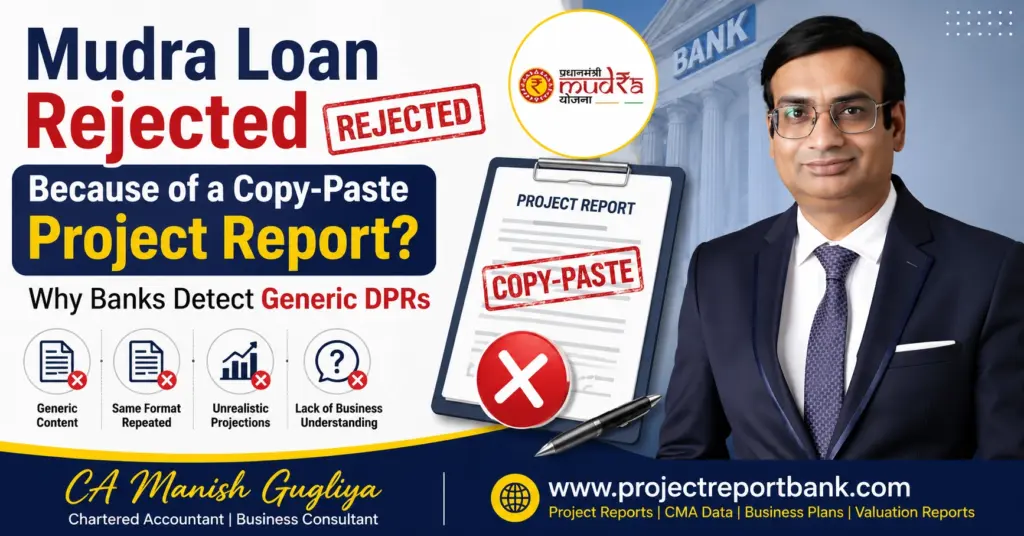
Key Takeaways
- Banks now easily identify generic mudra loan project reports downloaded from Google, YouTube, or copied from friends, and reject such loan applications quickly.
- A customized, realistic, and business-specific detailed project report with proper cma data, financial ratios, and genuine assumptions is essential for loan approval.
- If your mudra loan was already rejected because of a copy-paste DPR, prepare a fresh customized report, correct all mistakes, and reapply to the same or another bank.
- A well-structured project report increases loan approval chances far more than any impressive-looking template.
- This article is written by CA Manish Gugliya, a Chartered Accountant with 20+ years of experience in MSME finance and bank loan consulting, sharing practical tips to improve your approval chances.
Introduction – Why Copy-Paste Mudra Loan Project Reports Lead to Rejection
Many first-time borrowers download free project reports from Google, YouTube, or Telegram groups, assuming banks will accept any formatted document. This is one of the most common mistakes leading to mudra loan rejection across India today.
A project report is required to apply for a mudra loan. Most banks require it because it helps them assess loan viability – whether your business idea is realistic and whether you can repay. Banks require unique business plans for Mudra loan applications, not recycled templates.
Under PMMY (Pradhan Mantri Mudra Yojana), credit officers compare your DPR with KYC documents, GST data, and site inspection findings. Customizing reports for specific loan types improves approval chances significantly. A generic template simply cannot pass this scrutiny.
As CA Manish Gugliya, having prepared thousands of project reports and cma data for mudra and msme loan files, I regularly see applications rejected only because the DPR was obviously copy-paste. This article covers what a copy-paste DPR is, how banks detect it, real examples, and what to do if your mudra loan was already rejected.
Table of Contents
What Is a Copy-Paste Project Report for Mudra Loan?
A copy-paste project report is a generic DPR used repeatedly with minor or no changes for different borrowers, businesses, and cities.
Common forms include:
- PDF downloaded from the internet for a salon but submitted for a mobile shop
- Word file shared on WhatsApp, edited only by changing the applicant’s name and loan amount
- DPR bought from a cybercafé and sold to 20+ applicants in the same town
- ChatGPT-generated report where actual numbers, location, and licenses are not customized
- Software-generated 15–25 page report that looks professional but uses identical financial projections, debt service coverage ratio, and financial ratios for every sector
Even a template-based report becomes “copy-paste” if the entrepreneur plans, investment cost, sales, operating expenses, licenses, location, and risk analysis are not properly customized for that specific business loan application. The content of a project report should reflect the applicant’s own business insights.
Why Do Borrowers Still Use Generic or Internet-Copied Mudra Loan DPRs?
Many first-time entrepreneurs treat the mudra scheme as an “easy bank loan” and underestimate the need for a serious business plan and project report preparation.
Common reasons include:
- Saving money on CA fees by using free downloads
- Lack of awareness that banks deeply analyse project reports for loans above ₹2–3 lakh
- Urgency to submit the loan application before financial year-end
- Blind trust in YouTube videos promising “guaranteed mudra loan with this project report”
- Local agents or cybercafé operators selling the same report for ₹200–₹500, claiming it is “bank-approved format”
- Belief that “banks only check CIBIL and documents, not the DPR”
A generic DPR might save a few hundred rupees today but can cost months of delay, multiple rejections, and a damaged relationship with the bank branch.

Why Banks Reject Copy-Paste Project Reports for Mudra Loan
Bank loan officers compare information in the DPR with KYC, GST data, Udyam registration, site inspection, and standard industry benchmarks. Inconsistencies across documents may lead to loan application rejection. Here are the key areas where copy-paste DPRs fail:
- Business details mismatch: Report mentions manufacturing while the application shows trading; or the DPR refers to a shop in Jaipur while the borrower is in Jhansi
- Wrong project cost: Machinery or furniture listed in DPR doesn’t match attached quotations; promoter contribution is unrealistic
- Incorrect working capital: Stock, debtor levels, and working capital limit don’t match sales volume; working capital loan need is not justified
- Unrealistic sales projections: A small restaurant claims ₹2 crore first-year turnover with no marketing plan, staff cost, or customer footfall estimate
- Identical financial ratios: DSCR, gross profit ratio, net profit ratio, and current ratio appear exactly the same across years and across different reports-clear signal of copied cma data
- Generic market analysis: National-level data copied from the internet with no local competition, pricing, or target audience analysis
- Wrong location: Report text mentions another city or state different from address proof or Udyam registration
- Irrelevant licenses: DPR lists FSSAI, BIS, or pollution NOC that are not applicable to the actual business
- Fake profitability: Profit margins far exceed industry norms; rent, salary, electricity understated to inflate DSCR
- Template matching: Same fonts, tables, wording, and index sequence as DPRs rejected earlier at that branch
Generic project reports often lead to rejection due to unrealistic financial figures that no experienced credit officer will believe.
How Banks Detect Generic or Internet-Copied Mudra Loan Project Reports
Credit officers handle dozens of mudra and msme loan applications monthly. Repeated exposure makes template recognition almost instant.
- Some banks maintain internal folders where suspicious DPR formats are stored; new applications matching old templates get flagged immediately
- Financial analysis reveals problems: if DSCR, current ratio, and debt-equity remain exactly the same across 5 years, projections were clearly reverse-engineered
- Officers compare DPR numbers with GST returns, bank statements, and Udyam data; large gaps in turnover or margins trigger queries
- Many DPRs are received digitally; simple text searches sometimes reveal identical content on public websites
- Site inspection exposes gaps: if the DPR claims advanced machinery and high stock but the premises has a small rented shop, the report is clearly not genuine
- Generic templates fail to account for local market conditions, affecting loan viability-missing pin codes, local market names, or supplier names is a giveaway
- Copies of popular sector-specific templates (mobile shop DPR, beauty parlour DPR, dairy farm DPR) are submitted across many branches; once detected, similar future reports receive stricter scrutiny
Real Examples of Mudra Loan Rejection Due to Copy-Paste DPR
Here are practical cases from my professional experience (details information slightly changed for confidentiality):
- Mobile shop using dairy farm DPR: A borrower in Indore applied for ₹4 lakh for mobile accessories but submitted a dairy farm DPR mentioning cows, sheds, fodder, and milk sale. Bank rejected immediately.
- Restaurant with ₹2 crore turnover: A 20-seat restaurant in Raipur sought ₹7 lakh but the unrealistic project report showed ₹2 crore turnover with 40% net profit, no delivery commission, and minimal staff cost. Declined.
- Manufacturing unit without electricity: A plastic moulding DPR for a Kanpur unit omitted power and fuel expenses despite 35 HP machinery load. Marked technically unviable.
- Wrong machinery prices: Quotations showed Ahmedabad machines but DPR carried 2018 prices from another state. Incorrect project cost led to rejection.
- DPR mentioning another state: The narrative read “This unit will be set up at Vill. XYZ, Dist. Patna, Bihar” while the applicant was from Gwalior, Madhya Pradesh-a clear copy-paste rejection.

Common Mistakes in Copy-Paste Mudra DPRs – With Correct Approach
| Mistake | Why Bank Rejects It | Correct Approach |
|---|---|---|
| Same sales growth rate for all 5 years | Signals copied template, not real analysis | Use realistic ramp-up (5–10% monthly in year 1) |
| Promoter name/address not updated everywhere | Shows carelessness; may appear fraudulent | Check every page for old names, cities, states |
| Old loan amount still in text body | Mismatches with application form | Align figures across DPR, form, and CMA |
| Dairy industry ratios used for garment shop | Industry mismatch in ratio analysis | Use ratios relevant to your actual business model |
| Missing or incorrect CMA data | P&L and balance sheet don’t reconcile | Have a CA prepare connected financial statements |
| Generic market analysis (“India is growing”) | No proof of local demand or competition | Include local competitors, daily footfall, pricing |
| Ignoring working capital margin | Cash flow gaps not addressed | Calculate stock, debtor, creditor days properly |
| Unrealistic DSCR (e.g., 3.5 every year) | Banks know this is manufactured | Let DSCR emerge naturally from honest projections |
Tips: Correcting these common mistakes before submitting a loan request significantly improves approval chances. Always get fresh quotations and verify that your report format matches your actual business.
What Makes a Bank-Ready, Customized Project Report for Mudra Loan?
A bank ready project report is not just a formality-it tells the complete story of your business. A project report includes business description and market analysis, and banks use it to assess whether you can repay. Project reports should be concise and easy to understand.
Core components include:
- Project company profile: Type of activity, legal form, location, and company’s background
- Promoter background: Education qualification, experience, achievements export orders if any
- Total project cost: Machinery, furniture, renovation, initial stock, space or land requirement, working capital margin-with actual quotations
- Means of finance: Promoter contribution vs bank loan vs any subsidy
- Financial statements: Projected profit & loss (P&L), balance sheet, and cash flow statement for 3–5 years. A project report typically includes a balance sheet and cash flow statement.
- Repayment analysis: A repayment schedule matching the term loan tenure, showing exactly how EMIs will be paid from projected cash flow
- Technical feasibility: Manufacturing processes or commercial manufacturing processes, if applicable
- Break even analysis: When the business will start covering its costs
- Financial ratios: DSCR, current ratio, gross profit ratio-all based on realistic assumptions
- Market analysis: Local demand, main competitors, pricing strategy, target audience, advertising strategies, expected customer volume
- Licenses: GST, Udyam, FSSAI, trade license, pollution NOC-whichever are required
- Project logistics details and third party details: Supplier quotations, required third party details, and related services
The project report should detail the funding requirements clearly, and all narrative sections must use the borrower’s actual city, area, and state-not generic placeholders.
Importance of CMA Data and Financial Ratios in Mudra Loan Appraisal
CMA data is a structured set of complete financial information and projections that banks use to analyse sales, expenses, profit, working capital, and repayment obligations. Financial projections are essential in a project report, and CMA data is where they come alive.
- Even for small loans above ₹5 lakh, most banks ask for basic CMA to cross-check figures in the project report
- Banks examine debt service coverage ratio (DSCR ≥ 1.25 for trading/service, ≥ 1.50 for manufacturing), current ratio, and profitability ratios
- Copy-paste DPRs show identical, unrealistic ratios that don’t match actual operations
- Properly prepared CMA ensures logical connections: sales link to production capacity, stock and debtors match the working capital requirement, and EMI obligations are covered by projected profit and cash flows
- Avoid fixing DSCR first and back-calculating profit; instead, estimate honest sales and expenses, then let DSCR emerge naturally
- Engaging a professional CA for CMA data preparation reduces errors and strengthens your business loan project report
A project report should include financial projections and repayment plans that are internally consistent and defensible.
How to Prepare a Customized Mudra Loan Project Report – Step-by-Step
- Understand your business clearly: Write what you will sell or produce, who your customers are, your pricing, and how many units or bills per day you expect. To improve project report chances, tailor it to reflect your specific business idea.
- Calculate actual project cost: Collect latest 2025–2026 quotations for machinery, furniture, renovation, initial stock. Differentiate fixed assets from working capital margin.
- Decide means of finance: Assess your savings (promoter contribution of at least 10–25%) and the mudra loan or msme loan amount you need.
- Estimate realistic sales and expenses: Base monthly sales on capacity, working hours, local demand, and competition. Include rent, salary, electricity, marketing, repairs, insurance, and bank charges as operating expenses.
- Prepare CMA data and projections: Convert information into year-wise P&L, balance sheet, and cash flow for 3–5 years. Calculate DSCR and financial ratios.
- Draft narrative sections: Write project profile, promoter background, market analysis, SWOT, risk analysis reflecting actual local conditions-not copied text.
- Attach supporting documents: Quotations, rent agreement, photographs, licenses, educational certificates, and existing bank statements.
- Review for consistency: Match names, addresses, figures, and dates across project report, CMA data, application form, and documents. A strong project report improves chances of loan approval only when everything aligns.
- Get expert guidance: Have a CA review your DPR and financials before submission. Using specialized platforms can help structure project reports that meet bank expectations.

Checklist Before Visiting the Bank with Your Mudra Loan Application
- ☐ Project report is fully customized for your business type, location, and loan amount-no page contains someone else’s name or figures
- ☐ Project cost, means of finance, and loan amount in DPR match the bank’s mudra loan application form and any online portal entries
- ☐ CMA data reconciles with all DPR statements including DSCR, term loan EMI, working capital limit, and interest rates assumptions
- ☐ Official documents required include Aadhaar and PAN card for Mudra loan applications-carry updated KYC, address proof, business proof (Udyam, GST, shop act), and latest bank statements
- ☐ All licenses mentioned in DPR are actually obtained or applied for
- ☐ You have a 2–3 minute verbal explanation of your business plan ready, aligned with the DPR, so answers during bank interview don’t contradict your numbers
- ☐ DPR is printed neatly-banks prefer project reports that are neat and easy to understand. Sign all pages, include contact info on the first page
- ☐ A standard project report format is accepted by public sector banks and most private banks including ICICI bank-ensure yours follows accepted structure
If Your Mudra Loan Was Already Rejected Due to Copy-Paste DPR – What to Do Now
A common issue for Mudra loan rejections is a copied project report-but a previous rejection does not permanently close the door. Many clients later obtained mudra or msme loan approval after submitting a genuinely customized DPR.
- Request the exact rejection reason from the bank in writing. This clarifies whether the issue was DPR quality, financial ratios, documents, or CIBIL
- Fully discard the old copy-paste DPR. Start fresh with your actual investment, capacity, sales, and expenses
- Engage a CA with mudra loan experience to prepare a bank-ready project report and CMA data addressing all points raised by the banker
- After improvement, reapply at the same bank (if rejection was only DPR-related) or approach another branch with the fresh full report
- Avoid multiple simultaneous loan enquiries which can harm your CIBIL score
- Don’t argue about internet templates-show seriousness through improved content and evidence
Eligibility for Mudra loans includes a good credit track record, so also check and improve your CIBIL if needed alongside fixing the DPR.
Mistakes to Avoid in Future Mudra Loan Project Reports
| Mistake | Better Practice |
|---|---|
| Using same financial projections for different banks | Customize projections for each loan type and amount |
| Ignoring existing EMIs in repayment plan | Include all current EMIs in repayment capacity calculation |
| Assuming 0% rejection because DPR looks attractive | Focus on realistic numbers, not formatting |
| Not updating project cost when prices change | Get fresh quotations every 3–6 months |
| Signing with mismatched signatures | Ensure signatures match bank records and KYC |
| Writing “no competition” statements | Acknowledge competition; explain your differentiation |
| Not reading DPR fully before submission | Read every page-especially if someone else prepared it |
| Ignoring seasonal downtime | Include off-season months for seasonal businesses |
A well-structured project report outlines business plans and funding needs honestly. Honesty, realism, and consistency between documents matter more than flowery language or fancy templates.
Expert Advice from CA Manish Gugliya – How to Win Banker’s Confidence
In my 20+ years of preparing bank ready project reports across PSU and private banks, the strongest mudra loan files are not the ones with the most beautiful formatting. They are the ones where numbers, business assumptions, and the borrower’s verbal explanation all match logically.
Every small business is unique. A women-led boutique in Bhopal, a fabrication unit in Nagpur, and a home-based cloud kitchen in Delhi cannot use the same DPR. Mudra loans support Micro, Small, and Medium Enterprises (MSMEs) across vastly different sectors-each needs its own financial analysis, market study, and repayment plan.
I routinely reject ready-made templates when they don’t reflect ground reality. Instead, I prepare custom CMA data with financial ratios that withstand banker-level stress testing. Treat your project report as your own business plan first and a bank document second. If you don’t believe the numbers, the banker won’t either.
Banks finance real, thought-out entrepreneur plans-not copy-paste documents. A customized mudra loan project report significantly improves approval chances. A Mudra loan project report outlines business plans and financial needs-make sure yours genuinely does.
Frequently Asked Questions – Copy-Paste DPR and Mudra Loan Rejection
Can I download a free Mudra loan project report from Google and just change my name?
Simply changing name, address, and loan amount while keeping all other numbers same is the main reason for mudra loan project report rejection. Banks see dozens of such identical DPRs every year and reject them. Project reports for Mudra loans must include business and financial details specific to your venture.
Is it safe to use ChatGPT or other AI tools to create my Mudra loan DPR?
AI can help draft language and structure, but all figures, assumptions, and local market details must be customized by you or your CA. Otherwise it becomes a generic project report that banks can easily question during financial analysis.
Will bank officers really read my entire 20–25 page project report?
While they may skim narrative sections, they always carefully review project cost, means of finance, financial ratios, DSCR, and CMA data. Any inconsistency or obvious copy-paste in these key areas triggers rejection or heavy queries. A project report helps banks assess loan viability-they take it seriously.
Do all Mudra loans require such a detailed, customized DPR?
Mudra loan is categorized into three schemes: Shishu (up to ₹50,000), Kishore (₹50,001–₹5,00,000), and Tarun (₹5,00,001–₹10,00,000). For very small Shishu loans, some banks accept minimal documentation. But for Kishore and Tarun category-especially above ₹2–3 lakh-a customized project report with proper CMA data and financial projections is strongly recommended. Even for small loans, banks increasingly want credible documentation.
Can a CA guarantee Mudra loan approval if he prepares my DPR?
No CA or consultant can guarantee loan approval. They can improve presentation, ensure realistic financial ratios, align CMA data with banking norms, and prepare a bank ready report-but the final decision always rests with the bank’s credit committee based on overall risk assessment.
Conclusion – Don’t Risk Your Mudra Loan with a Copy-Paste DPR
A copied project report may save ₹500 today, but it can lead to mudra loan rejection, months of wasted time, and loss of banker confidence. Banks require project reports for Mudra loan applications that reflect genuine business understanding-not recycled templates.
A customized, bank-ready project report with correct CMA data, realistic projected profit, and proper financial ratios sends a powerful signal that you understand your business model and respect the bank’s risk concerns. A well-structured project report increases loan approval chances far more than any attractive formatting.
As CA Manish Gugliya, I help entrepreneurs across India prepare professional project reports, CMA data, business plans, financial projections, and business valuation reports tailored to their exact business and bank requirements-without false promises of guaranteed sanction. If your mudra loan was rejected due to a copy-paste DPR, or if you are applying for the first time, invest in a proper, customized project report before approaching the bank. It is the single most practical step to genuinely improve your approval chances.
- Mudra Loan Rejection Reasons: Complete Guide to Why Banks Reject Applications


- Mudra Loan Project Report Issues & Solutions: Complete Guide to Avoid Project Report Rejection
- Mudra Loan Documentation Issues: Complete Guide to Avoid Document-Related Loan Rejections

- Mudra Loan CIBIL Issues, Rejection Reasons & Solutions (2026) – Complete Guide
- Mudra Loan Rejected Due to Industry Specific Project Report Mistakes – What Banks Really Expect 2026

- Mudra Loan Rejected Because the Business Model Was Not Viable – How to Improve Your Project Report 2026
- Mudra Loan Rejected Due to Machinery Cost: Practical Guide to Fix & Avoid This Problem (2026)
- Mudra Loan Rejected Due to an Incomplete Business Plan 2026 – What Every Project Report Must Include
- Mudra Loan Rejected Due to Copy Paste Project Report – How Banks Detect Generic DPRs and What to Do Next
- Mudra Loan Rejected Due to Wrong Working Capital Calculation – How Banks Really Assess Your Requirement 2026

- Mudra Loan Rejected Because the Project Cost Was Incorrect – How to Estimate It Properly 2026
- Mudra Loan Rejected Due to Missing or Incorrect CMA Data – Complete Preparation Guide 2026

- Mudra Loan Rejected Because of Incorrect Financial Projections – Common Mistakes to Avoid 2026

- Mudra Loan Rejected Due to Unrealistic Project Report – How to Make It Bank-Ready (2026 Complete Guide)

- How to Prepare a Perfect Mudra Loan Document File Before Visiting the Bank 2026