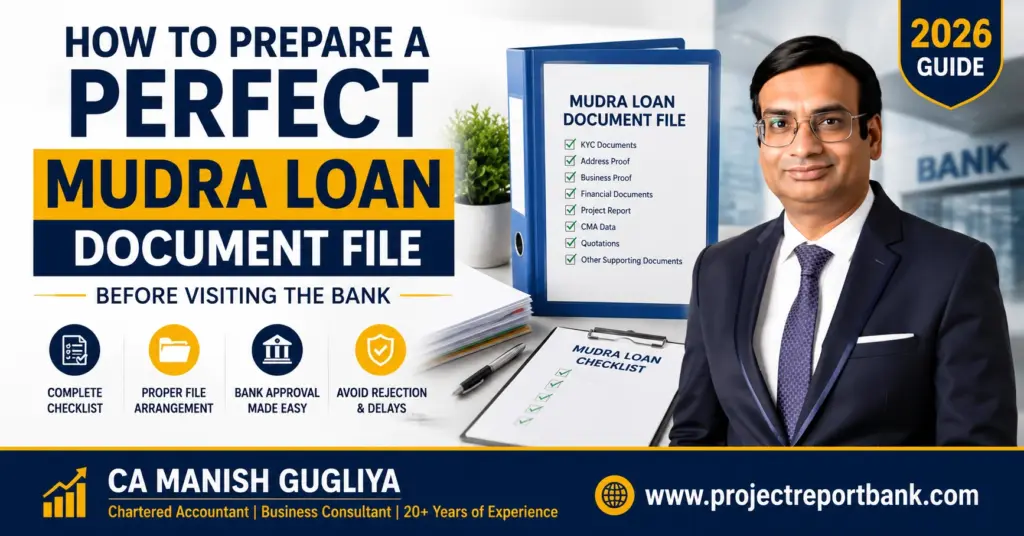
Your mudra loan document file is the first thing a bank officer judges you on – even before hearing your business idea. A scattered, incomplete file wastes everyone’s time and often leads to rejection. This guide, based on my 20+ years of experience as a practising Chartered Accountant, walks you through every document, every arrangement step, and every mistake to avoid so your file looks as professional as your business plan.
Key Takeaways
- A neat, complete mudra loan document file with proper index, page numbers, and logical sequence can dramatically speed up your approval process and help you avoid rejection at the very first stage.
- Banks primarily check KYC documents (pan card, aadhaar card, photographs), address proof, business proof (Udyam Registration, gst certificate, licences), financials (bank statements, ITR, income proof), and a proper project report with CMA data.
- All photocopies must be self-attested with matching signatures across every form and KYC document. Bank statements should cover the last six months to 12 months and must be recent.
- Arranging papers in a fixed sequence with separators, page numbering, and clips – not loose sheets – creates a strong first impression on the bank manager.
- If you find this overwhelming, CA Manish Gugliya and Project Report Bank can help you prepare a complete mudra loan document file and project report online across India.
Table of Contents
Why Proper Mudra Loan Documentation Matters Before You Visit the Bank
Mudra loans are collateral-free business loans available under the Pradhan Mantri Mudra Yojana, a government initiative that supports micro-enterprises in various service sectors, trading, and manufacturing. Applicants must be Indian citizens, aged between 18 and 65 years, and the scheme is open to both individuals and MSMEs. Mudra loans can be availed up to ₹10 lakh without collateral, making them one of the most accessible paths for small businesses to get funded.
There are three loan categories. Shishu loans provide up to ₹50,000 for startups. Kishore loans range from ₹50,000 to ₹5 lakh for businesses in the growth phase looking to expand. Tarun loans offer ₹5 lakh to ₹10 lakh for established enterprises. The maximum loan amount under the scheme is ₹10 lakh.
Yet most mudra loan delays in 2024–2026 are not because banks lack funds. They happen because the mudra loan document file is incomplete, badly arranged, or has mistakes in KYC or business proof. Applications can be submitted online through the Udyamimitra portal or offline to banks or NBFCs, but even with mudra loan online submission, the physical document file must still be presented at the branch for verification and final sanction.
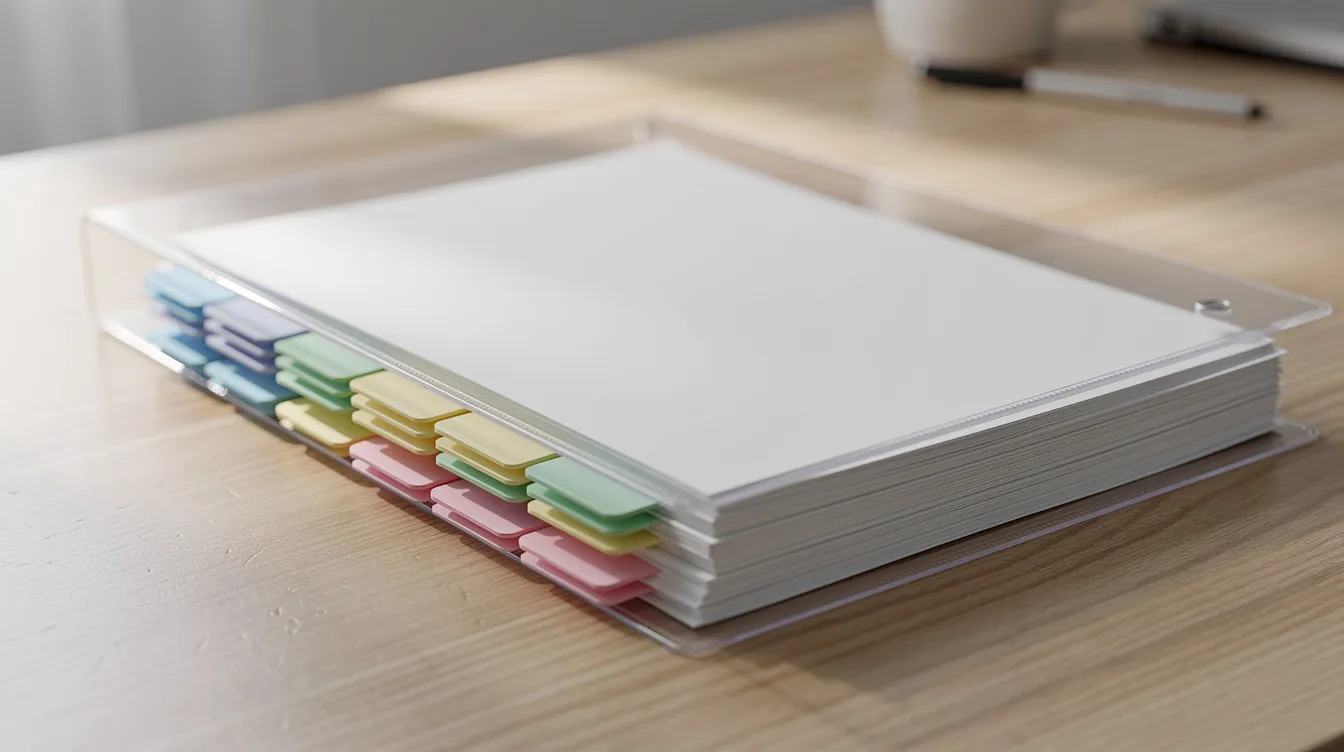
What does the bank officer actually want to see? Clear identity proof, correct address proof, proof that your business is real (Udyam, GST, licences), recent bank statements, income proof or ITR, and a realistic project report showing how the loan will be repaid. A professional-looking file – with an index page, numbered pages, and documents in logical order – often leads to fewer questions, less back-and-forth, and quicker approval.
As a practising Chartered Accountant, I have seen many good businesses rejected only because their mudra loan documents were weak or mismatched. That is preventable. This article is your step-by-step mudra loan documentation guide for 2026 – whether you are a first-time entrepreneur, a small shop owner, a service provider, or an existing MSME.
Why Banks Reject Poorly Prepared Mudra Loan Document Files
Bank officers handle dozens of files every week. Any confusion or perceived risk in your documents can push your mudra loan file towards delay or outright rejection. Here are the real reasons I have seen files returned or denied:
Signature and form issues:
- Missing signatures on application forms, declaration pages, or self-attestation
- Unsigned documents or signature mismatch between the application and bank records
- Overwriting on critical fields without countersigning
KYC-related problems:
- PAN and Aadhaar name mismatch – even a minor spelling difference triggers failure
- Expired voter ID or driving licence
- Aadhaar showing old address while a different address proof is submitted
- Incomplete KYC documents – unclear or dark photocopies, missing pages
Missing business proof:
- No Udyam Registration when it is expected for MSME status
- No GST when business clearly crosses the threshold
- Incorrect business activity on registration compared to the project report
- No Shop Act licence or trade licence when applicable
Financial documentation gaps:
- No project report or CMA data for loans above ₹2–3 lakh
- Bank statements older than 6 months or with missing pages
- Income proof not matching bank credits
- Existing EMIs not disclosed – banks always check repayment capacity
Presentation issues:
- Unorganized loose papers, torn or folded documents
- No index sheet, no page numbering, papers in random order
Banks also treat documentation quality as a signal. If your file is careless, the officer may wonder whether your business management will be equally careless. A well-prepared file quietly tells the bank: “This applicant is serious.”
Detailed Mudra Loan Documents Required and How to Prepare Each One
Required documents differ based on the loan category – Shishu, Kishore, or Tarun. Below is every major document, its purpose, common mistakes, and how to prepare it correctly.
PAN Card
PAN is your primary income tax identity. Banks use it to pull your CIBIL report and cross-check your tax returns. Common mistakes include name mismatch with Aadhaar, submitting old faded copies, and not self-attesting. Ensure the photocopy is clear and the name matches exactly across all documents.
Aadhaar Card
Aadhaar serves as both identity and address proof. Your mobile number and current address must be updated on it. A downloaded e-Aadhaar in pdf format with QR code is fully valid – just print it clearly and self-attest. If your Aadhaar still shows your old address, update it before applying.
Photographs, Mobile Number, Email ID
The mudra application form must be completed with photographs – typically 2 to 4 recent passport-size colour photos. Your active mobile number should be linked to both your bank account and Aadhaar for OTP-based verification. A simple working email is needed for e-statements and communication.
Address Proof (Residence)
Acceptable documents include Aadhaar, voter ID, passport, latest electricity bill, piped gas bill, or municipal tax bill showing your current address. Most banks prefer utility bills not older than 3 months. A bank passbook with your address page also works.
Business Address Proof
For your business location, submit a rent agreement for your shop, electricity bill in the shop’s name, trade licence, gst certificate, Udyam registration showing business location, or property tax receipt for owned premises. If the shop is rented, some banks also ask for an NOC from the landlord.
Business Registration and Licences
This depends on your business constitution:
- Proprietorship: Udyam Registration + GST (if applicable) + Shop Act licence
- Partnership: Partnership deed with firm registration certificate
- LLP: LLP agreement and incorporation certificate
- Company: MOA, AOA, Certificate of Incorporation, board resolution
For food businesses, FSSAI licence is essential. Other sector-specific approvals (like health practitioner licence) may be mandatory depending on your field.
Udyam Registration
Udyam is strongly preferred for all mudra loan applications to prove your MSME status and legitimacy. An incorrect Udyam category or activity description that doesn’t match your project report can cause serious issues. Many applicants skip this and face rejection – registering correctly takes only a few minutes on the Udyam portal.
GST Registration
GST is not mandatory for every small business, especially those below the threshold turnover. But if your business activity requires GST by law, banks expect the gst certificate, login summary, or filed returns as proof of genuine business activity. Submitting a GST certificate without any filed returns raises red flags.
Bank Statements and Cancelled Cheque
Financial documents include bank statements and income tax returns for higher loan amounts. Most banks ask for the last six months for Shishu loans and 6 to 12 months for Kishore and Tarun. Income proof includes a bank statement from the last 12 months. Submit statements in printed form with bank stamp or in pdf format – no skipped pages, all pages signed. Banks study your credit patterns, cash deposits, and existing EMIs. A cancelled cheque confirms your account number and IFSC code.

Income Proof and ITR
ITR from the previous year is required if applicable – especially for Kishore and Tarun categories. For existing businesses, submit the last 2 to 3 years of tax returns with computation, plus balance sheet and profit and loss account. For salaried people shifting to business, salary slips and Form 16 work. Shishu loans may be allowed with minimal income proof, but stronger financials always help.
Project Report and CMA Data
A business plan or project report is often required for larger loans, outlining the use of funds and expected income. In simple terms, a mudra loan project report includes your business profile, product or service details, cost of project, machinery details, working capital needs, sales projections, profit estimate, and repayment schedule. CMA data – fund flow, ratio analysis, projected balance sheet – helps the bank assess your repayment capacity. For Shishu loans, a project report is not mandatory, but for Kishore and Tarun it is generally required per Mudra Bank’s guidelines.
Quotations and Asset-Specific Documents
If the loan is for purchasing machinery, vehicles, or equipment, submit quotations or proforma invoices clearly showing make, model, amount including GST, and supplier details. Banks sometimes call the vendor for confirmation. Vague or handwritten quotations without complete details are a common reason for queries.
Existing Loan Details
Collect sanction letters, latest loan statements, EMI schedules, and foreclosure letters for any current or closed loans. This gives the bank a full picture of your liabilities. Not disclosing existing loans is one of the fastest ways to get rejected. Note that mudra loans are different from personal loans – they are specifically for business purposes and banks verify end-use carefully.
NOC and Property Papers
Although mudra loans are collateral-free, some banks may see property papers or ask for an NOC from the owner of premises, especially when the business runs from rented or parental property. This is more common in semi-urban and rural areas across India.
Special Category Documents
Women entrepreneurs, SC/ST/OBC applicants, and minorities may need caste certificates, subsidy eligibility certificates, or specific government IDs when applicable. Proof of business ownership is necessary for all loan applications regardless of category.
The exact documents required for pm mudra loan can vary slightly by bank and state, but this list covers roughly 90% of practical situations. Call the branch once to confirm if any bank-specific form is needed.
Correct Order and Format to Arrange Your Mudra Loan Document File
Even if every document is present, a scattered file irritates bank staff. A neat mudra loan document arrangement shows seriousness, saves the officer’s time, and reduces unnecessary queries during the approval process.
Here is the recommended sequence for your file:
- Transparent outer folder – clean, professional
- Cover page – applicant name, business name, loan type (Shishu/Kishore/Tarun), requested loan amount (for example, “₹5,00,000 Kishore Mudra Loan – Working Capital for Ready-Made Garments Shop”), contact details, and date
- Checklist – a printed list of all required documents with small checkboxes ticked off
- Mudra loan application form – complete, signed, photos pasted
- Photographs – extra copies clipped to the form
- KYC documents – PAN, Aadhaar, voter ID, driving licence, passport (whichever applicable)
- Address proofs – residence and business
- Business proof documents – Udyam, GST, trade licence, partnership deed, incorporation documents
- Financial and income proof – ITR, balance sheet, P&L, salary slips
- Bank statements and cancelled cheque
- Project report and CMA data
- Quotations and invoices
- Other documents – NOC, category certificates, existing loan details, additional documents as required
Your cover page is the first thing the bank manager sees. Make it clear and professional. The checklist on the first inside page ensures nothing is forgotten and lets the officer quickly verify completeness.
Number every page at the bottom right – for example, “Page 1 of 72” – and reference these numbers in the index sheet. Use coloured separators between major sections (KYC, business proof, financials, project report) so the manager can flip directly to any group.
Use good-quality photocopies. Avoid stapling thick bunches – prefer small clips or a transparent punch file. Keep original documents in a separate smaller folder to show only when asked. This professional file format is similar to what CAs use for term loans and significantly improves your chances during internal credit appraisal. It does an excellent job of communicating that you are organized and reliable.
Self-Attestation, Originals to Carry, Multiple Copies and Common Documentation Mistakes
This section covers three critical but often ignored areas: how to self-attest correctly, which originals to carry, how many copies to prepare, and 25+ frequent mistakes to avoid.
How to Self-Attest Documents
Sign each photocopy with your full signature as per bank records, in blue ink, preferably at the bottom of the page, with the date. Write “Self-attested – for Mudra Loan” near the signature. Ensure the photocopy does not cut off any part of the original document, photo, or signature. The applicant must use a consistent signature style across every single page.
Originals You Must Carry
Always carry originals of: PAN, Aadhaar, voter ID or passport, driving licence, latest electricity/water/gas bill, rent agreement, property papers, registration certificates (Udyam, GST, Shop Act, incorporation certificate), original quotations, ITR acknowledgement, and existing loan sanction letters. The bank will verify these against your photocopies and return them.
Some documents may occasionally need notarization – for example, a rent agreement not on registered stamp paper, an affidavit for a name difference, or translated documents in a regional language. Check with the branch in advance.
Multiple Copies
Keep at least 2–3 photocopy sets of core KYC (PAN, Aadhaar, photographs), 2 sets of address proof, 2 sets of business proof (Udyam, GST, licences), and 2 sets of project report and CMA data. Different bank departments or branches may ask for separate physical sets during the loan application process. The processing fee is minimal, but re-visiting the bank for missing copies wastes days.

25+ Common Mudra Loan Documentation Mistakes
Here are the mistakes I see most frequently – avoid every single one:
- Different signatures on application form vs bank account
- Name spelling mismatch on PAN and Aadhaar
- Aadhaar not updated after marriage or relocation
- Expired ID card (voter ID, driving licence)
- Submitting bank statements older than 6 months
- Missing or blank pages in statements or ITR
- Illegible or dark photocopies
- Dark or cut-off Aadhaar print missing QR code
- Wrong IFSC on cancelled cheque
- Old address proof after shifting house
- No rent agreement for rented shop
- Electricity bill in previous owner’s name with no NOC
- Business registration showing different activity than project report
- No Udyam registration for MSME
- Not disclosing existing EMIs or liabilities
- Unsigned mudra application form
- Overwriting on critical fields without countersign
- Leaving income or turnover fields blank
- No project report for loan above ₹2 lakh
- No machinery or vehicle quotation when loan is for asset purchase
- Submitting salary account statement instead of business account
- Mixing personal and business bank accounts heavily without explanation
- Submitting GST certificate but no GST returns filed
- Using local language documents without English translation
- Not updating mobile number in bank, causing OTP failures
- Giving incorrect email ID on the form
- Submitting ownership documents for wrong property
Several of these mistakes are formal reasons for mudra loan rejection. Taking one focused day to review your complete file against this list can save you weeks of delay.
Professional Tips, Complete Checklist, Final Home Verification and FAQs
This closing section brings together expert tips, a printable checklist, a quick final verification list before leaving home, and short FAQs covering the most common doubts.
Professional Tips to Impress Bank Managers
- Use a clean transparent folder, not a torn envelope
- Write a clear index on the first page
- Number every page sequentially
- Use coloured dividers between sections
- Avoid folded, crumpled, or faded copies – use fresh photocopies
- Carry a simple blue pen
- Reach the branch before rush hours (ideally 10:30–11:00 AM)
- Dress neatly – first impressions matter
- Be ready to explain your business model, cost, margin, and repayment schedule from the project report without reading line by line
- Know your interest rates, EMI amount, and how growth of revenue supports repayment
Complete Mudra Loan Document Checklist
Use this checklist to verify your file is complete before your bank visit:
- ☐ Mudra Loan Application Form (filled and signed)
- ☐ Passport-size photographs (4 copies)
- ☐ PAN Card (self-attested copy + original)
- ☐ Aadhaar Card (self-attested copy + original)
- ☐ Additional ID proof – voter ID / passport / driving licence
- ☐ Residence address proof (utility bills, passbook)
- ☐ Business address proof (rent agreement, electricity bill, property papers)
- ☐ Udyam Registration Certificate
- ☐ GST Registration Certificate (if applicable)
- ☐ Trade Licence / Shop Act Licence
- ☐ Sector-specific licence (FSSAI, health, etc.)
- ☐ Partnership Deed / LLP Agreement / Company documents (if applicable)
- ☐ Bank Statements (last 6–12 months, stamped)
- ☐ Cancelled Cheque
- ☐ Income Tax Returns (last 1–2 years with computation)
- ☐ Balance Sheet and Profit & Loss Account
- ☐ Project Report
- ☐ CMA Data
- ☐ Quotations / Proforma Invoices for machinery or assets
- ☐ Existing loan sanction letters and EMI statements
- ☐ NOC from landlord (if rented premises)
- ☐ Caste / Category certificate (SC/ST/OBC/women – if applicable)
- ☐ Any bank-specific forms
Final Verification Checklist Before Leaving Home
Run through these 20 quick checks:
- All forms signed on every required page?
- Photos pasted on application form?
- Self-attestation done on every photocopy?
- Originals kept in a separate folder?
- Page numbers written on every page?
- Index sheet completed with page references?
- Loan amount in application matches project report?
- Name spelled identically on PAN, Aadhaar, and application?
- Mobile number on form is active and linked to bank?
- Email ID on form is correct and accessible?
- Bank account number verified against cancelled cheque?
- IFSC code on cheque matches bank branch?
- Bank statements are recent (within last 30 days)?
- All statement pages present (no gaps)?
- ITR acknowledgement included?
- Quotations include GST and vendor address?
- Existing loan details enclosed?
- Coloured separators placed between sections?
- Extra photocopy set kept for your own records?
- Project report reviewed once – can you explain it confidently?
Expert Advice from CA Manish Gugliya
In my experience preparing thousands of mudra loan files, I have noticed that well-organized documentation reduces bank queries by more than half. It builds trust before the bank officer even reads your project report. Banks assess risk not just from numbers but from how you present yourself. A complete, clean file often leads to faster decisions and sometimes even better terms.
My honest advice: do not rush your file. Spend one focused day – just one – collecting, photocopying, self-attesting, and arranging every document properly. That single day of preparation can save you weeks of running back and forth.
Mudra loans support development and growth across India for every type of micro enterprise. The mudra yojana scheme is a genuine government effort under the Pradhan Mantri Mudra Yojana (PMMY) to make business loans accessible. Your job is simply to submit a file the bank can trust.
If you need professional help with your mudra loan project report, CMA data, financials, or complete document file preparation, you can get expert support online from anywhere in India through Project Report Bank. We help clients across every state – whether you run a small shop, a manufacturing unit, a service business, or a startup.
Frequently Asked Questions
These FAQs cover a few extra doubts not fully answered above, in simple language for first-time applicants.
Can I get a Mudra loan if I don’t have ITR yet?
For very small Shishu loans (up to ₹50,000), banks may rely mainly on KYC, basic income proof like bank credits or sales bills, and a simple project estimate. However, Kishore and Tarun categories normally require at least one year’s ITR or strong alternative proof of income such as audited financials. Filing even a basic ITR before applying significantly improves your eligibility.
Do I need a separate current account for my Mudra loan?
Many banks prefer – and some insist on – a current account in the business name for mudra loan disbursal, especially for traders and manufacturing enterprises. Technically, small proprietors may sometimes use a savings account, but this varies by bank. Always follow the lending bank’s specific policy to avoid unnecessary delays.
What if my PAN and Aadhaar have slightly different names?
Correct the mismatch in either PAN or Aadhaar before you submit your file. Even a minor difference like “Rajesh” vs “Rajesh Kumar” can trigger KYC failure and mudra loan document verification issues. You can consult a detailed guide on PAN–Aadhaar name mismatch for step-by-step correction.
Are scanned copies enough for Mudra loan online applications?
For mudra loan online, clear scanned copies are used for preliminary processing. But banks will call you with the original mudra loan document file for final verification and sanction. Both digital and physical sets must be ready – never assume that uploading scans is the end of the process.
How long should my bank statements cover for a typical Mudra loan?
Most banks ask for a minimum of 6 months bank statements for Shishu and 12 months for Kishore and Tarun. The statements should be recent – generally not older than 30 days from the application date. Submitting outdated statements is a common but easily avoidable mistake.
- Mudra Loan Rejection Reasons: Complete Guide to Why Banks Reject Applications


- Mudra Loan Documentation Issues: Complete Guide to Avoid Document-Related Loan Rejections

- How to Prepare a Perfect Mudra Loan Document File Before Visiting the Bank 2026
- Mudra Loan Rejected Due to Signature Mismatch – Practical Guide 2026 by CA Manish Gugliya
- Mudra Loan Rejected Due to Missing Udyam Registration – Complete 2026 Guide by CA Manish Gugliya
- Mudra Loan Rejected Due to Invalid or Old Bank Statements – What Banks Expect (Explained by CA Manish Gugliya) 2026
- Mudra Loan KYC Documents: Complete Checklist to Avoid Rejection 2026
- Mudra Loan Rejected Due to Address Proof Issues – Complete Guide 2026 by CA Manish Gugliya
- Mudra Loan Rejected Due to Incorrect Business Proof – What Documents Do Banks Accept? 2026
- Mudra Loan Rejected Due to PAN and Aadhaar Name Mismatch – Practical Fix by CA Manish Gugliya
- How to Identify the Actual Reason Behind Your Mudra Loan Rejection
- How Banks Assess Mudra Loan 2026 Risk Before Rejecting an Application

- Mudra Loan Interview Rejected: Common Mistakes and How to Prepare Successfully (2026 Guide)
- Mudra Loan Rejected Because the Proposed Business 2026 Already Has High Local Competition

- Mudra Loan Rejected Because Business Category Is Outside Bank Lending Preference 2026