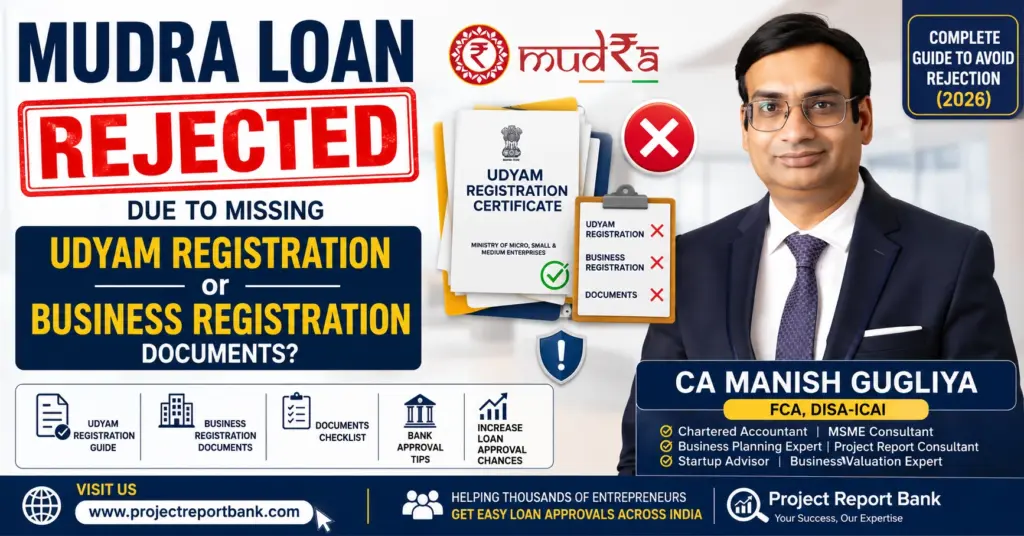
Many first-time entrepreneurs in India assume that PAN and Aadhaar alone are enough to get a Mudra Loan approved. But when the bank rejects the application citing “missing business proof” or “no Udyam Registration,” confusion and frustration set in. If your Mudra Loan was rejected due to missing Udyam Registration or incomplete business documents, this guide will explain exactly why it happened, what you can do about it, and how to get your loan approved on the next attempt.
Key Takeaways
- Many Mudra Loan applications get rejected because the bank cannot verify that a genuine business exists – missing Udyam Registration is one of the most common triggers.
- Udyam Registration is not legally mandatory for every loan under Pradhan Mantri Mudra Yojana, but in practice, most commercial banks and small finance banks treat it as a standard requirement in 2026.
- Proprietorship, home-based, and small service businesses can still qualify for mudra loans if they provide strong alternative business proof such as shop licence, GST registration, invoices, or a business bank statement.
- Applicants can fix the problem by obtaining Udyam Registration online (it is free), correcting document mismatches, and reapplying with a complete file to the same or a different eligible bank.
Table of Contents
Why Was Your Mudra Loan Rejected Due to Missing Udyam Registration?
Here is something I see regularly as a Chartered Accountant and MSME consultant with over 20 years of experience: an entrepreneur walks into a bank branch, fills out the Mudra application, attaches Aadhaar, PAN, two photos, and expects the loan to be sanctioned within days. When rejection comes, the reason often reads “no business proof” or “Udyam Registration not provided.”
Let me explain why this happens.

- Loan officers need evidence that you are running (or genuinely starting) a real business. Without Udyam Registration, GST certificate, shop licence, or at least regular business-related credits in your bank statement, the file looks like a personal loan request – not a business funding proposal.
- Under the mudra scheme, MUDRA stands for Micro Units Development & Refinance Agency, and the scheme supports non corporate small and micro enterprises. The Pradhan Mantri Mudra Yojana was launched on April 8, 2015, to provide loans up to ₹10 lakh to beneficiary micro unit borrowers. Loans are classified into Shishu, Kishore, and Tarun categories based on stage of business and loan amount needed.
- While RBI and the government do not explicitly make Udyam compulsory for every PMMY loan, each bank’s internal credit policy may treat Udyam or similar registration as mandatory proof. For instance, Indian Bank’s Online Shishu Mudra Loan explicitly requires a Udyam Registration Certificate before the applicant can even proceed, and PNB’s e-Mudra product lists Udyam Registration as mandatory for eligibility.
In my practice, the most common rejection patterns I see are:
- No Udyam, GST, or shop licence attached to the application
- Business address on Aadhaar does not match the actual shop or business site
- Only a salary or savings account statement is provided, with no business-related credits visible
- The applicant cannot demonstrate business continuity or trading history
The rest of this article will show you what Udyam Registration is, when it is truly needed, which alternative documents banks accept, and the exact steps to fix a rejected Mudra application and reapply successfully.
Is Udyam Registration Mandatory for Mudra Loan? (Including Alternative Business Proofs)
Udyam Registration for Mudra Loan is not legally compulsory in every single case. However, in 2026, most banks and financial institutions strongly prefer it – especially for existing micro and small enterprises applying under any MSME scheme.
What is Udyam Registration?
- Udyam Registration is a free and completely online process for MSMEs in India. It replaced the earlier Udyog Aadhaar Memorandum (UAM) system in July 2020.
- Any individual running a manufacturing, trading, or service business can register using Aadhaar, PAN, and basic business details on the official Udyam Registration portal.
- On successful registration, you receive a Udyam Registration Certificate with a unique number and QR code. This provides official government recognition of a business as an MSME.
- Udyam registration is a mandatory requirement for MSME loans since 2026, making it even more critical for individuals applying through banks, NBFCs, or the ministry-linked portals.
Why does Udyam matter for Mudra applicants?
- It establishes your identity as a micro or small enterprise, which helps the bank classify your loan under Priority Sector Lending as guided by RBI.
- It links your GST, PAN, and address in one verified document, reducing mismatches.
- Udyam registration can reduce loan processing time significantly and helps in obtaining collateral-free loans under the Pradhan Mantri Mudra Yojana.
- Having Udyam registration strengthens a loan application for various MSME schemes beyond just Mudra.
- Many lenders require Udyam registration when processing MSME-related applications, even if the central scheme documents do not explicitly mandate it.
What if you don’t have Udyam? Alternative business proofs banks may accept:
| Document | Typically Accepted For |
|---|---|
| GST Registration | Traders, manufacturers, service providers above threshold |
| Shop & Establishment Licence | Retail shops, salons, coaching centres, small offices |
| Trade Licence / Municipal Licence | Local businesses in cities requiring municipal registration |
| Partnership Deed / LLP Agreement | Partnership or LLP firms |
| Company Incorporation Certificate | Private limited companies |
| FSSAI Licence | Food-related businesses (tiffin, restaurant, bakery) |
| Factory Licence / Pollution Consent | Manufacturing units based on State rules |
| Professional Tax Registration | Professionals and service providers |
| Business bank statement (6–12 months) | Any business showing regular business credits |
| Purchase and sales invoices in firm name | Proprietorship, trading, and manufacturing businesses |
| Import Export Code (IEC) | Businesses involved in import or export |
Each lending institution – whether a public sector bank, RRB, small finance banks, NBFC, or MFI – has its own checklist for Mudra Loan documents required. Always ask in writing what business proof the branch will accept before you submit your application.
You need seven types of documents for a Mudra loan in general: identity proof, address proof, business proof, bank statement, income proof, ownership proof, and a passport-size photograph. Valid photo identity proof is required for Mudra loan applications, and a bank statement from the last six months is necessary. Proof of income includes the latest Income Tax Return, and ownership proof of residence or office is also required. Beyond these, other documents like a project report or business plan may be needed depending on the loan amount and bank policy.
For a detailed checklist, refer to the complete guide on Mudra Loan documents required.
Typical Mudra Loan Rejection Reasons Linked to Missing Business Registration
Even when an applicant feels “all documents” were submitted, the bank may still reject the Mudra Loan application for specific reasons tied to missing or weak business registration proof. Here are the practical, bank-side reasons I encounter most frequently:
No formal business registration at all:
- No Udyam Registration, GST, or any MSME registration – the file appears like a purely personal loan request, not a business proposal. The bank cannot classify the borrower as a business unit.
- No Shop & Establishment certificate or trade licence for a visible shop (kirana, salon, mobile repair, restaurant) in a city where such registration is compulsory.
- No GST registration despite declared turnover in the application being above common GST limits, which creates doubt about compliance and honesty.
Document inconsistencies:
- Application form mentions one business name, but PAN, bank statement, or invoices show a different or informal name. This is a very common problem for proprietorship businesses.
- Business address on Aadhaar, rent agreement, and Udyam or GST do not match – making physical verification at the site difficult. If you have faced rejection for this specific reason, read more about Mudra Loan rejected due to address proof issues.
- Only a savings account statement is provided, with mostly salary credits and UPI spends – no clear business-related credits that signify actual business activity.
Weak “paper trail”:
- No electricity bill, utility bills, property tax receipt, or rent agreement supporting the claimed shop address.
- Very few purchase or sales bills, or invoices raised in personal name rather than the firm name.
- For online or home-based businesses, no proof such as marketplace dashboard screenshots, order history, or payment gateway settlement reports.
Combined weaknesses:
Banks also check repayment capacity, CIBIL score, existing EMIs, and past defaults. If these are weak and business proof is also missing, rejection becomes very likely. If you suspect your rejection may involve incorrect business proof or incomplete KYC documents, those dedicated guides can help you identify the actual issue.
How to Obtain Udyam & Other Business Proofs and Reapply Successfully
A Mudra Loan application rejected due to missing Udyam Registration is not the end of the road. In most cases, you can fix the problem within a few days to a few weeks if you follow a clear plan. Here is exactly what to do.
Step-by-step: How to get Udyam Registration in 2026
- Visit the official Udyam Registration portal and select “For New Entrepreneurs who are not registered yet as MSME.”
- Enter your Aadhaar number (as proprietor, partner, or director) and validate with OTP sent to your registered mobile.
- Provide your PAN (personal or business), business name, full address, bank account details, investment estimates, turnover estimates, and select the correct NIC Code matching your business activity. Choosing the wrong NIC code is one of the most common mistakes – pick the code that accurately describes what you do (e.g., tailoring, food preparation, retail trading, IT services).
- Submit the form. Your Udyam Registration Certificate will be generated and emailed to you. Save and print it. The entire process is free and takes under 15 minutes.
Make sure the name, address, and mobile number on your Aadhaar, PAN, bank account, and Udyam certificate all match. Even small differences – like “Pvt. Ltd.” vs “Private Limited” or a missing flat number – can cause auto-rejection in digital loan flows.
Other business registrations to strengthen your file:
- Apply for a Shop & Establishment licence at your local municipal or State portal if you run a shop, salon, coaching centre, or small office.
- Obtain GST registration if your turnover is likely to cross the threshold, or if your business model (inter-State online selling, B2B supplies) requires it even below the threshold. For businesses operating without GST, understand what alternatives your bank will accept.
- Food businesses should obtain FSSAI registration. Manufacturers may need a factory licence or pollution consent depending on State rules.
For proprietorship and home-based businesses:
- Strengthen your file with a rent agreement in the business name, electricity bill for the business premises, business bank account statement showing regular credits, invoices in the firm name, online marketplace seller statements, or tuition attendance registers.
- Even a simple written project report and basic business plan – covering cost of the project, expected sales, and monthly EMI repayment capacity – prepared with professional help can significantly improve the bank’s trust. If your project report was rejected earlier, get it reviewed by a qualified consultant before resubmitting.
- Home-based entrepreneurs running businesses like tailoring, tiffin services, beauty parlours, or online reselling can learn more from the guide on Mudra Loan for home business.

Your reapply strategy:
- First, obtain the missing registrations (Udyam, shop licence, GST – whichever applies) and correct all name and address mismatches across Aadhaar, PAN, Udyam, GST, and your bank account master.
- Collect updated bank statements for the last 6–12 months showing business credits wherever possible. If your earlier rejection was due to old bank statements, make sure you provide fresh, updated ones.
- Re-approach the same branch with a covering letter explaining the corrections you have made. Attach all updated documents. If the branch is uncooperative, you can apply afresh to another eligible bank or financial institution – public sector banks, private banks, RRBs, small finance banks, and even NBFCs disburse Mudra loans.
A real-world example:
A home-based tailoring entrepreneur applied for a Shishu Mudra Loan (shishu loans are up to Rs. 50,000) through her local branch. The bank rejected her application citing “no business proof / missing Udyam.” She then obtained Udyam Registration online, collected 6 months of her business bank statement showing order payments from regular customers, attached a rent agreement for her workspace, and prepared a one-page project report. On reapplication, the loan was sanctioned within two weeks.
Remember: Final approval of any Mudra Loan – including the interest rates, sanctioned loan amount, and repayment terms – always depends on the bank’s own assessment of risk, credit history, and viability of the project. Even when all registration documents are perfect, the bank retains discretion. Individuals applying under Kishore loans (ranging from Rs. 50,001 to Rs. 5 lakhs), Tarun loans (ranging from Rs. 5,00,001 to Rs. 10 lakhs), or the recently introduced Tarun+ loans (ranging from Rs. 10,00,001 to Rs. 20,00,000) should expect more detailed scrutiny of business plans and financial projections as the maximum loan amount increases.
To understand how banks evaluate risk before making a lending decision, read the guide on how banks assess risk before rejecting Mudra Loan. And if you want to find the actual reason behind your Mudra Loan rejection, that step-by-step guide can help.
Frequently Asked Questions
Here are answers to questions that Mudra Loan applicants commonly ask but are not fully covered in the sections above.
Can I apply for Mudra Loan first and obtain Udyam Registration later if the bank asks for it?
Yes, in some cases you can start the application process and provide Udyam Registration when the bank requests it during processing. However, for online or digital Mudra Loan flows (like PNB e-Mudra or Indian Bank Online Shishu), the system will not let you proceed without a valid Udyam certificate. It is always safer to register on the Udyam portal before you apply – the process is free and takes minutes.
Is Udyam Registration necessary for very small home-based businesses like tiffin service, tailoring, or online reselling?
There is no turnover or size limit for Udyam – even a one-person home-based business can register. While the PMMY scheme does not explicitly require it for every applicant, having Udyam makes your application stronger because it gives the bank an official government-verified proof that your business exists. For very small businesses, it is one of the easiest and cheapest ways to expand your credibility with the bank.
Will Udyam Registration alone guarantee that my Mudra Loan will be approved?
No. Udyam Registration is one important document, but banks evaluate eligibility based on multiple factors: your CIBIL score, income and repayment capacity, business viability, bank statement quality, existing loans, and the overall project details you submit. A complete and consistent set of documents – not just one certificate – is what improves your approval chances.
How soon after getting Udyam can I reapply for Mudra Loan, and do I need a fresh project report?
You can reapply immediately after obtaining your Udyam Registration Certificate. If your earlier project report is still current and accurate, you may not need a completely new one – but do update it to reflect any changes in cost, revenue, or address. If the earlier report was weak or the bank raised questions about it, getting a professionally prepared project report is strongly recommended.
If my earlier Mudra application was rejected due to missing business proof, will it affect my CIBIL score or future loan chances?
A loan application rejection by itself does not directly lower your CIBIL score. However, multiple loan enquiries in a short period can appear on your credit report and may raise concerns for future lenders. The best approach is to fix all missing documents, correct mismatches, and then reapply to one bank at a time rather than submitting applications to many banks simultaneously.
About the Author
CA Manish Gugliya (FCA, DISA-ICAI) is a Chartered Accountant with over 20 years of experience in MSME finance, Mudra Loans, Project Reports, CMA Data preparation, Startup Advisory, Business Planning, and Business Valuation. Through Project Report Bank, he has assisted entrepreneurs across India in preparing bank-ready project reports and improving their loan approval chances.
Good documentation is the difference between rejection and approval. If your Mudra Loan application was rejected due to missing Udyam Registration or weak business proof, take it as a signal to get organised – not as a final “no.” Register on the Udyam portal today, align all your documents, prepare a solid project report, and walk into the bank with confidence. If you need professional help with your project report or CMA data, reach out to an experienced MSME consultant before you reapply.
- Mudra Loan Rejection Reasons: Complete Guide to Why Banks Reject Applications


- Mudra Loan Documentation Issues: Complete Guide to Avoid Document-Related Loan Rejections

- How to Prepare a Perfect Mudra Loan Document File Before Visiting the Bank 2026

- Mudra Loan Rejected Due to Signature Mismatch – Practical Guide 2026 by CA Manish Gugliya

- Mudra Loan Rejected Due to Missing Udyam Registration – Complete 2026 Guide by CA Manish Gugliya
- Mudra Loan Rejected Due to Invalid or Old Bank Statements – What Banks Expect (Explained by CA Manish Gugliya) 2026

- Mudra Loan KYC Documents: Complete Checklist to Avoid Rejection 2026
- Mudra Loan Rejected Due to Address Proof Issues – Complete Guide 2026 by CA Manish Gugliya

- Mudra Loan Rejected Due to Incorrect Business Proof – What Documents Do Banks Accept? 2026

- Mudra Loan Rejected Due to PAN and Aadhaar Name Mismatch – Practical Fix by CA Manish Gugliya
- How to Identify the Actual Reason Behind Your Mudra Loan Rejection

- How Banks Assess Mudra Loan 2026 Risk Before Rejecting an Application

- Mudra Loan Interview Rejected: Common Mistakes and How to Prepare Successfully (2026 Guide)

- Mudra Loan Rejected Because the Proposed Business 2026 Already Has High Local Competition

- Mudra Loan Rejected Because Business Category Is Outside Bank Lending Preference 2026