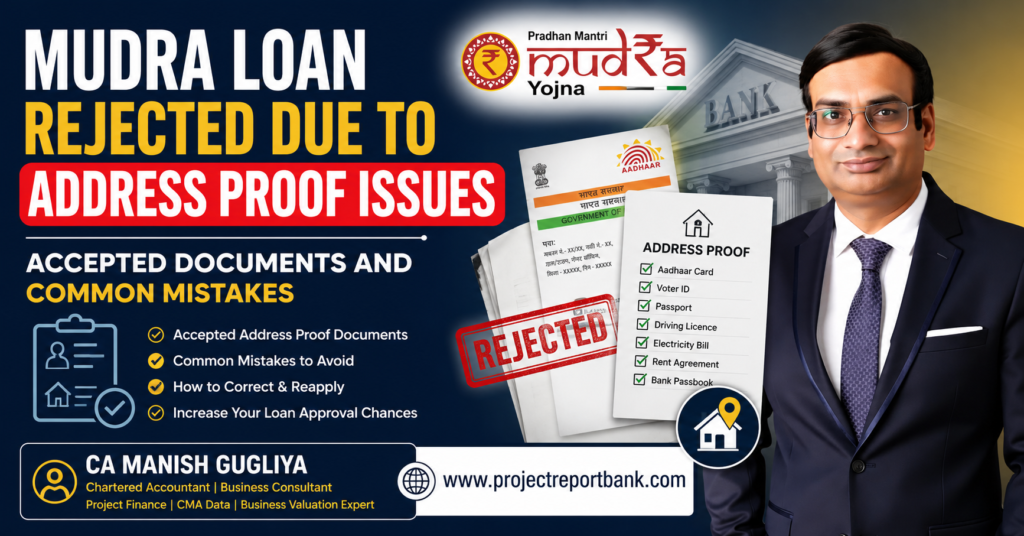
Key Takeaways
- Most mudra loan rejections due to address proof happen because of address mismatch between Aadhaar, PAN, bank records, and the loan application form – not because the business idea is weak.
- Banks follow strict RBI KYC rules and must confirm your current residential address before approving any mudra loan.
- Common fixable problems include old Aadhaar address, rented house without proper agreement, and electricity bill in someone else’s name.
- Incomplete or mismatched documents cause most mudra loan rejections, but address proof issues are among the easiest to correct before reapplying.
- By updating Aadhaar, keeping the same address across all documents, and preparing clean copies, your chances of loan approval increase significantly.
Introduction – Why Your Mudra Loan Was Rejected Only Because of Address Proof
Ramesh runs a small kirana shop in Indore. He applied for a ₹3 lakh kishore mudra loan in 2025. His bank statements showed healthy transactions, his basic business plan was solid, and his credit history was clean. Yet the bank rejected his application – simply because the address on his Aadhaar card showed his native village while his bank passbook carried his Indore address.
Even when income proof, business registration, and a clear business plan are all in order, a single address mismatch can stop your mudra loan application. This article focuses entirely on why a mudra loan gets rejected due to address proof and gives you step-by-step solutions to fix the problem. If you want to find the actual reason behind your mudra loan rejection, understanding address proof issues is a critical first step. The good news: compared to problems like a low CIBIL score (which can cause immediate rejection) or weak business viability, address proof errors are usually the easiest to correct.
Table of Contents
What Is Address Proof in a Mudra Loan? (Basic Concepts in Simple Language)
Identity proof tells the bank who you are – for example, your pan card or Aadhaar card. Address proof tells the bank where you live – your current residential address confirmed by an official document like an electricity bill or bank passbook.
Under the Pradhan Mantri Mudra Yojana (mantri mudra yojana pmmy), the loan scheme provides mudra loans for individuals and small businesses under four categories: shishu loans provide up to ₹50,000 for startups, kishore loans range from ₹50,000 to ₹5 lakh for expansion, tarun loans offer ₹5 lakh to ₹10 lakh for established businesses, and Tarun Plus loans provide up to ₹20 lakh for repeat borrowers. The minimum age for mudra loan applicants is 18 years.
KYC (Know Your Customer) is an RBI rule requiring every bank or financial institution to record your correct name, date of birth, photo, and address before giving any loan. Banks must also update your address if you shift from village to city. For higher category loans, the bank may send staff to physically visit the address in your mudra loan application to confirm it is genuine. Mudra loans can even be applied for without a PAN card, but address proof is always required.
Why Address Proof Is So Important for Mudra Loans
Banks treat correct address as a safety requirement, not a formality – especially for unsecured business loans like mudra loans where no property is pledged as security.
Your residential address helps the bank send loan sanction letters, EMI reminders, and legal notices if repayment stops. It supports on-site inspection of your business unit for kishore mudra loan and above, where field staff verify stock, machinery, and actual business activity. Accurate address also helps in risk assessment: the bank checks whether you live in a stable location or keep shifting frequently. Address verification is required for all business loans under the mudra scheme.
Regulatory compliance matters too – banks are audited by RBI, and incorrect KYC in mudra loan files can lead to penalties. Applicants must not have a history of loan defaults, and applying for an unjustified loan amount can also result in rejection. Correct address proof equally protects you from fraud, preventing someone from taking a loan in your name using fake documents.
Accepted Address Proof Documents for Mudra Loan (With Practical Notes)
Different banks – public sector banks, private sector banks, regional rural banks, small finance banks, non banking financial companies, and micro finance institutions – may accept slightly different combinations. But most banks follow RBI’s officially accepted OVD (Officially Valid Documents) list.
Here are the commonly accepted documents:
- Aadhaar Card – Most commonly used. Both physical and downloaded e-Aadhaar or DigiLocker versions are accepted. The address must be current.
- Passport – Valid, unexpired Indian passport with the same name as in the loan application.
- Driving Licence – Must be valid (not expired) with clear photo, signature, and address.
- Voter ID – Accepted if photo and address are legible; sometimes carries outdated village address.
- Utility bills – Recent electricity bill, water bill, piped gas bill. Proof of residence must not be older than two months. Recent telephone or electricity bills are valid address proof. Some banks accept bills in spouse or parent’s name with relationship proof.
- Property tax receipt – Issued by municipal authority showing your name and address.
- Registered rent agreement (rental agreement) – Especially required in cities like Mumbai, Pune, Delhi, and Bengaluru. Must be stamped and registered.
- Bank passbook or bank statements – A bank statement can also be used as address proof, if stamped by the bank showing current address.
- Post-paid mobile bill – Only some banks accept this; must be recent and carry full address.
- Employer certificate – For salaried co-borrowers; some banks accept employer-issued address confirmation.
Always confirm the latest list of mudra loan documents required with your specific bank branch before submitting.
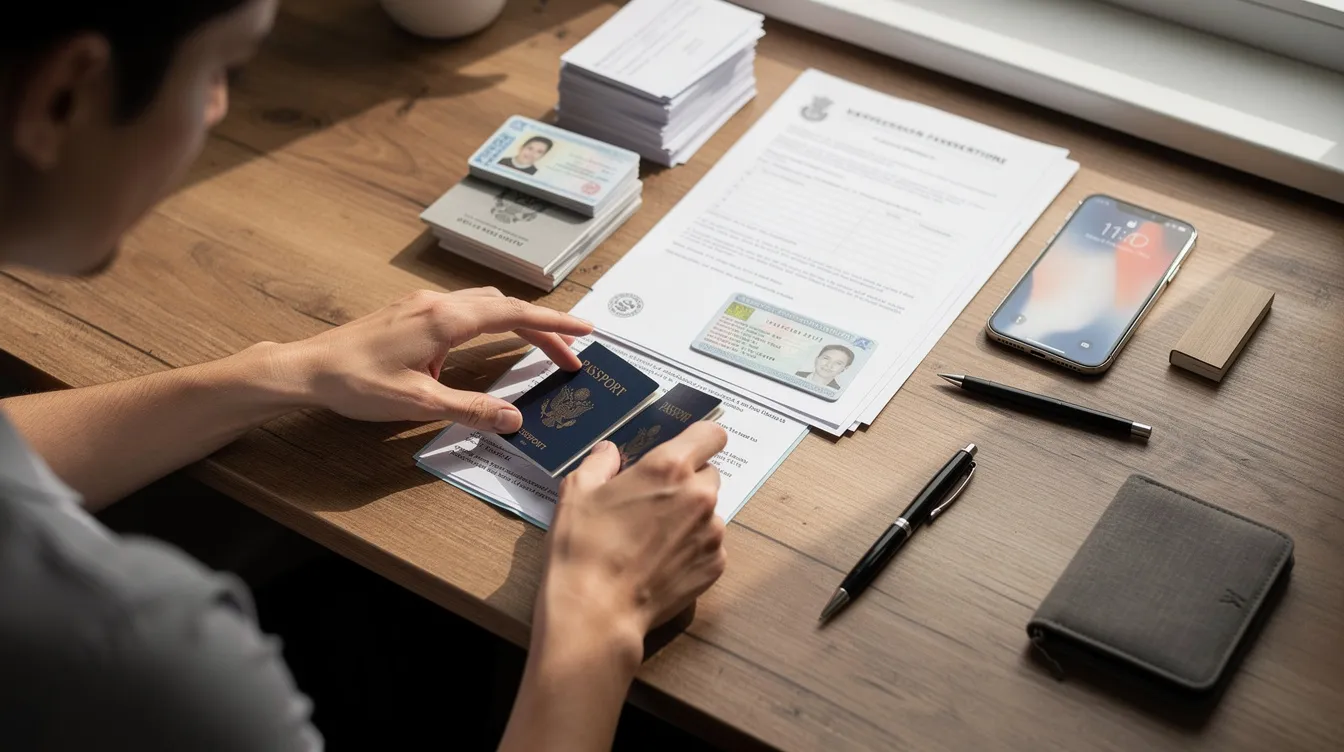
Documents Usually Not Accepted as Address Proof (And Why)
Many borrowers bring documents that seem valid but get rejected due to RBI guidelines or internal bank policy. Missing eligibility-specific documents can delay or reject applications.
- Expired documents – Old passport or driving licence with lapsed validity, even if the address is correct.
- Handwritten rent agreements – Without stamp duty or registration; banks consider these weak and easy to fabricate.
- Unregistered rent agreements – In states where registration is standard, many urban branches reject these for mudra loans above certain loan amount thresholds.
- Temporary stay slips – PG receipts, hostel slips, or hotel bills do not prove stable residence for the full repayment terms period.
- Old utility bills – Bills older than 3 months are usually rejected; banks need to know where you live now.
- Relative’s documents without proof – Uncle’s or cousin’s utility bills without your name or a legal relationship document.
- Illegible photocopies – Poor-quality uploads of address proofs can result in rejection of loan applications. If staff cannot read the address, they cannot approve it.
- Aadhaar printed from local shop – Without QR code or official download, it may look tampered. Use official UIDAI download or DigiLocker.
Top Reasons Mudra Loans Get Rejected Due to Address Proof Problems
During branch audits, address-related issues consistently appear as a core reason for mudra loan rejection. Here are the most common triggers:
- Aadhaar with old address – Applicant shifted to another city but Aadhaar still shows native village; bank cannot confirm current residence.
- Address mismatch across documents – Aadhaar, voter ID, bank passbook, and the mudra loan application form show different house numbers, localities, or even different cities.
- PIN code mismatch – Correct house name but wrong PIN code; system validation fails during e-KYC.
- Spelling differences – “Shri Ram Nagar” vs “Sriram Nagar” or “H. No. 21/7-B” vs “21-7B” creates doubt for the verification officer. Name must be spelled identically across all submitted documents.
- Missing house number – Only village or city name written; field staff cannot locate the exact address.
- Utility bill not in borrower’s name – Electricity bill in landlord’s or father’s name without rent agreement or relationship proof attached.
- Fake or doubtful addresses – Empty plots, under-construction sites; field investigation reports “party not found”.
- Blurred or cropped scanned documents – Clear and complete image uploads of documents are necessary for approval.
- Inconsistent business addresses can lead to loan application rejection when business address proof does not match what is declared in the application.
When multiple small address problems add up, the bank sees the file as high risk and rejects the mudra loan even if CIBIL score and simple business plan are fine.
Common Mistakes Applicants Make With Address Proof (With Solutions Table)
Below are real-life mistakes seen at Indian bank branches. Mudra loans require strict consistency in documentation – here is how to fix common errors before reapplying.
| Common Mistake | Why Bank Rejects | Practical Solution |
|---|---|---|
| Aadhaar shows village address while applying from city | Cannot verify current residence | Update Aadhaar to present city address |
| Electricity bill older than 6 months | Does not prove current stay | Get latest bill (within 2 months) |
| Dark or blurry mobile photos of documents | Address text not readable | Take clear, colour scans or photocopies |
| Aadhaar printed without QR code | Looks tampered | Download from UIDAI or DigiLocker |
| Different address on loan form vs KYC documents | Inconsistent information | Copy address exactly from Aadhaar |
| Office address given as residence | Bank asked for both separately | Provide separate proofs for each |
| Unregistered rent agreement | Weak legal proof | Get agreement registered with stamp duty |
| Bank statements with old or blank address | Does not match current KYC | Update address in savings account |
| Rent agreement unsigned or undated | Incomplete document | Complete all fields and get both signatures |
| In-laws’ proof without relationship document | No legal link established | Attach relationship affidavit or Aadhaar |
| Mobile number changed during processing | OTP verification fails | Keep Aadhaar-linked number active |
| Address in local language on form vs English on Aadhaar | Spelling mismatch | Use same language and spelling everywhere |
| Partially cut ration card photocopy | Missing address details | Submit full, clear copy |
| PG address on form but parents’ address on documents | No declaration provided | Attach self-declaration and PG owner letter |
| Old address in savings account despite shifting years ago | Mismatch with Aadhaar | Update bank account address immediately |
Aadhaar Address Problems and How to Fix Them Before Reapplying
Aadhaar card is the most used KYC document in mudra loan applications, making wrong address on Aadhaar the single biggest reason for address-related rejection. Typical issues include old village address, spelling mistakes in street name, wrong PIN code, or a card issued before marriage still reflecting parents’ address.
To update your Aadhaar address:
- Online: Use the UIDAI self-service portal or mAadhaar app with valid supporting documents.
- Offline: Visit the nearest Aadhaar Seva Kendra with originals like electricity bill, bank passbook, or registered rent agreement.
The update usually takes 7–10 days, though it can take up to 30 days. Do this well before starting your mudra loan process. Digital Aadhaar (PDF with QR code) from UIDAI or DigiLocker is fully valid – banks can scan the QR code to confirm it is genuine.
If your PAN and Aadhaar show different names or addresses, fix that mismatch first. PAN is mainly identity proof; bank relies on Aadhaar and utility bills for residence verification. Do not apply for mudra loan at multiple banks simultaneously while your Aadhaar address is under change – wait for the update to reflect.
Rented House Situations – How to Show Correct Address Proof
Many first-time entrepreneurs and migrant workers live in rented rooms, creating extra difficulty in proving address for a mudra loan. A valid rent agreement is required if renting a business location or residence.
Your rental agreement must include tenant name, landlord name, full address, rent amount, duration, and both parties’ signatures. In many states, banks prefer registered agreements with stamp duty paid.
If the electricity bill or water bill is in the landlord’s name, banks may still accept it when attached with the rent agreement plus a simple declaration from the landlord confirming tenancy. Adding bank statements from the same rented address strengthens your proof – update your savings account address as soon as you shift.
For PG or hostel stays, banks may ask for a letter from the PG owner on letterhead plus employment ID or college ID. For home-based businesses (tiffin service, tailoring, online selling), residential address and business address are usually the same, so one strong address proof can serve both with a simple business declaration. Avoid making last-minute rent agreements only on the date of bank visit – prepare them a few weeks before applying.
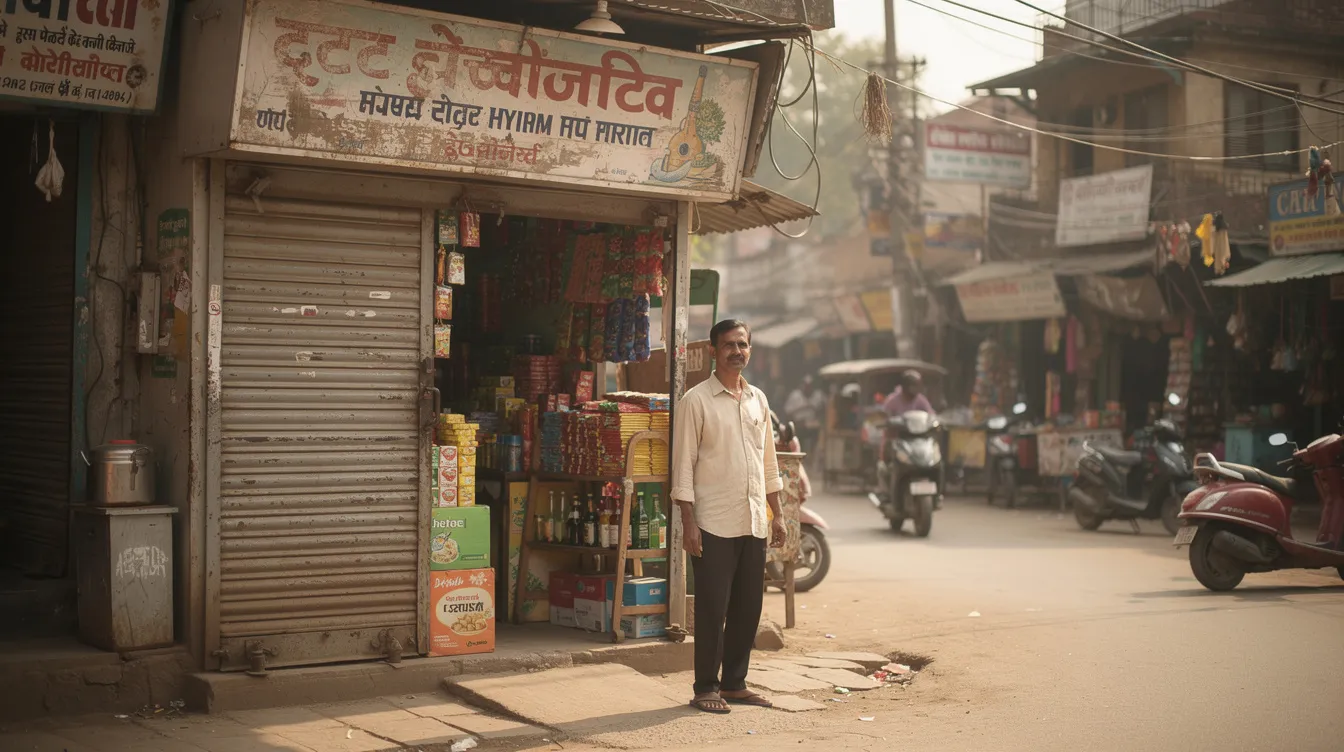
Business Address vs Residential Address – What Exactly Do Banks Check?
A mudra loan is a business loan, so the bank is interested in both where you live and where the business operates. Proof of business operations is required to avoid rejection.
- Residential address: Where you actually live; used for KYC, communication, and legal notices.
- Business address: Shop, workshop, godown, or home kitchen; used for site inspection and understanding actual business activity.
For shishu category loans, banks may accept only residential address plus a basic business plan since the business unit may not have fixed premises yet. For kishore mudra loan and higher loan amount, banks often ask for business address proof separately – electricity bill or property tax receipt for the shop, plus separate residential proof.
Banks may reject applications if they cannot verify a permanent business address. If you run a home-based business, provide a declaration and photographs of your business activity at that address. For incorrect business proof situations, keep the same spelling and format for both addresses across all documents.
How Banks Actually Verify Your Address in a Mudra Loan
Banks do not rely only on photocopies. They run several checks before approving a mudra loan, especially when the loan amount crosses ₹50,000–₹1,00,000.
- Phone verification: Bank staff or a third-party agency calls your mobile to confirm whether you are available at the declared address.
- Physical visit / field inspection: An officer visits your residential or business address, checks door nameplate, asks questions, and may take geo-tagged photographs.
- Neighbour enquiry: In small towns, the officer may ask 1–2 neighbours about your name, how long you have lived there, and your business activity.
- Backend verification: The bank compares your KYC address with your existing banker records, bank statements, and credit bureau profile to check if everything matches. Transaction history and regular transactions in your current account or savings account are also reviewed.
If the address is found locked repeatedly, “no such person” is reported, or neighbours deny knowledge, the bank may immediately decline the mudra loan or mark it as high risk.
How Banks Detect Fake or Risky Addresses in Mudra Loan Files
Deliberate misuse of address proof is taken seriously and can lead to fraud marking, hurting all future loan chances. When site inspection reports “vacant land,” “closed shop,” or “under construction building,” the bank assumes a non-genuine address.
Banks also run pattern checks – multiple mudra loan applications from different banks using the same small room or same utility bill get flagged as suspicious. They cross-check signatures and photos across other documents to detect forgery. Credit bureau data carries previous addresses; if you give a completely unrelated new address without transition proof, expect additional questions.
Giving a friend’s or relative’s address just to “fit eligibility” can backfire – once verification fails, it leads not only to rejection but internal blacklisting. Genuine but simple proof is always better than fancy but doubtful documents.
Step-by-Step Process to Correct Address Proof Before Reapplying for Mudra Loan
After rejection, you can clean up your address proof and reapply. Loan applications can be resubmitted after correcting documentation issues. Follow this checklist:
- Collect all current documents: Aadhaar, PAN, voter ID, driving licence, bank statements, utility bills, rent agreement, business registration.
- Identify which address is correct and stable for the next 2–3 years (usually your present residential address).
- Choose 1–2 documents as your “main” address proof – for example, Aadhaar plus electricity bill.
- Update Aadhaar address first using Seva Kendra or online process.
- Update address in your main savings bank account and get a fresh stamped bank passbook or statement.
- If renting, prepare or register a proper rent agreement and collect the latest utility bill.
- Correct address in business records like GST, Udyam Registration, and shop licence if applying for a higher loan amount.
- Re-check that the address in the mudra loan application form exactly matches your updated documents – house number, street, city, PIN.
- Rescan all documents clearly and submit with a covering note explaining the address update.
Do not reapply without fixing the root cause – it will usually lead to another rejection. If your loan was unjustifiably rejected despite correct documents, grievances can be raised with higher authorities including the banking ombudsman or through a formal appeal.
Tips to Avoid Mudra Loan Rejection Due to Address Proof (Expert Checklist)
Use this checklist the day before submitting your mudra loan application:
- Use the same residential address format across all documents and forms.
- Always write full address including house/flat number, street, locality, and PIN.
- Update Aadhaar before visiting the bank, not after.
- Keep at least one recent utility bill (not older than 2–3 months) from your current address.
- If electricity bill is in father’s or spouse’s name, attach relationship proof.
- Do not overwrite or scratch address fields in photocopies.
- Take coloured photocopies or clear scans where all text is readable.
- Carry original documents for verification along with photocopies.
- Avoid temporary stay addresses (hotel, short-term PG) in mudra loan KYC.
- Ensure rent agreement has date, signatures, and stamp duty complete.
- Keep your Aadhaar-linked mobile number active for OTP-based e-KYC.
- Copy address exactly from Aadhaar when filling forms by hand.
- For joint families, clarify whose name appears on bills and relationship.
- For rural areas, add nearest landmark in the address description.
- Respond quickly to bank SMS or emails regarding address verification.
- Do not apply in multiple banks with different addresses simultaneously.
- If you shift house during processing, immediately inform the bank.
- Verify that bank statements match the address on your mudra loan application.
- Keep at least two strong address proofs ready before starting the application.
- When in doubt, discuss your KYC set with a bank officer or CA before filing.
Real-Life Example – How One Applicant Solved Address Proof Rejection
Suresh, a grocery shop owner in Jaipur, applied in 2024 for a ₹4 lakh kishore mudra loan. His aadhaar card carried his old village address in Sikar district. His bank statements had yet another address from a previous rented room. The mudra loan application form mentioned his present Jaipur address near the shop.
The bank’s field verification officer could not match any document to the actual residential address. Despite good business turnover, regular transactions, and a project report showing clear repayment capacity, the credit department declined the file.
With professional help, Suresh took these steps:
- Updated Aadhaar to his current Jaipur residence using a registered rent agreement and recent electricity bill.
- Updated his savings account address and obtained a fresh 6-month bank statement.
- Prepared a simple letter explaining his address history with copies of old and new Aadhaar.
About 30 days later, he reapplied. The bank accepted the new address proof, performed successful site inspection, and the same ₹4 lakh mudra loan was approved with a 5-year repayment plan. The processing fee was standard, and interest rates were competitive.
Correcting address proof systematically is far more effective than arguing about the previous rejection.
Expert Advice from CA Manish Gugliya – Organising Your KYC for Smooth Mudra Loan Approval
With over 20 years of experience in MSME finance, project reports, and mudra loan documentation for traders, manufacturers, and service sectors providers, I have seen hundreds of files rejected for avoidable address issues.
My advice: maintain a dedicated “KYC folder” – physical or digital – containing updated Aadhaar, PAN, voter ID, driving licence, bank passbook, utility bills, and rent agreement. This prevents last-minute scrambling.
Make address consistency a habit. Whenever you move house, update your Aadhaar, primary bank account, and business registrations like Udyam or GST within 1–2 months. Before submitting any mudra loan application, sit with a knowledgeable person – a CA, bank relationship manager, or DIC officer – and cross-check all addresses line by line.
Strong documentation – correct address, clear business proof, consistent bank statements, and a solid repayment plan – results in faster sanction. Bank staff trust clean files. Small entrepreneurs should not feel scared of banking formalities. With honest information and simple preparation, getting your mudra loan approved from any lending institution – whether canara bank, other existing businesses of public sector banks, or any financial institution – becomes much easier. You can even apply online through the Jan Samarth portal for many banks.
Conclusion – Fix Address Proof Now, Improve Your Mudra Loan Chances
Address proof is a key part of mudra loan KYC, and many rejections happen only due to outdated or mismatched addresses – not due to weak business or poor repayment capacity. Whether you need working capital for your repair shops, category loans for expansion, or personal loans restructured as business loans, the documentation basics remain the same. Additional documents like years balance sheets and income proof matter, but without correct address proof, they cannot help.
Updating Aadhaar, aligning address across bank statements, rent agreements, and utility bills, and carefully filling the loan application form removes this obstacle completely. Treat this as a one-time cleanup exercise that helps in all future loans, credit cards, and government schemes – not only mudra loans.
Organise your required documents today and reapply confidently. Your business idea deserves the funding – do not let a fixable address error stand in the way.
Frequently Asked Questions on Mudra Loan Rejection Due to Address Proof
These FAQs cover additional doubts not fully answered in the main sections above.
Can my Mudra loan be rejected if my Aadhaar has my village address but I now live in a city?
Yes, this is one of the most common reasons for rejection. The bank must verify your current place of living, not just your old permanent address. Update your Aadhaar to your present city residence using a rent agreement, utility bill, or bank passbook, and then reapply with the new e-Aadhaar. Some banks may temporarily accept additional proofs with a declaration, but for smooth long-term approval, Aadhaar should reflect your current address.
If the electricity bill is in my father’s name, can I still get a Mudra loan?
Most banks allow this if you live in the same house and can show the relationship – for example, through Aadhaar showing your father’s name and the same address. Attach a simple declaration from your father plus the electricity bill and your own Aadhaar so the bank can link you to that address. Check with the branch if they need any additional document like a ration card or family card showing both names.
Does PAN card work as address proof for Mudra loan?
PAN is mainly an identity and tax document. In most banks, it is not treated as valid address proof for KYC in a mudra loan. You must still provide Aadhaar, passport, driving licence, voter ID, or recent utility bills as proper address proof along with PAN.
How old can my electricity or phone bill be for Mudra loan KYC?
Many banks accept bills not older than 2–3 months from the date of application. Some may allow up to 6 months depending on internal rules. Always submit the latest available bill to reduce questions and speed up the verification process.
Can I submit more than one address proof to strengthen my application?
Yes, providing two consistent address proofs – for example, Aadhaar plus a recent electricity bill – usually strengthens your file and makes verification easier for the bank. Ensure both documents show the same address. If they differ, include a written explanation and avoid confusing the eligibility criteria assessment.
- Mudra Loan Rejection Reasons: Complete Guide to Why Banks Reject Applications


- Mudra Loan Documentation Issues: Complete Guide to Avoid Document-Related Loan Rejections

- Mudra Loan CIBIL Issues, Rejection Reasons & Solutions (2026) – Complete Guide
- How to Prepare a Perfect Mudra Loan Document File Before Visiting the Bank 2026
- Mudra Loan Rejected Due to Signature Mismatch – Practical Guide 2026 by CA Manish Gugliya

- Mudra Loan Rejected Due to Missing Udyam Registration – Complete 2026 Guide by CA Manish Gugliya
- Mudra Loan Rejected Due to Invalid or Old Bank Statements – What Banks Expect (Explained by CA Manish Gugliya) 2026

- Mudra Loan KYC Documents: Complete Checklist to Avoid Rejection 2026

- Mudra Loan Rejected Due to Address Proof Issues – Complete Guide 2026 by CA Manish Gugliya

- Mudra Loan Rejected Due to Incorrect Business Proof – What Documents Do Banks Accept? 2026

- Mudra Loan Rejected Due to PAN and Aadhaar Name Mismatch – Practical Fix by CA Manish Gugliya

- How to Improve Your CIBIL Score Before Reapplying for a Mudra Loan (2026 Complete Guide)

- Mudra Loan Rejected Due to Poor Credit History Despite No Current Defaults – Complete Guide 2026 by CA Manish Gugliya
- Mudra Loan Rejected Because of Multiple Loan Enquiries – Does It Really Matter? 2026
- Mudra Loan Rejected Due to CIBIL Report Errors – Detailed Correction Guide 2026 by CA Manish Gugliya