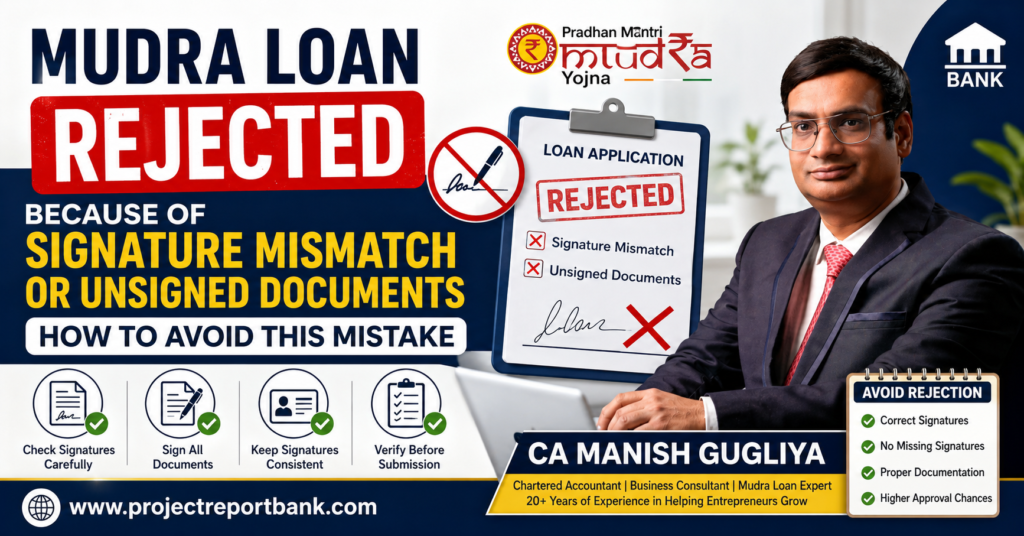
Many Mudra loan applications are rejected not because of weak business viability or poor credit history, but simply because of a signature mismatch or unsigned documents. This is one of the most frustrating – and most fixable – reasons for rejection.
Key Takeaways
Incomplete or mismatched documents cause most Mudra loan rejections, and signature errors are among the top documentation mistakes I see as a practicing Chartered Accountant.
- A Mudra loan application can be rejected due to signature discrepancies between your loan form, bank specimen, Aadhaar, or PAN card – even if your eligibility criteria, cibil score, and business plan are strong.
- Even one missing signature on a declaration page, ECS/NACH form, or self-attested photocopy can delay or cancel mudra loan approval entirely.
- Banks compare your signatures against the specimen stored in your savings or current account through their Core Banking System, and also cross-check against Aadhaar and PAN in many cases.
- You can reapply after correcting the mismatch. Correct documentation and consistent signing can help in reapplying for the loan, often within days.
- This article provides a step-by-step checklist to avoid rejection and to reapply correctly after a mudra loan application signature error.
Understanding Mudra Loans and Signature-Based Rejection
Mudra loans under the PM Mudra Yojana (PMMY) scheme, launched in April 2015, are collateral-free loans for small business owners, traders, street vendors, manufacturers, and service providers. Mudra loans are for non-farm, non-corporate income-generating activities, and Mudra loans can be applied for up to ₹20 lakh depending on the lender and bank policy.
The scheme has four categories of loans: small shishu loans (up to ₹50,000), Kishore (₹50,001 to ₹5 lakh), and Tarun (above ₹5 lakh). A basic business plan is required for kishore and tarun loans, and a clear business plan is required for loans above ₹50,000. A weak or missing business plan can result in application denial, and applying for an unjustified loan amount can also lead to rejection. A CIBIL score below 650 may lead to rejection as well.
Even though these are government backed loans disbursed through public sector banks, regional rural banks, and non banking financial companies, banks reject mudra applications for technical reasons – especially signature mismatch on key documents. In my two decades of practice, I have seen many applicants lose time and money simply because their signatures were inconsistent across paperwork, despite having a clear business plan and stable bank statements. Fixing these documentation errors often leads to smooth mudra loan reapproval without changing the requested loan amount or business model.

Table of Contents
What Is Signature Mismatch in a Mudra Loan Application?
Signature mismatches occur when signatures do not align across documents. In a Mudra loan context, this means the signature on your loan form, declarations, or self-attested copies differs from the specimen signature your bank holds on record – or differs between your Aadhaar, PAN, and the application itself.
Common causes of signature discrepancies include changing signature styles and digital uploads. Here are the patterns I see most often:
- Your signature naturally evolved over the years, but the bank account still holds the old specimen.
- You use a full signature on PAN and a short initial on your bank account.
- Your Aadhaar card carries a different signature style than what you use on the mudra loan form.
- You sometimes use a thumb impression and sometimes a handwritten signature.
Unsigned mudra loan application pages and blank declaration forms are also treated as “incomplete execution” by most banks. Overwriting, strike-throughs, or using two different signature styles within the same set of documents are flagged as mismatch. Digital signatures or scanned signatures are normally not accepted for branch-based Mudra loans; handwritten signatures matching bank records are required.
Why Banks Check Signatures So Carefully for Mudra Loans
Even though Mudra loans are small-ticket and free of collateral, Know Your Customer guidelines require signatures to match exactly during loan processing. Banks must follow strict RBI compliance to prevent fraud and future disputes.
A signature mismatch may flag potential fraudulent activity during verification. Consistent signatures help banks verify that the person taking the loan is the actual account holder, reducing risk of impersonation. Loan agreements, demand promissory notes, hypothecation agreements, and ECS/NACH forms are legally binding only if properly signed. The CBS stores a specimen signature captured when you open your account – loan processing staff and branch managers compare every fresh signature against this stored specimen.
Branches face internal audit objections if they sanction loans with apparent signature mismatch. For the bank, a Mudra loan with mismatched documents is a future legal risk, especially during recovery or dispute about the loan amount or EMI repayment plan. KYC discrepancies can include more than just signature mismatches, but signature issues remain the easiest to prevent.
Documents in a Mudra Loan Application Where Signatures Commonly Go Wrong
Most applicants underestimate how many signatures are needed in a single Mudra loan file. Common documents required include PAN, Aadhaar, and business proof – but that is only the beginning.
Your mudra loan application main form requires signatures on every page, annexures, and the photograph box. Declaration and undertaking pages (income declaration, non-defaulter declaration) each need a separate signature. KYC document photocopies – Aadhaar, PAN, voter ID, driving licence – must be self-attested with your signature, date, and “self-attested” written on each copy. Business proof documents such as Udyam Registration (recommended for better approval chances), GST certificate, shop licence, and rental agreement should also be self-attested. Banks require proof of ongoing business operations for loan approval, so evidence of regular transactions through your bank statements for 6–12 months may need your signature on each page as a “certified true copy.”
Your project report, business plan, or CMA data annexures typically need a signature on the last page. The ECS/NACH mandate form for EMI deduction requires a precise signature within the box. Consent forms for cibil report access and data sharing also need signing.
Typical mistakes include forgetting to sign back pages, leaving “I agree” boxes blank, signing only the first page, or not self-attesting submitted photocopies. For joint borrowers or partners, each co-applicant must sign in the correct column on every required page. Ask the loan officer to mark every place where your signature is required, and double-check before leaving the bank branch.
Top Signature-Related Reasons Why Mudra Loan Applications Get Rejected
In practical banking, signature issues are among the most frequent technical reasons for mudra loan rejection. Mudra loan applications can be rejected due to signature discrepancies of many kinds:
- Signature doesn’t match bank records: The style or pattern on your form differs from the specimen held for your savings or current account.
- Signature mismatch between Aadhaar and bank: Your Aadhaar carries a short signature while the bank has a different address proof or full-form style.
- Signature mismatch between PAN and bank: PAN may have an old signature; your current account has the new one.
- Unsigned photocopies: Aadhaar, PAN, business address proof, or bank statement copies not self-attested.
- Missing signatures on declarations, undertakings, or consent forms.
- Multiple signature styles used in one file – one on the application form, another on the NACH form.
- Overwriting or corrections through the signature box, making the document appear tampered.
- Signing outside the box on ECS/NACH forms, causing rejection by clearing systems.
Incomplete or mismatched documents cause Mudra loan rejections more often than most applicants realise. Many credit officers mark the file as “incomplete documentation” without specifying the exact mismatch, so applicants must proactively ask for the exact reason. If needed, you can identify the actual reason behind your Mudra loan rejection through a structured approach.
How Banks Actually Verify Signatures in Mudra Loan Processing
Signature verification happens at multiple stages during processing of your mudra loan application:
- At submission: The receiving staff checks whether all obvious signature fields in the application, declarations, and ECS/NACH forms are filled.
- KYC verification: Staff compares signatures on Aadhaar and PAN photocopies with originals, and then with the signature on the application form.
- CBS check: The loan officer opens your customer profile on Core Banking System and compares current signatures with the specimen captured when your account was opened.
- Manual comparison: For doubt cases, the officer prints the specimen and visually compares strokes and pattern side by side.
- Branch manager review: The sanctioning authority rechecks signatures before final sign-off on the proposal.
For higher amounts under kishore and tarun loans, banks may call the applicant to re-sign in the presence of the officer. In some PSB branches, if the customer has an active business account with regular transactions and strong transaction history, the branch manager may use discretion. But if the mismatch is serious, the bank will insist on updating the specimen signature before proceeding with loan approval.
Real-Life Example: Mudra Loan Rejected Due to Signature Mismatch and How It Was Fixed
A grocery shop owner in Indore applied for a ₹3.5 lakh Kishore Mudra loan through Canara Bank. He had changed his signature when opening a new current account, but his PAN card still carried the old one. His mudra loan application got put on hold because the declaration form and self-attested PAN copy had the old signature, while the bank system held the new specimen.
The bank recorded this as “signature mismatch / incomplete documentation” and did not move the file to the credit committee. After professional advice, the applicant visited the branch, submitted a written request to update his specimen signature, and re-signed all affected documents – the form, declarations, and self-attested PAN and Aadhaar copies – in front of the officer.
Once signatures were aligned, the same mudra loan application was processed and the mudra loan approved without changing the cibil score, loan amount, or business plan. The lesson: signature errors can be removed quickly without affecting eligibility – often faster than fixing issues like low creditworthiness or poor credit history.
Checklist: How to Avoid Signature Mistakes in Your Mudra Loan Application
Here is a practical checklist to prevent signature-related rejection before you even walk into the bank branch:
- Use one consistent signature across your mudra loan application, declaration forms, ECS/NACH forms, and all self-attested photocopies of Aadhaar, PAN, bank statements, and business proof. Applicants should ensure that signatures are consistent across all documents.
- Carry originals – Aadhaar, PAN, bank passbook, and cheque book – and sign in front of the officer if asked, so there is no doubt about who signed.
- Self-attest every photocopy by writing “self-attested,” signing, and adding the date on each page – not just the first.
- Sign everywhere the bank staff marks “X” or “sign here.” Check back pages and annexures carefully.
- Sign within the box on ECS/NACH and consent forms without touching borders.
- Avoid different ink colours on the same form, overwriting signatures, or signing on behalf of a spouse without proper Power of Attorney.
- If your signature has changed, proactively update your signature in the bank account before submitting a mudra loan application. It is advisable to submit fresh documents if a signature update is required. Most banks like HDFC Bank allow this in 2–7 working days.

What to Do After Your Mudra Loan Is Rejected Due to Signature Mismatch
Rejection due to signature mismatch is usually curable and faster to fix than credit-related rejection. Here is what to do:
- Visit the branch and ask for the exact written reason. Banks are required to provide reasons for rejection of loan applications. Applicants should confirm the specific document causing the signature mismatch.
- Request to see which pages or documents are problematic – application, declaration, self-attested copies, or ECS forms.
- Update your specimen signature if needed. To address rejection due to signature discrepancies, update records at the bank. Submit a formal request, sign in the presence of the officer, and carry valid identity proof. An affidavit may help confirm different signatures belong to the same person if needed.
- Re-execute all affected documents using the updated, consistent signature. Don’t just patch one page if the rest are inconsistent.
Processing time for Shishu loans is 7 to 10 working days once documents are complete. In most banks, correcting signatures does not require a completely new application number, though some branches may prefer to log a fresh one. Ask whether fresh KYC or bank statements are needed. If the bank continues rejecting for vague reasons, escalate through grievance channels or check whether parallel issues exist with incomplete KYC documents or incorrect business proof.
Signature Verification Checklist Before Submitting Your Mudra Loan File
Use this table to physically verify each document before handing your file to the office at the bank. You can apply online for some categories, but paperwork norms still apply for most branch-based mudra applications.
| Document | Signature Required | Self-Attestation Required | Original for Verification | Common Mistakes |
|---|---|---|---|---|
| Mudra loan application main form | Yes (every page) | No | No | Signing only first page |
| Annexure / additional details page | Yes | No | No | Left unsigned |
| Borrower photograph page | Yes | No | No | No signature near photo |
| Aadhaar photocopy | Yes | Yes | Yes | Not self-attested |
| PAN photocopy | Yes | Yes | Yes | Old signature used |
| Bank statements (6–12 months) | Yes (each page) | Yes | Yes | Missing on last pages |
| Udyam / GST / business registration | Yes | Yes | Yes | Copied but not signed |
| Rent agreement / shop licence | Yes | Yes | Yes | Different from bank specimen |
| Project report / simple business plan | Yes (last page) | No | No | No date with signature |
| Declaration and undertaking pages | Yes | No | No | Blank “I agree” boxes |
| ECS/NACH mandate for EMI | Yes | No | No | Signature outside box |
| CIBIL consent and data sharing form | Yes | No | No | Left entirely unsigned |
Frequently Asked Questions About Mudra Loan Signature Mismatch
Can a single missing signature fully reject a Mudra loan?
Yes. Even one unsigned declaration or consent form means the file is treated as incomplete paperwork. The bank will not forward it for credit assessment. This is why many applicants who otherwise qualify for the loan still face rejection.
Is a thumb impression accepted instead of a signature for Mudra loans?
Thumb impression is accepted for applicants who are illiterate or unable to sign, but it must be consistent across all documents and witnessed by a bank officer. If you normally sign, you cannot switch to thumb impression on selected pages – this creates a mismatch.
Can a family member sign Mudra loan documents on my behalf?
No, unless they hold a legally valid Power of Attorney. Banks do not accept signatures from relatives or friends on loan documents. The borrower must sign personally or through a registered representative.
Does signature mismatch affect my CIBIL score?
No. Signature errors do not reduce your cibil score, but they can delay loan approval and disbursement significantly. A CIBIL score below 650 often leads to loan rejection for separate reasons. If you suspect errors in your CIBIL report, address those independently.
How long does it take to update my signature at the bank?
Updating your specimen signature typically takes 2 to 7 working days at the same bank. You will need to fill a signature change form, provide identity proof, and sign in front of the bank officer. Government documents like PAN or Aadhaar updates may take longer.
Expert Tips and Final Conclusion from CA Manish Gugliya
Many Mudra loan rejections are entirely avoidable if applicants treat signatures and self-attestation as seriously as they treat their cibil score, business activity proof, and project report. Based on my experience helping entrepreneurs across India, here are my top recommendations:
- Maintain one permanent signature and avoid frequent changes.
- Immediately update your specimen signature in all bank accounts if you do change it.
- Self-attest every photocopy and sign every required page before approaching the bank counter.
- Never submit a Mudra loan file in a hurry – instead, use the checklist in this article and assess every page.
- Keep copies of all signed documents for your own record; this helps if you later face issues with delayed disbursement or disputes about repayment capacity.
Proper documentation protects you during the entire loan lifecycle – from application to repay and closure. Don’t let a simple paperwork error hold back your business growth.
Need a professionally prepared Mudra Loan Project Report, CMA Report, Business Plan, or Business Valuation Report? CA Manish Gugliya has helped entrepreneurs across India prepare bank-compliant financial reports for Mudra Loans, MSME financing, startup funding, and business expansion. Visit www.projectreportbank.com to get expert assistance and improve your chances of loan approval.
- Mudra Loan Rejection Reasons: Complete Guide to Why Banks Reject Applications


- Mudra Loan Documentation Issues: Complete Guide to Avoid Document-Related Loan Rejections

- How to Prepare a Perfect Mudra Loan Document File Before Visiting the Bank 2026
- Mudra Loan Rejected Due to Signature Mismatch – Practical Guide 2026 by CA Manish Gugliya

- Mudra Loan Rejected Due to Missing Udyam Registration – Complete 2026 Guide by CA Manish Gugliya
- Mudra Loan Rejected Due to Invalid or Old Bank Statements – What Banks Expect (Explained by CA Manish Gugliya) 2026

- Mudra Loan KYC Documents: Complete Checklist to Avoid Rejection 2026

- Mudra Loan Rejected Due to Address Proof Issues – Complete Guide 2026 by CA Manish Gugliya

- Mudra Loan Rejected Due to Incorrect Business Proof – What Documents Do Banks Accept? 2026

- Mudra Loan Rejected Due to PAN and Aadhaar Name Mismatch – Practical Fix by CA Manish Gugliya

- How to Identify the Actual Reason Behind Your Mudra Loan Rejection

- How Banks Assess Mudra Loan 2026 Risk Before Rejecting an Application

- Mudra Loan Interview Rejected: Common Mistakes and How to Prepare Successfully (2026 Guide)

- Mudra Loan Rejected Because the Proposed Business 2026 Already Has High Local Competition

- Mudra Loan Rejected Because Business Category Is Outside Bank Lending Preference 2026