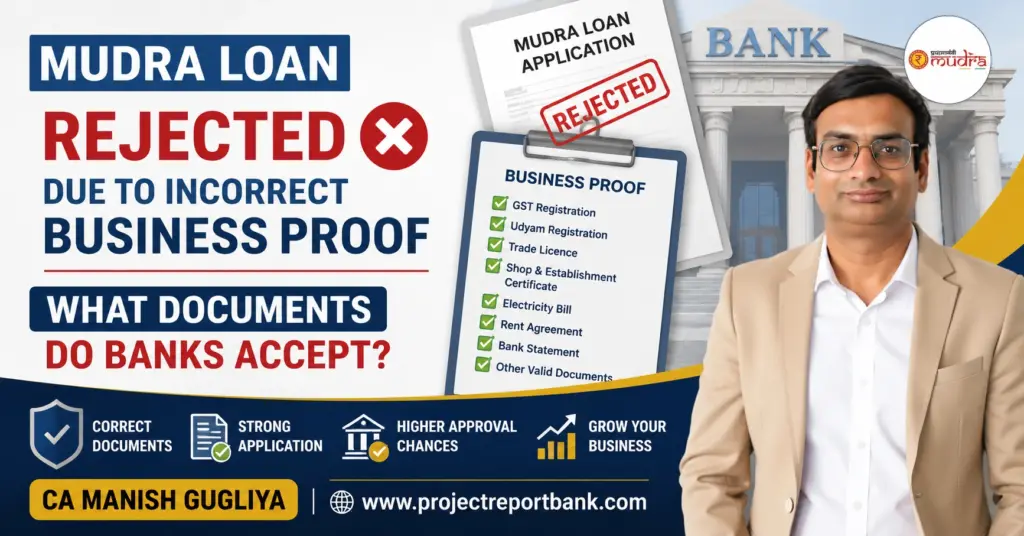
Every year, thousands of small entrepreneurs in India apply for a Mudra loan under the PM Mudra Yojana and get rejected – not because of low income, poor credit, or a weak business idea, but simply because their business proof documents were incorrect, incomplete, or mismatched. This guide explains exactly why banks reject business proof, which documents they accept, and how to fix the problem and reapply successfully.
Key Takeaways
Many Mudra loan applications – especially kishore mudra loan requests between ₹50,001 and ₹5 lakhs – are rejected only because the applicant submitted weak or wrong business proof, even when the business is genuine.
Business proof means documents that show your business exists at a particular address and is actually running. It is different from identity proof like Aadhaar or PAN.
- Use proper business registration documents such as GST registration, Udyam registration, trade licence, and shop establishment certificate as your primary proof.
- Correct all address mismatches across Aadhaar, GST, rent agreement, and licences before applying.
- Never submit fake or borrowed documents – banks verify them on government portals and through field visits.
- Even home-based, online, or new businesses can get mudra loans if they arrange acceptable alternative proofs and a proper project report.
Why Your Mudra Loan Was Rejected Due to Incorrect Business Proof
In early 2025, a kirana shop owner in Indore came to me after his ₹3.5 lakh Kishore Mudra application was rejected. His CIBIL was 720, PAN and Aadhaar were fine, and his shop had been running for three years. The bank’s rejection note simply said: “business not traceable – address mismatch – licence expired.” His rental agreement showed one address format, his shop licence (expired in 2023) showed another, and his Aadhaar showed his home address. The bank’s field officer could not confirm the business at the declared location.
This is exactly how Mudra loan rejected due to incorrect business proof situations play out. Under the PM Mudra Yojana (PMMY), which is a government of India loan scheme delivered through public sector banks, private sector banks, small finance banks, regional rural banks, and other financial institutions, the lender’s first question is always: “Is this business really running, and at this address?”
Banks evaluate the viability of the business when approving mudra loans. Many applicants lack awareness of eligibility criteria and assume that KYC documents alone are enough. They are not. Even if your CIBIL score, PAN, Aadhaar, and income are satisfactory, the bank can reject your application solely because the business proof is incorrect or suspicious.
Typical rejection remarks include “business not traceable,” “address mismatch,” “no valid business proof,” and “activity not established.”
Table of Contents
What Is Business Proof and How Is It Different from Other Documents?
Business proof is any document that shows a business exists, what activity it does, who owns or manages it (proprietorship, partnership, or company), and where it is located.
Here is the simple difference:
- Identity proof (Aadhaar, PAN, passport) = proves who the person is
- Address proof (Aadhaar, voter ID) = proves where the person lives
- Business proof (GST, Udyam, shop licence, rental agreement, utility bills in firm name, bank statement) = proves the business and its address
Mudra loans have four categories: Shishu (up to ₹50,000 for small businesses), Kishore (₹50,001 to ₹5 lakhs), Tarun (₹5 lakhs to ₹10 lakhs), and Tarun+ (₹10 lakhs to ₹20 lakhs). For a business loan under Mudra Yojana, banks mainly want proof that the business exists and proof of the business address. This is stricter for higher loan amount categories and in urban areas where municipal licences are mandatory.
For example, a beauty parlour might use a municipal trade licence plus an electricity bill in the parlour’s name. A mobile repair shop might use GST registration plus Udyam registration. These are considered strong proof.
Why Banks Reject Business Proof in Mudra Loan Applications
From the real Mudra loan files that come to ProjectReportBank.com after rejection, here are the most common reasons. Any one of these can cause a mudra loan rejected due to incorrect business proof situation:
Business address mismatch: Your Aadhaar shows a home address in one area, GST shows another, and the rent agreement mentions a third format. The field officer cannot confirm the business location. As MSMEGyan reports, “Even a small mismatch – like a different address on your Aadhaar card versus your shop’s rental agreement – can result in automatic rejection.”
Fake or borrowed documents: Submitting someone else’s GST certificate, outdated trade licence, or a rental agreement for a different shop. Incomplete or incorrect documentation can lead to rejection immediately, and these are caught during field verification.
Expired or wrong licences: A shop establishment certificate that expired in March 2024 or a licence showing a completely different business activity triggers rejection. Missing necessary documents can cause immediate rejection.
No visible business activity: Shop closed during inspection, no signboard, no stock, neighbours unaware. The field officer writes “business not found at address.”
Incorrect GST or Udyam details: GST address not updated after shifting. Udyam registration showing “manufacturing garments” while you actually run a mobile showroom. Not registering your business correctly can lead to loan rejection.
Temporary or informal location: Street-side handcart or weekly market seller without a stable point. The officer doubts continuity and writes adverse remarks.
Documents in another person’s name: Electricity bill or property tax in father’s or landlord’s name without a rent agreement or NOC connecting the applicant to the premises.
Accepted and Weak Business Proof Documents for Mudra Loan
Different banks may have slightly different internal lists, but across PSU banks and major private sector banks, the following pattern is common for Mudra loan document verification. Mudra loans require proof of business existence like Udyam registration and GST returns.
Strong / Generally Accepted Business Proof
| Document | Accepted? | Purpose | Remarks |
|---|---|---|---|
| GST Registration Certificate | Yes | Business registration + address | Verify address matches current premises |
| Udyam Registration (MSME) | Yes | Business identity + activity | Free on government portal; essential for micro units development |
| Shop & Establishment Certificate | Yes | Business address + legality | Must be current, not expired |
| Municipal Trade Licence | Yes | Business permission | Varies by city; mandatory in many urban areas |
| FSSAI Licence | Yes | Food business proof | Required for bakery, restaurant, food traders |
| Drug Licence | Yes | Medical store proof | Mandatory for pharmacy businesses |
| Factory Licence | Yes | Manufacturing unit proof | Needed for units with workers/machines |
| Professional Tax Registration | Conditional | Business existence | Accepted in states where applicable |
| Company/LLP Incorporation Certificate | Yes | Entity proof | For Pvt Ltd, OPC, LLP form businesses |
| Partnership Deed + Firm PAN | Yes | Partnership proof | Along with registration certificate |
| Business bank statement | Yes | Operational proof | Shows regular credits from customers |
| Purchase and sales bills/GST invoices | Yes | Activity proof | Providing recent invoices and bank statements can serve as evidence of ongoing business operations |
| Business electricity bill (firm name) | Yes | Address proof | Commercial meter bill preferred |
| Registered rent agreement / lease deed | Yes | Premises proof | Notarized rent agreements can serve as alternative business proof for loans |
| Property tax receipt + ownership documents | Yes | Own-premises proof | Title deed or registry copy |
| Import Export Code (IEC) | Conditional | Traders in import/export | Supporting document |
Weak / Usually Not Accepted Alone
| Document | Accepted Alone? | Why It’s Weak |
|---|---|---|
| Simple unregistered rent agreement | No | No legal validity; easy to fabricate |
| Electricity bill only in landlord’s name | No | Does not prove applicant’s business presence without NOC |
| Visiting card | No | Anyone can print a card |
| WhatsApp Business / Facebook / Instagram / Google Business Profile | No | No official registration or verification |
| Business brochure or pamphlet | No | Self-made, unverifiable |
| Self-declaration on plain paper | No | Not backed by any authority |
These weak documents can support your file as other documents but cannot replace formal business registrations, especially for loans above ₹50,000.

Special Situations: Home-Based, New, Online, Rented and Street Businesses
Many genuine micro entrepreneurs work from home, rented shops, streets, or fully online. Banks can still finance them through this scheme if documentation is planned smartly.
Home-based business: Use Udyam registration at home address, FSSAI licence for a home bakery, electricity bill of residence plus self-declaration and photos of working area and machinery. Banks may treat home-business proof strictly for manufacturing. You can learn more about Mudra loan for home business options.
Rented shop: Submit a registered or notarised rental agreement plus landlord’s NOC, latest electricity bill, and shop establishment certificate or municipal trade licence. Ensure all show the same address.
New business / startup: Banks require a business plan for new businesses to support loan applications. Apply for Udyam, take GST if required, sign a proper rental agreement, open a current account in the business’s name, and prepare a detailed project report. A detailed project report may be needed for Mudra loan applications for certain amounts, especially Kishore and Tarun. Rural applicants may struggle with digital access and form completion, so consider getting professional help.
Manufacturing unit: Factory licence, Udyam as manufacturing, electricity bill for industrial meter, machinery purchase bills, and photos of the plant serve as strong proof.
Service business: Udyam registration, shop licence, service GST if applicable, signboard photos, customer receipts, and a business bank statement work well.
Street vendor: Municipal vending licence or ID card under the Street Vendors Act, Udyam registration, photos of stall, and a stable vending point. Some banks may ask for a guarantor for additional security.
Online business: Banks look for GST registration, seller account screenshots with regular sales, courier receipts, payment gateway statements, and a business bank statement where online sales are credited. Details on Mudra loan without GST explain when GST is not mandatory.
Bank Verification Process and Common Applicant Mistakes
Even after submitting perfect paperwork, banks must verify documents before sanctioning any Mudra business loan. Processing delays can occur due to high workloads at banks, but the process typically follows these steps:
- Document verification at branch: Checking names, addresses, dates, and registration numbers for consistency across the application.
- System-based portal checks: Verifying GST registration on the GST portal, Udyam on the Udyam registry, and company details on the MCA website.
- Field visit / site inspection: A bank officer or third-party agency visits the premises, takes photographs of the shop, machines, stock, and signboard.
- Phone verification: Calling the applicant, landlord, and sometimes neighbours to confirm the business operates at the stated address.
- Activity comparison: Matching the business activity seen on-site with what the application and project report describe.
Common mistakes that lead to “business proof not satisfactory”:
- Aadhaar address not updated after shifting, causing mismatch with rental agreement and licence
- No signboard installed; shop closed during inspection; officer marks “not traceable”
- Using backdated or expired municipal licences
- Submitting fake purchase or sales bills created only for the loan – experienced officers identify these quickly
- Applying as an individual instead of a business entity can confuse documentation and raise red flags
- Weak financial credibility such as low average bank balance can lead to loan rejection even when other documents are fine
A CIBIL score below 650 may result in application denial regardless of business proof quality. If your credit score needs work, improving your CIBIL score before reapplying is essential.
How to Fix Incorrect Business Proof and Reapply Successfully
In my experience, incorrect business proof is one of the easiest rejection reasons to fix, provided you are ready to regularise your business and update documents properly. Applicants can address documentation issues by updating their records and ensuring consistency across all paperwork.
Step 1: Get a clear reason for rejection from the bank. Ask for it in writing. If denied, individuals can follow a grievance mechanism to challenge unjust loan rejections. You can also find the actual reason behind your Mudra loan rejection using the right approach.
Step 2: Identify which specific document was weak or missing – was it the rental agreement, GST, Udyam, or licence?
Step 3: Correct address mismatches. Update your Aadhaar address, revise GST place of business, and ensure all documents show the same business address.
Step 4: Apply for required business registrations – Udyam, shop establishment certificate, municipal trade licence, FSSAI – as applicable to your activity and city.
Step 5: Collect supporting evidence: recent purchase bills, sales invoices, business bank statement for at least 3–6 months, and clear photos of your shop, stock, and machinery.
Step 6: Prepare a proper, realistic project report with sales estimates, cost details, and repayment capacity. Banks often require a basic business plan for larger loans. Professional help from ProjectReportBank.com can save time and reduce trial-and-error.
Step 7: Reapply at the same bank after correcting issues, or at another bank. Carry a complete, consistent, and updated document set. A current bank account in the business’s name is advisable for loan applications.
Checklist Before Reapplying for Mudra Loan
Use this checklist before you submit your application again:
- ☐ Aadhaar and PAN name spelling checked and consistent with the application form
- ☐ Aadhaar address updated or linked to business address through rental agreement / NOC
- ☐ Udyam registration obtained, showing correct business name, activity, and address
- ☐ GST registration (if applicable) obtained or amended to current shop or unit address
- ☐ Valid shop establishment or trade licence in force, not expired
- ☐ Proper rental agreement (preferably registered) + landlord NOC + landlord ID proof
- ☐ Latest electricity bill or property tax receipt for business premises
- ☐ Business bank statement for last 6 months with visible business transactions
- ☐ 8–10 sample sales invoices and purchase bills in business name
- ☐ Clear photos of shop signboard, interior, stock, machinery, and working area
- ☐ Simple, realistic project report with investment details, projected sales, and EMI calculation
- ☐ All documents arranged in logical order in a file, with readable photocopies

Real Case Examples from My Practice
Here are three cases (names changed for privacy) that show how incorrect business proof caused rejection and how it was solved.
Example 1 – Rented Garment Shop, Indore (2024): A Kishore Mudra loan of ₹4 lakh was rejected because the rental agreement was on plain paper from 2021, the shop establishment certificate had never been renewed, and the field officer wrote “licence expired – business not regularised.” The solution: we got a registered rental agreement, renewed the shop licence, and updated Udyam with the correct address. The bank approved ₹3.5 lakh on reapplication.
Example 2 – Home Bakery, Jaipur (2025): The applicant ran a home bakery with only an Instagram page and a visiting card. The bank rejected it saying “no business proof,” despite a good CIBIL score and savings balance. Incomplete documentation can lead to immediate rejection regardless of other factors. We obtained FSSAI registration, Udyam registration at her home address, opened a current account, and maintained 3 months of regular online orders and bank credits. Another bank sanctioned a ₹2 lakh Mudra loan.
Example 3 – Startup Mobile Repair Shop, Bhopal (2023): The GST registration showed an old address, Aadhaar had a village address, and the new city shop had only a board and cash sales. The bank field visit failed and the loan was rejected. We amended GST to the new shop address, took a notarised rental agreement plus landlord NOC, opened a current account, and collected 4 months of sales bills. On the second attempt, a Mudra Yojana loan of Rs 1.8 lakh was approved. If your application was rejected after site inspection, these steps apply directly.
Expert Tips from CA Manish Gugliya to Avoid Business-Proof Rejection
Based on 20+ years of handling MSME and Mudra loan files across different banks, here are my practical tips:
- Keep the same business name and address across Udyam, GST, bank account, and all licences.
- Do not apply immediately after shifting premises – first update every registration, then apply.
- For Kishore and Tarun categories, avoid using residence-only proof for a commercial shop unless the business genuinely runs from home.
- Never submit fake rental agreements or borrowed GST numbers. Banks verify these on portals and through field visits.
- Install a clear, permanent signboard with the business name before the field inspection.
- Maintain at least 2–3 months of visible business transactions in your bank account before applying.
- Keep all registrations (GST, shop licence, FSSAI) renewed at least one month before expiry.
- If your business is seasonal, mention it in the project report so off-season low activity does not alarm the banker.
- For online businesses, route all marketplace payments to one business bank account to create a clean trail.
- Carry originals of all licences and registrations on the day you visit the bank to build the officer’s confidence.
- If one bank is rigid about a particular proof, try another PSU or private sector bank – but never compromise on genuineness.
- Banks assess eligible borrowers across multiple parameters; ensure your documents help, not hurt.
- A low CIBIL score below 650 may result in rejection, so check your score before applying. Consider checking for CIBIL report errors that could be dragging your score down.
- Prepare for the bank interview – know your business numbers, past turnover, and growth plans.
- Remember that Mudra is a refinance agency – the lending bank makes the final call, not the government.
- Individuals who have been rejected should not panic. Understand the process, fix the gaps, and reapply with confidence.
Professional documentation and a solid project report often make the difference between repeated rejection and smooth approval.
Frequently Asked Questions on Business Proof for Mudra Loan
These are common queries from entrepreneurs who approach ProjectReportBank.com after their Mudra loan was rejected due to business proof issues.
Can I get a Mudra loan without GST registration?
Yes, GST is not mandatory for Shishu loans up to ₹50,000 and for businesses below the GST threshold. However, having GST strengthens your application, especially for Kishore and Tarun categories.
Is Udyam registration compulsory for Mudra Yojana?
Udyam registration is strongly recommended and most banks now treat it as near-mandatory. It is free on the government portal and serves as powerful business proof for micro and small units.
Can a simple rent agreement and electricity bill work as business address proof?
A simple unregistered rental agreement alone is weak. A registered or notarised agreement plus an electricity bill in the business or shop name, along with the landlord’s NOC, is accepted by most banks.
I run a home-based business. What can I show as business proof?
Use Udyam registration at your home address, FSSAI or other relevant licence, photos of your work area, business bank statement showing regular customer payments, and online order records if applicable.
Can online businesses get Mudra loan approval?
Yes. Submit GST registration, marketplace seller dashboard screenshots showing sales, payment gateway or courier statements, and a business bank statement where sales credits are visible.
Can I use my father’s or spouse’s property documents as business proof?
Only if supported by a proper rent agreement or NOC from the property owner, plus utility bills showing business usage. Property ownership documents alone in another person’s name do not prove your business.
My business is new and I have no sales yet. How can I convince the bank?
Get Udyam registration, sign a rental agreement, open a current account, prepare a realistic project report with cost and revenue projections, and collect pro-forma invoices for planned machinery or stock. Banks require a business plan for new businesses.
What if my business address is different from my Aadhaar address?
This is very common and acceptable – but you must bridge the gap with a proper rental agreement, shop licence, or utility bill at the business address. The mismatch itself is not the problem; lack of supporting documents is.
Is field inspection compulsory in every Mudra loan case?
Banks typically conduct field verification for Kishore and Tarun loans. For Shishu loans, it may be less rigorous, but banks retain the right to verify any application at any stage.
Can I reapply after my Mudra loan was rejected?
Absolutely. There is no rule preventing reapplication. Correct the specific documents that caused rejection, and you can reapply at the same bank or a different lender. There is no mandatory waiting period for Mudra loans.
Do all banks accept the same business documents?
Not exactly. While RBI and PMMY guidelines set a base, each bank – whether PSU, private sector banks, small finance banks, or regional rural banks – may have slightly different internal requirements. Always check with the specific branch.
Can a street vendor or hawker get Mudra loan?
Yes. Use a municipal vending licence or ID card under the Street Vendors Act, Udyam registration, photos of your stall, and a bank statement. Shishu loans up to ₹50,000 are particularly suited for street vendors and traders.
Why did my friend get a Mudra loan only with Udyam, but my bank asks for more?
Bank-level policies differ. Interest rates, documentation strictness, and lending preferences vary across financial institutions. One bank may accept Udyam alone for Shishu; another may want additional licences for Kishore. If your bank is rigid, try another lender.
How long does it take to correct business proof and reapply?
Typically, updating GST address takes 7–15 days, Udyam registration is instant, shop establishment renewal takes 1–4 weeks depending on the city, and a registered rental agreement can be done in a day. Most applicants can reapply within 3–6 weeks.
How can ProjectReportBank.com help if my Mudra loan was rejected?
We prepare professional Mudra loan project reports, CMA data, financial projections, and provide guidance on correct MSME documentation and business proof. We help you build a complete, bank-ready file – though the final approval decision always rests with the bank.
Conclusion and Call to Action
Incorrect or weak business proof is one of the most frequent yet easily correctable reasons for Mudra loan rejection. Once your business is properly documented – with Udyam registration, GST, valid licences, a proper rental agreement, and a clean bank statement – your chances of approval for Shishu, Kishore, or Tarun Mudra loans improve significantly.
Even if your application was rejected once or twice, you can still succeed. Correct your documents, prepare a realistic project report, and present a clean, consistent file to the bank.
If you need help, reach out to ProjectReportBank.com for professionally prepared Mudra loan project reports, CMA data, and documentation guidance. We help entrepreneurs expand their funding options with the right paperwork – while being clear that no one can guarantee loan approval and the final decision always rests with the bank.
- Mudra Loan Rejection Reasons: Complete Guide to Why Banks Reject Applications


- Mudra Loan Documentation Issues: Complete Guide to Avoid Document-Related Loan Rejections

- Mudra Loan CIBIL Issues, Rejection Reasons & Solutions (2026) – Complete Guide

- How to Prepare a Perfect Mudra Loan Document File Before Visiting the Bank 2026

- Mudra Loan Rejected Due to Signature Mismatch – Practical Guide 2026 by CA Manish Gugliya

- Mudra Loan Rejected Due to Missing Udyam Registration – Complete 2026 Guide by CA Manish Gugliya
- Mudra Loan Rejected Due to Invalid or Old Bank Statements – What Banks Expect (Explained by CA Manish Gugliya) 2026

- Mudra Loan KYC Documents: Complete Checklist to Avoid Rejection 2026

- Mudra Loan Rejected Due to Address Proof Issues – Complete Guide 2026 by CA Manish Gugliya

- Mudra Loan Rejected Due to Incorrect Business Proof – What Documents Do Banks Accept? 2026

- Mudra Loan Rejected Due to PAN and Aadhaar Name Mismatch – Practical Fix by CA Manish Gugliya

- How to Improve Your CIBIL Score Before Reapplying for a Mudra Loan (2026 Complete Guide)

- Mudra Loan Rejected Due to Poor Credit History Despite No Current Defaults – Complete Guide 2026 by CA Manish Gugliya

- Mudra Loan Rejected Because of Multiple Loan Enquiries – Does It Really Matter? 2026

- Mudra Loan Rejected Due to CIBIL Report Errors – Detailed Correction Guide 2026 by CA Manish Gugliya