Key Takeaways
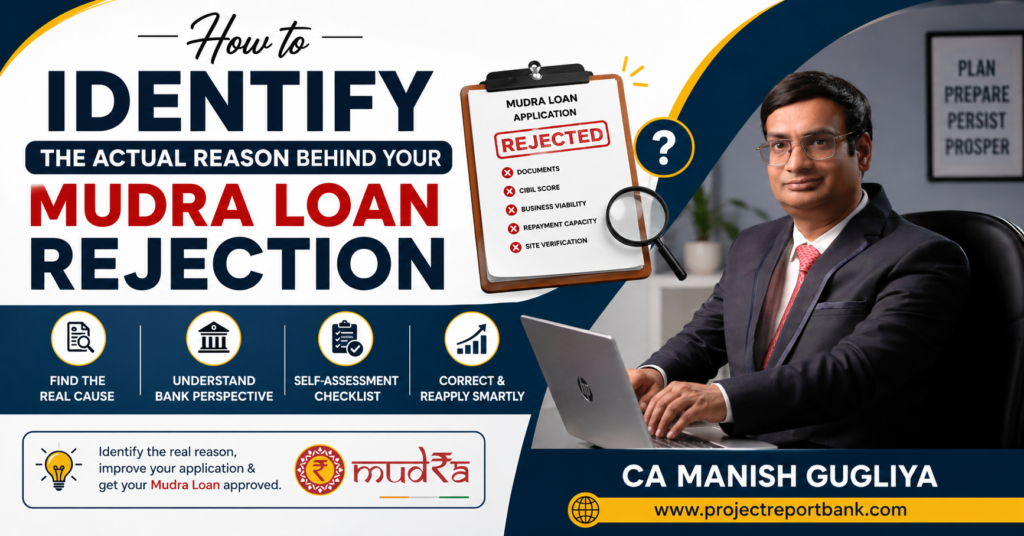
- The bank’s written rejection reason is often a generic label like “application not found suitable.” The real internal reason is usually different and more specific.
- To identify the actual cause, you must review your full loan application file, cibil report, income, existing EMIs, submitted documents, business plan, and recall the interview and site inspection experience.
- Multiple small weaknesses – a slightly low credit score, a weak business plan, missing business proof, thin bank statements – usually combine to trigger mudra loan rejection, not just one single issue.
- Once you identify the real reason, you can correct it (fix documents, improve CIBIL, revise the project report, match eligibility criteria) and reapply with genuine confidence instead of randomly trying different banks.
Introduction: Why Finding the Real Mudra Loan Rejection Reason Matters
You submit your mudra loan application, wait for weeks, and then receive a short SMS: “Your application is not found suitable.” No explanation. No next steps.
This is how many applicants experience loan rejection. But simply reapplying to another bank with the same mistakes – same cibil score, same documents, same business plan – almost always leads to the same result.
A mudra loan is a government backed collateral-free business loan under PMMY, available up to ₹10 lakh across four categories. But loan approval is never automatic. In my experience as CA Manish Gugliya, banks evaluate multiple risk factors before deciding: credit history, income, business viability, current account behaviour, and document quality.
This article gives you a practical, step-by-step method to identify the true rejection reason before you reapply.
Table of Contents
Why Banks Usually Do Not Mention the Exact Mudra Loan Rejection Reason
Most banks write only generic remarks in the mudra loan rejection letter – phrases like “does not meet internal criteria” or “profile not suitable.” Here is why:
- Banks use in-house scoring models, risk grades, and credit committee notes. These are proprietary and confidential. Staff often lack authority to share the detailed scorecard.
- Multiple risk factors (borderline cibil score, low income, weak business activity, existing EMIs) may all contribute. It is difficult for a single rejection message to capture every issue.
- Under RBI guidelines, banks must provide a written statement explaining why a loan was denied, following the Fair Practices Code. However, they are not required to disclose the full internal risk model.
Common reasons for loan rejection include missing documents and poor credit history, but the written reason rarely tells the whole story. Two applicants may both receive “not eligible as per policy,” yet one is rejected for recent defaults while the other applied for a business activity not covered under PMMY.
Official Reason vs Actual Reason: How They Differ in Mudra Loan Rejections
The “official reason” is what the bank writes or tells you at the counter. The “actual reason” is what appears in the internal file notes when the credit officer records the decision. The rejection reason can often include issues with business viability or clarification of loan utilization that the bank never communicates clearly.
Consider these contrasts:
- Official: “Insufficient documents” → Actual: Business bank statements show very low turnover and frequent cash withdrawals.
- Official: “CIBIL not satisfactory” → Actual: Two earlier credit card settlements plus multiple recent hard enquiries applying for other loans.
- Official: “Profile not suitable” → Actual: New business with no proof of operations, projected income unrealistic, and local competition too high.
In one case from my practice, a trader’s rejection letter said only “profile not suitable.” But the internal file noted: business was only 2 months old, the project report claimed revenue that did not exist yet, and the proposed business faced heavy local competition. The bank simply chose a mild phrase to avoid confrontation.
Learn to read between the lines of generic reasons before reapplying.
Step-by-Step Process to Identify the Real Reason Behind Your Mudra Loan Rejection
Follow this ordered checklist at home before visiting the bank again.
Review Your Loan Application
Obtain a copy of your filled mudra loan form. Check for incorrect information – age, business vintage, loan amount breakup, purpose, business activity code. Even small mismatches with your documents can cause problems. Mistakes in KYC documents can lead to immediate rejection of loan applications.
Review Your Submitted Documents
Verify that your KYC, business proof, quotations, rental agreement, and photos all match each other in name, address, firm name, and line of business. Incomplete or mismatched documents cause most mudra loan rejections. Mudra loan applications require PAN, Aadhaar, and business proof at minimum.
Check Your CIBIL Report
Download your latest credit report. CIBIL scores range from 300 to 900, reflecting credit behavior. A cibil score below 650 may lead to rejection, while banks prefer applicants with a CIBIL score above 700. Look for write-off or settled status, overdue EMIs, late payments, and multiple hard enquiries in the last 3-6 months. Low credit scores indicate high risk of default to lenders. A defaulted loan can remain on your cibil report for 7 years.
Analyse Your Income and Bank Statements
Check monthly credits in your savings or current account. Look at cash deposits, cheque bounces, and transaction history. A high debt-to-income ratio can indicate low repayment capacity and lead to rejection. If your proposed EMI would exceed 50-55% of your average monthly income, most banks will decline.
Evaluate Existing Loans
List all current EMIs – personal loan, two-wheeler loan, credit card minimum payments, informal microfinance. Compare total outgo with your declared monthly income. Even a secured loans portfolio that looks manageable can push your repayment capacity below acceptable levels when combined with a new mudra loan EMI.
Review Your Business Plan and Project Report
Banks require evidence of a running business or a solid project report for loan applications. A basic business plan is mandatory for kishore and tarun loans. Check if projections are realistic, costs are justified, and the business activity matches Mudra’s non-farm criteria. A credible business project report is required, especially for higher loan categories like Tarun.
Recall the Bank Interview
Write down the exact questions the branch managers asked about experience, business location, customers, and own contribution. If the officer seemed unconvinced or kept cross-questioning on a particular topic, that area was likely the concern. If your loan was rejected after the interview, the answers you gave likely mattered more than your documents.
Review Site Inspection Feedback
If the bank visited your shop or unit and rejected soon after the site inspection, the issue may be weak location, low stock, no real business activity, or a mismatch between what you declared and what they found.
Compare With Bank Eligibility Norms
Check official PMMY or bank branch websites to confirm your chosen category (Shishu, Kishore, Tarun) and loan amount fit your business age and turnover. Banks require proof of ongoing business operations for loan approval.
Common Signs That Reveal the Real Mudra Loan Rejection Reason
The bank’s behaviour during processing often reveals what went wrong before the formal rejection arrives.
- Frequent requests for additional documents: When a bank keeps asking for extra bank statements, GST returns, or income proofs, the real doubt is usually about income or business continuity – not just KYC. If a bank keeps asking for new documents, pay attention to what they are asking for.
- Rejection after field verification: If your application moved smoothly until a site visit, then stalled, the concern is typically business viability, local competition, or mismatch between your declared set-up and reality.
- Questions focused heavily on repayment: If the branch manager spent most of the interview asking about monthly income, household expenses, and existing EMIs, the main worry was repayment capacity, not your documents.
- Questions around experience and business knowledge: Repeated questions like “have you done this business before?” signal concern about lack of experience or a weak business plan. Self employed applicants without relevant experience face extra scrutiny.
- Long delay without clear reason: If the loan remains under process for more than 30 days, it may indicate internal credit committee discomfort or multiple marginal risk factors that no single officer wants to reject outright.
Create Your Own Mudra Loan Rejection Self-Assessment Checklist
Use this as a do-it-yourself diagnostic tool. Print it, tick each item, and identify your gaps.
| Category | Check Item | Status |
|---|---|---|
| Identity & Address | Aadhaar, PAN, voter ID – names, dates, and addresses match across all documents. No different address between ID and business address proof. | ✓ / ✗ |
| Business Proof | Udyam Registration, GST (if applicable), shop licence, partnership deed, invoices showing current business activity. Register your business on the Udyam portal for credibility. | ✓ / ✗ |
| Financial Documents | Last 6-12 months bank statements (savings and current account), ITRs if filed, basic profit & loss statement. | ✓ / ✗ |
| Own Contribution | Evidence of margin money – cash in bank, FD, capital introduced. Quotations clearly justify how the loan amount will be used. | ✓ / ✗ |
| CIBIL & Previous Loans | No overdue EMIs, write-offs, or settlements. All earlier Mudra or other category loans closed properly. A CIBIL score above 700 significantly improves approval chances. | ✓ / ✗ |
| Business Viability | Market demand exists, local competition is manageable, location is accessible, expected monthly sales and profit margin are realistic. | ✓ / ✗ |
| Applicant Profile | Age, education, prior business history or job experience in same line, family support. Banks prefer applicants who understand their business thoroughly. | ✓ / ✗ |
Ensure all documents are complete and correctly matched. If several boxes remain “No” or “Not Available,” fix them before submitting another mudra loan application.
Hidden Mudra Loan Rejection Reasons Banks Rarely Mention
Even when documents and CIBIL look acceptable, banks may still reject based on factors they do not politely share.
- Weak or non-viable business model: Projected sales are unrealistic for a small shop, product margins are razor-thin, or the town already has dozens of players. Banks internally mark such projects as non-viable.
- Inconsistent or inflated information: Claimed turnover of ₹50 lakh while bank credits show ₹5-7 lakh per year destroys trust instantly. Lenders prefer consistency across application, interview, and bank statements.
- Poor banking behaviour: Frequent cash deposits followed by immediate withdrawals, cheque bounces, or using a salary account for business transactions are red flags for financial discipline.
- Existing overdue or restructured loans: Even if you are currently paying EMIs, any previous loan with restructuring or settlement history can push your risk rating below the bank’s internal standards. Lack of proof of business operations can also result in standalone rejection.
- Lack of owner commitment: Wanting to keep a full-time job while running a new business part-time with borrowed money is perceived as low commitment and higher failure risk by most banks.
Mistakes Applicants Commonly Make That Hide the Real Problem
Many applicants focus on one missing document and never notice deeper issues.
- Assuming documents are the only issue: Even a perfect file with Aadhaar, PAN, photos, and quotations gets declined if business viability or repayment capacity is weak.
- Ignoring CIBIL and previous defaults: Some applicants never check their credit report, or assume small credit card settlements will be overlooked in a government scheme. Banks reject mudra applications for these reasons routinely.
- Copy-paste project reports: Banks easily recognise generic, unrealistic project reports downloaded from the internet. Not having a clear business plan is a common rejection reason. A simple business plan with real numbers beats a polished template with fake projections.
- Giving different information in different places: Stating one income in the application, another during the interview, and a third in your ITR is a serious warning signal.
- Applying for the wrong category or loan amount: New businesses often jump directly to tarun loans without turnover history. Applying for an unjustified loan amount leads to rejection even when small shishu loans or kishore and tarun loans at smaller amounts would have been approved. Create a solid business plan for Kishore and Tarun loans.
- Applying to a bank branch with no interest in MSME: Certain branches or lender offices prefer big-ticket secured loans. Regional rural banks and non banking financial companies sometimes process mudra applications more efficiently. Even trying HDFC Bank or Canara Bank may yield different results depending on the branch.
How to Confirm the Real Reason and What to Do After You Find It
After your self-analysis, confirm your understanding with the bank and create a correction plan.
Speaking with the branch manager: Use specific, polite language: “Sir, my Mudra loan was rejected. I want to improve and reapply later. Could you tell me which areas were weak – CIBIL, income, business plan, or documents?” If an application is rejected, the applicant can request a grievance redressal through the bank’s formal channels.
Reviewing your file together: Take your cibil report, bank statements, and project report to the bank and ask whether your understanding of the weakness matches theirs.
Creating an action plan based on the reason:
- If documents: collect missing proofs, update KYC, register Udyam, correct mismatched documents.
- If CIBIL: clear overdues, avoid multiple applications and new hard enquiries, wait 3-6 months. Improving documentation and credit profile can increase chances of loan approval in the future.
- If business viability: revise the project report with realistic projections, stronger market data, and a clear repayment plan.
Follow up weekly after submitting your loan application to stay informed of progress. For complex cases involving multiple risks or repeated rejections, working with an experienced CA for project report preparation and CMA data can significantly strengthen the next application.
Do not rush to apply online or visit the same bank or a different bank until you have fixed the underlying issue.

FAQs: Practical Questions on Finding the Real Mudra Loan Rejection Reason
Below are focused questions that come up frequently in day-to-day client discussions about mudra loan rejection.
Can the bank tell me the exact internal reason for my Mudra loan rejection?
Banks usually share only broad reasons – CIBIL, income, documents, or business viability. Banks must provide a written statement explaining why a loan was denied under RBI guidelines, but they will not disclose their full internal scorecard. You can ask the bank branch in writing or via email for “broad reasons for rejection” and keep the reply safely for planning your next application. This is your right, and most banks will cooperate when asked politely.
Should I apply to another bank immediately after my Mudra loan was rejected?
No. Rushing to a new bank without correcting the underlying problem is one of the biggest mistakes. Every fresh application adds a hard enquiry to your CIBIL, and the same weaknesses – low score, low income, weak project – follow you. Finish the full self-assessment first, fix what needs fixing, and only then consider applying to another bank or the same bank after 3-6 months. Small business owners who apply to many lenders in panic often damage their credit further.
My CIBIL score is good; can my Mudra loan still be rejected?
Yes. Even with a score above 700, a mudra loan approved status is not guaranteed. Banks also check repayment capacity, business viability, consistency of information, business proof, and banking behaviour. If your clear business plan is missing, your business activity is not eligible under PMMY, or your current account shows unstable money flow, the loan can still be declined. CIBIL is only one factor in loan approval.
What if my Mudra loan was rejected after site inspection or interview?
Post-inspection or post-interview rejection usually points to doubts about real business activity, stock levels, location quality, or the applicant’s understanding of the business. If you face this, revisit your proposed location, improve your business set-up, prepare better answers about customers and competition, and consider revising your project report before reapplying. Your business history and commitment matter as much as paperwork.
Should I prepare a new project report before reapplying for a Mudra loan?
If your earlier project report was generic, copy-pasted, or clearly unrealistic, preparing a fresh, customised report is essential. It should include an accurate cost breakup, realistic sales projections, and a clear repayment schedule matched to your eligibility criteria. Working with an experienced CA like CA Manish Gugliya to prepare a bank-oriented project report and CMA data can significantly improve how your next mudra loan application is evaluated by the lender.
Conclusion: Use the Rejection as a Tool to Build a Stronger Mudra Loan Application
Understanding the actual reason behind a mudra loan rejection is far more valuable than quickly trying another bank with the same weak profile. By carefully reviewing your loan application, documents, income, CIBIL, business plan, and interview performance, you can usually pinpoint and correct the real weaknesses.
No professional can guarantee mudra loan approval. But high-quality project reports, realistic financial projections, clean documentation, and a credible business plan significantly improve the odds. The rejection itself is data – use it.
If you need professional help with Mudra loan project reports, CMA data preparation, business plans, financial projections, or MSME loan documentation, consult CA Manish Gugliya through Project Report Bank to build a stronger, more credible application for your next attempt.
- Roller Flour Mill Setup Cost in India: Professional Investment & Project Cost Guide


- Poha, Puffed Rice & Value-Added Rice Products Project Report & Processing Opportunities

- Integrated Value-Added Rice Products Processing Plant Project Report & DPR

- Integrated Rice Plant Bank Loan, Feasibility, ROI, IRR, Payback & Sensitivity Analysis

- Integrated Rice Processing Plant Financial Projections, Working Capital & DSCR

- Integrated Rice Products Revenue Model, Market Strategy & Profitability

- Integrated Value-Added Rice Plant Project Cost & Means of Finance

- Raw Material Procurement & Inventory Planning for Integrated Value-Added Rice Plant

- Common Utilities, Warehousing, Packaging & Material Handling for Integrated Rice Plant

- Integrated Rice Processing Plant Land, Building & Multi-Line Plant Layout – A Practical Guide for DPR & Bank Finance

- Integrated Rice Processing Plant Capacity Planning & Product Mix

- Integrated Value-Added Rice Plant Machinery & Equipment Cost – A Practical DPR-Oriented Guide

- Integrated Poha, Puffed Rice & Rice Snacks Manufacturing Process & Line Integration

- Instant Poha Manufacturing Plant Project Report & DPR – Bankable Guide by Project Report Bank

- Ready-to-Cook Rice Breakfast Mixes Manufacturing: Products, Process & Plant Setup