Key Takeaways
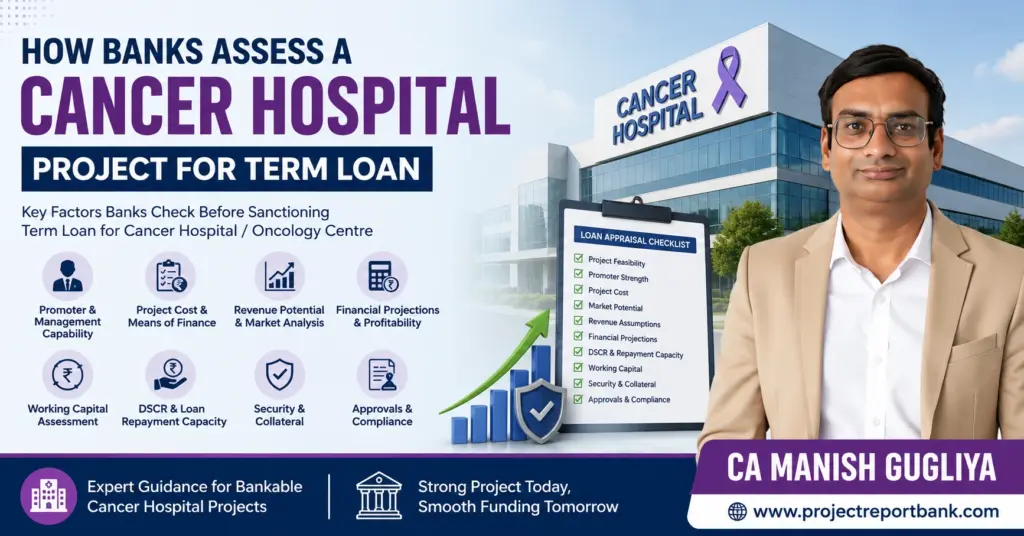
- Banks evaluate a cancer hospital term loan assessment as a combination of promoter strength, technical feasibility, market demand, realistic project cost and cash-flow-based repayment capacity – not just collateral value.
- Lenders examine the complete cancer hospital project loan appraisal across clinical, financial, market and regulatory dimensions before sanctioning a bank loan for cancer hospital projects.
- A robust DPR with integrated financial projections, conservative ramp-up assumptions and a sustainable DSCR profile carries more weight than aggressive profitability numbers on paper.
- Promoter contribution, a balanced debt-equity structure, and repayment schedules aligned to hospital cash flows are central to cancer hospital project finance decisions.
- This article is written from CA Manish Gugliya’s credit-appraisal perspective and is India-focused, helping promoters prepare bankable proposals for oncology centres.
Explore Cancer Hospital DPR Guides
Explore our complete series on Cancer Hospital project planning, financial analysis and bank finance.
Introduction – Why Cancer Hospital Loan Appraisal Is Different
A cancer hospital is not a standard healthcare facility. It requires substantial capital across land, building, radiotherapy bunkers, LINACs, chemotherapy day-care units, surgical oncology OTs, advanced diagnostics and ICU infrastructure. The investment profile, regulatory complexity and revenue dynamics of an oncology centre are fundamentally different from a general hospital or a chain of clinics. Cancer hospitals have unique operational and financial profiles compared to general hospitals, and lenders recognise this distinction clearly.
This is precisely why a bank loan for cancer hospital cannot be approached like a routine medical loan or personal loan. While medical loans can cover unexpected medical expenses in a medical emergency, offering quick access to funds, quick approval, flexible tenure, and support for patients who cannot afford the full cost upfront, and personal loans for medical emergencies may go up to ₹5 lakhs with no collateral required, instant approval and disbursal within 24-48 hours, a cancer hospital term loan is an entirely different category. Healthcare project finance relies on future cash flow for repayment, involves detailed appraisal over months, and demands comprehensive documentation of project viability.
Banks treat oncology project finance as a long-tenure infrastructure-style decision. They focus on technical feasibility, commercial viability, promoter capability and term loan repayment capacity derived from projected hospital cash flows. This article walks through how Indian banks and financial institutions generally appraise a cancer hospital project, and how a properly prepared DPR and financial model can support faster, more favourable decisions.
What Banks Examine in a Cancer Hospital Term Loan Proposal – Eligibility Criteria Overview
Before diving into individual appraisal components, here is a consolidated view of what lenders typically examine during a cancer hospital project loan appraisal. Lenders evaluate term loan applications from cancer hospitals using certain clinical, financial, and market parameters.
| Appraisal Area | What the Bank Generally Examines |
|---|---|
| Promoter & Management | Oncology experience, net worth, credit history, past banking track record |
| Project Scope | Hospital configuration, bed count, service lines, phasing |
| Project Cost | Reasonableness of total cost vs benchmarks, component-wise breakup |
| Means of Finance | Debt-equity split, source of promoter contribution, subsidy if any |
| Technology & Equipment | LINAC, diagnostics, vendor quotations, useful life vs loan tenure |
| Location & Market | Catchment population, cancer incidence, competition, accessibility |
| Revenue Model | Capacity × utilisation × volumes × tariff, ramp-up assumptions |
| Profitability | EBITDA margins, net margins, trend over projection period |
| Cash Flow | Year-wise cash accrual, peak funding gap, liquidity buffers |
| DSCR | Year-wise and average debt service coverage ratio |
| Working Capital | Drug inventory, TPA receivables, salary overheads, operating cycle |
| Security & Collateral | Charge over assets, additional collateral, guarantees |
| Regulatory Compliance | Hospital registration, AERB approvals, biomedical waste, fire safety |
| Risk & Sensitivity | Downside scenarios, break-even, occupancy stress, cost escalation |
The rest of this article unpacks these appraisal areas one by one. Each section explains what the bank checks, why it matters for your cancer hospital loan eligibility, who may be eligible, and the likely loan amount.
Promoter and Management Assessment
For any cancer hospital bank finance proposal, lenders usually look first at who is behind the project before evaluating the project itself. An oncology hospital loan proposal is stronger with experienced promoters and secured collateral backing the application.
Banks evaluate promoter background across several dimensions:
- Healthcare experience: Years of operating hospitals, diagnostic centres or specialist services. Direct oncology exposure adds significant comfort.
- Clinical team: Presence of qualified radiation oncologists, surgical oncologists and medical oncologists. The presence of certified oncologists reduces operational risk in cancer hospitals. Banks also assess lenders’ key-person risk related to medical staff retention in oncology facilities – whether critical doctors are on full-time contracts or only visiting arrangements.
- Management depth: A professional CFO, hospital administrator and project manager alongside doctor-promoters signals operational maturity.
- Financial strength: Promoter net worth, liquidity, existing borrowings, tax compliance, credit history and age. Banks routinely check CIBIL scores, review bank statements and look at income stability to verify the ability to bring in proposed equity and service debt.
Consider a practical example: a 150-bed cancer hospital proposed in a Tier-2 city like Lucknow, led by two experienced oncologists who have run a 30-bed day-care centre for eight years. They bring a professional CFO and a project management company on board. From the bank’s lens, this is a strong promoter profile – clinical expertise combined with financial and operational management.
Even a technically sound oncology project can face delays in sanction if promoters have weak financials, poor credit discipline, opaque ownership or inability to evidence their equity sources.
Assessment of Cancer Hospital Project Cost
Banks benchmark total project cost against similar oncology projects and internal norms. A solid project plan includes a detailed assessment of project costs and promoter equity, and lenders will question both understated and inflated figures.
The DPR must clearly show these cost heads:
- Land (with purchase date and current valuation)
- Site development and civil construction (OPD, IPD, ICU, OT, radiotherapy bunkers)
- Interiors, HVAC, electrical systems, medical gas
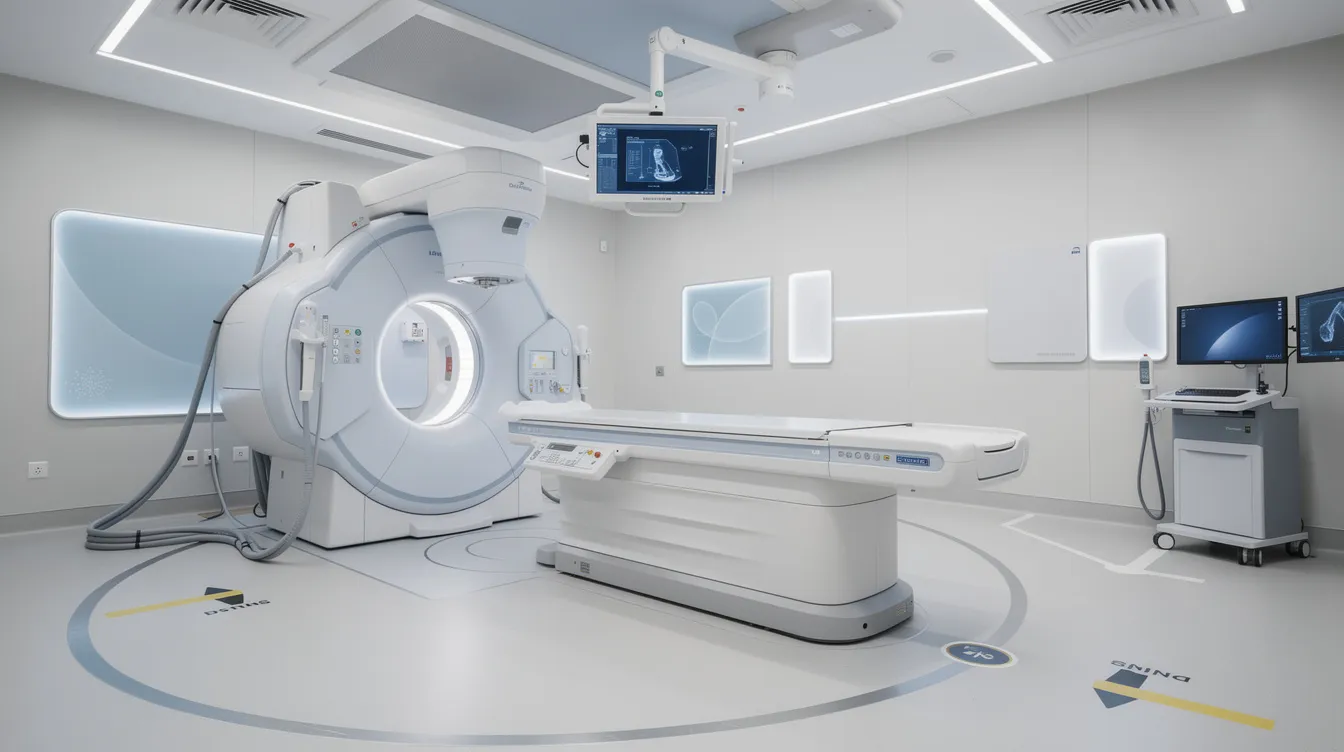
- LINAC and radiotherapy equipment
- Chemo day-care and surgical oncology setup
- Imaging and diagnostics (CT, MRI, PET-CT)
- Furniture, IT/HMIS infrastructure
- Pre-operative expenses, contingencies
- Interest during construction (IDC)
For context, a 120-bed cancer hospital DPR estimated total project cost at approximately ₹54.44 crore, including land and building at ₹28.07 crore and machinery at ₹22.42 crore. Larger oncology centres with advanced radiotherapy can run into ₹150–500 crore depending on scale and location. These figures are indicative – for detailed breakup guidance, refer to Cancer Hospital Project Cost in India.
Banks also check phasing of project cost over the construction period and ensure that proposed term loan disbursement and promoter equity infusion align proportionately.
A sample percentage split for a mid-sized oncology project might look like:
| Component | Approximate Share |
|---|---|
| Civil Construction | 30–35% |
| Medical & Radiotherapy Equipment | 35–45% |
| Interiors & Utilities | 8–12% |
| IT, Furniture & Others | 3–5% |
| IDC & Contingencies | 8–12% |
This is illustrative, not a universal template. Each project’s split will differ based on land cost, equipment configuration and city.
Equipment Cost and Technology Assessment
In oncology hospitals, equipment and technology often form 40–60% of total project cost. Evaluation of high-value oncology equipment is critical for lenders, and this component receives detailed scrutiny.
Banks expect to see itemised budgets for:
- Radiotherapy systems (LINAC, CT simulator, treatment planning system)
- Chemotherapy chairs and infusion pumps
- Surgical oncology OT equipment
- Imaging (CT, MRI, PET-CT)
- Pathology and histopathology labs
- ICU, HDU and general hospital devices
Lenders check whether vendor quotations are current, include installation and bunker-shielding costs, account for customs and GST on imported machines, and specify warranty and AMC terms. Projected equipment utilization and ROI are important for financing in oncology – a LINAC costing ₹22–30 crore must be justified by adequate patient volumes and radiotherapy fractions. A Salem Government Hospital example shows LINAC acquisition at ₹22.96 crore and a brachytherapy unit at ₹4 crore, illustrating realistic equipment costs.
Banks may also question specification mismatches – installing a high-end imported LINAC for a catchment that can only support 20 fractions per day raises questions about whether the investment will generate adequate returns.
For detailed equipment selection and budgeting, refer to Cancer Hospital Equipment List & Cost.
Means of Finance and Promoter Contribution
For any cancer hospital project finance structure, banks place strong emphasis on a balanced means of finance statement – how the total project cost is split between promoter funds, term loans, equipment finance and other permissible sources.
Typical components include:
- Equity capital from promoters
- Unsecured loans from promoters/directors (subject to subordination)
- Bank term loan for building and core infrastructure
- Separate equipment finance where applicable
- State or central subsidies, if genuinely available
- Margin for working capital
The debt-equity ratio is a practical indicator of leverage. While many hospital project guides reference a 70:30 debt-equity split, acceptable leverage varies by lender, project risk and promoter strength. Riskier projects – say in remote locations or with first-time promoters – may require 40–50% equity. Repayment tenure for healthcare project financing typically ranges from 5 to 15 years, with some banks like IOB offering up to 15 years including moratorium, though the maximum tenure permitted will depend on the lender’s scheme, loan size and eligibility norms.
Banks ask for clear evidence of promoter contribution – past savings, asset liquidation, internal accruals from existing business – and analyse bank statements to confirm equity is being deployed proportionately with loan disbursement. For structuring guidance, see Cancer Hospital Project Cost & Means of Finance.
Location and Market Potential Assessment
Lenders test whether the catchment area can generate the patient volumes and revenue needed to service the oncology hospital term loan. Demographic demand assessments are crucial for cancer hospital financing, and banks go well beyond population statistics.
The DPR should address:
- District-wise catchment population
- Regional cancer incidence trends
- Current availability of radiotherapy and chemo facilities
- Distance to nearest tertiary cancer centres (government and private)
- Road, rail and airport connectivity for outstation patients
- Payor profile: self-paying, insured/TPA, government scheme beneficiaries
Lenders evaluate patient volume projections using local cancer incidence rates and compare them against installed capacity. A balanced payer mix – combining self-pay patients, insurance customers and government scheme beneficiaries – reduces the risk of delayed reimbursements for cancer hospitals.
Banks also assess referral strategy: tie-ups with district hospitals, diagnostic centres, individual practitioners, NGOs and cancer foundations. The DPR should convert market data into realistic daily OPD visits, bed-occupancy rates, radiotherapy fractions and chemotherapy cycles that can be cross-checked against installed capacity.
Consider the contrast: a 120-bed oncology centre in Jaipur with multiple competitors and strong insurance penetration versus a 60-bed centre in a smaller Rajasthan district with no existing cancer facility. Banks view market depth, competition and pricing power very differently in each case.
Cancer Hospital Revenue Model – How Banks View It
For lender appraisal, the revenue model must translate capacity into realistic volumes and average realisations. Patient volume stability and referral networks are key metrics for cancer hospitals, and banks will scrutinise these closely.
Major revenue streams banks expect to see separately:
- OPD consultations
- Day-care chemotherapy
- Radiotherapy sessions
- Surgical oncology packages
- In-patient bed charges (ward, private room, ICU)
- Imaging (CT, MRI, PET-CT)
- Pathology and pharmacy margins
The basic formula should be clearly demonstrated: installed capacity × expected utilisation × patient volumes × average tariff = projected revenue. Patient volume and expected treatment cycles are essential for evaluating demand in cancer care, and banks discount projections that assume 80–90% bed occupancy from day one.
A more credible ramp-up might show 35–45% occupancy in year one, rising to 65–75% by year three. For a single LINAC delivering 70 fractions per day at stabilisation (not from commissioning), annual radiotherapy billing alone could exceed ₹15–20 crore depending on tariffs – a figure that directly feeds into cash available for loan servicing.
Distribution of insurance sources and self-pay patients affects consistent cash flow in healthcare. Operating margins in oncology require steady revenue streams due to high overhead costs. For detailed revenue-line modelling, refer to Cancer Hospital Revenue Model.
Financial Projections Examined by Banks
Financial projections are vital for evaluating the viability of a cancer hospital project. Banks typically expect projections covering at least 7–10 years, matching or exceeding the tenure of the proposed term loan.
Core projected statements that lenders scrutinise:
- Profit & Loss Account
- Balance Sheet
- Cash Flow Statement
- Term loan amortisation schedule
Lenders review historical earnings and cash flow for loan viability in hospitals with existing operations. For greenfield projects, they focus on key metrics: EBITDA margin, net profit margin, cash accrual (PAT + depreciation), interest coverage and year-wise DSCR.
Common projection mistakes that weaken a proposal:
- Revenue growing in straight lines without corresponding marketing or staffing cost increases
- Underestimating salaries for oncologists and nursing staff
- Ignoring periodic equipment replacement and overhaul expenses
- Not providing for bad debts or delayed TPA receipts
One useful point for promoters: depreciation on high-value radiotherapy equipment (say ₹25 crore on a LINAC depreciating over 10-13 years) improves cash accrual without requiring cash outflow, thereby supporting debt servicing even when accounting profit appears modest. For integrated projection preparation, see Cancer Hospital Financial Projections.
Working Capital Assessment for Cancer Hospitals
Even though the primary facility sought is a term loan, banks assess working capital needs to ensure the hospital can operate smoothly. Healthcare project finance allows funding without straining working capital, but only if working capital requirements are separately planned.
Typical working capital components for an oncology centre:
- High-cost chemotherapy drugs and oncology consumables
- Blood products and surgical implants
- Receivables from TPAs and insurance (often 30–60 days)
- Dues under government health schemes (can stretch longer)
- Corporate client receivables
Operating expenses during ramp-up – salaries, utilities, maintenance contracts, marketing – must be funded even before revenue stabilises.
Consider a practical scenario: if monthly chemo billing is ₹3 crore and TPA collection takes 60 days, approximately ₹6 crore remains locked in receivables at any time. If drug inventory for two months adds another ₹2 crore, the hospital needs ₹8+ crore in working capital just for this segment. Banks test whether proposed working capital lines and promoter buffers can handle this.
Inadequate working capital can create liquidity stress even in an otherwise viable project. For detailed assessment methodology, see Cancer Hospital Working Capital Requirement.
DSCR, Loan Amount, and Loan Repayment Capacity
DSCR – debt service coverage ratio – measures operating income relative to debt obligations. It is the ratio of cash available for servicing debt (typically PAT + depreciation + interest, i.e., cash accrual) to total debt obligations (interest + principal repayment) in a given year.
In cancer hospital term loan assessment, lenders track year-wise DSCR during construction, ramp-up and stabilised years, as well as average DSCR over the full tenure. Lenders typically look for a DSCR of ≥ 1.25 to 1.50 for cancer hospitals, though exact comfort ranges vary by lender and scheme.
Illustrative DSCR Example (not a banking norm):
| Parameter | Amount (₹ crore) |
|---|---|
| Net Profit After Tax | 8.00 |
| Add: Depreciation | 6.00 |
| Add: Interest on Term Loan | 4.00 |
| Cash Available for Debt Service | 18.00 |
| Annual Interest Payment | 4.00 |
| Annual Principal Repayment | 8.00 |
| Total Debt Service | 12.00 |
| DSCR | 1.50 |
Banks also look at the trend – an improving DSCR from 1.15 in year one to 1.60 by year four is generally viewed more favourably than flat or declining ratios.
For deeper DSCR modelling approaches, refer to Cancer Hospital DSCR & Loan Repayment Capacity.

Break-Even and Sensitivity Analysis
Banks rarely rely on a single base case. Lenders conduct risk analysis and sensitivity analysis for assessing cancer hospital projects, testing how the project behaves under less favourable conditions.
Break-even analysis in practical terms asks: how many chemo cycles, radiotherapy sessions and IPD bed-days are required each year to cover all fixed costs and debt servicing? A sample DPR for a 120-bed cancer hospital showed break-even occupancy at approximately 65%.
Common sensitivity scenarios lenders may simulate:
- 10–20% lower patient volumes than projected
- Delayed commissioning by 6–9 months
- 10–15% equipment cost escalation
- Higher salary bills due to specialist scarcity
- Slower TPA and insurance collections
Sensitivities related to patient occupancy and average revenue are tested during project financing. For each scenario, banks check the impact on profitability, cash flow and DSCR:
| Scenario | Base Case DSCR | Downside DSCR |
|---|---|---|
| Stable operations (Year 4) | 1.50 | – |
| 15% lower patient volume | 1.50 | 1.18 |
| 6-month commissioning delay | 1.50 | 1.10 (Year 2) |
| 10% salary escalation | 1.50 | 1.32 |
A project that collapses below DSCR of 1.0 in moderate downside scenarios raises serious concerns during appraisal.
Regulatory and Technical Feasibility
While banks are not regulators, they check whether the proposed cancer hospital appears compliant with key statutory and technical requirements. Regulatory and legal due diligence is necessary for oncology facilities seeking loans, and regulatory compliance and standards are crucial for cancer treatment facilities.
Cancer treatment facilities must meet rigorous federal and state healthcare regulations. Typical approval areas lenders seek evidence for:
- Land use and building plan approvals
- Fire and safety clearances
- Hospital registration under state rules
- Biomedical waste disposal arrangements
- Pharmacy licence
- Blood bank or storage permissions, where relevant
- Diagnostic and radiology permissions
Critically, hospitals must show proper clearance for handling radioactive materials and biomedical waste. For radiotherapy, this means AERB approvals for LINAC installation, bunker shielding designs, CT simulator placement and radiation safety officer appointment.
Exact licence requirements vary by state and project configuration. Delayed approvals can shift timelines, increase interest during construction and postpone revenue – all factors banks build into their sensitivity scenarios.
Security and Collateral Assessment
While cash-flow-based viability is central, collateral and asset valuation are critical for loan approval in healthcare financing as part of overall credit risk management.
Banks distinguish between:
- Primary security: First charge over hospital land, building, medical equipment and other financed assets
- Collateral security: Additional property or assets, depending on lender policy and project risk
- Guarantees: Personal or corporate guarantees from key promoters, with assessment of their net worth and contingent liabilities
Security is assessed through independent valuations considering both market value and realisable value. However, security alone cannot compensate for poor DSCR or weak project viability.
It is important to note that while no collateral is needed for personal loans for medical emergencies (with minimum income requirement of ₹25,000 monthly and approval timelines as quick as 24 hours), project term loans operate under entirely different security frameworks. Requirements depend on the scheme, lender, project size and promoter strength.
How the Bank Evaluates the DPR (Detailed Project Report)
A DPR for a cancer hospital is not a descriptive brochure – it is the core appraisal document. Banks look for a clear logical chain:
Project Cost → Means of Finance → Physical Capacity → Patient Volumes → Revenue → Operating Costs → Profit → Cash Accrual → DSCR → Term Loan Repayment
A bankable cancer hospital DPR should demonstrate:
- Realistic and sourced assumptions
- Consistency between narrative sections and financial annexures
- Sensitivity analysis covering key downside scenarios
- Alignment with promoter capabilities and market study findings
- Clear phasing of investment, commissioning and revenue ramp-up
Lenders compare DPR assumptions with internal benchmarks and, for larger projects, independent consultant reports. Any significant deviations must be well supported rather than left unexplained.
From my experience preparing DPRs and CMA data for hospital projects, I can confirm that anticipating the questions a bank’s credit team will raise – and addressing them proactively in the DPR – significantly reduces back-and-forth during appraisal.
Documents Required: What Banks May Examine
Documentation requirements vary among banks, but most cancer hospital loan eligibility checks involve similar broad categories. Personal loans require identity and income proof documents, but project term loans demand substantially more. Here is an indicative framework:
| Document Category | Examples |
|---|---|
| KYC & Constitution | PAN, Aadhaar, identity proof, passport (for NRI promoters), partnership deed, MoA/AoA |
| Promoter Profile | Resume, net-worth certificate, income statements |
| Financial History | Last 3 years audited financials, ITR, bank statements (6–12 months) |
| Land & Building | Title documents, building plan approvals, valuation reports |
| Cost Estimates | Civil BOQ, contractor estimates, architect drawings |
| Equipment | Updated vendor quotations with validity, customs/GST workings |
| Regulatory | Status of hospital registration, AERB application, fire NOC |
| Project Report | Detailed DPR with financial projections, CMA data |
| Existing Liabilities | Details of existing term loans, working capital limits, repayment records |
| Collateral | Title deeds, valuation of additional documents required for security |
Actual checklists are provided by lenders during processing and may include additional documents based on case-specific assessment.
Common Reasons a Cancer Hospital Loan Proposal Appears Weak
Many promising oncology projects struggle to secure timely sanction because of presentation and structuring gaps. Here are typical red flags from a bank’s viewpoint:
- Project cost significantly below or above realistic benchmarks
- Thin or uncertain promoter contribution with unclear equity sources
- Aggressive utilisation assumptions – 80% bed occupancy in year one is rarely credible
- Weak DSCR in initial years with no provision for cost overruns or delay
- Absence of signed MoUs or LOIs with key oncologists
- Incomplete regulatory roadmap, especially for AERB approvals
- Inadequate working capital planning for chemo drugs and TPA receivables
- Inconsistencies between DPR narrative and financial projections
- Copied or generic market study without local validation
Remedies: Revisit assumptions with fresh market data, phase investments to match realistic capacity build-up, enhance equity contribution, adjust the repayment schedule to accommodate ramp-up, and refine revenue projections to produce a sustainable DSCR trend. Banks appreciate promoters who demonstrate awareness of risks rather than presenting only optimistic scenarios.
How to Make a Cancer Hospital Project More Bankable
In my experience preparing cancer hospital DPRs and financial models, the most common issue is not that the project lacks potential – it is that the proposal fails to communicate that potential in a way the lender’s credit team can verify and rely upon.
Key steps to strengthen your proposal:
- Prepare a realistic, well-documented project cost with adequate contingency (typically 5–10%)
- Secure credible and comparable vendor quotations for major equipment, with clear validity dates
- Clearly plan and evidence promoter contribution through bank statements, investment records or asset valuations
- Use conservative ramp-up assumptions – 35–45% occupancy in year one is more credible than 70%
- Separate working capital requirement from term loan needs; fund ramp-up losses explicitly
- Structure repayment with appropriate moratorium – lower instalments during initial 2–3 years while volumes stabilise
- Conduct internal sensitivity analysis ensuring DSCR does not collapse even in moderate downside scenarios
- Document the strength of the clinical team, promoter track record, and any strategic tie-ups (teaching affiliations, referral networks, NGO partnerships)
- Maintain consistency across all loan documents – DPR, CMA data, projections and application forms should tell the same story

Bank Finance Options, Interest Rates, and Structuring for Cancer Hospital Projects
A comprehensive cancer hospital project finance package typically blends multiple banking products. Project financing can support hospital construction and medical equipment upgrades through structured combinations.
Common components from an appraisal viewpoint:
- Long-term loan for land, building and core infrastructure
- Separate term loan or equipment finance for radiotherapy and imaging equipment
- Short-term or non-fund-based limits for import of machines
- Working capital facilities (cash credit, overdraft) for day-to-day operations
Project finance involves multiple participants in the funding process – sometimes including multiple banks, equipment finance companies and government subsidy channels. Banks assess each component’s risk and security individually but also evaluate consolidated exposure and total repayment obligations at promoter level.
Repayment tenures for personal loans can range from 3 to 72 months, but project term loans operate on fundamentally different timelines – typically 5 to 15 years for healthcare infrastructure. Specialised healthcare financing windows may offer different terms subject to eligibility criteria, project size, and internal policy, and some lenders may extend pre approved or easier-to-avail facilities to existing customers.
For detailed financing structures and documentation guidance, refer to Bank Loan for Cancer Hospital.
CA Manish Gugliya’s Practical View on Cancer Hospital Loan Appraisal
Having worked on DPR preparation, CMA data and financial modelling for multiple hospital project loan appraisal assignments, I can share one observation that consistently holds true: the strength of a cancer hospital term loan assessment lies in the internal consistency of assumptions, not in the absolute size of projected profits.
Banks detect back-fitted numbers quickly. If your DSCR looks perfect only because you assumed 85% occupancy from year one, or because you underestimated oncologist salaries by 30%, the credit team will raise questions – and the proposal loses credibility.
A financially attractive projection is not necessarily a bankable projection. The assumptions behind the numbers must be commercially reasonable and capable of explanation during lender appraisal.
Anticipate the questions your banker will ask: Why this city? Why two LINACs instead of one? How will promoters fund overruns? How are regulatory timelines factored? What happens if radiotherapy utilisation is 30% lower than projected?
If you are planning a cancer hospital and need professional assistance with a comprehensive, lender-ready DPR, financial projections, CMA data or bank-finance documentation, feel free to contact us at ProjectReportBank.com. We help promoters prepare – we do not promise or guarantee sanction, because that decision rests entirely with the lending institution.
Conclusion – Preparing for Successful Cancer Hospital Term Loan Assessment
Banks assess a cancer hospital project as a combination of promoter strength, technical feasibility, market potential, reasonable project cost, appropriate means of finance, realistic revenue, adequate working capital, sustainable cash flow and DSCR-based repayment capacity. Collateral and security matter, but they are generally secondary to cash-flow-based viability and professional project execution capability.
Approach loan planning proactively. Assemble documents early, validate assumptions against comparable projects, align project phasing with finance, and treat the DPR as a live planning document rather than a one-time submission. The effort you invest before approaching the bank directly influences how smoothly the appraisal proceeds.
For professional assistance with cancer hospital project reports, DPR preparation, financial projections, CMA data and bank-finance documentation for oncology projects across India – from New Delhi to Tamil Nadu – CA Manish Gugliya and ProjectReportBank.com are available to deliver comprehensive, lender-oriented support. Contact us to discuss your project details.
FAQs – Cancer Hospital Term Loan Assessment
These questions address practical points that often arise after promoters first discuss their bank loan for cancer hospital with lenders.
How early should we approach banks for a cancer hospital term loan?
It is advisable to approach banks once land is substantially tied up, preliminary designs and cost estimates are available, and a draft DPR with initial financial projections is ready – typically 9–12 months before targeted commissioning. Early engagement allows lender feedback on structure, promoter contribution and tenure, which can then be incorporated into the final project plan. This avoids costly rework at later stages.
Can banks finance an oncology centre in phases – for example, starting with chemotherapy and adding radiotherapy later?
Many lenders are open to phased projects, provided each phase is viable on a standalone basis and the overall expansion roadmap is clearly documented in the DPR. Patients can still be treated in earlier phases, even before the full radiotherapy build-out is completed, so long as the phased model is clinically and financially viable; banks usually reassess market conditions, updated financial projections and DSCR at each phase before sanctioning additional term loans or top-up facilities. This approach can help promoters expand to serve more patients without taking on excessive upfront risk.
Is refinancing possible after the cancer hospital becomes operational?
Some banks and financial institutions may consider refinancing or balance transfer once the hospital demonstrates stable cash flows, satisfactory occupancy and consistent repayment behaviour, subject to their credit policies. Refinancing terms – including affordable interest rates, remaining tenure and covenants – depend on updated valuations, revised DSCR and the overall banking relationship. This should not be assumed as a certainty at the project planning stage.
Do promoters always need to offer personal guarantees for cancer hospital loans?
Many lenders prefer personal or corporate guarantees for closely-held hospital projects, but exact requirements depend on the size of exposure, security cover, ownership structure and lender policy at the time of appraisal. In some specialised or structured finance cases, guarantee conditions may differ. Promoters should discuss this point upfront with prospective lenders to understand what is mandatory and what is negotiable in their specific situation.
How long does a typical cancer hospital term loan appraisal process take?
Subject to complete documentation and a clear DPR, a project that meets the lender’s norms is more likely to move faster through internal appraisal and sanction for mid-sized oncology projects, which can still take anywhere from 6 to 12 weeks depending on lender hierarchy and credit committee schedules. Promoters should budget additional time for perfection of security, regulatory clarifications and pre-disbursement conditions before civil or equipment-related payments are due, especially when delays during an emergency build or urgent commissioning window could escalate costs. Preparing a hassle free submission with minimal documentation gaps can significantly reduce the overall disbursal timeline, with benefits such as fewer clarification rounds and smoother disbursal in time-sensitive cases.
Explore All Cancer Hospital Project Report Guides
Continue exploring our complete series on Cancer Hospital project planning, project cost, equipment, financial projections, repayment capacity and bank finance.