Key Takeaways
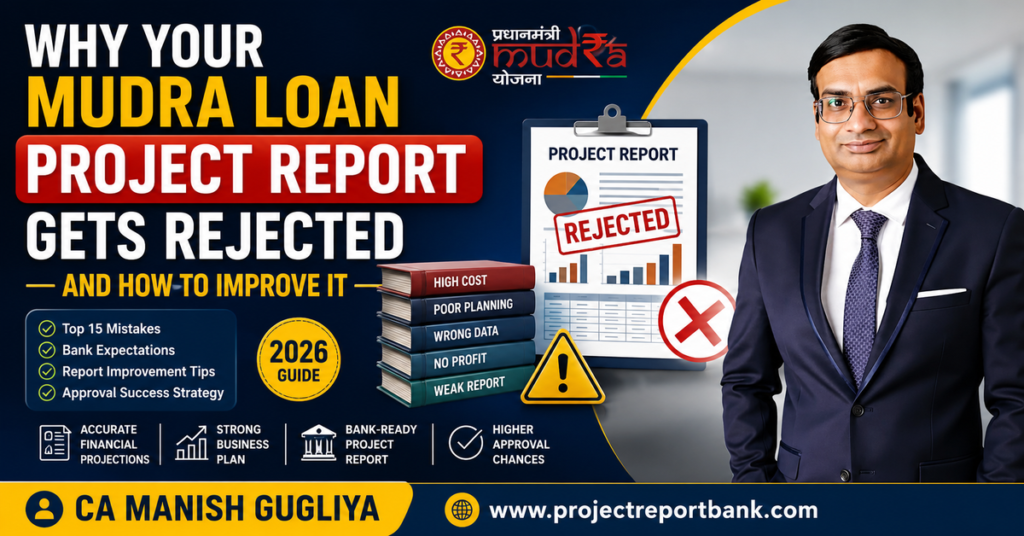
- Most Mudra loan project report rejected cases happen because of weak project report content, unrealistic numbers, or missing documents – not because the business idea itself is bad.
- Banks evaluate your detailed project report primarily on repayment capacity, realistic financial projections, and cash flow planning. Tools like DSCR (Debt Service Coverage Ratio) and break even analysis are central to their decision.
- Incomplete project reports, inconsistent figures between the DPR and bank statements, and copy-paste templates are among the fastest routes to rejection, especially for Kishor and tarun loans.
- A revised project report can often be resubmitted to the same bank or a different lender after correcting the specific issues flagged during the first review, improving your approval chances meaningfully.
- Seeking professional help for customized financial projections and CMA data is strongly recommended for loan amounts above ₹3 lakh, where banks apply stricter scrutiny.
Table of Contents
Introduction: Mudra Loan Project Report Rejected? Read This First
Imagine this: Ramesh, a shopkeeper in Indore, applied for a ₹7 lakh Mudra Kishor loan in early 2026 to expand his grocery business. He downloaded a project report format from the internet, filled in a few numbers, and submitted it at his local public sector bank. Three weeks later, the branch told him the loan application was rejected. The reasons? His sales projections assumed full capacity from month one, there was no cash flow statement, and his bank statements didn’t match the revenue figures in the report.
Ramesh’s experience is far from unique. Across Indian banks – SBI, Bank of Baroda, ICICI Bank, and dozens of regional and co-operative lenders – thousands of Mudra loan applications are returned or rejected every quarter. The most common culprit is not a bad business idea. It is a weak project report that fails to convince the credit officer.
Under the Pradhan Mantri Mudra Yojana (PMMY), also referred to as mantri mudra yojana pmmy, the government supports collateral free business loans to micro enterprises and small business owners. Mudra loans are categorized into Shishu (up to ₹50,000 for seed-stage businesses), Kishor (₹50,001 to ₹5 lakh for established businesses), and Tarun (₹5 lakh to ₹10 lakh for scaling operations). While Shishu loans need minimal paperwork, banks require a detailed project report for Kishor and Tarun loans – and this is where most problems begin.
This article will walk you through the exact reasons why your mudra loan project report gets rejected, how banks actually evaluate your DPR, practical steps to improve it, a pre-submission checklist, common myths, and when you can resubmit a revised project report. Whether you run repair shops, beauty parlors, a small manufacturing unit, or a street food stall, this guide is written for you.

What is a Mudra Loan Project Report (DPR) and Why It Matters
A mudra loan project report describes your business plan in a structured, number-backed format that the bank can evaluate. Think of it as a written promise: here is what my business does, here is what I need the money for, and here is exactly how I will repay it.
A typical DPR includes:
- Business profile and company’s background: What the business does, its business stage, the promoter’s education qualification, experience, and track record.
- Project cost and means of finance: An itemized breakdown of where the money will go (machinery, setup, working capital) and how it will be funded (promoter contribution plus the loan amount).
- Revenue and profit projections: Expected revenue, expenses, and net profit. Project reports should include realistic financial projections covering at least three years. Revenue projections should span 5 years for tarun loans.
- Cash flow and repayment plan: Monthly or annual cash flow showing surplus available for EMI. The project report must include a repayment schedule for all loans.
- Market analysis: Who are the target customers, what is the market demand, and how does the business compare with local competitors.
- Key assumptions: Pricing, capacity utilisation, growth rates, and working capital cycle.
For Shishu loans, a simple one-page business overview may suffice. But for Kishor and Tarun categories, banks expect a structured DPR with a balance sheet, profit and loss statement, and cash flow for 3–5 years. The project report must include a business and promoter profile along with complete financial information.
All Mudra loans are collateral-free for most lenders under the mudra scheme, but that does not mean the bank will skip its homework. In 2026, with stricter RBI oversight and digital scoring, even a small inconsistency between your DPR and your bank statements or GST returns can delay or derail your mudra loan application.
Why Banks Carefully Review Your Mudra Loan Project Report
Think from the banker’s side for a moment. The money being lent is public money. Every credit officer must be satisfied that the term loan or working capital being sanctioned will come back on time, with interest.
When a bank reviews your mudra loan project report, it is checking three things:
- Repayment capacity: Can your business generate enough monthly surplus to cover the EMI after all expenses, including your household drawings?
- Commercial viability: Will the business actually make a profit over time, given the project commercial aspects and local competition?
- Sustainability: Can the business survive seasonal dips, unexpected costs, or new competitors entering the market?
Reports not aligned with bank expectations often get rejected – not because the banker dislikes your idea, but because the numbers on paper do not add up. Maintaining a healthy financial history is crucial for securing a mudra loan, and the DPR is the primary document where this discipline is demonstrated.
Inside the bank, a branch-level appraiser first screens the report. If the DPR is clearly incomplete or unrealistic, it gets rejected right there – before it even reaches the regional credit manager. A strong, well-structured report moves through the process faster and with fewer queries.
Remember: even though the mudra yojana is a collateral free loan scheme under PMMY, it carries full repayment responsibility. The project report is not a formality – it is the single most important document in your loan application.
How Banks Evaluate a Mudra Loan Project Report in Practice
Here is a step-by-step look at what a bank officer actually checks when your DPR lands on their desk.
Promoter Profile The officer reviews your age, education qualification, business experience, and banking history. A CIBIL score above 700 is comfortable; below 650 raises red flags. Relevant education and experience of promoters can strengthen a Mudra loan application. If you are a first-time entrepreneur, strong planning and a clear business description can compensate for limited experience.
Project Cost and Means of Finance The officer checks whether the project cost is realistic. Are the machinery or vehicle quotations current? Do they include GST and transport? Is the total project cost consistent with the loan requirement and the correct Mudra category? Banks require an itemized breakdown of loan usage in the report. A mudra loan project report should explain how funds will be utilized precisely – vague statements like “miscellaneous expenses ₹1 lakh” do not work.
Revenue, Profitability, and Break-Even Officers compare your projected sales against shop size, local footfall, average ticket size, and seasonality. They look for the break-even point – the month or year when your revenue finally covers all fixed and variable costs. Include revenue projections in your project report for approval.
DSCR and Cash Flow The Debt Service Coverage Ratio (DSCR) is an important financial metric for lenders. It measures how much surplus cash your business generates relative to your debt obligations. For tarun loans, most banks expect DSCR of at least 1.25. For example, if your annual EMI obligation is ₹1,00,000, your net cash surplus should be at least ₹1,25,000. Cash flow statements must be included in the project report for Mudra loans – a P&L alone is not sufficient.
Working Capital Assessment How much stock will you hold? What credit terms do you offer customers? What credit do suppliers give you? Banks check whether your working capital cycle is properly funded. For businesses that use a mudra card or cash credit limits, the officer verifies utilisation patterns.
Market Demand and Licences A clear market analysis is essential for a successful mudra loan project report. The officer checks if you have mentioned your location, competition, and target customers. Required licences – GST, Udyam, FSSAI (for food businesses), trade licence, vehicle permits – must be referenced and, ideally, attached.
Consistency Check All figures in the DPR must match your CMA data, bank statements, ITR, and GST returns. Inconsistent financial information can cause loan applications to fail. If your DPR claims ₹50,000 monthly revenue but your bank statements show ₹15,000, the officer loses trust immediately.

Top Reasons Why Mudra Loan Project Reports Get Rejected
When a mudra loan project report is rejected, it is rarely because of a single glaring mistake. Usually, several smaller issues pile up. Here are the most common ones.
Unrealistic Sales Projections Unrealistic revenue projections are a common rejection reason. A new salon in a small town projecting ₹6 lakh monthly turnover from day one is simply not believable. Banks know that new businesses take 6–12 months to build a customer base. A better approach: start Year-1 at 50–60% capacity and show gradual ramp-up.
Inflated Profit Margins Claiming 60–70% net profit for a grocery shop or a retail business raises immediate suspicion. Industry norms for grocery retail are closer to 15–20% net margin. Banks routinely do comparative analysis against sector benchmarks. Use realistic margins and account for spoilage, discounts, and labour costs.
Incorrect or Outdated Quotations If your machinery quotation is from 2023 and excludes GST and transport, the bank questions your project cost. Detailed cost breakdowns and supplier quotations improve the project’s credibility. Always get fresh quotations with required third party details such as supplier name, GSTIN, and installation charges.
Underestimated Working Capital Even a profitable P&L can mask trouble if your working capital needs are ignored. A trader who expects payment in 30 days but actually collects in 60 will face a cash crunch. Factor in realistic collection periods, stock holding days, and supplier credit terms.
Missing or Weak Cash Flow and Repayment Planning Missing repayment plans can lead to loan rejection. Without a monthly cash flow statement showing that your surplus exceeds the EMI, the bank simply cannot assess whether you can service the debt. Every DPR must include a repayment schedule for loans with the EMI amount mapped against projected surplus.
No Break-Even Analysis If your report does not show when fixed costs will be covered, the bank cannot judge how long you might sustain losses. For Kishor and Tarun categories, aim to show break-even within 12–18 months.
Poor Market Research Understanding local demand and competitors is vital in the project report for Mudra loans. Quoting metro-level pricing in a rural setting, or ignoring the three established competitors on the same street, signals overestimation risk. Include customer perception insights, footfall data, and realistic pricing for your area.
Copy-Paste or Template DPR Generic or template project reports are often rejected by banks. If the city name, rent, or capacity figures in your DPR do not match your actual situation, the banker spots it immediately. Personalize every section – your project logistics details, space or land requirement, and land requirement must reflect reality.
Inconsistent Figures Claiming ₹40,000 in monthly household expenses in your DPR while your bank statements show much higher spending creates a trust deficit. Borrowers should ensure all figures in the project report are consistent and accurate.
Missing Promoter Contribution Banks prefer to see equity contribution from applicants for Mudra loans. If your project cost is ₹5 lakh and you want 100% bank financing with zero personal investment, the bank sees higher risk. Even 10–15% promoter contribution shows commitment.
Wrong Category or Business Classification Choosing Tarun for a ₹3 lakh requirement, or applying under Mudra for farm-related activities like crop loans, leads to automatic rejection. Mudra under the pmmy scheme is strictly for non-farm micro enterprises. Double-check your loan categories and business classification before submitting.
Mini Case Study: A trader applying for a Tarun loan in 2024–25 was rejected because his DPR assumed 100% sales capacity from month one, DSCR was below 1, and he had no machinery quotations. After revising – lowering Year-1 sales by 30%, attaching fresh quotations with third party details, and extending the repayment tenure to improve cash flow – his revised application was approved. Rectifying errors in the project report after rejection is essential before reapplying.
How to Improve Your Mudra Loan Project Report Before Resubmission
A rejected DPR is not the end of the road. In many cases, an improved project report plus proper documentation converts an earlier rejection into approval – at the same bank or another lender. A structured project report improves approval chances significantly.
Here is a practical step-by-step improvement plan:
Step 1: Get the exact rejection reasons. Ask the bank officer for specific remarks or the query letter. Without knowing what went wrong, you cannot fix it.
Step 2: Revisit your business model assumptions. How many customers per day? What is your average bill? How many working days per month? Adjust these to conservative, defensible levels. For a beauty parlor, if the local average is 8–10 clients per day, do not assume 25.
Step 3: Prepare fresh 3–5 year financial projections. Build a proper P&L, balance sheet, and cash flow that align with your corrected assumptions. The use of customized financial projections is recommended for better chances of approval.
Step 4: Recalculate DSCR. Make sure it stays comfortably above 1 – ideally 1.25 to 1.50 – even when you reduce projected sales by 15–20%. This buffer reassures the banker.
Step 5: Update project cost and means of finance. Get fresh quotations for machinery, equipment, or vehicles. Clearly show your promoter contribution separately from the loan project report figures.
Step 6: Add or update supporting documents. Attach valid licences, rent agreements, Udyam registration, GST certificate (if applicable), photos of premises, and proofs of your education and business experience. Improving the credit score can enhance the chances of receiving a Mudra loan – if your CIBIL is low, pay off pending dues before reapplying.
A quick sanity check before resubmission: does your business profile match the loan application form? Are your financials internally consistent? Is your repayment schedule linked to projected monthly surplus? Is your market analysis paragraph present with location, competition, and advertising strategies for customer acquisition?
For tarun loans, multi-branch businesses, or cases where the bank specifically asks for CMA data, consider engaging a Chartered Accountant or experienced consultant. Professional help at this stage can save months of back-and-forth.
Professional Tips Used by Chartered Accountants While Preparing Mudra DPRs
Based on more than 20 years of hands-on experience preparing project reports and CMA data for msme loan and Mudra loan applications across India, here are practical tips that make a real difference:
- Use conservative Year-1 capacity utilisation. For new units, assume 50–60% in Year 1, rising to 75–80% by Year 3. Banks are skeptical of 100% utilisation from day one – whether you run a food stall, a manufacturing unit with commercial manufacturing processes, or a trading firm.
- Run a simple sensitivity analysis. Reduce your projected sales by 15–20% and check if DSCR still stays above 1. If it drops below, your projections are too tight and the bank will flag this.
- Align cash flow with realistic credit terms. Do not assume 100% cash sales unless your business model genuinely supports it (like street vendors or small retail). Show credit given to customers and credit received from suppliers.
- Show household drawings honestly. Deduct your family’s monthly expenses before calculating the surplus available for EMI. Hiding this makes the numbers look artificially strong – and banks know it.
- Match GST and bank statement trends with projections. If your last 12 months of banking show ₹25,000 monthly average, projecting ₹80,000 from month one needs strong justification (like a confirmed order book with details information or achievements export orders).
- Avoid perfectly round figures everywhere. Numbers like ₹2,83,500 look worked-out and credible. ₹3,00,000 looks guessed. Small detail, big impact on customer perception at the bank.
- Add a one-page promoter note. Describe your experience, local market knowledge, employees working with you, and why this project will succeed. This qualitative note adds strength beyond the numbers.
- Prepare CMA data and ratio analysis even if not asked. Current ratio, interest coverage, and fund flow statements show professionalism. Banks like SBI have internal tools for this – if you provide it upfront through a well-prepared sbi project report format, it speeds up processing and signals seriousness. This approach works across most banks and loan schemes, including pmegp loan applications.
Project Report Checklist Before Submitting to Bank
Use this as a pre-submission checklist before visiting the branch or uploading on the Jan Samarth portal.
Business and Legal Items
- ✅ Correct firm name, address, loan amount, and Mudra category (Shishu/Kishor/Tarun) on all pages
- ✅ Udyam registration certificate attached
- ✅ PAN, Aadhaar, and other KYC documents matching DPR details
- ✅ Bank statements (6–12 months) provided
- ✅ Business description and business overview section completed
- ✅ Project company profile with promoter background included
Financial and Projection Items
- ✅ Project cost breakup tallying with total funding and loan requirement
- ✅ 3–5 year P&L, balance sheet, and cash flow prepared and internally consistent
- ✅ DSCR calculation attached with clear assumptions for interest rate and tenure
- ✅ Working capital cycle explained (stock holding, credit terms, cash buffer)
- ✅ Repayment schedule with EMI amount and period linked to projected monthly surplus
- ✅ Complete financial information including all sources and uses of funds
Operational and Risk Items
- ✅ Required licences identified and mentioned (FSSAI, trade licence, shop act, vehicle permits)
- ✅ Market analysis paragraph present with location, competition, and target customers
- ✅ Supplier quotations are current and include GST, transport, and installation costs
- ✅ Manufacturing processes or service delivery process briefly explained
- ✅ Advertising strategies for initial customer acquisition mentioned
- ✅ Export orders or other confirmed business, if any, documented
This is not an exhaustive list, but covering these key areas reduces the chance of your project report being rejected for avoidable issues.

Can You Submit a Revised Mudra Loan Project Report After Rejection?
Yes. A rejected mudra loan project report does not permanently block you from trying again. Here are the common scenarios:
Same bank, revised DPR: Many branches allow resubmission after you correct the specific issues – updated quotations, revised financial projections, additional experience proofs. The bank officer reviews the revised project report afresh.
Different bank or lender: You can approach another bank – a different PSB, a regional rural bank, an NBFC, or a small finance bank – with an improved DPR. There is no rule preventing this.
Credit score issues: If rejection was due to low CIBIL (below 650) or past defaults, you may need 3–6 months to improve your score before reapplying. Pay off overdue small loans, regularize accounts, and request a corrected credit report if there are errors.
While there is no formal “appeal” mechanism specific to Mudra, you can:
- Request reasons for rejection in writing from the branch
- Ask whether the bank will consider a revised project report
- Approach the branch manager or regional office if you believe the rejection was unfair
The key is to make genuine improvements – not just cosmetic changes. When the banker sees updated numbers, fresh documents, and a clearer repayment plan, it signals seriousness.
Common Myths About Mudra Loan Project Reports and Rejections
Myth 1: “Mudra is a government scheme, so banks must approve my application once I submit the form.” Reality: The bank has full authority to reject if the DPR, credit profile, or documentation is weak. Financial inclusion goals do not override credit appraisal norms.
Myth 2: “If my mudra loan project report is rejected once, I can never get a Mudra loan.” Reality: You can reapply with an improved DPR and better eligibility. Many borrowers succeed on their second or third attempt.
Myth 3: “Banks cannot ask for documents since Mudra is collateral free.” Reality: Collateral free means no external asset security. KYC, business documents, and financial records are absolutely mandatory. Banks can and do ask for documentation.
Myth 4: “High profit projections always impress the bank.” Reality: Unrealistic profits are a major rejection trigger. Banks prefer honest, conservative margins consistent with your industry.
Myth 5: “Only big CA firms can prepare acceptable DPRs.” Reality: Quality matters more than brand name. Even individual practitioners or informed entrepreneurs can prepare strong, bank-ready reports if they use proper structure and truthful numbers.
Myth 6: “My business administration skills don’t matter if the numbers are good.” Reality: Banks look at the whole picture – your experience, financial discipline, and how well you understand your own business plan and market. A report is a reflection of the person behind it.
Frequently Asked Questions (FAQ) – Mudra Loan Project Report Rejected
If my Mudra project report is rejected, how soon can I apply again?
If rejection was due to DPR issues or missing documents, you can often reapply within 1–2 weeks after corrections. If CIBIL score or past defaults caused the rejection, allow 3–6 months to improve your credit history before reapplying. You can use the same project report format but must address the specific issues the bank flagged.
Do I really need 5-year financial projections for a small Kishor loan of ₹3 lakh?
Banks generally expect 3-year projections for Kishor and 5-year projections for Tarun loans. For a ₹3 lakh Kishor loan, three years of P&L and cash flow with a clear repayment schedule is usually sufficient. Including a DSCR calculation – even if the bank hasn’t explicitly asked – adds credibility and can improve your approval chances.
Will a professionally prepared CMA report improve my Mudra loan approval chances?
Yes. CMA data with fund flow statements, ratio analysis (current ratio, interest coverage), and accurate past financials enhances your profile, especially for Tarun loans above ₹5 lakh. Banks like SBI automatically run internal CMA checks during appraisal. Providing this data upfront saves time and signals professionalism.
Is GST registration mandatory in the DPR if my turnover is below the threshold?
If your business turnover is below the GST threshold, registration is not legally mandatory. However, many banks appreciate voluntary GST registration as it provides verifiable sales data. At minimum, ensure you have Udyam registration, trade licence, or shop establishment certificate as alternatives.
Can a housewife or student with no income apply for a Mudra loan if the project report is strong?
Yes, under the pradhan mantri mudra yojana, eligibility is based on the business plan viability, not the applicant’s current salary. A housewife or student with a well-prepared DPR, relevant skills, and a realistic business idea can apply. The bank will evaluate the mudra loan project based on projected cash flow, repayment capacity, and promoter contribution – not just current income.
Conclusion: Turning a Rejected Mudra DPR into a Bank-Ready Proposal
A rejected mudra loan project report is a starting point for improvement – not the end of your entrepreneurial journey. In the vast majority of cases, the problem lies not in your business idea but in how it was presented on paper.
Realistic financial projections, strong cash flow planning, and a clear explanation of your business experience matter far more than showing impressively high profits. Banks are not looking for the most optimistic picture. They want the most believable one.
Take the checklists from this guide, revisit every section of your DPR, and fix inconsistencies. If your loan requirement falls under Kishor or Tarun, consider getting professional help to prepare a customized, bank-ready mudra loan project report and CMA data. A detailed project report improves approval chances significantly – this has been demonstrated across thousands of successful cases at Indian banks.
Careful planning today can help you secure the right collateral free business loan under the pradhan mantri mudra yojana and support sustainable growth for your small business over the next 3–5 years. Whether you are applying for your first time or resubmitting after a rejection, the right report makes all the difference.
About the Author – CA Manish Gugliya
CA Manish Gugliya (FCA, DISA ICAI) is a practising Chartered Accountant with more than 20 years of experience in project reports, CMA data preparation, Mudra loans, MSME finance, startup advisory, business planning, and business valuation. Through Project Report Bank, he has helped entrepreneurs across India prepare bank-ready project reports and financial documentation for Mudra, PMEGP, MSME, and other government and bank loan schemes.
His focus is on simple, practical guidance that helps first-time borrowers understand how banks think and how to present their business ideas properly. Whether you are a shop owner, a manufacturer, a service provider, or a first-generation entrepreneur, the goal is the same: give the bank a report it can trust.
If you are dealing with a mudra loan project report rejected situation and need help preparing a customized, realistic DPR and CMA data for your specific business, consider reaching out for professional assistance. Every business is unique, and tailored financial projections significantly improve the quality of your application – though final approval always depends on the bank’s overall assessment of eligibility and documentation.
- Can Bank Reduce Mudra Loan Amount Without Your Consent? Complete Practical Guide (2026)

- What to Do If You Cannot Pay Your Mudra Loan EMI (2026 Guide)

- Can a Bank Refuse a Mudra Loan Because the Target Is Completed? Complete Guide (2026)

- Bank Refused My Mudra Loan Application – What Are My Rights?

- Mudra Loan for Used Vehicles (2026): Eligibility, Documents, Bank Rules & Complete Guide

- Rejected Mudra Loan – What to Do Next? Appeal Process Explained (2026)

- Mudra Loan Project Report Madhya Pradesh – Bank-Ready DPR & CMA Guide
- Project Report for Mudra Loan Maharashtra: Complete Guide for MSMEs, Startups and Small Businesses (2026)

- Mudra Loan Uttar Pradesh: Complete Guide for MSMEs, Startups and Small Businesses (2026)

- Mudra Loan Bihar 2026: Eligibility, Documents, Online Application Process & Project Report Guide

- Jan Samarth Mudra Loan 2026: Complete Guide to Online Application, Eligibility, Documents & Approval Process

- MSME Mudra Loan: Complete Guide for Small Businesses, Startups & Manufacturing Units in India (2026)

- Is the Mudra Loan Subsidy Real or Fake? Get the Facts Here

- Mudra Loan Without CIBIL Score: How to Qualify and Apply

- Mudra Loan for Used Machine (2026 Guide) – Eligibility, Documents, Valuation & Approval Tips