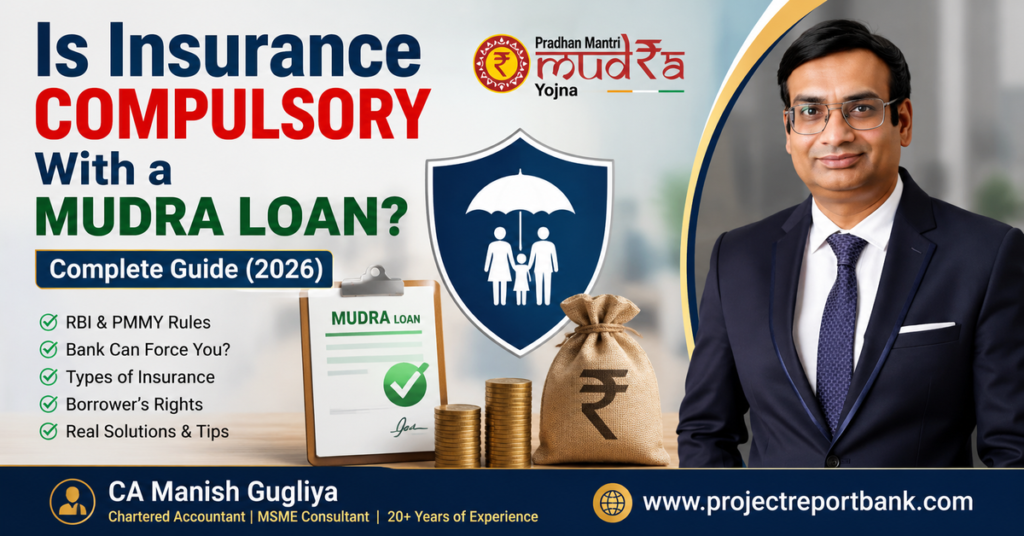
You walk into a bank branch to apply for a Mudra loan. Before discussing your business plan or eligibility, the bank employee says: “You must purchase insurance first.” You feel confused, pressured, and unsure whether this is a legal requirement or simply a sales pitch. This guide will answer every question you have about whether insurance is compulsory with a Mudra loan, what official rules actually say, and what your rights are as a borrower.
Key Takeaways
Here is a quick summary of everything this guide covers, so you can get the core answer immediately.
- Insurance is NOT automatically compulsory under Pradhan Mantri Mudra Yojana (PMMY) for every mudra loan. Life insurance is not mandatory for taking out a Mudra loan. However, individual banks may require specific insurance as part of their internal credit policy, particularly when assets like machinery or vehicles are financed.
- A bank generally cannot force you to buy a particular third-party insurance product as a condition for sanction. But it may insist on basic risk cover (such as shop or machinery insurance) where assets are created from the loan amount.
- Mudra Yojana offers loans up to ₹20 lakh across four categories – Shishu (loan upto rs 50,000), Kishore (₹50,000 to ₹5 lakh), Tarun (₹5 lakh to ₹10 lakh), and Tarun Plus (₹10 lakh to ₹20 lakh). No collateral is required for Mudra loans.
- If a bank tells you “insurance is compulsory with Mudra loan,” always ask them to show the written rule, circular, or sanction terms in writing.
- Before accepting any insurance, compare the cost, check the policy tenure, avoid signing blank forms, and seek professional help (such as a CA experienced in MSME finance) if anything seems unclear.
Table of Contents
Why Are So Many Borrowers Confused About Insurance?
Imagine this: a small shopkeeper walks into a public sector bank branch to apply for a Shishu mudra loan of ₹40,000 for working capital. The bank officer processes the application form, glances at the documents, and then casually says: “You need to take this insurance policy – it is part of the Mudra loan package.” The shopkeeper, a first-time applicant, assumes it must be a government rule and signs whatever is placed in front of them.
This scenario plays out thousands of times across india every month. And it is the root cause of confusion.
Here is why borrowers get confused:
- Pradhan mantri mudra yojana pmmy rules, RBI guidelines, and each bank’s internal credit policy are three different documents. Most borrowers never see any of them.
- Bank staff often use short phrases like “Mudra loan insurance mandatory,” “package product,” or “head office circular” without explaining whether the insurance requirement is a legal rule under the mudra scheme or simply an internal practice of that particular bank.
- Many first-time entrepreneurs mix up three very different things: (a) insurance for financed assets like machinery, vehicles, or stock, (b) credit life or personal accident insurance that pays off the loan if the borrower dies, and (c) purely optional insurance products that the bank is cross-selling for commission.
During my 20+ years as a practising Chartered Accountant, I have repeatedly seen MSME owners sign insurance forms without understanding the tenure, coverage amount, or whether the policy was actually needed for their small business loan. This confusion is exactly why people search “is insurance compulsory with Mudra loan” before or after visiting the bank branch.

Quick Answer
Here is the direct answer: PM Mudra Yojana itself does NOT make insurance compulsory for every Mudra loan. Insurance may be recommended or required only as per individual bank policy or when specific assets are financed from the loan proceeds.
Let me be more specific:
- There is no general PMMY rule that every Shishu, Kishore, or Tarun borrower must buy credit life insurance or personal accident insurance. The official PMMY FAQ states clearly: “Life insurance is not required for loans under PMMY.”
- However, banks can, under their approved credit policy, insist that assets financed from the loan (like vehicles, machinery, shop premises, stock) are insured against fire, theft, accident, and other risks. Comprehensive insurance of securities is required for Mudra loans where assets are created, and this insurance must include a bank clause so the bank’s interest is protected.
- Lending policies may vary by financial institution regarding insurance requirements. Banks cannot legally force you to buy a particular company’s policy – they must allow you to choose any equivalent cover if insurance is genuinely required under their policy.
Refusal to take a purely optional, bundled insurance product that is not recorded in your sanction conditions should not, in principle, be a reason to reject an otherwise eligible Mudra loan application.
Ask these questions immediately if told insurance is compulsory:
- “Is this insurance required by PMMY guidelines or only by your bank’s internal policy?”
- “Can you please show me the circular or write this requirement in my loan sanction letter?”
- “If I arrange the same type of insurance from another company, will you still sanction my Mudra loan?”
The sections below will explain official guidelines, when insurance is beneficial, and how to handle pressure from banks.
What Official PM Mudra Guidelines Say
As per publicly available PMMY scheme documents (up to 2025–26), there is no clause that universally makes insurance compulsory for all mudra loans. Life insurance is not mandatory for taking out a Mudra loan – this is confirmed directly in government FAQs.
What is PMMY? Pradhan mantri mudra yojana was launched on April 8, 2015, as a government scheme to provide collateral-free financial assistance to non-farm micro units and small businesses. MUDRA – which stands for micro units development and Refinance Agency – acts as a refinance agency that supports banks and micro finance institutions in lending to the enterprise sector.
Mudra loans are available to sole proprietorships, partnerships, and any other legal entity engaged in manufacturing, trading, services, food processing, and allied activities. Agricultural businesses are not eligible for Mudra loans directly under PMMY, though agriculture-related allied activities may qualify in some cases. Applicants must be aged between 18 to 65 years.
Official PMMY guidelines focus on:
- Eligibility criteria and loan limits across Shishu, Kishore, Tarun, and Tarun Plus categories.
- The collateral-free nature of loans – no collateral is required for obtaining a Mudra loan.
- Coverage under the credit guarantee fund for Micro Units (CGFMU scheme), which protects the lender against default risk, not the borrower’s life or assets.
- Sector coverage including trading, services, manufacturing, and allied activities.
The guidelines do NOT specifically say “every borrower must buy life insurance, credit life insurance, or personal accident insurance.” Eligible Mudra loans are covered under the Credit Guarantee Fund for Micro Units – but this guarantee protects the bank, not the borrower.
Since bank-specific circulars are not publicly available, borrowers should politely ask their branch to show the relevant internal rule if the bank claims “PM Mudra Yojana insurance is mandatory.” Also keep checking official government websites for updated PMMY rules, because policies may evolve after 2026.
Why Banks Recommend Insurance
Banks recommend insurance with business loans, including mudra loans, to protect two things: (a) the borrower’s family from loan liability in case of death or disability, and (b) the bank’s recovery in case financed assets are damaged or destroyed.
Here are the key insurance types commonly linked with Mudra loans:
- Credit life insurance: Covers the outstanding loan if the borrower dies during the loan tenure. Some banks may offer optional credit life insurance for Mudra loans, but this does not make it a scheme-level compulsion.
- Personal accident insurance: Pays a benefit if the borrower suffers disability or death due to an accident. Often sold alongside credit life cover.
- Machinery or equipment insurance: Protects financed machines against fire, theft, and breakdown. The main security for the Mudra loan is the hypothecation of assets created, so banks naturally want those assets protected.
- Shop or office insurance: Covers business premises, stock, furniture, and computers against fire, burglary, and natural calamities.
- Vehicle insurance: Motor insurance is legally compulsory for all commercial vehicles in india, regardless of whether the funding came through PMMY or any other source. This is a legal requirement under the Motor Vehicles Act, not a Mudra-specific rule.
Sometimes banks bundle these into a “Mudra loan insurance package” to simplify processing for staff. Unfortunately, this gives borrowers the impression that it is a legal compulsion under the mudra yojana rules.
Real-world examples:
- A small manufacturing unit taking a ₹7 lakh Kishore loan for a cutting machine: machinery insurance is sensible because one fire or theft could destroy the asset and leave the borrower with debt but no income.
- A street-food vendor taking a Shishu loan of ₹40,000 for working capital: an expensive credit life insurance premium of ₹3,000–₹5,000 may be disproportionate to the loan amount and unnecessary if the vendor has no significant financed asset.
Recommendation is not the same as compulsion. Understand the benefit, cost, and tenure before accepting any insurance linked to your Mudra loan. Insurance fees for Mudra loans are borne by the borrower – never assume the government pays.
Can the Bank Reject My Mudra Loan If I Refuse Insurance?
In practice, a bank usually cannot refuse a genuinely eligible Mudra loan application only because the borrower declines to buy a particular third-party insurance product. However, it can set conditions in line with its written credit policy, especially for asset-backed lending.
Here are three distinct scenarios:
- Scenario 1 – Asset-linked insurance (commercial vehicle, machinery, shop with financed stock): The bank may legitimately insist that these financed assets are insured. For instance, Indian Bank’s Tarun Plus policy explicitly states: “All securities should be adequately insured with Bank Clause – Premium to be borne by the borrower.” In such cases, refusal to insure financed assets may delay or affect sanction.
- Scenario 2 – Purely optional credit life or PA policy: If this is not mentioned in the bank’s written policy or your sanction terms, refusal should not be a formal ground for rejection. However, some staff may indirectly discourage your application.
- Scenario 3 – Bank’s internal policy requires basic life cover for a segment: Then the bank can frame this as a lending condition, but you still have the right to choose the insurer and product.
What you should do:
- Ask the manager to put any “compulsory” insurance requirement in the sanction letter or in an email referencing the specific circular or policy clause.
- If the branch verbally threatens rejection without showing written rules, request written reasons for any refusal.
- If needed, use the bank’s internal grievance redressal mechanism or consider the Mudra Loan Appeal process.
Keep in mind that other factors like a weak project report, poor credit score, incomplete documents required, or ineligible activity are far more common official reasons for Mudra loan rejection than declining an optional insurance add-on.
Questions Every Borrower Should Ask Before Buying Insurance
Before agreeing to any Mudra loan insurance, use this checklist of questions. Write down the answers or take a photo of the brochure so you have a record.
- “Is this insurance compulsory under your bank’s Mudra loan policy, or is it optional?”
- “What type of insurance is this – credit life, personal accident, shop insurance, machinery cover, or something else?”
- “What events are covered and what are the main exclusions?”
- “What is the total premium, and is it a single premium or yearly premium?”
- “Will the premium be added to my Mudra loan amount, or will it be deducted from the disbursed amount?”
- “What is the policy tenure in years, and does it match my loan tenure?”
- “Can I take the same type of cover from another insurance company and still get the loan?”
- “Will I receive a separate policy document in my name with clear sum assured and nominee details?”
- “If I pre-close or foreclose my Mudra loan, can I get any refund of the insurance premium?”
- “Is there a free-look period during which I can return this policy if not satisfied?”
Professional Tip: A CA experienced in MSME finance can help you compare total cost of credit – loan interest plus insurance premium plus processing fee – before you make a final decision. Sometimes the insurance premium significantly increases the effective cost of borrowing.

When Buying Insurance Is Actually a Good Decision
Although insurance is not universally compulsory with a Mudra loan, in many real-life situations it is financially wise for the borrower and their family.
Here are realistic use-cases where insurance genuinely helps:
- Sole-proprietor with dependents: A person running a small manufacturing unit with high fixed equipment cost and a family to support. Credit life insurance combined with machinery insurance can prevent the family from inheriting debt if something unexpected happens.
- Commercial vehicle owner under PMMY: Motor insurance is legally mandatory. Adding personal accident cover for the driver or owner is a low-cost, high-value decision.
- Shop owner with significant stock: Fire and burglary cover protects against events that could destroy the business overnight – especially relevant for traders dealing in goods with high cash flow sensitivity.
- First-time entrepreneurs taking Tarun loans above ₹5 lakh: A low-cost term or credit life insurance policy can safeguard the family from the loan burden during the repayment tenure.
- Women entrepreneurs or elderly borrowers (near 60–65 years) seeking income stability for their dependents – simple accident or term cover provides peace of mind without heavy cost.
Your insurance decision should depend on:
- The loan amount and tenure (Mudra loans have a repayment tenure of up to 5 years).
- Nature of business – risk level, physical assets, location.
- Existing insurance you already hold (life, health, or asset policies).
- Family responsibilities and financial backup.
You are free to buy similar cover from any IRDAI-registered insurer, not only through the bank, as long as any conditions in your sanction letter are satisfied.
Situations Where Borrowers Should Be Careful
Many issues arise not because insurance itself is bad, but because of how it is sold or bundled with mudra loans. Watch out for these red flags:
- Hidden charges: Premium added to the loan amount without clearly informing the borrower, silently increasing the EMI.
- Bundled products: Multiple policies (credit life, health, accidental, investment-linked) sold as a “Mudra package” when only basic cover was needed.
- Single premium policies: A large one-time premium financed as part of the business loan, making small Shishu loans unnecessarily costly.
- Loan amount deductions: Bank disburses less than the sanctioned amount because the insurance premium is cut upfront without proper explanation.
- Blank or partially filled forms: Borrowers asked to sign blank proposal forms, leaving details to be filled later by staff.
- No separate policy document: Insurance done under a group scheme but the borrower never receives an individual certificate.
- Unclear nominee details: Nominee section either left blank or filled incorrectly, creating issues at claim time.
- Tenure mismatch: Very short coverage compared to loan tenure, or vice versa, because policy term is not matched with the EMI schedule.
- Scam risk: Scammers may request upfront fees for processing Mudra loans and bundle fake insurance products. Borrowers should verify loan terms through official channels like the Mudra Loan FAQ Portal.
Warning: Always take photocopies or digital photos of all signed forms. Check the policy schedule for correct name, address proof details, loan reference, and sum assured. Clarify the cancellation or free-look period (typically 15–30 days) during which you can return the policy if not satisfied.
Real Practical Tips from CA Manish Gugliya
Based on more than 20 years of working with MSME clients, project reports, CMA data, and Mudra loan consulting, here are my street-level practical tips:
- Never say “yes” to any insurance on the same day. Ask for the brochure, go home, and think at least one night.
- For Shishu loans below ₹50,000 (which provide up to ₹50,000 for startups), be extra cautious about high single-premium covers that significantly increase your effective interest cost. Interest rates for Mudra loans start from 7.25% p.a. – don’t let insurance premiums double your effective borrowing cost.
- For vehicle loans under PMMY, focus on getting the right motor policy including third-party liability and own-damage cover. This is truly essential and legally required.
- Always compare the total EMI with and without insurance. If the difference is large, investigate carefully.
- Ask the bank to mention any “compulsory” insurance clearly in the sanction letter and keep that letter safely.
- If you already have adequate term life insurance, you may not need an expensive credit life policy on top.
- For machinery-heavy units, do not skip asset insurance. One fire can destroy years of savings and leave you with debt and no income.
- Use a proper Mudra Loan Project Report so the bank focuses on your business viability and cash flow projections, not on cross-selling products.
- Take help from a CA or experienced MSME consultant if you cannot understand the insurance quotation or policy wording.
- Ensure all address proof, aadhaar card details, and KYC information on the policy exactly match your loan application to avoid claim disputes.
- Do not let agents rush you during signature. Read at least key fields: sum insured, premium, tenure, nominee.
- If the bank insists that the policy must be from a particular company, calmly ask if you can submit an equivalent policy from any IRDAI-approved insurer.
- Re-evaluate your insurance when you expand your Mudra limit from Shishu to Kishore or Tarun. If you have successfully repaid previous loans and are moving to a higher category, your coverage should match the new risk.
- Keep premium receipts and policy copies along with your loan documents, bank statement copies, business registration papers, and business licenses in one safe folder.
- At the time of Mudra loan closure, ask whether any surrender value or refund from insurance is due, especially for long-term or investment-linked policies.
CA Advice: Treat insurance as a risk-management cost, not a blind compulsion attached to a government scheme. An informed enterprise owner evaluates every cost – including insurance – against their business needs.
Example Conversation Between Borrower and Bank Manager
Here is a realistic, polite conversation showing how you can ask questions about insurance when applying for a Mudra loan. You can adapt this language at your own bank branch.
Borrower: Good morning, sir. I want to apply for a Kishore Mudra loan of ₹3 lakh for my tailoring business. I have checked the Mudra loan eligibility criteria and I believe I qualify. I have my documents required for the application ready – identity proof, passport-size photos, aadhaar card, address proof including utility bills, rent agreement, business registration certificate, and other documents.
Manager: Good. Let me review your business plan and documents. By the way, you will also need to take our insurance package – it is part of the Mudra loan process.
Borrower: Thank you for informing me. May I ask – is this insurance required by PM Mudra Yojana guidelines, or is it your bank’s internal policy?
Manager: Well, it is our bank’s standard practice for all Mudra borrowers.
Borrower: I understand. Could you please show me the specific circular or note this requirement in my sanction letter? I want to understand what type of insurance this is – credit life, personal accident, or asset insurance?
Manager: It is a credit life insurance policy. It covers your outstanding loan if something happens to you.
Borrower: What is the premium amount, and will it be deducted from my loan disbursement?
Manager: The premium is ₹4,500 as a single premium. It will be deducted from the disbursed amount.
Borrower: I see. So I will receive ₹2,95,500 instead of ₹3,00,000, but my EMI will be calculated on ₹3,00,000?
Manager: Yes, that is correct.
Borrower: If I already have a term life insurance policy for ₹10 lakh, do I still need this? And can I bring a similar policy from another insurance company?
Manager: Let me check with my branch head. Generally, if you can submit proof of equivalent cover, we may accept it.
Borrower: Thank you. I also want to confirm – if I politely decline this optional insurance, will it be recorded as a reason for rejecting my Mudra loan application?
Manager: No, the loan decision is based on your eligibility, credit score, and business viability. Insurance is recommended, not a rejection criterion for Kishore loans in our bank.
Borrower: Perfect. I appreciate your clarity. Please proceed with my application and I will review the insurance option separately.
This conversation shows that firm but polite questioning works. You are not being difficult – you are being a responsible borrower.

Common Myths vs Facts
Many myths circulate about “Mudra loan insurance mandatory.” Here is the reality:
| Myth | Fact |
|---|---|
| Insurance is compulsory for every Mudra loan under PMMY rules. | PMMY does not mandate universal insurance. Requirements depend on bank policy and loan type. |
| The bank can force me to buy only their tied-up insurance company’s policy. | You can usually choose any equivalent cover from an IRDAI-registered insurer. Forced selling of a particular product can be challenged. |
| If I refuse insurance, my Mudra loan will definitely be rejected. | Eligibility, documents, credit score, and business viability matter more. Only asset-linked covers may be insisted upon. |
| Credit life insurance means my family will always receive money. | Claims are subject to policy terms, exclusions, and correct disclosure. Read the fine print. |
| Insurance premium is free because it is a government scheme. | The premium is always paid by the borrower – either separately or built into loan cost. |
| Guarantee cover under CGFMU means borrower is insured. | MUDRA guarantee cover is available under the CGFMU scheme, but it protects the lender against default – not the borrower’s life or assets. |
| Only banks offer Mudra loans, and they all require insurance. | Mudra loans are also available through non banking financial companies and micro finance institutions, each with their own policies. |
| Insurance is never useful for small loan amounts. | Even for small loans, asset insurance can be critical if you have financed equipment or stock. Evaluate case by case. |
Common Mistakes Borrowers Make
Here are practical mistakes I have seen repeatedly in my CA practice when people combine mudra loans with insurance:
- Signing insurance forms without reading them due to fear of loan rejection. Fix: Read before signing, even if it takes extra time.
- Assuming “government loan” means “government-paid insurance.” Fix: Understand that PMMY provides the lending framework; insurance cost is always on the borrower.
- Not checking whether the insurance tenure matches the Mudra loan repayment period. Fix: Compare policy tenure with your loan tenure (up to 5 years for Mudra loans).
- Accepting investment-linked (ULIP) products when only simple term or accident cover was needed. Fix: Insist on knowing the exact product type before signing.
- Ignoring nominee details and later facing hurdles in claim processing. Fix: Fill nominee details carefully at the time of policy issuance.
- Failing to keep copies of policy bonds, leading to confusion when branch staff change. Fix: Keep physical and digital copies of every document.
- Believing verbal assurances like “everything is covered” without written proof. Fix: Get every promise in writing.
- Not comparing premium rates with outside agents or online options. Fix: Spend 30 minutes checking premium rates online before accepting.
- Not disclosing pre-existing health conditions honestly in proposal forms. Fix: Be truthful – non-disclosure can void claims later.
- Forgetting to update address or contact details, causing loss of policy communication. Fix: Update your address with insurer whenever you change location.
- Confusing the credit guarantee fund coverage with personal insurance. Fix: Remember – CGFMU protects the bank, not you.
What Should You Do If You Feel Pressured?
You are not alone if you feel pressured by staff to buy insurance with a Mudra loan. Here is a structured, step-by-step action plan:
Step 1: Stay calm. Do not argue. Simply ask whether the insurance is part of official PMMY rules or the bank’s internal policy.
Step 2: Request that the bank provide the requirement in writing or show the circular. Note down the circular number if shown.
Step 3: Ask whether your refusal will be recorded as the official reason for rejection. Request them to mention this in any rejection letter if they insist on making it a condition.
Step 4: If unsatisfied at the counter level, politely approach the branch manager or cluster head with all your documents and a written request.
Step 5: Use the bank’s internal grievance redressal mechanism. Escalate to the regional office if the branch does not resolve your concern.
Step 6: As a last resort, consider filing a complaint with the Banking Ombudsman or RBI’s Complaint Management System, especially where mis-selling or forced selling is evident.
Important Note: Simultaneously ensure that all your Mudra loan documentation – project report, CMA data, address proof, KYC, identity proof, and business proof – is strong and complete, so the bank cannot hide behind other rejection reasons. If needed, review whether the bank can legally ask for security or whether a bank can ask for a guarantor in a Mudra loan.
Also consider whether the bank is refusing because their target is completed – a separate issue unrelated to insurance. You can also check if you can get a Mudra loan without GST registration if that was cited as a barrier.
Frequently Asked Questions
This FAQ section quickly answers common queries around “is insurance compulsory with Mudra loan” for first-time borrowers.
Q1: Is credit life insurance compulsory for all Mudra loans?
No. The pradhan mantri mudra yojana scheme does not mandate credit life insurance for every borrower. Some banks may offer optional credit life insurance for Mudra loans as a recommendation, but it is not a universal rule.
Q2: Can the bank include insurance premium inside my Mudra loan amount?
Yes, some banks add the premium to the loan amount. This means you pay interest on the premium too, increasing your effective EMI. Always ask for a clear breakdown before signing.
Q3: If I already have term life insurance, do I still need separate Mudra loan insurance?
Not necessarily. If your existing term cover is adequate and you can submit proof to the bank, many branches will accept it as equivalent coverage.
Q4: Are there any government-subsidised insurance schemes specifically for Mudra borrowers?
As of 2026, there is no central government scheme that subsidises insurance premiums exclusively for Mudra borrowers. The CGFMU guarantee is for the lender’s protection, not borrower insurance.
Q5: What happens to the insurance policy when I pre-close my Mudra loan?
It depends on the policy type. Some single-premium policies may have a small surrender value. Others may continue independently. Ask before pre-closure.
Q6: Can I cancel the insurance after the loan is disbursed?
Most insurance policies have a free-look period of 15–30 days. Within this window, you can return the policy and receive a refund of the premium, minus applicable charges.
Q7: Does insurance improve my chances of Mudra loan approval?
Marginally. Banks may view an insured borrower as lower risk, but your eligibility primarily depends on business viability, credit history, income, and proper documentation – not on whether you bought insurance.
Q8: Are PMMY insurance rules different for Shishu, Kishore, and Tarun categories?
The central scheme does not differentiate insurance rules by category. However, banks are more likely to insist on asset insurance for larger Tarun and Tarun Plus loans where significant machinery or equipment is financed.
Q9: Mudra loans are collateral-free – so why does the bank talk about security and insurance?
No collateral is required, but the main security for the Mudra loan is the hypothecation of assets created from the loan proceeds. This means the bank has interest in those assets and may require insurance to protect them.
Q10: Who pays the insurance premium in a Mudra loan?
The borrower always pays. This is applicable across all categories and banks.
Q11: Can non banking financial companies or micro finance institutions also require insurance?
Yes. Any lending institution – whether a bank, NBFC, or MFI – can set its own lending policy, which may include insurance conditions. Always check the specific institution’s policy.
Q12: What if the bank refuses to give me a copy of the insurance policy?
This is a red flag. Under IRDAI regulations, every policyholder must receive a policy document. If the bank does not provide it, submit a written complaint to the branch manager and follow up with the insurer directly.
Final Advice from CA Manish Gugliya
Insurance with a Mudra loan is a tool, not a trap – when used correctly and not treated as a blind compulsion attached to a government scheme.
Here is my closing guidance:
- Always separate your decision about the loan from your decision about insurance, even if the bank discusses them together.
- Focus first on business viability, a proper Mudra loan project report, and clean documentation. See insurance as a risk-management layer on top.
- Do not let fear of rejection force you into costly, unsuitable policies. Ask questions until you are personally satisfied.
- If the loan amount is large or terms seem complex, consider independent advice from a CA experienced in MSME finance and business valuation.
- Review your overall family protection – life, health, and asset covers – at least once a year as your business grows from Shishu to Kishore to Tarun and beyond. As your enterprise requires more funding, your risk cover should grow proportionally.
Professional assistance is available for preparing bank-ready project reports and CMA data if required. However, the most important thing is this: informed borrowers are respected borrowers. Whether you are a small shopkeeper, a woman entrepreneur running a food processing unit, a street vendor, or a trader looking to expand – you have every right to understand what you are signing, whether it is a business loan, insurance policy, or any finance document.
Eligible businesses include small producers and service providers across the non-farm sector. Whether you operate as a legal entity or sole ownership, whether you are in the trading sector or services, you deserve clarity. Never hesitate to ask, verify, and protect yourself.
Author Bio – CA Manish Gugliya
CA Manish Gugliya is a Practising Chartered Accountant (FCA, DISA – ICAI) with over 20 years of experience in business finance, MSME advisory, and banking documentation. He specialises in business project reports, CMA data preparation, Mudra loan consulting, startup advisory, and business valuation.
Over the past two decades, CA Manish Gugliya has assisted thousands of micro and small businesses in securing business loans under pradhan mantri mudra yojana and other MSME schemes across india. His clients include entrepreneurs in manufacturing, trading, services, food processing, and allied activities who require funds to start, run, or grow their enterprises.
Through ProjectReportBank.com, he helps entrepreneurs prepare lender-friendly documents like Mudra Loan Project Reports and guides them through eligibility, documents required, and appeal processes. His approach is simple: give borrowers the knowledge and tools to walk into any bank branch with confidence – whether they are dealing with loan applications, insurance questions, or processing requirements.
Additional Short FAQ
Here are a few follow-up questions that may not have been covered directly above:
Q: Is shop insurance compulsory if I take a small Shishu Mudra loan only for working capital and not for fixed assets?
Generally, no. If your Shishu loan (up to ₹50,000) is purely for working capital and you have not availed funding for any fixed asset like machinery or shop furniture, most banks will not insist on asset insurance. However, always confirm with your specific branch, as policies vary.
Q: If the bank refuses to give me a copy of the insurance policy even after repeated requests, what should I do?
Submit a written complaint to the branch manager with a copy to the bank’s nodal officer. Simultaneously, contact the insurance company directly using the policy number (if available) and fill a complaint form on the IRDAI grievance portal. You are entitled to receive your policy document – this is non-negotiable.
Q: Can I shift my insurance policy to another insurer while the Mudra loan continues?
In most cases, yes. If the bank policy requires insurance on financed assets, you can submit a new policy from another IRDAI-registered insurer with a valid bank clause. Inform the bank in writing and ensure continuous coverage so there is no gap.
Q: Does taking insurance help in getting higher loan limits when moving from Kishore to Tarun category?
Having successfully repaid previous loans matters far more than having insurance. Banks evaluate your repayment track record, business growth, updated business plan, bank statement history, and cash flow when considering limit enhancement. Insurance alone will not get you a higher limit, but it may support your overall credit profile marginally.
- Can Bank Reduce Mudra Loan Amount Without Your Consent? Complete Practical Guide (2026)


- What to Do If You Cannot Pay Your Mudra Loan EMI (2026 Guide)

- Can a Bank Refuse a Mudra Loan Because the Target Is Completed? Complete Guide (2026)

- Bank Refused My Mudra Loan Application – What Are My Rights?
- Mudra Loan for Used Vehicles (2026): Eligibility, Documents, Bank Rules & Complete Guide

- Rejected Mudra Loan – What to Do Next? Appeal Process Explained (2026)

- Mudra Loan Project Report Madhya Pradesh – Bank-Ready DPR & CMA Guide

- Project Report for Mudra Loan Maharashtra: Complete Guide for MSMEs, Startups and Small Businesses (2026)
- Mudra Loan Uttar Pradesh: Complete Guide for MSMEs, Startups and Small Businesses (2026)
- Mudra Loan Bihar 2026: Eligibility, Documents, Online Application Process & Project Report Guide
- Jan Samarth Mudra Loan 2026: Complete Guide to Online Application, Eligibility, Documents & Approval Process
- MSME Mudra Loan: Complete Guide for Small Businesses, Startups & Manufacturing Units in India (2026)
- Is the Mudra Loan Subsidy Real or Fake? Get the Facts Here

- Mudra Loan Without CIBIL Score: How to Qualify and Apply

- Mudra Loan for Used Machine (2026 Guide) – Eligibility, Documents, Valuation & Approval Tips