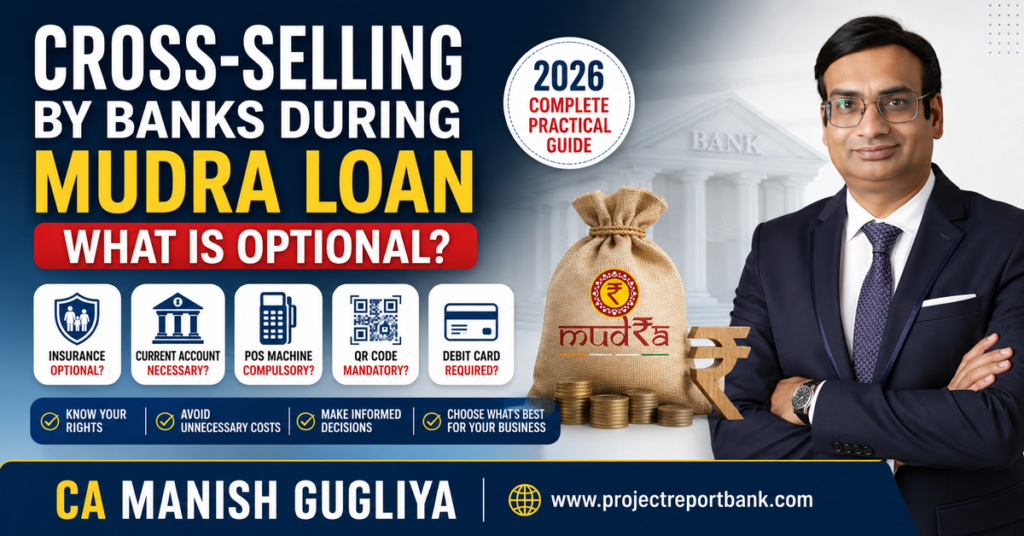
When you walk into a bank for a Mudra loan, you expect to discuss your business, submit documents, and walk out with funding. Instead, many entrepreneurs find themselves sitting through pitches for insurance policies, credit cards, POS machines, and mutual funds. If you have ever wondered which of these products you actually need and which ones are purely optional, this guide will give you straight, practical answers based on years of real consulting experience.
Key Takeaways
Banks commonly offer extra products like insurance, current accounts, debit cards, credit cards, POS machines, QR codes, fixed deposits, and mutual funds during Pradhan Mantri Mudra Yojana processing. Most borrowers cannot tell what is compulsory from what is optional. This confusion sometimes leads to unnecessary expenses or reduced working capital.
Here is what you need to know upfront: the sanction or rejection of a Mudra loan under Shishu, Kishore, Tarun, or Tarun Plus categories should primarily depend on your business viability, repayment capacity, satisfactory credit track record, and proper documentation – not on whether you buy extra banking products.
MUDRA loans are classified into four categories: Shishu, Kishore, Tarun, and Tarun Plus. These categories cover loans from upto rs 50,000 all the way to ₹20 lakh for micro enterprises engaged in non-farm activities.
A quick overview of typical cross-sold items:
| Product | Status |
|---|---|
| Business Insurance | Usually optional, but recommended for sizeable assets |
| Current Account | Generally useful for active businesses |
| Debit Card | Usually optional |
| Credit Card | Purely choice-based |
| POS Machine | Usually optional |
| QR Code | Generally useful and low-cost |
| Fixed Deposit from loan funds | Should be avoided |
| Mutual Funds / SIP | Purely choice-based |
You always have the right to ask: “Is this compulsory under Pradhan Mantri Mudra Yojana guidelines, or is it optional?” If the answer is not clear, ask for written clarification.
A balanced approach works best. Do not fight with the bank, but do not blindly sign for every product. Decide based on your business needs and total yearly cost.
Table of Contents
Understanding Mudra Loan and Cross-selling (Simple Introduction)
Since 2015, I have seen hundreds of entrepreneurs come back from banks saying, “Sir, Mudra loan to mil raha hai, par insurance, card, FD sab lene ko bol rahe hain – kya karein?” This is one of the most common concerns I hear during Mudra loan consultancy.
Let me quickly recap the basics. The scheme was launched on April 8, 2015, to improve access to institutional credit for small enterprises. Under Pradhan Mantri Mudra Yojana, the government provides financial assistance through collateral-free business loans to non-farm micro units. Shishu loans provide up to ₹50,000. Kishore loans range from ₹50,001 to ₹5 lakh. Tarun loans are available from ₹5 lakh to ₹10 lakh. Tarun Plus loans range from ₹10 lakh to ₹20 lakh, available to those who have successfully repaid previous loans under Tarun. No collateral is required for loans up to ₹10 lakh.
Mudra loans are available up to ₹20 lakh for eligible businesses. Applicants must be aged between 18 to 65 years. Eligible businesses include shop owners, vendors, and service providers. Agricultural activities are not eligible for Mudra loans. Interest rates for Mudra loans are generally lower than traditional loans. You can apply for a Mudra loan online, or offline through banks, NBFCs, or MFIs. The application process can be completed online or offline.
Mudra is meant for income-generating activities – shops, traders, small manufacturing, food processing, services, trading, and similar proposed activity areas. This is exactly why banks see every Mudra borrower as a potential long-term “business banking” customer. Mudra loans serve as an entry point for banks to offer additional products.
Cross-selling in banking simply means that when you come for a Mudra loan, the bank or financial institution offers you additional products – insurance, cards, digital services, accounts – alongside the loan. Cross-selling itself is not illegal or always bad. Some products genuinely help. A current account helps a busy shop. Business insurance protects a factory. The problem starts when the borrower assumes everything is compulsory when it is actually optional.

Here is a realistic example. A grocery shop owner applying for a ₹3 lakh Kishore loan in 2026 is offered a current account, QR code, POS machine, and personal accident insurance – all on the same day. The shop owner does not know what to choose, what to refuse, or whether refusing will delay the loan.
If you want to understand the basics of eligibility criteria, documents, interest rate, and security requirements, I suggest reading the guide on documents required for Mudra loan and the article explaining whether a bank can legally ask for security in a Mudra loan.
This guide will act as your practical checklist to navigate cross-selling by banks during Mudra loan processing without disturbing your relationship with the bank.
What Is Cross-selling by Banks During Mudra Loan?
Cross-selling during a Mudra loan happens when a bank uses your loan interaction to offer other products – insurance, deposits, cards, and digital solutions – either at the time of application, sanction, or disbursement. Cross-selling financial products during the Mudra loan application can benefit both banks and customers when done transparently.
In real life, this looks like the banker filling your Mudra loan form and casually saying, “Sir, saath hi ek personal accident policy karwa lein, ek current account bhi khol dete hain, POS laga dete hain – aapko bhi fayda rahega.”
There is an important difference between genuine financial advice and pure sales:
- Advice means the banker studies your situation, understands your risks, and then suggests a product that fits.
- Cross-selling often means a standard package offered to almost everyone, driven by internal targets rather than individual needs.
Why do banks push cross-selling? Several practical reasons:
- Cross-selling can increase the fee income of banks while increasing customer loyalty
- Banks can generate non-interest income through commissions on cross-sold products
- Banks use cross-selling strategies to build long-term relationships with borrowers
- Cross-selling can enhance customer insights for banks by understanding cash flows better
- Cross-selling allows banks to gather more information on customers for better risk profiling
- Customer retention increases when banks offer multiple relevant financial products
- Using transaction data, banks can offer tailored financial products to Mudra loan borrowers
When done correctly, customers benefit from receiving comprehensive financial solutions tailored to their needs. Cross-selling can improve efficiency for borrowers by providing multiple services in one place. It can also improve financial inclusion for first-time entrepreneurs under the Mudra scheme.
But there are real risks: unnecessary annual fees, duplicate insurance cover, paying for services never used, blocking your loan amount for forced fixed deposits, and complexity in understanding your bank statements.
Expert Tip from CA Manish Gugliya: Always ask the banker to write on paper or email which products are compulsory as per PMMY or bank circular, and which are purely optional. This one step eliminates 80% of later confusion.
Cross-selling should be voluntary and based on customer consent according to RBI guidelines. Whether it becomes useful or costly depends entirely on how wisely you evaluate each product before signing.
Why Do Banks Recommend Extra Products with Mudra Loan?
After preparing hundreds of Mudra project reports, I have seen broadly similar reasons across public sector commercial banks, private banks, small finance banks, RRBs, and cooperative banks for recommending extra products. Let me break these down.
Customer convenience and digital push: Since 2016-17, RBI and the government have encouraged digital payments. Banks want every Mudra borrower to accept QR codes, UPI, and POS machines so that business turnover becomes transparent and trackable. Mobile and internet banking help the borrower monitor EMI payments and cash flow.
Business banking relationship: Banks prefer that all business transactions happen in the same bank where the loan was sanctioned. Hence they push a current account, QR code linked to that account, and sometimes a business debit or credit card.
Risk management and insurance: For secured business loans, banks often insist on asset insurance. For Mudra loans, some banks recommend business insurance, stock insurance, or credit life cover. Cross-selling products can mitigate risk for banks by providing insurance alongside loans.
Fee-based and third-party income targets: Many banks have yearly targets for selling insurance, mutual funds, SIPs, and credit cards. Staff performance appraisals sometimes depend on these numbers, which is why they appear so insistent. Banks treat every borrower as a potential source of fee income.
| Product | Primary Purpose | Benefit to Bank | Possible Benefit to Borrower |
|---|---|---|---|
| Current Account | Business transactions | Higher CASA base, monitoring | Clear records for GST, tax, future credit |
| QR Code | Digital payments | Account activity, digital push | Instant payments, no change needed |
| Business Insurance | Risk cover | Loan asset protection | Protection against fire, theft, loss |
| Fixed Deposit | Savings | Term deposit base | Safe returns on surplus funds |
| SIP / Mutual Funds | Investment | Commission income | Long-term wealth (if suitable) |
The presence of targets does not automatically make a product bad. Some targets align with genuine needs – for example, making sure every Mudra borrower has basic SMS alerts and mobile banking activated is genuinely helpful.
Expert Tip from CA Manish Gugliya: Politely ask the banker: “Agar main yeh product nahi leta hoon, to bhi mera Mudra loan normal process se ho jayega na?” The response will tell you everything you need to know.
Now let me break down each commonly cross-sold product so you can decide what fits your business.
Detailed Guide to Common Products Cross-sold During Mudra Loan
From 2016 to 2026, in my practice I have repeatedly seen the same 15–18 products offered during Mudra loan processing across banks, especially for loan amount between ₹1 lakh and ₹10 lakh.
Each product below covers: what it is, why banks promote it, who should consider it, who may avoid it, and questions to ask. The explanation is based on real cases handled in my consultancy, so you can relate to actual branch-level practice rather than only reading mudra scheme rules.
Charges, terms, and compulsion can vary between banks and even branches. Always confirm with your own banker and ask for a copy of the relevant circular.
| Product | Usually Optional? | Typical Users | Key Point Before Saying Yes |
|---|---|---|---|
| Business Insurance | Optional but recommended for sizeable assets | Manufacturers, medical stores | Check coverage vs. premium |
| Personal Accident Insurance | Optional | Traders, delivery-based businesses | Check existing cover |
| Credit Life Insurance | Optional (some banks push hard) | All categories | Check impact on net disbursement |
| Current Account | Generally expected for active businesses | Shops, restaurants, manufacturers | Compare minimum balance charges |
| Debit Card | Optional | All | Check annual fees |
| Credit Card | Purely optional | Established businesses only | Understand interest rate |
| POS Machine | Optional | High-transaction retail shops | Check MDR and rental |
| QR Code | Optional but highly useful | Almost everyone | Usually free or very low cost |
| FD from loan funds | Should be refused | None (avoid this) | Reduces working capital |
| SIP / Mutual Funds | Purely optional | Stable businesses only | Market risk, not guaranteed |
Simply saying “I will think about it and confirm in 1–2 days” is perfectly acceptable before agreeing to any product.
Business Insurance (Fire, Burglary, Stock and Asset Cover)
Business insurance covers your shop premises, furniture, fittings, machinery, and stock against fire, theft, burglary, and natural calamities. Products like business insurance can provide a safety net for micro-entrepreneurs.
Banks promote it because it protects financed capital assets and reduces loss risk. In some cases, internal bank guidelines require asset insurance when machinery value exceeds a certain threshold.
Who should consider it: Manufacturing units with machinery above ₹2–3 lakh, medical stores with high-value stock, restaurants with expensive kitchen equipment, beauty parlours with imported machines.
Who may skip: Very small shishu loans borrowers with minimal stock, home-based tailors or freelancers with mainly service income and low physical assets.
Questions to ask: What exactly is covered? What is excluded? What is the sum insured? Premium per year? Claim process? Is GST extra?
In my experience, a small manufacturing unit in Rajasthan with a ₹7 lakh Tarun Mudra loan for machinery benefited enormously when water damage occurred – those with proper insurance survived, those without struggled badly.
Personal Accident Insurance
Personal accident insurance is a low-premium policy that pays a fixed sum if the insured suffers death or permanent disability due to an accident. Banks bundle it because it is a low-ticket, high-volume product.
For many individual borrowers – auto repair shop owners, delivery-based traders, small traders who travel frequently – accident risk is real. A ₹2–5 lakh accident cover for a tea stall owner travelling daily by bike for purchasing milk and supplies could meaningfully help the family in worst-case scenarios.
Disadvantages: There may be overlapping cover in existing life or health policies. Some policies auto-renew and debit the account yearly without the borrower remembering.
Questions to ask: Exact coverage amount, accident definition, yearly premium, debit method, and whether nomination is properly recorded.
Usually personal accident cover is optional. But in my professional opinion, a reasonably priced policy is often worth considering for self-employed persons with no other cover.
Life Insurance (Including Credit Life Linked to Loan)
Life insurance pays a sum to your nominee if you die during the policy term. Credit life is a special type where the cover amount roughly equals the outstanding loan extended, so the loan can be repaid from insurance in case of death.
Banks push credit life because it protects their exposure and also protects the family from loan burden. There are important differences:
- Pure term life insurance bought independently is often cheaper per lakh cover
- Single-premium credit life tied to the Mudra loan has its premium sometimes added to loan amount
- Traditional endowment or ULIP policies mix savings and insurance and are usually expensive
One mistake I frequently notice: many Mudra borrowers already have life insurance from LIC or private insurers. Buying another high-premium policy just because of the loan may not be necessary unless total cover is clearly inadequate.
Warning: Taking a large single-premium policy deducted from the loan amount means you receive less working capital than sanctioned. For example, on a ₹5 lakh Kishore loan where bank insists on an ₹80,000 single-premium policy, your net disbursement drops to ₹4.20 lakh – and your business suffers from day one.
Questions to ask: Is this compulsory as per bank policy? What is the premium and mode? Can I use any insurer or only the tie-up company? What happens if I pre-close the loan? Is the policy assigned to the bank?
Adequate life cover is important for every enterprise owner, but it is usually better to plan life insurance separately based on family needs rather than purely as a loan condition.
Current Account
A current account is a business-focused bank account with no interest but higher transaction limits, cheque book, overdraft eligibility, and easier GST and payment handling.
Banks encourage Mudra borrowers to open a current account for monitoring business turnover, routing EMI payments, and deepening the relationship. For businesses with daily customer transactions, business registration with GST, and suppliers’ NEFT payments, a current account is practically necessary regardless of the Mudra loan.
Charges to watch: Quarterly average balance requirements, non-maintenance penalties, cheque book charges, and other legal entity documentation fees.
- Grocery shops, medical stores, restaurants – usually benefit from current account
- Very small home-based workers with limited monthly transactions may manage with a savings account
Expert Tip from CA Manish Gugliya: Even if the bank opens a current account, actively use it for business receipts and payments. This builds a strong transaction history that helps enormously when you submit your business plan for future loan enhancements.
Savings Account
Smaller Mudra loans, especially Shishu and lower-range Kishore, are sometimes linked to a simple savings account rather than a current account, particularly for tiny traders and street vendors.
If you already have a well-operated savings account in the same bank, it may be possible to link the Mudra loan to that account instead of opening another one, subject to KYC and internal rules.
Advantages: Familiar account, passbook facility, some interest on balance, lower charges.
Disadvantages: Limited free transactions, restrictions on cash deposits, and mixing personal and business transactions complicates bookkeeping and tax filing.
For very small weekly-income businesses like tea stalls or home tiffin services, initially operating through a savings account may be fine. But once turnover increases, shifting to a clear business account is better.
Debit Card
A debit card is linked to your account for ATM withdrawals, POS swipes, and online payments. Banks almost automatically issue debit cards with new accounts, and staff may present it as mandatory without clearly stating the annual fee.
Advantages: Easy cash access, online payment facility for purchasing supplies, UPI linking.
Disadvantages: Annual maintenance charges, extra charges for ATM withdrawals beyond limits, risk of misuse if lost.
In most cases, a debit card is not strictly compulsory for Mudra loan sanction. Borrowers who rarely use ATMs or shop online can weigh cost-benefit before accepting. Ask about yearly charges including GST, and whether you can opt for a basic RuPay card with lower fees.
Credit Card
A credit card means the bank offers a spending limit; you use the card and pay the bill later. If you delay or pay partly, high interest is charged – often 30–40% per annum.
Many banks try to cross-sell credit cards to Mudra borrowers, positioning them as “business credit card” and highlighting reward points while downplaying the interest rate.
Potential advantages: Short-term working capital for urgent stock, building credit history if bills are paid in full on time.
Strong disadvantages: High interest, late payment fees, over-limit charges, and the risk of revolving debt for small shops with fluctuating cash flow.
During Mudra loan consultancy, I always advise first-time entrepreneurs to be very cautious before accepting any credit card. A tailoring shop owner who used the credit card to buy personal items instead of business expenses, then struggled with EMIs and card dues, is a scenario I have seen repeatedly.
POS Machine (Card Swipe Machine)
A POS machine lets customers pay via debit or credit card at your shop. Money settles into your account after deducting the MDR (merchant discount rate) fee.
Useful for: Restaurants, medical stores, electronics shops, garment showrooms, mid-size grocery stores where the average bill per customer is relatively high.
May not be necessary for: Tea stalls, small vegetable vendors, street food carts, tiny kiosks where almost all customers pay via cash or UPI QR.
Charges to watch: Monthly rental or zero-rental but higher MDR, settlement time, and minimum monthly transaction commitment.
POS machine is almost always optional for Mudra loan approval. Many borrowers accept one assuming it is free, later discovering monthly charges even when they rarely use it.
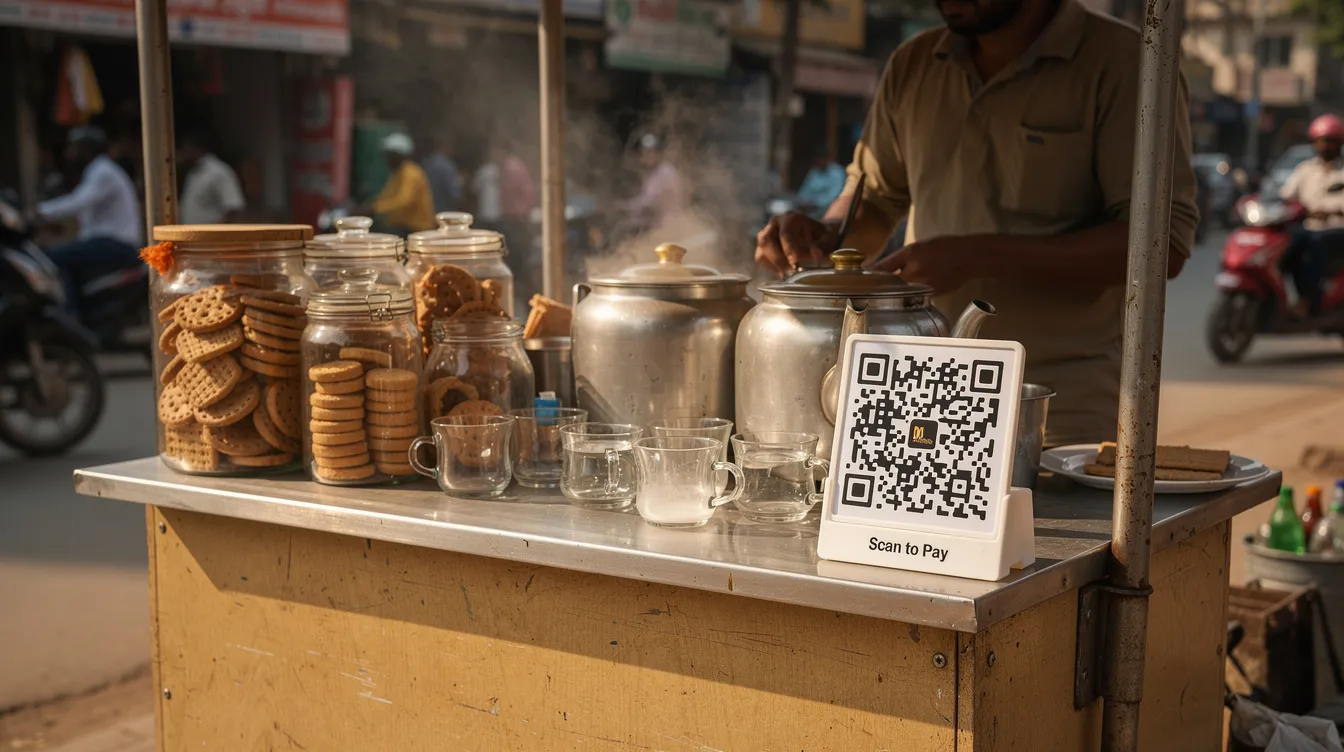
QR Code for UPI / Digital Payments
A QR code is a printed code that customers scan with apps like BHIM, PhonePe, Google Pay, or Paytm to send money directly to your bank account.
Banks love issuing QR codes because it improves account activity, promotes digital payments, gives clear proof of business turnover, and usually has very low or zero charges for small merchants.
Major advantages: Instant receipt of money, no need to keep change, better safety than handling lots of cash, and transaction history useful for future higher loan proposals.
A 2026 chai tapri near a college using QR for student payments can easily track daily sales without manual notes.
Among cross-sold products, QR code is usually one of the most beneficial and least risky. In my consulting practice, I generally encourage eligible borrowers and micro-entrepreneurs to adopt it, provided charges are nominal.
Internet Banking
Internet banking gives you online access to your account through a computer or mobile browser to view balance, download statements, and make transfers via NEFT, RTGS, or IMPS.
Advantages: Saves time by avoiding branch visits, easy vendor and salary payments, quick GST and tax payments, and downloadable statements for your CA when preparing books or filing returns.
Risks: Phishing, password sharing, logging in from public devices. Basic cyber security knowledge is essential.
Internet banking is usually free or low cost and generally useful for any growing enterprise.
Mobile Banking
Mobile banking uses the bank’s official app to check balance, pay suppliers, approve UPI transactions, and manage QR receipts from your smartphone.
Benefits: Quick view of transactions, immediate alert of EMI debit, easy fund transfers even after branch hours.
Safety checklist:
- ✔ Update app regularly
- ✔ Never share OTP
- ✔ Use strong phone lock
- ✔ Log out after use
- ✔ Immediately block if phone is lost
Mobile banking activation is usually optional but highly recommended in my professional experience.
SMS Alerts
SMS alerts send a message whenever there is a debit, credit, or other important activity in your account. Many banks charge a small quarterly or yearly fee.
The strong security benefit: immediate detection of unauthorised withdrawals, cheque misuse, or wrong transfers. This helps even borrowers who do not use mobile banking apps.
In my experience, SMS alerts are one of the few small charges that actually save more money than they cost by preventing fraud or catching errors early.
Locker Facility
A bank locker is a rented safe storage space inside a bank vault for jewellery, documents, and valuables. Some banks casually offer lockers to good Mudra borrowers as a cross-sell.
Locker is 100% optional and not in any way linked to Mudra loan eligibility or approval. Take it only based on personal and family need for safe storage. Yearly rent and limited access hours are the main considerations.
Fixed Deposit (FD)
A fixed deposit means keeping a lump sum with the bank for a fixed period at a fixed interest rate. There are two very different uses:
- Voluntary FD as savings or emergency fund from your own surplus
- FD “encouraged” by bank from part of the Mudra loan itself to increase their deposit base
I always advise my clients: never allow the bank to create an FD out of your Mudra loan disbursement. This directly reduces actual working capital available to the beneficiary micro unit. Under the mudra scheme, loan funds should be used strictly for business needs – stock, machinery, working capital – and not locked into long-term instruments.
Questions to ask: Source of money for FD (own savings or loan funds), lock-in period, interest rate, penalty on premature closure, and whether the FD is lien-marked for any purpose.
Expert Tip from CA Manish Gugliya: If a bank insists on creating an FD from your loan disbursement, politely ask for the written circular requiring this. In most cases, no such circular exists for standard Mudra loans.
SIP (Systematic Investment Plan)
An SIP is a fixed amount invested every month, usually into mutual funds, aimed at long-term wealth creation. Some bank branches promote SIPs to Mudra borrowers who maintain good balances.
SIPs involve market risk. Value can go up or down. They are not guaranteed like fixed deposits and should not be funded from money needed for daily working capital or EMI payments.
Who might consider: Entrepreneurs with stable cash flow, basic understanding of market risk, and clarity that SIP is for long-term goals.
Who should avoid at this stage: First-time borrowers still stabilising their business, or those struggling with existing debts.
Mutual Funds (Lump Sum or Other Schemes)
Mutual funds are pooled investments in stocks, bonds, or a mix, managed by professionals. Returns are market-linked, not guaranteed. In some banks, relationship managers are incentivised to sell mutual funds to all high-activity customers, including Mudra borrowers.
Mutual fund investment should be treated as a separate financial planning decision and never mixed with the purpose of the Mudra loan, which is strictly for business working capital or assets created for the enterprise.
Advise: First stabilise business cash flow, build emergency reserves, and maintain clean EMI payment track for at least 1–2 years before committing substantial amounts.
Other Banking Products
Other items sometimes pitched include health insurance tie-ups, top-up or second business loans, overdraft facilities, business credit lines, and packaged “combo” offers combining insurance, cards, and services.
Overdraft limits and working capital lines can genuinely support growing businesses but require strong discipline as interest is charged daily on the utilised amount.
Before accepting any additional credit line beyond Mudra, create a simple cash flow plan with your CA to check whether the business can safely repay both the Mudra EMI and extra borrowing. This is something I always advise my clients to do before signing any form.
How to Decide What Is Optional and What Is Useful (Practical Framework)
In my consulting practice, I use a simple 4-step test with every Mudra borrower to decide on any cross-sold product:
- Is it compulsory by written rule? Ask to see the circular.
- Does it fit my business type and size? A POS machine makes no sense for a home-based tiffin service.
- What is the total yearly cost? Include all fees, GST, maintenance, and renewal charges.
- Is there an immediate or long-term benefit for me? If neither, decline politely.
Before Accepting Any Banking Product – Checklist
- ✔ Understand the purpose of the product
- ✔ Ask all charges including GST and annual fees
- ✔ Ask if loan sanction depends on this product
- ✔ Check if you already have similar cover or service
- ✔ Clarify how to cancel later if not needed
- ✔ Get photocopy or email of all forms you sign
- ✔ Confirm whether refusal will delay loan processing
- ✔ Ask if you can choose any provider (for insurance, mutual funds)
Sample Polite Conversations
Asking about insurance:
“Thank you for explaining this insurance. Could you please help me understand – is this compulsory under PMMY guidelines, or is it your bank’s recommendation? Also, what are the exact charges and coverage details?”
Requesting time:
“I appreciate the suggestion. I would like to discuss this with my CA and confirm in a day or two. Will that be okay?”
Confirming optionality:
“If I decide not to take this product right now, will my Mudra loan processing continue normally?”
Expert Tip from CA Manish Gugliya: Tone and politeness matter more than arguments. Calm, clear questions usually work far better than confrontation. Written clarification is always more reliable than verbal promises from any bank or financial institution.
Practical Scenarios
Grocery shop (₹3 lakh Kishore loan): I would normally recommend current account, QR code, SMS alerts, and mobile banking. I would decline POS machine (most customers pay cash or UPI), credit card, mutual funds, and FD from loan funds. Business insurance depends on stock value – if stock exceeds ₹1–2 lakh at any time, a basic fire and theft policy makes sense.
Beauty parlour (₹5 lakh Tarun loan): QR code, current account, and equipment insurance are useful. POS machine can be considered if clientele is affluent. SIP and mutual funds should wait until business is stable for at least a year.
Small manufacturer (₹8 lakh Tarun loan): Current account, business insurance covering loans for machinery, internet banking, and mobile banking are practically necessary. Credit life insurance should be evaluated carefully. POS and credit card are likely unnecessary.
Decisions can change over time. You may decline POS today but adopt it after business expands. That is normal business evolution, not a mistake.
Real-life Mistakes, Expert Tips, and How to Maintain Good Relations with the Bank

Here are anonymised stories from my practice:
Story 1: A grocery shop owner in Uttar Pradesh took a ₹3 lakh Kishore loan. The bank manager asked him to buy personal accident insurance, open a current account with ₹10,000 minimum balance, get a POS, and link QR – all on the same day. The insurance premium of ₹5,000 was deducted from the loan, reducing actual working capital without the borrower realising until later.
Story 2: A small tailor in Rajasthan was offered business insurance at a premium that seemed disproportionate to assets worth barely ₹30,000. She refused insurance but accepted QR and mobile banking. The loan was processed without any delay. No one forced insurance.
Story 3: A borrower at a private bank discovered that a POS machine was installed with a monthly rental. For two years, the machine sat unused while the account was debited ₹300 every month.
Common Mistakes to Avoid
- Assuming every product offered is compulsory for the loan
- Ignoring annual charges that quietly accumulate
- Not checking whether existing insurance or other documents already cover the same risk
- Accepting products just to “please” the branch staff
- Signing forms without reading or understanding details
- Allowing loan funds to be diverted to FD or investment products
Corrective Actions
- Request policy copy and schedule of charges before signing
- Examine your first bank statement after loan disbursal carefully
- If a product was added without explicit consent, raise the issue with the branch manager immediately
Expert Tip: Always note down names and dates of discussions with bank staff. This simple habit protects you if any dispute arises later.
Expert Tip: Never allow loan funds to be locked into long-term investments. Your mudra loans are for running the business – stock, machinery, and working capital.
Expert Tip: Check your CIBIL report yearly. Your credit history as an applicant with a satisfactory credit track record is your most valuable asset for future funding.
Expert Tip: Route maximum business transactions through your loan-linked account. This builds proof of healthy cash flow and makes your next loan application much stronger – whether it is assessed based on turnover or profitability.
Expert Tip: Involve your CA when you receive any document that you do not fully understand. This small step can save unnecessary expenses.
If you feel pressured, escalate politely: speak to the branch manager, then the regional office or customer care. Only as a last resort, use formal complaint channels. If your loan was rejected or delayed because you refused an optional product, read the guidance on common reasons for Mudra loan rejection and how to appeal after a Mudra loan rejection for structured next steps.
The RBI’s Responsible Business Conduct Directions of 2026, effective from January 1, 2027, explicitly ban compulsory bundling and dark patterns in digital interfaces. After this date, banks cannot make loan approval dependent on purchasing another product. Borrowers must give explicit consent for each product separately. In case of mis-selling, full refund plus compensation must be provided.
Most bank officials respond well when the borrower is serious, organised, and clear about requirements. Preparation and proper documentation – identity proof, other documents, business registration, rent agreement, educational qualification details where applicable, and a solid business plan – speak louder than debate on cross-selling. The reference point for any discussion should always be: does this product genuinely help my enterprise?
Frequently Asked Questions on Cross-selling by Banks During Mudra Loan
These FAQs are based on questions repeatedly asked by small business owners, shopkeepers, women entrepreneurs, and youth during my Mudra loan consultancy sessions. Answers reflect general banking practice. Specific policies can differ among banks, so always verify with your own branch.
Is insurance mandatory for a Mudra loan, or can I refuse it?
Under the general Mudra loan framework, collateral-free lending does not automatically make any specific insurance policy compulsory. Loans under Mudra scheme are collateral-free, and the official PMMY guidelines do not mention mandatory insurance. Individual banks may have internal guidelines for asset insurance above certain loan amounts, but personal accident or life insurance is usually optional. Refusal should not be a reason to deny a genuinely eligible Mudra loan. As insurance experts have confirmed, no regulator requires customers to buy any insurance plan to get a loan approved. Politely ask the bank to show any written circular that makes insurance mandatory – if none exists, treat it as optional and decide based on your business needs.
Will my Mudra loan be rejected if I say no to a credit card, POS machine, or mutual fund?
Products like credit cards, POS machines, and mutual funds are typically pure cross-selling items. They do not form part of the core eligibility criteria for Pradhan Mantri Mudra Yojana. In my professional experience, when borrowers firmly yet politely decline such products and keep their proof of identity, business plan, and all required documents complete, most Mudra loans get processed normally. The mudra stands as a refinance agency supporting micro units development through lending institutions. If any staff member links approval directly to these optional products, request a short discussion with the branch manager and ask for written confirmation. This itself usually resolves the issue.
Should I open a current account in the same bank for my Mudra loan even if I already have accounts elsewhere?
Many banks prefer business transactions to flow through the same financial institution from where the Mudra loan is taken, as it helps them monitor turnover and repayment capacity. Practically, for medium and growing businesses – especially those in food processing, manufacturing, or active trading – having the main current account with the lending bank can be beneficial for future enhancements. Compare charges and convenience. If the new current account offers reasonable terms, it often makes sense to route the majority of business transactions through that account. For very small enterprises or non corporate businesses with minimal transactions, discuss with your banker whether linking the existing savings account is acceptable.
How can I know whether a suggested product is really suitable for my type of business?
Ask yourself a quick self-test: does the product directly help my daily business operations, risk protection, or long-term financial planning? If the answer is unclear, take time to evaluate. Discuss with an independent advisor or CA who has the necessary skills and knowledge to understand your specific business type. Start with essential, low-risk services – QR code, SMS alerts, basic digital banking – and add more advanced products like insurance, mutual funds, or SIP later once cash flow stabilises and your understanding improves. Every enterprise has different needs. A street vendor and a small factory have completely different risk profiles.
What should I do if I realise later that an unwanted product was added during my Mudra loan process?
First, check your account statements and other documents to confirm what exactly has been added and what charges have been debited. Second, visit the branch and discuss calmly with the officer who handled your file or with the branch manager. Ask whether the product can be cancelled and whether any portion of premium or fees is refundable. Request written acknowledgement of your cancellation request. If a satisfactory response is not received, use the bank’s formal grievance channels. The RBI’s new directions effective January 2027 will strengthen your position further. Going forward, make sure you fully read and clarify every form before signing to avoid this problem. If you are availed of a government subsidy or credit guarantee under any scheme, ensure these are not affected by cancellation of unrelated products. You can always submit a written complaint through the bank’s processing and grievance mechanism.
This article is written by CA Manish Gugliya (FCA, DISA-ICAI), a Chartered Accountant with over 20 years of experience in project reports, CMA data preparation, business planning, Mudra loan consulting, MSME consulting, startup advisory, business valuation, business finance, and bank loan documentation. His mission through ProjectReportBank.com is to provide practical, trustworthy guidance to Indian entrepreneurs navigating the real world of banking and government schemes for micro and small enterprises across India.
- Can Bank Reduce Mudra Loan Amount Without Your Consent? Complete Practical Guide (2026)


- What to Do If You Cannot Pay Your Mudra Loan EMI (2026 Guide)

- Can a Bank Refuse a Mudra Loan Because the Target Is Completed? Complete Guide (2026)

- Bank Refused My Mudra Loan Application – What Are My Rights?

- Mudra Loan for Used Vehicles (2026): Eligibility, Documents, Bank Rules & Complete Guide

- Rejected Mudra Loan – What to Do Next? Appeal Process Explained (2026)

- Mudra Loan Project Report Madhya Pradesh – Bank-Ready DPR & CMA Guide

- Project Report for Mudra Loan Maharashtra: Complete Guide for MSMEs, Startups and Small Businesses (2026)
- Mudra Loan Uttar Pradesh: Complete Guide for MSMEs, Startups and Small Businesses (2026)
- Mudra Loan Bihar 2026: Eligibility, Documents, Online Application Process & Project Report Guide

- Jan Samarth Mudra Loan 2026: Complete Guide to Online Application, Eligibility, Documents & Approval Process

- MSME Mudra Loan: Complete Guide for Small Businesses, Startups & Manufacturing Units in India (2026)
- Is the Mudra Loan Subsidy Real or Fake? Get the Facts Here

- Mudra Loan Without CIBIL Score: How to Qualify and Apply

- Mudra Loan for Used Machine (2026 Guide) – Eligibility, Documents, Valuation & Approval Tips