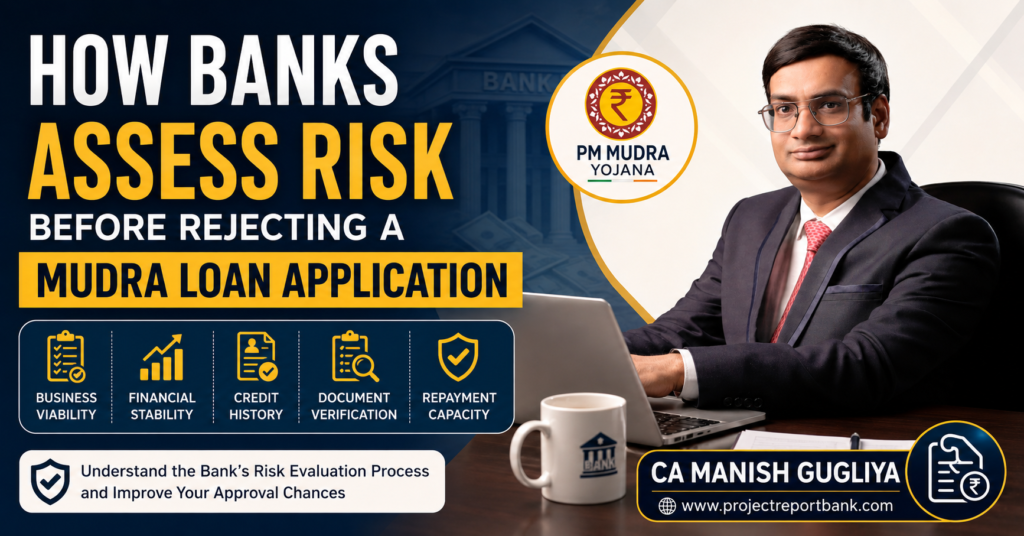
Many applicants believe banks reject mudra loans randomly. In reality, every bank or financial institution follows a structured mudra loan risk assessment process before making a decision. Understanding how banks assess mudra loan risk helps you prepare better, avoid common mistakes, and significantly improve your chances of approval under the Pradhan Mantri Mudra Yojana.
Key Takeaways
Banks evaluate mudra loan applications across multiple risk areas before sanctioning or rejecting. Even though loans up to ₹10 lakh require no collateral security, the assessment is thorough because these are unsecured business loans backed only by future income and the credit guarantee mechanism.
- Banks check business viability, cash flow stability, credit history, documentation accuracy, project report quality, and repayment capacity before approving any loan amount.
- Mudra loans are classified into four categories: Shishu (upto rs 50,000), Kishore (₹50,001 to ₹5 lakhs), Tarun (₹5 lakhs to ₹10 lakhs), and Tarun+ (₹10 lakhs to ₹20 lakhs).
- Many rejections in 2023–2025 resulted from avoidable issues: unrealistic projections, weak project reports, incorrect information, and poor bank statements.
Before applying:
- Prepare all documents with consistent details across KYC, address proof, and business registration.
- Check and improve your CIBIL score and credit behaviour.
- Get a realistic project report prepared for your specific business.
- Understand what to expect during bank interviews and site visits.
Table of Contents
What Is Risk Assessment in a Mudra Loan Under PMMY?
Mudra loan risk assessment is the process through which a lender evaluates whether a borrower can and will repay a collateral-free loan on time. Under the mudra scheme, loans are available for non corporate, non-farm micro and small enterprises – and since these are unsecured, the assessment relies heavily on business strength and the applicant’s financial behaviour rather than assets pledged.
Each bank has its own internal credit policy, but most follow a similar framework: verify the borrower, evaluate the business, review the project, and estimate repayment capacity. This protects both sides – banks must safeguard public deposits and comply with RBI’s MSME lending guidelines, while borrowers are protected from over-borrowing and EMI stress.
The applicant must be an Indian citizen, aged 18 to 65 years, and the purpose of the loan must be for income-generating activities rather than personal expenses. In practice, risk assessment looks like this:
- Analysing 6–12 months’ bank statements for income stability
- Verifying GST and Udyam data online
- Conducting a field visit to the shop or factory
- Cross-checking quotations and business proof

Why Banks Cannot Approve Every Mudra Loan Application
Although the government launched this scheme in April 2015 to provide financial assistance to micro enterprises, commercial banks are not allowed to approve every application just to meet targets. Over ₹6 lakh crore has been disbursed under the mudra scheme so far, and non-performing assets from mudra loans are about 5.2% for SBI – which means credit discipline matters enormously.
The loan is covered under the Credit Guarantee Fund for Micro Units, which protects banks against default, but this guarantee does not remove the bank’s duty to verify business viability and repayment capacity. Banks check that the applicant is not a defaulter to any bank or financial institution before processing the application. Additionally, banks may prioritize larger loans over multiple smaller mudra loans due to the processing effort involved, and MUDRA Ltd (a refinance agency under SIDBI) expects responsible lending from every institution where a loan is extended.
Major Risk Areas Banks Assess in a Mudra Loan
Banks don’t look at just one score. The mudra loan application review covers multiple risk dimensions together – business, financial, credit, documentation, project report, operational, location, industry, repayment, and compliance risk. A borrower may have a strong CIBIL score but a weak business plan, and decisions are assessed based on combined risk.
Business Risk: Is the Mudra Loan Business Idea Viable?
Business risk means whether the proposed activity – trading, manufacturing, service activities, home-based work, or franchise – can realistically generate enough income to cover EMIs. Applicants must demonstrate necessary skills and knowledge to undertake the proposed business activity. Officers look at clarity of business model, target customers, local competition, and demand sustainability.
Shishu loans provide up to ₹50,000 for micro enterprises. Kishore loans range from ₹50,001 to ₹5 lakhs. Tarun loans offer funding from ₹5 lakhs to ₹10 lakhs, while Tarun+ loans provide funding from ₹10 lakhs to ₹20 lakhs – and scrutiny increases with each category.
A mobile repair shop near a busy bus stand has different risk than the same enterprise on an empty side street. Banks evaluate whether the business idea faces excessive local competition before sanctioning.
Financial Risk: Cash Flow, Bank Statements, and Existing Loans
Financial risk is the possibility that actual cash flow will be insufficient to repay EMIs alongside household expenses and other liabilities. Banks typically review 6–12 months’ bank statements, checking average balance, deposit frequency, and returned cheques. Higher amounts of mudra loans require more rigorous financial documentation.
Banks also assess existing banking relationships to evaluate the applicant’s track record. The average sanctioned loan size under mudra was ₹52,706 in 2017-18, which shows most funding goes to very small enterprises where even minor cash flow gaps matter. Red flags include heavy personal loans, frequent nil-balance days, and sudden large deposits just before applying.
Credit Risk: CIBIL Score and Past Borrowing Behaviour
A CIBIL score is a 3-digit number (300–900) reflecting your credit history. A strong personal or business credit history is essential for mudra loan approval, and low CIBIL scores below 650 may result in outright rejection at many branches. However, the CIBIL score is preferred but not mandatory – some banks approve small shishu loans even with thin credit files if the business strength compensates.
Individual borrowers who have successfully repaid previous loans and maintained a satisfactory credit track record get processed faster. To improve your chances, pay existing EMIs on time for 6–12 months, reduce credit card balances, and avoid unnecessary new enquiries before applying.
Documentation Risk: Accuracy and Authenticity
Incomplete documentation can lead to immediate rejection. Documentation risk covers mismatches in KYC, incorrect information on applications, fake invoices, or wrong nature of business declared. Banks now cross-verify PAN, Aadhaar, GST, and Udyam data digitally.
Eligible borrowers include proprietorship and partnership firms, and applicants must register their business on the Udyam portal. Keep a checklist: identity proof, address proof with utility bills, rental agreement where applicable, business registration documents, bank statements, and genuine quotations from registered suppliers.
Project Report Risk: Quality of DPR and Assumptions
For Kishore and Tarun mudra loans, applicants must submit a detailed project report highlighting the economic viability of their business. Banks assess the viability of the business model and the economic life of the assets created through the loan – whether capital assets like machinery will last long enough to generate returns.
Common issues flagged include copy-paste reports, unrealistically high profit margins, and missing expense heads. A professionally prepared project report tailored to your city and line of business carries significantly more weight during the mudra loan project report evaluation.
Operational, Location, Industry, Repayment, and Compliance Risks
Operational risk – Banks evaluate whether the promoter has relevant experience, educational qualification in the field, and basic knowledge of vendor arrangements and billing. Many applicants lack awareness of eligibility criteria, and applicants often face confusion applying as individuals versus businesses.
Location risk – Site visits check whether the beneficiary micro unit actually exists at the declared address. Some loans get rejected after site inspection when the business is not found or the space is inadequate.
Industry risk – Seasonal businesses (festival-only sales, for example) carry higher risk unless supported by off-season income. Micro enterprises engaged in trading, manufacturing, and services are each viewed differently.
Repayment risk – Banks estimate monthly surplus after subtracting all expenses and existing EMIs. If surplus is too thin, the sanctioned amount may be reduced.
Compliance risk – PAN, Aadhaar, Udyam, GST (where applicable), and local licences are now essential. Delays in processing can also occur due to high workloads at banks, and some banks may discourage applications due to processing costs for very small loans.
How Banks Actually Evaluate a Mudra Loan Application Step by Step
While the flow varies across commercial banks, small finance banks, and NBFCs, the overall mudra loan approval process follows this sequence:
- Application submission and initial eligibility check under PMMY (you can also apply online through Jan Samarth portal)
- Document verification and KYC
- CIBIL/credit bureau enquiry
- Analysis of bank statements and income
- Business and project report evaluation
- Field visit or site inspection (especially for new units or larger amounts)
- Internal risk scoring and appraisal note
- Branch manager or credit committee recommendation
- Sanction, amount modification, or rejection
During site inspection, officers verify actual stock, machinery, and premises – not just photographs. If you believe your application was declined without proper review, resources like understanding your rights when a bank rejects without verification can help.

Common Warning Signs That Increase Mudra Loan Risk
From a banker’s desk, certain patterns immediately raise caution:
- Incomplete forms or frequent changes in loan purpose
- Mismatch between declared income and bank statement turnover
- Over-estimated sales in the project report
- Unclear source of margin money or own contribution
- Inconsistent answers during the bank interview, inability to explain basic costs
When multiple risk factors combine – weak CIBIL, poor project report, unstable income – chances of approval drop sharply, as discussed in detail in cases involving multiple risk factors.
In the 3–6 months before applying, avoid heavy cash withdrawals, cheque bounces, covering loans from informal sources, and unnecessary new borrowings.
How to Reduce Risk Before Applying for a Mudra Loan
Many common mudra loan rejection reasons are preventable with 1–3 months of preparation:
- Documentation readiness: Updated KYC with consistent details, Udyam registration, necessary licences, and clean bank statements for 6–12 months
- Financial clean-up: Clear small overdues, regularise EMIs on previous loans, maintain a stable average bank balance, and reduce high-interest debts
- Business plan and project report: Prepare a realistic DPR with conservative sales estimates, proper cost break-up, and clear use of mudra funds (stock, machinery, working capital) – this serves as the reference point for the bank’s entire evaluation
- Personal preparedness: Rehearse answers about your business, pricing, and expenses; be transparent about existing liabilities; keep the business premises ready for site inspection without last-minute artificial arrangements
Practical Case Study: Why One Mudra Loan Was Rejected and Another Approved
Applicant A applied for a ₹8 lakh Tarun loan to open a new garments showroom. No prior business experience, erratic bank statements, a copy-paste project report with inflated sales, and a CIBIL score of 620 with late EMI history. Documents showed name mismatches across Aadhaar and PAN. The bank flagged high business, financial, and documentation risk – the application was rejected.
Applicant B sought a ₹5 lakh Kishore loan to expand an existing kirana store running for 4 years. Consistent bank deposits, proper GST and Udyam registration, a realistic DPR matching local market conditions, and a CIBIL score of 720 with no outstanding defaults. The small enterprise was already operational and verified during site visit. Loan sanctioned as requested.
The contrast is clear: approval is about reducing perceived risk in the banker’s eyes through preparation, proof, and honesty – not just filling out a form.
Expert Advice from CA Manish Gugliya on Navigating Mudra Loan Risk Assessment
In my 20+ years of working with entrepreneurs and micro units seeking finance, I have seen the same patterns repeatedly. Here is what I tell every applicant:
- Start with business viability before chasing loan limits. If the enterprise cannot sustain EMIs, no amount of documentation will save the application.
- Never underestimate bank statements. They are the most honest mirror of your financial health, and bankers read them carefully.
- Treat the project report as a serious financial plan, not a formality. It should reflect your actual costs, realistic interest and income projections, and the next phase of your business growth.
- Be completely honest about existing liabilities. Banks will find them through credit bureaus anyway.
Many rejected mudra loans later get approved – sometimes in the same bank – once issues around documentation, projections, and compliance are fixed. Professional help with project report preparation and understanding bank queries can reduce identifiable risk, though no professional can guarantee approval.
Frequently Asked Questions on Mudra Loan Risk Assessment
These questions address common doubts about mudra loan due diligence and bank verification. Answers reflect typical banking practice up to 2025, but specific rules vary across banks.
Does a low CIBIL score automatically lead to Mudra loan rejection?
Not always. A score below 650 increases credit risk significantly, but some banks may still consider very small shishu loans or cases where business cash flow is strong and the applicant provides proper explanations. I advise obtaining your credit report, correcting errors, clearing old overdues, and waiting 3–6 months to show improved repayment behaviour before applying.
Can a bank reject a Mudra loan without doing a site inspection?
For smaller amounts or simple top-ups, some banks decide based on documents and bank statements alone. For new units or larger Tarun and Tarun+ amounts, site visits are standard practice. If you believe your case was declined without adequate review, you have grievance options – including approaching the bank’s nodal officer or the banking ombudsman.
How many times can I reapply if my Mudra loan is rejected?
There is no fixed legal limit, but each rejection may reflect in internal systems. It is better to first understand the exact reasons in writing, improve the weak areas – whether it is documents, CIBIL, or the business plan – and then reapply with a stronger case, either at the same branch or a different financial institution.
Is a detailed project report always required for a Mudra loan?
Very small shishu loans often need only a simple business plan describing the proposed activity and expected income. Kishore and Tarun loans – especially above ₹2 lakh – almost always require at least a basic DPR. Even when not formally demanded, preparing one helps you think through costs and EMI planning, which directly supports the bank’s assessment of your repayment capacity.
Can a salaried person get a Mudra loan for starting a side business?
Yes. Many banks allow salaried individual borrowers to take mudra loans for genuine micro-business ventures, provided the applicant can show a clear business plan and sufficient surplus income. Repayment capacity is calculated by combining salary with projected business income, and compliance requirements like Udyam registration and local licences must still be met once the enterprise begins operations.
Conclusion: Use Bank Risk Assessment Logic to Strengthen Your Mudra Loan Application
Mudra loan applications are accepted or rejected based on perceived business, financial, and compliance risk – not randomly, and not solely on one factor like CIBIL. Banks follow a structured mudra loan risk assessment framework because these are unsecured loans disbursed from public funds to eligible borrowers across India.
Applicants who prepare realistic project reports, keep clean bank statements, maintain good credit discipline, submit accurate documents, and answer bank queries transparently stand a far better chance of approval. Treat the bank’s risk checklist as your own self-assessment tool before you apply – that shift in perspective is what separates approved applications from rejected ones.
- Roller Flour Mill Setup Cost in India: Professional Investment & Project Cost Guide


- Poha, Puffed Rice & Value-Added Rice Products Project Report & Processing Opportunities

- Integrated Value-Added Rice Products Processing Plant Project Report & DPR

- Integrated Rice Plant Bank Loan, Feasibility, ROI, IRR, Payback & Sensitivity Analysis

- Integrated Rice Processing Plant Financial Projections, Working Capital & DSCR

- Integrated Rice Products Revenue Model, Market Strategy & Profitability

- Integrated Value-Added Rice Plant Project Cost & Means of Finance

- Raw Material Procurement & Inventory Planning for Integrated Value-Added Rice Plant

- Common Utilities, Warehousing, Packaging & Material Handling for Integrated Rice Plant

- Integrated Rice Processing Plant Land, Building & Multi-Line Plant Layout – A Practical Guide for DPR & Bank Finance

- Integrated Rice Processing Plant Capacity Planning & Product Mix

- Integrated Value-Added Rice Plant Machinery & Equipment Cost – A Practical DPR-Oriented Guide

- Integrated Poha, Puffed Rice & Rice Snacks Manufacturing Process & Line Integration

- Instant Poha Manufacturing Plant Project Report & DPR – Bankable Guide by Project Report Bank

- Ready-to-Cook Rice Breakfast Mixes Manufacturing: Products, Process & Plant Setup