Key Takeaways
Most Mudra loan rejections for manufacturing and processing units happen because the machinery cost shown in the project report and quotations looks fake, inflated, or unrealistic to the bank – even when the applicant is otherwise fully eligible with a good CIBIL score and proper KYC.
Here is how banks actually check your machinery quotations and why getting them wrong leads to a mudra loan rejected due to machinery cost:
- Online price comparison: Bank officers quickly search manufacturer websites, IndiaMART, and similar portals to verify whether your quoted machinery price is in the normal market range.
- GST portal verification: Banks check the supplier’s GSTIN on the government GST portal to confirm the business actually exists at the address shown on the quotation.
- Direct supplier calls: Credit officers often call the phone number printed on the quotation, ask for the machine’s current price, and compare it with what you submitted.
- Internal benchmarking: Experienced branch managers compare your quotation with recently sanctioned Mudra proposals in the same industry and region.
- Cross-checking with DPR: Every figure in your quotation is matched against your Detailed Project Report – any mismatch in totals, tax calculations, or specifications triggers suspicion.
Typical examples that lead to instant rejection:
- Applicant quotes ₹12 lakh for an automatic pouch packing machine that normally sells for ₹6–7 lakh from reputed Indian manufacturers.
- Machinery quotation shows GST amount but no GSTIN of the supplier – bank cannot verify whether the supplier even exists.
- Three “different” supplier quotations all carry the same mobile number and Gmail address, suggesting the borrower created them.
- Project report shows machinery cost of ₹8.50 lakh, but the sum of all attached quotations is only ₹6.20 lakh – clear mismatch.
In this guide, you will learn exactly how to prepare correct machinery quotations, estimate total machinery cost properly, match it perfectly with your Mudra project report, and what practical steps to take if your loan application has already been rejected due to machinery cost issues.
Table of Contents
Introduction: Why Machinery Cost Can Get Your Mudra Loan Rejected
Let me share something I see regularly in my practice. In 2025, a young entrepreneur from Madhya Pradesh applied for a Kishore mudra loan of ₹4.5 lakh to buy a semi-automatic packaging machine for his spice business. His credit history was clean, CIBIL score was 740, KYC documents were perfect, Udyam registration was done, and he had a running proprietorship firm with a rental agreement for his shop. On paper, everything looked ideal.
Yet, his loan application was rejected.
The only reason noted in the bank’s internal sanction memo? “Machinery quotation appears inflated – supplier not traceable on GST portal – project cost not realistic.”
This is not a rare case. Under Pradhan Mantri Mudra Yojana (PMMY), also known as mantri mudra yojana pmmy, banks treat machinery quotations as “high-risk” documents. The reason is simple – the quoted machinery price directly determines your total project cost, your EMI, your repayment capacity, and ultimately whether the bank’s money is safe.
Mudra loans are provided by public sector banks, private sector banks, regional rural banks, small finance banks, cooperative banks, non banking financial companies, and micro finance institutions. The scheme covers four mudra loan categories: Shishu loans offering up to ₹50,000 for new businesses, Kishore loans ranging from ₹50,001 to ₹5 lakh for growing businesses, Tarun loans providing ₹5 lakh to ₹10 lakh for established businesses, and Tarun Plus loans ranging from ₹10 lakh to ₹20 lakh for repeat borrowers. Eligibility includes non-corporate, non-farm micro and small enterprises. A CIBIL score above 700 improves Mudra loan approval chances, and Udyam registration enhances credibility for applications.
Even technically eligible borrowers – with good CIBIL, proper business proof, correct business type, and clean bank statements – face rejection if:
- Machinery quotation prices are inflated compared to actual market rates
- Supplier details on quotation cannot be verified
- Quotation figures do not match the project report
- Quotation appears copied from internet or edited digitally
- Business activities are not eligible under PMMY guidelines
This guide covers everything: why banks verify machinery costs, common quotation mistakes, how banks catch fake or edited quotations, how to prepare genuine quotations, how to align your quotation with a Mudra project report, and recovery steps if your mudra loan was rejected due to incorrect project cost.

What Are Machinery Quotations in a Mudra Loan Proposal?
A machinery quotation is a written price offer from a real supplier for a specific machine. It mentions the make, model, capacity, rate, applicable taxes, delivery terms, and validity period. The bank or financial institution uses this document to fix the project cost and decide your loan amount.
Here is why banks ask for quotations:
- To confirm the machine actually exists and is currently available in the market
- To verify that the price is realistic and in line with current market rates
- To help determine how much business loan the applicant truly needs
- To support the business plan and DPR machinery cost estimation
- To calculate the EMI and check if the borrower can repay
There is an important difference between a rough “estimate” and a formal “quotation.” An estimate is approximate and often verbal – a dealer might tell you over the phone, “This machine will cost around ₹2–2.5 lakh.” A quotation, on the other hand, is a printed document on the supplier’s letterhead, signed, with complete GST details, a validity date, and exact pricing. Banks prefer a formal quotation or proforma invoice – not just a verbal estimate.
A supplier quotation shows the proposed selling price with terms and conditions. A proforma invoice goes a step further – it is almost like a bill issued before payment, often used when the buyer needs to arrange financing first. Both are acceptable for mudra loan applications if they are complete and genuine.
For loans above ₹50,000, documentation must include a business plan. Mudra loans can finance machinery purchases for small businesses and can be up to ₹20 lakh for eligible borrowers. Under Kishore and Tarun loan category requirements, banks usually expect at least one detailed machinery quotation for every major machine listed in the project report.
Why Banks Verify Machinery Costs So Strictly in Mudra Loans
Although Mudra loans are a government backed scheme with collateral free lending and no collateral security requirements, the bank or lending institution still carries the full credit risk. If the borrower defaults, the bank loses money. That is why every financial institution verifies machinery cost thoroughly before giving loan approval.
Here are the main reasons banks scrutinise machinery costs:
- Preventing loan misuse: Some applicants take money under the “machinery” head but divert it for personal expenses, trading, or unrelated activities. Verified quotations reduce this risk.
- Stopping inflated project reports: Inflated machinery cost means artificially higher project cost, which means the applicant requests a bigger loan amount than genuinely needed. Applying for unjustified loan amounts can trigger rejection.
- Verifying borrower’s own contribution: Most banks require margin money of 10 to 15 percent of machinery cost. If the machine price is fake, the margin calculation is also wrong.
- Checking EMI affordability: A detailed project report is necessary to explain how machinery will generate income. If the machine cost is inflated, the projected EMI becomes unrealistically high compared to actual business income.
- Avoiding future NPAs: A clear business plan is required for Tarun category loans. Mudra loan applications can be rejected due to inadequate financial viability if costs do not add up.
- Audit and compliance: Banks face internal audit and Reserve Bank inspection. Every sanctioned file must justify the machinery cost with proper documentation.
- Lack of a clear business plan combined with questionable machinery costs results in loan denial.
A credit officer reads your quotation alongside the DPR or Mudra project report. They compare machine capacity with your projected production volume, verify the number of machines, and check whether transportation and installation charges look proportionate.
Quick example: An applicant quoted a 5 HP atta chakki unit at ₹3.75 lakh. The bank officer searched online and found that the same capacity machine from reputed Indian manufacturers costs ₹1.80–2.10 lakh. The quotation was almost double the market rate. This immediately triggered deeper verification, and the loan was ultimately declined because the applicant could not justify the price difference. Applicants must demonstrate adequate repayment capacity based on projected income from machinery – and inflated costs make those projections unbelievable.
Common Reasons Banks Reject Machinery Quotations
From my 20+ years of experience in preparing project reports and CMA data for bank loans, I can tell you that most cases where a mudra loan is rejected due to machinery cost fall into a repeat pattern of 10–15 quotation problems.
These are the red flags that most banks and financial intermediaries look for:
- Inflated or unrealistically high prices
- Fake or non-existent suppliers
- Digitally edited or manipulated PDF quotations
- Outdated or expired quotations
- Missing GST, PAN, or basic supplier details
- Wrong machinery specifications or capacity mismatch
- Quotation total not matching project report machinery cost
- Multiple quotations with wildly different prices
- Unrealistic transportation or packing charges
- Unrealistic installation or commissioning charges
- Imported machinery without proper cost breakup
- Handwritten quotations or unsigned documents
- Old, discontinued machinery models
- Wrong quantity, unit, or total calculations
When such issues are found, the typical outcomes are: proposal moved to the “decline” tab, or the loan amount drastically reduced after the bank reworks the project cost using their own market estimates.
These quotation problems frequently combine with other project issues like unrealistic financial projections or incomplete or mismatched documents, which cause immediate loan rejection on their own.
Let me now explain each of these reasons in detail.
Inflated or Unrealistically High Machinery Prices
“Inflated price” simply means quoting ₹8 lakh for a machine that any experienced banker knows normally costs ₹4–₹5 lakh in the market. Machinery costs must not be inflated relative to market rates to avoid loan rejection.
Why do some borrowers or their agents do this? Usually to get a higher loan amount under the Mudra scheme, or to secretly cover working capital needs within the “machinery” head – assuming the bank will not detect the difference.
Here are concrete examples by sector:
- Small paper cup machine: Market price for a semi-automatic paper cup forming machine is typically ₹2.5–₹4 lakh. Rejected quotations often show ₹6–₹7 lakh.
- Mini flour mill (atta chakki): A standard 5 HP unit with accessories costs ₹1.80–₹2.50 lakh. Inflated quotations show ₹3.5–₹4 lakh.
- Small injection moulding machine: Market range for a basic tabletop model is ₹3–₹5 lakh. Rejected files sometimes quote ₹8–₹9 lakh.
- Automatic pouch packing machine: Indian brand VFFS machines cost approximately ₹2.5–₹6 lakh. Proposals quoting ₹10–₹12 lakh for the same capacity are instantly flagged.
How do bank officers catch overpricing? They run a quick search on manufacturer websites and platforms like IndiaMART. They refer to past sanctioned cases for similar machinery. They may call a known dealer in the area. Some branches maintain internal industry circulars with approximate machinery cost ranges for common businesses.
Here is the critical point: if a bank finds even one inflated item in your quotation, they start doubting the entire project report. The typical remark in the sanction memo reads: “Project cost not realistic – Mudra loan declined.” One inflated figure can undermine months of preparation.
Fake or Non-Existent Machinery Suppliers
A fake supplier is a name printed on a quotation that has no real registered business behind it. Sometimes a friend or relative issues a made-up quotation from a non-existent firm, or the applicant simply creates one using a word processor.
Common signs of fake suppliers that bank officers look for:
- No GST number or an invalid GSTIN that does not exist on the government portal
- Residential address printed as the supplier’s office address
- Only a mobile number – no landline, website, or proper email
- Mismatched city or state name and PIN code (e.g., PIN code belongs to Delhi but address says Mumbai)
- Bank account in a personal name instead of the firm’s name
- Blank logo area or a generic free-template letterhead downloaded from the internet
Banks verify such suppliers systematically. The officer checks the GSTIN on the GST portal, does a quick Google Maps or address search, and sometimes calls the supplier asking basic technical questions about the machine – which a fake supplier cannot answer convincingly.
Here is a real-style example: A borrower from Madhya Pradesh submitted three quotations for three different machines. All three quotations had the same mobile number and the same Gmail address, though the supplier names were different. One supplier had a valid GST registration; the other two did not exist on the portal. The bank rejected the loan application instantly, noting “supplier authenticity doubtful – suspected manipulation.”
Lenders require verified quotations from registered machinery vendors for loan approval. Using fake suppliers is one of the fastest ways to get permanently flagged in a bank’s internal system.
Edited or Manipulated PDF Quotations
Many applicants take a genuine quotation PDF from a real supplier and then change the price, quantity, or GST amount using editing tools. This is one of the fastest ways to get a mudra loan rejected due to machinery cost.
Bank officers and credit appraisal teams are trained to spot these edits. Here are the technical signs they look for:
- Mismatched font size or style in one particular line compared to the rest of the document
- Numbers not perfectly aligned with the rest of the table columns
- Different colour or sharpness around the edited text area
- Date format that differs from the rest of the document (e.g., DD/MM/YYYY in most places but MM-DD-YYYY in one line)
- Supplier’s stamp looking scanned or photocopied while the price text appears freshly typed
- Absence of a quotation reference number despite complex professional layout
- PDF metadata showing a different creation date than the date printed on the quotation
Some banks now compare the soft copy with the printed original. They may also ask the applicant to arrange an email confirmation directly from the supplier’s official email ID (not Gmail or Yahoo, but the company’s domain email).
Here is a concrete example: A supplier’s website clearly showed a semi-automatic VFFS packing machine at ₹2,35,000. But the quotation PDF submitted to the bank showed ₹3,85,000 for the exact same model number and specifications. The bank officer noticed the font inconsistency, visited the supplier’s website, and found the real price. The loan was rejected, and the applicant’s file was internally marked as “quotation suspected of manipulation.”
Outdated, Expired or Old-Dated Machinery Quotations
Most genuine machinery quotations mention a validity period – for example, “valid for 30 days from date of issue” or “prices subject to revision after 60 days.” Banks generally prefer quotations that are not older than 60–90 days at the time of credit appraisal.
Why does the date matter so much? Because GST rates, raw material costs (especially steel and electronic components), and exchange rates change over time. A quotation from January 2025 may no longer reflect accurate prices when submitted with a mudra loan application in September 2025. The project cost estimation based on that old quotation becomes unreliable.
Here is a realistic timeline issue I have seen: An applicant collected quotations in early 2025 while preparing his basic business plan. Due to delays in gathering other documents – bank statements, Udyam registration, business address proof – he finally submitted the loan application eight months later. By then, steel prices had increased and the supplier had revised rates by 12%. The bank asked for fresh quotations, which delayed the sanction by another six weeks.
Practical guidance:
- Always update quotations if more than 3 months have passed since the issue date
- If there has been a major price change in your industry (steel, imports, electronics), get fresh quotes even if it has been just 2 months
- Ask every supplier to clearly mention the validity date on the quotation
- If a quotation has expired, do not submit it – request a fresh one
Quotations With Missing GST, PAN or Basic Supplier Details
Every bank or financial institution expects certain minimum details on a machinery quotation submitted with a Mudra or MSME loan application:
- Full legal name of the supplier firm
- Complete office address with PIN code
- GSTIN (GST Identification Number)
- PAN of the firm (if available)
- Contact details (phone, email)
- Quotation reference number and date
- Detailed item description with make, model, and capacity
- Price breakup: basic price, GST amount, and total
When the GST number or full address is missing, the bank immediately doubts the supplier’s genuineness. Without a GSTIN, the bank cannot verify the supplier on the government portal. This makes the machinery quotation unacceptable for project cost justification.
Common failure examples:
- Quotation printed on a plain A4 sheet with only a name and mobile number – no firm name, no address, no GST
- Quotation header says “Proprietor: Rahul” but mentions no firm name, no registration, and no address
- Quotation shows ₹54,000 as GST amount but does not mention the supplier’s GSTIN anywhere – how can the bank verify if this GST will actually be deposited?
Even if the supplier is genuinely unregistered (turnover below the GST threshold), the applicant should attach at least the supplier’s business registration document or visiting card, and add a cover note to the bank explaining the supplier’s registration status.
Wrong Machinery Specifications or Capacity Mismatch
Sometimes the quotation mentions a machine that simply does not match the business model described in the project report. This disconnect tells the bank that the borrower has not genuinely planned the business.
Typical mismatches I have seen in rejected files:
- Food processing unit: Project report mentions automatic pouch packing at 20 pouches per minute, but the quotation is for a basic manual hand-sealing machine that can manage only 3–4 pouches per minute.
- Garment unit: DPR assumes production using 15 stitching machines with 15 workers, but only 6 machines are listed in the quotation. Where are the other 9?
- Printing unit: Project report describes a four-colour offset press with high-quality output, but the quotation is for a single-colour used machine from an unknown year of manufacture.
- Packaging unit: DPR mentions daily production capacity of 500 kg, but the quoted machine has a maximum capacity of only 100 kg per day.
Experienced bank officers spot these mismatches within minutes by comparing project report sections – capacity utilisation, projected production, labour requirement – with each machine’s technical specification on the quotation. If the machine cannot physically produce what the project report claims, the entire business viability assessment falls apart.
Such mismatches create the impression that the borrower has not really finalised the machinery and that the simple business plan is just theoretical. This leads to rejection or a request for complete reworking of the DPR.
Quotation Not Matching Project Report Machinery Cost
One of the most common technical reasons noted in bank sanction memos as “reason for decline” is: quotation amount and DPR machinery cost do not tally.
This mismatch arises in several ways:
- DPR shows total machinery cost of ₹8.50 lakh, but the sum of all attached quotations adds up to only ₹6.20 lakh – where is the remaining ₹2.30 lakh?
- Quotations include GST and installation charges, but the project report uses only the basic price under the machinery head – creating a shortfall in total project cost
- DPR combines two or three machines into one line item (e.g., “Processing & Packaging Equipment – ₹5,00,000”), while quotations break them into separate items totalling a different amount
- Quotation is in GST-exclusive terms, but DPR shows GST-inclusive figures without any reconciliation note
How to avoid this? Prepare one summary reconciliation sheet listing each machine separately: supplier name, basic price, GST amount, freight, installation charge, and total. Then match this grand total exactly with the “Plant & Machinery” block in your project report.
Failure to reconcile these numbers often makes the bank doubt the entire loan project report. This problem frequently combines with issues like wrong working capital calculation – when multiple numbers do not add up, the bank sees the entire proposal as unreliable.
Multiple Quotations With Confusing or Very Different Prices
Some banks ask for 2–3 quotations for comparison to verify that the machinery cost is reasonable. But when an applicant submits wildly varying prices – for example, ₹3 lakh, ₹5.5 lakh, and ₹7.2 lakh for broadly similar machines – without any explanation, it raises suspicion rather than building confidence.
What banks actually expect is either:
- One final selected supplier with the best technical and commercial terms, clearly identified as the chosen option
- A comparison sheet where the applicant explains briefly why a particular quotation was selected over others (e.g., better warranty, local service centre, proven track record)
Here is a real-style example: A small packaging unit applicant submitted three quotations for a semi-automatic VFFS machine. All three quoted prices were significantly lower than the standard market range visible on manufacturer websites. The bank treated them as “adjusted” prices created to match a low project cost, suspected the quotations were not genuine, and rejected the case.
My advice: your project report should use only one chosen quotation for costing purposes. Additional quotations, if provided, should be clearly marked “for comparison only” and should not contradict the main cost estimate.
Unrealistic Transportation, Packing and Forwarding Charges
Transportation and packing charges are genuine components of machinery cost, but they must be in reasonable proportion to the machine price and the distance involved.
Common mistakes I see in rejected proposals:
- Charging ₹45,000 freight on a small ₹1.20 lakh machine being transported within the same state – this is clearly inflated
- Showing zero freight for very heavy industrial equipment coming from another state – this is equally suspicious because transporting heavy machinery always costs something
- Including local delivery, loading, and unloading charges in both the quotation and the project report separately, resulting in double counting
- Lumping “miscellaneous transport charges” of ₹30,000–₹50,000 without any basis or supporting transporter quotation
Banks perform a simple sanity check on freight: they consider the distance between cities, the type and weight of machine, and normal trucking rates in the region. Sometimes they even call the transporter indicated on the quotation.
As a general guideline, keep freight charges realistic – typically 2–8% of machinery value for domestic transportation. If the exact freight quote is not available yet, mention “approximate actuals” and keep the estimate conservative.
Unrealistic Installation, Commissioning and Training Charges
Many genuine machinery suppliers include free installation and basic training in the machine price, especially for smaller and simpler machines. Some specialised or heavy machines do require separate commissioning fees – but banks cross-check this carefully.
Examples of what looks suspicious:
- A small dough kneader or mixer with an installation charge of ₹25,000 – the machine itself costs ₹80,000 and can be set up in two hours
- A basic printing press showing ₹40,000 for “commissioning and training” when the supplier’s website mentions free installation
- A complex imported CNC machine with installation at 8–10% of machine cost – this actually looks reasonable because such machines genuinely need technical commissioning
Unrealistically high installation charges are sometimes used to secretly load working capital needs into the machinery cost head. Bank officers are trained to spot this pattern.
Practical advice: ask the supplier to clearly mention on the quotation whether installation is free or chargeable. If it is chargeable, ensure the rate is in line with industry norms. Avoid clubbing many unrelated expenses (painting, civil work, furniture) under “installation.”
Imported Machinery Without Proper Costing Breakup
Imported machinery for small Mudra loans is possible, but banks become extra cautious because the final landed cost can differ substantially from the basic foreign price.
For imported machines, the following cost components must be separately listed and justified:
- Basic FOB (Free on Board) or CIF (Cost, Insurance, Freight) price in foreign currency
- Custom duty and other import taxes applicable to that HSN code
- Clearing and forwarding charges
- Marine insurance
- Inland transport from port to the applicant’s factory
- Installation, commissioning, and training charges
Here is an example: A small food processing machine is priced at USD 3,000 by a Chinese manufacturer. At a 2026 exchange rate of approximately ₹85 per dollar, the basic cost is ₹2,55,000. Add custom duty at 7.5%, GST at 18% on assessed value, clearing charges of ₹15,000, inland freight of ₹12,000, and installation of ₹10,000 – the realistic landed cost comes to approximately ₹3,80,000.
Now, if the applicant simply writes “₹2,50,000 all inclusive” on the project report without any breakup, the bank will immediately flag it. The number does not make sense – it is lower than even the basic converted price.
My recommendation: if importing, attach the supplier’s proforma invoice, email confirmation, duty calculation sheet, and, if using an Indian dealer, get the quotation in INR with clear mention that the price includes all duties and freight.
Hand-Written Quotations, Missing Stamps and Unsigned Documents
In 2026, hand-written machinery quotations on plain paper are rarely accepted for Mudra loans by most banks. They are easy to fabricate and extremely difficult to verify.
Banks expect:
- Printed letterhead with the supplier’s full name, address, GSTIN, and contact details
- Authorised signatory’s signature with name and designation
- Company stamp or seal
- In many cases, email confirmation from the supplier’s official domain (not just a free email service)
Common failure examples:
- A photocopy of a quotation with no original signature – the bank has no way to confirm it was genuinely issued
- A letterhead with detailed pricing but absolutely no seal or sign – it could have been created by anyone
- A quotation signed by “Sales Executive” but with no name, employee ID, or direct contact number mentioned
- WhatsApp screenshot of a price message submitted as the “quotation” – no bank will accept this alone
Always request your supplier for a properly signed and stamped quotation. If the initial communication happened over WhatsApp, ask the supplier to follow up with a formal quotation via email, which you can print and attach to your loan application along with the email header showing the sender’s verified email address.
Old or Discontinued Machinery Models in Quotations
Some applicants attach quotations for older or discontinued models because these are cheaper or were pulled from old proposals prepared years ago. But bank officers treat discontinued or obsolete models as a risk – spare parts may not be available, service support may not exist, and resale value drops sharply.
How banks detect this:
- Checking the supplier’s or manufacturer’s website for currently available models
- Searching the model number online to see if it is still in production
- Asking for an updated product brochure or catalogue
- Noticing that the model year does not match the project report’s assumptions about efficiency and output quality
Real-style example: A printing unit applicant quoted a specific offset press model that had stopped production in 2019. His DPR assumed 2026-level efficiency, output quality, and spare part availability. The bank noticed the mismatch, asked for a brochure, and could not find the model on the manufacturer’s website. The loan was rejected on technical feasibility grounds.
If you are intentionally buying a discontinued model at a heavy discount (which is legitimate in some cases), clearly mention this in the project report with proper justification, condition assessment, and realistic efficiency assumptions. You may also refer to the guide on financing used machines under Mudra loan for additional documentation tips.
Wrong Quantity, Unit or Total Amount Calculation
Even basic arithmetic mistakes can lead to confusion, delay, or outright rejection. Banks notice these errors quickly, and they create an impression of carelessness or deliberate manipulation.
Specific examples of calculation errors:
- Quotation shows 4 machines at ₹75,000 each, but the total is written as ₹2,50,000 instead of the correct ₹3,00,000
- GST is described as 18%, but the actual calculated amount implies only 12% – which rate is correct?
- The unit column says “set” while the description talks about individual pieces, causing quantity confusion
- Total machinery cost in the project report summary sheet does not match the detailed machinery table on the next page
Such errors make the bank question whether the applicant or agent actually understands project cost estimation. If basic multiplication is wrong, how reliable are the financial projections and the repayment plan?
My advice: double-check every single figure in every quotation and the project report before submission. If needed, prepare a separate Excel summary comparing each supplier quotation line item with the corresponding DPR figure. This simple exercise can catch mismatches before the banker does.

How Banks Actually Verify Machinery Quotations in 2026
Bank appraisal today is a combination of experienced human judgment and quick digital verification. For Mudra and MSME loan proposals, here is what actually happens behind the scenes when your file reaches the credit officer’s desk.
Online market price comparison: The officer searches for your machine’s make and model on manufacturer websites, IndiaMART, TradeIndia, and similar B2B portals. Within minutes, they have a fair idea of the current market price range. If your quotation is 30–40% above or suspiciously below this range, it gets flagged.
GST portal verification: The officer enters the supplier’s GSTIN on the government GST portal. They check whether the business is active, whether the registered address matches the address on the quotation, and what trade name is registered. If the GSTIN is invalid or the business description does not match machinery supply, the quotation is treated as suspicious.
Direct supplier contact: Many credit officers simply call the phone number on the quotation. They ask for the machine’s current price, delivery timeline, and warranty terms. If the person on the phone does not know the technical details or quotes a significantly different price, the bank records this as a verification failure.
Website and social media checks: A quick search for the supplier’s website, Google Maps listing, or social media presence helps confirm whether the business genuinely exists. A machinery supplier with no online footprint at all raises questions.
Internal benchmarking: Experienced branch managers at commercial banks like HDFC Bank, ICICI Bank, or Canara Bank compare your quotation with recently approved project reports in the same industry. If similar loans in the region were sanctioned with machinery costs 30–40% lower than your quotation, your file stands out for the wrong reason.
Technical consultation: For specialised machinery, some branches consult technical officers or refer to industry associations and DPR component benchmarks to verify whether the specifications and pricing are realistic.
Here is something most applicants do not realise: once a bank flags your file for fake or manipulated quotations, the remarks get recorded in their internal system. This can affect your future business loan or term loan applications, even at a different branch. The transaction history of your application matters.
Frequent Machinery Quotation Mistakes Made by Mudra Applicants
Based on what I have observed across hundreds of small factory, workshop, and service unit applications at multiple banks, here is a checklist of the most common mistakes:
- Downloading sample quotations from Google Images and editing them with new prices and supplier names
- Using the same supplier for many unrelated machines just to simplify paperwork – a packaging machine and an air compressor from the same “general supplier” looks odd
- Not updating quotations when the project is delayed beyond 3–6 months
- Selecting very high-end machines when the projected business volume is too small to justify the investment
- Underestimating true machinery cost by missing GST, freight, installation, and electrical work – then the bank finds the project cost is lower than what is actually needed
- Overestimating to hide working capital inside the machinery head, hoping the bank will not notice
- Miscalculating GST percentage or applying it on the wrong base (e.g., calculating GST on the price that already includes GST)
- Ignoring civil work, foundation, or electrical panel costs needed to run the machine – these are real costs that must appear somewhere in the project report
- Not matching quotation line items with the project report format headings – creating confusion for the appraising officer
- Sending low-quality scanned copies that are barely readable – blurry figures and faded text invite suspicion
- Submitting quotations without a cover letter or machinery summary sheet, forcing the banker to do the reconciliation themselves
- Using outdated project report templates where machinery list belongs to a completely different business type
Correcting these mistakes before submitting your loan application can dramatically improve your chances of getting the mudra loan approved.
Step-by-Step: How to Prepare Correct Machinery Quotations for Mudra Loan
Here is a clear process that any first-time entrepreneur can follow, even without hiring a consultant:
Step 1: List all machines required
Based on your clear business plan, prepare a simple list of every machine you need. For each machine, note the required capacity, preferred brand (if any), and whether you want new or used equipment. This list becomes the foundation of your DPR machinery cost estimation.
Step 2: Identify genuine suppliers
Find at least 2–3 genuine suppliers for each major machine. Sources include:
- Referrals from other business owners in the same industry
- Manufacturer’s authorised dealer list (available on manufacturer websites)
- Industry associations and trade fair contacts
- Established B2B portals where supplier ratings and reviews are visible
Step 3: Contact suppliers with clear requirements
Call, email, or visit each supplier. Share your exact requirement: quantity, capacity, optional features, delivery location, and expected timeline. The more specific you are, the more accurate the quotation will be.
Step 4: Request GST-compliant formal quotations
Ask each supplier for a quotation on their printed letterhead, including:
- Exact model name and number
- Technical specifications and capacity
- HSN code (Harmonised System of Nomenclature)
- Basic price, GST rate and amount separately
- Freight and delivery charges
- Installation and commissioning charges (or mention if free)
- Warranty period and terms
- Validity period (e.g., 30 or 60 days)
- Payment terms
- Supplier’s GSTIN, address, and authorised signatory
Step 5: Get soft copies via email
Request the supplier to send the quotation via their official email. This gives you a clear printout and also serves as authentication proof for the bank.
Step 6: Verify all calculations
Before using the quotation for your project report, verify every calculation: quantity × rate = subtotal, correct GST percentage and amount, freight, installation, and grand total. Even one arithmetic error can raise doubts.
Step 7: Prepare an internal machinery costing sheet
Create a simple Excel summary listing each machine, its supplier, basic price, GST, freight, installation, and total cost. The grand total of this sheet must match the “Plant & Machinery” figure in your project report – exactly.
When selecting the final supplier, choose not only based on lowest price but also on service support, warranty quality, and availability of spare parts. Mention this reasoning briefly in your project report to show the bank that you have made a thoughtful business decision. Micro enterprises and small businesses benefit greatly from suppliers who offer reliable after-sales support.
Documents Banks Prefer Along With Machinery Quotations
Strong documentation around machinery builds banker confidence and speeds up appraisal for Kishore and Tarun Mudra loans. Here are the documents that strengthen your file:
- Original supplier quotation or proforma invoice: Signed and stamped on letterhead. This is non-negotiable.
- GST registration certificate of supplier: A printout from the GST portal showing the supplier’s active status and registered address.
- Machinery brochure or product catalogue: Printed material from the manufacturer showing technical specifications, images, and available models.
- Email trail from supplier: A printed copy of the email where the supplier sent the quotation, showing the sender’s email address, date, and attachment name.
- For imported machines: Proforma invoice in foreign currency, customs duty estimation sheet, and possibly ICEGATE printouts if the same dealer has previously imported similar equipment.
- AMC (Annual Maintenance Contract) proposal: If available, this shows the bank that post-purchase maintenance costs are planned and realistic.
- Supplier profile: Some banks, particularly for larger Tarun loans, may ask for the supplier’s company profile, list of clients, or years in business.
Attaching these documents along with a bank-ready Mudra project report reduces back-and-forth queries and prevents “information incomplete” based rejection. Incomplete documentation is a common reason for Mudra loan rejection, so it pays to be thorough from the start.
For the complete list of KYC and supporting documents needed for your file, you can refer to the Mudra loan documentation guide.
Machinery Cost Calculation Example for a Small Manufacturing Unit
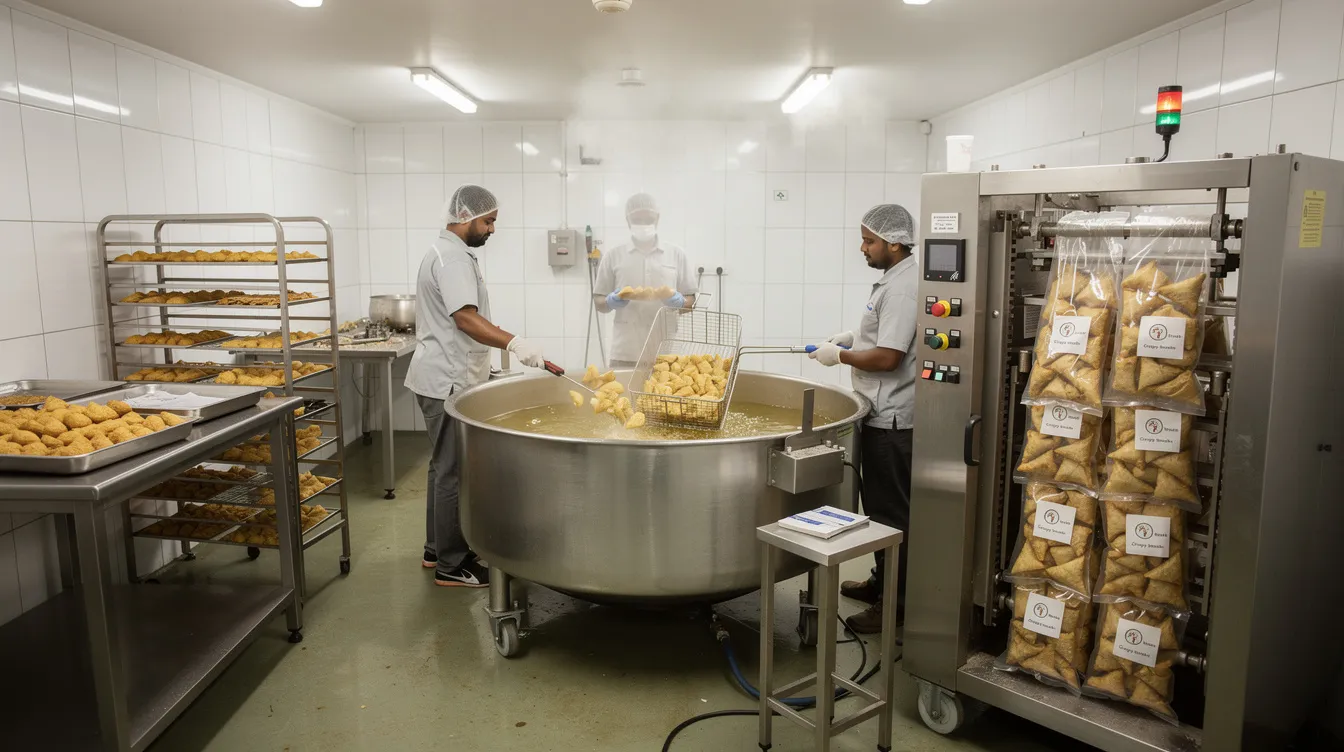
Let me walk you through a realistic 2026 machinery cost estimation for a small snack manufacturing unit applying for a Kishore mudra loan. The unit plans to produce packaged namkeen and requires one main machine and two accessories.
| Cost Component | Amount (₹) |
|---|---|
| Semi-automatic VFFS packing machine (Indian brand, 15 pouches/min) – Basic price | 1,85,000 |
| Namkeen fryer (gas-operated, 25 kg batch) – Basic price | 95,000 |
| Sealing machine (continuous band sealer) – Basic price | 18,000 |
| Subtotal – Basic machinery price | 2,98,000 |
| GST @ 18% on machinery | 53,640 |
| Transportation (within state, approx. 250 km) | 12,000 |
| Installation & commissioning | 8,000 |
| Electrical wiring and panel work | 15,000 |
| Transit insurance | 3,500 |
| Total Machinery Cost | 3,90,140 |
This total of approximately ₹3.90 lakh must appear under the “Plant & Machinery” block in the project report. The EMI calculation and repayment schedule should be based on this total.
Important adjustments banks expect:
- Refundable security deposits (e.g., electricity connection deposit) should not be included under machinery cost – they go under “preliminary expenses” or “deposits.”
- Computers, printers, and office equipment should be listed separately from core plant and machinery if required by the scheme or the bank.
- If the applicant claims margin money contribution of 10 to 15 percent of machinery cost, the bank will verify whether that amount actually exists in the applicant’s bank statements or savings account.
Inconsistent numbers between this machinery cost table and the DPR totals will invite queries or outright rejection. The project report must show realistic and correct project cost at every level – machinery, working capital, pre-operative expenses, and total.
Real Case Study: Mudra Loan First Rejected, Then Approved After Fixing Machinery Cost
Let me share an anonymised case from my practice – a 2024–25 case of a beneficiary micro unit in Indore, Madhya Pradesh.
Initial Situation:
Mr. Sharma (name changed), a 32-year-old with 3 years of experience working in a namkeen factory, decided to start his own micro food processing unit. He had a CIBIL score of 720, valid Udyam registration, a running proprietorship firm, and operated from rented premises with a proper rental agreement. His education qualification was 12th pass. He applied for a ₹7 lakh Kishore mudra loan at a public sector bank.
The Machinery Plan and Initial Quotation:
His project report listed the following machinery: a namkeen fryer, a continuous sealing machine, and a small automatic packing machine. The total machinery cost in the DPR was ₹6.50 lakh. The quotations were obtained from a single supplier whose GSTIN could not be verified on the government portal.
Rejection:
The bank’s internal note cited: “Machinery quotation appears inflated – supplier GST not traceable – project cost unrealistic – business viability assessment: not satisfactory.” The bank officer had searched online and found that comparable Indian-brand machines for similar capacity were available in the ₹3.5–₹4.5 lakh range. The financial statements and cash flow projections based on inflated costs did not support realistic repayment capacity.
Corrective Actions:
Mr. Sharma consulted a qualified CA who helped him:
- Obtained fresh quotations from two reputed, GST-registered machinery suppliers – one from Ahmedabad and one from Indore itself
- Each quotation was on proper letterhead with GSTIN, HSN codes, warranty details, and validity period
- Revised the DPR machinery cost from ₹6.50 lakh to ₹4.80 lakh – reflecting the correct market price with realistic freight and installation charges
- Separated the working capital requirement of ₹1.20 lakh from the machinery head – instead of hiding it inside inflated machine cost, it was shown as a separate line item funded partly by the loan and partly by own contribution
- Updated all financial projections, EMI calculations, and the repayment plan to match the revised project cost
Outcome:
The corrected file was resubmitted to the same bank branch. After routine verification – including a call to both suppliers who confirmed the prices – the loan was sanctioned at ₹6 lakh with a 5-year tenure and competitive interest rates.
Key lesson: Genuine quotations and realistic costing changed the bank’s decision. No “approach,” no bribe, no political reference. Just accurate documentation.
Warning Signs Bankers Notice in Machinery Quotations
Think of this as a quick red-flag checklist. If your file contains several of these issues, the chances of rejection become very high.
Warning signs that experienced bank managers catch:
- Round figures everywhere: Machine price exactly ₹2,00,000, freight exactly ₹10,000, installation exactly ₹5,000. Real quotations almost never have such perfectly round numbers.
- Missing GST or suspiciously low tax component: If a ₹5 lakh machine shows only ₹12,000 as GST, something is wrong with the calculation.
- Same mobile number or email on multiple “different” suppliers: This is an instant rejection trigger.
- No physical address or incomplete address without city, state, or PIN code.
- Identical formatting across quotations from supposedly different suppliers in different cities – indicates all quotations were created on the same computer.
- Handwritten corrections on price or GST without a fresh signature and stamp near the correction.
- Unrealistic discounts of 40–50% on brand new machinery with no explanation.
- Very old letterheads with outdated logos, registration numbers, or phone number formats.
- Scanned signatures that appear cut and pasted identically onto multiple documents.
- Quotations issued on Sundays or public holidays repeatedly, suggesting backdating.
- No quotation reference number despite an otherwise professional-looking document.
If your file triggers even 3–4 of these red flags, the credit officer will mark the file as “quotation doubtful” – and your mudra loan application enters the decline queue.
Best Practices to Avoid Mudra Loan Rejection Due to Machinery Cost
Here is a ready checklist of 18 action-focused tips. Treat this as your pre-submission audit:
- Always use genuine, GST-registered suppliers for main machines wherever possible
- Never edit supplier PDFs – if a correction is needed, ask the supplier for a fresh revised quotation
- Keep quotations recent – preferably less than 60–90 days old at the time of bank submission
- Cross-check your quotation amounts with online market price ranges on manufacturer websites
- Ensure every quotation clearly mentions make, model, capacity, HSN code, and warranty period
- Separate basic price, GST, freight, and installation charges clearly in both the quotation and the DPR
- Prepare a single consolidated machinery cost sheet and match its total with the project report
- Avoid overloading machinery cost to indirectly fund working capital – show working capital separately
- Add a short note in the project report justifying your choice of specific machinery and supplier
- Attach brochures, catalogues, and email trails wherever available
- If purchasing used or second-hand machinery, obtain a proper valuation or quotation with clear condition assessment, serial number, year of manufacture, and remaining useful life. Banks often prefer financing new machinery over second-hand or unsupported machinery, and valuation reports are needed for used machinery proposed in loan applications.
- Verify that the quotation format matches what your specific bank branch expects – some ask for proforma invoice, others accept quotation
- Redo all arithmetic calculations manually before submitting the file
- Do not use the same supplier for completely unrelated machines – it looks suspicious
- If a supplier is from another state, mention the delivery timeline and freight estimate clearly
- Ensure financial projections in the project report are based on the actual quoted machinery capacity, not theoretical maximum
- Include supplier contact details so that the bank can independently verify
- If your project involves imported equipment, provide a complete landed-cost breakup with duty, freight, insurance, and installation
Following these practices also helps with other msme loan schemes like PMEGP, Stand-Up India, and general term loans beyond Mudra. The discipline of accurate documentation benefits every business loan application.
What To Do If Your Mudra Loan Was Already Rejected Due to Machinery Cost
A first rejection is not the end. Many borrowers successfully get approval in their second attempt after correcting machinery quotations and the project report. Stay calm and follow this step-by-step recovery plan:
Step 1: Get the exact rejection reason
Request written or verbal clarification from the bank about the specific reason. Most banks will share phrases like “machinery quotation appears inflated,” “supplier not traceable,” “quotation mismatch with DPR,” or “project cost unrealistic.” This clarity is essential for fixing the right problem. You have the right to know the actual reason for Mudra loan rejection.
Step 2: Review your old quotations
Collect all the quotations you originally submitted. Go through the red-flag checklist from the previous section. Identify every issue – inflated prices, missing GST, outdated dates, calculation errors, supplier problems.
Step 3: Obtain fresh, genuine quotations
Approach reputed, GST-registered suppliers. Get fresh quotations with realistic, current market prices. Ensure all documentation standards are met – letterhead, signature, stamp, GSTIN, HSN code, validity date.
Step 4: Revise your project report
Update the DPR with:
- Correct machinery cost based on fresh quotations
- Updated total project cost
- Realistic financial projections matching the new machinery capacity
- Correct EMI and repayment schedule
- Accurate promoter’s margin (own contribution) that can be verified from your bank statements
If necessary, reduce the loan amount to match the true machinery cost and your genuine repayment capacity. It is better to get ₹5 lakh sanctioned than to get ₹8 lakh rejected.
Step 5: Reapply
You can reapply at the same bank branch with the corrected file, or approach a different bank or branch. If applying elsewhere, disclose the earlier rejection honestly when asked. Low CIBIL scores below 650 often lead to rejection on their own, so also verify your credit history is clean before reapplying.
Step 6: Address other issues if they exist
If the rejection involved multiple factors – such as poor credit history, incorrect business proof, or missing CMA data – address each one. You can refer to guides on incomplete business plans or unrealistic project reports for specific fixes.
Step 7: Consider professional help
If your project involves multiple machines, imported equipment, or complex financial projections, consider engaging a qualified CA or experienced consultant. The cost of professional project report preparation is a fraction of the loan amount and can make the difference between rejection and sanction.
Mudra loans offer up to ₹20 lakh for small enterprises. Even micro businesses and micro units with modest requirements can access this funding – provided the documentation is honest and accurate.

FAQs on Mudra Loan Rejection Due to Machinery Cost
These frequently asked questions address common doubts that Mudra loan applicants have about machinery quotations, used equipment, price changes, and the impact of rejection on future applications.
How many machinery quotations are usually required for a Mudra loan?
Most banks are satisfied with one final, detailed quotation per major machine. However, some branches informally ask for 2–3 comparative quotations to verify price reasonableness – this is especially common for Kishore and Tarun category loans where the machinery cost is a significant portion of total project cost.
My advice is to keep at least two options ready for each major machine but clearly highlight one as the “selected supplier” in your project report with a brief justification for your choice.
Remember, the quality and genuineness of the quotation matter far more than the number of quotations. One solid, verified, GST-compliant quotation from a reputed supplier is worth more than five questionable ones.
Can I use online or email quotations for my Mudra loan application?
Yes, many banks now accept quotations received by email or downloaded from official manufacturer websites, provided they contain full details – price, GST, model, specifications, validity period, and supplier contact information.
Print the complete email trail (showing sender’s email address, date, subject line, and the attached quotation) and include it in your file. This helps the banker verify authenticity quickly without having to request separate confirmation.
However, avoid submitting anonymous shopping-site screenshots without clear seller details. A price listing from a marketplace without the seller’s GSTIN, address, and formal terms will not be accepted as a valid machinery supplier quotation.
You can also apply online through portals like Jan Samarth for mudra loan online applications, but the machinery quotation documents must still meet the same quality standards.
Is second-hand or used machinery allowed under Mudra loan, and how is cost checked?
Many banks do allow financing of good-condition used machinery, especially for small workshops and existing businesses expanding their business operations. However, they are stricter about valuation and remaining useful life.
To strengthen your application for used machinery, obtain a proper valuation quotation from a dealer who regularly trades in used industrial equipment. The quotation should be on letterhead and include photographs, serial number, year of manufacture, current condition assessment, and estimated remaining useful life in years.
Banks may finance a lower percentage of used machinery value compared to new equipment and may insist on a higher own contribution. A formal valuation report carries more weight than a simple price estimate. The refinance agency guidelines under PMMY generally support both new and used machinery, but the project must demonstrate business viability regardless.
What happens if machinery price increases after my Mudra loan is sanctioned?
Minor price increases of 5–10% are normally managed by the borrower through additional own contribution or small internal reallocation within the project cost, with the bank’s written consent.
For larger price increases, the bank may need to revise the sanction terms or may decline to increase the loan amount. This is why it is important to act quickly after loan sanction – place the machine order within the quotation’s validity period and finalise payment terms with the supplier.
If the price increase is substantial (say 15–20%), inform the bank in writing immediately. Attach a fresh quotation showing the new price and propose how you plan to manage the difference – either through additional margin money or by choosing an alternative machine within the original budget.
Will one rejection due to machinery quotation affect my future Mudra or MSME loan applications?
A single rejection is not a permanent ban on borrowing. Banks primarily evaluate your repayment capacity, CIBIL score, business plan, and documentation quality – not your history of old declined proposals. A CIBIL score is not mandatory but preferred for Mudra loans, and if your score is healthy, one past rejection should not block future applications.
However, there is a nuance. If the bank recorded internal remarks like “fake quotation submitted” or “suspected manipulation,” this stays in their system. If another lending institution – whether private sector banks, cooperative banks, or microfinance institutions – contacts the original bank for a reference, those remarks could surface.
Therefore, every future application must be 100% genuine and transparent, with properly verified machinery cost, correct project report format, and honest financial statements. The credit guarantee fund under PMMY supports covering loans for micro units, but the guarantee is only useful if the loan gets sanctioned – and that requires trustworthy documentation.
Conclusion
Machinery quotations are not a formality. They are the backbone of your project cost estimation and can single-handedly determine whether your Mudra loan is sanctioned or rejected. I have seen too many otherwise-eligible applicants lose months of effort because of a careless quotation or an inflated price that took only two minutes for the bank officer to verify.
The path to a successful mudra loan application for any manufacturing, processing, or service business is straightforward: source genuine suppliers, obtain realistic and GST-compliant quotations, document everything transparently, and ensure complete alignment between your quotation figures and your project report totals. This is how business growth happens – through honest planning and solid documentation, not shortcuts.
Do not rely on copy-paste quotations downloaded from the internet. Do not inflate costs hoping the bank will not check. Do not submit outdated or fabricated supplier letters. Invest the time to prepare a correct Mudra project report with accurate DPR machinery cost estimation. The effort you put in before submission directly determines the speed and success of your loan approval.
For a complete picture of what makes a bank-ready file, study related guides on topics like incorrect project cost estimation, CMA data preparation, and financial projection accuracy. Each piece of your loan file must work together – and machinery cost is usually the most scrutinised piece of all.
With proper preparation and realistic costing, even first-time entrepreneurs without any prior banking experience can comfortably secure Kishore or Tarun Mudra loans for their machinery purchases and business expansion. Mudra loans are designed for small and micro businesses – the scheme exists to help you. Just make sure your documentation helps you back.
Author Box: About CA Manish Gugliya
CA Manish Gugliya is a Fellow Chartered Accountant (FCA) with over 20 years of hands-on experience in preparing Detailed Project Reports (DPRs), CMA data, Mudra and MSME finance proposals, business valuation, and bank loan documentation across manufacturing, trading, and service sectors.
His specific expertise lies in machinery cost estimation, project report machinery costing, and resolving complex Mudra loan rejection issues related to quotations, project cost, and business viability assessment. He has worked extensively with micro enterprises, small businesses, and startups applying through public sector banks, private sector banks, small finance banks, and non banking financial companies.
Over the years, CA Manish Gugliya has helped thousands of entrepreneurs nationwide get their business loans sanctioned – by converting raw business ideas into structured, bank-ready project reports with realistic financial projections, accurate CMA data, and documentation that meets actual banking expectations. His approach is practical and solution-oriented, drawn from real banking experience rather than textbook theory.
If you are planning to apply for a Mudra or MSME loan, or if your application was rejected due to machinery cost, project report problems, or quotation issues, consider seeking professional assistance. A properly prepared project report with genuine machinery quotations and accurate financial projections is the most effective investment you can make toward getting your loan sanctioned – the first time around.
- Roller Flour Mill Setup Cost in India: Professional Investment & Project Cost Guide


- Poha, Puffed Rice & Value-Added Rice Products Project Report & Processing Opportunities

- Integrated Value-Added Rice Products Processing Plant Project Report & DPR

- Integrated Rice Plant Bank Loan, Feasibility, ROI, IRR, Payback & Sensitivity Analysis

- Integrated Rice Processing Plant Financial Projections, Working Capital & DSCR

- Integrated Rice Products Revenue Model, Market Strategy & Profitability

- Integrated Value-Added Rice Plant Project Cost & Means of Finance

- Raw Material Procurement & Inventory Planning for Integrated Value-Added Rice Plant

- Common Utilities, Warehousing, Packaging & Material Handling for Integrated Rice Plant

- Integrated Rice Processing Plant Land, Building & Multi-Line Plant Layout – A Practical Guide for DPR & Bank Finance

- Integrated Rice Processing Plant Capacity Planning & Product Mix

- Integrated Value-Added Rice Plant Machinery & Equipment Cost – A Practical DPR-Oriented Guide

- Integrated Poha, Puffed Rice & Rice Snacks Manufacturing Process & Line Integration

- Instant Poha Manufacturing Plant Project Report & DPR – Bankable Guide by Project Report Bank

- Ready-to-Cook Rice Breakfast Mixes Manufacturing: Products, Process & Plant Setup