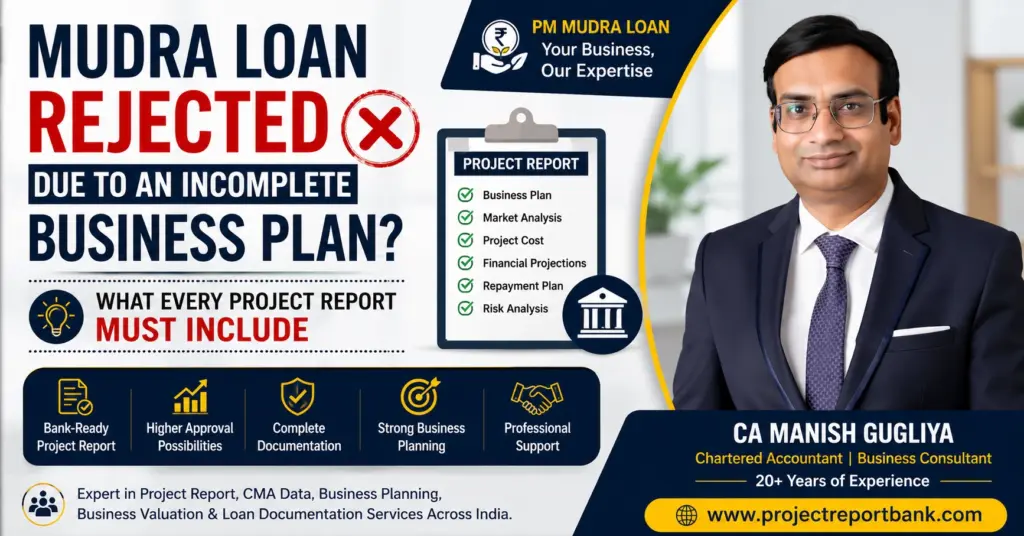
Many Mudra loan applications are rejected not because the business idea is bad, but because the business plan submitted to the bank is incomplete. Banks finance viable businesses backed by solid numbers – not enthusiasm or verbal promises. If your Mudra loan project report is missing critical sections, no amount of follow-up will save the application.
In this detailed guide, I will walk you through every component that a bank-ready project report must contain, explain why banks reject incomplete plans, and share practical steps you can take right now to strengthen your Mudra loan application.
Key Takeaways
Consider a ladies’ boutique owner in Indore who applied for a ₹4 lakh Kishore category Mudra loan in early 2025. Her business idea was solid – she had three years of tailoring experience, a rented shop in a busy market, and regular walk-in customers. Yet, her application was returned with the remark “incomplete project report.” The reason? Her plan was a single page that mentioned “ladies garments business” without any cost breakup, sales projection, working capital estimate, or repayment schedule. The bank simply could not evaluate her repayment capacity from what she submitted.
This is not an unusual story. Incomplete documents are the primary reason for Mudra loan rejections across public and private sector banks. Whether you approach SBI, PNB, Bank of Baroda, or private banks such as HDFC Bank, they all follow similar principles: they finance numbers and viability, not just good intentions.
Here is what you need to know before reading further:
- Mudra loans are categorized into Shishu, Kishore, and Tarun schemes – Shishu covers loans up to ₹50,000, Kishore covers ₹50,001 to ₹5 lakh, and Tarun covers ₹5 lakh to ₹20 lakh. A project report is essential for Mudra loan applications, especially for Kishore and Tarun categories.
- A complete Mudra loan project report must cover business profile, market analysis, project cost, means of finance, working capital, financial projections, debt service coverage ratio, and a clear repayment schedule.
- Banks assess business viability through project reports – they do not sanction loans based on verbal discussions or one-line descriptions of your business idea.
- A clear project report improves loan approval chances significantly, even if you are a first-time entrepreneur with limited banking history.
- This article, written from my experience of over 20 years as CA Manish Gugliya (FCA, DISA ICAI) preparing thousands of project reports for different banks, serves as a step-by-step checklist to convert an incomplete plan into a bank-ready Mudra loan DPR.

Table of Contents
Why Mudra Loans Get Rejected Due to Incomplete Business Plans
Under the Pradhan Mantri Mudra Yojana (PMMY), Mudra loans can provide up to ₹10 lakhs for business funding, and the scheme is designed to support micro, small, and medium enterprises (MSMEs). The mudra scheme is available through commercial banks, regional rural banks, NBFCs, and other financial intermediaries. But despite wide availability, branch-level rejections remain common – and the most frequent cause is a vague or incomplete business plan.
Here are typical “incomplete plan” situations I encounter regularly:
- The applicant submits only the loan application form without any attached project report
- The report mentions a business idea but offers no cost breakup for machinery, furniture, or stock
- No sales projections or monthly sales estimates are provided
- There is no written repayment plan – the applicant simply tells the branch manager “I will pay on time”
- Working capital needs are completely ignored
- Financial projections are absent or limited to a single optimistic number
From a banker’s perspective, the credit officer must justify every loan sanction to higher authorities and internal auditors using written documents. The branch manager cannot write in the internal noting sheet, “Applicant seemed confident during the bank interview.” They need a structured, internally consistent project report that they can reference, score, and defend.
Consider a real example from a Kishore category application in Jaipur – a mobile repair shop owner applied for approximately ₹3.5 lakh but submitted a report that only said “expand business.” There was no working capital calculation, no description of loan purpose, and no realistic monthly income estimate. The application was rejected. When the applicant resubmitted with a proper cost breakup, bank statements, vendor quotations, and a repayment schedule, the loan was approved.
Remember: “incomplete” for the bank does not mean you forgot to staple a page. Even a 20-page report is considered incomplete if it lacks proper assumptions, DSCR calculation, and repayment logic.
What Is a Business Plan in the Context of a Mudra Loan?
A Mudra loan business plan – or what banks call the project report – is a written document that explains what business you will run, how much you will invest, how you will earn money, and how you will repay the bank on time. A project report includes business description and funding needs in a structured format that any bank officer can read and evaluate.
The core elements that must be clearly described include:
- Business concept: What exactly will you do? A tailoring unit, small manufacturing plant, kirana store, salon, food stall, online selling – define it clearly
- Target customers: Who will buy from you and why?
- Expected revenue: What are your estimated monthly sales based on realistic assumptions?
- Main expenses: Rent, raw materials, salaries, utilities, loan EMI
- Loan requirement: How much do you need, for what purpose, and in what form (term loan for assets, working capital limit for daily operations)?
For banks, “business plan” and “Mudra loan project report” are practically the same thing. It is the structured financial story behind your loan application. A project report must include a clear snapshot of business and loan requirement – without this, the credit officer has nothing to work with.
Even for very small Shishu loans (up to ₹50,000), a basic written plan is highly recommended. A complete business plan is essential for securing a Mudra loan over ₹50,000, and for Kishore and Tarun categories, most banks require a proper project report as a mandatory part of the application.
How Banks Think: A Banker’s Perspective on Your Mudra Business Plan
Imagine you are a credit officer in a PSU bank branch in 2025. You receive 15–20 Mudra applications every month. Each one needs to be appraised, documented, and either recommended or declined – with written reasons. You do not have hours to spend on each file. You need a project report that answers your questions clearly and quickly.
The banker checks three broad questions:
- Is the business technically possible? Does the applicant have the skills, the location, the equipment, and the licences needed to actually run this business? This is technical feasibility.
- Are the financial numbers realistic? Do the sales figure, expenses, and profit margins make sense compared to similar businesses in the area? Lenders look for credible repayment plans and business viability in loan applications.
- Will EMI be paid on time from business cash flow? After all expenses, does enough cash remain to service the loan comfortably?
Bankers compare your plan with similar businesses they see daily. If your tea stall claims ₹3 lakh monthly profit in the first month, they know it is unrealistic. If your salon projects ₹50,000 daily revenue in a small town, the numbers do not add up.
The banker also checks whether your plan adheres to reserve bank and internal bank guidelines – for instance, that no collateral is required for eligible micro enterprises up to ₹10 lakh under the mudra scheme. Branches now often feed your projections into their own systems, which automatically calculate DSCR, break even point, and repayment capacity. Inconsistent or inflated numbers get flagged instantly.
Core Reasons Banks Reject Incomplete Mudra Business Plans
Based on my experience preparing reports for different banks, here are the specific reasons why incomplete plans lead to rejection. Each one relates directly to a missing or weak section in the project report.
- Business idea not properly explained: The report says “trading business” without specifying product range, target area, or customer segment. The bank asks, “Trading in what? Where? For whom?” and gets no answer from the document.
- No proper market analysis: No details about demand in the local area, existing competition, shop location advantage, or online competition. Without this, the banker has no basis to believe your sales projections.
- Missing investment details: Banks require a detailed project cost breakdown in the report. Submitting a single rounded figure like “₹5,00,000” without itemising machinery, furniture, stock, installation, and taxes is a common cause of rejection due to incorrect project cost.
- No working capital calculation: The report covers only machinery cost but ignores daily expenses like rent, electricity, staff salaries, and credit given to customers. This leads to future EMI stress and makes the banker uncomfortable.
- No written financial projections: Only a verbal claim like “business will earn enough to pay EMI” without a projected profit and loss or cash flow statement. Strong financial projections must include profit and loss statements and cash flow projections – without them, the bank cannot assess repayment capacity.
- No profitability estimation or DSCR: The bank cannot judge whether yearly net profit covers yearly instalment plus interest.
- Missing promoter profile: No information on the business owner’s experience, education qualification, skills, or existing business track record. This weakens trust.
- No structured repayment plan: Repayment schedule details how loan principal and interest will be paid. If tenure, EMI amount, and repayment start date are not discussed, the bank has no way to match cash flow with debt service.
Checklist: What Every Mudra Loan Project Report Must Include
Over 20+ years, I have prepared project reports for banks ranging from SBI to HDFC Bank, PNB, Bank of India, cooperative banks, and regional rural banks. Whether the loan is for a salon, fabrication unit, e-commerce startup, or small manufacturing plant, the basic structure remains similar – though the depth of details information varies by loan size and bank.
A standard project report format is accepted by major Indian banks and typically includes these sections:
- Business Profile (company’s background and promoter details)
- Market Analysis (demand, competition, location)
- Products and Services (what you sell, pricing, USP)
- Project Cost (detailed investment breakup)
- Means of Finance (own funds + loan + subsidy)
- Working Capital Requirement (daily operating funds)
- Financial Projections (P&L, balance sheet, cash flow statement)
- DSCR (proving repayment ability)
- Break-even Analysis (when costs are covered)
- Repayment Schedule (EMI affordability)
- Risk Analysis (what could go wrong, and your plan)
Any missing block in this checklist increases the chance of “incomplete proposal” remarks in the internal bank noting, which often leads to rejection or long delays. Banks require a project report detailing business plans for Mudra loans – and each of these sections matters.
Use the following subsections as a practical template when preparing your own Mudra loan DPR, or while reviewing any template-based report you have received.
Business Profile – Introducing You and Your Enterprise
The first part of the project report should be a simple but complete business profile – essentially the project company profile written in plain language that any branch manager can quickly understand.
Required details include:
- Proposed business name and constitution (proprietorship, partnership, private limited company)
- Address of the unit – whether the premises are owned, rented, or leased, including rent amount and tenure
- Nature of business activity – manufacturing, trading, services, or a combination
- Employees working or planned to be hired
Promoter profile elements:
- Full name, age, education qualification
- Previous work or business experience (for example, “5 years as a mechanic in Maruti service centre before opening own garage in 2023”)
- Special skills, certifications, or training relevant to the business
- Any achievements export orders, industry awards, or recognitions
For existing businesses, include:
- Years in operation and present turnover
- Existing bank accounts (savings or current) and transaction regularity
- Any current EMIs or bank loan repayment history
- Previous ITR filings and GST returns
Banks give extra weight to positive banking history. Regular transactions in your savings or current account and timely repayment of earlier loans signal reliability, even before the banker reads your financial projections.
Market Analysis – Showing Demand and Competition Clearly
Many Mudra applications fail because the project report jumps directly to numbers without first proving that a real market exists. This is where your market analysis makes or breaks the plan.
Target customers should be described with concrete examples:
- Office workers within a 2 km radius of your shop
- Students from nearby colleges looking for affordable meals
- Local factory workers needing daily consumables
- Online buyers on Amazon or Flipkart if you plan e-commerce
Local demand indicators to mention:
- Nearby residential colonies and estimated population
- Daily footfall in the market or commercial area
- Number of existing similar businesses (and whether the area is saturated or underserved)
- Any seasonal patterns – festivals, harvest seasons, tourism peaks
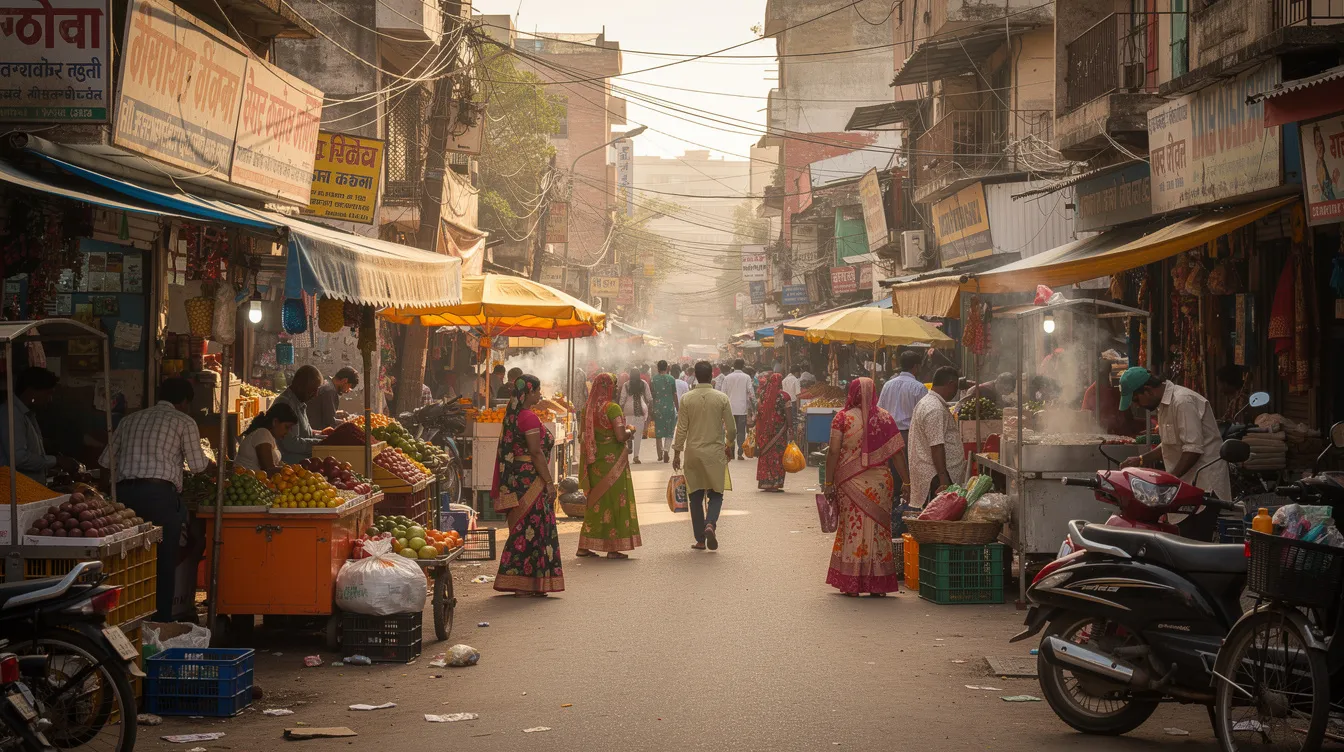
Competitors should be listed by type. For example, “three existing salons on the same road, two hardware shops within 500 metres.” Briefly compare their strengths and weaknesses with your offering. This is where you demonstrate that your entrepreneur plans are grounded in reality, not hope.
Location advantage matters more than many applicants realise:
- Corner shop with visibility from the main road
- Proximity to bus stand, railway station, or industrial area
- Available parking space
- Lower rent in a side lane that still attracts walk-in customers
Even 2-3 paragraphs covering these points with local specifics can make a significant difference. Banks dealing with Mudra loan rejection due to local competition concerns want to see that you have thought about your competitive environment.
Products and Services – What Exactly Will You Sell?
This section gives the banker a clear picture of your specific offerings and related services, and why customers will pay for them.
Describe your main product or service categories with approximate price ranges:
- Women’s kurtis priced ₹699–₹1,499
- Motorcycle servicing packages priced ₹600–₹1,200
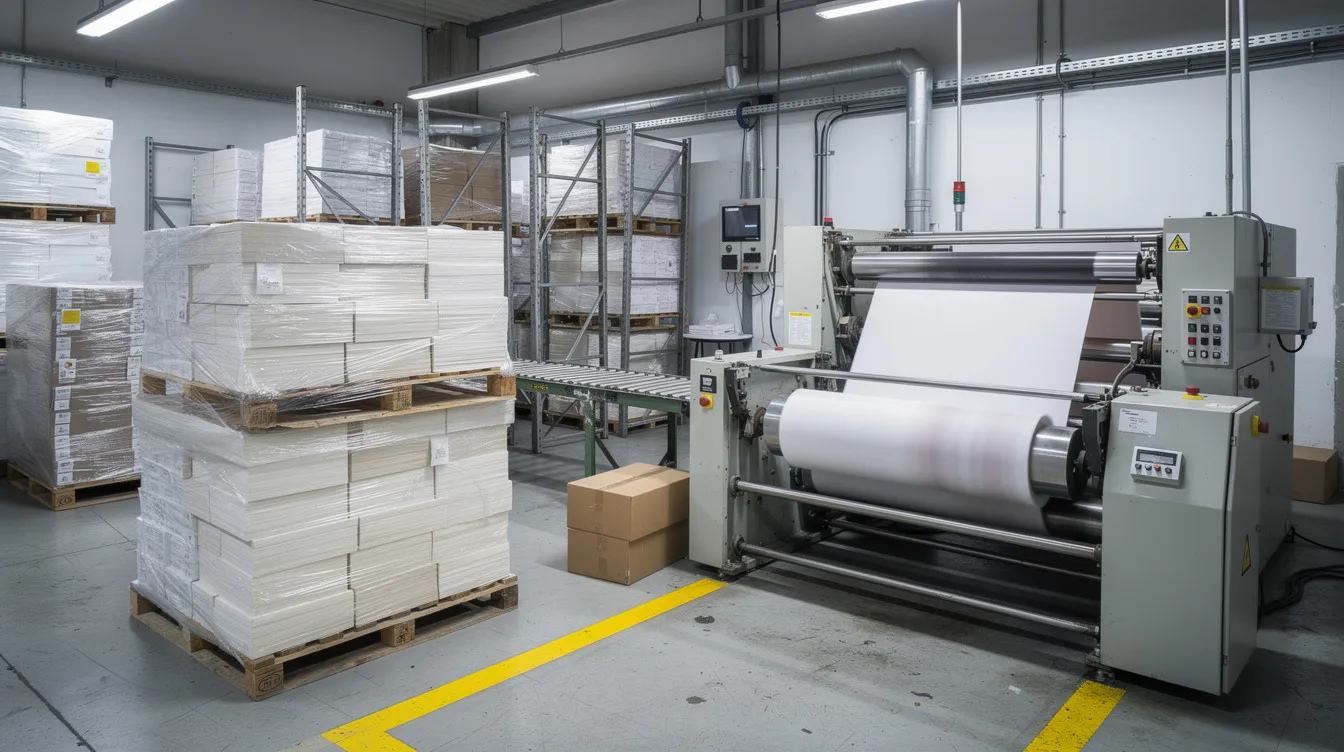
- Paper cups manufactured at ₹0.35 per piece, sold at ₹0.55 per piece
- Home-cooked tiffin service at ₹100–₹150 per meal
Highlight your USP (unique selling proposition):
- Home delivery within a 3 km radius
- Extended evening hours (open till 10 PM when competitors close at 8 PM)
- Higher quality raw materials compared to neighbouring shops
- Specialisation in a niche, such as bridal makeup or organic food
Connect product mix with margins:
Mention which items carry higher profit margins and how that supports loan repayment. For instance, if accessories carry 50% margin while garments carry 25%, a smart product mix helps maintain profitability even if one category slows down.
Future expansion plans:
Briefly mention any plans for the next 2–3 years that can improve turnover – adding online sales channels, introducing premium product variants, or expanding into adjacent services. This shows the banker that your business model has growth potential beyond the initial loan period.
Project Cost – Detailed Investment Break-up
One of the most common reasons for Mudra loan rejection is incorrect or lump-sum project cost. This section must provide item-wise details with realistic values based on recent quotations.
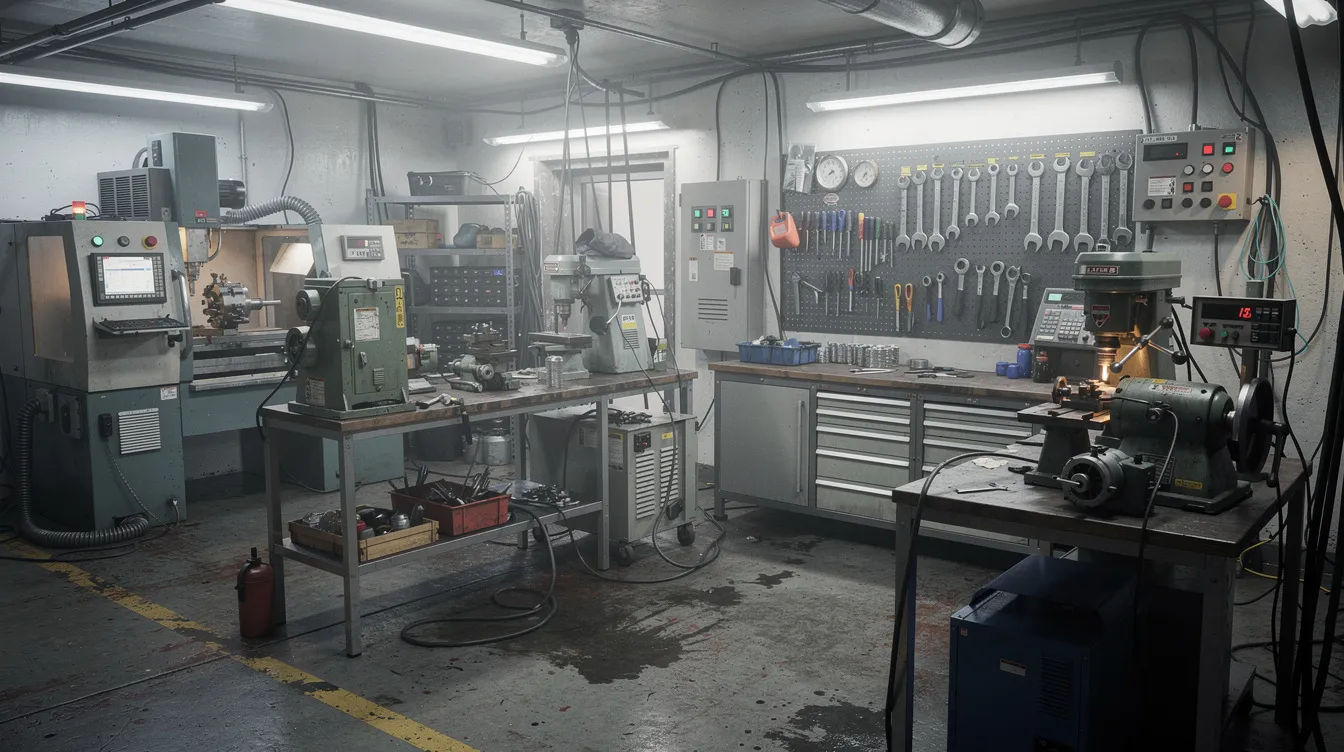
Fixed assets (itemise separately):
| Cost Component | Example Items | Estimated Cost Range |
|---|---|---|
| Machinery & Equipment | Sewing machines, packaging machine, grinder | ₹1,00,000 – ₹5,00,000 |
| Furniture & Fixtures | Counters, racks, chairs, display shelves | ₹30,000 – ₹1,50,000 |
| Interior Work & Renovation | Flooring, painting, electrical fittings | ₹20,000 – ₹1,00,000 |
| Tools & Accessories | Hand tools, measuring instruments | ₹10,000 – ₹50,000 |
| Signboard & Branding | Shop name board, flex printing | ₹5,000 – ₹25,000 |
| Computers & Electronics | Laptop, printer, billing machine | ₹15,000 – ₹50,000 |
Initial working capital margin in the project cost:
- Opening stock or raw material inventory
- Advance rent deposit (often 2–3 months for rented premises)
- Security deposit to electricity department
- Initial marketing and advertising strategies budget (pamphlets, social media promotion)
Taxes and installation charges must be included – not just basic equipment price. If you quote a machine at ₹1,50,000 but the actual delivered cost with GST and installation is ₹1,82,000, the mismatch will raise questions.
Attach vendor quotations to justify funding requests for equipment purchases. Recommend mentioning the date (for example, “quotations obtained in March 2026”) and attach 2–3 quotations from different vendors as annexures. This strengthens authenticity and shows the banker that you have done your homework.
Means of Finance – How Will the Project Be Funded?
Banks expect a clear statement showing how the total project cost will be financed. This is called the “means of finance” and must balance exactly with your project cost.
Three main components:
- Promoter contribution (margin money): Typically 10–25% of project cost, funded from personal savings, family support, or sale of existing assets. Mention the source briefly – “₹1,50,000 from personal savings accumulated over 4 years.”
- Mudra loan component: The amount you are requesting from the bank, shown as a separate line. Ensure the requested loan amount fits within scheme limits:
- The Shishu category covers loans up to ₹50,000
- The Kishor category covers loans from ₹50,001 to ₹5 lakh
- The Tarun category covers loans from ₹5 lakh to ₹20 lakh
- Subsidy or government scheme support: If you are eligible for any scheme like PMEGP loan subsidy or state-level incentives, mention it clearly with eligibility conditions and whether the subsidy is upfront or reimbursed later.
The total of all means of finance must exactly equal the total project cost. Even a small mismatch – say ₹5,000 – creates doubt in the bank’s appraisal. If project cost is ₹6,50,000, and you show ₹1,00,000 promoter contribution plus ₹5,50,000 Mudra loan, that totals ₹6,50,000. Perfect balance. No gaps, no excess.
Working Capital Requirement – Daily Funds to Run the Business
Many otherwise good Mudra proposals are rejected – or approved but later face EMI stress – because working capital was either ignored or calculated incorrectly. This section deserves serious attention.
Inventory requirement should be calculated realistically:
- Retail garments: 30–45 days of stock
- Perishable food items: 3–7 days of stock
- Hardware or electrical: 20–30 days of stock
- Manufacturing raw material: 15–30 days based on supplier lead time
Multiply the number of days by your average daily cost of goods to arrive at the inventory figure.
Receivables and payables affect your net working capital:
- If you sell on credit (for example, 15 days credit to institutional buyers), you need funds to cover that gap
- If your suppliers give you 30 days credit, it reduces your immediate funding need
- The net working capital limit requirement accounts for this cycle
Monthly fixed expenses to include:
- Rent (with reference to rent agreement terms)
- Staff salaries (number of employees working and their pay)
- Electricity and utilities
- Internet and telephone
- Transport and delivery costs
- Consumables and office supplies
Buffer for initial months:
Include at least 2–3 months’ buffer at the start of operations. Many new businesses take time to build customer flow, and without a buffer, the business owner may struggle with both daily expenses and EMI from day one.
The working capital funding pattern should clearly mention how much comes from own funds, how much from the Mudra loan (especially if a CC limit or working capital loans component is included), and how cash cycles will be managed during the initial months.
Financial Projections – Turning the Plan into Numbers
Financial projections are the heart of any Mudra loan project report. They convert your business idea into monthly and yearly numbers that the bank can analyse, question, and verify. Project reports must include detailed financial projections – without them, no credit officer can recommend your file for approval.
Duration and scope:
- Financial projections cover 5-year P&L statements and cash flow for Tarun and Tarun Plus categories
- Banks require detailed financial projections for at least three years to evaluate loan applications
- Smaller Kishore loans may need 3-year projections as a minimum
Sales projections should be based on capacity or realistic turnover per day or per month:
- Year 1: 50–60% of full capacity (ramp-up period)
- Year 2: 70–80% of capacity
- Year 3 onwards: 85–95% of capacity
For a retail shop, this might translate to average daily sales of ₹8,000 in Year 1 growing to ₹14,000 by Year 3. The build-up must be logical, not a sudden jump from zero to peak.
Major operating expenses to project:
- Raw material or purchase cost (typically the largest expense)
- Direct labour or manufacturing processes costs
- Rent and utilities
- Administrative expenses
- Marketing and advertising strategies expenses
- Loan interest at a realistic interest rate based on current bank offerings
Include depreciation and tax:
Many applicants forget depreciation on fixed assets and income tax, which inflates profit figures artificially. Banks catch this immediately because it distorts both the balance sheet and DSCR calculation.
The financial statements should include:
- Projected Profit & Loss account (year-wise)
- Projected balance sheet (showing assets, liabilities, and capital)
- Projected cash flow statement (showing actual cash movement, not accounting profit)
Each statement must be internally consistent. The profit shown in P&L must flow into the balance sheet. The cash flow must reconcile with opening and closing bank balances. Incorrect financial projections that do not tie together across statements are a major red flag.
Debt Service Coverage Ratio (DSCR) – Proving Repayment Ability
The debt service coverage ratio is one of the most important numbers in your project report from the bank’s perspective. In simple terms, DSCR tells the bank: “For every ₹1 of EMI due, how many rupees does the business generate in cash?”
The formula:
DSCR = (Net Profit + Depreciation + Interest on Term Loan) ÷ (Principal Repayment + Interest on Term Loan)
What banks expect:
- DSCR above 1.5 is crucial for loan repayment assurance, especially for Tarun and Tarun Plus categories
- Most banks prefer DSCR comfortably above 1.25–1.50 for MSME and Mudra loans
- A DSCR below 1.0 means the business does not generate enough cash to pay EMIs – this is an automatic rejection trigger
How to present it:
Calculate DSCR year-wise based on your projected financials. Show the calculation transparently – not just the final number, but the components that feed into it.
| Year | Net Profit + Depreciation + Interest | Annual Debt Service | DSCR |
|---|---|---|---|
| Year 1 | ₹2,40,000 | ₹1,75,000 | 1.37 |
| Year 2 | ₹3,10,000 | ₹1,75,000 | 1.77 |
| Year 3 | ₹3,60,000 | ₹1,75,000 | 2.06 |
An improving DSCR trend – from 1.37 in Year 1 to 2.06 in Year 3 – tells the banker that repayment capacity strengthens as the business matures. This is exactly what builds confidence.
If your DSCR falls below 1 in any year, the bank will either reject the application or reduce the loan amount to bring DSCR into the acceptable range. Including a short interpretation in your project report, explaining why the trend is safe, helps the credit officer write a positive recommendation.
This is part of the broader ratio analysis that banks perform during appraisal. The stronger your DSCR, the smoother your approval process.
Break-even Analysis – When Will the Business Start Covering Its Costs?
The break even point is the sales level at which total revenue equals total fixed and variable costs – meaning the business stops making a loss and starts generating profit.
What the project report should show:
- Monthly or yearly break-even sales quantity and value
- Fixed costs per month (rent, salaries, EMI, insurance – these do not change with sales)
- Variable costs per unit or per service (raw material, packaging, delivery)
- Contribution margin: selling price minus variable cost per unit
Example:
If your fixed costs are ₹60,000 per month and your average contribution margin per unit is ₹30, your break-even quantity is 2,000 units per month. If you project selling 3,000 units, your safety margin is 33% – meaning sales can drop by a third before you start losing money.
What bankers look for:
- Whether projected sales cross break-even within a reasonable period – typically 6–18 months depending on business nature
- The safety margin between projected sales and break-even sales
- Whether break-even assumptions are realistic given local demand and capacity
Very high break-even levels relative to local demand will cause the bank to doubt project viability. If your break-even requires capturing 90% of the local market, no banker will feel comfortable. This could lead to rejection or a suggestion to reduce project size and loan amount.
Repayment Plan and EMI Affordability
A repayment schedule is not optional – the project report should specify loan tenure (for example, 3, 5, or 7 years), moratorium period if applicable, and estimated EMI at a realistic interest rate based on current market trends.
Comparing profit with EMI:
Show that your projected monthly net profit (after all expenses including tax) comfortably covers the proposed EMI. As a general guideline, the EMI should not exceed 40–60% of monthly surplus cash flow. If your projected monthly surplus is ₹25,000, an EMI of ₹12,000–₹15,000 is manageable. An EMI of ₹22,000 out of ₹25,000 surplus is risky.
Cash flow alignment:
For seasonal businesses like agriculture-related processing, tourism-based services, or festival-driven retail, EMI payment timing matters. If 60% of your revenue comes in four months, the remaining eight months may generate barely enough to cover operating costs. In such cases:
- Propose staggered or seasonal repayment structures with lower EMIs during lean months
- Show the bank how annual cash flow covers annual debt service, even if monthly patterns vary
Plan B scenario:
Include a simple explanation: if sales fall 10–15% below projection, EMI can still be serviced by reducing optional expenses (cutting discretionary marketing, postponing hiring, using owner’s reserve). This “Plan B” thinking impresses bankers because it shows you are realistic and prepared.
The project report should include a repayment schedule and revenue projections that are aligned with each other. Some banks provide standard repayment schedule formats, but a borrower-prepared logical plan always creates a stronger impression during appraisal.
Risk Analysis and Mitigation Strategies
Banks know every business has risk. What they want to see is whether the promoter has thought about potential problems and has basic strategies to handle them.
Key risks to address:
- Market risk: Increased competition (a new shop opening nearby), changing customer preferences, price wars
- Raw material risk: Fluctuation in raw material prices, supplier reliability, import duty changes
- Seasonal risk: Demand dips during off-seasons (for example, tourism businesses during monsoon, ice cream shops in winter)
- Regulatory risk: New licensing requirements, changes in GST rates, environmental clearances
Operational risks:
- Equipment or machinery breakdown
- Dependence on a single major customer or supplier
- Key employee leaving the business
- Delays in project logistics details during setup phase
Simple mitigation strategies:
- Maintain 2–3 alternative suppliers for critical raw materials
- Create a basic equipment maintenance schedule and budget
- Build a small emergency fund (even ₹20,000–₹50,000 can help during lean periods)
- Diversify your customer base across walk-in, online, and institutional channels
- Keep conservative assumptions in financial projections so that actual performance exceeds expectations
Including even a simple risk section gives comfort to bankers that the entrepreneur is realistic and prepared. It reduces the chances of rejection due to perceived over-optimism, which is one of the common reasons for Mudra loan rejection.
Common Mistakes That Make Mudra Business Plans Incomplete
Based on hundreds of practical cases where I have seen Mudra applications rejected or repeatedly returned, here is a red flag list that every applicant should avoid.
1. Copy-paste DPRs from the internet
Downloading a generic template and submitting it without customisation to your actual business, city, or bank format is one of the fastest routes to rejection. Banks quickly detect when the business description says “Delhi” but the applicant is in Indore, or when machinery costs do not match local vendor rates. This leads to remarks like “unrealistic/copy-paste project report” in rejection notes.
2. Unrealistic sales projections
Jumping from zero to ₹10 lakh monthly turnover in three months without any marketing plan, market size proof, or capacity details. If you cannot logically explain how you will achieve your projected sales figure, the bank will not believe it either.
3. Incorrect project cost
Overstated interior costs, missing installation charges, or quoting machinery prices that are outdated by two years. The bank often cross-checks with their own vendor contacts or online references.
4. Missing or wrong working capital calculation
Many reports calculate only fixed asset cost and ignore the daily funds needed to run the business. Without proper working capital planning, even an approved loan can result in business failure.
5. No promoter profile or experience details
If the bank does not know who you are, what your experience is, or how you plan to manage the business, your credibility drops sharply.
6. Generic assumptions
Statements like “sales will grow 20% every year” without any supporting logic. Growth rates should be tied to specific factors – expanding product range, adding delivery services, or entering a new customer segment.
7. Inconsistent figures across sections
When costs in the project cost section do not match the means of finance, or when financial projections do not align with the sales structure described earlier. These inconsistencies signal carelessness at best and dishonesty at worst.
How Banks Evaluate a Mudra Business Plan Internally
After the branch receives the Mudra application and project report, the proposal goes through a structured appraisal process. Understanding this process helps you prepare a stronger report.
Step 1: Initial screening
The branch staff checks whether all required documents are present – KYC, business proof, bank statements, and the full report. Incomplete submissions are returned without detailed evaluation.
Step 2: Three-angle evaluation
| Evaluation Angle | What the Bank Checks |
|---|---|
| Technical feasibility | Is the project workable with proposed machinery, location, and space or land requirement? Does the promoter have the skills? |
| Financial feasibility | Does DSCR, break-even, and profitability look acceptable? Are the reports generated consistent? |
| Economic viability | Is the project beneficial and sustainable in the local economy? Does it create employment for the beneficiary micro unit? |
Step 3: Cross-checking numbers
Banks compare your projections with industry norms, prior similar sanctions, and government guidelines. They look at whether your cost estimates for commercial manufacturing processes or service delivery are in line with what other businesses in your area report. Outdated vendor quotations or prices that seem too low or too high are flagged.
Step 4: Internal scoring (for higher loans)
For Kishore and Tarun loans, many banks run internal scoring models. These assign points based on promoter experience, CIBIL score (generally 700+ is preferred), DSCR, completeness of cost breakup, and business proof quality. Missing sections reduce the score and can lead to decline, even if the business idea is viable.
Step 5: Credit history check
They verify CIBIL score, existing EMIs, and previous loan conduct through reports generated from credit bureaus. But even good credit history cannot fully compensate for a weak, incomplete business plan. Clear justification for loan usage is preferred by banks during loan evaluations.
Documents to Attach Along with Your Mudra Business Plan
Even a well-written business plan can be delayed or rejected if basic documentation is incomplete. The Mudra loan document file preparation should include a complete set alongside your project report.
KYC documents (mandatory):
- Aadhaar card
- PAN card
- Recent passport-size photographs
- Address proof (voter ID, driving licence, or utility bill)
KYC documents must match exactly in name and address to avoid rejections. Even minor mismatches – such as a spelling difference between Aadhaar and PAN – can cause delays or return of the application. If you face such issues, resolving them before applying saves significant time.
Business-related documents:
- Udyam Registration (MSME registration) – increasingly expected by most banks
- GST registration certificate (if applicable based on turnover threshold)
- Shop and Establishment licence or Trade licence
- FSSAI licence (for food-related businesses)
- Professional or technical certificates, if relevant
Financial documents:
- Last 6–12 months’ bank statements (regular transactions matter)
- Previous 2–3 years’ ITR returns and financial statements for existing businesses
- Any existing loan sanction letters and repayment track records
- GST returns for recent quarters (if registered)
Mudra loan applications should include identity and address proofs, financial statements, and project reports as a complete package.
Supporting project documents:
- Vendor quotations or proforma invoices for machinery and equipment
- Rent agreement or property ownership papers with photographs of the proposed site
- Machinery brochures or specifications
- Partnership deed or MOA (for firms and companies – covering required third party details)
- Any relevant third party details such as franchise agreements, supplier contracts, or customer orders
Real-Life Style Case Study – From Rejection to Approval
Let me share a case from my practice that illustrates exactly how a complete project report changes outcomes.
The applicant: Ravi (name changed), a 32-year-old entrepreneur in Nagpur who wanted to start a small manufacturing unit producing disposable paper bowls. He had worked for three years in a similar factory and understood the manufacturing processes well. His project cost was approximately ₹8 lakh, and he applied for a ₹7 lakh Tarun category Mudra loan at a nationalised bank branch.
First submission – rejected:
Ravi’s initial project report was four pages long. It mentioned “paper bowl manufacturing unit” as the business concept, listed one machine costing ₹4.5 lakh, and wrote “total project cost ₹8 lakh.” There was no break-up of remaining ₹3.5 lakh. No financial projections were attached. No DSCR calculation. No working capital details. No market demand explanation.
The branch returned the file with remarks: “Projections not attached. No DSCR. No working capital details. Market demand not explained. Proposal incomplete.”
What changed:
Ravi approached a professional for help. A detailed Mudra loan project report was prepared covering:
- Item-wise machinery cost with two vendor quotations
- Complete project cost breakup: machinery ₹4,50,000 + furniture ₹35,000 + electrical fittings ₹25,000 + initial raw material stock ₹90,000 + working capital buffer ₹1,00,000 + other expenses ₹1,00,000 = ₹8,00,000
- Means of finance: own contribution ₹1,50,000 + Mudra loan ₹6,50,000
- Monthly sales projection based on machine capacity (60% utilisation in Year 1, 80% in Year 2)
- 3-year P&L, balance sheet, and cash flow projections
- DSCR calculated at 1.35 in Year 1, improving to 1.80 in Year 3
- Break-even analysis showing recovery within 8 months
- Clear repayment schedule with EMI of approximately ₹14,000 per month against projected monthly surplus of ₹22,000
Result:
The same branch reconsidered the application and sanctioned ₹6,50,000 (slightly reduced from ₹7 lakh) with a 5-year repayment period and realistic EMI. The business idea did not change. The promoter did not change. Only the quality and completeness of the business plan and financial documents improved – and that made all the difference.
A clear project report improves loan approval chances significantly. Lenders assess project viability through a detailed business plan, and Ravi’s case proves that the effort of preparing complete financial information pays off directly.
Practical Tips to Prepare a Bank-Ready Mudra Business Plan
Here are actionable tips from my consultancy experience – things a first-time entrepreneur can implement without advanced financial knowledge.
1. Use actual local market data
Talk to 3–5 similar businesses in your area. Note down their typical daily sales, average customer count, and seasonal patterns. Use conservative averages – not the best shop’s numbers – in your projections.
2. Support project cost with quotations
Get at least two quotations for every major equipment or asset, preferably on vendor letterhead. Match those values exactly in your project report. Consulting with a bank loan officer can provide clarity on missing application information or format expectations for your specific branch.
3. Be internally consistent
Total capital introduced in the balance sheet must equal promoter contribution shown in means of finance. The loan amount in the project report must match the application form and repayment schedule. Even small mismatches create doubt.
4. Calculate working capital properly
Do not guess. List every monthly expense, estimate how many days of stock you need, and factor in credit cycles. If unsure, use the working capital calculation method described earlier in this article.
5. Keep projections conservative
It is better to project monthly sales of ₹80,000 and actually achieve ₹1,00,000 than to project ₹1,50,000 and be questioned by the banker for unrealistic assumptions.
6. Write for the reader, not yourself
The project report should be concise and easy to understand. Avoid long paragraphs of jargon. Use tables, bullet points, and clear headings. Remember, the branch manager may spend only 15–20 minutes reading your report.
7. Check the correct format preferred by your bank
Different banks may have slightly different expectations. Some bank asks for CMA data, others want a specific project report template. Check with the branch before preparing the final document.
8. Review as if you are the banker
Read your report twice. Every time you see a number, ask: “Can I justify this if the bank questions it?” If the answer is no, revise the assumption.
9. Include an implementation schedule
Add a simple timeline showing when you will purchase equipment, set up the premises, hire staff, and begin operations. This shows the bank that your entrepreneur plans are thought through, not vague.
10. Do not hide challenges
If your area has seasonal demand dips, say so – and explain how you will manage EMI during those months. Honest disclosure builds more trust than hiding problems the banker already knows about.
Role of CMA Data and Financial Documents in Stronger Mudra Proposals
CMA data is a structured financial statement format used by banks for appraising credit proposals. It stands for Credit Monitoring Arrangement data and includes past actual and projected financial statements in a format that financial institutions are familiar with.
When is CMA data needed?
- Small Shishu loans typically do not require CMA data
- For Kishore and Tarun proposals, especially from growing MSMEs, banks often benefit from at least a simplified CMA-style presentation covering covering loans, term loans, and working capital requirements
- Some banks like Axis Bank, SBI, and HDFC Bank specifically request CMA data for proposals above ₹5 lakh
- If missing or incorrect CMA data leads to queries, the approval process stalls
Why clean financial documents matter:
- Bank statements for the last 6–12 months should show regular, genuine business transactions
- GST returns (if applicable) should match the sales figure shown in bank statements
- ITR filings for existing businesses should align with what you project for the future
- A sudden big jump in projected turnover without any logical explanation raises suspicion
Alignment is everything:
Your CMA data, project report, and supporting financial documents should tell the same story. The current ratio, DSCR, and projected profitability in CMA data must match the project report’s assumptions. If your CMA data shows a different loan amount or different sales projection than your DPR, the bank will send the file back.
A Mudra loan project report outlines business plans and financial needs – but when it is supported by complete financial information in CMA format and consistent financial documents, the overall proposal becomes significantly stronger. The project commercial aspects become clear, and the bank can move to sanction faster.
Professional Insights from CA Manish Gugliya – After Thousands of Reports
Over the past two decades, I have prepared project reports for businesses ranging from small business kirana stores in rural Madhya Pradesh to manufacturing units in Maharashtra, service startups in Bangalore, and food businesses in Rajasthan. Here are a few observations from this experience that I believe every Mudra loan applicant should know.
Banks prefer realistic over impressive.
I have seen many applicants inflate their projected turnover to make the business look more attractive. In reality, this backfires. When the credit officer sees numbers that do not match the local market or the applicant’s current income, credibility drops. A slightly conservative, evidence-backed projection is always more effective communication than glossy optimism.
Every business is unique – treat it that way.
A project report for a salon in Jaipur cannot be the same as one for a fabrication unit in Ludhiana, even if both are applying for the same loan size. The market, the cost structure, the customer base, and the risk profile are entirely different. Copy-paste templates hurt more than they help during appraisal. Even bank-ready project reports from a template must be customised to reflect the applicant’s actual circumstances.
Your DPR signals your seriousness.
Many branch managers informally consider the quality of the project report as an indicator of the promoter’s planning ability and commitment. A well-prepared Mudra DPR – with accurate numbers, logical assumptions, and proper documentation – tells the banker that this business owner is someone who plans before acting. That matters, sometimes as much as CIBIL score.
Professional preparation helps but does not guarantee sanction.
No consultant, CA, or advisor can guarantee that your loan will be sanctioned. The final decision rests with the bank based on their internal policies, risk appetite, and your overall profile. What professional preparation does is significantly reduce the chance of rejection due to documentation or projection issues. It ensures that your good business idea is not lost because of incomplete paperwork.
Whether you are dealing with a refinance agency requirement, applying for term loans, or seeking working capital, the principle remains the same: give the bank what it needs to say “yes.”
Frequently Asked Questions on Mudra Loans and Business Plans
Here are answers to common questions I receive from entrepreneurs across India about Mudra loan business plans and project reports.
Can my Mudra loan be rejected only because the business plan is incomplete?
Yes, absolutely. Even if you and your business idea are otherwise eligible, banks can and often do reject Mudra applications when the project report is incomplete, inconsistent, or unrealistic. From the bank’s side, incomplete documentation means they cannot justify the loan to internal auditors and higher authorities. They prefer to decline rather than take unrecorded risk. A project report is essential for Mudra loan applications – without it, the file simply does not move forward.
Is market analysis really necessary for a small Mudra loan like ₹2–3 lakh?
While some branches may not demand a detailed research report, at least a basic written market analysis is strongly recommended and often requested. Describe who will buy from you, where they are located, and why your offer is better than existing alternatives. Even 2–3 paragraphs with local examples and realistic numbers can make a significant positive difference in the bank’s comfort level during evaluation.
Can I use a free Mudra project report template I found online?
Templates are useful as a starting framework, but they must be carefully customised to your specific business, city, loan amount, and bank’s requirements. Blindly copy-pasting figures or using sector-irrelevant assumptions is one of the common reasons for remarks like “unrealistic/copy-paste project report” in rejection notes. Most banks require a project report for Mudra loan applications that reflects the applicant’s actual situation, not a generic download.
Do banks verify the financial projections I put in my Mudra business plan?
Banks do not verify every line item on the ground, but they cross-check logic, ratios like DSCR, and overall assumptions against their market knowledge, your bank statements, and your experience. If projections look inflated compared to your current income or sector norms, they may call you for detailed clarification or reduce the sanctioned amount. The key areas they focus on are consistency, reasonableness, and repayment capacity.
Can I prepare the Mudra business plan and project report myself?
Many small business entrepreneurs successfully prepare their own basic project reports using guides like this one, especially for Shishu loans and smaller Kishore loans, provided they are careful, honest, and logical in their approach. For larger or more complex proposals – particularly where CMA data, multi-year financial projections, and ratio analysis are required – taking help from an experienced professional like a CA or MSME finance consultant can save time and significantly reduce rejection risk. Different banks may have varying expectations regarding loan types and documentation depth.
Conclusion – Turn Your Incomplete Plan into a Bank-Ready Mudra DPR
Banks reject incomplete Mudra loan applications not to discourage entrepreneurs, but because they must ensure that every rupee lent is backed by a viable, well-planned business with clear repayment capacity. Whether it is SBI, PNB, Bank of Baroda, or private banks like HDFC Bank and Axis Bank, the evaluation logic remains the same.
A complete business plan and project report should cover business profile, market analysis, products, project cost and means of finance, working capital, financial projections, DSCR, repayment schedule, and risk analysis in a coherent, consistent manner. The project report should be supported by proper financial documents, vendor quotations, KYC documents, and business proof – every piece telling the same story.
When these elements are thoughtfully prepared – with realistic assumptions, proper calculations, and honest disclosure – approval chances improve significantly across all loan types, whether you are applying for Shishu loans, Kishore, or Tarun. Mudra loans support micro, small, and medium enterprises, and the entire micro units development ecosystem is designed to help you grow – but only when you present your case properly.
If you feel unsure about the numbers, DSCR calculations, or CMA data, do not let your good business idea be rejected simply due to incomplete paperwork. Consider professional support to prepare a project report that reflects the true potential of your business.
Call-to-Action – Get Expert Help for Your Mudra Loan Project Report
As CA Manish Gugliya (FCA, DISA ICAI), I have been preparing bank-ready project reports, CMA data, and financial projections for entrepreneurs across India for over 20 years. My services are available through online consultation and document sharing – you do not need to visit an office.
Services I provide:
- Mudra loan DPR and project report preparation (Shishu, Kishore, Tarun, Tarun Plus)
- Term loan and working capital project reports for MSME bank loans
- CMA data preparation for CC limit, working capital limit, and higher business loan proposals
- Financial modelling for startups and new business ventures
- Business valuation reports where required by financial institutions
- Complete documentation advisory for PMEGP loan and other government scheme applications
Every report I prepare is tailored to the applicant’s specific business model, city, and bank requirements. I do not use copy-paste templates. Each DPR reflects real market conditions, achievable projections, and the correct format expected by the lending branch.
While no professional can guarantee loan sanction, a well-structured, complete, and realistic project report significantly improves the quality of your discussion with the bank and often speeds up decision-making. Banks appreciate when an applicant comes prepared – and effective communication of your business viability starts with the project report.
Ready to get started?
Gather your basic details – your business idea, approximate project cost, existing bank statements, and KYC documents – and reach out for step-by-step guidance. Let us convert your small business plan into a strong, bank-ready Mudra loan proposal that gives your application the best possible chance.
- Mudra Loan Rejection Reasons: Complete Guide to Why Banks Reject Applications


- Mudra Loan Project Report Issues & Solutions: Complete Guide to Avoid Project Report Rejection
- Mudra Loan Documentation Issues: Complete Guide to Avoid Document-Related Loan Rejections

- Mudra Loan CIBIL Issues, Rejection Reasons & Solutions (2026) – Complete Guide

- Mudra Loan Rejected Due to Industry Specific Project Report Mistakes – What Banks Really Expect 2026

- Mudra Loan Rejected Because the Business Model Was Not Viable – How to Improve Your Project Report 2026
- Mudra Loan Rejected Due to Machinery Cost: Practical Guide to Fix & Avoid This Problem (2026)

- Mudra Loan Rejected Due to an Incomplete Business Plan 2026 – What Every Project Report Must Include
- Mudra Loan Rejected Due to Copy Paste Project Report – How Banks Detect Generic DPRs and What to Do Next

- Mudra Loan Rejected Due to Wrong Working Capital Calculation – How Banks Really Assess Your Requirement 2026

- Mudra Loan Rejected Because the Project Cost Was Incorrect – How to Estimate It Properly 2026
- Mudra Loan Rejected Due to Missing or Incorrect CMA Data – Complete Preparation Guide 2026

- Mudra Loan Rejected Because of Incorrect Financial Projections – Common Mistakes to Avoid 2026

- Mudra Loan Rejected Due to Unrealistic Project Report – How to Make It Bank-Ready (2026 Complete Guide)

- How to Prepare a Perfect Mudra Loan Document File Before Visiting the Bank 2026