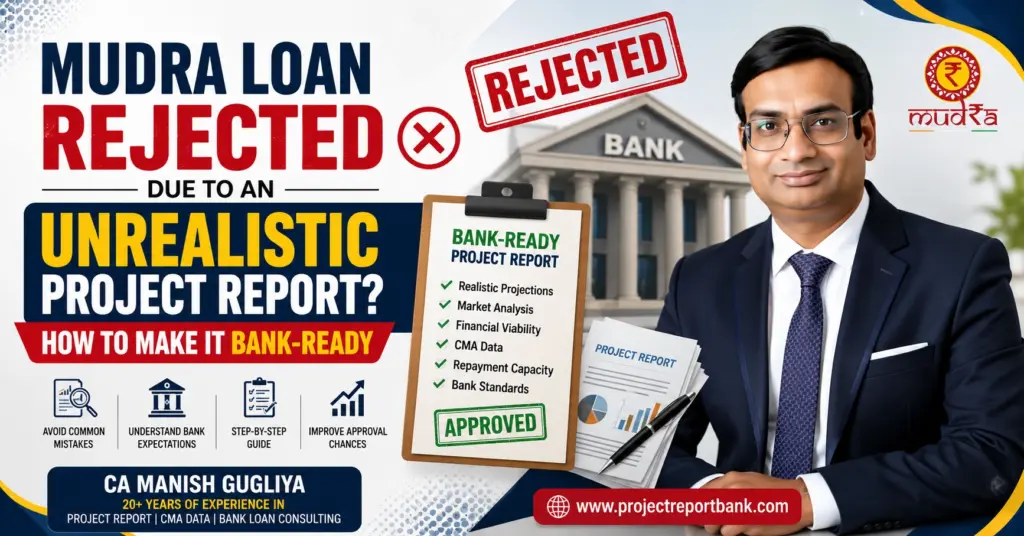
Key Takeaways
- Most Mudra loan rejections in 2026 happen because the project report has overestimated sales, copy-paste financial projections, and weak financial logic-especially around DSCR and cash flow.
- A Mudra loan rejected due to unrealistic project report is not the end. You can usually reapply with the same or a different bank after preparing a realistic, customised report.
- A “bank-ready project report” means your assumptions, financial projections, and documents match both bank norms and local market reality-this increases likelihood of Mudra loan approval, though it is never a guarantee.
- Common reasons for Mudra loan rejection also include low CIBIL scores and incomplete documents, so fixing the project report alone may not be enough.
Introduction: “My Mudra Loan Was Rejected Because the Project Report Was Not Practical”
I hear this almost every week. A small business owner walks into my office, frustrated, saying the bank rejected their Mudra loan even though their business idea was solid. When I check their project report, the problem is usually obvious within two minutes.
Many first-time entrepreneurs download free templates from the internet, change the name and loan amount, and submit copy-paste financial projections that bankers immediately recognise as unrealistic. The Pradhan Mantri MUDRA Yojana requires proof of personal creditworthiness and business viability-not just a formatted PDF.
Banks do not reject Mudra loans to harass you. They reject when your numbers, market assumptions, and repayment ability do not match ground reality.
I am CA Manish Gugliya, and I have over 20 years of experience in project report preparation, CMA data, and Mudra loan consulting across public sector banks and private banks. This guide explains exactly why your report was rejected, what “unrealistic” means from a banker’s perspective, and how to prepare a bank-ready project report for your next application.

Table of Contents
What Is a Mudra Loan Project Report and Why Banks Need It
A Mudra loan project report is a written business plan submitted to the bank that describes your business idea, how much loan you need, how you will use the funds, and how you will repay. It applies to loans up to ₹10 lakh under Shishu, Kishor, and Tarun categories. Mudra loans are only applicable for non-farm business activities.
Banks require a project report for Mudra loan applications because the credit officer at SBI, PNB, HDFC Bank, ICICI Bank, Axis Bank, or any other lender needs to decide whether your business can realistically earn enough to pay EMIs on time. A project report must clearly outline business viability to avoid rejection.
A typical mudra loan project report format includes:
- Business description and project company profile
- Cost of project and means of finance
- Sales and profit projections (financial projections for 3–5 years)
- Cash flow statement
- Debt service coverage ratio (DSCR) calculation
- Repayment schedule
A Mudra loan project report includes business description and financial needs in one document. Banks require a project report to assess loan viability and repayment capacity before sanctioning any loan amount.
For small Shishu loans, some branches accept a shorter profile. For Kishor and Tarun categories, or when seeking an existing business loan enhancement, many branches insist on a more detailed project report with CMA data.
Why Banks Reject Unrealistic Mudra Loan Project Reports
A large share of Mudra loan rejections in 2024–2026 come down to one problem: the project report numbers do not match local market conditions, applicant experience, or basic financial logic. Projections that show unrealistic financial figures raise red flags for bank managers instantly.
Here are concrete examples of what “unrealistic” looks like:
- Showing ₹60 lakh first-year turnover from a new kirana shop in a small town with only ₹8 lakh investment
- Claiming 30–40% net profit margin in a low-margin trading business
- Planning to repay a 5-year term loan fully in 2 years without supporting cash flow
Copy-paste reports from the internet-with the same wording, same tables, and identical financial projections-make bankers doubt your seriousness. When multiple applicants in the same district bring identical reports, credibility drops to zero.
Other red flags include machinery costs not matching current 2026 quotations, incorrect working capital calculation, fake or outdated third party details on quotations, and projecting continuous high growth with no explanation. Unrealistic sales projections can lead to loan rejection even when the business idea itself is sound.
Incomplete project reports may result in loan application denial. Missing financial documents-like last 12-month bank statements for an existing business-combined with inflated future income almost always leads to rejection.
Real Case Study: Grocery Shop Mudra Loan Rejected for Unrealistic Projections
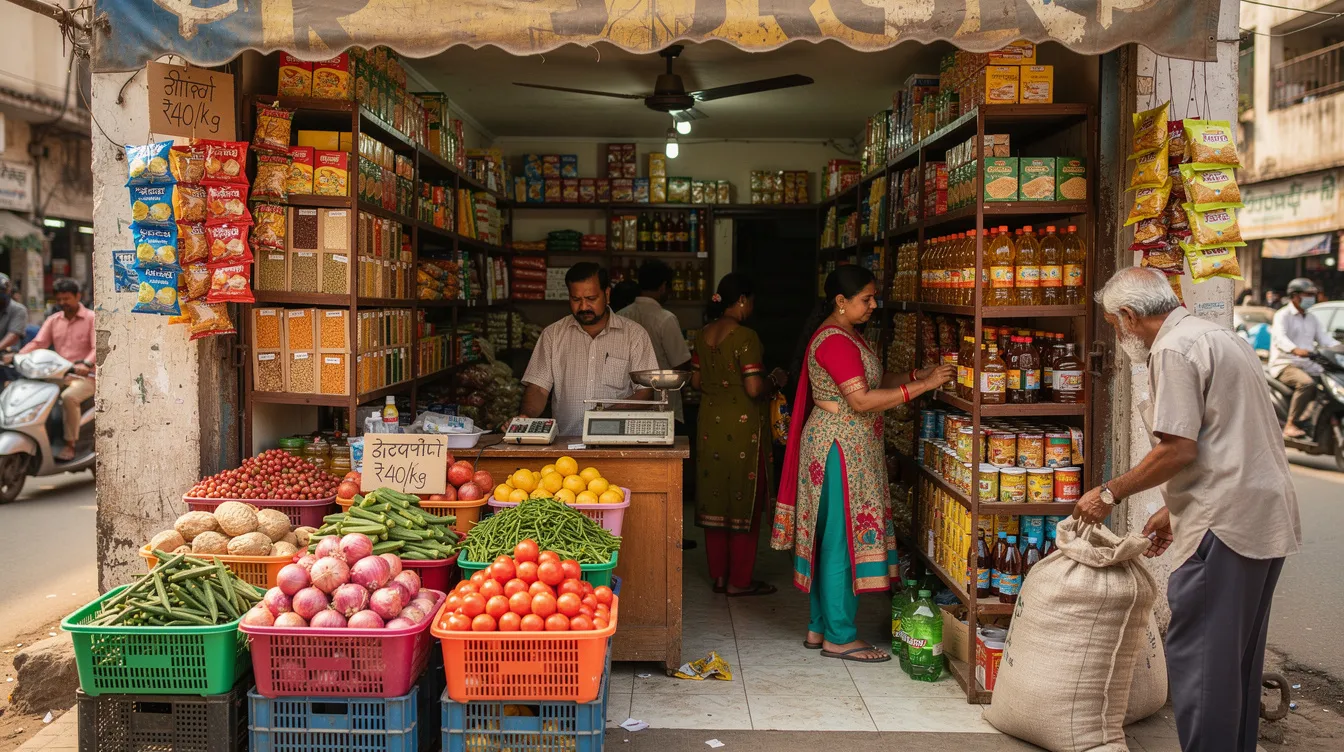
Consider the case of Rajesh (name changed), a small business owner in Jaipur who applied for a ₹8 lakh Mudra loan under the Kishor category in 2025 to open a new grocery shop.
His project report showed annual turnover of ₹60 lakh in Year 1 and ₹90 lakh in Year 2, with net profit margins above 30%. There was no data on shop location, local competition, or realistic customer footfall. The monthly sales figure was simply divided equally across 12 months with no seasonal variation.
The bank officer compared these projections with typical grocery shop sales in that locality. Most new shops near that area reported ₹20–25 lakh annual sales in the first year. The report was flagged as unrealistic, and overstated financial assumptions undermined his loan approval chances completely.
After consulting a professional, Rajesh’s corrected report showed:
| Parameter | Original Report | Corrected Report |
|---|---|---|
| Year 1 Turnover | ₹60 lakh | ₹22 lakh |
| Year 3 Turnover | ₹1.2 crore | ₹30 lakh |
| Gross Profit Margin | 30%+ | 12–15% |
| DSCR | 4.5 (inflated) | 1.6–1.8 (realistic) |
The same business, same promoter, and same loan amount got approved by another bank once the numbers matched what bankers actually see in the market.
How Banks Evaluate Your Mudra Loan Project Report
Different banks and NBFCs have slightly different internal formats, but the basic appraisal logic for Mudra loans is similar across Indian banks.
Here is the typical evaluation flow:
- Business feasibility: Is there real demand for the product or service in that locality? What does local competition look like? Are pricing assumptions reasonable for 2026?
- Promoter capability: Education qualification, business experience, existing track record, handling of previous bank loans, and stability of income. Banks prefer loan applications that justify the requested amount with specific business needs, not vague entrepreneur plans.
- Financial checks: The officer compares cost of project and means of finance, checks working capital needs, examines sales and profit projections, and computes DSCR to see if cash flow comfortably covers EMI and interest. Banks assess risk across multiple dimensions before making a decision.
- Document verification: For existing business loan enhancement, they analyse past bank statements, GST returns, and ITRs to check if projected growth is consistent with past figures.
- Risk assessment: Business continuity risk, sensitivity to local competition, and whether the loan purpose is actually eligible under the Mudra scheme are all reviewed.
Banks require realistic repayment plans to approve loans. If your cash flow projections cannot sustain EMI payments, the application fails at this stage regardless of how well-formatted your report looks.
Twenty Common Mistakes That Make a Project Report Look Unrealistic
From reviewing hundreds of Mudra loan project reports between 2018–2026, here are the most common mistakes that lead to rejection:
- Copying exact financial projections from a sample PDF found online
- Showing same monthly sales every month with no seasonal variation
- Estimating sales with no basis in local market data or customer perception research
- Ignoring rent, electricity, salaries, and maintenance in expense projections
- Using outdated machinery prices instead of fresh 2026 quotations
- Not including GST where applicable
- Inflating promoter’s margin money contribution with no proof in bank statements
- Projecting 70–80% capacity utilisation from Month 1 for a new business
- Claiming net profit margins of 30–40% in low-margin trading or related services
- No break even point calculation
- DSCR calculation missing or artificially inflated
- Mismatch between profit projections and expense estimates
- No mention of space or land requirement or rental costs
- Missing details about employees working in the business
- No advertising strategies or customer acquisition plan
- Using generic national data instead of local market data
- Ignoring depreciation and replacement costs for machinery
- No sensitivity analysis-one downside scenario shows the business fails
- Repayment schedule that starts EMIs immediately though revenue will take months to build
- Report language copied from complex jargon sources, making it look like a summer internship project rather than a real business plan
Each mistake signals risk to the banker. Correcting even 5–6 major mistakes-especially around sales figure, margin, expenses, and EMI capacity-can dramatically improve the report’s credibility.
How to Prepare a Bank-Ready Mudra Loan Project Report
A bank-ready project report is one whose assumptions, financial projections, and documents match bank norms and local market reality-not just a nicely formatted PDF. A well-structured project report increases the likelihood of loan approval across different banks.
Every realistic Mudra loan project report should cover these key areas:
- Business introduction: Business model, project commercial aspects, and project logistics details
- Promoter profile: Company’s background, education, experience, achievements export orders (if any)
- Market analysis: Local competitors, realistic customer numbers, pricing-not generic national averages
- Cost of project: Machinery, furniture, renovation, with current quotations showing required third party details
- Means of finance: Loan amount requested plus promoter’s own contribution
- Working capital assessment: Stock levels, debtor/creditor days, working capital limit needs
- Financial projections: Sales, expenses, profit for 3–5 years with moderate growth
- Cash flow: Monthly or yearly, showing the business can sustain itself
- Balance sheet projections: Assets, liabilities, net worth accumulation
- Ratio analysis: DSCR, break even point, ROI
- SWOT and risk analysis: What if sales drop 20%?
- Repayment schedule: EMI matched to business cash flow
Banks accept project reports in a standard format for Mudra loans. A standard project report format includes financial projections and repayment plans. Project reports should detail project costs and repayment plans clearly. The project report should not exceed 27 pages for Mudra loans-keep it focused.
For higher Mudra limits or combined working capital loans plus term loan, banks may ask for CMA data. All figures across CMA, the full report, and financial documents must be consistent.

Financial Projections Banks Expect: Sales, Profit, Cash Flow and DSCR
Financial projections are the heart of any mudra loan project report and the main reason why reports generated from templates get called unrealistic.
Building sales projections: Base your numbers on shop size, machine output, working days per month, average ticket size, and local footfall. Show at least 3–5 years with moderate growth. Banks flag capacity utilisation above 60% in Year 1 for new businesses as a red flag.
Profit margins: Use realistic numbers. For example, a small mobile repair shop might project 25–30% gross margin and a modest net profit after rent, salary, electricity, and EMI-not the 40% net margin that many template-based reports show.
Working capital: Think about stock levels, credit to customers, credit from suppliers, and how much cash is realistically needed. The working capital cycle directly impacts your cash flow statement.
DSCR: This is the ratio that tells the bank whether your business cash flow is enough to pay EMI plus interest. DSCR above 1.5 is preferred by banks for loan approval. A DSCR below 1.0 means automatic rejection.
Your projections should be realistic enough that even if sales drop 15–20% below plan, EMIs can still be paid from business cash flow. This is what technical feasibility and financial analysis really mean in practice.
Documents to Attach with a Mudra Loan Project Report
Even the best project report will not help if basic KYC and business proof documents are incomplete or inconsistent with the basic details written in the report. Supporting documents such as supplier quotations and business licenses are often required alongside the report.
Typical documents banks ask for include:
| Category | Documents |
|---|---|
| Identity & Address | Aadhaar, PAN, address proof, photographs |
| Business Proof | Udyam registration, GST (if applicable), shop act license, trade license |
| Premises | Rent agreement or property papers for business premises |
| Financial documents | Last 6–12 months bank statements, previous ITRs, existing loan sanction letters |
| Project-specific | Machinery/vehicle quotations with vendor GST number, details information on suppliers |
Ensure your name, address, and business details on all documents match what is written in the project report. Mismatches in address proof or business proof are separate rejection triggers.
For a complete document checklist, refer to the Mudra Loan Documents Required guide.
How to Correct an Existing Unrealistic Project Report and Reapply
A Mudra loan rejected due to unrealistic project report is not the end. In most cases, you can correct the report and reapply.
Step-by-step improvement process:
- Collect written or verbal feedback from the bank on what they found unrealistic
- Recheck all assumptions-especially sales, profit margins, and expenses
- Update machinery and working capital costs with fresh 2026 quotations
- Recalculate all financial projections and DSCR with conservative assumptions
- Align report figures with actual bank statements and ITRs for existing businesses
- Prepare complete financial information that reconciles across all documents
After correction, discuss with the same branch whether to reopen the file or submit a fresh application. You are also free to approach another bank, small finance bank, or NBFC.
For repeated rejections or complex cases-multiple existing EMIs, irregular bank statements, seasonal business-consider taking professional help for revising the project report. Every new submission must be customised. Simply reprinting the old rejected report with a different bank name will lead to the same result.
Can You Reapply for Mudra Loan After Rejection? Practical 2026 Guidance
In most public sector banks and private banks, a Mudra loan rejection does not create a permanent ban. You can reapply after correcting deficiencies.
Some banks may have an internal cooling period of 3–6 months before accepting a fresh application for the same purpose. This varies by bank and branch.
You are free to approach a different bank with an improved business loan application, but must disclose existing loans and past rejections honestly wherever the bank asks. A project report must include business description and financial projections tailored to the new bank’s preferred correct format and loan schemes.
What to change in the new application:
- Corrected project report with realistic projections
- Updated financial statements and documents
- Improved CIBIL score if that was a contributing factor
- Better explanation of your business model during the bank interview
For understanding all possible reasons behind Mudra loan rejection-including KYC problems, non-viable business type, or existing loan EMIs-explore the detailed guides available on ProjectReportBank.com.
Expert Tips from CA Manish Gugliya to Avoid “Unrealistic Project Report” Remarks
These tips come from 20+ years of working with branch managers, credit officers, and entrepreneurs across different states and micro enterprises.
- Start conservative: Show modest Year 1 projections and gradual growth. Banks respect honesty over optimism.
- Match local reality: Your rental costs, wage levels, and customer behaviour assumptions should reflect your actual city and locality in 2026, not generic data from old PDFs. Banks value financial inclusion but verify against ground reality.
- Never hide existing EMIs: The bank will check. Hiding liabilities destroys trust.
- Avoid round figures everywhere: ₹5,00,000 revenue per month looks made up. ₹4,72,000 based on 40 customers × ₹395 average ticket × 30 days looks calculated.
- Match your spoken story with the written report: If you tell the banker you expect 20 customers a day but your report shows 80, credibility collapses.
- Keep language simple: Write in plain English or Hindi. Complex jargon copied from a business administration textbook does not impress bankers-it confuses them.
Insider observation: Many bankers look at DSCR, promoter contribution, and repayment schedule first, before reading the rest. If those three areas are clean and realistic, the rest of the appraisal becomes smoother.
A customised, professionally prepared mudra loan project report-tailored to your city, business type, and the specific bank’s preferred format-significantly outperforms generic templates. If you feel stuck or confused after rejection, consider getting professional help to build bank ready project reports that match what the interest rate, cc limit, and loan types at your chosen bank actually require.

Frequently Asked Questions (FAQs)
These FAQs cover practical doubts that come up after a Mudra loan is rejected due to an unrealistic project report. Answers are based on common practices observed up to 2026, but individual banks may have slightly different rules.
Can the bank verify the figures I show in my Mudra loan project report?
Yes. Banks cross-check your sales and income assumptions with past bank statements, GST returns, and ITRs where available. They also compare your projections with local market data and sometimes make informal enquiries in the area of your business. For machinery and vehicles, they compare quotations with known vendor price ranges. Inflated or fake quotations are easily spotted during appraisal or site visits. This is why your report must reflect what you can actually prove with financial documents.
Is CMA data compulsory for every Mudra loan?
For small Shishu loans and many Kishor loans, full CMA data is usually not compulsory. However, some branches may ask for basic working capital and cash flow information even at lower amounts. For Tarun or Tarun Plus categories, combined term loan plus working capital, or when total exposure with the bank is large, branches may insist on CMA data to properly assess fund flow. If your loan amount exceeds ₹2–3 lakh, it is wise to keep CMA data ready.
Can I use one project report for multiple banks?
You can use the same base project information, but submitting exactly the same report to different banks without changes is risky. Each bank may have slightly different loan schemes, margin norms, and documentation formats. Customise the report for each bank-update the cover page, scheme name, margin money requirements, and ensure the repayment schedule matches that particular bank’s expected EMI structure, interest rate, and tenure.
Will using AI or online software to generate a project report guarantee Mudra loan approval?
AI tools and online software-like Finline, which generates a bank-ready project report in under 10 minutes-can quickly produce a formatted report with ratios and projections. However, banks still judge based on realism and consistency with your actual documents and local market conditions. Reports generated through any tool still need manual review and customisation. No tool or consultant can guarantee loan approval. Only a realistic, honest project report combined with clean credit history and proper documentation can maximise your approval chances.
What should I do if my Mudra loan was rejected even after I corrected the project report?
Ask the bank for specific written reasons. The issue may no longer be the projections-it could be CIBIL score, KYC problems, a non-eligible business purpose, or existing liabilities. If your appeal was rejected, consider clearing small overdues, correcting KYC documents, or refining your business model. After addressing the specific weakness, reapply after a gap-possibly to a different bank-with guidance from an experienced consultant who understands what that particular bank’s credit team expects in a pmegp project report or pmegp loan context, or specifically for MSME loan and Mudra scheme applications. This is not an exhaustive list of steps, but continuous support and persistence usually lead to a better outcome.
- Mudra Loan Rejection Reasons: Complete Guide to Why Banks Reject Applications


- Mudra Loan Project Report Issues & Solutions: Complete Guide to Avoid Project Report Rejection
- Mudra Loan Documentation Issues: Complete Guide to Avoid Document-Related Loan Rejections

- Mudra Loan CIBIL Issues, Rejection Reasons & Solutions (2026) – Complete Guide

- Mudra Loan Rejected Due to Industry Specific Project Report Mistakes – What Banks Really Expect 2026

- Mudra Loan Rejected Because the Business Model Was Not Viable – How to Improve Your Project Report 2026
- Mudra Loan Rejected Due to Machinery Cost: Practical Guide to Fix & Avoid This Problem (2026)
- Mudra Loan Rejected Due to an Incomplete Business Plan 2026 – What Every Project Report Must Include

- Mudra Loan Rejected Due to Copy Paste Project Report – How Banks Detect Generic DPRs and What to Do Next

- Mudra Loan Rejected Due to Wrong Working Capital Calculation – How Banks Really Assess Your Requirement 2026

- Mudra Loan Rejected Because the Project Cost Was Incorrect – How to Estimate It Properly 2026
- Mudra Loan Rejected Due to Missing or Incorrect CMA Data – Complete Preparation Guide 2026

- Mudra Loan Rejected Because of Incorrect Financial Projections – Common Mistakes to Avoid 2026

- Mudra Loan Rejected Due to Unrealistic Project Report – How to Make It Bank-Ready (2026 Complete Guide)

- How to Prepare a Perfect Mudra Loan Document File Before Visiting the Bank 2026