Key Takeaways
- Mudra loans under Pradhan Mantri Mudra Yojana are collateral free and categorized into Shishu (up to ₹50,000), Kishore (₹50,001 to ₹5,00,000), and Tarun (₹5,00,001 to ₹10,00,000) for non corporate micro and small enterprises.
- One active mudra loan per PAN is allowed at a time, but you can reapply after rejection or closure-there is no mandatory waiting period after rejection.
- A mudra loan rejection at one bank does not automatically block approval at another, but unresolved issues like low CIBIL, weak documents, or poor business viability will follow you everywhere.
- If rejection was due to minor documentation gaps, reapplying with the same cooperative bank is usually faster than shifting.
- Where there is unreasonable delay or poor service, shifting to another lender with stronger MSME focus may help-but only after fixing root problems first.
Introduction: Why Mudra Loan Reapplicants Get Confused
I am CA Manish Gugliya, and over the past 20+ years of working in banking, MSME finance, and business loan consulting, I have seen many applicants struggle with one recurring question after their mudra loan application is delayed or rejected: should I reapply with the same bank, or try a different one?
Under the mudra yojana (PMMY), applicants seeking funding for working capital or small term loans often face months-long “under process” status, repeated document demands, or outright rejection without clear reasons. This confusion wastes weeks of valuable time. The mudra scheme covers income-generating activities in manufacturing, trading, services, and allied agricultural activities-but each bank evaluates proposals at its sole discretion using its own credit policy.
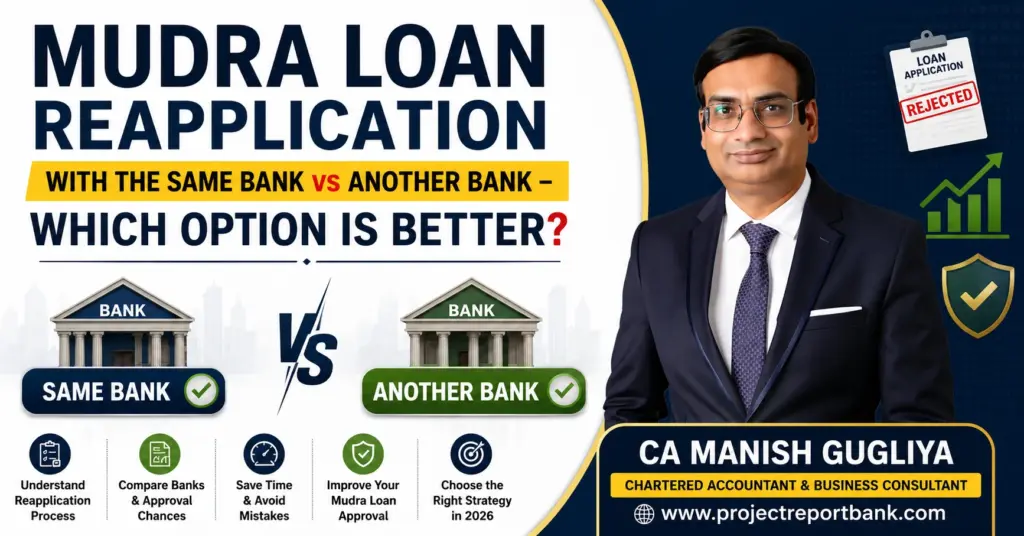
This article will help you understand the reasons for Mudra loan rejection, the difference between rejection statuses, and exactly when staying with the same bank or moving to another makes practical sense.
Table of Contents
Rejection, Pending, Withdrawn & Abandoned: Know Your Exact Mudra Status First
Before deciding your next phase, understand what actually happened to your first application:
- Rejected: The bank formally declined your file with recorded reasons-low CIBIL score, non-eligible business activity, incomplete documents, or weak revenue proof. You can request written reasons under the bank’s grievance policy. Incomplete documents are one of the most common reasons for mudra loan rejection.
- Pending / Under Process: Your form is logged but no final decision exists. The bank may be waiting for a site visit, CIBIL check, or paperwork clarification. Internal processing typically takes 7–15 working days, but delays often stretch far beyond this.
- Withdrawn: You submitted a request to stop processing-perhaps to shift to another bank or change your loan amount.
- Abandoned: The file was never completed due to missing documents or no follow-up, and the bank internally closed it without a formal rejection code.
Your strategy depends on this status. For clear rejection, you must fix the rejection reason before reapplying for a mudra loan. For pending files, escalation or understanding your rights when banks keep applications pending may help. For withdrawn or abandoned cases, a fresh application is treated like a new file, though earlier enquiry records may still appear internally.
Does a Rejected Mudra Loan Spoil Future Eligibility? What Banks See
One rejection does not mean permanent ineligibility under the scheme. The eligibility criteria remain the same across all Member Lending Institutions-but each bank uses its own risk assessment.
Here is how information flows between banks:
- CIBIL report: Records all existing EMIs, defaults, write-offs, settled accounts, and recent loan enquiries. A bank will assess creditworthiness based on previous loan experiences when you reapply. A low or no CIBIL score leads to rejection at most banks. A good credit record is required to reapply for a mudra loan.
- PMMY portal: Records sanctioned mudra loans against your PAN and Aadhaar, ensuring only one active mudra loan exists per borrower.
- Internal bank systems: Store field visit remarks and rejection reasons-but only within that specific bank group’s branches.
A rejected mudra application is not labelled as “rejected” in another bank’s system. However, the underlying problems-weak cash flow, high existing debt, poor creditworthiness-remain visible through credit bureau reports. Multiple loan enquiries in a short period appear in CIBIL and can reduce your score, creating a “credit hungry” perception. The myth that “once rejected, no bank will ever approve” is incorrect if you genuinely improve your CIBIL score and strengthen your application.
Same Bank vs Another Bank: Detailed Comparison for Mudra Reapplication
The table below compares what actually happens in branches when you reapply:
| Factor | Same Bank | Another Bank |
|---|---|---|
| Documentation | May reuse prior KYC and business proof; still needs updated bank statements and financials | Everything collected afresh-complete paperwork required |
| Processing Speed | Often faster if prior verification exists | Slower initially, but may be faster overall if old bank was delaying |
| Previous Verification | Field reports, site visit photos, and CIBIL already available | Must verify from scratch-useful if earlier officer had negative bias |
| Credit Assessment | May hesitate to reverse earlier opinion without clear improvement | Fresh assessment with no internal baggage; approval rates vary based on the bank’s MSME loan share |
| Relationship Benefits | Existing current account with regular transactions and good banking behaviour helps significantly | No relationship, but bank may be eager to onboard a new MSME customer |
| Risks | Getting stuck in prolonged re-verification or internal objections | Multiple enquiries, duplicated effort, and perception of hiding earlier rejection |
Existing banks may require fewer documents for customers who have maintained good accounts. For example, a Kishore loan applicant whose GST turnover mismatch was corrected got approval within two weeks at the same bank. Conversely, a service business facing repeated refusal at a PSU branch got faster sanction after shifting to a small finance bank with dedicated MSME officers.

How Banks Evaluate a Second Mudra Loan Application
Whether you reapply with the same bank or another, the file goes through a fresh credit decision. Banks impose strict scrutiny on past repayment history for reapplications. Key checks include:
- Previous rejection reason: Was it documentation error, negative CIBIL, non-viable project, incorrect business proof, or a technical issue like signature mismatch?
- CIBIL report: Score, recent enquiries, overdue credit cards, existing EMIs. Existing loan defaults trigger immediate rejection.
- Banking behaviour: Cheque bounces, irregular deposits, and whether the current account reflects genuine business transactions.
- Existing liabilities: Other business loans, gold loans, or consumer EMIs that affect repayment capacity for the requested loan amount.
- Business experience & continuity: Years in operation, stability, and any changes in business activity or ownership. Proof of business continuity is necessary when reapplying, and lack of proof of business operations leads to rejection.
- Project report & CMA data: A professionally prepared plan with realistic projections improves credibility, especially for kishore and tarun loans.
- Applicant credibility: Consistency across Aadhaar, PAN, GST, and ITR. Repayment history from previous loans strengthens an application under the mudra scheme.
If you are reapplying with the same bank, the office will compare new information against older data-so any inconsistencies in turnover, investment, or loan purpose must be properly explained with evidence.
When to Stay with the Same Bank for Mudra Loan Reapplication
Reapplying for a mudra loan can be faster if there is a good repayment record and the original rejection was minor and correctable:
- Documentation gaps: Missing bank statements, outdated utility bill, or incomplete GST returns-once provided, the same branch can quickly reprocess.
- Registration issues: Trade licence renewal was pending, Udyam registration obtained after first application, or GST made active again.
- Corrected financial mismatches: GST turnover mismatch resolved with revised returns and reconciled bank statements.
- Improved project report: A detailed, realistic project report prepared by a professional, addressing issues like incorrect working capital calculation or unrealistic projections.
- Strong relationship: Long-standing current account with regular transactions, timely EMI track, and cooperative branch staff.
When Shifting to Another Bank Makes More Sense
Changing banks is not automatically better, but you may try a different lending institution when:
- Unreasonable delay: Application kept pending beyond 30–45 days without clear communication despite repeated follow-up.
- Poor customer service: Branch refusing to give written reasons, or repeatedly asking for unnecessary security or collateral not required under mudra norms.
- Branch refusing applications: Manager states “targets are finished” or insists on cross-selling insurance or expensive add-on products.
- Lack of MSME expertise: Branch with no dedicated MSME officer or visible discomfort in assessing project reports.
- Better relationship elsewhere: Active current account with good turnover at another bank, or business relocation.
Small finance banks have better approval rates for mudra loans, and regional rural banks often approve faster than large banks. Non banking financial companies like Muthoot Microfin are accessible for small shishu loans. The best bank for approval is often local and smaller. However, never shift without first fixing core issues-incomplete KYC, weak CIBIL, or non-eligible business will cause rejection again.
Common Mistakes While Changing Banks & How to Avoid Them
Many applicants believe a new bank will “ignore” previous problems. This is incorrect. Reapplying with the same documents is unlikely to succeed at any lender. Common mistakes:
- Not correcting deficiencies: Same low CIBIL, same overdue accounts, same incomplete documents.
- Submitting inconsistent information: Different turnover figures across project report, GST returns, and ITRs. Incomplete or mismatched documents cause most rejections.
- Changing business details without proof: Different address, ownership, or business activity without supporting documents.
- Hiding previous rejection: Earlier enquiries are visible in CIBIL; dishonesty damages credibility.
- Simultaneous applications: Filing at many banks triggers multiple loan enquiries and signals desperation.
- Copied project reports: Generic reports that don’t match local conditions or actual costs. Applying for an unjustified loan amount results in rejection. Documentation errors of any kind can lead to rejection of a mudra loan application.
How to Improve Approval Chances Before Any Mudra Reapplication
Whether you choose the same bank or apply online with another, upgrade your application quality first:
- Professional project report: Clear business activity description, local market analysis, realistic sales projections, and a repayment schedule aligned with cash flow. A new project report may be needed for higher category loans.
- Updated financials: Latest ITRs, profit and loss statements, and bank statements reflecting declared revenue. Updated financials such as bank statements are required for reapplications.
- Fix CIBIL issues: Dispute errors, close small overdue accounts, regularise EMI payments. Avoid fresh enquiries for a few months.
- Complete KYC and business documents: PAN, Aadhaar, rental agreement, electricity bill, Udyam registration (often required for Kishore and Tarun loans), GST registration, and trade licence. Updated KYC documents might be required.
- Align all records: Ensure business name, address, and ownership match across GST, Udyam, current account, and your mudra loan application.
- Improve banking transactions: Route maximum business receipts through your current account to demonstrate genuine turnover and business purpose.
- Investment proof: Keep invoices for machinery, furniture, or deposits ready to show your own money contribution and seriousness.
CA Manish Gugliya and his team prepare customised Mudra project reports, CMA data, and financial projections through www.projectreportbank.com aligned with actual banking expectations.

Should You Inform the New Bank About Previous Mudra Rejection?
Many borrowers are afraid to disclose earlier rejections. From a banker’s perspective, honesty usually helps more than it hurts.
When to disclose: When the rejection was due to correctable issues like incomplete documents or a weak project report that you have now rectified. Also, when your CIBIL report already shows earlier enquiries-hiding them would be caught immediately.
How banks discover past applications: Credit bureaus list all enquiries by date and lender name. The PMMY portal shows existing government backed mudra loans against your PAN, preventing multiple active loans.
How to explain professionally: Keep it fact-based-“My file was rejected because GST registration was inactive; it is now active and returns are filed.” Show evidence: latest statements, corrected registrations, or a professionally revised project report. Avoid blaming the previous bank. Honest and consistent information builds trust with credit officers, especially for small mudra loans where character matters.
Checklists & Myths: Final Preparation Before You Decide Your Bank
Checklist Before Reapplying (Same Bank or Another):
- Confirm exact status and reason of earlier rejection, preferably in writing
- Review and address CIBIL report issues
- Verify business activity qualifies under mudra yojana (non-farm micro/small enterprise)
- Decide realistic loan amount and category based on turnover and repayment capacity
- Update project report, financial statements, and cash flow estimates
Documents to Review Before Applying to Another Bank:
- Fresh KYC with matching name/address across PAN, Aadhaar, and bank records
- Latest 6–12 months’ bank statements showing business activity. Shishu loans require basic KYC documents and a business plan. Kishore loans need 12 months of business bank statements. Tarun loans require a detailed project report for approval.
- Last 1–3 years’ ITRs, GST returns, Udyam certificate, and business licences
- Previous rejection or closure letters to explain history clearly
Myth vs Reality:
| Myth | Reality |
|---|---|
| Another bank always approves if one rejects | Core issues must be fixed first; banks reject for the same reasons |
| Same bank never changes its decision | Banks can approve after genuine improvements and fresh assessment |
| Multiple applications increase chances | They lower CIBIL score and create negative perception |
| Banks cannot see past enquiries | Credit bureaus report all recent enquiries to every lender |
| Changing branch within same bank guarantees approval | Internal credit policy is common across all branches of a bank |
Complete this checklist review before deciding whether to stay or shift. Cooperative banks, small finance banks, and regional rural banks each have different risk appetites-choose based on your specific stage and situation.
Conclusion: Which Option Is Better for Your Mudra Reapplication?
There is no universal answer. If your mudra loan application failed due to technical or documentation issues and the existing branch is cooperative, reapplying with the same bank saves time because verifications are already complete. If there are serious service issues, unreasonable delays, or the branch lacks MSME understanding, moving to another well-chosen bank after correcting deficiencies is wiser.
Whichever option you choose, the foundation remains the same: fix your CIBIL, correct business records, and present a professional project report supported by CMA data and consistent financials. Getting a mudra loan approved depends on preparation, not just the bank’s logo.
If you need expert help with Mudra loan project reports, CMA statements, financial projections, business valuation, or complete loan documentation, consult CA Manish Gugliya through www.projectreportbank.com so your application matches real banking expectations.
Frequently Asked Questions on Mudra Loan Reapplication
Can I upgrade from a Shishu Mudra loan at one bank to a Kishore Mudra loan at another bank?
Yes, but your existing Shishu loan must be fully closed first. The PMMY portal tracks active mudra loans against your PAN, and most banks will not sanction a new facility until the previous one is settled. You will also need fresh eligibility assessment including CIBIL check and updated business proof.
How long should I wait before reapplying for a Mudra loan after rejection?
There is no mandatory waiting period. However, if rejection was due to CIBIL issues or financial gaps, allow 3–6 months for corrections to reflect in credit bureau records. If it was a simple documentation error, you can reapply much sooner once corrections are complete.
Is a current account compulsory for Kishore or Tarun Mudra loans?
While not a formal PMMY rule, most banks insist on a current account where the maximum loan disbursement and business transactions will be routed. Maintaining one with regular transactions strengthens your application considerably.
Will reapplying multiple times reduce my CIBIL score?
Each application can generate a hard enquiry. Repeated enquiries in a short time can slightly pull down your score and create a negative perception. Focused, well-prepared applications are far better than scattershot submissions across many banks.
Can Tarun Plus loans go above ₹10 lakh?
Yes. Tarun Plus loans can go up to ₹20 lakh for repeat borrowers who have earlier taken and successfully repaid a Tarun loan. This category was introduced in October 2024 and requires documented proof of prior repayment through the same or another bank.
- Can Bank Reduce Mudra Loan Amount Without Your Consent? Complete Practical Guide (2026)


- What to Do If You Cannot Pay Your Mudra Loan EMI (2026 Guide)

- Can a Bank Refuse a Mudra Loan Because the Target Is Completed? Complete Guide (2026)

- Bank Refused My Mudra Loan Application – What Are My Rights?

- Mudra Loan for Used Vehicles (2026): Eligibility, Documents, Bank Rules & Complete Guide

- Rejected Mudra Loan – What to Do Next? Appeal Process Explained (2026)

- Mudra Loan Project Report Madhya Pradesh – Bank-Ready DPR & CMA Guide

- Project Report for Mudra Loan Maharashtra: Complete Guide for MSMEs, Startups and Small Businesses (2026)

- Mudra Loan Uttar Pradesh: Complete Guide for MSMEs, Startups and Small Businesses (2026)

- Mudra Loan Bihar 2026: Eligibility, Documents, Online Application Process & Project Report Guide

- Jan Samarth Mudra Loan 2026: Complete Guide to Online Application, Eligibility, Documents & Approval Process

- MSME Mudra Loan: Complete Guide for Small Businesses, Startups & Manufacturing Units in India (2026)

- Is the Mudra Loan Subsidy Real or Fake? Get the Facts Here

- Mudra Loan Without CIBIL Score: How to Qualify and Apply

- Mudra Loan for Used Machine (2026 Guide) – Eligibility, Documents, Valuation & Approval Tips