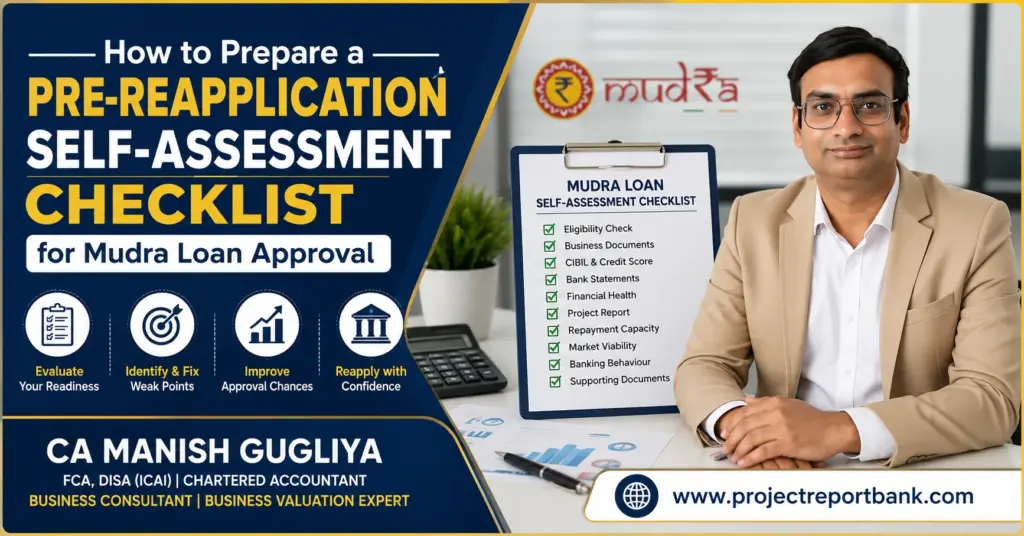
Key Takeaways
Here is a quick mudra loan self assessment checklist summary before you read the full article:
- Most repeat Mudra Loan rejections happen because applicants reapply without correcting earlier issues in documents, banking behaviour, and project report.
- A structured mudra loan reapplication checklist helps identify gaps in eligibility, documents (pan card, aadhaar card, address proof, bank statement, income proof), and business viability before visiting the bank again.
- This article provides a practical pre-reapplication checklist for Mudra Loan covering eligibility, documents, banking, financial ratios, project report, and risk factors in simple language.
- Following this self-assessment step-by-step can significantly improve mudra loan approval chances and save time, money, and frustration.
Introduction: Why You Must Self-Assess Before Reapplying for Mudra Loan
In my 20+ years of helping clients across India with MSME funding, I have seen one pattern repeatedly: a business owner gets rejected for a Mudra Loan, then walks into the same bank with the same file and expects a different result. It does not work that way.
A readymade garment trader applied for a Kishor loan of Rs 4 lakh. His ITR showed Rs 6 lakh turnover, GST returns showed Rs 5 lakh, but his bank statement had only Rs 1.5 lakh in business credits. The application was rejected. A mobile repair shop owner submitted a Tarun loan application without a proper project report or quotations. Rejected again. Both made the same core mistake: no self-assessment before reapplying.
A mudra loan self assessment checklist is a step-by-step list where you honestly check your own eligibility, mudra loan documents, business strength, and financials before approaching the bank again. This checklist is useful for proprietorships, partnerships, LLPs, and private limited companies whose earlier applications were rejected or kept pending. Banks already perform an internal version of this assessment. When you do it in advance, you align expectations and improve mudra loan approval chances.
Table of Contents
Why Banks Reject Repeat Mudra Loan Applications
Before using any pre-reapplication checklist for Mudra Loan, understand why the bank said “No” last time. Here are the common rejection reasons:
- Incomplete mudra loan documents, expired address proof, missing identity documents, old or invalid bank statements, and PAN–Aadhaar name mismatch
- Weak or copy-paste project report, unrealistic financial projections, low profitability, poor cash flow, and wrong working capital calculation
- Cheque bounces, heavy cash withdrawals, low average balance, multiple loan enquiries, high existing EMIs, low CIBIL score, and inconsistent information between application form, ITR, GST, and bank statements
A bank risk officer reads your file by comparing turnover shown in GST with bank credits, checking for frequent EMI delays, and verifying business activity during site inspection. According to recent data, roughly 80% of rejections among self-employed individuals stem from document mismatches, irregular deposits, and multiple active unsecured loans.
Action tip: Obtain and read your earlier rejection reason in writing before starting self-assessment.
What is a Pre-Reapplication Mudra Loan Self Assessment Checklist?
A mudra loan self assessment checklist is a written list of questions covering eligibility, documents, business viability, and financial health that the applicant answers honestly before visiting the bank again.
Its purpose is to convert a vague “let me try again” approach into a clear mudra loan reapplication preparation plan covering what to correct, arrange, and update. Benefits include fewer bank visits, confident discussion with the loan officer, faster processing, and higher approval chances.
Banks do the same assessment internally: they check KYC, CIBIL, business proof, turnover, profit, cash flow, DSCR, FOIR, and market risk before sanctioning any loan. The next sections break this checklist into concrete parts.
Complete Mudra Loan Self-Assessment Checklist (Personal, Business, Documents & Viability)
This is the core mudra loan approval checklist. Work through each cluster honestly.
Personal and Business Eligibility
- Confirm Indian nationality, age between 18–65 years, and that your activity (manufacturing, trading, or service sectors) is permitted under PMMY
- Mudra loans are available in four categories: Shishu (up to Rs 50,000), Kishor (Rs 50,001 to Rs 5 lakhs), Tarun (Rs 5 lakhs to Rs 10 lakhs), and Tarun Plus (Rs 10 lakhs to Rs 20 lakhs). The Tarun Plus category was introduced in October 2024 for applicants who have fully repaid a Tarun loan
- Seasonal businesses and home-based enterprises are also eligible under the scheme
Business Experience and Registration
- Check business start date, experience in the same line, and availability of GST registration, Udyam certificate, Shop and Establishment licence, partnership deed, LLP agreement, or incorporation certificate
- Common mistake: Expired licence or missing Udyam registration creates doubt about legitimacy
Aadhaar, PAN and Address Proof
- Verify that aadhaar card and pan card names match exactly across all documents. A pan card is not mandatory for Mudra Loan applications, but if provided, details must be consistent
- Main business address proof is usually sufficient for Mudra Loans. Use current utility bills, rent agreement, or property tax receipt. A passport, voter id, or driving licence can serve as identity proof
Contact Details
- Ensure mobile number is active and linked with Aadhaar, email ID is regularly accessed, and both are consistent across bank account, GST, and loan application
Existing Loans and CIBIL Score
- List all current loans: business loans, personal loans, vehicle loans, credit card dues
- Check for overdue EMIs and obtain your latest CIBIL report to see score, past defaults, settlements, or write-offs. Banks generally prefer a score above 650–700 for Kishor and Tarun categories
Banking Behaviour and Bank Statements
- Download last 6–12 months’ bank statements from the main business account
- Review cheque bounces, cash withdrawals, average monthly balance, and whether business turnover is visibly routed through banking channels
- Bank checks this because: For collateral-free mudra loans, bank statements act as a mirror of your financial discipline
Statutory Compliance
- Check last 2–3 years’ GST returns (if applicable), income tax returns, and whether turnover reported in ITR, GST, and bank statements are broadly aligned
- Common mistake: GST turnover mismatch with bank credits is a frequent red flag
Financial Statements and Profitability
- Prepare basic financials (trading and profit and loss account, balance sheet) for at least the last 1–2 years. Even small micro enterprises should have these ready
- Review whether business shows consistent profit or healthy gross margins
Cash Flow and Working Capital
- Estimate monthly inflows (sales collections) versus outflows (purchases, rent, salaries, EMIs, electricity) and check whether existing cash flow supports a new EMI comfortably
Project Cost and Quotations
- List exact project cost for machinery, equipment, furniture, stock, and working capital supported by recent quotations (within 3 months) from suppliers with GST numbers. Avoid inflated costs
Project Report and CMA Data
- Review or prepare a customised project report with business profile, market summary, projected sales, expenses, profit, and CMA-style data for 3–5 years using realistic assumptions
- For Kishor and Tarun categories, a strong project report is mandatory
Business Viability and Market Demand
- Write a short note on your product or service, target customers, competition, and how you will achieve sales to repay the loan amount
Repayment Capacity, DSCR and Margin Money
- Calculate how much EMI you can safely pay from net monthly surplus. Ensure DSCR (the number of times your yearly net surplus covers yearly total EMIs) is above 1.25–1.50
- Confirm availability and source of margin money (own contribution)
Business Continuity and Risk Factors
- Think about key risks: seasonal demand, local competition, supplier issues, personal health. Note simple backup plans to show stability and continuity
Supporting Documents
- Assemble a neat file containing all mudra loan documents: aadhaar card, pan card, photographs, address proof, GST and ITR copies, Udyam certificate, licences, bank statements, quotations, and project report
Self-Assessment Scorecard: Rate Your Mudra Loan Application Readiness
Convert your checklist answers into a simple scorecard on paper or Excel:
| Checklist Item | Status (Yes/No) | Improvement Needed | Priority |
|---|---|---|---|
| CIBIL Score above 650 | No | Clear overdue credit card, wait 3 months | High |
| Bank statements clean (no bounces) | Yes | – | – |
| Updated project report ready | No | Prepare fresh report with CA | High |
| GST and ITR filed and aligned | Yes | – | Medium |
If too many high-priority items show “No,” postpone reapplication and correct gaps first. A small packaging material unit, for example, found three high-priority gaps (CIBIL, project report, margin money) and decided to fix them over 3 months before reapplying.
Documents to Verify Before Reapplying for Mudra Loan
Most rejections involve small document issues easily fixed in advance.
KYC and Identity Documents:
- Aadhaar card, pan card, recent passport-size photographs, current address proof (electricity bill, rent agreement, property tax receipt), business registration proof, Udyam certificate, Shop and Establishment licence, and trade-specific licences (like FSSAI for food business)
- Income proof is not required for Shishu category loans (up to Rs 50,000)
- Additional documents may be required for Tarun Plus category loans given the higher loan amount
Financial and Tax Documents:
- Last 6–12 months’ bank statements with bank seal, latest 2–3 years’ income tax returns, GST registration and recent GSTR-3B and GSTR-1 returns if applicable
Business and Project Documents:
- Updated project report, machinery quotations, rent agreement or ownership papers, existing loan sanction letters
For each document, check: correctness of name and address, legibility, date validity, and consistency across all documents. Prepare two sets of copies and carry originals for verification.
Financial Checks Before Mudra Loan Reapplication
Banks do not rely on collateral for Mudra Loan. They mainly assess repayment capacity using these checks:
- Cash flow: Calculate average monthly net surplus after all business and household expenses
- Profitability: Compare sales with total costs for last year. Ensure at least a reasonable gross profit margin. Do not show suddenly inflated profit just to impress the bank
- DSCR: In simple terms, how many times your yearly net surplus covers your yearly total EMIs. A DSCR above 1.25–1.50 is comfortable
- FOIR: The percentage of monthly income already going into EMIs. Keep total EMI burden (existing plus proposed) below 50–60% of stable monthly income
- Existing liabilities: List all business loans, personal loans, vehicle loans, credit card dues, and informal borrowings. Check whether a new Mudra Loan will over-stretch the business
- Bank balance: Maintain some minimum balance and emergency reserve so seasonal slowdown does not cause immediate EMI default
Simple illustration: If monthly business surplus after all expenses is Rs 15,000 and proposed Mudra EMI is Rs 8,000, your repayment capacity looks tight. If surplus is Rs 25,000, the EMI is more comfortable. Financial institutions like small finance banks and other lenders also look at similar ratios.
Banking Behaviour Checklist Before Reapplying
For collateral-free Mudra Loan, your bank statement acts as a mirror of your banking habits:
- Cheque and ECS bounces: Count bounces in last 6–12 months. Zero bounces for 3 months before reapplication is the minimum target
- Average balance: Maintain at least the minimum required balance. Aim for a reasonable average instead of nil balance most of the time
- Transaction pattern: Route more sales and purchases through the bank. Reduce unexplained large cash deposits or withdrawals
- Digital banking: Use UPI, NEFT, and RTGS for vendor and customer payments to create a clean, traceable trail
- Loan repayment behaviour: Clear overdue EMIs, regularise accounts, and maintain clean payment for a few months before reapplying
If present banking history is very weak, stabilise operations and improve 3–6 months of statements before approaching the bank again.
Project Report Review Checklist for Mudra Loan Reapplication
Many applications are rejected because of copy-paste or unrealistic project reports that do not match actual business reality. Review these elements:
- Business profile: Nature of business, products, customers, location, ownership structure, promoter background and experience
- Market analysis: Simple local-level note on demand, competitors, pricing, and your unique advantage
- Financial projections: Realistic sales, expense, and profit projections for 3–5 years based on capacity and past performance, not imaginary numbers
- Cost estimation: Project cost must match quotations and trading pattern. Working capital should be neither too low nor unrealistically high
- Profitability and DSCR: Projected profit must comfortably cover proposed EMI with a safety margin
- CMA data: Fund flow, balance sheet projections, and ratio summary should be internally consistent with assumptions written clearly
- Industry benchmarks: Compare gross margin and stock holding days with typical figures in your industry
For complex or higher-ticket loans, taking professional help from an experienced Chartered Accountant for project report and CMA data can significantly reduce rejection risk. The Micro Units Development and Refinance Agency (MUDRA) expects credible, bank-ready reports.
Top Mistakes Applicants Make Before Reapplying for Mudra Loan
Avoid these specific mistakes that cause repeat rejection:
- Reapplying with the same old project report without any update
- Not downloading and reviewing the latest CIBIL report
- Continuing frequent cheque bounces after rejection
- Showing sudden unrealistic profit only in the reapplication year
- Hiding existing loans or EMI obligations from the bank
- Mismatch between GST turnover and bank credits
- Using different signatures across documents
- Not updating expired Shop and Establishment licence
- Using friends’ or relatives’ bank accounts for business transactions
- Submitting blurred or illegible scanned copies
- Not carrying original documents for verification
- Being absent during site inspection
- Giving inconsistent answers during bank interview
- Over-committing EMI beyond actual repayment capacity
- Giving vague explanations for earlier rejection
- Not updating bank statements to recent months
Check your earlier application against this list. Mark which mistakes applied and correct every one before reapplying.
Practical Tips to Improve Mudra Loan Approval Chances
After completing the mudra loan eligibility self assessment and correcting weak areas:
- Route more business turnover through the main bank account for at least 3–6 months so the bank can clearly see business activity
- Clear small overdues, settle credit card dues, and avoid fresh unsecured loans to keep CIBIL and FOIR healthy
- Complete Udyam registration, renew all licences, and regularise GST and income tax filings before visiting the bank branch
- Prepare a short one-page business summary and carry a neat, indexed document file. This creates a positive impression of seriousness
- Consult an experienced Chartered Accountant for project report, CMA data, and document file preparation to convert a borderline case into an approvable one. The processing fee for Mudra Loans is minimal, so invest your energy in preparation instead
- Consider whether to reapply at the same bank or try another bank based on your specific situation

Real-Life Example: How Self-Assessment Turned a Rejection into Mudra Loan Approval
A readymade garment retailer from a small city applied for a Kishor loan of Rs 4 lakh. The first application was rejected due to incomplete mudra loan documents, a weak project report, low average bank balance, and multiple cheque bounces noted by the bank.
Guided by a Chartered Accountant, the owner used a detailed mudra loan self assessment checklist to identify gaps. The CIBIL report showed a settled personal loan dragging the score down. GST returns had a turnover of Rs 5 lakh, but the bank statement showed only Rs 1.5 lakh in business credits. The income tax return declared Rs 6 lakh turnover, creating a three-way mismatch.
Over the next five months, the owner regularised all EMIs, routed sales through the bank account consistently, corrected a PAN–Aadhaar spelling mismatch, and arranged margin money from personal savings. The CA prepared an updated project report with realistic projections showing a DSCR of 1.4 and FOIR under 40%. An excellent job was done aligning GST, ITR, and bank statement figures.
The reapplication was approved for Rs 4 lakh under Kishor category. The owner availed the loan, purchased stock, and expanded the business into an adjacent shop. The interest rate offered was competitive, and the government scheme ensured no collateral was needed.
Frequently Asked Questions (FAQs) on Mudra Loan Self-Assessment Before Reapplying
These FAQs address practical questions that usually arise while preparing a mudra loan reapplication checklist.
Should I check my CIBIL score before reapplying for a Mudra Loan?
Yes, checking CIBIL in advance is highly recommended. A low score, past settlements, or unpaid loans are common hidden reasons for rejection. Correct errors in the report, close small overdue accounts, and if the score is below 650, wait a few months for improvement before reapplication. This single step can dramatically improve your mudra loan application readiness.
Can I reapply for Mudra Loan immediately after rejection?
Technically, banks may accept a fresh application, but practically it is better to first understand the exact rejection reason, use a mudra loan rejection checklist, fix issues in documents, banking, or project report, and then reapply after visible improvements, typically 3–6 months later.
Do I need to prepare a new project report for reapplication?
If the previous project report was generic, unrealistic, or did not match your actual business, a fresh customised report is almost always needed. Updated figures, current quotations, and corrected financial projections are essential. The process of how to reapply for Mudra Loan starts with an honest review of the earlier report.
Is GST registration compulsory for all Mudra Loan applicants?
GST is not mandatory for businesses with turnover below the legal threshold. However, if the business is already liable for GST and has not registered or filed returns properly, it creates doubt in the banker’s mind during reapplication. Compliance strengthens your case.
Can a Chartered Accountant help in preparing the Mudra Loan Self-Assessment Checklist?
An experienced CA can review financials, banking details, tax compliance, and project report. They can identify weaknesses a business owner may miss and design a clear action plan based on applicable RBI and government guidelines to improve development of a strong application. For Kishor and Tarun categories, professional help is especially valuable in ensuring all requirements are met and growth projections are credible.
Final Conclusion: Review, Correct, Then Reapply for Mudra Loan
Successful mudra loan reapplication is not about trying repeatedly. It is about systematically using a mudra loan self assessment checklist to review eligibility, documents, banking behaviour, financial strength, and project viability before approaching the bank.
Do not rush to submit the same file at another stage. Fix weaknesses step-by-step, especially in CIBIL, bank statements, income proof, GST, ITR, and project report. Every correction you make brings you closer to approval.
Treat this self-assessment as an investment of time. It can save multiple branch visits, reduce frustration, and significantly improve your chances of getting the required Mudra Loan to find the funding needed to expand your business across units in any part of India. If you are unsure about numbers or documentation, seek guidance from an experienced Chartered Accountant or MSME finance expert before you apply again.
- Can Bank Reduce Mudra Loan Amount Without Your Consent? Complete Practical Guide (2026)


- What to Do If You Cannot Pay Your Mudra Loan EMI (2026 Guide)

- Can a Bank Refuse a Mudra Loan Because the Target Is Completed? Complete Guide (2026)

- Bank Refused My Mudra Loan Application – What Are My Rights?

- Mudra Loan for Used Vehicles (2026): Eligibility, Documents, Bank Rules & Complete Guide

- Rejected Mudra Loan – What to Do Next? Appeal Process Explained (2026)

- Mudra Loan Project Report Madhya Pradesh – Bank-Ready DPR & CMA Guide

- Project Report for Mudra Loan Maharashtra: Complete Guide for MSMEs, Startups and Small Businesses (2026)

- Mudra Loan Uttar Pradesh: Complete Guide for MSMEs, Startups and Small Businesses (2026)