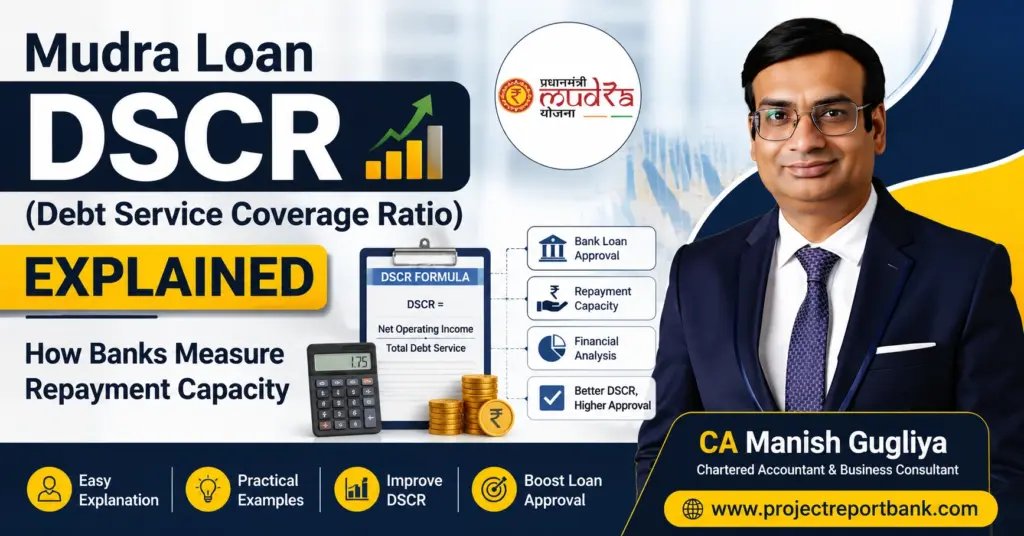
Many Mudra Loan applicants believe that a good CIBIL score and proper documents guarantee approval. But banks dig deeper. They want to know whether your business generates enough cash to comfortably repay the loan EMIs every single month. This is where the debt service coverage ratio steps in as the most crucial financial metric in your Mudra Loan project report.
Key Takeaways
- Mudra Loan DSCR tells the bank whether your business cash profit is enough to pay your EMIs comfortably, even if sales dip slightly in some months.
- Even with good CIBIL, complete documents, and a genuine business, banks may reject your Mudra Loan if DSCR is weak, missing, or incorrectly shown in the project report or CMA data.
- The practical DSCR formula used by most Indian banks: (Net Profit after Tax + Depreciation + Interest on Term Loan) ÷ (Annual EMI of all term loans).
- For Kishor and Tarun categories, lenders typically require a minimum DSCR of 1.2 to 1.25, and they feel more comfortable when projected DSCR is between 1.50 and 2.00 over five years.
- A DSCR of at least 2.00 is considered very strong by lenders.
- Realistic projections, correct DSCR calculation, and a professionally prepared Mudra Loan project report from ProjectReportBank.com can significantly improve your loan approval chances.
Real-Life Introduction: Why Banks Question Repayment Even When Everything Looks Perfect
Let me tell you about a situation I see almost every week. Sunita, a 32-year-old woman entrepreneur from Indore, applied in 2026 for a ₹7 lakh Mudra Tarun business loan to expand her beauty parlour. Her CIBIL score was 760. Her KYC, GST registration, and ITR were all in order. Yet the bank manager told her: “Repayment capacity doubtful.”
She was shocked. And honestly, most entrepreneurs would be.
Here is what most applicants believe: “If my business shows profit and I have good CIBIL, the bank must approve my Mudra Loan.” But that is not how banks think. Bank officers look at whether your monthly and yearly cash flow can safely pay the EMI after covering all your regular operating expenses. This is exactly where DSCR comes in.
A Mudra loan is a government-backed initiative in India under the PMMY, providing funding up to ₹10 lakhs to non-corporate, non-farm small and micro-enterprises. Loans are categorized by growth stage, including Shishu, Kishore, Tarun, and Tarun Plus, and can be accessed through commercial banks, RRBs, small finance banks, MFIs, and NBFCs. Funds from Mudra loans can be used for various business activities, including working capital and purchasing equipment.
Based on my 20+ years of experience with PSU banks and private banks for MSME finance, many genuine files are delayed or rejected only because DSCR is wrongly calculated, missing, or built on unrealistic projections.
In this article you will learn:
- What DSCR means in simple language
- The exact DSCR formula banks use
- Step-by-step DSCR calculation
- Good vs bad DSCR ranges for Mudra Loans
- Common mistakes that lead to rejection
- How to improve DSCR before applying
- How to present DSCR properly in your project report
Table of Contents
Meaning of DSCR in Mudra Loans – Explained in Very Simple Words
Mudra Loan DSCR tells the bank: “For every ₹1 of EMI the business must pay in a year, how many rupees of cash profit does it actually earn?”
DSCR stands for Debt Service Coverage Ratio. Here, “Debt Service” means the total EMI (both principal repayments and interest payments) payable in a year on all term loans. “Coverage” means how much profit is available to cover debt payments.
The important word is “cash profit.” Banks do not simply use your book profit from the P&L statement. They add back depreciation, which is a non cash expense that reduces profit on paper but does not actually take any cash out of the business. They also add back term loan interest because that interest is already part of the EMI you are paying.
A small illustration makes this clear. If your yearly cash profit is ₹3,00,000 and your total annual EMIs are ₹2,00,000, then DSCR = 1.50. This means the business earns 1.5 times the EMI requirement. A DSCR above 1 indicates sufficient income to cover debt obligations.
For big project finance deals, DSCR calculations can be extremely complex, involving sinking fund payments, lease payments, and debt service reserve accounts. For Mudra Loans, the dscr calculation is much simpler, but the core idea remains the same: available cash flow versus required debt payments.

Why Banks Calculate DSCR Before Approving a Mudra Loan
Bank officers are trained under RBI guidelines and internal bank policies to assess repayment capacity, not just collateral or credit score. DSCR is their quickest repayment test, and one of the most important financial ratios in any loan appraisal.
Under Mudra (Shishu, Kishore, Tarun), loans are collateral-free up to ₹10 lakh and are supported by the Credit Guarantee Fund for Micro Units. Since the bank cannot rely on property security, a company’s ability to generate enough operating income to service debt becomes the primary safety net. Financial institutions assess DSCR for larger Mudra loan categories like Kishor and Tarun as a standard practice.
DSCR helps the bank answer three critical questions:
- Will the business be able to pay EMI even if sales are slightly lower than projected?
- Is the requested loan amount reasonable compared to cash profit?
- Is the repayment period adequate, or is the EMI burden too heavy?
Lenders use DSCR to assess a company’s creditworthiness and the company’s financial health. Many banks informally keep minimum dscr requirements around 1.25 across all projection years. A strong DSCR can compensate for some small weaknesses like thin margins or limited experience, whereas a weak DSCR can kill even a technically good project.
Profit vs Repayment Capacity – Why Cash Flow Matters More Than Just “Net Profit”
Many Mudra applicants bring an ITR or P&L showing “good profit” and assume that is enough. But banks focus on operating cash flow because EMIs are paid in cash, not in accounting entries.
Here is why net profit alone is misleading:
- Net profit is reduced by non-cash charges like depreciation
- It may not reflect seasonal cash shortages or irregular collections
- Owner’s drawings can drain actual cash even when profit looks healthy
- Certain operating expenses may be understated on paper
Consider two quick examples. A medical store earns moderate profit but receives stable daily cash from customers. Its DSCR stays strong because actual cash matches projections. A restaurant showing high profit on paper but with heavy owner withdrawals and irregular weekend-heavy collections may show weak DSCR because real cash available for debt service is much less than it appears.
This is why banks use cash profit for DSCR: Net Profit after Tax + Depreciation + Term Loan Interest. Net operating income, in this simplified Mudra context, represents company’s revenue minus operating costs and taxes, with non-cash items added back. It captures the real money sitting in the business to meet repayment obligations.
Two businesses with ₹3 lakh net profit can have completely different DSCR values if one has ₹50,000 in existing debt obligations while the other has ₹1,80,000 in total annual EMIs.
Core Components Used in Mudra Loan DSCR Calculation
For Mudra Loans, most Indian banks and every lending institution use a practical dscr formula built from three items in projected financials and CMA data.
Cash Profit (Numerator): Derived from the projected Profit and Loss statement. It equals Net Profit after Tax + Depreciation + Interest on Term Loan. Think of it as a simplified version of company’s net operating income adjusted for the small borrower context. This is the money available before making obligatory cash payments toward the loan.
Total Debt Service (Denominator): Annual EMIs payable on all term loans, existing plus the proposed Mudra Loan. This includes both interest and principal payments as per the repayment schedule. To calculate total debt service, you simply add up all the EMI payments due in that year.
Other Loan Obligations: Banks may include existing vehicle loans, equipment loans, or other business term loans when assessing DSCR. However, working capital interest on cash credit or overdraft facilities is usually not added into the DSCR denominator for small Mudra cases. The Mudra Card allows for easy withdrawal of working capital based on real-time cash flows, and this is treated separately.
Each component connects to a specific section of the project report: cash profit from the P&L, interest from the finance cost section, principal from the loan repayment schedule, and all of these flow into the final DSCR table in CMA data.
Mudra Loan DSCR Formula and Step-by-Step Calculation Method
Here is the exact formula used by Indian banks for Mudra and small business loan appraisals:
DSCR = (Net Profit after Tax + Depreciation + Interest on Term Loan) ÷ (Total Annual EMI of all Term Loans)
This is essentially dividing net operating income (adjusted for small borrowers) by total debt service. Net operating income here is revenue minus operating expenses, with depreciation and loan interest adjustments.
Step-by-step process:
- Prepare realistic projected P&L for 5 years
- Compute Net Profit after Tax for each year
- Note annual Depreciation and Term Loan Interest separately
- Prepare a term loan repayment schedule showing yearly principal and interest
- Apply the formula for each projection year
Worked Example – Tailoring Shop (₹5 Lakh Mudra Tarun Loan):
| Item | Amount (Year 1) |
|---|---|
| Net Profit after Tax | ₹2,40,000 |
| Depreciation | ₹60,000 |
| Interest on Term Loan | ₹30,000 |
| Cash Profit (Numerator) | ₹3,30,000 |
| Annual EMI (Principal + Interest) | ₹2,40,000 |
| DSCR | 1.375 |
A DSCR of 1.375 is acceptable but borderline. Banks would prefer it closer to 1.50. Note that DSCR relies on accounting methods that may vary widely, so using the formula your bank expects is essential. Some internet sources use EBITDA-based formulas or different treatments – stick to the Indian banking standard shown above to avoid confusion during appraisal. DSCR also follows accrual based accounting guidance, meaning timing of revenue recognition matters in projections.
For existing businesses, banks verify DSCR against the last 2–3 years of actual data plus projections. For new businesses, Year 1 DSCR may be weaker, but banks expect it above 1.50 by Year 2 or 3. A DSCR of 1.00 indicates just enough income to cover debt, leaving zero margin for unexpected expenses.

How Banks Interpret DSCR Values in Mudra Loan Sanction Decisions
Based on my experience across PSU banks and RRBs, here is how branch managers mentally classify DSCR when checking a Mudra Loan project report:
| DSCR Range | Bank’s Typical Reaction |
|---|---|
| Below 1.00 | Almost certain rejection – negative cash flow, business cannot cover even basic EMIs |
| 1.00 – 1.24 | High risk – may approve only with strong collateral or additional household income |
| 1.25 – 1.49 | Acceptable with conditions – minimum threshold for most Tarun loans |
| 1.50 – 2.00 | Comfortable – smooth processing, indicates company’s financial strength |
| Above 2.00 | Ideal if realistic; suspicious if projections seem inflated |
A DSCR below 1.0 suggests a company may default on loans and indicates a cash flow shortage. Higher DSCR values indicate a better capacity to repay loans and lower risk for lenders. A DSCR of at least 1.25 is often considered strong by most financial institution standards for Mudra cases.
Lenders typically look for a minimum DSCR of 1.25 to 1.5 for loan approval in Kishor and Tarun categories. DSCR is particularly important for determining loan eligibility in higher loan amounts.
Two important exceptions exist. First, banks may still approve a loan with DSCR near 1.10 if there is a strong existing banking relationship or additional salary income in the household. Second, very high DSCR based on unrealistic projections – say DSCR of 4–5 in Year 1 for a new boutique – makes banks suspicious and invites detailed questioning. The company’s financial trend should show gradual improvement, not magical jumps.
DSCR in Project Reports & CMA Data – How It Should Appear for Mudra Loans
For loans above approximately ₹5 lakh (Kishore and Tarun categories), many banks require formal CMA data or at least a structured financial projection where DSCR is clearly presented. Loan applicants should provide documents like ID proof and project reports to lenders alongside the DSCR analysis.
A proper Mudra Loan DSCR section should contain a 5-year summary table with:
- Year
- Cash Profit (Net Profit + Depreciation + Interest)
- Interest on Term Loan
- Principal Repayment
- Total Debt Service
- DSCR for each year
The term loan repayment schedule must match figures in the projected balance sheet and cash flow statement. Any mismatch – for example, principal in the DSCR table not matching the loan schedule – immediately raises red flags for the credit officer. Lenders determine the financial position by cross-checking these schedules during appraisal.
DSCR can be calculated over time to track the company’s financial trend across projection years. I always recommend highlighting DSCR in the executive summary of the project report with a line like: “Average DSCR over 5 years: 1.72.” Many busy managers read the summary first and decide whether to go deeper into the file.
At ProjectReportBank.com, we always cross-check that DSCR figures flow correctly from P&L, balance sheet, and loan schedule so a bank officer can trace each number without doubt.
Practical Examples: DSCR for Different Small Businesses Under Mudra
DSCR behaves differently across sectors because margins, seasonality, fixed costs, and debt structure differ significantly. Here are quick illustrations.
Manufacturing Unit – LED Bulb Assembly, Pune (₹9 Lakh Loan): A small manufacturing company earns Rs 18 lakh in annual sales, with operating costs of about ₹13 lakh, generating cash profit around ₹3,80,000. With annual EMIs of ₹2,60,000, DSCR comes to approximately 1.46. Banks still ask for conservative projections due to raw material price fluctuation and capital expenditures requirements. The debt coverage ratio here is acceptable but needs to show improvement by Year 3.
Retail Kirana Shop (₹3 Lakh Loan): Stable monthly sales and lower fixed costs result in moderate but steady DSCR, often around 1.60–1.80. Banks appreciate this stability in company’s finances even when margins are thin.
Medical Store (₹5 Lakh Loan): Essential goods provide consistent cash flow. A typical medical store generates DSCR around 1.80. With sufficient income from daily sales, banks view this positively. A DSCR of 1.67 means income covers debt service 1.67 times over – and medical stores often exceed this.
Mobile Repair Shop / Computer Centre (₹4 Lakh Loan): Lower fixed investment but variable monthly volume causes DSCR to fluctuate. Projections must be conservative and supported by local demand data. A typical DSCR path might show 1.25 in Year 1 rising to 1.70 by Year 3 as the customer base stabilizes. The interest coverage ratio tends to be healthier because these are low-asset businesses with smaller interest obligations.

Common DSCR Mistakes in Mudra Project Reports (and How Banks Catch Them)
Many rejected Mudra Loan files share the same DSCR-related mistakes, especially when reports are copy-pasted from internet templates without proper customization.
Key mistakes I see regularly:
- Using wrong formula (like using sales instead of cash profit in the numerator)
- Ignoring existing EMIs on personal or business loans – banks check CIBIL for existing debt and current debt obligations
- Showing unrealistic profit jumps in Year 1 without market justification
- Underestimating operating expenses such as rent, electricity, wages
- Wrong EMI calculation assuming too low interest rates or a tenure not allowed by the bank’s loan terms
Bank officers verify DSCR by checking depreciation against the asset schedule, verifying interest rate with the bank’s Mudra circular, cross-checking EMI with standard calculators, and comparing projected margins with industry norms and GST returns.
A real case I recall: a bakery in Bhopal projected ₹40 lakh sales in the first year without any track record, showing DSCR above 4.0. The manager doubted the entire report and returned the file. DSCR may not fully incorporate all company expenses if the preparer is careless or dishonest.
| Common Mistake | Bank’s Interpretation |
|---|---|
| Inflated profit projections | “Applicant is not serious / report is copy-paste” |
| Missing existing EMIs | “Hiding information – trust issue” |
| Wrong interest rate in EMI | “Does not understand loan agreements or scheme rules” |
| DSCR mismatch with repayment schedule | “Report is unreliable – send back for correction” |
| 100% capacity utilization in Year 1 | “Unrealistic – no new business runs at full capacity immediately” |
How to Improve DSCR for Mudra Loan Before You Submit Your Application
DSCR can often be improved with sensible adjustments before the application reaches the sanctioning officer. These changes in advance are far better than facing rejection.
Practical improvement techniques:
- Reduce requested loan amount slightly to bring EMI within realistic cash profit range
- Increase own capital/margin so that the term loan requirement reduces – this directly lowers annual loan repayments
- Choose the maximum repayment tenure allowed under Mudra to lower yearly EMI burden
- Correct under-reported expenses that are actually unavoidable, to avoid future cash crunch
- Plan gradual sales growth instead of sudden spikes to keep DSCR believable across projection years
Before-and-After Example – Restaurant:
| Parameter | Before | After Adjustment |
|---|---|---|
| Loan Amount | ₹8,00,000 | ₹6,00,000 |
| Tenure | 5 years | 7 years |
| Annual EMI | ₹2,10,000 | ₹1,25,000 |
| Cash Profit | ₹2,48,000 | ₹2,48,000 |
| DSCR | 1.18 | 1.98 |
By reducing the loan amount and extending the tenure, DSCR jumped from a risky 1.18 to a comfortable 1.98. Factors influencing DSCR include loan amount, tenure, interest rates, and the business’s actual profitability.
For existing businesses, consider repaying small high-EMI loans before applying, and improve record-keeping so that real cash profit can be demonstrated through GST returns and bank statements. Non operating income like rental income from a portion of premises, if documented, can also strengthen the numerator.
These improvements must be done honestly. Manipulating projections only on paper without the ability to actually run the business at those numbers will be caught during business verification or site inspection. Banks verify projected repayment capacity through accrual accounting records and actual bank statement analysis.
CA Manish Gugliya’s Practical Advice on DSCR and Mudra Loans
Having prepared hundreds of Mudra Loan project reports and discussed them with branch managers across different banks, here are my direct observations.
Most bank managers in 2024–2026 openly tell me: “If DSCR is below 1.25 or not properly shown, I don’t forward the file to the next level.” The company’s operating income relative to principal payments is the first thing they scan. Lenders rely heavily on this single number to decide whether to proceed.
Unrealistic DSCR projections – say DSCR of 3–4 in the first year for a new restaurant or boutique – immediately create doubt. Officers ask for additional documents, order field investigation, or reject outright citing “non-viable projections.” According to NITI Aayog’s PMMY impact assessment, rejection rates linked to weak documentation and viability assessments remain high across the country.
Avoid copy-paste project reports. I have seen the same DSCR table used for a kirana store, a mobile shop, and a dairy farm in the same file format. No experienced banker takes such reports seriously. Your report should reflect your specific business reality, including tax deductible expenses, actual rent, real wage costs, and genuine market demand.
Before approaching the bank, get your DSCR checked by a professional who understands banking expectations. Walk into the branch with a bank-ready report that answers the DSCR and cash flow questions before the manager even asks them.
Frequently Asked Questions about Mudra Loan DSCR
What is a good DSCR for Mudra Loan?
- Lenders are comfortable when average projected DSCR over 5 years is between 1.50 and 2.00.
- A DSCR of 2.00 is typically viewed as very strong.
- The minimum DSCR should not fall below approximately 1.25 in any single projection year for Kishor and Tarun categories.
- Lenders may require a minimum DSCR of 1.2 to 1.25 depending on the specific bank and branch policies.
Is DSCR compulsory for small Shishu loans under ₹50,000?
- Banks usually do not prepare a formal DSCR table for very small Shishu tickets.
- However, they still look informally at income versus EMI, so repayment capacity as a financial metric remains important.
- A DSCR below 1 suggests a cash flow shortage even for small loans and will raise concerns.
Can my Mudra Loan be approved if DSCR is low but my spouse has a good salary?
- If your spouse is a co-applicant, banks may consider household income, which can improve the overall financial position.
- However, spouse’s salary alone does not fix a fundamentally weak business DSCR – the business itself must show enough income to service debt.
- Banks assess whether the business has a company’s ability to generate enough cash independently.
Who actually calculates DSCR – the bank or my CA?
- You or your CA/consultant prepare the DSCR as part of the project report and CMA data.
- The bank’s credit officer then verifies and may recalculate DSCR independently using their own assumptions.
- Lenders assess a borrower’s DSCR to evaluate loan eligibility, and any mismatch between your report and their calculation creates delays.
Can wrong DSCR in a project report cause rejection even if the business is good?
- Absolutely. A wrong DSCR – whether due to incorrect EMI assumptions, missing sinking funds, or inflated projections – makes the entire report unreliable in the bank’s eyes.
- Banks also use other financial ratios like interest coverage ratio alongside DSCR, and if multiple ratios look inconsistent, the file is questioned or returned.
- Professionally prepared reports with correct DSCR improve credibility and speed up the loan approval process.
Conclusion – Use DSCR as Your Tool to Get Mudra Loan Approved
DSCR is not just a bank’s control tool. It is your self-check mechanism to confirm whether the planned EMI is actually safe for your business cash flow. If your own DSCR looks weak, the bank will certainly see it too.
Remember three things:
- Profit alone is not enough – real cash profit versus EMI (DSCR) decides repayment capacity
- Realistic projections with DSCR above 1.25–1.50 are essential for smooth Mudra Loan approval
- Copy-paste reports with wrong DSCR often lead to rejection or heavy reduction of loan amount
Treat DSCR analysis as your starting point while planning project cost and loan amount, not as a last-minute formality. A DSCR below 1.0 suggests insufficient income to cover debts, and no amount of good CIBIL can compensate for that.
If you want a professionally prepared Mudra Loan project report and CMA data with correct DSCR, realistic 5-year projections, and bank-ready format, visit ProjectReportBank.com. With expert guidance, your DSCR, cash flow, and overall financial story will be presented in a way that matches how banks actually think – improving your chances of timely Mudra Loan sanction in 2026 and beyond.
- Can Bank Reduce Mudra Loan Amount Without Your Consent? Complete Practical Guide (2026)


- What to Do If You Cannot Pay Your Mudra Loan EMI (2026 Guide)

- Can a Bank Refuse a Mudra Loan Because the Target Is Completed? Complete Guide (2026)

- Bank Refused My Mudra Loan Application – What Are My Rights?

- Mudra Loan for Used Vehicles (2026): Eligibility, Documents, Bank Rules & Complete Guide

- Rejected Mudra Loan – What to Do Next? Appeal Process Explained (2026)

- Mudra Loan Project Report Madhya Pradesh – Bank-Ready DPR & CMA Guide

- Project Report for Mudra Loan Maharashtra: Complete Guide for MSMEs, Startups and Small Businesses (2026)

- Mudra Loan Uttar Pradesh: Complete Guide for MSMEs, Startups and Small Businesses (2026)

- Mudra Loan Bihar 2026: Eligibility, Documents, Online Application Process & Project Report Guide

- Jan Samarth Mudra Loan 2026: Complete Guide to Online Application, Eligibility, Documents & Approval Process

- MSME Mudra Loan: Complete Guide for Small Businesses, Startups & Manufacturing Units in India (2026)

- Is the Mudra Loan Subsidy Real or Fake? Get the Facts Here

- Mudra Loan Without CIBIL Score: How to Qualify and Apply

- Mudra Loan for Used Machine (2026 Guide) – Eligibility, Documents, Valuation & Approval Tips