Key Takeaways
- Business verification, site visit, or field inspection is a normal, compulsory step under Pradhan Mantri Mudra Yojana – not a sign your loan will be rejected.
- Bank officers mainly check three things: your business actually exists at the given address, activity matches your project report, and the loan amount looks reasonable and repayable.
- Verification happens after document scrutiny but before final sanction, and includes a visit, questions, photographs, and sometimes neighbour confirmation.
- If your business is genuine, documents are correct, and you keep basic proofs ready (rent agreement, bills, invoices, Udyam/GST), verification usually clears smoothly.
- Applicants must be aged between 18 to 65 years and run eligible small non-farm enterprises to qualify.
Introduction: Why Business Verification for Mudra Loan Makes People Nervous
As a practising Chartered Accountant for almost 20 years, I have seen hundreds of entrepreneurs panic the moment they hear: “Sir, tomorrow our officer will visit your shop for Mudra Loan verification.” They assume something went wrong.
It did not. Under Pradhan Mantri Mudra Yojana, launched on April 8, 2015, business loans are collateral-free, so banks rely on field verification instead of property security. Mudra Yojana offers collateral-free loans up to ₹20 lakh for micro and small enterprises across India, with loans offered by banks, NBFCs, and MFIs. The Mudra loan application can be submitted online or offline.
Whether you call it Mudra Loan Business Verification, Mudra Loan Physical Verification, or Mudra Loan Site Verification – it is the same step. This guide covers who comes, what they check, how to prepare, and what happens next. If you want to ensure your project report is also properly prepared, that helps verification go even smoother.
Table of Contents
What Is Business Verification in Mudra Loan and Why Banks Do It
Business verification for Mudra Loan simply means the bank or financial institution confirming on ground that the business, owner, address, and loan purpose declared in your application are real and reasonable.
Officers check whether business premises exist, the nature of activity (trading, manufacturing, food processing, or services), owner identity matches documents, investment already made is visible, and the proposed activity matches the loan purpose. Mudra Yojana supports various business activities including manufacturing and services. Proprietorship and partnership firms or any other legal entity can apply, while agricultural activities like crop loans are not eligible.
Because mudra loans are collateral-free – no collateral is required for loans up to ₹10 lakh – the bank needs this verification as a reference point to replace property security. The objective is not to find fault but to confirm repayment capacity, check cash flow potential, and reduce NPA risk under PMMY guidelines. This is how banks assess risk before approving financial assistance to individual borrowers, non corporate micro enterprises, and small enterprises alike.
When and Who: Stage of Business Verification and People Involved
The typical 2026 processing timeline runs like this:
- Enquiry and eligibility criteria check
- Project report and application submission
- Document verification and digital KYC
- CIBIL and credit history check
- Business verification (site visit)
- Credit assessment
- Sanction, documentation, and disbursement
Mudra loans are classified into four categories: Shishu loans offer upto rs 50,000, Kishore loans range from ₹50,001 to ₹5 lakh, Tarun loans provide ₹5 lakh to ₹10 lakh, and Tarun Plus loans range from ₹10 lakh to ₹20 lakh. Eligibility for Mudra loans depends on the loan category. Field inspections may be conducted for higher loan amounts to verify business operations – most Kishore and Tarun applications get a visit. A business plan may be required for higher loan categories in the mudra scheme.
Who visits? In small towns, the branch manager often comes personally. In cities, a credit officer or field verification officer handles it. Some commercial banks and small finance banks outsource to third-party agencies. For home-based or online businesses, the officer may first visit residence, then the actual place of activity like a godown or shared office.
Step-by-Step Mudra Loan Business Verification Process (From Call to Report)
Here is how the Mudra Loan business verification process actually happens:
Step 1–2: Internal Review. The branch reviews your form, KYC documents, business proof documentation, project report, and interest rate discussion. You need seven types of documents for a Mudra loan: valid photo identity proof (identity proof options include Aadhaar, PAN, and Voter ID), current address proof (which can include utility bills or lease agreements), income proof like latest Income Tax Return, a bank statement from the last six months, ownership proof of residence or office, business registration proof, and other documents like quotations. Aadhaar-based OTP verification is used for completing digital KYC instantly as part of the Mudra loan verification process, which includes document submission and assessment.
Step 3: Telephone Confirmation. The officer calls to fix visit time, verify location on Google Maps, and confirm that business will be open and the applicant is present.
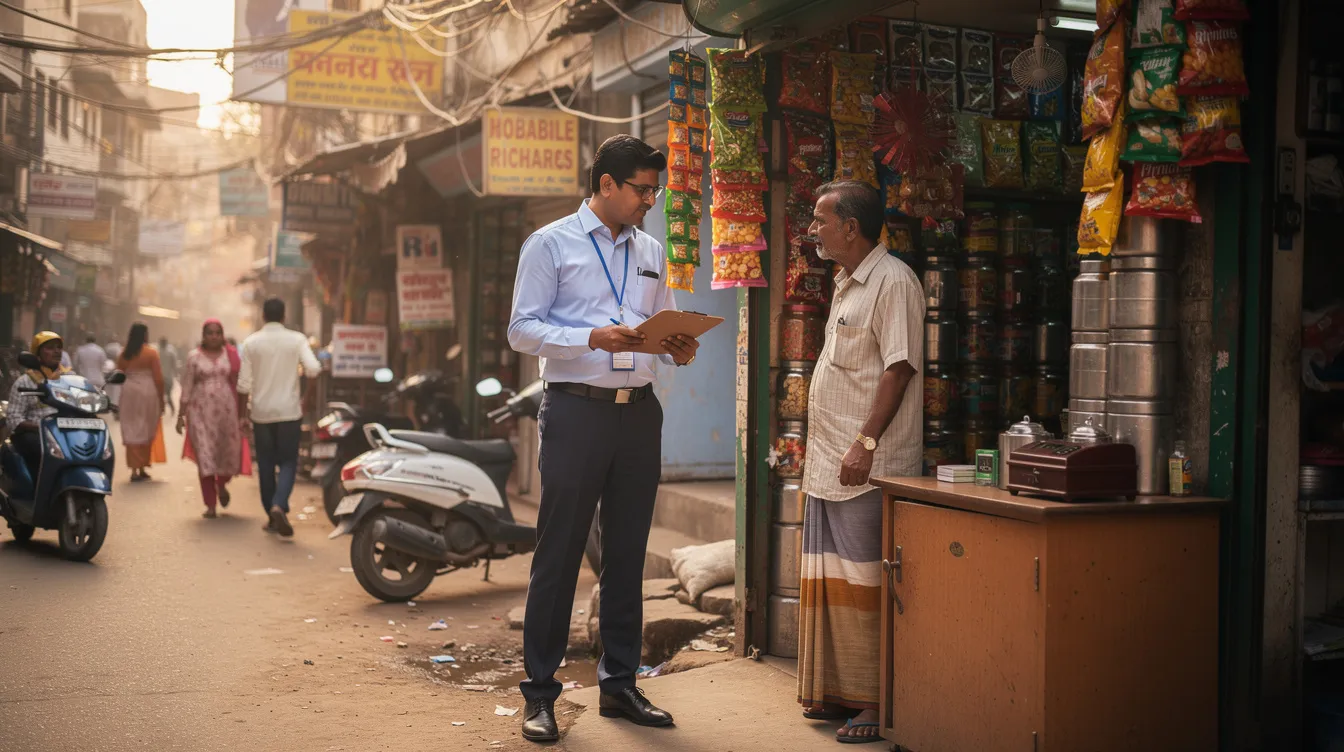
Step 4: Site Visit. The officer arrives, introduces himself, and asks for basic documents – Aadhaar, PAN, rent agreement, electricity bill, and registration certificates.
Step 5: Business Inspection. The officer checks your signboard, layout, machinery, stock, furniture, staff, and whether these match your project report. If the report says “2 embroidery machines,” the officer should see them.
Step 6: Owner Interview. Common questions include: What is your monthly turnover? Who are your suppliers? How will you use the loan amount? How many employees do you have? The bank tries to judge your knowledge, necessary skills, and understanding of your business model plus realistic repayment capacity.
Step 7: Photographs and Geo-tagging. Officers click pictures of signboard, interior, machinery, and sometimes the borrower, often through a mobile app with location capture.
Step 8: Neighbour Verification. Officers may casually ask nearby shops if your enterprise has been running and whether you are known there.
Step 9–10: Report. The officer prepares a written verification report – rating the business as satisfactory, not satisfactory, or re-visit required – and sends it to the credit department for the next phase of processing.
What Banks Actually Check During Mudra Loan Business Premises Verification
Think of this as your Mudra Loan verification checklist from real banking practice.
Premises and Identity Checks: Signboard with business name, exact address matching documents, shop open during normal hours, electricity meter and bills, rent agreement or ownership proof, and any displayed licences like GST, FSSAI, trade licence, or Udyam Registration certificate. Business proof can include Udyam Registration, trade licenses, or partnership deeds.
Business Activity Checks: Nature of work – whether trading, services, or manufacturing – type of customers, machinery installed, stock level compared to claimed turnover, and ongoing work like orders in progress. Micro enterprises engaged in these activities are assessed based on what the officer actually sees.
Document and Registration Checks: GST registration (if applicable), Udyam certificate, shop licence, previous loan sanction letters if the borrower has successfully repaid previous loans, bank statements supporting claimed sales, and invoices from suppliers. A satisfactory credit track record and extended banking history matter here.
Financial Sanity Checks: Whether project report figures for investment, working capital, and capital assets look realistic compared to what is visible. If your project report numbers do not match reality, banks may treat it as unrealistic – you can read detailed cases here: Mudra loan rejected due to unrealistic project report.
Behaviour Checks: Owner’s confidence, consistency of answers with submitted details, and absence of fake bills or borrowed machinery.
How to Prepare and Avoid Common Reasons for Mudra Loan Verification Failure
Most genuine beneficiary micro unit owners clear Mudra Loan field verification easily with honest preparation.
Common failure reasons include: wrong address on proof, closed shop at time of visit, no signboard, business not started despite showing running-unit projections, mismatch between project report and actual setup, applicant absent, neighbours denying knowledge, fake machinery, forged invoices, or unrealistic turnover claims.
Prevention tips:
- Fix your signboard at least 2–3 days before the expected visit
- Keep shop open, phone active, and inform family or staff about the visit
- Keep original documents ready: Aadhaar, PAN, rent agreement, electricity bill, Udyam, GST, quotations, purchase and sales bills
- Never create temporary setups or bring borrowed machines – I have personally seen a Tarun category loan rejected after site inspection because the officer noticed brand-new machines with no dust, no wiring, and a neighbour confirmed the setup appeared overnight
- Keep premises clean, files organised, project report printout available, stock arranged neatly, and basic billing records open to show transactions
If some equipment is ordered but not delivered, explain honestly and show advance payment receipt or supplier quotation. For a detailed breakdown of how site inspection issues lead to rejection, see Mudra loan rejected after site inspection.

After Verification: What Banks Decide, Next Steps, and Practical Tips from CA Manish Gugliya
After successful verification, the officer submits the report. The credit department combines it with your CIBIL score, bank statement analysis, business plan review, and project report. A decision follows: approve full amount, reduce the loan amount, or ask for clarifications. The Mudra loan amount is directly credited to the borrower’s bank account upon approval. Interest rates for mudra loans are generally lower than traditional business loans, and the final interest rate is confirmed based on internal risk assessment.
If verification is not satisfactory, the bank may request re-verification, ask for additional documents, or reject the application. Eligible borrowers who face rejection should politely ask the branch for the actual reason – you have that right under the mudra scheme and credit guarantee framework.
My practical tips:
- Never hide existing EMIs or previous loans – banks always find out through credit bureau checks
- Keep financial projections in your project report realistic and matching your actual setup
- Route business transactions through your bank account to show genuine funding and cash flow
- Do not submit a copy-paste project report – the bank officer will spot inconsistencies immediately
- Cooperate fully; answer every question about your enterprise honestly
- If unsure about aligning CMA data with your on-ground setup, get professional help so figures, business model, and premises all tell the same story
Genuine entrepreneurs should not fear Mudra Loan business verification. Under this government scheme, the micro units development and refinance agency (MUDRA – mudra stands for Micro Units Development and Refinance Agency) exists specifically to support eligible micro units and small enterprises. Verification is simply the bank’s way of understanding your business before extending trust and covering loans with credit guarantee support. Whether you have availed shishu loans before or are applying for the first time, whether your educational qualification is basic or advanced – what matters is a real business, honest answers, and matching documents. No subsidy or shortcut replaces genuine preparation. When loan extended to the right borrower meets a real enterprise, everyone benefits – that is exactly what this scheme was designed for. The next phase of your entrepreneurial journey starts right after you submit your application and clear this verification with confidence. Every applicant, every legal entity, every beneficiary micro unit in India deserves a fair shot – and honest preparation is how you apply online or offline and succeed.

Frequently Asked Questions on Mudra Loan Business Verification
Below are practical doubts that entrepreneurs frequently ask about the Mudra Loan field verification process.
Can the bank reject my Mudra Loan even after a positive business verification?
Yes. Even if site verification is satisfactory, the loan can be rejected due to low CIBIL score, multiple existing EMIs, weak banking history, or a non-viable business model. Verification is only one part of overall credit assessment – not the final decision.
Will the officer inform me before coming for Mudra Loan Site Verification?
In most cases, the officer calls a few hours before to fix time and confirm address. However, some banks do surprise visits, especially during re-verification, to observe natural business activity.
What if my shop is rented or home-based – will verification fail?
Rented shops, shared spaces, and home-based units are generally acceptable. You need a proper rent agreement or consent letter, some visible business activity, and neighbours who can confirm you actually run the business there.
Can family members answer on my behalf during business verification?
It is always better if the main applicant is present. A spouse or partner can speak initially if you step out briefly, but banks usually insist on talking to the actual borrower before finalising their report.
How long after business verification is Mudra Loan usually sanctioned?
If everything is clear, sanction may happen within 3 to 10 working days. Delays are common when documents are incomplete, clarifications are pending, or higher-level approval is needed for larger amounts.
- Roller Flour Mill Setup Cost in India: Professional Investment & Project Cost Guide


- Poha, Puffed Rice & Value-Added Rice Products Project Report & Processing Opportunities

- Integrated Value-Added Rice Products Processing Plant Project Report & DPR

- Integrated Rice Plant Bank Loan, Feasibility, ROI, IRR, Payback & Sensitivity Analysis

- Integrated Rice Processing Plant Financial Projections, Working Capital & DSCR

- Integrated Rice Products Revenue Model, Market Strategy & Profitability

- Integrated Value-Added Rice Plant Project Cost & Means of Finance

- Raw Material Procurement & Inventory Planning for Integrated Value-Added Rice Plant

- Common Utilities, Warehousing, Packaging & Material Handling for Integrated Rice Plant

- Integrated Rice Processing Plant Land, Building & Multi-Line Plant Layout – A Practical Guide for DPR & Bank Finance

- Integrated Rice Processing Plant Capacity Planning & Product Mix

- Integrated Value-Added Rice Plant Machinery & Equipment Cost – A Practical DPR-Oriented Guide

- Integrated Poha, Puffed Rice & Rice Snacks Manufacturing Process & Line Integration

- Instant Poha Manufacturing Plant Project Report & DPR – Bankable Guide by Project Report Bank

- Ready-to-Cook Rice Breakfast Mixes Manufacturing: Products, Process & Plant Setup