Key Takeaways
- Integrated value-added rice plant project cost in India is driven by plant capacity, product mix (Poha, puffed rice, snacks, breakfast products), machinery configuration, land and construction costs, and working capital requirements. The cost of plant setup varies widely based on capacity, technology, and location.
- Promoters must budget for both fixed capital expenditure-covering civil works, machinery, utilities-and sufficient working capital margin to cover seasonal raw materials and inventory cycles. Mid-scale automated rice plants typically range from ₹1.2 crore to ₹15+ crore in total investment depending on scale and integration.
- A realistic means of finance structure combines promoter contribution, a term loan for rice processing plant assets, and separate working capital bank finance rather than relying only on subsidy disbursements.
- A bankable DPR for an integrated value-added rice processing plant must connect technical design, total project cost, and debt-equity structure to demonstrate repayment capacity and DSCR before banks will consider financing.
- Project Report Bank and CA Manish Gugliya specialise in preparing integrated rice plant DPRs, CMA Data and funding strategies tailored to MSME investors in India.
Introduction: Why Project Cost and Finance Planning Matter for Integrated Value-Added Rice Plants
Estimating integrated value-added rice plant project cost and means of finance is one of the most critical steps before committing to land acquisition, machinery orders, or bank term loans. Setting up an integrated value-added rice plant requires substantial capital investment, and getting the numbers wrong at this stage can mean cost overruns, under-financing, or a project that never reaches commercial production.
An integrated value-added rice processing plant in India typically combines multiple lines-Poha (rice flakes), puffed rice (murmura), rice-based snacks, ready-to-cook breakfast mixes, and packaged value-added rice products-under one facility. Rice is a staple food across India, and the Indian snack market, including rice-based snacks and puffed rice products, is valued at over ₹40,000 crore and growing steadily. This creates a strong foundation for market demand.
Actual value-added rice processing plant cost depends on production capacity, product mix, automation level, building standards, utilities, and working capital cycle. Two projects with similar TPD (tons per day) processing capacity can have very different total project cost based on these variables. A well-run 4 TPH rice mill can deliver ₹35-50 lakh annual EBITDA, but integrated plants targeting higher-margin products can aim for stronger returns when structured correctly.
As a practising Chartered Accountant who regularly prepares bankable DPRs, CMA Data, and financial projections for integrated food processing and rice projects across India, I can say that the difference between a project that gets financed and one that stalls often comes down to how accurately the project cost is estimated and how credibly the means of finance is presented. This article breaks down the capital expenditure, explains rice plant means of finance, and highlights what lenders expect in bankable DPRs.
What Is an Integrated Value-Added Rice Processing Plant?
An integrated value-added rice processing plant is a multi-line industrial unit where various rice-based products are manufactured using shared infrastructure, utilities, and management. Unlike a conventional rice mill that primarily converts paddy into milled rice or parboiled rice, integrated rice plants include processes like cleaning, milling, and packaging alongside value-added product lines that generate higher profit margins.
Product lines commonly combined in Indian projects include:
- Poha / rice flakes (thick and thin grades)
- Puffed rice / murmura (plain and flavoured)
- Chivda and namkeen-style rice snacks
- Ready-to-cook rice breakfast mixes
- Cup Poha and single-serve instant products
- Flavoured puffed rice and premium packaged rice variants
Such a plant leverages common facilities-shared cleaning and grading systems, roasting and puffing sections, central packaging and labelling lines, quality control laboratories, and utilities like boilers and electrical sub-stations. This integration leads to better utilisation of land and building, lower per-unit civil construction costs, and more efficient management overheads compared to running separate standalone units for each product.
For a deeper understanding of how Poha, murmura, and snacks lines can be technically combined within one factory, refer to the integrated Poha, puffed rice and rice snacks manufacturing process guide at Project Report Bank.
Major Factors Determining Integrated Value-Added Rice Plant Project Cost
Integrated rice processing plant cost and means of finance must be built around a realistic view of three technical levers: capacity, product mix, and automation level. These key factors influence rice processing machinery cost, size of civil structures, connected electrical load, manpower deployment, and working capital requirement-all of which roll up into total project cost. Initial feasibility work should quantify each factor before drafting a detailed integrated rice plant DPR.
Plant Capacity
For integrated value-added rice processing plants, capacity is often expressed in MT/day of paddy or broken rice input and MT/day (or kg/hour) of finished Poha, puffed rice, or snacks output for each line. Large-scale mills can process 50 to 100+ tons per day, while smaller MSME-scale units may start at 2-5 TPD.
Increasing capacity from 5 MT/day to 20 MT/day multiplies integrated rice plant machinery cost, civil construction size, transformer ratings, boiler sizing, and working capital stocking for raw materials and finished goods. Installed capacity and achievable capacity utilisation are different-most projects start at 50-60% utilisation in Year 1 and ramp up across 3-4 years. These assumptions directly affect DPR projections and payback period calculations.
For a structured capacity sizing exercise, refer to the integrated rice processing capacity planning and product mix resource.
Product Mix
Project cost for a single-product Poha unit will be materially lower than that of a multi-product integrated rice snacks manufacturing plant producing Poha, puffed rice, chivda, and ready-to-cook breakfast mixes. Market demand can guide the development of value-added rice products to improve margins beyond what a plain rice mill business typically achieves.
Broader SKU count, flavoured variants, and different packaging sizes (pillow packs, pouches, cups, HDPE bags) require additional storage, seasoning systems, and packaging machines-each adding to capital expenditure. Product mix also affects raw materials: flattened rice grades, broken rice, spices, edible oil, and premixes have different costs and sourcing cycles, changing both working capital needs and gross profit structures for each line.
The DPR should show product-wise installed capacity, expected sales mix, and contribution margins to demonstrate that the integrated portfolio improves overall project viability.
Automation Level
Semi-automatic, automatic, and highly automated integrated rice products manufacturing plants differ significantly in cost and performance. Mid-size semi-automatic rice mills range from ₹15 lakh to ₹60 lakh in machinery cost, while fully automatic rice mill plants can exceed ₹2 crore. Fully automatic rice mills process over 5 tons per hour, offering significantly higher throughput.
Adopting fully automated systems raises initial costs but reduces long-term labor expenses. Higher automation supports better capacity utilisation, improved hygiene-critical for branded retail snacks-and lower product wastage. For integrated plants targeting modern retail and e-commerce channels, automation in processing and packaging can justify the higher initial integrated rice plant setup cost in the financial model.
Promoters should balance capex versus operating costs and consider future expansion when finalising the automation level in consultation with machinery suppliers and their financial advisor.
Land and Site Development Cost
Land cost is normally shown separately from building and civil construction cost in a DPR. Many banks prefer to see land value clearly disclosed while assessing security and debt equity ratio for rice processing projects. Site location influences total investment due to land acquisition and logistics costs-a plot near paddy procurement zones with good transportation networks will differ significantly from one in an urban industrial estate.
Typical land requirements for MSME-scale integrated value-added rice plants range from 0.75-2.0 acres for small-to-medium setups, with provision for future expansion. How much land is needed depends on the machinery layout, number of product lines, paddy storage requirements, and finished rice storage yards. The question of land purchase versus long-term lease has DPR implications: freehold land increases fixed capital but improves security coverage, while lease can lower upfront cost but may have collateral limitations.
Key site development items under construction costs include site levelling, internal roads, boundary wall, storm-water drainage, septic and waste systems, weighbridge foundations, security cabin, parking areas, green belt development, and provision for future line additions. For layout design guidance, see the integrated rice plant land, building and multi-line layout resource.
Building and Civil Construction Cost
Integrated rice processing plant civil construction cost in India is a significant component of fixed capital investment and must be aligned with food processing hygiene norms, material flow, and machinery layout. Rice mill construction cost varies depending on structural type (PEB shed versus RCC), floor loading requirements, and food-grade finishes.
Typical civil blocks include:
- Raw material godown for paddy or broken rice
- Poha and puffed rice processing halls
- Snack frying or roasting area
- Seasoning and blending room
- Packaging hall
- Finished goods warehouse
- Utility block (boiler, compressor, DG)
- QC laboratory
- Administration office and worker amenities
- Loading and unloading platforms
Clear height requirements for elevators and conveyors, ventilation systems, food-grade flooring, drainage channels, and pest-control features all affect value-added rice processing plant civil construction cost. Promoters should obtain at least a preliminary civil estimate from a local architect or structural consultant based on a conceptual layout before freezing DPR project cost figures.
Plant and Machinery Cost
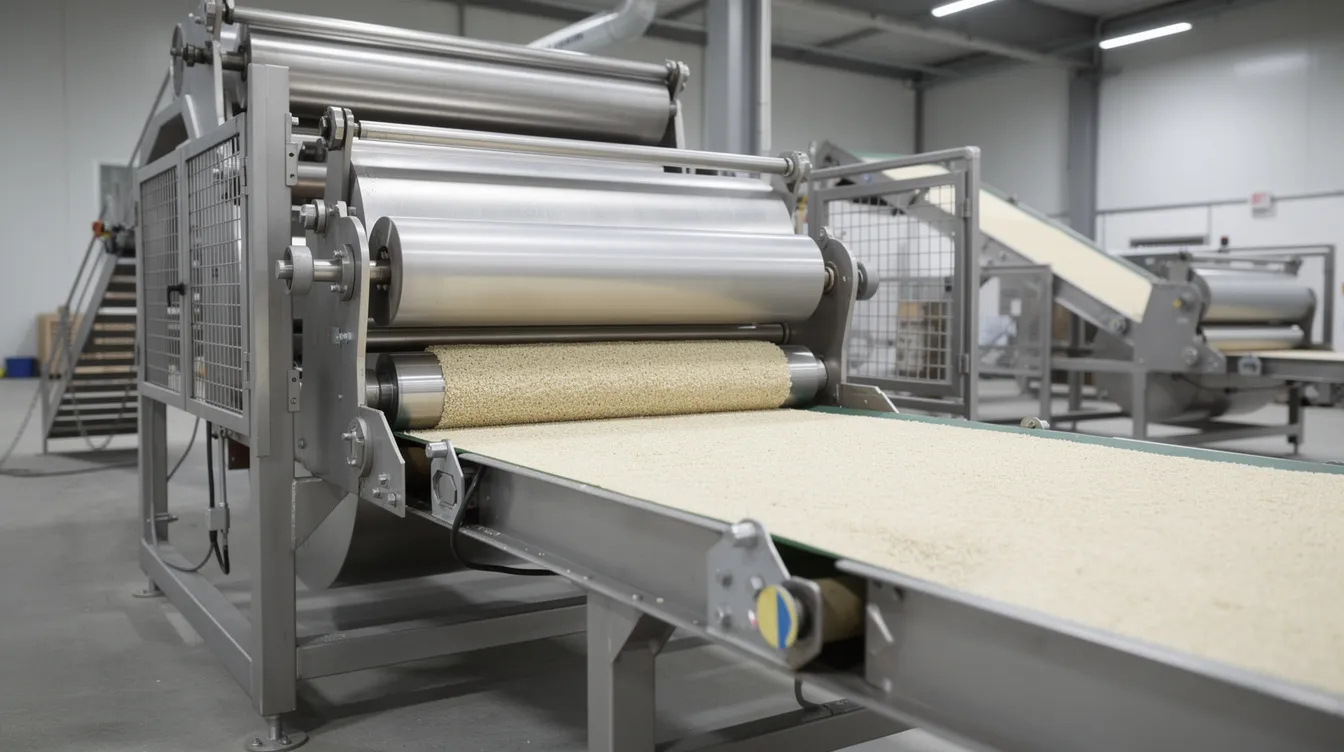
Integrated rice plant machinery cost is usually the single largest head within fixed capital expenditure. Machinery costs account for 50-65% of total project cost for a technically balanced project. A 4 TPH rice mill machinery line costs ₹65 lakh to ₹1.4 crore, while fully automatic rice mills can exceed ₹5 crores in cost depending on configuration.
Major machinery clusters to be budgeted include:
- Pre-cleaning, grading, and de-stoning equipment
- Soaking and conditioning systems for Poha
- Roasters, sand-roasting units, or drum roasters
- Puffing equipment for murmura
- Flaking machines with rollers
- Dryers and coolers
- Seasoning, oil spraying, and mixing systems
- Snack frying or roasting lines
- Elevators, screw conveyors, and belt conveyors
- Weighing and batching systems
- Automated packaging machines
- Compressors and dust-control systems
- Paddy separator and grading equipment
- Laboratory and testing instruments
Investing in parboiling and drying units adds significant capital expenditures to rice processing if the business model includes a milling process alongside value-added lines. For multi-product plants, some essential equipment can be shared between Poha, puffed rice, and snacks lines, while certain machines must be dedicated due to process flow. A 25 TPD rice mill production line costs $50,000 to $120,000, providing a reference for export-oriented capacity benchmarks.
It is critical to obtain itemised quotations from multiple machinery suppliers including freight, GST, erection, and commissioning. A detailed discussion of equipment groups and budgeting approaches is available in our integrated value-added rice plant machinery and equipment cost note.
Utilities and Common Infrastructure Cost
Even when promoters focus on rice processing machinery cost, utilities often add 10-20% to fixed capital and are critical for smooth operations. Infrastructure costs for utilities are frequently underestimated in initial budgets.
Key utility and common infrastructure heads include:
- Electrical sub-station, transformer, LT panels, internal cabling, and lighting
- DG set for backup power
- Boiler or thermic-fluid heater for roasting or drying
- Air compressor and compressed-air lines
- Water supply systems, storage tanks, and plumbing
- Effluent or wastewater treatment (where legally required)
- Fire-fighting system and hydrants
- Material handling equipment-forklifts, pallet trucks, and racks
- Basic IT and communication infrastructure
Design of electrical and utility systems should be based on total connected load of all product lines, diversity factor, and safety margins. Under-sizing leads to costly retrofits when new lines are added. For integrated planning of common utilities, warehousing and packaging infrastructure, a unified approach reduces life-cycle cost.
Packaging Equipment and Packaging Infrastructure
For value-added rice products manufacturing plants, packaging is not only a cost centre but also a brand differentiator. Packaging equipment cost deserves a dedicated capital budget line separate from bulk-processing machinery.
Different packaging formats serve different target markets:
- Bulk HDPE or PP bags for institutional buyers
- Retail pillow packs and small pouches
- Stand-up pouches with zipper
- Nitrogen-flushed packs for longer shelf life
- Cup Poha and single-serve breakfast packs
- Multi-layer laminates for flavoured snacks
Higher automation through FFS (form-fill-seal) machines, multi-head weighers, and cup filling systems increases packaging equipment costs but reduces packing labour and improves seal consistency. SKU diversity-50 g, 100 g, 200 g, 500 g, and 1 kg packs-may require change parts and additional packaging machines.
For entrepreneurs exploring the convenience segment, the Cup Poha and single-serve packaging business model and the ready-to-cook rice breakfast mixes manufacturing guide explain how packaging strategy ties into business planning.
Preliminary and Pre-Operative Expenses
Many first-time promoters underestimate integrated value-added rice plant project cost by ignoring preliminary and pre-operative expenses. Banks scrutinise these carefully in DPRs.
Preliminary expenses include company or firm registration, PAN/TAN, professional fees for CA/CS advisors, project consultancy fees, DPR preparation charges, and technical feasibility studies.
Pre-operative expenses cover architecture and structural design, statutory approvals (factory licence, FSSAI, Pollution Control Board, fire NOC, local body permissions, and all necessary licenses), electricity connection and deposit, trial production expenses, salaries of core staff during project implementation, travel costs, insurance during construction, interest during construction on term loan drawdowns, and machinery installation support. Licenses and regulatory clearances can impact project costs significantly and should not be treated as afterthoughts.
These items should be properly capitalised in the total project cost. Hiding or omitting them distorts DSCR, payback period, and the real funding requirement.
Contingency Provision
Contingency in a DPR is a planned buffer to cover unforeseen cost variations, not arbitrary padding. It reassures lenders that minor deviations will not derail project implementation.
Major sources of cost variation include steel and civil material price changes, machinery specification changes after final layout, freight or unloading requirements, unexpected site-development work, and design modifications demanded by statutory authorities or food-safety auditors. Contingency should be linked to the stage of estimation and the complexity of an integrated multi-line plant rather than applying a random flat percentage.
Margin Money for Working Capital
It is essential to distinguish between fixed capital expenditure (land, building, plant and machinery, utilities) and working capital requirement-the funds blocked in stock and receivables once the plant is operational. Working capital is critical for securing raw material and managing operations during harvest seasons.
Major working capital components for integrated value-added rice plants include:
- Raw paddy and broken rice stock (typically 15-30 days of supply)
- Auxiliary raw materials-spices, edible oils, premixes
- Packaging materials inventory
- Finished goods inventory for different SKUs
- Trade receivables from distributors or modern retail
- Minimum cash balances for operational costs
Cash flow management is essential to balance seasonal procurement and operational expenses. Seasonal paddy procurement strategies-bulk buying during harvest to secure low-cost paddy-can significantly increase working capital requirement for several months. Accurate inventory-cycle assumptions are critical, and the raw material procurement and inventory planning guide at Project Report Bank provides a structured approach.
Illustrative Project Cost Structure
The following table shows a standard classification of integrated rice processing plant total project cost heads. This is an illustrative classification and not a fixed project-cost estimate-actual costs depend on capacity, location, and business model.
| Project Cost Head | Typical Coverage |
|---|---|
| Land | Industrial land or lease premium |
| Site Development | Roads, drainage, boundary, levelling |
| Building & Civil Works | Production, warehouse, utilities, administration |
| Plant & Machinery | Main processing equipment, core machinery |
| Packaging Equipment | Retail and bulk packing systems |
| Utilities | Electrical, boiler, compressor, water systems |
| Material Handling | Conveyors, elevators, forklifts |
| Laboratory Equipment | Quality control and testing |
| Furniture & Office Equipment | Administrative infrastructure |
| Preliminary Expenses | Incorporation, approvals, consultancy |
| Pre-operative Expenses | Interest, salaries, installation, trial runs |
| Contingencies | Cost variations |
| Working Capital Margin | Promoter contribution toward working capital |
Percentage shares of each head vary with project size and product mix. A plant focusing heavily on packaged snacks may have a relatively larger packaging equipment component, while a unit with extensive paddy storage will see higher civil works share.
What Is Meant by Means of Finance?
“Means of finance” shows how the total project cost will be funded. The fundamental identity is simple: Total Project Cost = Total Means of Finance. Raising capital through a mix of equity and loans is common for mid-to-large scale setups.
Common components include promoter contribution (equity or capital), bank term loan for rice processing plant fixed assets, working capital bank finance, unsecured loans from promoters (as treated by banks), and eligible subsidies or grants. Lenders expect internal consistency between project cost, means of finance, debt servicing capacity, and security coverage when assessing rice processing plant bank loan proposals.
Promoter Contribution
Promoter contribution is the amount that promoters bring into the project through share capital, partners’ capital, or proprietors’ own funds. Banks want meaningful promoter equity for risk sharing, commitment to the rice mill business, and a healthy debt equity ratio for rice processing projects.
Possible sources include accumulated savings, sale of non-core assets, internal accruals from an existing business, unsecured loans from directors or promoters (subject to bank treatment), and equity participation from strategic or financial investors. The acceptable percentage varies by bank, scheme, borrower profile, and security-advisors should model multiple combinations while preparing DPR and CMA Data rather than assuming a single number.
Bank Term Loan
A term loan for rice processing plant projects is typically used to finance eligible fixed assets: civil construction, plant and machinery, utilities, electrical systems, installation, and certain pre-operative expenses. A 4 TPH rice mill costs ₹1.2-2.5 crore in 2026, and rice processing plant bank loan tenure in the Indian MSME context generally ranges from 5-8 years including a moratorium period.
During the moratorium (typically covering construction and initial stabilisation), only interest is serviced, while principal repayment begins after commercial production starts. Interest during construction is capitalised and included in total project cost. Banks assess project viability-including DSCR and break-even-before sanctioning bank finance for rice processing plant projects.
Working Capital Finance
Working capital finance is distinct from term loans. Where term loans fund long-term capital expenditure, working capital facilities fund day-to-day operations.
Common working capital instruments in India include cash credit (hypothecation of stock and receivables), working capital demand loan, LC (Letter of Credit) for raw material or packaging purchases, and bank guarantees. Integrated value-added rice processing plants often need well-structured working capital limits due to high raw materials cost, especially during harvest, and inventory requirements across multiple SKUs.
Working capital assessment should be based on a proper operating cycle analysis in the DPR rather than adding a flat percentage of sales as a rule of thumb. Operational costs are heavily influenced by raw paddy prices, making realistic paddy price assumptions essential.
Debt-Equity Structure
Debt equity ratio for rice processing projects-total term debt divided by tangible net worth-is one of several indicators banks use to judge leverage. Lenders evaluate whether proposed debt levels are sustainable by looking at projected cash flows, DSCR stability, raw material supply security, selling price trends, promoters’ track record, and collateral coverage.
Very high leverage in initial years can strain repayment if capacity utilisation or profit margins fall short of projections. DPRs for integrated rice plants should present multiple scenarios of debt equity ratio-for example, with and without subsidy drawdown-to demonstrate robustness. Profitability depends on paddy procurement costs and market prices, so sensitivity testing is non-negotiable.
Example Means of Finance Structure
| Means of Finance | Nature |
|---|---|
| Promoter Contribution | Equity / capital contribution |
| Bank Term Loan | Fixed asset financing |
| Eligible Subsidy | If applicable and accepted in financing structure |
| Unsecured Promoter Funding | Subject to lender acceptance |
| Working Capital Bank Finance | Separate operational funding |
Some banks treat subordinated, non-withdrawable unsecured loans from promoters as quasi-equity, while others do not. Working capital finance is normally assessed and sanctioned separately from term loan, though margin money for working capital appears in total project cost.
Treatment of Subsidy in Project Finance
Government schemes may provide significant financial assistance for agro-processing projects, but promoters should not structure rice plant means of finance assuming subsidy as guaranteed upfront equity.
Key facts to consider:
- PMFME offers a 35% capital subsidy for rice mills and micro food processing enterprises
- NABARD Agriculture Infrastructure Fund (AIF) provides 3% interest subvention on loans up to ₹2 crore
- State-level subsidies can add 5-10% to rice mill investments
- Combined subsidies can reduce project costs by ₹20-40 lakh in eligible cases
- PMFME applications must be filed before machinery delivery
Some banks count expected subsidy as secondary comfort rather than primary equity. DPRs should indicate both pre-subsidy and post-subsidy scenarios. Promoters must verify current scheme guidelines with implementing agencies and their bankers before finalising project cost and means of finance.
Interest During Construction (IDC)
IDC is the interest on term loan that accrues during the project implementation period before the commercial operations date. It depends on implementation schedule, timing of term-loan disbursements, and moratorium terms.
In many DPRs, IDC is capitalised under pre-operative expenses within total project cost, especially for integrated value-added rice plants with construction periods extending 9-15 months. Underestimating implementation time leads to under-provisioning of IDC and working capital during the ramp-up phase.
Project Implementation Schedule and Its Impact on Cost
Typical milestones include land finalisation, statutory approvals, DPR and bank sanction, civil design, foundation work, super-structure, machinery ordering, delivery, erection, utilities commissioning, trial runs, and commercial production.
Delays at any stage-late power connection, prolonged statutory approvals, machinery dispatch slippage-can escalate pre-operative expenses and IDC, affecting total project cost and payback period. Integrated rice processing project DPRs should include a realistic implementation schedule and sensitivity analysis showing the financial impact of delays.
Why Machinery Quotations Alone Are Not the Project Cost
One of the most common mistakes promoters make is to treat rice mill machinery cost or integrated rice plant machinery quotations as the complete integrated value-added rice plant project cost. This significantly underestimates actual costs.
A proper project cost must also include:
- Land and site development (land costs and levelling)
- Civil construction (building and shed construction costs)
- Electrical installation and transformer
- Utility systems (boiler, compressor, water, cold storage)
- Packaging equipment and infrastructure
- Laboratory and quality control equipment
- Furniture and office setup
- DPR and consultancy charges
- Statutory approvals and licensing
- Interest during construction
- Working capital margin money
Promoters should prepare a consolidated project-cost sheet instead of circulating only supplier quotations when discussing rice processing project cost and finance with banks or investors.
How Banks Assess an Integrated Rice Processing Project
Beyond rice processing plant cost in India, banks review promoter background, market feasibility for value-added rice products, paddy availability in the project’s catchment area, and technical soundness. Key appraisal aspects include:
- Reasonableness of total project cost
- Means of finance and promoter contribution
- Expected sales volumes and selling prices
- Paddy procurement strategy and steady supply assurance
- Expected operating costs, profit margins, and cash flows
- Working capital assessment based on operating cycle
- DSCR and break-even analysis
- Security, collateral, and asset coverage
- Sensitivity analysis for paddy price changes and capacity variations
A professionally prepared integrated rice plant project report for bank loan makes it easier for credit officers to understand the project and speeds up the appraisal process.
Role of DPR in Bank Finance
A Detailed Project Report (DPR) for an integrated value-added rice processing plant should integrate technical, market, and financial aspects into a single coherent document. Effective project reports help secure loans and grant funding for rice milling projects-a detailed DPR is necessary for assessing project viability and securing funding.
A bankable DPR for rice processing plant typically includes: project overview, promoter profile, market assessment for Poha, puffed rice, and rice snacks, manufacturing process description, capacity and product mix, detailed machinery list with rice mill machines specifications, land and building details, utility requirements, manpower planning, raw materials and suppliers, project cost, means of finance, projected P&L, balance sheet, cash flow, DSCR, break-even analysis, repayment schedule, and sensitivity analysis.
For a related example, see the puffed rice manufacturing plant project report and DPR at Project Report Bank.
Common Mistakes While Estimating Project Cost
Frequent errors include:
- Underestimating building and civil construction costs
- Excluding transformer, DG, boiler, or compressor from initial budgets
- Ignoring installation, commissioning, freight, and after sales service costs
- Under-budgeting packaging and secondary handling equipment costs
- Assuming minimal pre-operative expenses
- Insufficient working capital provision
- Optimistic capacity utilisation in Year 1
- Unrealistic selling prices or gross margins
- Ignoring seasonal price variations in raw materials and paddy price fluctuations
- Assuming that subsidies will arrive early enough to fund construction
- Treating machinery quotations as complete project cost
Revising the DPR once more accurate quotations and civil estimates are available is far better than approaching banks with under-estimated project cost figures that later require re-sanction.
How to Prepare a Bankable Financial Structure
Robust financial projections must tie production volumes to installed capacity and phased ramp-up. Operating cost assumptions to model include paddy and rice prices, seasoning and packaging costs, power consumption per MT, fuel consumption for boilers or dryers, manpower costs, repair and maintenance, administrative overheads, and logistics expenses.
Interest, depreciation, tax, and loan-repayment schedules must be modelled accurately so that DSCR, IRR, and payback period reflect true risk. Rice mill profit margins in India range from 5-10% for plain milled rice, but value-added products can command better margins when capacity utilisation is healthy. Mills achieving 60-65% head rice recovery maximise profitability from the milling process.
Stress-test the model with adverse scenarios-lower capacity utilisation, higher raw materials cost, delay in subsidy-to understand project resilience before finalising rice plant means of finance.
Integrated Rice Plant Cost – Single Product vs Multi-Product Project
Single Product Plant
A standalone Poha plant or puffed rice unit has lower complexity: fewer rice mill machines, simpler packaging, lower construction costs, easier operations, and a shorter payback period. Small-scale rice mills can be set up for ₹10-25 lakhs, and a mini mill with basic rice mill machinery costs ₹3 lakh to ₹15 lakh. Even a 1 TPD rice mill can cost around ₹2-3 lakhs for very basic configurations. However, single-product plants face more exposure to market risk and limited competitive advantage.
Multi-Product Integrated Plant
A multi-product integrated rice products manufacturing plant requires additional investments-snack lines, flavoured variants, ready-to-cook breakfast mixes, cup-based products-but offers diversification, cross-utilisation of core machinery, shared packaging, and higher value per kg of processed rice. Byproducts like husk and bran can enhance profitability if efficiently managed, and byproduct sales can significantly enhance overall rice mill profitability.
Small-scale rice mills typically cost between ₹10 to ₹25 lakhs for basic configurations, while mid-scale integrated projects require substantially more. The right level of integration depends on promoter capability, market access, and ability to manage more complex operations.
Phased Investment Strategy
Instead of implementing a full-scale integrated rice snacks manufacturing plant on day one, promoters may choose a phased approach:
- Phase 1: Core Poha and puffed rice lines with basic packaging
- Phase 2: Addition of flavoured snacks and chivda frying line
- Phase 3: Introduction of ready-to-cook breakfast mixes and Cup Poha packaging
- Phase 4: Expanded warehousing, cold storage, or distribution hubs
Phased implementation lowers initial capex, shortens the payback period for early phases, and reduces risk. However, it can result in higher overall cost if expansions are not planned in the original machinery layout and utility design. The DPR should model the long-term integrated vision even if funding is sought only for the first phase, so that land, building, and utilities are sized for future expansion.
Financial Due Diligence Before Finalising Project Cost
Before freezing integrated value-added rice plant project cost figures, promoters should complete:
- Independent validation of machinery quotations and equipment costs against multiple vendors
- Civil and structural estimates from qualified professionals
- Electrical and utility load calculations
- Verification of raw material availability-paddy availability, distance to growing clusters, transport cost
- Cross-checking selling prices with distributors for Poha, puffed rice, and snacks
- Review of alternative locations (land and construction costs vary significantly between states)
- Confirmation of licensing, approval, and statutory costs
Working with an experienced CA or financial consultant helps ensure all cost components, including hidden or indirect costs, are factored into the DPR before approaching banks.
How CA Manish Gugliya and Project Report Bank Can Assist
In my practice, I focus on preparing Detailed Project Reports, bankable DPRs for rice processing plants, CMA Data, and financial projections for MSME and industrial food processing projects across India. Setting up a rice processing project-whether a rice mill project or a fully integrated value-added facility-involves significant capital investment and careful financial structuring.
Specific services for integrated value-added rice plants include:
- Rice mill project cost estimation and structuring
- Preparation of integrated rice plant DPR
- CMA Data and working capital assessment
- Means-of-finance planning and debt equity ratio analysis
- DSCR and repayment-schedule modelling
- Break-even, ROI, and payback period calculations
- Sensitivity analysis on raw materials prices and capacity utilisation
- Financial assistance documentation for rice processing plant bank loans
All financial projections, DPRs, and CMA Data are prepared or assisted based on business plans, cost quotations, and assumptions shared or approved by the promoters. They serve as decision-support tools and should not be described as certified future performance guarantees.
Entrepreneurs, existing millers, and investors evaluating integrated rice processing projects are welcome to reach out via Project Report Bank for customised project reports, feasibility studies, and financial structuring.
Conclusion
Integrated value-added rice processing plants-combining Poha, puffed rice, snacks, and ready-to-cook breakfast products-can be a profitable business opportunity with genuine diversification benefits. But their success depends heavily on accurate estimation of project cost and a realistic financing structure.
Accurate budgeting for land, civil construction, integrated rice plant machinery cost, utilities, packaging, preliminary expenses, and working capital is essential to determine realistic profit margins, payback period, and loan repayment capacity. Banks and investors look for a coherent story linking technology, market demand, total project cost, and financial structure-best captured in a professionally prepared, bankable DPR.
If you are evaluating integrated rice processing plant cost and finance in India-whether for a new rice mill plant, a diversification from an existing rice mill, or a greenfield value-added project-reach out to Project Report Bank and CA Manish Gugliya for tailored DPRs, CMA Data, and project-finance advisory.
Frequently Asked Questions
What is the difference between an integrated value-added rice plant and a traditional rice mill?
A traditional rice mill primarily converts paddy into raw or parboiled rice, focusing on milling efficiency and head rice recovery. Mini rice mills process up to 1 ton per hour, mid-size rice mills process 1 to 4 tons per hour, and fully automatic rice mills handle over 5 tons per hour. An integrated value-added rice processing plant converts rice and broken rice into higher-margin products-Poha, puffed rice, chivda, and ready-to-cook breakfast mixes-under one roof. Integrated plants require more diverse milling machinery, packaging lines, and product-development capabilities, which changes both the rice mill cost structure and profitability drivers compared with a conventional rice mill in India. A 1 TPD combined mill costs under $10,000 USD for very basic milling, but integrated value-added lines involve substantially higher investment.
Is an integrated value-added rice plant more profitable than a standalone Poha or puffed rice unit?
Integrated plants often have potential for higher aggregate profit margins because they sell multiple SKUs and can utilise byproducts or off-grade material across lines. However, they also involve higher capital investment, more complex operations, and greater working capital needs. Whether a rice mill business is profitable depends on realistic capacity utilisation, market reach, paddy procurement efficiency, and cost control. A detailed DPR and sensitivity analysis are necessary rather than assuming automatic superiority of integration.
How should I decide capacity for each line in an integrated plant?
Start from your target markets and likely demand for each product, assess paddy availability and raw material access, review competitor capacities in your catchment area, and then design capacity with allowance for phased ramp-up. Use technical input from machinery vendors alongside a capacity planning exercise to avoid both oversizing and bottlenecks. The DPR should clearly model capacity for each product line tied to revenue and operating cost assumptions.
Can I use one DPR to apply for both term loan and working capital limits?
In practice, a well-prepared integrated rice plant DPR and matching CMA Data are usually sufficient for banks to appraise both a term loan for rice processing plant assets and working capital limits, provided the document clearly separates fixed capital, working capital requirement, and margin money. Some banks may request additional formats or updated projections at the time of working capital sanction, so DPRs should be designed to be easily updatable.
How often should the financial projections and project cost be updated?
Integrated value-added rice plant project cost and projections should be revisited at key stages: after final machinery quotations, when civil contracts are finalised, at financial closure, and during implementation if there are major scope or cost changes. Post-commissioning, promoters should compare actual performance with DPR assumptions at least annually, updating financial models to support future expansion decisions or restructuring discussions with banks.