Value addition to rice can dramatically improve realization compared with selling conventional milled rice. An integrated plant combining poha, puffed rice, snacks and ready-to-cook products under one roof offers diversified revenue and better raw material utilization. But the machinery investment for such a facility is far from straightforward. This guide, written from a project finance and DPR preparation perspective, breaks down integrated value added rice plant machinery requirements, realistic cost ranges and the planning decisions that separate bankable projects from poorly conceived ones.
Key Takeaways
- An integrated value added rice products plant combines shared rice processing infrastructure (cleaning, grading, storage, utilities) with separate lines for poha, puffed rice, snacks and ready-to-cook products. This architecture strongly influences machinery selection and total project cost.
- Integrated value added rice plant machinery cost in India typically ranges from about ₹1.75–2.50 crore for small semi-automatic multi-product units to ₹10+ crore for large, fully automatic integrated lines, depending on capacity, automation and product mix.
- Only a portion of investment goes into core value added rice processing machinery. Promoters must also budget for cleaning, grading, packaging, utilities, electricals, installation, laboratory and material handling equipment.
- Commercial viability depends on aligning plant capacity, product mix, rice processing machinery investment and automation level with realistic sales projections and bank finance eligibility, supported by a detailed value added rice plant project report.
- Project Report Bank, led by CA Manish Gugliya, focuses on preparing DPRs, CMA Data, financial projections and bankable project reports – not on selling machinery – and can help entrepreneurs evaluate quotations and structure phased investment.
What Is an Integrated Value-Added Rice Products Plant?
An integrated value added rice products plant is a manufacturing facility that uses common front-end rice milling equipment – cleaning, grading and sometimes full milling – combined with multiple product-specific processing lines for poha, puffed rice, rice snacks, ready-to-cook and instant rice products. This is fundamentally different from a conventional rice mill focused only on producing polished rice. Here, the emphasis is on branded, packaged, value-added products with higher realization per tonne of paddy or raw rice.
Typical value-added rice products that may be included:
- Poha / flattened rice / rice flakes
- Puffed rice / murmura
- Roasted or puffed seasoned rice snacks
- Ready-to-cook rice breakfast mixes and instant poha
- Flavored rice mixes, khichdi-style mixes and snack mixes
- Packaged retail SKUs (pouches, cups, jars, bulk packs) for modern trade and export
Investing in integrated systems can improve overall yield and operational efficiency because common infrastructure handles cleaning, grading, storage and utilities once, while multiple product lines share it. Integrated machinery systems also enable better product consistency and compliance with safety standards. The model supports phased expansion – you can add new value-added lines later without redoing the entire plant. Startup costs for rice mills range from ₹10 lakhs to ₹5 crores depending on scale, and an integrated value addition approach pushes the upper range further but also unlocks significantly higher margins.
“Integrated” does not mean one magical machine. It is a well-planned combination of integrated rice processing plant equipment plus product-specific value added rice processing machinery housed in one industrial premises.
Integrated Value-Added Rice Plant Process Flow
Process flow design is the backbone of machinery selection, capacity calculation and rice processing plant project cost estimation. Integrated plant machinery includes stages like cleaning, dehusking, milling, and packaging – but value-added lines add several more in between.
A typical integrated value added rice plant follows this flow:
Raw Rice/Paddy Procurement → Raw material storage → Rice cleaning machine and destoner → Grading machines → Conditioning/soaking/steaming → Product-specific processing (flaking, puffing, roasting, seasoning) → Drying → Cooling → Final grading → Packaging → Finished goods storage → Dispatch.
The front end (receiving, cleaning, grading, storage) is usually common across all lines. The mid-section varies by product, and the rice milling step may be inside or outside the plant depending on whether the promoter buys paddy or already milled rice.
Key process routes for major product categories:
- Poha / Rice Flakes: Pre-cleaned rice → soaking/conditioning → roasting or parboiling → flaking via rice flakes making machine → drying → cooling → grading → packaging.
- Puffed Rice / Murmura: Raw or semi-parboiled rice → soaking/conditioning → drying → roasting/puffing via puffed rice making machine → cooling → sieving/grading → optional seasoning → packaging.
- Rice Snacks and Seasoned Products: Base poha/puffed rice/roasted rice → roasting/frying → coating/seasoning via rice seasoning machine and coating drum → mixing via ribbon blender → cooling → packaging.
- Ready-to-Cook / Instant Rice Products: Cleaned and graded rice or poha → pre-cooking/roasting → blending with spices, pulses and vegetables → drying if needed → dosing/filling → packaging (often nitrogen-flushed pouches or cups).
The exact integrated rice processing production line will differ based on target markets, pricing strategy, shelf-life requirements and available utilities.
Major Machinery Required for an Integrated Value-Added Rice Plant
Below are the major categories of integrated value added rice plant machinery as considered in a professional rice processing plant DPR. Modern integrated rice milling equipment features compact structure and high-efficiency output, making it suitable for plants where space and power consumption matter. Each subsection covers specific machines, their roles and planning considerations from a commercial feasibility perspective.
Raw Material Receiving and Storage Equipment
Raw material receiving and storage design must match your procurement strategy. Whether you buy local paddy seasonally or purchase milled rice year-round directly affects working capital, utility sizing and storage requirements.
Key equipment includes:
- Truck/trolley unloading system (pit, tipper or manual unloading plus food processing conveyor system)
- Weighbridge or platform scale for commercial weighing
- Pre-cleaning hopper with feed control
- Raw rice/paddy storage bins or godowns; silos are justified for larger plants or export-focused units
- Bucket elevators, chain conveyors and other rice plant material handling equipment
- Intermediate day bins for feeding individual lines
Storage capacity is typically sized for 20–45 days depending on crop season and finance availability. Bulk storage via silos increases initial integrated rice plant machinery cost but improves long-term handling efficiency and reduces losses.
Cleaning and Pre-Processing Machinery
Effective cleaning protects downstream rice processing machinery, improves final product quality and is often common across multiple value-added lines. Pre-cleaning machines remove impurities from paddy before milling, which is essential for both product safety and equipment longevity.
Core cleaning and grading machines include:
- Pre-cleaner for removal of dust, chaff and large impurities
- Vibro cleaner and aspirator for fine dust and light impurities
- Destoner for stones and heavy foreign matter
- Magnetic separator for ferrous contaminants
- Rice grading machine for size separation (whole kernels, brokens)
- De-husking / paddy husker if paddy is processed in-house
- Online weighing equipment between stages
Grading machines categorize rice by size and quality for market standards. The throughput of the cleaning line should slightly exceed the bottleneck process capacity so it never starves downstream equipment. These machines can be shared between poha, puffed rice and snack lines by scheduling batches.
Rice Milling and Preparation Equipment
Not every integrated value-added rice plant needs a full rice mill. Smaller units may buy already milled rice, while larger integrated rice processing plants in India may install a complete modern rice mill for better margin control. Small-scale rice mills cost ₹10 lakhs to ₹25 lakhs, while larger automated rice mills can exceed ₹5 crores depending on throughput and automation.
Typical rice milling equipment where paddy is processed includes:
- Paddy cleaner and paddy huskers that remove husks from paddy during initial milling stages
- Paddy separator
- Whitening machines that enhance rice quality by removing bran layers
- Polishing machines that give rice a shiny appearance post-milling
- Grading machines for head rice and brokens
- Optical color sorting, which enhances quality control and reduces defects
- Bran and husk handling system – integrated rice milling equipment produces byproducts for animal feed
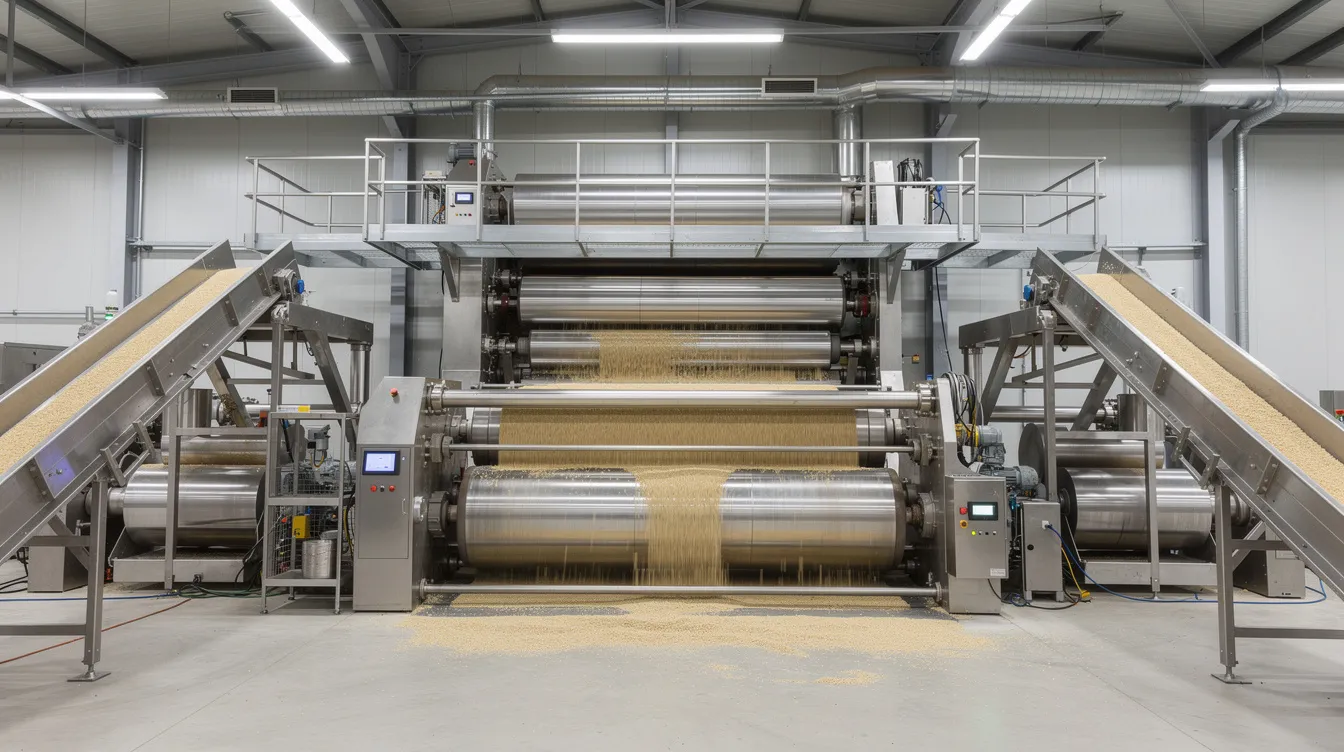
Higher market recovery rates are achieved with multi-stage rice milling systems. Precision milling parameters in integrated systems reduce waste and increase by-product efficiency. At threshold capacities of 4–5 TPH and above, full in-house rice milling becomes more attractive economically. A 4 TPH milling line typically costs ₹65 lakh to ₹1.4 crore depending on brand and automation level.
Poha / Rice Flakes Processing Machinery
Poha is one of the most widely consumed value-added rice products in India and a poha making machine is often the first line added by existing rice mills entering the value addition business.
Main machines and systems include:
- Soaking or conditioning tanks with controlled water temperature and time
- Roaster / parboiling or steaming unit as per chosen technology
- Rice flaking machine for flattening grains to desired thickness
- Rice drying machine (batch or continuous) – batch dryers remove moisture from rice to prevent mold growth
- Cooling system (cooling conveyor or ambient cooling bins)
- Grader and screening equipment to separate thickness grades and fines
- Conveyors, elevators and bins for integrated material handling
Different poha thicknesses (thin, medium, thick) significantly affect flaker selection and line capacity. SS 304/SS 316 contact parts are required for food safety. Uniform soaking and roasting are critical to achieve stable flake quality and lower breakage. The instant poha manufacturing process and production line explains how a standard poha line can be adapted for higher-value instant products.
Puffed Rice / Murmura Machinery
Modern industrial puffed rice making lines differ significantly from small traditional units in consistency, throughput and food safety, which directly influences puffed rice plant machinery cost. A NABARD tender for a 1,000 kg/hr puffed rice plant shows cumulative unit cost of ₹95–100 lakh for plant and machinery.
Key elements of a semi-automatic or automatic puffed rice line:
- Soaking/conditioning equipment with controlled water temperature and time
- Steaming or pre-treatment system where required
- Rice drying machine to bring moisture to puffable level
- Roasting or puffing machine (rotary roaster, sand-less puffing units)
- Dedicated murmura manufacturing machine
- Cooling conveyors or trays
- Grading/sieving equipment for uniform bulk density
- Conveyors and elevators connecting the line
For a detailed breakdown of how DPR covers machinery selection and investment for this segment, refer to the puffed rice manufacturing plant project report. Energy source options – LPG, diesel or rice husk – significantly affect operating cost. Larger industrial lines with PLC automation deliver better consistency but higher capital outlay.
Rice Snack and Seasoning Equipment
Snack and seasoning equipment is where much of the “value addition” happens through flavors, mixes and premium packaging. These machines often use base materials (poha, murmura) produced by other lines in the same plant.
Key snack-processing machines:
- Continuous roaster or batch roaster for rice roasting
- Frying system where fried snacks are planned
- Coating or seasoning drum for uniform flavor application
- Rice mixing machine (ribbon blender) for snack mixes
- Oil spraying system for seasoned products
- Cooling conveyor and sieving equipment to remove loose seasoning and fines
These lines offer flexibility to run multiple SKUs by changing recipes. Hygiene, CIP (clean-in-place) and allergen management are important where multiple seasonings are used across the same rice snack manufacturing machine setup.
Ready-to-Cook and Instant Rice Product Machinery
Ready-to-cook and instant rice breakfast products (like instant poha, upma-style mixes) typically require more precise dosing, dehydration and packaging, and can be high-margin if supported by proper branding and shelf-life studies.
Typical value added rice manufacturing equipment for this segment:
- Dry and wet mixing systems for rice, pulses, vegetables, spices and premixes
- Roasting or pre-cooking equipment (continuous or batch)
- Dehydration / drying system (tray dryer, fluid bed dryer) where needed
- Seasoning and blending equipment for uniform taste
- Dosing systems (auger or cup fillers)
- Filling and sealing machines compatible with pouches, cups or jars
For a deeper look at process and machinery combinations in this category, refer to the article on ready-to-cook rice breakfast mixes manufacturing. Accurate weighing, recipe control and moisture management are essential for consistent shelf life.
Common Machinery vs Product-Specific Machinery
A key design decision in an integrated value added rice products plant is what equipment will be common and what will be dedicated to each product line. The integration of machines in rice processing leads to reduced labor dependence and handling, but over-sharing equipment creates bottlenecks at higher capacities.
Equipment commonly shared across product lines: raw material receiving and storage, cleaning and pre-cleaning (pre-cleaner, destoner, magnetic separator), grading systems, basic rice milling equipment, material handling, weighing systems, utilities (boiler, compressor, power distribution), quality control laboratory, some packaging machinery with format changeover, and finished-goods storage.
Product-specific or line-specific machinery: poha flaking machines and associated soaking/roasting line, puffed rice puffing/roasting machines, specialized snack roasting/frying and seasoning lines, dehydration systems for instant or ready-to-cook mixes, and certain dedicated packaging lines (cup-filling, jar filling, high-speed FFS machines).
Assuming a single multi-purpose machine can produce all value-added rice products is both technically and commercially risky. At higher capacities, shared equipment can become a scheduling bottleneck if not sized for aggregate peak load.
Integrated Poha, Puffed Rice and Rice Snacks Line Integration
A realistic integrated layout places poha, puffed rice and rice snack lines side by side, drawing from common cleaning, grading and utilities but with separate core process machines – all within one commercial rice-based food processing plant.
- The poha line can supply both plain poha and serve as input for instant poha and flavored snacks
- The puffed rice line can supply murmura both plain and seasoned
- A common seasoning and snack line can process outputs from both poha and murmura lines into multiple SKUs
- Capacities of poha, puffed rice and snack seasoning sections must be aligned to avoid idle time
For a detailed explanation of how process integration affects machinery layout and production planning, see the article on integrated poha, puffed rice and rice snacks manufacturing line. Phased capacity increases are possible by adding additional flakers, roasters or seasoning drums as demand grows.
Packaging Machinery for Value-Added Rice Products
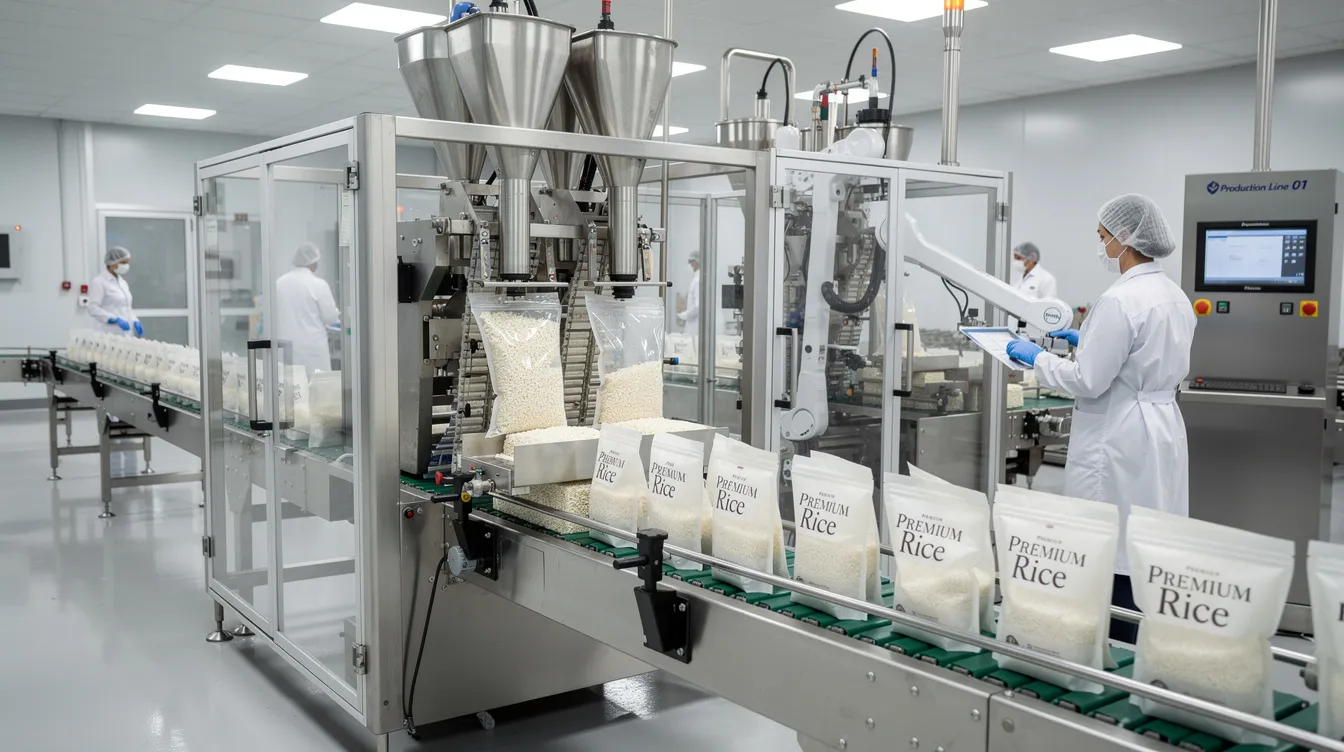
For an integrated value added rice plant, packaging systems often represent 20–35% of the core machinery budget, especially where multiple SKUs and small retail packs are planned.
Major packaging machinery types:
- Electronic weighing and dosing systems (multi-head weighers, auger fillers, cup fillers)
- Vertical form-fill-seal (VFFS) automatic pouch packing machine
- Rice product packaging machine with nitrogen flushing for snacks and instant products
- Cup-filling and sealing machines for cup poha and single-serve instant poha packaging
- Jar filling machines and bulk bagging systems
- Coding/inkjet printers for MRP, batch and expiry
- Check weigher and metal detector for quality and food safety
- Carton sealing and secondary packaging equipment
Speed (packs per minute), automation level and number of SKUs strongly influence rice processing plant machinery price for packaging. Stringent food safety and hygiene standards can be met effectively with modern integrated setups that include gas flushing and barrier films – topics covered in detail in the guide on instant poha packaging, shelf life and food safety.
Supporting Equipment and Utilities
Promoters frequently underestimate the cost and importance of utilities, which can add 20–30% to the total installed integrated rice plant machinery cost when electricals, piping and safety systems are included. Installation costs for rice mills range from ₹5 lakhs to ₹20 lakhs depending on complexity.
Key supporting equipment:
- Boiler or thermic fluid heater (for steaming, roasting, puffing)
- Air compressor and compressed-air distribution lines
- Water treatment plant for process and boiler water
- Electrical panels (MCC, PCC), cabling and LT distribution
- Transformer, DG set and power backup
- Material handling (conveyors, lifts, pallet trucks)
- Weighing scales (platform, bench, laboratory balances)
- Laboratory equipment for moisture, FFA and microbiological tests
- Fire-fighting and safety systems
- Effluent or waste handling systems where applicable
- Maintenance tools, workshop equipment and spares
These items must be part of the rice processing plant project cost, not treated as afterthoughts. Include an allowance for internal piping, insulation and utility supports in the machinery budget during DPR preparation.
Indicative Integrated Value-Added Rice Plant Machinery Cost in India
All figures below are indicative based on 2025–26 price levels in India and will vary with capacity, specifications, vendor, location, taxes and exchange rates. Machinery costs range from ₹25 lakhs to ₹2.5 crores for individual processing sections, with total integrated plant machinery running significantly higher.
| Plant Section | Major Machinery | Indicative Range | Key Cost Drivers |
|---|---|---|---|
| Cleaning & Grading | Pre-cleaner, destoner, grader, aspirator, elevators | ₹15–45 lakh | Capacity TPH, material specs |
| Rice Milling (if included) | Husker, whitener, polisher, sorter | ₹65 lakh–₹1.4 crore | Automation, color sorter inclusion |
| Poha Line | Soaking, roaster, flaker, dryer, cooler | ₹20 lakh–₹80 lakh+ | Capacity, flake type, SS construction |
| Puffed Rice Line | Soaking, dryer, puffer, cooler, sieve | ₹25 lakh–₹1 crore+ | Energy source, automation level |
| Snack/Seasoning Line | Roaster, seasoning drum, blender, cooler | ₹15–50 lakh | Number of SKUs, frying inclusion |
| Packaging | VFFS, weighers, coders, metal detector | ₹20 lakh–₹1.2 crore+ | Speed, nitrogen flush, cup filling |
| Utilities & Supporting | Boiler, compressor, panels, DG, lab | ₹25–75 lakh | Steam load, power backup, lab scope |
Project-level categories:
- Small commercial / semi-automatic plant (500–1,500 kg/hr combined): indicative machinery investment ₹1.75–2.50 crore
- Medium industrial plant (2–4 TPH combined): machinery cost ₹5–10 crore
- Large fully automatic integrated plant (5+ TPH): sophisticated industrial rice processing equipment and high-speed packaging, machinery running beyond ₹10 crore
Factors that shift rice processing machinery cost in India include number of shifts, domestic vs imported advanced machinery, PLC/SCADA automation, stainless-steel fabrication extent and inclusion of multi-head weighers with nitrogen flushing.
Example Machinery Cost Breakup
An illustrative machinery-cost breakup format useful for DPRs and rice processing plant feasibility studies (not a quotation):
- Raw material handling and cleaning & grading
- Rice milling (if included)
- Poha line machinery
- Puffed rice line machinery
- Snack/seasoning line machinery
- Drying and roasting systems
- Packaging machinery (primary and secondary)
- Utilities (boiler, compressor, electricals)
- Laboratory and quality control
- Material handling and storage aids
- Erection, commissioning and training
- Freight, insurance and taxes
- Contingency (typically 5–10% of machinery cost)
This structured view helps when preparing a bank loan project report for a rice processing plant. Lenders prefer clear segregation between process machinery cost, utilities and installation rather than a single lump-sum figure. Installation costs for rice mills can range from ₹5 lakh to ₹20 lakh depending on project complexity and vendor scope.
Poha Plant Machinery Cost
Many promoters start with a poha line and later integrate puffed rice and snacks. Hence a separate focus on poha plant machinery cost is useful even within an integrated project. For small semi-automatic poha units (100–150 kg/hr), machinery starts from a few lakhs. Medium automatic lines (300–800 kg/hr) typically range ₹18–45 lakh for the core poha making machine section. Larger fully automatic lines exceed ₹45 lakh and can run into multiple crores.
Major cost components specific to the poha line include soaking/conditioning system, roaster/steaming equipment, rice flaking machine, dryers and coolers, graders and sieves, interconnecting conveyors and associated control panels. In an integrated plant, some costs are reduced because cleaning, grading and packaging are shared across lines.
For details on upgrading a poha line for instant products, see the guide on instant poha and ready-to-cook rice products machinery. The poha manufacturing project report covers the complete business plan including machinery, capacity and financial projections.
Capacity Selection and Machinery Sizing
Selecting the right rice processing plant capacity is a financial decision as much as a technical one. Oversizing machinery is a common mistake in DPRs. Integrated rice milling equipment can process 40-50 tons per day at higher scales, but a fully automatic rice mill producing 40-50 tons of rice daily is not the right starting point for every promoter.
Key parameters to consider: annual sales target in tonnes per product, operating days per year (typically 300), number of shifts, assumed capacity utilization during initial years (70–80%), product mix, packaging speeds and future expansion scope.
Simple example: A promoter targeting 3,000 tonnes per year of combined value-added products at 300 operating days and 8-hour shift needs about 10 tonnes per day or roughly 1.25 TPH product output. Allowing for 70–80% utilization in early years, rated capacity of the integrated rice plant machinery should be around 1.8–2.0 TPH. Modular machinery options (extra flaker, second puffing machine, additional seasoning drum) make phased enhancement easier and should be consistent with projected sales and bank appraisal.
Semi-Automatic vs Fully Automatic Rice Processing Plant
Both semi-automatic and fully automatic integrated rice processing lines can be viable. The right choice depends on scale, labor cost, product positioning and finance availability. It features a fully automatic production line with low power consumption at the higher end, while semi-automatic setups work well for smaller capacities.
| Parameter | Semi-Automatic | Fully Automatic |
|---|---|---|
| Capital Cost | Lower (₹1.5–4 crore range) | Higher (₹5–15+ crore) |
| Labor Requirement | Higher, moderate skill | Lower, higher skill |
| Output Consistency | Operator-dependent | Machine-controlled, uniform |
| Throughput | Moderate | High |
| Process Control | Manual adjustments | PLC/SCADA based |
| Maintenance | Simpler but more frequent | Complex but predictable |
| Scalability | Limited without re-layout | Modular expansion possible |
| Packaging Speed | Lower, manual changeovers | High-speed, automated |
| Suitability | Small-medium plants | Medium-large plants |
Labor and operational costs can be significantly reduced with automated systems in rice processing. The cheapest machinery quotation is not always the most economical investment over the project life cycle. Automation reduces wastage and gives better product consistency, which is critical for branded retail products where consumers expect uniformity. Monthly operational costs can be ₹1 lakh to ₹5 lakhs depending on scale, and automation helps keep these efficient relative to output.
Machinery Cost vs Total Project Cost
Many promoters confuse integrated rice plant machinery cost with total project cost. Banks appraise the entire project. Machinery typically forms only 35–55% of total project cost in a food-processing DPR.
Key components of total project cost:
- Land and site development
- Factory building, warehouse and utilities block
- Plant and machinery (process and packaging)
- Electrical installation, cabling and power connection charges
- Utilities (boiler, compressor, DG, water systems)
- Laboratory equipment and quality control instruments
- Furniture, computers and office equipment
- Pre-operative expenses (interest during construction, consultancy, approvals)
- Contingency margin
- Margin money for working capital
For an illustrative breakdown of how machinery cost fits within the total picture, see the guide on instant poha plant project cost and means of finance. Overlooking non-machinery costs leads to underestimation of required term loan and promoter contribution, which is a common reason for bank proposal rejection.
How to Compare Machinery Quotations
For DPR and bank loan purposes, it is not enough to simply collect price lists. Quotations must be comparable on scope, capacity and specifications. After sales service and technical support availability vary widely between vendors.
Key evaluation parameters:
- Rated vs practical operating capacity in kg/hr or TPH
- Raw material specifications (grain size, moisture, broken percentage)
- Finished product specifications (texture, bulk density, breakage)
- Power consumption per kg of output
- Manpower required per shift
- Construction material (SS 304/316 vs MS) and finish of food-contact parts
- Warranty terms, spare parts availability and after sales service
- Scope for erection, commissioning and trial production
- Freight, insurance and applicable GST
- Foundation, civil and electrical work (promoter vs vendor scope)
- Control panels, automation level and PLC/SCADA if offered
As project advisor, I recommend evaluating total installed cost per tonne of annual capacity rather than basic machine price alone. Detailed comparisons help avoid under-budgeting and unrealistic DSCR in bank proposals. Always compare at least 2–3 suppliers with clear price options actions to make informed decisions.
Machinery Selection for Bank Finance and DPR Preparation
Banks expect the value added rice plant project report and CMA Data to be based on realistic machinery capacities and vendor quotations. As CA Manish Gugliya, I see many proposals where machinery capacity, projected sales and working capital are inconsistent – and these get returned by credit departments.
Points that should be cross-checked in the DPR:
- Installed machinery capacity vs proposed annual production
- Raw material requirement vs procurement plan and storage volume
- Power consumption vs proposed electrical connection and boiler/utility size
- Labor requirement vs local availability and wage assumptions
- Working capital requirement vs production, credit period and inventory norms
- Total project cost vs term loan and promoter’s margin
- Sales projections vs market study and distribution strategy
I assist project promoters in preparing DPRs, CMA Data, project cost estimates, financial projections, DSCR analysis and bank finance proposals based on commercially reasonable assumptions and project-specific information. These projections are professionally prepared and aligned with machinery and capacity planning – not certified guarantees of performance.
Bank Finance for an Integrated Value-Added Rice Plant
Integrated rice processing plant investment is capital intensive, typically funded through a mix of promoter contribution and term loan, with separate working capital limits. Working capital for rice mills typically requires ₹10 lakh to ₹50 lakh depending on scale and inventory norms.
Key bank finance aspects:
- Promoter margin typically 20–30% of project cost (varies by scheme and lender)
- Term loan eligibility based on project cost, security and projected cash flows
- Working capital assessment covering stock, receivables and cash credit limits
- Machinery quotations and vendor proforma invoices as essential documents in sanction
- Role of a bankable project report and CMA Data in appraisal
- DSCR, interest coverage and projected profitability benchmarks
For an example of how feasibility, ROI and sensitivity analysis support integrated rice value addition projects, refer to the guide on bank finance and DSCR analysis for puffed rice and value-added rice plants. Properly structured initial investment with phased implementation can improve DSCR and make proposals more bankable. Over-aggressive capacity and automation can strain cash flows in early years.
Key Factors Affecting Integrated Rice Plant Machinery Cost
Value added rice plant equipment cost is driven by more than just plant capacity. Technology, product mix and packaging also play major roles, and the interplay between these factors determines the rice processing line cost in India.
Main factors include: overall production capacity (kg/hr, TPH and number of shifts), number and type of finished products, process technology (traditional vs modern continuous lines), level of automation, form of raw material (paddy vs milled rice), packaging formats and speeds, material of construction and hygiene design standards, use of imported components, food safety requirements (FSSAI, HACCP, BRC), utility systems, installation location and freight, and complexity of civil integration and plant layout.
Common Machinery Planning Mistakes
Many rice mill business promoters underestimate planning complexity when shifting from basic rice milling to an integrated value added rice processing plant. Here are the most common mistakes:
- Finalizing machinery before freezing the product mix and target markets – leads to idle or mismatched equipment
- Buying excessive capacity based on vendor suggestions rather than demand estimates – inflates project cost and depresses DSCR
- Ignoring the cost of packaging equipment for small retail SKUs – often 20–35% of machinery budget
- Under-budgeting for utilities, electricals, installation and commissioning
- Mismatched capacities between cleaning, core processing and packaging sections – creates production bottlenecks
- No provision for future expansion or additional product lines
- Assuming 100% capacity utilization from first year onward – unrealistic for bank appraisal
- Selecting rice mill machines only on lowest price without checking energy use, breakage and service support
- Overlooking seasonal raw material availability and the need for adequate storage
- Relying on a single basic quotation with no scope details – makes DPR preparation unreliable
Phased Investment Strategy
Phased investment allows promoters to start with a viable core and gradually expand integrated value added rice plant machinery in line with sales growth and cash generation.
Sample phased plan:
- Phase 1: Common cleaning and grading line + basic poha line + semi-automatic packaging
- Phase 2: Addition of puffed rice / murmura line with shared packaging
- Phase 3: Installation of snack seasoning and roasting line for flavored SKUs
- Phase 4: Upgrade to higher speed automatic pouch packing machines and cup-filling lines
- Phase 5: Addition of ready-to-cook and instant rice breakfast products using more sophisticated value added rice processing machinery
Advantages include lower initial capital, learning curve before scaling, and better DSCR in early years. Limitations include possible re-layout costs and temporary under-utilization of some utilities. The key is designing the initial layout with long-term integration in mind.
Is an Integrated Value-Added Rice Products Plant Financially Viable?
Financial viability is project-specific and depends on market, scale and execution. No universal ROI claim applies. Modern rice mills can significantly improve profitability and reduce wastage when the business model is sound.
Key drivers of viability:
- Capacity utilization achieved over the first 3–5 years
- Raw material cost and procurement efficiency – farmers and local markets are primary sources
- Realization per kg for different products and SKUs
- Product mix between low-margin bulk vs high-margin branded packs – higher demand for premium products justifies automation
- Packaging cost, distribution margin and retail trade schemes – convenience drives consumer preference
- Energy, labor and maintenance costs
- Interest burden, loan repayment and working capital management
- Brand positioning, sales channel strategy (local wholesale, modern trade, e-commerce, export) and growth trajectory
Modern rice milling machines reduce losses and increase profitability when machinery selection is aligned with realistic sales and distribution plans. Sensitivity analysis (±10% changes in raw material and selling price) should be part of every rice processing plant feasibility study.
Project Report and DPR for an Integrated Value-Added Rice Plant
A professional value added rice plant project report is essential for both internal decision-making and bank finance, especially when multiple product lines and automation levels are being evaluated. It serves as both a planning tool and a financing document.
Typical DPR contents include:
- Executive summary and project concept
- Promoter background and experience
- Detailed product mix and value-added strategy
- Market potential and competition analysis (domestic and export)
- Manufacturing process and integrated process flow
- Detailed machinery list and technical specifications
- Capacity planning and production program
- Land, building and layout planning
- Utilities and infrastructure
- Manpower planning and HR cost
- Project cost and means of finance
- Working capital assessment
- Projected profitability, cash flows and balance sheets
- DSCR, break-even analysis and ROI/IRR where appropriate
- Sensitivity analysis and risk assessment
- Implementation schedule and key milestones
CA Manish Gugliya and Project Report Bank specialize in industrial and food-processing DPRs, including integrated value added rice plants. Promoters should use DPRs as internal planning tools, not just bank documentation. For product-specific DPR examples, see the puffed rice plant financial projections guide.
Conclusion
- Integrated value added rice plant machinery selection directly affects project cost, production efficiency, product quality, scalability and profitability.
- A well-designed combination of common and product-specific equipment maximizes raw material utilization and revenue diversification while meeting the highest standards of food safety.
- Underestimating utilities, packaging and installation leads to inaccurate rice processing plant project cost estimates and bank finance gaps.
- Careful DPR-based planning, realistic capacity selection and phased investment significantly improve the chances of financial success and sustainable growth.
If you are a serious promoter planning an integrated rice products manufacturing unit in India, I invite you to obtain a customized DPR, project cost assessment, financial projections, CMA Data and bank loan documentation support. Contact CA Manish Gugliya through ProjectReportBank.com with your basic project details – location, proposed capacity and product mix – to receive tailored advisory rather than generic machinery suggestions.
Frequently Asked Questions (FAQ)
What is the minimum viable capacity for an integrated value-added rice plant in India?
For a genuinely commercial integrated unit (not micro cottage scale), a practical starting point is often around 500–1,000 kg/hour combined capacity for poha and puffed rice with semi-automatic packaging. However, the real “minimum” depends on targeted markets, available finance, local demand and whether the promoter already operates a rice mill with existing cleaning and grading infrastructure that can be leveraged. Budget constraints and the market’s ability to absorb output matter more than theoretical capacity. Search for suppliers at affordable prices who can provide equipment matched to your actual requirements rather than oversized lines.
Can an existing rice mill be upgraded into an integrated value-added rice products plant?
Yes, many conventional rice mills in India can add poha, murmura and snack lines using existing cleaning, grading and milling infrastructure. The essential equipment – flakers, puffers, seasoning drums and packaging lines – can often be integrated into available building space. However, a DPR should assess building layout, utility adequacy (steam, compressed air, power), packaging needs and whether the existing rice milling process flow can accommodate additional product streams without creating bottlenecks. This is a common and efficient route for established rice mill business operators looking to expand into value addition.
How long does it typically take to install and commission an integrated value-added rice plant?
Indicative timelines run 6–9 months from final machinery order to commercial production for small-medium plants, including civil work, utility installation, equipment erection, electrical integration and trial runs. Larger and more automated plants with multiple product lines may take 10–15 months. Coordinated planning with machinery suppliers, civil contractors and bankers is essential to avoid delays. The implementation schedule in the DPR should account for realistic lead times, monsoon interruptions and regulatory approvals. Efficient project management during this phase can save significant pre-operative interest costs.
Do I need different food safety certifications for value-added rice products compared to plain rice?
While FSSAI registration or license is common across all rice processing operations, value-added and ready-to-cook products may require more detailed HACCP implementation, regular laboratory testing and thorough documentation – especially for exports or supply to modern trade chains. Product labeling, nutritional information, shelf-life validation and allergen declarations become mandatory. This should be factored into plant design choices (SS construction, CIP systems), material specifications and laboratory equipment planning from the outset, not as an afterthought.
How can Project Report Bank help if I have already collected machinery quotations?
Project Report Bank, led by CA Manish Gugliya, can help promoters interpret existing quotations, check whether capacities and scopes across vendors are consistent, identify missing cost heads (installation, utilities, electricals, contingency), build a realistic integrated rice plant project cost, and prepare DPRs, CMA Data and bankable financial projections aligned with the selected machinery. The goal is to ensure that the machinery investment, production projections, working capital and debt servicing all form a coherent, defensible proposal that banks and financial institutions can appraise with confidence. Visit the website to get started.