Instant poha packaging is far more than wrapping a product before dispatch. For any entrepreneur planning a commercial Instant Poha manufacturing plant in India, the packaging decision directly shapes shelf life, consumer perception, regulatory compliance, market returns and, ultimately, profitability. A single batch of poorly sealed pouches can erode weeks of production value. This article covers the technical, commercial and project-finance dimensions of instant poha packaging, shelf life, quality control and food safety-written from a practising CA and DPR consultant’s perspective to help promoters build bankable, investor-ready project plans.
Key Takeaways
- In Instant Poha manufacturing, profit depends as much on packaging, shelf life management and food safety as on production cost; packaging failures cause returns, wastage and brand damage that directly reduce margins.
- Moisture control, oxygen exposure, rancidity and sealing quality are the primary factors that decide instant poha shelf life, market complaints and product returns.
- Choosing the right poha packaging materials, pouch format and machinery must be planned alongside the DPR, finance proposal and plant layout-not treated as an afterthought.
- FSSAI compliance, HACCP, GMP and robust instant poha quality control systems are essential for brand reputation, regulatory safety and bankable project feasibility.
- Project Report Bank, led by CA Manish Gugliya, helps promoters integrate packaging specifications, quality-control infrastructure and realistic costing into practical, bank-acceptable Instant Poha project reports.
Importance of Packaging in an Instant Poha Manufacturing Plant
Instant poha packaging is a strategic decision that touches every part of the business-from product protection and shelf-life preservation to branding and logistics. Ready-to-eat poha is ready in just minutes, requires no cooking (just add hot water), and is easy to digest and nutritious. These convenience benefits, however, only reach the consumer if the packaging protects the product throughout the supply chain. Instant poha offers speed and convenience with minimal preparation required, and the packaging must deliver on that promise at the point of consumption.
Instant poha packaging protects poha and preserves its quality during storage. It must guard against moisture, oxygen, contamination, physical damage and light exposure while maintaining the crispness and flavour of the seasoning. It also serves as the primary branding surface: design, colours, transparent windows and clearly printed instant poha mix recipe instructions communicate product quality and usage to consumers. For urban buyers who crave home cooked food but face a tough time preparing breakfast, the packaging is the first impression.
Poor packaging quality causes measurable financial damage. Leaking seals, insect infestation, stale smell, broken flakes and faded print lead to retailer returns, credit notes, negative consumer reviews and lost shelf space. From a DPR and project-finance perspective, packaging failure translates directly into higher wastage assumptions, reduced DSCR and weaker investor confidence.
Factors Affecting the Shelf Life of Instant Poha
The shelf life of packaged poha is not a fixed number. It depends on formulation, process quality, packaging barrier and storage conditions-and must always be validated through actual product testing. Properly packaged instant poha can have a shelf life of 6 to 12 months under ideal conditions, while an instant poha mix stays good for 2 to 3 months without refrigeration in simpler packaging formats. Here are the primary deterioration drivers:
- Moisture absorption: poha flakes absorb ambient humidity, leading to clumping, sogginess and microbial growth.
- Oxygen exposure: accelerates lipid oxidation, especially in products containing oil, peanuts or fried seasoning.
- Rancidity: free fatty acid and peroxide values rise over time; research on high-protein instant poha showed significantly higher oxidation in polypropylene packs versus metallised polyester pouches over six months.
- Seasoning deterioration: volatile flavour compounds from spices like turmeric powder, ginger and curry leaves degrade with heat and light.
- Microbial growth: poor barrier or high moisture enables yeast, mould and bacterial contamination.
- Sunlight and heat: Indian ambient temperatures of 30–35°C combined with humidity above 60% accelerate all of the above.
- Packaging defects: pinholes, weak seals and poor laminate quality can shorten instant poha shelf life despite good processing.
Shelf life should never be assumed; it must be validated through real-time and accelerated shelf-life studies before declaring a “best before” date on the label.
Moisture Control in Instant Poha
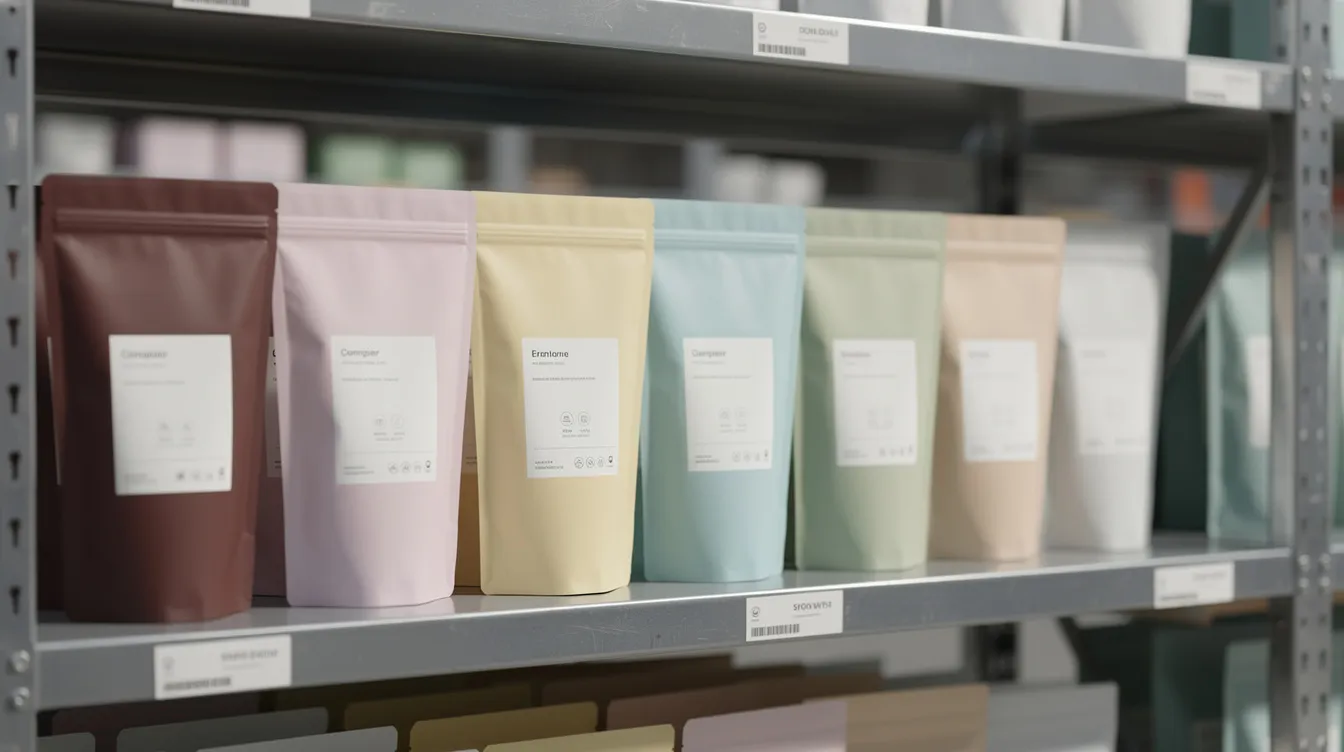
Poha moisture control is arguably the single most important technical parameter. Excess moisture affects texture (the poha won’t stay crisp), promotes microbial growth, causes clumping and drastically shortens shelf life. Instant poha packaging must have a strong moisture barrier to prevent sogginess, and the product itself must be dried to an appropriate level before packing.
Uneven drying or inadequate cooling after roasting can leave pockets of higher moisture within the poha mix. When seasoning premixes containing oil, lemon powder, dehydrated vegetables or spice pastes are blended with dry flakes, they can reintroduce moisture. The flakes absorb this moisture unevenly, creating localised zones that support microbial activity. Water activity-a measure of free moisture available for microbial growth-is more informative than moisture content alone, though fewer small plants measure it routinely.
Effective moisture management requires moisture-barrier packaging, correct sealing temperature and pressure, use of desiccants in bulk or export packs where relevant, and dry, well-ventilated finished-goods storage. Even a small compromise in any of these areas can undo weeks of careful production.
Packaging Materials for Instant Poha
There is no single best packaging material for all instant poha products. Instant poha packaging refers to ready-to-use packaging formats for poha, and the final choice depends on the target shelf life, product formulation (plain versus masala), cost budget and the packaging machine available. Packaging for instant poha should use food-grade materials to ensure safety, and instant poha packaging should limit oxygen entry to preserve freshness.
Popular poha packaging materials include laminated flexible pouches (PET/PE, PET/foil/PE), metallised films for medium-to-high barrier, and polyethylene mono-layers for economy or short-shelf-life applications. High-quality instant poha packaging is lightweight and shelf-stable for extended periods when the right barrier structure is selected. Instant poha packaging must also protect against light to maintain quality, which is why metallised or opaque laminates outperform transparent mono-films. A study on instant dhal stored in polyester-aluminium-polyethylene laminate showed significantly better sensory and oxidation results over 105 days compared to mono-layer films-findings directly applicable to ready poha mix packaging.
| Packaging Option | Major Advantage | Barrier Level | Typical Instant Poha Application | Relative Cost |
|---|---|---|---|---|
| Metallised polyester laminate (PET/Al/PE) | Excellent moisture, oxygen and light barrier | High | Premium masala poha, export packs, products with nuts/oil | High |
| PET/PE laminate (non-metallised) | Good printability, moderate barrier | Medium | Standard retail packs, medium shelf-life products | Medium |
| Polypropylene (PP) mono-layer | Low cost, easy sourcing | Low | Short shelf-life local distribution, economy packs | Low |
| LDPE pouches | Flexible, cheapest option | Low | Very short shelf-life, bulk inner liners | Low |
| Paper–biopolymer laminate | Eco-friendly appearance | Low–Medium | Fast-moving local sales, pilot eco-range | Medium–High |
Packaging material specifications-including migration limits and regulatory compliance certifications from suppliers-should be documented and annexed to the project report.
Instant Poha Pouch Sizes and Pack Formats
Pouch size selection affects consumer convenience, packaging cost per kg, pricing strategy and working capital. Instant poha products are designed for easy preparation and portability, so pack formats must reflect actual usage occasions. Ready-to-eat poha is ideal for travel and busy mornings, making single-serve formats attractive for modern retail and online channels.
Common retail sizes include:
- Single-serve 60–80 g cups or pouches (add hot water, eat from the pack-ideal for office lunch or morning commute)
- 80–100 g snack packs for quick breakfast
- 200–500 g family packs for regular home use
- 1–5 kg institutional or bulk packs for caterers and HoReCa
Convenient design features like ziplock bag closures and easy-tear openings enhance usability and resealability. Stand-up zipper pouches, pillow pouches and gusseted bags each offer different shelf-display and transportation advantages. Portion control in instant poha packaging reduces food waste and ensures consistency across servings.
Small pouches carry a higher packaging cost per kg but support premium pricing; larger packs suit value-conscious customers. Promoters should align final pack sizes with the automatic poha packing machine capability and planned SKUs in the DPR to avoid expensive retooling later. Some consumers even pack individual portions into a jar or ziplock bag for carry-on travel.
Packaging Process for Instant Poha
The instant poha packaging process must be standardised and documented as an SOP, forming part of the overall Instant Poha manufacturing process and production line. Instant poha requires only boiling water or short heating to prepare, so the packaging must preserve that reconstitution quality from factory to consumer.
Key steps in sequence:
- Finished-product inspection – visual check of flake integrity, colour, seasoning distribution.
- Cooling/conditioning – product must reach ambient temperature to avoid internal condensation inside the pouch.
- Accurate weighing – multi-head weighers or volumetric fillers calibrated to target net weight.
- Filling – controlled feed into pouch or FFS film.
- Nitrogen flushing (optional) – displacing headspace air for oxidation-sensitive formulations.
- Sealing – proper sealing and tamper protection are critical in instant poha packaging; seal temperature and pressure must be monitored continuously.
- Batch coding – date, shift, line code printed legibly on every pouch.
- Check weighing – reject underweight or overweight packs.
- Metal detection – where applicable, especially if the line processes products with nuts or spices.
- Secondary packaging – carton packing, shrink-wrapping, palletisation.
Special care: poha should be packed at ambient temperature; packing warm product causes moisture condensation inside the pouch, negating even the best barrier material.
Automatic Poha Packaging Machinery
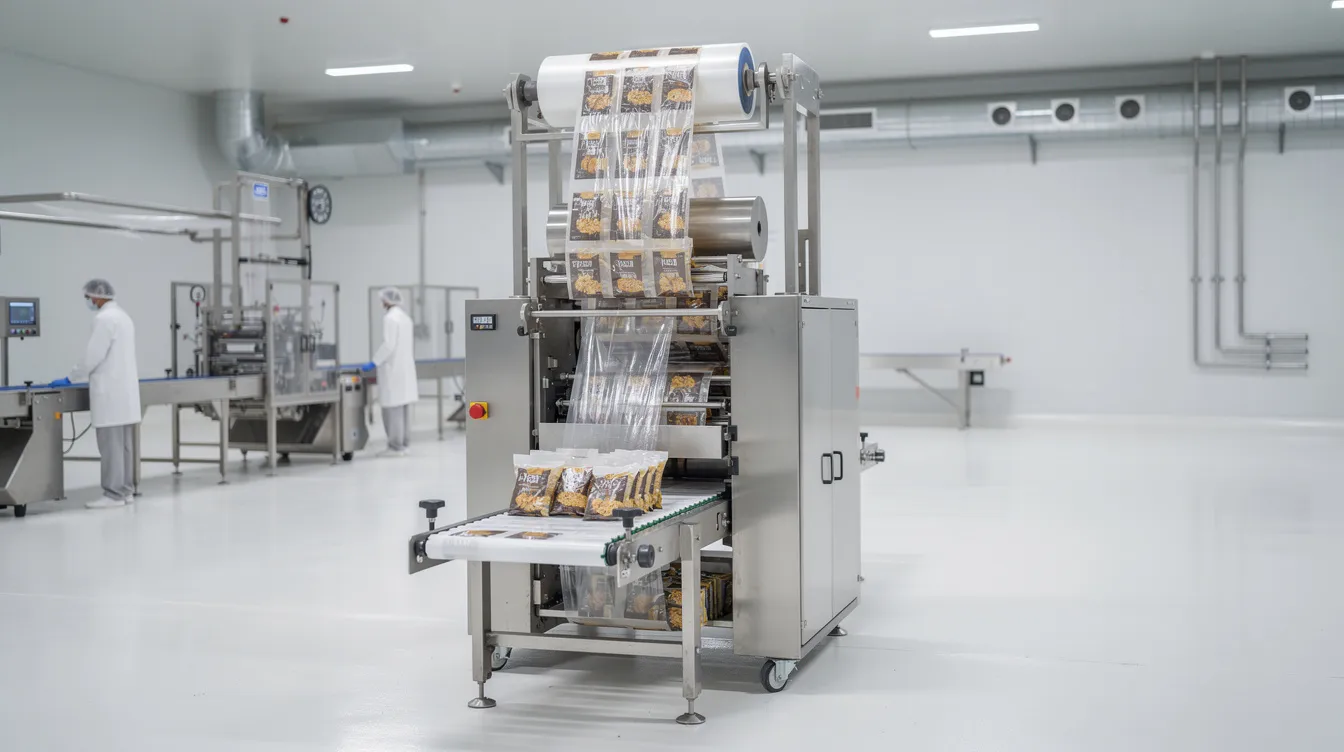
Automation level-manual, semi-automatic or fully automatic form-fill-seal-directly affects instant poha packaging line capacity, labour cost and consistency. Higher automation reduces human error in weighing and sealing but requires greater CAPEX.
| Machine | Function in Packaging Line | Typical Use in Instant Poha Plant | Impact on Labour/Accuracy |
|---|---|---|---|
| Multi-head weigher | Accurate, high-speed weighing | Matches FFS speed; reduces giveaway | High accuracy, reduced labour |
| Vertical FFS machine | Forms pouch from roll, fills and seals | Core machine for pillow/gusseted pouches | High throughput, consistent seals |
| Continuous band sealer | Seals pre-formed pouches | Semi-auto lines, bulk packs | Moderate speed, manual feeding |
| Nitrogen flushing unit | Replaces headspace air with N₂ | Masala/oil-rich products | Adds minor cycle time |
| Batch coder (inkjet/thermal) | Prints lot number, dates | All lines | Ensures traceability |
| Check weigher | Verifies pack weight post-seal | QC compliance, net-weight accuracy | Rejects non-conforming packs |
| Metal detector | Detects ferrous/non-ferrous contamination | Safety-critical, especially with spice lines | Prevents physical hazard |
From a DPR perspective, the choice of machinery capacity (packs per minute) must match upstream production output, planned shifts and sales targets. A promoter should study overall Instant Poha machinery and equipment requirements when finalising the packaging line.
Nitrogen Flushing for Instant Poha Packaging
Nitrogen flushing involves replacing air in the pouch headspace with food-grade nitrogen to reduce oxygen concentration and slow oxidation. This is particularly relevant for instant poha mixes with fried peanuts, cashews, sev, added oils or high-fat seasoning, where rancidity control in poha is a priority.
However, nitrogen flushing only works when paired with high-barrier laminates and reliable sealing. If the pouch has micro-leaks, oxygen ingress negates the benefit within days. The instant poha packaging machine cost increases with nitrogen-flushing capability due to additional gas lines, regulators and flow controls.
Cost considerations include nitrogen generation or cylinder procurement, extra equipment maintenance, and a minor increase in packaging cycle time. The decision should be taken after pilot trials and shelf-life comparison studies-not assumed as mandatory for every product. If adopted, it should be documented clearly in the DPR and financial projections.
Instant Poha Shelf Life
There is no universal instant poha shelf life figure. A plain, low-oil instant poha mix in high-barrier metallised laminate may target 5–6 months at Indian ambient temperatures, based on research where metallised polyester pouches maintained sensory acceptability over six months. Economy products in mono-layer PP or PE may need to be limited to 2–3 months. An instant poha mix stays good for 2 to 3 months without refrigeration in simpler packaging, while properly packaged instant poha can have a shelf life of 6 to 12 months in high-barrier structures.
Packaged poha shelf life must be supported by real data-laboratory testing, sensory panels and field storage trials-before declaring “best before” on labels. Variables include raw-material freshness, manufacturing quality control, sealing integrity, distribution-chain conditions (hot warehouses, non-AC transport) and retailer display practices. Storage temperature for instant poha and the moisture effect on poha shelf life should be evaluated with help from food technologists and accredited testing labs.
From my experience while evaluating food-manufacturing projects, banks and investors take comfort when the DPR explains expected shelf life and the basis for the claim (testing plan and data references), rather than vague or unsupported assertions.
Shelf-Life Testing of Instant Poha
Shelf-life testing validates how long instant poha remains safe and acceptable under defined storage conditions. It is not optional-it is the foundation for your “best before” declaration and regulatory compliance.
Two approaches are standard: real-time shelf-life testing (storing product at normal conditions for the full intended period) and accelerated shelf-life study for poha (storing at elevated temperature and humidity to predict behaviour faster). Both should be conducted, ideally by a competent food technologist or NABL-accredited laboratory.
| Parameter | Why It Matters | Suggested Monitoring Stage |
|---|---|---|
| Moisture content | Texture, microbial safety, clumping | Raw material, finished product, during storage |
| Peroxide value (PV) | Early indicator of lipid oxidation/rancidity | Finished product at intervals (monthly/quarterly) |
| Free fatty acid (FFA) | Fat breakdown, off-taste | Same as PV |
| TBA / malonaldehyde (MDA) | Secondary oxidation, flavour deterioration | Same as PV |
| Microbial load (TPC, yeast, mould) | Food safety, spoilage risk | Finished product, mid-life, end-of-life |
| Sensory evaluation (hedonic score) | Consumer acceptability of taste, aroma, colour, texture | At regular intervals; benchmark ≥ 7/9 |
| Seal integrity | Prevention of moisture/oxygen ingress | Every batch at packaging, periodic during storage |
| Package appearance | Print clarity, pouch condition, no swelling | Visual at each test interval |
Sampling plans should specify the number of pouches, test frequency and storage conditions. Do not wait for consumer complaints to discover a shelf-life problem.
Quality Control Parameters for Instant Poha
Consistent quality is critical for repeat sales and retail listing continuity. Instant poha quality control must span raw materials, process, packaging and finished product. Instant poha maintains a consistent taste through standardized seasoning ratios, but this consistency requires disciplined QC systems.
Key quality parameters of poha include flake size and integrity, percentage of broken flakes, colour uniformity, absence of stones or foreign matter, moisture content and insect-free status. Finished-product checks cover seasoning uniformity, taste, aroma, colour, texture after adding hot water, cooking/reconstitution time and net weight accuracy. After reconstitution, the product should deliver soft and fluffy poha-not mushy, clumped or off-flavoured.
Packaging-related checks include seal strength, print clarity, coding accuracy, pouch appearance and absence of leaks or pinholes.
| Test | Parameter | Stage | Method | Purpose |
|---|---|---|---|---|
| Flake integrity | Broken %, size distribution | Incoming / finished | Visual, sieving | Consumer perception |
| Moisture | % moisture content | Incoming, finished, storage | Moisture meter / oven method | Shelf life, texture |
| Foreign matter | Stones, metal, insects | Incoming, in-process | Visual, metal detector, sieve | Safety, regulatory |
| Seasoning uniformity | Colour, flavour distribution | In-process, finished | Visual, taste panel | Consistency |
| Net weight | Grams per pouch | Packaging line | Check weigher | Regulatory, cost control |
| Seal strength | Seal integrity (N/mm) | Packaging line | Seal-strength tester, burst test | Shelf life, leak prevention |
| Microbial load | TPC, yeast, mould | Finished product | Lab analysis | Food safety |
| Reconstitution quality | Texture after adding water | Finished product | Sensory panel | Consumer satisfaction |
Raw Material Quality and Its Effect on Final Product
Even the best packaging cannot correct poor raw materials. Weak or stale poha, rancid oil or poorly dried spices will produce an inferior product with a shorter shelf life and consumer complaints. Raw material quality is where quality assurance truly begins.
Key raw materials include rice flakes (thick poha or medium-grade depending on product format), edible oil, spices (mustard seeds, turmeric, ginger, curry leaves, coriander leaves), salt, sugar, peanuts, urad dal, dehydrated vegetables and permitted additives. Each influences flavour, colour and shelf stability. Oil quality directly affects rancidity risk; spice freshness determines aroma retention over storage.
Promoters should study Instant Poha raw materials, seasoning and product mix to ensure that moisture, oil and flavour profiles are optimised for stable shelf life. Practical QC checks include supplier approval, incoming inspection (moisture, foreign matter, microbial load), controlled storage conditions for spices and nuts, and periodic laboratory tests.
Claims like “soft and fluffy poha” or “fluffy poha” after reconstitution depend on using properly processed, parboiled and flattened rice flakes in the upstream process. You can roast poha for about 15 minutes to make it crispy before seasoning, but the base flake quality determines whether the final product delivers a delicious, yum eating experience.
Quality Control During the Manufacturing Process
Process control is essential for food safety in poha manufacturing and must be captured in SOPs and HACCP plans. Key stages include cleaning and destoning of raw poha, roasting or light frying (if used), tempering with oil where you heat oil and saute mustard seeds and spices on a low flame till they splutter, seasoning, mixing, drying, cooling, sieving and transfer to the packaging line.
Critical control points include correct drying temperature and duration, prevention of cross-contamination between raw and finished materials, control of oil temperature during frying, and ensuring uniform mixing of the instant poha mix and masala. Where recipes call for a tempering step, oil temperature and low flame duration must be logged.
Readers can explore the detailed Instant Poha manufacturing process and production line to understand how packaging fits into the full line design. Basic records-in-process checklists, temperature logs, moisture logs and packaging-line inspection formats-support traceability and internal or external audits.
Food Safety in an Instant Poha Plant
Food safety in a poha plant is non-negotiable and must align with FSSAI and general food-safety management system expectations. It protects consumers, the brand and the business from regulatory action.
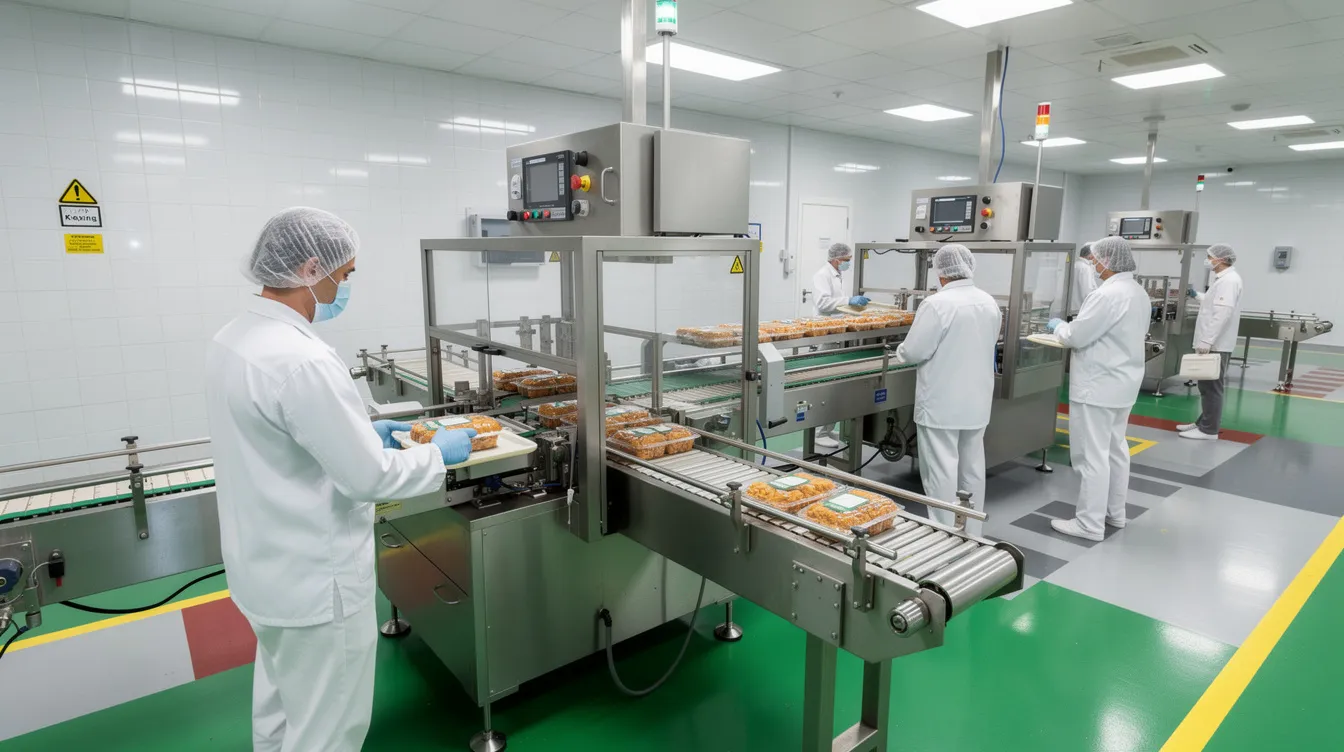
Hygiene requirements for the poha plant include staff uniforms, hand-washing stations, hairnets, restricted jewellery, periodic health and medical checks as per regulations, and regular food-safety training. Contamination control in the poha plant involves separation of raw and finished goods, closed product-transfer systems, sieve magnets and metal detection, and controlled access to the packaging area.
Pest control plans, cleaning and sanitation schedules, water quality monitoring (if water is used in the process) and waste-disposal practices must be documented. Every husband-and-wife startup or large MSME should have documented SOPs, incident-reporting procedures, corrective-action protocols and periodic internal audits. Detailed protocols should be designed with a competent food technologist.
GMP and HACCP for Instant Poha Manufacturing
Good Manufacturing Practices (GMP) cover building design, equipment layout, personal hygiene, cleaning systems, preventive maintenance and documentation. GMP for an instant poha plant is the foundation upon which food-safety systems are built.
Hazard Analysis and Critical Control Points (HACCP) for poha manufacturing involves systematically identifying hazards at each production stage and establishing controls at critical points-raw-material receiving, sieving, roasting, drying, seasoning and packaging.
| Hazard Type | Example in Poha Plant | Typical Control Measure |
|---|---|---|
| Biological | Microbial contamination from raw spices | Supplier approval, storage control, periodic lab tests |
| Chemical | Pesticide residues in rice flakes or spices | Supplier certification, incoming testing |
| Chemical | Cleaning chemical contamination | SOP for rinsing, equipment inspection |
| Physical | Stones, metal fragments in raw poha | Destoner, sieve, metal detector |
| Physical | Plastic or glass foreign matter | Visual inspection, controlled access, equipment maintenance |
Each plant must prepare its own HACCP plan with expert help. The article outlines expectations; it does not serve as a one-size-fits-all HACCP template.
FSSAI Requirements for Instant Poha Manufacturing
Promoters must always check the latest FSSAI notifications, regulations and guidelines from official sources or professional advisors before finalising compliance steps. FSSAI requirements for instant poha manufacturing include obtaining the appropriate FSSAI licence or registration, classifying the product under the correct regulatory category, and ensuring that all ingredients and additives are permitted.
Generic FSSAI-linked requirements cover hygiene, sanitation, food-safety management, periodic testing and proper record-keeping. Labelling requirements under the Packaging and Labelling Regulations mandate batch or lot number, manufacturing and packing dates, “best before” declaration, ingredient listing in descending order by weight, allergen declaration (for example, peanuts, cashew), nutrition information, net quantity, FSSAI licence number and manufacturer or packer details. Products making claims like “no preservatives” or “high protein” must comply with prescribed FSSAI standards and have supporting evidence.
Plant-specific legal obligations must be reviewed with a qualified food-law consultant. This article provides guidance from a DPR and finance perspective, not legal advice.
Packaging and Labelling Information
Packaging and labelling communicate critical safety, usage and marketing information to consumers and regulators. Instant poha packaging typically includes clear labeling for transparency-both regulatory and consumer-facing.
Front-of-pack elements include the product name (for example, “Instant Masala Poha Mix”), flavour variant, net weight, vegetarian logo, spice-level indication, and appealing images. A common back-of-pack feature is a recipe card style instruction panel: for instance, use 1 cup of poha mix with 1.5 cups of boiling water, add hot water just above the level of poha, cover with a lid, and let poha rest for 15 minutes after adding water. Some brands add salt to taste, fluff with a fork, and suggest garnishing with coriander leaves and a squeeze of lemon. The instructions should be clear enough that a consumer can add hot boiling water and get soft and fluffy poha without any confusion.
Poha product labelling requirements under FSSAI include the ingredient listing by descending order, nutrition panel, FSSAI logo and licence number, and details of the manufacturer, packer or importer. All artwork, claims and language versions should be legally vetted before printing bulk packaging material to avoid costly reprints. A single labelling error can force write-off of thousands of pre-printed pouches.
Batch Coding and Traceability
Proper instant poha batch coding allows the manufacturer to trace which raw materials, production date and line produced any pouch circulating in the market. This is essential for complaint investigation, recall management, stock rotation and quality tracking.
Common coding methods include inkjet coding, thermal transfer printing and laser coding. The code must be legible, permanent and placed consistently on every pouch. A simple illustrative lot-code logic might be: plant code + production date + line number + shift (e.g., PH-20260709-L1-A).
Batch records connect incoming poha, spices and packaging material with finished-goods lots and market invoices. When a consumer raises a comment or complaint, the manufacturer can trace the exact production batch, raw-material lots and packaging roll used. Lenders and investors view strong traceability as a sign of professional management and reduced operational risk.
Finished Goods Storage Requirements
Even the best packaging fails if finished goods sit in hot, humid, pest-prone conditions. Stored product must be protected through disciplined warehouse management.
Good practices include:
- Cool, dry, well-ventilated storage facility
- Pallets or racking to keep cartons off the floor
- Avoidance of direct sunlight and protection from roof leaks
- Rodent-proofing and pest-control measures
- First-In-First-Out (FIFO) and First-Expiry-First-Out (FEFO) stock rotation
- Routine visual inspection of cartons and pouches for infestation, swelling, moisture damage or seal failures
- Quarantining suspect stock immediately
Storage conditions and controls should be documented in both the DPR and the food safety management system poha plant documentation.
Plant Layout and Hygiene Zoning
Plant layout should separate raw-material receiving, processing, seasoning, packaging and finished-goods zones to reduce cross-contamination risk. Typical zoning includes low-risk areas for raw grain and poha receiving, medium-risk zones for roasting and drying, high-hygiene zones for seasoning and packing of ready to cook poha packaging, and dedicated finished-goods storage.
People and material movement should be controlled: separate entrances, controlled change rooms and restricted access to high-hygiene zones. Promoters should review Instant Poha plant capacity, layout and utility requirements to ensure that packaging and QC rooms are sized and positioned in line with production capacity.
Provision for a QC lab, packaging-material store and waste-handling area should be included in the layout, keeping regulatory and certification audits in view.
Packaging Cost in an Instant Poha Project
Packaging cost is a significant component of unit cost for instant poha, especially for small retail pouches and premium, high-barrier materials. Cost components include:
| Cost Element | Basis | Cost Behaviour | Notes for DPR |
|---|---|---|---|
| Primary pouch laminate | Per pouch or per kg | Variable | Largest packaging cost element |
| Printing cylinders/plates | Per design | Semi-fixed (amortised) | Higher for multi-colour, multi-SKU |
| Secondary cartons | Per carton | Variable | Depends on corrugation quality |
| Coding consumables (ink, ribbons) | Per pouch | Variable | Minor but recurring |
| Nitrogen (if used) | Per pouch or per minute | Variable | Applicable only for N₂-flushed lines |
| Packaging labour | Per shift | Fixed/semi-variable | Depends on automation level |
| Electricity for machines | Per hour | Variable | Linked to production volume |
| Packaging wastage | % of material | Variable | Budget 2–5% for start-up and ongoing |
Packaging cost as a percentage of MRP varies by brand positioning (economy versus premium) and pack size. In financial models, promoters should factor normal wastage, start-up losses and trial batches rather than assuming zero waste.
Packaging Machinery as Part of Project Cost
Instant poha packaging machine cost and related automation can be a significant CAPEX line item. Key investments include semi-automatic or automatic form-fill-seal machines, multi-head weighers, sealing units, conveyor systems, compressors, nitrogen plants or cylinders, batch coders, check weighers and metal detectors.
From a project-finance angle, equipment choice influences bank-loan requirement, term-loan structure and depreciation in financial projections. Promoters may evaluate starting with semi-automatic packing versus direct investment in fully automatic lines, depending on expected volumes and funding comfort. The decision should be evaluated alongside the overall Instant Poha plant project cost and means of finance.
Packaging Cost and Profitability
Packaging decisions directly affect gross margin. Higher-barrier materials cost more per pouch but reduce market returns, discounts on near-expiry stock and hidden costs from quality complaints. Better packaging can also enable access to modern trade or export channels with longer shelf-life requirements, improving effective profitability.
Working-capital implications are real: more expensive high-barrier laminates increase inventory value. However, the trade-off may be justified if the packaging enables premium pricing and reduces returns. Promoters should model different packaging scenarios in their financial plans, as discussed in Instant Poha profitability, financial projections and working capital. Banks and investors look for sensitivity analysis around packaging-cost changes and their impact on DSCR and ROI.
Working Capital Impact of Packaging Material Inventory
Printed laminate rolls, pre-formed pouches and cartons typically have supplier minimum order quantities (MOQs), locking in capital. Multiple SKU designs-different flavours, sizes, institutional packs-multiply the inventory requirement. A new product that consumers eat as instant poha mix for breakfast or lunch may require separate artwork for each variant.
Risks include obsolescence due to regulatory changes (new FSSAI labelling rules), rebranding or recipe changes, all of which force write-offs of pre-printed stock. Strategies to manage this include staged procurement, generic outer cartons, careful forecast-based ordering and trial runs on unprinted material before finalising large print orders. These aspects feed directly into working-capital assessment in the DPR and cash-flow projections for MSME loan or investor funding proposals.
Quality Failures That Can Affect Project Profitability
Packaging and quality failures are a great option for destroying profitability. Typical problems include:
| Problem | Likely Root Cause | Impact | Corrective Action |
|---|---|---|---|
| Weak seals causing moisture ingress | Incorrect seal temperature/pressure, worn jaws | Soggy product, consumer complaints, returns | Calibrate sealer, periodic jaw replacement, seal-strength testing |
| Insect infestation | Poor warehouse hygiene, floor-level storage | Product recall, brand damage, regulatory action | Pest control programme, pallet storage, FEFO |
| Incorrect net weight | Weigher calibration drift | Regulatory penalty, consumer distrust | Daily check-weigher verification |
| Wrong or missing labels | Artwork error, line-clearance failure | Product recall, retailer rejection | Label verification SOP, line-clearance checklist |
| Seasoning inconsistency | Uneven mixing, variable raw-material quality | Taste complaints, repeat-purchase loss | Mixer validation, blend time SOP |
| Broken flakes | Rough handling, conveyor drops | Poor visual and eating quality | Gentle handling, padded conveyors, flake QC |
| Stale or rancid flavour | Poor oil quality, inadequate barrier packaging | Consumer rejection, retailer returns | Oil QC, high-barrier laminates, nitrogen flushing where needed |
A robust instant poha quality assurance and quality-control system is cheaper in the long run than managing repeated failures, returns and a damaged brand. Never compromise on packaging and QC fundamentals.
Packaging and Quality Considerations in Bank Finance and DPR
From a DPR and project-finance perspective, lenders now expect bankable project reports to discuss packaging, quality-control labs and food-safety systems-not just capacity and revenue. A DPR should include the packaging-line description, QC lab equipment, packaging material specifications, estimated shelf life (with testing basis), storage infrastructure and assumptions on wastage and market returns.
Instant poha packaging requirements and quality-control planning support better DSCR projections because they reduce the risk of unsaleable inventory. These technical aspects feed into financial modelling and risk analysis, as explored in Instant Poha bank finance, DSCR and feasibility analysis. Clearly documenting FSSAI and food-safety commitments also improves bank and investor confidence in project-execution capability.
Practical Packaging and Quality-Control Checklist
This section serves as a ready-to-use checklist for promoters and plant managers:
Before Production: Verify supplier approvals for all raw materials and packaging materials. Inspect incoming poha, spices and laminates against specifications. Confirm hygiene readiness of the production and packaging area. Ensure all equipment is clean and calibrated (line clearance).
During Production: Monitor drying temperature and duration. Check moisture at defined intervals. Verify seasoning uniformity through visual and sensory checks. Maintain personal hygiene and contamination-control discipline.
At Packaging: Verify pack weight on every batch using check weigher. Test seal strength at start-up and periodically. Confirm batch code is legible and accurate. Inspect label content against approved artwork. Check pouch for leaks, pinholes and print defects.
Before Dispatch: Obtain QC release approval for every batch. Inspect cartons for damage. Verify FEFO compliance in loading order. Confirm batch traceability records are complete. Check storage conditions of outgoing goods.
These checklist items should be converted into SOP formats, QC log sheets and internal audit forms as part of the food safety management system. Periodically review findings during management meetings and incorporate learnings into process improvements.
Common Mistakes in Instant Poha Packaging
Many new units treat packaging as an afterthought, leading to avoidable failures:
- Selecting packaging purely on the lowest quote, ignoring moisture and oxygen barrier needs
- Assuming shelf life without conducting any testing
- Using wrong sealing settings (temperature, dwell time, pressure) for the laminate selected
- Poor warehouse hygiene: storing cartons directly on the floor, no pest control, no temperature monitoring
- Launching too many SKUs early, leading to excessive packaging inventory and slow-moving printed stock
- Underestimating packaging cost in DPR financial projections
- Skipping proper artwork and legal review before large print runs
- No incoming QC of laminate rolls from suppliers
- Inadequate coding and traceability systems
- Missing documented SOPs for packaging operations
Learning from established brands, consulting food technologists and packaging experts, and investing time in pilot trials can help new promoters avoid these pitfalls. Many brands that now sell in foreign countries started with disciplined, modest packaging operations and scaled up systematically.
How to Select Packaging for a New Instant Poha Project
A step-by-step framework for promoters:
- Define the product range – plain, masala, vegetable, travel-pack ready to eat variants.
- Decide target shelf life – economy (2–3 months) versus premium (6+ months).
- Assess moisture and oil sensitivity – products with added oil, peanuts or fried ingredients need higher barriers.
- Shortlist 2–3 packaging structures with supplier samples and barrier-property data sheets.
- Conduct pilot trials on a provisional poha packaging machine; fill, seal and check reconstitution to confirm the product delivers soft and fluffy poha.
- Validate seal integrity through burst tests and visual leak checks.
- Conduct shelf-life studies – real-time and accelerated.
- Finalise pouch dimensions, artwork and coding location compatible with automatic poha packing machine or FFS machine parameters.
- Estimate unit packaging cost and incorporate into the DPR and operating-cost model.
- Finalise commercial packaging only after validation, not before.
Packaging, Shelf Life and Product Positioning
Packaging and shelf-life targets must align with brand positioning. An economy pillow pack for price-sensitive consumers who want a quick morning breakfast or light snack need not carry the same barrier and cost structure as a premium stand-up pouch targeting metro modern trade. Some consumers look for a microwave-safe container, while others simply want to add hot water and wait a few minutes for fluffy poha.
Different strategies may include attractive stand-up pouches with a recipe card style back panel for modern retail, single-serve cups for travel and office, and bulk sacks for caterers. For export to foreign countries, stronger cartons, longer shelf-life expectations and possibly stricter certifications (BRC, ISO 22000) in addition to FSSAI may be necessary. Clear product positioning at the planning stage avoids confusion in packaging design and prevents mid-course corrections that waste artwork and laminates.
Instant poha is a great option for anyone who wants the health benefits of a light, nutritious meal without spending a long time in the kitchen.
Role of Packaging in Overall Instant Poha Project Feasibility
Packaging, shelf life and food safety materially influence overall feasibility, DSCR and investor comfort. A realistic DPR should connect technical packaging decisions-barrier level, pouch size, machinery automation-with financial outcomes such as cost per kg, gross margins, working-capital cycle and wastage assumptions.
Lenders scrutinise assumptions on product returns, expiry write-offs and inventory days. Robust packaging and QC planning support more optimistic yet defensible projections. Packaging should be viewed as a risk-mitigation investment that protects brand reputation and cash flows, not merely an avoidable expense.
In my experience, involving qualified food technologists, packaging experts and financial consultants together during the planning stage leads to a more bankable, sustainable instant poha project. The fill of technical detail in a DPR signals to lenders that the promoter understands operational realities beyond just sales projections.

Conclusion
- Success in Instant Poha manufacturing depends on integrated planning of the manufacturing process, packaging design, moisture and oxygen control, shelf-life validation, food safety and quality assurance.
- All key elements-packaging materials, the poha packaging line, QC lab, storage infrastructure, working capital for packaging inventory and expected shelf life-must be built into the DPR and financial projections.
- A robust project report links technical decisions to DSCR, ROI and sensitivity analysis, showing banks and investors that risks from packaging failures and product recalls have been thoughtfully addressed.
- Promoters should validate technical and regulatory details with competent food technologists, packaging specialists and regulatory advisors before final plant design and commercial launch. A cool, methodical approach to planning-covering everything from the flame temperature in tempering to the seal strength on every pouch-is what separates sustainable businesses from those that struggle with avoidable quality and financial problems.
Frequently Asked Questions (FAQ)
These FAQs address practical doubts that promoters frequently raise during project planning. Specific numerical values-exact shelf life, machine prices-depend on product formulation and supplier, and should be confirmed through trials and quotations.
What is the difference between ready to eat and ready to cook instant poha from a packaging point of view?
Ready to eat poha typically has higher moisture content and may require retort-style pouches or refrigerated and frozen distribution chains. Ready to cook and instant poha mix products are low-moisture, needing high moisture-barrier pouches but no cold chain. Ready to cook packs focus on protecting dry ingredients and ensuring they become soft and fluffy poha after consumers add hot water. Reconstitution instructions-such as add hot water, cover with a lid, and let it absorb all the water-are critical on the label.
Can compostable or paper-based packaging be used for instant poha?
Fully compostable or paper-only packs usually have lower moisture and oxygen barrier properties. They may be feasible only for very short shelf-life products or fast-moving local sales. Promoters should discuss paper–biopolymer laminates with packaging suppliers and test barrier performance and seal integrity before adopting eco-friendly options commercially. The half measure of using paper outer with a plastic inner liner is a common interim approach.
Do all instant poha products need nitrogen flushing?
Plain, low-fat instant poha mix may not require nitrogen flushing if packed in suitable barrier laminate and stored properly. Products with higher oil content, nuts or fried inclusions benefit more from reduced oxygen headspace. The decision should be validated through oxidation and rancidity tests and cost–benefit analysis, not assumed as standard practice for every SKU.
How often should a small instant poha plant test its products in external laboratories?
Frequency depends on risk profile, production scale and regulatory expectations. Even MSMEs should plan periodic microbial, moisture and basic chemical tests-quarterly at minimum, monthly during initial production months. Consulting a food technologist or FSSAI consultant to create a practical testing schedule suitable for the plant’s size and risk exposure is strongly recommended.
Is it necessary to have an in-house lab for instant poha manufacturing?
A basic in-house lab for routine checks-moisture, weight, visual inspection, simple sensory tests-is strongly recommended. Advanced analyses such as microbial testing of instant poha, peroxide value and TBA can be outsourced to NABL-accredited laboratories. From a DPR and finance angle, including modest lab infrastructure improves project credibility without very large investment compared to overall plant cost. It also helps you respond to any consumer or retailer complaint quickly rather than having to wait for external lab turnaround.
Author
Written by CA Manish Gugliya, practising Chartered Accountant and project finance consultant, for ProjectReportBank.com.