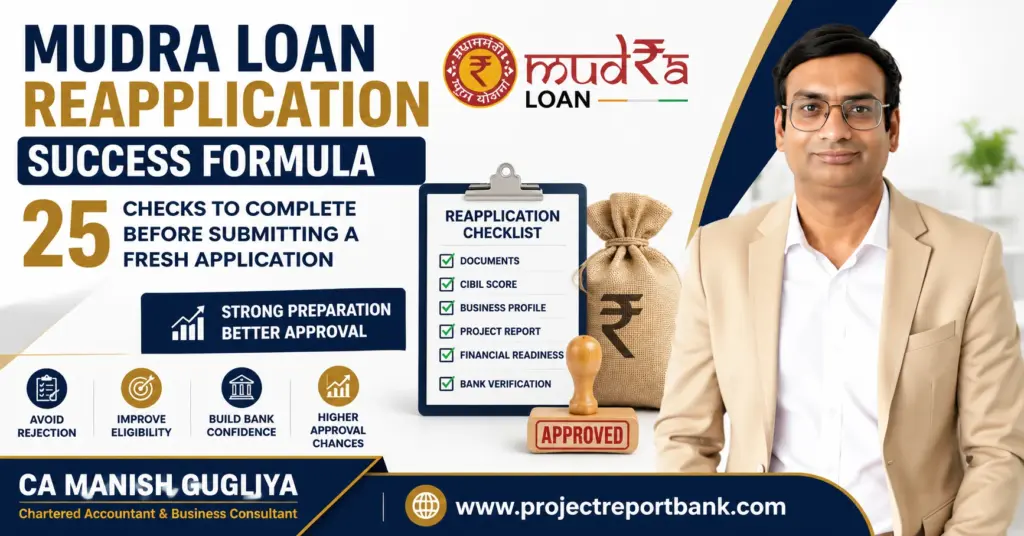
Most Mudra Loan reapplications fail not because the scheme is difficult, but because borrowers submit the same flawed file a second time. As CA Manish Gugliya, I have reviewed hundreds of rejected Mudra Loan cases across India and can tell you this: the applicant who spends three months fixing weaknesses before reapplying has a far better shot than the one who rushes back to the bank within a week.
Mudra loans are classified into four categories – Shishu, Kishore, Tarun, and Tarun+ – with loan amounts ranging from Rs 50,000 to Rs 20 lakhs for micro enterprises in non-farm sectors. The opportunity under Pradhan Mantri Mudra Yojana is real. But so is the rejection rate if your file is not bank-ready.
This article gives you the complete Mudra Loan reapplication success formula: a practical 25-point checklist you can work through before submitting a Mudra Loan fresh application.
Key Takeaways
- Most Mudra Loan second applications under Pradhan Mantri Mudra Yojana fail because applicants repeat the same mistakes – unchanged CIBIL, weak project report, mismatched KYC documents.
- The Mudra Loan reapplication success formula is a 25-point checklist covering credit history, bank statements, GST, ITR, CMA Data, business proof, and interview preparation.
- Borrowers should wait 3–6 months after rejection, fix every identified weakness, then file a carefully prepared Mudra Loan fresh application.
- This guidance draws from CA Manish Gugliya’s direct experience helping MSMEs, traders, manufacturers, service providers, partnership firms and proprietary concerns across India.
Why Mudra Loan Reapplications Fail Again and Again
Under PMMY, shishu loans cover amounts up to Rs 50,000, Kishore loans range from Rs 50,001 to Rs 5 lakhs, and Tarun loans range from Rs 5 lakhs to Rs 10 lakhs. The scheme provides financial assistance to income generating micro enterprises through commercial banks, small finance banks, and RRBs. Eligible borrowers include individuals and partnership firms, and applicants must not be defaulters to any bank.
Yet roughly 45% of Mudra Loan applications get rejected across India. The Finance Ministry separately noted a 43.2% rejection rate on the JanSamarth portal, driven largely by incomplete documents and wrong data entry. Mudra loans can be applied online through the JanSamarth portal, and an application number is generated after submission – but digital convenience alone does not fix a weak file.
Common repeat mistakes include:
- Submitting the same incomplete Mudra Loan document checklist
- Leaving a low CIBIL score unaddressed
- Using incorrect business proof or outdated KYC
- Filing an unrealistic project report with inflated turnover projections
- Ignoring mismatches between Aadhaar, PAN, GST, and bank statements
Important Bank Insight: Branch managers at public sector banks and RRBs compare your first and second files. They look for visible improvement – a higher credit score, cleared defaults, stronger bank statements. If the second file mirrors the first, the credit officer treats it as an even bigger risk signal. Simply changing the bank or financial institution without correcting root issues rarely improves Mudra Loan approval chances.
Table of Contents
The 25‑Point Mudra Loan Reapplication Success Formula
Think of this Mudra Loan reapplication checklist as your pre-flight inspection. Skip a single check and your PMMY reapplication may stall on the runway.

Understanding Rejection and Credit Profile (Checks 1–4)
1. Understand the exact reason for previous rejection. Banks are required to communicate rejection reasons. Get this in writing. Without knowing whether the issue was CIBIL, documents, or business viability, you are guessing. Learn how to find the actual reason for your Mudra Loan rejection before anything else.
2. Correct all document deficiencies. Compare your submitted file against the bank’s requirement list. Missing Udyam registration, expired trade licence, or unsigned forms are easy fixes that borrowers overlook repeatedly.
3. Verify Aadhaar, PAN, and KYC details. A partnership firm in Jaipur was rejected purely because the promoter’s name was spelled differently on PAN and Aadhaar. Fix every PAN-Aadhaar name mismatch before reapplying. Required documents include ID proof and address proof – ensure they are current and consistent.
4. Improve CIBIL score if required. Banks prefer scores above 700. Clear outstanding dues, reduce credit card utilization below 30%, and avoid new loan enquiries. A satisfactory credit track record built over 3–6 months changes how the credit officer sees your file. Guidance on how to improve your CIBIL score for a Mudra Loan can accelerate this process.
CA Manish Gugliya’s Expert Tip: Pull your CIBIL report yourself before reapplying. If a settled loan still shows as “default,” raise a dispute with the bureau – updates take 30–45 days.
Banking and Liabilities (Checks 5–9)
5. Review existing loan liabilities. Banks calculate your Fixed Obligation to Income Ratio (FOIR). If existing EMIs consume more than 40–50% of income, even a profitable business gets rejected. Applicants who have successfully repaid previous loans carry a natural advantage.
6. Update business registration documents. Udyam registration, GST certificate, Shops & Establishment licence – all must be current. A non corporate entity operating without registration is a red flag.
7. Verify GST information. GST turnover must align with bank statements and ITR. A GST turnover mismatch is one of the fastest ways to lose a bank officer’s trust.
8. Review Income Tax Returns. Banks cross-check last 2–3 years of ITRs against bank inflows. If your ITR verification reveals underreported income, expect scrutiny.
9. Analyse recent bank statements. The last six months to twelve months of statements should show regular inflows, no cheque bounces, and adequate minimum balances. A proprietary concern in Indore was rejected solely due to repeated cheque bounces; after maintaining six clean months, the reapplication succeeded. Read more about how bank statements affect Mudra Loan reapplication.
Project Report and Financials (Checks 10–15)
10. Prepare a stronger project report. This is where most Mudra Loan reapply after rejection attempts collapse. Your project report must reflect the proposed activity, realistic cost estimates, and conservative revenue projections. Avoid copy-paste project reports – banks spot them instantly.
11. Update CMA Data. CMA schedules showing margin trends, working capital cycles, and profitability over recent years give the loan officer confidence. Missing or incorrect CMA data is a documented rejection trigger.
12. Correct sales and turnover projections. Projections must match GST returns and bank statement patterns. Inflated numbers suggest either ignorance or misrepresentation.
13. Prepare realistic financial projections. Use conservative assumptions. A Debt Service Coverage Ratio (DSCR) above 1.2–1.3 shows the business can service its term loan obligations comfortably. Understand how DSCR is assessed for Mudra Loans.
14. Calculate proper working capital requirement. Banks verify whether the requested loan amount actually matches the working capital gap. A wrong working capital calculation inflates risk perception.
15. Arrange promoter’s contribution. Even though loans up to Rs 10 lakh require no collateral security, banks still look for skin in the game. Show your own capital contribution clearly in the project cost breakdown.
Business Proof and Assets (Checks 16–21)
16. Maintain sufficient bank balance. Steady balances signal financial discipline. Erratic balances or negative banking habits hurt credibility.
17. Clear cheque bounce issues. Even one bounce in recent months can derail your Mudra Loan bank verification. Maintain zero bounces for at least six months before reapplying.
18. Organize business proof. Trade licence, rental agreement, supplier invoices, stock records – every piece should confirm the business is operational. Business enterprises without verifiable proof look fictitious to the bank.
19. Prepare business photographs. Photos of your shop, workshop, manufacturing unit, stock, signboard – simple evidence that assets created from the business are real.
20. Keep machinery quotations updated. Quotations older than 90 days are treated as expired. Get fresh quotes that match the capital assets listed in your project report.
21. Prepare rent agreement or ownership proof. Ensure the address matches across all documents. For borrowers in a rented business premises, the agreement must be currently valid and registered where applicable.
Profile, Interview, and Final Self-Assessment (Checks 22–25)
22. Improve business profile. GST filing consistency, online presence, customer references, and a clear narrative of what the business does all help. Learn how to build a strong business profile before reapplying.
23. Prepare answers for bank interview questions. The loan officer will ask about your business model, repayment plan, nature of the proposed activity, and how you possess the necessary skills to run it. Educational qualifications depend on the proposed activity, but practical knowledge and experience matter more. Rehearse clear, confident answers.
24. Ensure consistency across every document. Names, addresses, business descriptions, legal forms – everything must align across PAN, Aadhaar, GST, rent agreement, bank account, and project report. Misalignment is a silent killer of Mudra Loan approval chances.
25. Conduct a final self-assessment. Before walking into the bank, sit down and review all 25 checks. If even one critical item is unresolved, delay your submission. A well-prepared Mudra Loan second application is worth more than five hasty ones.
25-Point Reapplication Checklist (Summary)
| # | Check | Key Focus |
|---|---|---|
| 1–4 | Rejection reason, documents, KYC, CIBIL | Credit profile cleanup |
| 5–9 | Liabilities, registration, GST, ITR, bank statements | Banking and compliance |
| 10–15 | Project report, CMA, projections, working capital, promoter contribution | Financial readiness |
| 16–21 | Bank balance, cheque bounces, business proof, photos, quotations, rent | Business proof and assets |
| 22–25 | Profile, interview prep, document consistency, self-assessment | Final preparation |
Common Rejection Reasons vs Corrective Actions
| Rejection Reason | Corrective Action |
|---|---|
| CIBIL below 650 | Clear defaults, reduce credit card usage, wait 3–6 months with disciplined repayment |
| PAN-Aadhaar name mismatch | Apply for correction with UIDAI/NSDL; verify spellings match on every document |
| Weak or missing project report | Prepare detailed report with realistic projections, recent quotations, and CMA schedules |
| Cheque bounces in bank statements | Maintain zero bounces for 6 months; ensure sufficient balance before any cheque clearance |
| Unrealistic loan amount vs cash flow | Reduce requested amount to match actual DSCR and working capital need |
Documents and Financial Readiness Before a Fresh Mudra Loan Application
After fixing root issues, run a strict final review before visiting the bank or financial institution. Here is what to verify.
Document Verification Checklist
| Document | Details |
|---|---|
| KYC | Aadhaar, PAN (consistent names), latest passport-size photographs |
| Business Registration | Udyam, GST, Shops & Establishment, trade licence |
| Constitution Documents | Partnership deed for partnership firm; MOA/AOA for private or public company; declaration for proprietary concern and other legal forms |
| Rent/Ownership | Current rent agreement or ownership documents matching business address |
| Bank Statements | Last 6–12 months from current/savings account used for business |
| ITRs | Last 2–3 years (mandatory for Kishore and Tarun; Shishu may be lighter) |
| Project Report | Updated with fresh quotations, realistic projections, and CMA data |
| Other Documents | GST returns, sales invoices, stock registers, staff details |
For Shishu loans (up to Rs 50,000), processing fees are often waived by banks and document requirements are lighter. Kishore and Tarun categories demand a comprehensive Mudra Loan project report with detailed financials.
Financial Readiness Checklist
| Parameter | What Banks Expect |
|---|---|
| Promoter’s Contribution | Visible own funds or margin money in project cost |
| Minimum Bank Balance | Consistent, no overdrafts; reflects business activity |
| DSCR | Above 1.2 for Kishore/Tarun |
| FOIR | EMI burden below 40–50% of income |
| Interest rates | Deregulated and reasonable under PMMY; factor into EMI affordability |
Common Mistake: Many MSME owners hide existing EMIs or cash-based sales. These surface during bank statement analysis or ITR cross-verification and destroy trust during Mudra Loan bank verification.

How Banks Evaluate a Second Mudra Loan Application Under PMMY
When your Mudra Loan fresh application reaches the branch, the loan officer pulls your previous file (if it was at the same bank) and checks what went wrong. The application moves through scrutiny, possible field investigation, and then the sanctioning authority’s desk.
Banks compare the two files side by side. They check whether the earlier rejection reasons – low CIBIL, weak margins, incorrect business proof, or a non-viable business model – have been fully addressed or just cosmetically patched. Applications for loans up to Rs 5 lakh should be processed within 2 weeks, but only if the file is complete.
Important Bank Insight: Under PMMY, officers assess based on sector viability, local competition, business continuity, ownership structure, and whether the loan purpose is eligible. Mudra loans are available for various income-generating activities allied to micro enterprises engaged in trading, manufacturing, and services. The loan extended must serve a beneficiary micro unit – not personal consumption. Tarun+ loans cover amounts from Rs 10 lakhs to Rs 20 lakhs for individual borrowers or entities at the next phase or stage of growth development and funding needs. Cash flow stability, assets backing the enterprise, and profitability trends quietly influence the officer’s comfort with sanctioning a collateral-free loan under mudra ltd guidelines, as directed by the reserve bank.
Bank Verification Preparation Checklist
| Item | Action |
|---|---|
| Business operational | Ensure shop/unit is running on verification date |
| Books and stock | Keep ledgers, stock, and invoices accessible |
| Licences displayed | FSSAI, GST, trade licence visible at premises |
| Staff awareness | Staff should know owner’s name, nature of business, and loan purpose |
When to wait: If CIBIL is below 650, if you have multiple recent loan enquiries, or if GST/ITR filing for the current year is pending – delay your Mudra Loan reapplication by 3–6 months. The reference point should be the date your credit bureau report shows a clean record.
When to Change the Business Plan, Loan Amount, or Ownership Structure
Sometimes the problem is not just documents – it is the entire business model, loan quantum, or legal form. This applies especially to new startups, seasonal businesses, or borrowers shifting from a salaried position to business ownership who may lack business experience.
Adjusting the loan amount: A salon owner originally requested Rs 10 lakh under Tarun but had insufficient cash flow to justify the amount. Reducing the request to Rs 6 lakh aligned the DSCR with bank expectations, and the loan was sanctioned. You can explore whether to change your loan amount during reapplication based on actual need.
Updating the project report: If your business has expanded or pivoted since the first application, the old report is obsolete. Consider whether you should update your project report before reapplying.
Changing legal form: Moving from a proprietary concern to a partnership firm or company can sometimes strengthen an application – but only if the change is genuine. A khadi activity unit or a trading business cannot simply add a partner to bypass rejection. The scheme requires the beneficiary micro unit entrepreneur to demonstrate real control and the stage of operations must signify the stage of actual business activity, not paper restructuring. Changing to other legal forms like a private or public company does not erase the promoter’s personal credit history.
Pro Tip: Do not randomly add partners or change ownership solely to bypass earlier rejections. Banks verify whether the change in legal forms reflects actual business control and operations. If you undertake a genuine restructuring, prepare fresh constitution documents, updated licences, and ensure every partner’s credit profile is clean.
Mudra loans provide up to Rs 20 lakhs for micro enterprises – the funding is available. The eligibility criteria require that the proposed activity falls within non corporate, non farm income generating micro enterprises. No collateral is required for loans up to Rs 10 lakhs. Interest rates for Mudra loans are deregulated and reasonable, keeping the cost of finance manageable for micro units.

Are You Truly Ready to Reapply? Final Self‑Assessment, FAQs and Conclusion
Final Self-Assessment Before Reapplication
Before submitting your Mudra Loan fresh application, sit down with your complete file and go through this final pre-submission review checklist. Every “Not Done” item is a potential rejection trigger.
| Item | Status (Done / Not Done) | Remarks |
|---|---|---|
| CIBIL score ≥ 650 and no active defaults | Previous loans assessed based on bureau report | |
| KYC consistent (Aadhaar, PAN, address) | All details matching across documents | |
| GST returns filed, turnover aligned with ITR | Last six months of returns verified | |
| Bank statements clean (no bounces, steady inflows) | 6–12 months of processing history reviewed | |
| Project report updated with fresh CMA Data | Quotations ≤ 90 days, conservative projections | |
| Business proof and site ready for verification | Photos, licences, stock, staff in place |
This is your Mudra Loan pre-submission checklist. If even one critical row shows “Not Done,” delay your visit to the bank.
A rejected Mudra Loan application is not a dead end. I have seen first-time entrepreneurs, women business owners running home-based enterprises, traders with no formal education, and small manufacturers convert their rejections into approvals – simply by investing time in preparation rather than speed. The development and funding needs of the beneficiary micro unit are real, and this government scheme was designed to meet them. The availed benefits under this scheme are substantial when the application is handled correctly.
Focus on correction, not speed. That is the real Mudra Loan rejection solution.
How long should I wait before Mudra Loan reapply after rejection?
Wait at least 3–6 months. This window allows you to clear defaults, improve CIBIL, accumulate clean bank statements over the last six months, and file pending GST or ITR returns. Reapplying within days without fixing anything results in the same outcome. If you are considering reapplication after 6 months, ensure every weakness has been addressed.
Can I reapply with a different bank under Pradhan Mantri Mudra Yojana?
Yes, you can approach a different bank or financial institution – including commercial banks, small finance banks, or NBFCs. However, your CIBIL report travels with you. If the original rejection was due to a low score or existing defaults on covering loans, changing the bank alone will not help. Fix the root cause first, then decide whether to apply at the same bank or another bank.
Is it easier to get approval for Shishu loans up to Rs 50,000 after earlier rejection?
Shishu loans covering loans upto Rs 50,000 have lighter documentation and simpler processing. If your earlier rejection was in Kishore or Tarun category, starting with a Shishu loan builds a credit relationship with the bank. Once you have successfully repaid the Shishu loan, moving to the next phase – Kishore or Tarun – becomes significantly easier. The signify the stage approach means you progress through the categories as your needs of the beneficiary micro unit grow.
Does changing from proprietary concern to partnership firm increase Mudra Loan approval chances?
It can – but only if the change is genuine and both partners have a clean credit history. Banks still check personal CIBIL of every promoter. Adding a partner with defaults or doing a paper-only change will backfire during Mudra Loan bank verification. Ensure new constitution documents, updated licences, and clear ownership structures are in place.
What if my CIBIL is still below 700 but business is profitable?
A score between 650–700 is workable if you can demonstrate strong bank inflows, consistent GST filings, profitable ITRs, and a realistic project report. Reduce the loan amount to match a comfortable DSCR, show promoter’s contribution, and provide a clear repayment plan. Banks weigh multiple factors – a profitable business with improving credit behaviour and solid documentation can still clear the Mudra Loan eligibility criteria.
CA Manish Gugliya is a practicing Chartered Accountant and Business Consultant with over 20 years of experience in Mudra Loans, MSME Finance, Project Reports, CMA Data, Credit Analysis, and Business Valuation. He helps entrepreneurs across India prepare bank-ready loan applications and convert rejections into approvals.
- Can Bank Reduce Mudra Loan Amount Without Your Consent? Complete Practical Guide (2026)


- What to Do If You Cannot Pay Your Mudra Loan EMI (2026 Guide)

- Can a Bank Refuse a Mudra Loan Because the Target Is Completed? Complete Guide (2026)

- Bank Refused My Mudra Loan Application – What Are My Rights?

- Mudra Loan for Used Vehicles (2026): Eligibility, Documents, Bank Rules & Complete Guide

- Rejected Mudra Loan – What to Do Next? Appeal Process Explained (2026)

- Mudra Loan Project Report Madhya Pradesh – Bank-Ready DPR & CMA Guide

- Project Report for Mudra Loan Maharashtra: Complete Guide for MSMEs, Startups and Small Businesses (2026)

- Mudra Loan Uttar Pradesh: Complete Guide for MSMEs, Startups and Small Businesses (2026)