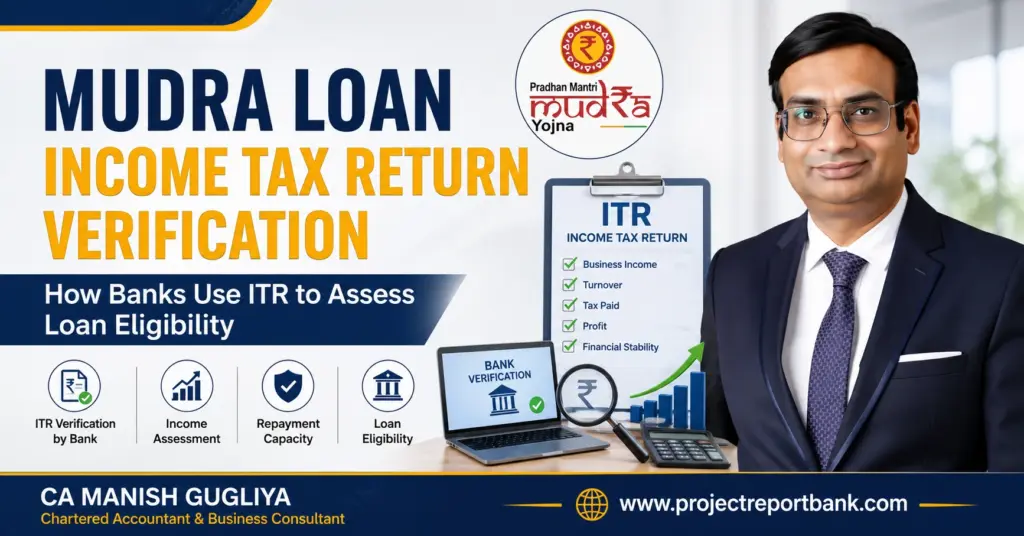
Key Takeaways
- For Kishore and Tarun mudra loans, banks almost always verify last 2–3 years’ income tax returns online before sanctioning the loan.
- Mismatches between ITR, GST returns, bank statement figures, and project report are one of the most common hidden reasons for Mudra loan rejection.
- Shishu category borrowers may sometimes get a loan without ITR, but documented income proof like bank statements is still carefully checked.
- No collateral is required for loans up to ₹10 lakh under the mudra scheme, making ITR verification even more critical for the lender’s risk assessment.
- Clean, consistent ITRs paired with properly prepared CMA data and project reports significantly improve approval chances for business loan, vehicle loan, and business installment loan applications under mudra yojana.
Introduction – Why Your ITR Can Make or Break a Mudra Loan
Most small business owners treat their Income Tax Return as just another piece of paper to submit at the bank counter. In my 20+ years as a practicing Chartered Accountant handling thousands of Mudra and MSME loan files, I have seen this assumption cost applicants their entire loan approval.
Verifying income tax returns is crucial for Mudra loan applications. When a bank receives your Mudra loan application, the credit officer does not simply file your ITR in a folder. The officer reads it, cross-checks it, and uses it to judge whether your business can actually repay the loan.
Here is what the bank is really looking for inside your ITR:
- Business stability – Has the business earned income continuously over multiple years?
- Annual turnover – Is it large enough to justify the requested loan amount?
- Net profit – After all expenses, is there enough surplus to cover EMI payments?
- Tax compliance – Has the applicant filed returns regularly and paid taxes honestly?
- Repayment capacity – Can the business comfortably service a new loan?
Improper, inconsistent, or back-dated ITR filing is a major silent reason behind mudra loans getting rejected or reduced – especially Kishore and Tarun applications.
Mudra loans are available to individuals and MSMEs across india. Eligible entities include sole proprietorships, partnership firms, and other non corporate small enterprises. The minimum age for applicants is 18 years, and the maximum age limit for applicants is 65 years. The Pradhan Mantri Mudra Yojana (PMMY), operated under the ministry of finance, government of india, was created with the micro units development and refinance agency (MUDRA) to provide funding to micro and small units that struggle to access formal credit from financial institutions.
I am CA Manish Gugliya, and this guide is based on real bank interactions – not textbook theory. Let me walk you through exactly how the Mudra loan income tax return verification process works.

Table of Contents
Why Banks Ask for Income Tax Returns for Mudra Loans
Under mudra yojana, many banks and small finance banks treat ITR as the single most reliable financial document to assess business income. Why? Because an ITR is a legal declaration filed with the Income Tax Department. It carries far more weight than self-declared figures on a loan application form or informal cash books.
Applicants typically submit ITRs for the past two to three years. ITR from the previous year is required if applicable. Upon submission, the bank uses this data to verify:
- Total income – including business income, any salary, rental income
- Business turnover – whether declared sales support the requested loan amount
- Gross and net profit – whether margins are healthy enough for EMI servicing
- Income trend – whether income has grown, remained stable, or declined
Regular tax filing with no outstanding demand signals financial discipline and creditworthiness – both of which directly influence the lender’s comfort in approving a collateral-free Mudra business loan.
Compared to relying only on a bank statement, an ITR provides a structured, government-verified snapshot of the applicant’s finances. This is why, especially for higher-ticket loans, ITR is always preferred over informal income proof. As per reports, roughly 3 in 10 loan applications show mismatches between ITR and bank statement – a pattern banks are now catching more aggressively.
Is ITR Mandatory for Shishu, Kishore and Tarun Mudra Loans?
The mudra scheme guidelines set broad eligibility rules, but documentation requirements for Mudra loans vary by lender and loan amount. Each bank – whether public sector, private, or small finance banks – follows its own internal credit policy on when ITR is compulsory, recommended, or relaxed.
Here is how it typically works across the three main types of Mudra loans, as defined by the PMMY official page:
Shishu Loans (Up to ₹50,000)
Shishu loans provide up to ₹50,000 for startups. Many banks do not insist on ITR for street vendors, very small traders, or brand-new businesses at this stage. They rely on bank statements, local verification, shop licence, and simple income proof instead.
Kishore Loans (₹50,000 to ₹5 Lakh)
Kishore loans range from ₹50,000 to ₹5 lakh for expansion. Lenders generally request ITRs from the last two financial years for Kishore and Tarun loans. If the business is more than one year old, most banks will ask for at least one to two years’ ITR to check turnover and repayment capacity.
Tarun Loans (₹5 Lakh to ₹10 Lakh)
Tarun loans offer ₹5 lakh to ₹10 lakh for established businesses. At this loan amount, Mudra loan income tax return verification becomes mandatory in virtually every bank. Expect to provide 2–3 years of ITR along with audited financials.
Tarun+ Loans
Tarun+ loans exceed ₹10 lakh for larger funding needs. Introduced in October 2024 for borrowers who have successfully repaid a prior Tarun loan, the documentation scrutiny here is the strictest.
ITRs are often required for Kishore and Tarun categories. The Mudra application form must be completed with photographs, and proof of business ownership is necessary for loan applications. Lenders may waive ITR requirements for new businesses with a detailed business plan and supporting documents like Udyam registration.
Practical rule of thumb: If your requested loan amount is above rs 2–3 lakh, prepare at least two years of ITR before you apply.
What Exactly Do Banks Verify in Your ITR for Mudra Loan?
Bank officers do not just tick the ITR checkbox in the documents required list. ITR verification processes include authenticity checks and income assessments. They actually open your return, read specific line items, and compare them against your loan application.
Here is what they examine:
Business Turnover
The officer checks your declared turnover – whether filed under Section 44AD/44ADA (presumptive taxation) or regular books – and compares it with the loan amount requested. A ₹7 lakh Tarun loan with a declared turnover of only ₹6 lakh will raise immediate red flags.
Gross Profit and Net Profit
Gross profit margin and net profit are scrutinized to assess whether the business generates enough surplus to service EMI. A low gross profit margin is a known reason for rejection.
Consistency of Income
Year-on-year income trends matter. Sudden large jumps right before the loan application or continuous losses weaken your case significantly.
Other Verification Points
| ITR Element | What the Bank Checks |
|---|---|
| Depreciation | Whether claimed depreciation on machinery or vehicle is legitimate |
| Tax paid | Whether tax liability is fully settled, no outstanding demands |
| Business continuity | Whether the business has operated across multiple assessment years |
| PAN and address | Whether PAN card details and business address match KYC documents |
| Capital introduced | Whether owner’s capital injection matches bank statement credits |
| Business nature code | Whether ITR business code matches actual trade or activity |
Banks may cross-verify ITRs with the Income Tax Department’s Centralized Processing Center to confirm the acknowledgement number and figures are genuine. KYC documents include pan card and aadhaar card, and lenders may require proof of business address as part of the application.
How Banks Compare ITR with GST Returns, Bank Statements and Project Report
Mudra loan financial verification is never done on ITR alone. The credit officer cross-checks your ITR figures with several other documents before giving final approval.
ITR vs GST Returns
Lenders compare income declared in the ITR with bank statements and GST returns. Turnover in your ITR is matched against GST outward supplies for the same financial year. If GST shows ₹8 lakh in sales but your ITR declares only ₹5 lakh, expect serious questions – or outright rejection. For a deeper look at this issue, see this guide on Mudra loan GST turnover mismatch.
ITR vs Bank Statements
Income documentation includes a bank statement from the last 12 months. The officer reviews credit entries (sales receipts, cash deposits) and checks whether they broadly correspond to the income declared in your ITR. Large unexplained credits not reflected in ITR suggest under-reporting.
ITR vs Project Report and CMA Data
Numbers in your project report, CMA data, balance sheet, and profit & loss account must broadly align with ITR. Unrealistic projections or copy-paste project reports are caught easily by experienced bank managers reviewing other documents alongside the ITR.
If differences are explainable – for instance, a COVID-19 impact in FY 2020–21 or a one-time large order – a proper written clarification from the applicant or CA usually helps save the loan proposal.

Common ITR Issues That Lead to Mudra Loan Rejection or Delay
Based on real cases I have handled, many mudra loans are rejected not because the business is fundamentally weak, but because of how income is shown – or not shown – in the ITR. Here are the most frequent problems:
Income and Turnover Problems
- Very low income declared to save tax, while bank statements show much higher receipts
- Sudden jump in turnover just before the loan application, without supporting business growth
- Sharp fall in profit or continuous losses despite steady bank credits
- ITR not filed for earlier years while the business clearly existed
Documentation Mismatches
- Different business address in ITR compared to identity and address proof (like aadhaar card, driving licence, voter id, or passport)
- Wrong business nature code in ITR
- PAN mismatch between ITR and loan application
- Non-filing of GST while ITR turnover suggests GST registration should exist
- Utility bills or other address documents not matching the business location shown in ITR
Fake or Manipulated ITR
Some applicants file backdated returns just before applying, or submit fabricated PDFs. Banks now verify ITR acknowledgement numbers directly on the income tax portal – and any manipulation is easily detected.
Even if past ITRs are weak, voluntarily correcting them and paying due tax before applying is always better than trying to hide or defend inaccurate returns. For a comprehensive list of rejection triggers, refer to this detailed guide on reasons for Mudra loan rejection.
Can You Get Mudra Loan Without ITR? Practical Scenarios and Alternatives
Many small traders, new service businesses, and street vendors ask whether a Mudra loan is possible without filing any income tax return at all.
For Shishu loans, some banks may sanction based on alternative and additional documents:
- Savings or current account bank statement (last 6–12 months)
- Simple income certificate from local authority
- Trade references from suppliers or customers
- Proof of business ownership and continuity – shop licence, UDYAM registration
- Business registration or establishment certificate
For Kishore and Tarun loans, complete absence of ITR is a serious hurdle. Officers may either reduce the loan amount substantially or ask the applicant to first file at least one year’s return before processing the application further.
If you are a home-based business owner, small manufacturer, or freelancer who has never filed returns, you can build eligibility by filing ITR under presumptive taxation (Sections 44AD/44ADA) from the next assessment year. This does not require maintaining detailed books – just declare turnover and a deemed profit percentage.
The bottom line: Mudra loan without ITR is sometimes possible for very small limits, but for serious business expansion at the Kishore or Tarun stage, regular ITR filing is almost unavoidable if you want smooth approval. The process is governed by RBI guidelines, and banks are advised to ensure proper documentation even when interest rates are competitive and collateral is not needed.
Practical Tips, Case Examples and How I Can Help
Actionable Tips to Strengthen Your ITR Before Applying
- File ITR every year on time – even if your income is below the taxable threshold
- Avoid showing unrealistically low income just to save tax; it directly hurts your loan eligibility
- Keep GST returns and ITR aligned in terms of turnover
- Route all business transactions through a dedicated bank account
- Prepare a professional project report and basic CMA data, even for smaller Mudra loans
Real Case Snapshots
Case 1 – Quick Approval: A grocery shop owner applied for a ₹4 lakh Kishore loan. His ITR, GST returns, and bank statements all showed consistent monthly turnover of ₹1.5 lakh. The loan was sanctioned within two weeks. The bank could easily verify business turnover because every number matched.
Case 2 – Rejection Reversed: A small manufacturer’s Tarun loan was initially rejected because ITR showed flat turnover of ₹6 lakh while bank statement credits exceeded ₹14 lakh. After filing a revised return, paying the additional tax, and providing a CA letter explaining the discrepancy, the loan was approved on reapplication – though at a reduced amount.
Case 3 – Amount Reduced: A service provider applied for ₹8 lakh but had net profit margins below 5% in ITR. The bank approved only ₹4 lakh, citing insufficient DSCR based on declared profits.
Case 4 – Missing CMA Data: An applicant submitted ITR but no CMA data or project report. The bank kept asking for additional financial documentation, delaying the process by months.

How I Can Help
If you are facing complex verification issues – whether it is re-verification, DSCR concerns, or turnover mismatch – professional guidance can make a significant difference. At Project Report Bank, we prepare bank-ready project reports, CMA data, and financial projections specifically designed to align with your ITR and GST records.
As CA Manish Gugliya, I invite business owners to reach out for end-to-end documentation support – whether you need help with a Mudra loan, vehicle loan, or business installment loan application. Getting the paperwork right the first time saves you months of back-and-forth with the bank.
Frequently Asked Questions on Mudra Loan ITR Verification
These are practical questions I hear repeatedly from small business owners during Mudra loan consultations.
Is ITR compulsory for all Mudra loans?
Not always. For Shishu loans up to ₹50,000, many banks relax ITR requirements and accept alternative income proof. However, for Kishore loans (₹50,000 to ₹5 lakh) and Tarun loans (₹5 lakh to ₹10 lakh), ITR is strongly expected or mandatory. The higher the loan amount, the stricter the requirement.
How many years of ITR do banks normally check?
Most banks look at the last two assessment years. For larger Tarun or Tarun+ limits, or when the bank’s overall exposure to the applicant is high, they may request three years. Some lenders may also find it necessary to check older returns if they notice inconsistencies.
Can revised ITR help if my earlier returns show very low income?
Yes, genuine revision before loan processing – supported by proper books, updated financial statements, and actual tax payment – often improves eligibility. But intentionally overstating income without substance will backfire during verification, since the bank compares your revised figures against bank statements and GST records.
Will banks verify my ITR online?
Absolutely. Bankers can log into the income tax portal or use CBDT’s bulk compliance check systems to confirm that your ITR acknowledgement number, filing date, and declared figures are real. Fabricated PDFs or manipulated printouts are caught this way. Many banks also qualify applicants by checking Form 26AS and Annual Information Statement (AIS) for additional details.
Can I apply for Mudra loan if my business started this year and I have no ITR yet?
You can still apply – particularly for Shishu loans. Banks may evaluate you based on bank statements, provisional accounts, purchase orders, Udyam registration, and a detailed project report. However, you are strongly advised to file your first ITR as soon as you become eligible to strengthen your loan capacity for future applications and to ensure smooth processing at every stage.
- Can Bank Reduce Mudra Loan Amount Without Your Consent? Complete Practical Guide (2026)


- What to Do If You Cannot Pay Your Mudra Loan EMI (2026 Guide)

- Can a Bank Refuse a Mudra Loan Because the Target Is Completed? Complete Guide (2026)

- Bank Refused My Mudra Loan Application – What Are My Rights?

- Mudra Loan for Used Vehicles (2026): Eligibility, Documents, Bank Rules & Complete Guide

- Rejected Mudra Loan – What to Do Next? Appeal Process Explained (2026)

- Mudra Loan Project Report Madhya Pradesh – Bank-Ready DPR & CMA Guide

- Project Report for Mudra Loan Maharashtra: Complete Guide for MSMEs, Startups and Small Businesses (2026)
- Mudra Loan Uttar Pradesh: Complete Guide for MSMEs, Startups and Small Businesses (2026)

- Mudra Loan Bihar 2026: Eligibility, Documents, Online Application Process & Project Report Guide

- Jan Samarth Mudra Loan 2026: Complete Guide to Online Application, Eligibility, Documents & Approval Process

- MSME Mudra Loan: Complete Guide for Small Businesses, Startups & Manufacturing Units in India (2026)

- Is the Mudra Loan Subsidy Real or Fake? Get the Facts Here

- Mudra Loan Without CIBIL Score: How to Qualify and Apply

- Mudra Loan for Used Machine (2026 Guide) – Eligibility, Documents, Valuation & Approval Tips