Key Takeaways
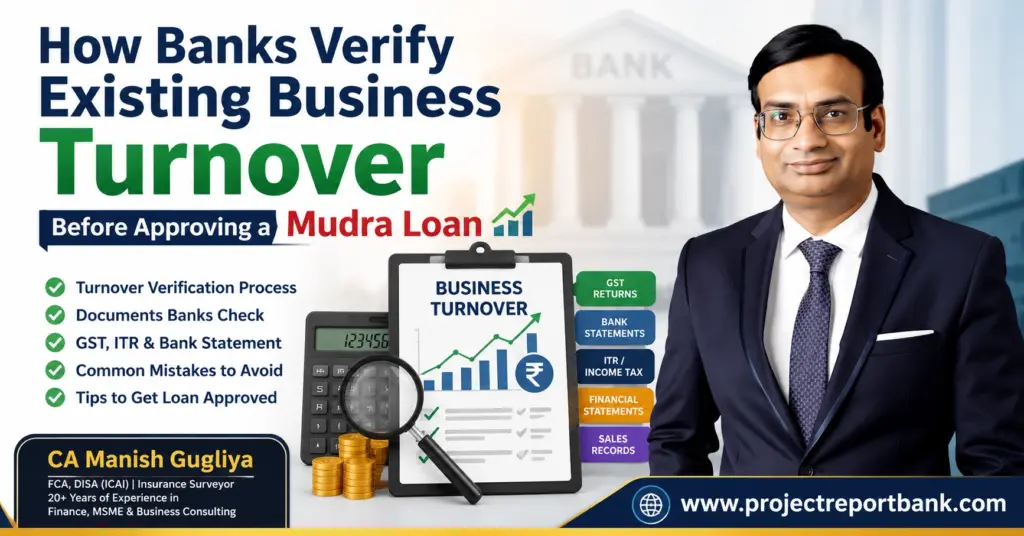
- Banks cross-check GST returns, bank statements, and income tax returns before sanctioning any loan under PMMY – even small shishu loans worth up to ₹50,000.
- For most existing businesses, mudra loan business turnover verification is the main basis for deciding eligibility and the maximum loan amount (up to 10 lakh under the mudra scheme).
- Officers match sales in GST with deposits in your bank account and income shown in ITR. A big mismatch can lead to delay, reduction of the loan amount, or straight rejection.
- Even cash-heavy businesses like kirana stores, small traders, and workshops can prove turnover using simple records, consistent deposits, and basic books of accounts.
- Honest figures, proper documents required (KYC, business proof, financials), and a realistic project report usually pass verification smoothly.
Introduction: Why Turnover Verification Decides Your Mudra Loan Amount
In my 20-plus years as a practising Chartered Accountant, I have seen one pattern repeat itself hundreds of times: the most common reason a mudra loan application gets stuck or rejected is wrong or unsupported turnover claims. Not low CIBIL. Not missing KYC. Turnover.
Under pradhan mantri mudra yojana (PMMY), launched on April 8, 2015, by the government of india, banks use your business turnover to decide two things – whether to approve your loan and how much to sanction. Shishu loans provide up to ₹50,000 for startups. Kishore loans range from ₹50,001 to ₹5 lakh for expansion. Tarun loans offer ₹5 lakh to 10 lakh for established businesses. Mudra loans are available to individuals and MSMEs, applicants must be aged between 18 to 65 years, and no collateral is required for loans up to ₹10 lakh. Agricultural businesses are not eligible for mudra loans.
So what does “mudra loan business turnover verification” actually mean? It means the bank checks if the sales you claim match your income proof – GST returns, bank statements, and ITR. This article focuses only on existing businesses (shops, traders, manufacturers, service providers). New businesses with little or no turnover can still apply for a mudra loan with a business plan and projected sales figures, but that is a different discussion.
Here is what we will cover: why banks verify turnover, the required documents, the step-by-step verification process, common mismatches that cause rejection, how cash businesses can still qualify, and practical tips to pass verification.

Table of Contents
What Exactly Is Business Turnover and How Banks Look at It
Turnover means your total sales in a year, before any expenses. If your shop sold goods worth ₹40 lakh last year and your costs were ₹36 lakh, your turnover is ₹40 lakh. Your profit is ₹4 lakh. Banks care about both, but they start with turnover.
The difference matters. A trading business often has high turnover but thin margins – say ₹50 lakh sales with just 5% profit. A small manufacturer might have lower turnover at ₹15 lakh but 20% margins. Banks judge each sector differently because cash flow patterns and repayment capacity vary.
For mudra loans and other business loan products, officers first look at annual turnover to judge business size. Only then do they check profit to estimate if you can handle the EMI. For very small shishu loans, banks may even consider just 6–12 months of turnover from your bank statement verification. For Kishore and Tarun categories, lenders typically require the last 6 to 12 months of bank statements to analyze cash flow, along with 1–3 years of ITR.
Here is a quick illustration: A retail shop with ₹15 lakh annual turnover is viewed as a small but steady unit. A service provider (say an internet café) with the same ₹15 lakh turnover might show higher profit because costs are lower. A manufacturer at ₹15 lakh may have significant raw material costs. Same turnover, different assessment – and that is exactly why banks dig deeper.
Why Banks Verify Existing Business Turnover Before Sanctioning Mudra Loans
Public sector banks, private banks, small finance banks, non banking financial companies, and micro finance institutions – all financial institutions lending under the PMMY scheme cannot rely on spoken figures. They must record and justify every sanctioned amount based on turnover proof. Lenders assess an applicant’s repayment capacity through an evaluation of financial records.
Repayment capacity is the first concern. If you request a ₹8 lakh business installment loan with a repayment tenure of up to 5 years, the bank estimates whether the monthly EMI is comfortable compared to your monthly sales and net profit. If your net profit is only ₹8,000 per month, an EMI of ₹18,000 makes no sense.
Business stability is next. Consistent turnover over 2–3 years gives officers comfort that your business can survive slow months. The importance of turnover increases with the loan category for PMMY loans – a Shishu applicant faces lighter scrutiny, while Tarun requires stricter verification.
Internal thumb rules also matter. Many branches informally expect that the loan amount requested should be around 10–25% of your annual turnover. This is not written in PMMY guidelines, but it is common practice. In the Mathew K. Jacob vs Union of India case, a borrower with annual turnover of ₹19.6 lakh was rejected for a ₹10 lakh working capital loan because the bank deemed it magnified compared to his turnover. The court upheld the rejection.
Fraud prevention is equally important. Banks verify turnover to avoid fake shops, benami transactions, and misuse of financial assistance. The maximum loan amount under mudra is ₹20 lakh for Tarun Plus, which covers expanded businesses – so scrutiny only gets tighter as amounts rise. Mudra yojana integrates small micro units into the formal credit system, and maintaining credibility of this system requires proper verification.
Documents Banks Use to Verify Business Turnover for Mudra Loan
No single paper is enough. Officers normally combine 3–6 documents depending on ticket size and business profile. Verifying business turnover for a mudra loan requires submitting specific financial documents. Here is what banks typically review:
| Document | What Bank Checks | Why It Matters |
|---|---|---|
| GST Returns (GSTR-1, GSTR-3B) | Sales turnover, outward supplies | Primary turnover proof for GST-registered units |
| Bank Statements (6–12 months) | Daily credits, cash flow pattern | Shows actual money coming into the business |
| ITR and Computation | Declared income and turnover | Consistency with GST and bank data |
| Profit & Loss Account | Revenue, expenses, net profit | Financial health of the business |
| Balance Sheet | Assets, liabilities, net worth | Business stability and existing debts |
| Sales Register | Daily sales entries | Business operations proof |
| Purchase Register / Bills | Inventory movement, supplier details | Genuine business verification |
| Invoice Book | Sales records, billing pattern | Authenticity of claimed turnover |
| Udyam Registration | MSME category, business details | Confirmation of micro and small enterprises status |
| Shop / Trade License | Business existence, location | Legal business registration verification |
| Rent Agreement / Ownership Papers | Premises details | Address proof and business location |
| Digital Sales Reports (POS, UPI) | Electronic transaction records | Additional documents supporting turnover |
For GST-registered businesses, GST verification for mudra loan usually becomes the primary turnover proof. Lenders check GST registration certificates and sale invoices to verify turnover. Income documentation includes a bank statement from the last 12 months, and ITR from the previous year is required if applicable. Income tax returns are often required for Kishore and Tarun loan categories. Audited financial statements are required for larger loans in the Tarun category.
For very small, unregistered units (typically under Shishu category), for shishu loans, minimal turnover proof is often accepted. Banks rely more on bank statements, basic books, stock verification during site visit, and simple self-declared sales statements. Service-based businesses must provide formal work orders to verify expected income.
The mudra application form must be completed and submitted. KYC documents include pan card and aadhaar card. Other valid identity documents include passport, voter i card, or driving licence. Proof of business ownership is necessary, along with utility bills and any other documents the bank branch requires. All these papers must match the identity proof and address proof in the KYC file.

Step-by-Step: How Banks Actually Verify Turnover for Mudra Loans
In practice, the sequence can vary, but most commercial banks follow a similar 7–8 step method. Kishore and Tarun loans require strict verification through ITR and bank statements. Here is how it works:
Step 1 – Basic Document File Check. The officer checks that your loan application form, KYC (pan card, aadhaar card, address proof), business proof, last 6–12 months bank statements, last 1–3 ITRs, GST returns, and a simple project report are all present and complete. Missing pages or unsigned forms get sent back immediately.
Step 2 – GST Verification. The officer logs into the GST portal using your supplied returns or view access. They check outward supplies in GSTR-1 and GSTR-3B against the turnover you declared in your loan application and project report. Since GSTN is now a Financial Information Provider under the Account Aggregator framework, banks can pull this data digitally with your consent.
Step 3 – Bank Statement Analysis. Credits pattern, average monthly sales, cash versus digital mix, and any unusual high-value or circular transactions are reviewed. Banks evaluate business turnover by reviewing sales receipts and financial statements. Lenders may use previous year’s turnover or projected sales for credit assessment.
Step 4 – ITR Verification. The turnover figure in your ITR (and audited financials where applicable) is matched with GST figures and the financial statements submitted with the file. If you filed under the presumptive scheme (ITR-4), they look at declared turnover and assumed profit margin.
Step 5 – Financial Statement Review. P&L and balance sheet are checked for reasonableness of gross profit margin, stock levels, creditors, and existing loan EMIs. If you already have other EMIs, the bank checks whether adding a new EMI is feasible.
Step 6 – Field / Site Verification. Banks may conduct physical verification of business premises for higher loan amounts. Officers visit your shop or unit to check stock, machinery, customer footfall, and whether the scale matches your claimed turnover. For a detailed breakdown of what happens during such visits, read the Mudra loan field investigation report guide.
Step 7 – Phone Verification. The bank confirms your mobile numbers, references, and sometimes calls suppliers or customers listed in your bills. Trade references play a role here. If you want to know what questions banks ask during calls, see this guide on Mudra loan phone verification.
Step 8 – Cross-Check and Approval Note. All figures from different sources are tallied. If comfortable, the officer records a justification for sanctioning the requested amount – or reducing it. This is the final gate before your loan gets approved.
How Banks Compare GST, Bank Statements, ITR, and Project Report Figures
As a CA preparing hundreds of mudra and MSME project reports every year, I can tell you the most common reason for queries is mismatch between GST, ITR, bank statement and the turnover written in loan forms. Here is how the comparison flows:
| Step | What Is Compared | What Must Match |
|---|---|---|
| 1 | GST Sales (GSTR-1/3B) | Outward supplies total |
| 2 | Bank Credits (6–12 months) | Should broadly match GST turnover |
| 3 | ITR Turnover & Profit | Must align with GST and bank data |
| 4 | Financial Statements (P&L) | Revenue consistent with ITR |
| 5 | Project Report | Past turnover and projections based on actuals |
| 6 | Loan Application | Requested amount justified by all above |
Banks expect reasonable tolerance – say 5–15% difference due to cash transactions, timing gaps, or non-GST sales. But big gaps raise red flags.
Example 1: Your GST shows ₹40 lakh annual turnover but bank credits are only ₹20 lakh. The officer immediately asks – where did half the money go? If you cannot explain with supporting records, the assessed turnover drops to ₹20 lakh, and your sanctioned amount shrinks accordingly.
Example 2: Your ITR shows ₹12 lakh turnover but your project report assumes ₹30 lakh next year. Officers will question such a jump. All future projections should logically link to past actual turnover. Copy-paste project reports with unrealistic numbers are a common reason for rejection.
Red Flags: How Bank Officers Detect Fake or Inflated Turnover
Banks now have systems, transaction monitoring, and experience. Simple “window dressing” rarely works for mudra loan business turnover verification.
Here are the major red flags officers watch for:
- Sudden cash deposit spikes – large amounts deposited in one month, right before applying, with no matching invoices or supplier bills.
- Circular transfers – money moving between related accounts (family members, friends) to inflate credits, then withdrawn quickly.
- Fake invoices – round-figure bills, same handwriting across different “suppliers,” non-GST compliant formats, or suppliers not traceable on the GST portal or by phone.
- Irregular GST filing – nil returns filed for most months, then suddenly high turnover claimed in the project report. Or GST returns filed for the first time just before applying.
- ITR filed only to get a loan – if you never filed ITR before and suddenly file one showing high income right before a loan application, it raises suspicion.
- Physical mismatch – during field inspection, claiming ₹80 lakh annual sales from a tiny, partly closed shop with almost no stock is a strong ground for rejection. Officers compare what they see with what you wrote.
Common Reasons Turnover Verification Fails – and How to Fix Them
Many genuine businesses lose their chance not because of low turnover, but because of poor documentation, mismatched figures, or wrong guidance. Here are the common pitfalls and how to fix them:
GST mismatch issues: Under-reporting sales in GST to save tax but over-declaring in the loan file. Late filing leading to missing months. Using multiple GSTINs without disclosing all of them. Fix: File GST correctly and on time for at least 12 months before applying.
Bank statement mismatch: Heavy cash sales never deposited. Using multiple bank accounts without disclosing them. Routing business through a personal savings account, making turnover look artificially low. Fix: Use one primary current account for all business transactions.
Problems with ITR: Filing low or nil turnover to save tax, then claiming high turnover in the loan application. Filing under presumptive schemes without proper purchase records. Fix: File correct ITR with reasonable turnover for at least one full year before applying for larger Kishore or Tarun loans.
Project report errors: Outdated data, inflated projections, or not reconciling opening stock, purchases, and sales with bank statements and GST returns. These are among the top reasons for mudra loan rejection.
Corrective action: Start depositing regular sales in one current account. Get a CA to align all numbers before submission. Submit the mudra application only when GST, ITR, bank statements, and your project report tell the same story.

How Cash-Heavy and Small Informal Businesses Can Still Prove Turnover
Many kirana stores, vegetable vendors, small eateries, salons, and workshops run mostly in cash and may not have GST. Yet several of them successfully get mudra loans each year. The non corporate, non farm small enterprises segment is exactly whom the mudra scheme targets. Mudra stands for micro units development and refinance agency, and its goal is to bring funding to micro units that need financial assistance to expand.
For such borrowers, banks rely more on:
- Consistent daily or weekly cash deposits into a dedicated bank account
- Basic handwritten sales and purchase registers
- Stock level observed during the field visit
- Local market reputation and trade references
- Supplier bills, even simple handwritten ones
Practical steps to build a turnover trail: Start using a current account (or at least a dedicated savings account) for the business. Collect simple bills from suppliers. Maintain a rough day book for sales and expenses. Even if GST registration is not compulsory because your turnover is below the threshold, filing regular ITR with reasonable turnover declared gives strong support during verification. You can apply for Mudra loan without GST – but documentation must compensate.
Be honest about your current scale. It is better to qualify for a smaller Shishu or Kishore loan that gets approved than to overstate turnover and face rejection. You can always come back for a larger loan after building a clean track record. A beneficiary micro unit that shows genuine growth gets faster approvals the second time around.
Practical Tips from CA Manish Gugliya to Pass Turnover Verification
These tips are based on preparing thousands of CMA data and project reports for MSME and mudra clients across india. Here is what works:
- Keep all sales in one main current account – avoid splitting across personal and business accounts.
- Deposit cash sales regularly, even if small amounts daily or weekly.
- File GST returns on time every month or quarter. Do not file nil returns when you have actual sales.
- File ITR every year with accurate turnover. Do not suppress income just to save tax – it hurts your credit record when you apply for a loan.
- Never create fake or back-dated invoices. Banks and officers can spot them.
- Keep invoice books and sales registers updated. Even handwritten records count.
- Ensure UPI and QR collections go into the business account, not a personal one.
- Reconcile GST, bank credits, and books every quarter. Fix mismatches before they pile up.
- Maintain purchase bills from your main suppliers. If you buy in cash, get a receipt.
- Make sure your project report data matches your past actual turnover. Avoid projections that cannot be justified.
- Attach all additional documents – Udyam registration, shop license, rent agreement, business registration certificate.
- Respond quickly to bank queries with written explanations. Delays kill applications.
- Do not use someone else’s GSTIN or borrow invoices to inflate turnover.
- Understand the interest rate and EMI before applying. Higher, proven turnover can justify a slightly larger limit without over-stretching EMI. Calculate in advance how the EMI fits within your monthly profit.
- For loans of ₹5 to rs 10 lakh, get a practising CA to review all numbers before you submit. The application process for Tarun is stricter, and small errors in financial projections cause rejection.
No collateral is required for loans under ₹10 lakh, so the bank’s only security is your turnover credibility. Treat your documents as your collateral.
You can also apply online through portals like Jan Samarth, but even digital applications require you to upload clean, consistent documents. The application form and supporting papers still get reviewed by a human officer.
FAQs on Mudra Loan Business Turnover Verification
These FAQs address common doubts that remain even after reading the full article. Each answer is written for shop owners, traders, and small businesses in simple language.
How do banks verify business turnover for a Mudra loan?
Banks combine GST returns, bank statements, ITR, and basic books of account to see if the sales you claim are realistic for your size and location. For most cases, officers first compare GST outward supplies with monthly bank credits, then check if ITR and P&L show similar annual turnover. They may also visit your shop or unit, check stock and invoices, and talk to nearby shops to confirm whether such turnover is possible. The entire business verification process is designed to protect both the lender and the borrower.
Can I get a Mudra loan without GST registration or formal income proof?
Yes, it is possible for small Shishu or lower Kishore category loans if your business is genuinely below the GST threshold and you maintain some basic records. In such cases, banks depend more on bank statements, simple sales and purchase registers, field verification, and local references to estimate turnover. However, for higher loans of ₹5 to ₹10 lakh, at least one year of ITR and better documentation is strongly recommended to avoid rejection or drastic reduction in the loan amount. You can also explore options for a vehicle loan under the scheme if your business requires transport assets.
What if my GST turnover and ITR turnover are different?
Small differences due to exempt or non-GST sales can be explained, but large gaps create doubt and may delay or block the loan. Give a written reconciliation, with support from your CA, showing which sales are included in GST and which are not, and why ITR figures differ. Intentionally under-reporting in ITR to save tax while over-declaring in a loan application is easily caught and can damage your credibility for all future loans. Lenders across commercial banks, small finance banks, and non banking financial companies share data through credit bureaus.
Do banks always visit my business place before approving a Mudra loan?
For most public sector banks and for amounts above very small tickets, a field visit or site inspection is standard practice – especially for Kishore and Tarun loans. During the visit, officers observe shop size, stock, machinery, customer flow, and ask simple questions about daily sales and suppliers to cross-check turnover. For very small Shishu loans with clean digital data, some branches may skip the physical visit, but this is not guaranteed. The inspection helps lenders assess whether your assets and operations justify the requested loan amount.
How much turnover is needed to get a ₹10 lakh Mudra loan?
There is no single minimum business turnover prescribed under the PMMY. However, in practice, many banks prefer that annual turnover is several times the loan amount – roughly 3 to 5 times. If your proper documents show turnover of ₹40–₹60 lakh with healthy margins and clean bank statements, a ₹10 lakh limit is more realistic than if turnover is only ₹10–₹15 lakh. Always aim for a loan size where the EMI is comfortably manageable from your current net profit, rather than relying only on optimistic future projections. This is the most practical way to ensure your loan application does not face reduction or rejection, and you can always expand your limit after building a strong repayment history.
- Can Bank Reduce Mudra Loan Amount Without Your Consent? Complete Practical Guide (2026)


- What to Do If You Cannot Pay Your Mudra Loan EMI (2026 Guide)

- Can a Bank Refuse a Mudra Loan Because the Target Is Completed? Complete Guide (2026)

- Bank Refused My Mudra Loan Application – What Are My Rights?

- Mudra Loan for Used Vehicles (2026): Eligibility, Documents, Bank Rules & Complete Guide

- Rejected Mudra Loan – What to Do Next? Appeal Process Explained (2026)

- Mudra Loan Project Report Madhya Pradesh – Bank-Ready DPR & CMA Guide

- Project Report for Mudra Loan Maharashtra: Complete Guide for MSMEs, Startups and Small Businesses (2026)

- Mudra Loan Uttar Pradesh: Complete Guide for MSMEs, Startups and Small Businesses (2026)

- Mudra Loan Bihar 2026: Eligibility, Documents, Online Application Process & Project Report Guide

- Jan Samarth Mudra Loan 2026: Complete Guide to Online Application, Eligibility, Documents & Approval Process

- MSME Mudra Loan: Complete Guide for Small Businesses, Startups & Manufacturing Units in India (2026)

- Is the Mudra Loan Subsidy Real or Fake? Get the Facts Here

- Mudra Loan Without CIBIL Score: How to Qualify and Apply

- Mudra Loan for Used Machine (2026 Guide) – Eligibility, Documents, Valuation & Approval Tips