
Key Takeaways
- Many Mudra Loan applications under Pradhan Mantri Mudra Yojana (PMMY) are rejected because the reported gross profit margin is too low to comfortably cover EMI repayment.
- Banks look at gross profit, operating profit, net profit and actual cash flow – not only turnover or total revenue figures from your project report or ITR.
- Wrong pricing, heavy discounting, and incorrect accounting often make the gross profit margin look weaker on paper than it actually is, especially for traders and small manufacturers.
- Low gross profit margins may result in loan denial, but by improving margins and preparing realistic financials (CMA data, income statement, cash flow), applicants can re-apply and often get approval.
Introduction – Why Low Gross Profit Margin Leads to Mudra Loan Rejection
Imagine a kirana shop owner in Bhopal, 2025. Annual sales of ₹18 lakh. He walks into a bank expecting easy approval for a ₹3 lakh Mudra Loan. The bank officer opens his ITR, calculates the gross profit margin at barely 5–6%, and rejects the application within a week. The owner is shocked – “But my sales are good!”
This happens more often than you think. Under the Pradhan Mantri Mudra Yojana, which was launched on April 8, 2015, for small businesses, banks care far more about repayment capacity and business profitability than just revenue numbers. Even for Shishu loans offering up to ₹50,000 for startups, or Kishore loans ranging from ₹50,001 to ₹5 lakh, bankers quickly check whether gross profit and net income are enough to pay EMI, rent, staff wages and family expenses.
In this article, written from my experience as CA Manish Gugliya with 20+ years in MSME finance, I will explain what gross profit margin means, how banks evaluate it, why low margins cause rejection, and what practical steps can improve your chances. A Mudra Loan rejected due to low gross profit margin is not the end – with better pricing, costing and a proper project report, many clients successfully get loans sanctioned on their second attempt.
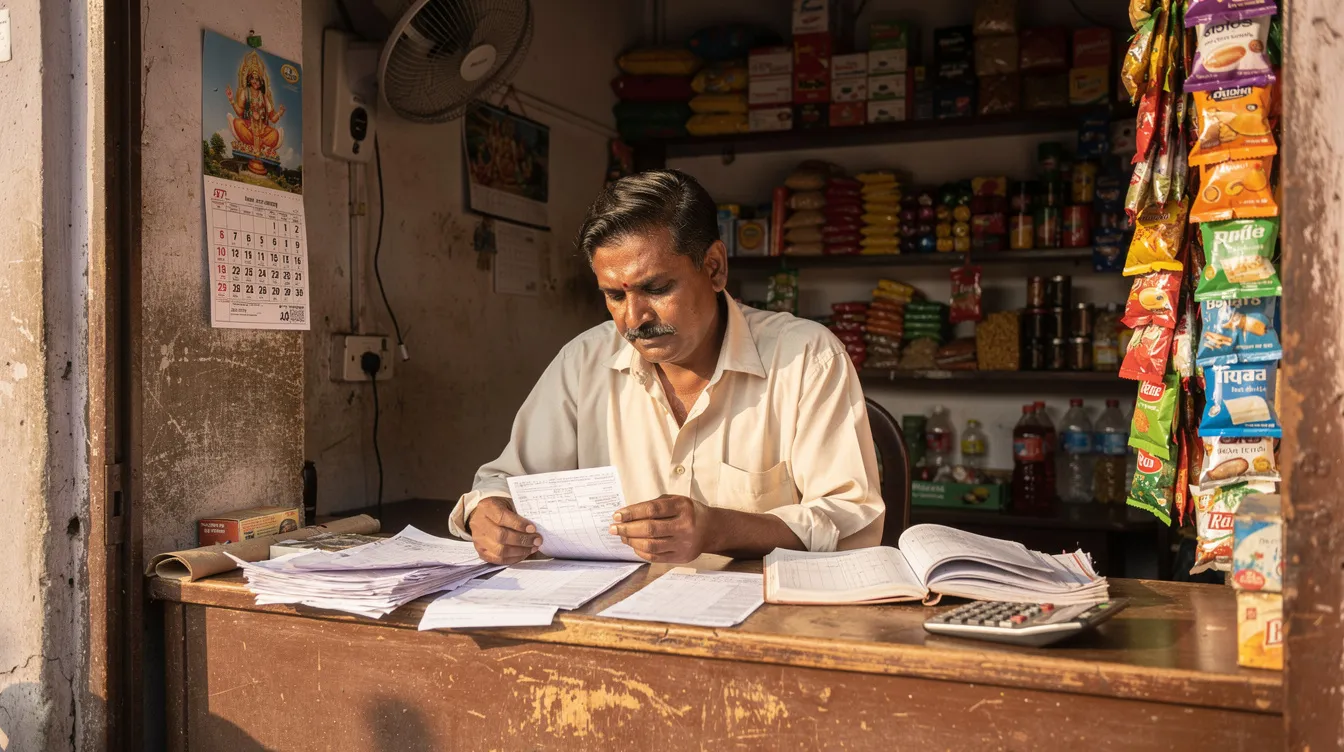
Table of Contents
Understanding Gross Profit, Net Profit and Gross Profit Margin in Simple Terms
Let me explain three terms that every bank officer uses during a business loan appraisal. Gross profit equals revenue minus cost of goods sold (COGS) – it is the money left after paying for the goods you purchased or the raw materials and production costs you spent. Gross profit measures efficiency in producing goods or services. Gross profit does not include operating expenses like rent or salaries – those come later.
Here are the formulas:
- Gross Profit = Sales (Revenue) – Cost of Goods Sold
- Gross Profit Margin (%) = (Gross Profit ÷ Sales) × 100
- Operating Profit = Gross Profit – Operating Expenses (rent, salary, electricity, other expenses)
- Net Profit (Net Income) = Operating Profit – Interest – Taxes
Example: A mobile shop in Indore
| Item | Amount (₹) |
|---|---|
| Annual Sales | 12,00,000 |
| Purchases & Direct Costs | 10,20,000 |
| Gross Profit | 1,80,000 |
| Gross Profit Margin | 15% |
| Operating Expenses | 90,000 |
| Operating Profit | 90,000 |
| Interest & Taxes | 15,000 |
| Net Profit | 75,000 |
Banks prefer percentage (gross profit margin) over rupee amount because it lets them compare a company’s performance across businesses of different sizes. Gross profit appears at the top of the income statement; net profit sits at the bottom after all expenses.
What Is Gross Profit Margin and Why It Matters More Than Only Turnover
Gross profit margin is the percentage of profit left from sales after paying for goods sold or direct costs, before rent, salary and other overheads. It is expressed as a percentage of revenue.
The difference between 8% and 18% margin can determine whether your Mudra Loan is approved or rejected, even at the same turnover.
Consider two businesses:
| Business A | Business B | |
|---|---|---|
| Annual Sales | ₹20 lakh | ₹10 lakh |
| Gross Profit Margin | 6% | 25% |
| Gross Profit | ₹1.2 lakh | ₹2.5 lakh |
Business B is safer for a Mudra Loan despite lower sales, because EMI coverage is significantly better. A company can have high gross profit but low net profit if operating expenses are heavy – but without sufficient gross profit margin, there is nothing left to work with at all.
Industry-wise margins differ sharply. A grocery wholesaler may survive on 4–6% margin, while a restaurant or mobile accessories shop may operate at 20–40%. Banks compare your margin with typical margins for your specific line of business, not against a universal number.
Very low margin on paper sometimes results from underbilling, unrecorded cash discounts, or inflated purchases. For Kishore and Tarun mudra loans, bankers question any project report where the gross profit margin looks either too low or unrealistically high compared to local market practice.
Why Banks Check Gross Profit Before Approving a Mudra Loan
From a banker’s perspective: the EMI for a ₹5 lakh Mudra Loan over 5 years at around 10–12% interest rate is roughly ₹10,000–₹11,000 per month. This money must comfortably come from business profits and cash flow.
Here is how profitability feeds into credit appraisal:
- Gross profit shows whether the business earns enough on each sale to stay viable.
- Operating profit reveals whether any surplus remains after rent, salary and electricity.
- Net profit (plus household income) shows final repayment capacity.
Lenders reject applications if businesses cannot comfortably cover loan EMIs due to low gross profit margins. High operating expenses on top of thin margins make rejection almost certain. Since mudra loans under the mudra scheme are collateral free loans – collateral is not typically required but may enhance approval likelihood for low-margin businesses – banks depend heavily on profitability rather than property security. MUDRA itself functions as a refinance agency that channels funding through commercial banks, non banking financial companies, small finance banks and micro finance institutions.
In many rejection files I have reviewed, the sanctioning officer wrote remarks like “low GP ratio”, “thin margin, high competition” or “insufficient surplus for proposed EMI.”
How Banks Evaluate Business Profitability for Mudra Loans
Banks do not rely on a single document. They cross-check turnover, gross profit margin and cash flow from multiple sources before sanctioning any business loan under Pradhan Mantri Mudra Yojana.
Key things a banker analyses:
- Sales trend over 1–3 years from ITR, GST returns and bank statements.
- Purchase pattern and cost of goods from bills and GST data to estimate gross profit calculations and the gross profit ratio.
- Operating expenses such as rent, wages, electricity, travelling and marketing costs to derive operating profit.
- Net profit and personal drawings from P&L account or ITR to check final surplus.
- Working capital cycle and assets position.
For existing businesses, banks often prepare or request CMA data where sales, gross profit, net profit, working capital and cash flow are projected for the next 3–5 years. Documentation issues can cause Mudra loan applications to be rejected – so applicants must ensure that figures in GST returns, ITR and bank statements are aligned to avoid mismatches that create doubt about a company’s financial health.
Common Practical Reasons for Low Gross Profit Margin in Small Businesses
In my experience preparing hundreds of project reports, most “low gross profit margin” cases stem from avoidable business practices:
- Excessive discounting to match nearby competitors, especially in mobile shops, garments and electronics.
- High purchase cost from middlemen instead of wholesalers, common for small kirana and hardware stores.
- Wrong pricing – the owner calculates selling price only as “purchase + small markup” without including transport, packing, wastage or GST impact.
- Poor inventory management leading to expired or damaged stock, silently reducing effective profitability.
- Pilferage and leakages (staff taking goods without billing) that reduce stock and reported margin.
- Low production efficiency and high wastage in manufacturing units due to untrained labour or old machinery.
- Incorrect costing in the services sector – salons, repair shops, printing units – where labour cost and consumables are underestimated.
- Financial projections showing low historic margins with unrealistic profit projections can cause rejection. Copy-paste project reports with generic numbers are a common trigger.
- Negative gross profit indicates potential loan rejection risks and signals a fundamentally unprofitable business.
Before applying, owners should sit with their CA to do a quick margin analysis and correct obvious mistakes.
Industries Where Low Gross Profit Is Common and How Banks View Them
Banks do not use one fixed benchmark. They judge margins differently for trading, manufacturing and services sector businesses within mudra yojana. Lenders prefer businesses with stable gross profit margins over time.
| Industry | Typical Gross Profit Margin | Bank’s View |
|---|---|---|
| Grocery / Kirana shops | 4–10% | Accepted if turnover is stable and expenses low |
| Wholesale traders | 2–6% | Allowed if volume is large and payment discipline strong |
| Garment / Footwear shops | 20–40% (before discounts) | Concerned if books show below 10–12% |
| Restaurants / Sweet shops | 30–60% | Low margin raises suspicion of unrecorded cash sales |
| Mobile / Electronics retailers | 8–20% | Viable if stock and purchase bills support the stated margin |
| Small manufacturing | 20–35% | Banks also factor in power cost and labour productivity |
| Service businesses | Varies widely | Focus shifts to operating profit and cash flow |
Tarun Plus loans range from ₹10 lakh to ₹20 lakh and face even stricter scrutiny. Never blindly copy high margins from someone else’s report – unrealistic projections also trigger rejection.
Does a Low Gross Profit Margin Always Mean Mudra Loan Rejection?
No. Low gross profit margin increases risk but does not automatically guarantee rejection. Banks look at the full picture.
When banks may still approve:
- Turnover is stable or growing over 2–3 years, indicating a strong customer base in existing or new markets.
- Cash flow in bank statements shows regular deposits and the borrower has successfully repaid loans in the past.
- Promoter has long experience and a strong personal and business CIBIL score, which can mitigate risks presented by low margins.
- Additional household income (salary, rent, pension) supports EMI.
- Requesting a lower loan amount can improve the chances of approval if margins are thin.
When rejection becomes likely:
- Very low or fluctuating sales with thin margin and heavy personal withdrawals.
- Multiple existing EMIs already consuming monthly surplus.
- Poor repayment history making the bank conservative about the small business.
- Project report showing low margin plus unrealistic expense assumptions.
Approaching alternative lenders – non banking financial companies, small finance banks or micro finance institutions – may yield better outcomes after a rejection from a commercial bank.
How to Improve Gross Profit Margin Before Applying for a Mudra Loan
Improving gross profit is often easier and faster than people think. Even a 2–3% margin improvement can change the bank’s decision.
- Review pricing strategy product-wise; increase price on slow-moving or unique items where competition allows.
- Negotiate better rates with suppliers or shift to wholesalers who offer lower purchase cost on frequently sold items.
- Reduce wastage, leakage and pilferage through strict stock counting and better storage. Improving operational efficiency can enhance gross profit margins.
- Optimise product mix: focus on higher-margin items (accessories, premium garments, specialty snacks) to lift average margin.
- Improve inventory control using a simple stock register or basic software so that closing stock and purchases are correctly recorded.
- Separate personal and business expenses; do not book household costs as business expenses.
- Maintaining accurate financial records is essential for successful loan applications. A detailed project report is vital when applying for loans to demonstrate how funds will improve profitability.
- Before filing, recalculate expected EMI based on likely interest rate and tenure, and verify that revised net profit easily covers that EMI plus family expenses.

How a Chartered Accountant Helps in Improving Loan Approval Chances
Many Mudra Loan files land on my table after rejection due to “low gross profit margin” or “financials not satisfactory.” Here is how a CA can help entrepreneurs and small enterprises:
- Analyse past sales, purchases and expenses to determine true gross profit margin and identify where margin is leaking.
- Benchmark your margins against similar businesses in your city and suggest a realistic target range.
- Prepare or correct income statement, balance sheet and cash flow so the bank officer can see repayment capacity clearly.
- Prepare professional CMA data and a realistic project report for Kishore and Tarun category loans with justified profit assumptions.
- Align figures in GST returns, ITR and bank statements to remove contradictions.
- Guide on answering bank queries about low margin, seasonal sales and competition.
A CA cannot guarantee approval, but proper financial planning significantly improves chances. The government created the mudra scheme so that every beneficiary micro unit and non corporate small enterprise can access financial assistance – but the business plan must be credible.
Real-Life Style Case Study – Mudra Loan Rejected Due to Low Gross Profit Margin
A garment retailer from Jaipur applied for a ₹7 lakh Tarun category Mudra Loan in FY 2024–25. Tarun loans provide ₹5 lakh to ₹10 lakh for established businesses. Here is what happened:
Initial numbers (Year 1):
| Item | Amount |
|---|---|
| Annual Sales | ₹36 lakh |
| Purchases & Direct Costs | ₹33.5 lakh |
| Gross Profit | ₹2.5 lakh (6.9% margin) |
| Operating Expenses | ₹2.1 lakh |
| Net Profit | ₹40,000 |
The banker noted: “Low GP margin, no cushion for EMI of ~₹15,000/month. Loan not recommended.”
After detailed review, we found unrecorded cash sales, wrong stock valuation, and personal expenses booked as business cost – all artificially pulling down profitability. Over the next 12 months, the owner corrected stock records, properly recorded all sales and revenue, increased prices slightly on premium items, and renegotiated with two key suppliers to reduce purchase cost. Investments in better display and marketing helped attract more profitable customers.
Revised numbers (Year 2):
| Item | Amount |
|---|---|
| Annual Sales | ₹40 lakh |
| Purchases & Direct Costs | ₹31 lakh |
| Gross Profit | ₹9 lakh (22.5% margin) |
| Operating Expenses | ₹3 lakh |
| Net Profit | ₹5.5 lakh |
On re-application in early 2026, the same bank sanctioned ₹7 lakh. The company went from paying money in penalties for late credit to running a profitable, growing business.
Practical Checklist Before Applying for Mudra Loan When Margin Is Low
Use this checklist before visiting the bank or filling the JanSamarth portal to apply online:
- ☐ Review last 1–2 years’ gross profit margin from trading and P&L account; ensure margin is reasonable for your industry.
- ☐ Verify that sales, purchases and stock figures are correctly recorded; correct errors before filing ITR.
- ☐ Check that GST returns, ITR and bank statements broadly match in terms of turnover – banks use these to verify profitability.
- ☐ Prepare a realistic business plan, project report and CMA data showing how the loan amount will actually increase sales and improve net profit.
- ☐ Calculate expected EMI and confirm current net profit and household income can comfortably cover it.
- ☐ Ensure bank statements show no frequent cheque bounces or suspicious patterns.
- ☐ Keep supporting documents (bills, stock records, rent agreement, UDYAM registration) ready.
- ☐ Discuss file with a CA before submission to avoid “low profitability” remarks.
MUDRA stands for Micro Units Development and Refinance Agency Limited. The scheme exists to provide credit and growth opportunities to micro units. Use it wisely by being prepared.
Frequently Asked Questions on Mudra Loan Rejection Due to Low Gross Profit Margin
Is there any fixed minimum gross profit margin required for Mudra Loan approval?
RBI has not prescribed any fixed gross profit margin for mudra loans. Each bank – whether commercial banks or financial institutions – uses internal guidelines and compares your margin with typical margins for your line of business in your city. For very thin-margin trading businesses, banks look more at turnover stability and cash flow, whereas for manufacturing and services they expect somewhat higher margins to create a cushion for EMI.
If my Mudra Loan was rejected due to low gross profit, how long should I wait before re-applying?
Instead of re-applying immediately, spend 6–12 months improving pricing, purchase cost, bookkeeping and stock records so that the next income statement and bank statement clearly show better profitability. However, if the rejection was mainly due to a calculation or presentation error rather than genuinely weak margin, you can re-apply earlier with a corrected project report and financials.
Do banks check GST data and bank statements to verify my gross profit?
Yes. For most Kishore and Tarun category Mudra Loans, banks cross-check GST returns, bank statements and sometimes purchase bills to verify whether reported sales and purchases (and hence gross profit) look genuine. Even for small Shishu loans, some branches scan bank account credits and basic stock details to ensure that the business generates sufficient cash flow for EMI.
Which is more important for Mudra Loan – gross profit or net profit?
Both matter. Gross profit margin shows whether each sale is profitable enough to sustain the business, while net profit (after rent, salary, interest and taxes) shows the final surplus available for EMI and family needs. In borderline cases, banks pay closer attention to net profit and average monthly surplus in bank statements, but a very low gross profit margin almost always makes them cautious.
Can a CA really change the bank’s decision if my margin is genuinely low?
If the business is structurally unprofitable, no amount of financial presentation can “create” profit. But a CA can help redesign pricing, product mix and cost structure so that next year’s results actually improve. A CA also ensures your real profitability is correctly reflected in books and the project report, preventing rejection due to avoidable accounting or documentation mistakes. Many of my clients have gone from rejection to approval by simply fixing what was already a viable business on paper.
- Can Bank Reduce Mudra Loan Amount Without Your Consent? Complete Practical Guide (2026)


- What to Do If You Cannot Pay Your Mudra Loan EMI (2026 Guide)

- Can a Bank Refuse a Mudra Loan Because the Target Is Completed? Complete Guide (2026)

- Bank Refused My Mudra Loan Application – What Are My Rights?

- Mudra Loan for Used Vehicles (2026): Eligibility, Documents, Bank Rules & Complete Guide

- Rejected Mudra Loan – What to Do Next? Appeal Process Explained (2026)

- Mudra Loan Project Report Madhya Pradesh – Bank-Ready DPR & CMA Guide


- Project Report for Mudra Loan Maharashtra: Complete Guide for MSMEs, Startups and Small Businesses (2026)

- Mudra Loan Uttar Pradesh: Complete Guide for MSMEs, Startups and Small Businesses (2026)

- Mudra Loan Bihar 2026: Eligibility, Documents, Online Application Process & Project Report Guide

- Jan Samarth Mudra Loan 2026: Complete Guide to Online Application, Eligibility, Documents & Approval Process

- MSME Mudra Loan: Complete Guide for Small Businesses, Startups & Manufacturing Units in India (2026)

- Is the Mudra Loan Subsidy Real or Fake? Get the Facts Here

- Mudra Loan Without CIBIL Score: How to Qualify and Apply

- Mudra Loan for Used Machine (2026 Guide) – Eligibility, Documents, Valuation & Approval Tips