
An export-grade pulse cleaning, colour sorting and packing plant represents one of the more commercially disciplined agro-processing investments an Indian promoter can undertake today. This article examines the technical process, machinery requirements, investment structure, financial projections and regulatory framework that a Detailed Project Report must address for such a facility.
Key Takeaways
- This project centres on export-grade cleaning, grading, destoning, optical colour sorting and hygienic packing of whole pulses-it is not a conventional dal mill. Typical target capacity ranges from 1 to 5 metric tons per hour for small-to-medium scale plants, while commercial industrial installations typically have a target capacity of 10+ metric tons per hour.
- Multi-stage cleaning, aspiration, destoning, gravity separation, optical colour sorting and metal detection are essential to meet international buyer specifications. Advanced pulses processing plants achieve 99.99% purity through integrated mechanical and electronic stages.
- Project cost comprises land, building, specialised machinery (including colour sorter machine and automatic packing line), utilities and working capital margin. Automation level strongly affects total investment, and raw uncleaned pulses account for 88–92% of operating expenses.
- A bankable Detailed Project Report with 5–7 year financial projections, DSCR analysis, sensitivity modelling and CMA Data is essential for obtaining term loan and working capital finance from Indian commercial banks. A Detailed Project Report for a pulse cleaning and grading plant includes technical specifications, financial feasibility and risk assessment.
- Project Report Bank, led by CA Manish Gugliya, FCA, DISA (ICAI), prepares customised DPRs and CMA Data for export-oriented pulses processing plant projects across India.
Introduction – Export-Grade Pulses Processing Opportunity in India
India’s position in global pulse production and trade is substantial. According to APEDA’s FY 2025–26 data, India produced approximately 274.09 lakh tonnes of pulses and exported about 10,00,547 metric tonnes valued at around US$ 969.53 million. India exported pulses to over 20 countries worldwide, with China, the UAE, Bangladesh, the United States and Sri Lanka being the major destinations.
Globally, pulses account for over 90 million tonnes of production annually, and the global pulses market was valued at USD 103.25 billion in 2025. The market is expected to reach USD 140.23 billion by 2034, driven substantially by growing consumer demand for vegetarian and vegan diets. Pulses are naturally rich in plant based protein and dietary fiber, contain essential minerals and vitamins beneficial for health, and are integral to vegan diets worldwide. They also improve soil fertility by fixing nitrogen naturally, making them increasingly important in sustainable agriculture.
An export-grade pulses processing plant is fundamentally different from a traditional dal mill. The focus here is on cleaning grading, destoning, optical colour sorting, metal detection and final packaging of whole pulses to consistently meet strict export specifications-not necessarily on dehusking or splitting. While pulses processing includes cleaning, dehulling and sorting in a fully integrated facility, dehulling removes the outer seed coat and is only added where the product portfolio or buyer demands justify it.
Consider this scenario: a merchant exporter procures raw chickpeas from mandis but faces repeated shipment rejections due to discoloured kernels, stones or foreign matter exceeding buyer limits. A dedicated pulses processing plant with multi-stage cleaning and colour sorting eliminates this problem by producing consistent quality output that meets destination-country specifications.
This article serves as a practical export grade pulse cleaning plant project report guide-covering process flow, machinery, plant capacity, investment, profitability, bank finance and export risks. Promoters seeking a comprehensive framework for a multi-pulse cleaning, grading and packing plant will find this a relevant starting point.
Business Model & Product Portfolio of an Export-Grade Pulses Processing Plant
The business model can be inventory-based (buying, processing and exporting pulses) or job-work based (earning per-tonne processing charges on customer-owned raw materials). A well-prepared DPR should clearly define which model-or blend-is proposed, because the working capital requirement, risk profile and profitability structure differ materially.
The product portfolio for an export-quality pulses processing plant typically covers:
- Whole chickpeas (Kabuli and desi varieties, which together constitute roughly 44.6% of India’s pulse exports)
- Tur or pigeon peas
- Moong beans and dry beans
- Urad dal and black gram
- Masoor dal and lentils
- Yellow peas and other exportable legumes
Optional value-added SKUs include retail pouches, private-label packs and bulk 25–50 kg bags. Pulses processing also enhances convenience for ready-to-eat meals and nutritious food products, catering to the increasing popularity of processed pulses in international markets.
Customer segments range from bulk B2B exports to importers and packers, private-label packing for international brands, supply to Indian merchant exporters operating from ports like Nhava Sheva or Mundra, and high-quality supply to domestic food processing and HoReCa channels.
In a job-work model, revenue comes from per-tonne processing charges with lower price risk but dependence on consistent supply of orders. In a commodity trading model, the plant procures and owns raw materials, earning trading margins but bearing price volatility. Where a promoter already runs a dal mill and wants to upgrade with an export-grade sorting and packing line, the Dal Mill & Integrated Pulse Processing Plant Project Report provides a comparative reference. The key distinction is that a cleaning grading and colour sorting operation does not require dehulling machines or splitting equipment.
Technical Process Flow – Cleaning, Grading, Colour Sorting & Packing
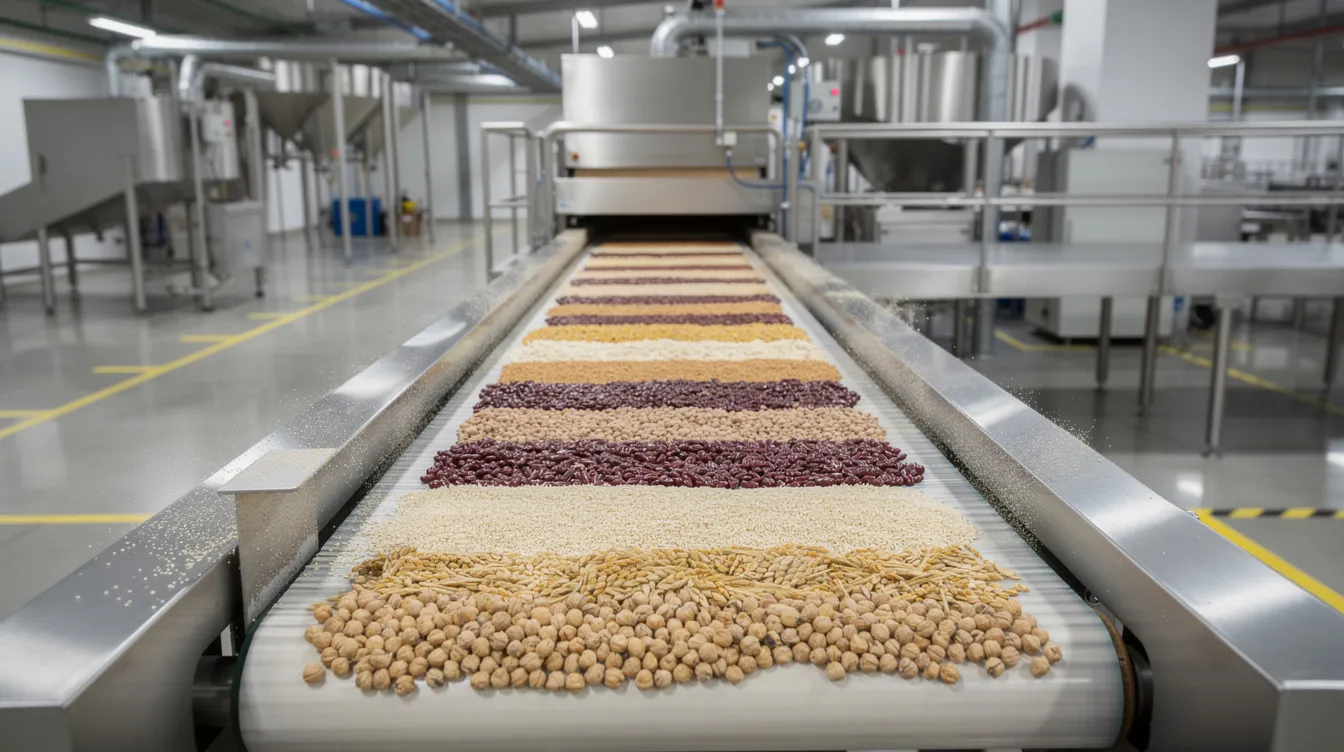
The complete process flow for export-quality pulses processing follows these stages:
Raw Pulse Receiving → Sampling & Quality Inspection → Pre Cleaning → Aspiration → Destoning → Magnetic Separation → Size Grading → Gravity Separation (if required) → Optical Colour Sorting → Re-sorting/Rejection Handling → Metal Detection → Final Inspection → Weighing & Packing → Batch Coding → Finished Goods Storage → Export Dispatch.
The engineering phase may involve customizing screen sizes and aspiration airflows according to pulse types, since moisture and climate adaptability is critical for grain flow in pulse processing. Mechanical cleaning uses pre-cleaners and gravity separators as the first line of defence against contaminants.
Key components of a pulse cleaning and grading plant include pre-cleaning, destoning and grading units, supplemented by optical colour sorting for precision removal of discoloured or damaged kernels.
| Stage | Machine/Equipment | Purpose | Key Quality Parameter |
|---|---|---|---|
| Pre cleaning | Vibro pre-cleaner with aspiration | Remove large debris, dust, loose husks | Foreign matter reduction |
| Aspiration | Aspirator channel | Separate light impurities by air flow | Dust and chaff removal |
| Destoning | Destoner | Remove stones, glass, heavy particles | Stone-free output |
| Magnetic separation | Magnetic separator | Extract metal contaminants | Metal-free product |
| Size grading | Multi-deck sieve grader | Classify by size for uniformity | Size consistency |
| Gravity separation | Gravity separator | Separate by density (immature, damaged kernels) | Density-based purity |
| Colour sorting | Optical colour sorter machine | Reject discoloured, damaged, off-type grains | Colour and defect accuracy |
| Re-sorting | Secondary pass through sorter | Tighten rejection for strict buyers | Rejection recovery |
| Metal detection | Inline metal detector | Final check for metal contaminants | Food safety compliance |
| Weighing & packing | Automatic bagging and sealing | Precise weight, hygienic sealing | Net weight accuracy |
| Batch coding | Inkjet or thermal printer | Date, batch, origin traceability | Traceability and labelling |
Rejected material-slightly discoloured or off-grade pulses, stones, dust and foreign matter-can partly be reprocessed or sold into lower-grade domestic markets to improve overall phase recovery. This is a critical detail in financial modelling because it affects net yield and revenue.
For a detailed comparison of how this flow differs from a full dal milling operation involving conditioning, dehusking and splitting, the reader should understand that export-grade cleaning and sorting plants deliberately omit those steps unless the product mix demands chana dal, urad dal or split masoor.
Machinery & Equipment Requirements for Export-Quality Pulse Cleaning and Colour Sorting
The heart of an export-grade pulses processing plant is a balanced processing line of cleaning, grading sorting, colour sorting and packing machinery, sized to match the desired plant capacity and product mix. Pulses processing plants require advanced cleaning and sorting machinery; capacity mismatches between stages create bottlenecks that reduce throughput and increase operating costs.
Quality assurance protocols include Factory Acceptance Testing of the machinery before shipment, ensuring that equipment performs to specification before installation.
Major machinery groups include:
- Raw material intake hoppers, pre-cleaners and vibro cleaners with aspiration
- Destoners and magnetic separators
- Multi-deck size graders and gravity separators for fine cleaning
- Optical colour sorter machines (CCD-based or newer camera/LED systems)
- Metal detectors and inline inspection systems
- Automatic weighing and bagging systems with sealing or stitching equipment
- Conveyors, bucket elevators and storage bins
- Dust collection and filtration systems
- Air compressors and dryers (critical for stable colour sorter ejector operation)
- Electrical control panels, PLC/SCADA automation where justified
For optical colour sorting specifically, the distinction between CCD-based and newer high-resolution camera systems matters for grading sorting precision and throughput. Domestic manufacturers offer CCD-based machines in the 2–3 TPH range, while premium multi-sensor or AI-enhanced sorters provide superior performance for strict export specifications. Colour sorter machine prices in India range from approximately ₹7–28 lakh depending on capacity and technology, with high-end export-grade units costing significantly more.
Ancillary equipment often overlooked includes laboratory instruments for moisture and foreign matter testing, weighing scales, pallet trucks, fumigation infrastructure and pest-control systems. A complete DPR must budget for these. For a wider discussion of colour sorter, grading and packaging machinery, detailed specifications and selection criteria are covered separately.
| Equipment Category | Functional Role | Capacity Alignment (5 TPH example) | Cost Contribution |
|---|---|---|---|
| Pre-cleaners, aspirators, destoners | Cleaning grading | Matched to 5 TPH throughput | Medium |
| Size graders, gravity separators | Grading sorting by size and density | 5–6 TPH rated | Medium |
| Optical colour sorter machine | Colour sorting and defect removal | 3–5 TPH per unit (may need two) | High |
| Metal detector | Final food safety check | Inline, matched to packing speed | Low |
| Automatic bagging and sealing | Final packaging | 100–300 bags/hour | Medium |
| Conveyors, elevators, bins | Material handling | Matched to overall line speed | Medium |
| Dust collectors, compressors | Utilities | Sized for total connected load | Medium |
| Lab instruments, pest control | Quality and compliance | Not capacity-dependent | Low |
Plant Capacity, Land, Building & Layout Planning
Many export-oriented pulses processing plants start at 2–5 TPH for MSME-level projects, scaling to 10–20 TPH for larger trading and export houses. A well-configured facility can process 50,000 MT annually on a double-shift basis. Total connected electrical load and power requirements should align with the capacity chosen and local supply reliability.
Capacity planning must align raw material requirements, buyer commitments, power availability and working capital. Promoters may compare multiple scenarios in the DPR, following general capacity planning principles adapted for cleaning and sorting operations.
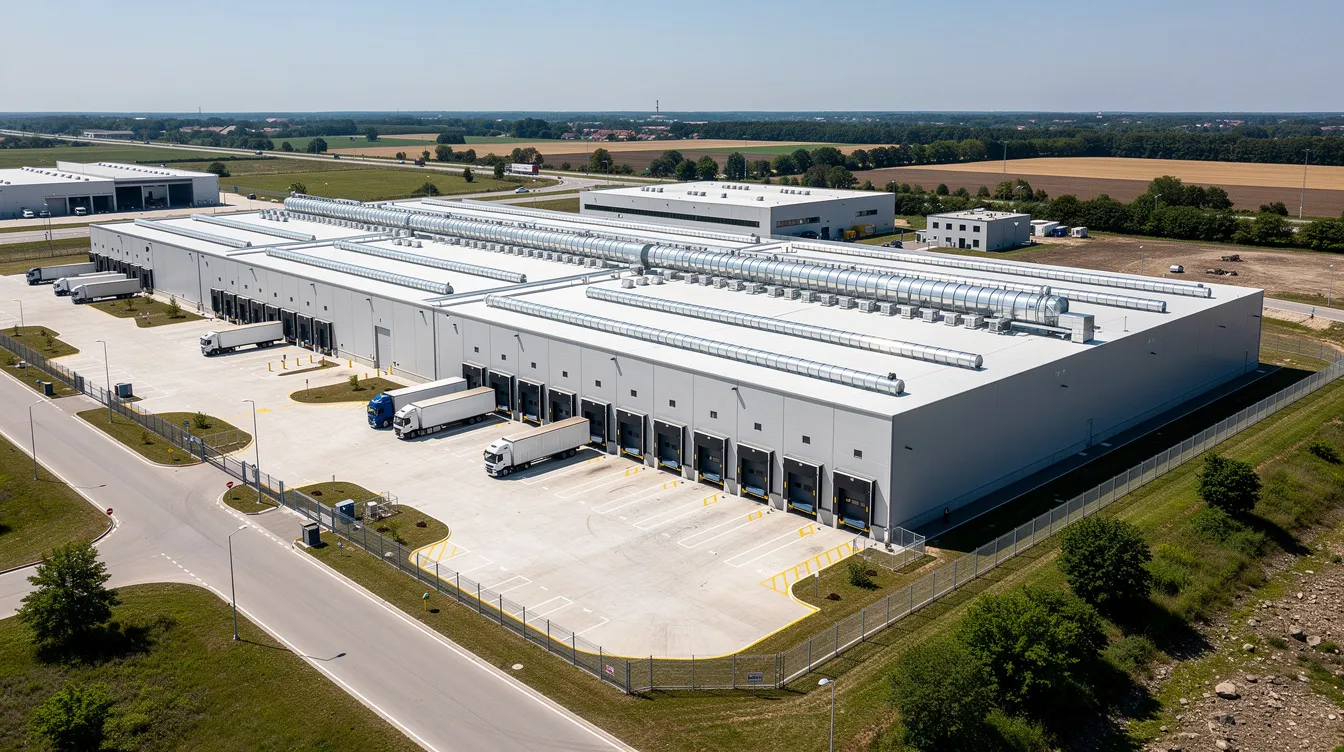
Typical land and building requirements include covered processing sheds, separate godowns for raw and finished food grains, a quality laboratory, compressor and DG-set rooms, staff amenities and an office block. Layout must ensure unidirectional product flow-raw materials entering at one end, finished goods dispatched from the other-to avoid cross-contamination.
For export-grade operations, dust-free zones around the colour sorter machine and automatic packing line are essential. Physical segregation of allergen, organic or special lots may be needed. Rodent and pest control measures, container loading bays and truck docking provisions for export dispatch should be incorporated. The DPR should include a schematic layout drawing prepared specifically for the promoter’s site rather than copied from generic templates.
Export Standards, Food Safety & Regulatory Approvals
An export-quality pulses processing plant is not only about machinery. Quality compliance requires adherence to international food safety standards covering moisture (typically ≤ 12–14%), foreign matter (≤ 1–2%), damaged kernels, colour consistency, size uniformity, pesticide residues, heavy metals, microbial load and packaging integrity. Quality compliance also includes CE marking and ISO 9001 manufacturing standards where applicable to machinery or systems.
Indian regulatory requirements include:
- FSSAI Licensing: Every food business operator, including a pulses processing and packing plant, must obtain a food business licence under the FSS Act, 2006, through the FoSCoS portal.
- IEC: An Importer Exporter Code from DGFT is mandatory for any exporter.
- APEDA RCMC: For pulses falling under APEDA’s scheduled products, exporters apply for the Registration-cum-Membership Certificate through the DGFT portal as per APEDA’s July 2023 notification. Not every buyer mandates APEDA registration, but most organised exporters obtain it.
Export procedures require documentation such as a Commercial Invoice, Certificate of Origin, shipping bill, bill of lading, phytosanitary certificate and, where buyers require, third-party inspection or fumigation certificates. A project report should include assessments of local customs and export regulations relevant to the destination market. Export compliance involves conforming to international quality standards and local regulations simultaneously.
Voluntary but commercially valuable certifications include HACCP, ISO 22000 or FSSC 22000. These are often demanded by large foreign buyers, supermarket chains and businesses worldwide, requiring documented GMP, standard operating procedures and traceability from mandi lot to export consignment.
Plant Setup Cost, Total Investment & Working Capital
Total project cost for an export-grade pulses processing plant in India has three major blocks: fixed capital, pre-operative and contingency expenses, and working capital margin.
| Cost Head | What It Includes | Quantum |
|---|---|---|
| Land and site development | Land acquisition, levelling, compound, drainage | Location-specific |
| Factory building and civil works | Processing shed, godowns, office, lab, amenities | Project-specific (area-driven) |
| Plant and machinery including colour sorter machine and packing line | All process machines, conveyors, bins, compressors | Major component; varies by capacity and automation |
| Electricals and utilities | Transformer, cabling, DG set, compressed air, dust collection | Capacity-driven |
| Pre-operative expenses | Installation, trial runs, travel, professional fees, interest during construction | Typically 5–8% of fixed capital |
| Contingency | Unforeseen cost overruns | 5–10% of fixed capital |
| Working capital margin | Raw material stock, finished goods, receivables, operating expenses | Business model-driven |
Semi-automatic plants use manual bag handling and simple panel controls. Fully automated systems integrate SCADA/PLC automation, automatic bagging and palletising, raising machinery cost but reducing labour and improving consistent production quality. The DPR must model this trade-off explicitly.
Working capital planning depends on raw material stocking strategy (harvest-season bulk buying versus continuous procurement), credit terms to foreign buyers versus advance or LC arrangements, inventory levels of finished pulses awaiting shipment, and packing material requirements. These assumptions flow directly into the CMA Data statement prepared for banks.
Financial Projections, Profitability & Risk Analysis in the DPR
From a Chartered Accountant’s perspective, a bankable DPR for an export-grade pulses processing plant must contain 5–7 year financial projections linked to clearly stated assumptions. A Detailed Project Report should assess the financial viability of the project through transparent, defensible modelling rather than optimistic guesswork.
Key assumptions requiring careful modelling include:
- Annual throughput in tonnes and capacity utilisation ramp-up (realistically 40–50% in year one, 70–80% by year two)
- Processing yield and rejection ratios at each stage of cleaning grading and colour sorting
- Selling price or processing charge per tonne
- Average power, labour, packing and maintenance costs per tonne
- Operating costs driven by raw material consumption, which typically constitutes 88–92% of total OpEx
Financial projections should include a breakdown of costs and expected profit margins. Gross profit margins for pulses processing typically range from 8–12%, depending on whether the plant operates as a merchant exporter or processes on job-work. Financial feasibility analysis includes evaluating cash flow forecasts and return on investment across the projection period.
Core financial metrics in the DPR include projected P&L showing EBITDA, depreciation and interest; Cash Flow statement; term loan repayment schedule; DSCR analysis; break-even capacity utilisation; ROI, IRR and payback period. Risk assessment should identify potential project risks and their mitigation strategies through sensitivity analysis-modelling adverse raw pulse price movements, lower-than-expected utilisation, currency fluctuations and quality rejection scenarios.
The financial model must differ across three archetypes: a merchant exporter bearing price risk, a job-work processing plant with lower inventory but order-flow dependence, and a hybrid model requiring more sophisticated working capital management.
Bank Finance, CMA Data & Preparation of a Bankable DPR
Banks in India assess term loans and working capital for a pulses processing plant project by examining a professionally prepared DPR demonstrating technical feasibility, realistic project cost, means of finance and projected profitability.
A bank-ready export grade pulse cleaning plant project report should contain: project background and promoter profile, detailed description of the processing plant and machinery, plant capacity and utilisation plan, project cost and means of finance, projected financial statements for 5–7 years, DSCR, break-even analysis and risk-mitigation strategies.
CMA Data requirements include projected balance sheets, profit and loss accounts, fund flow statements, working capital assessment, drawing power calculations and MPBF workings. Export projects often require additional documentation: IEC, sample buyer communications, pre-shipment and post-shipment credit structures, and foreign exchange risk policies. Export pricing should be calculated considering local duties and delivery terms.
Project Report Bank, under the guidance of CA Manish Gugliya, provides customised, project-specific DPRs and CMA Data-not generic templates-ensuring that assumptions are transparent and tailored to the promoter’s actual location, scale and business model.
Export Market Opportunities, Commercial Risks & Feasibility Checkpoints
India is a leading exporter of pulses, with key destinations including China, UAE, Bangladesh, United States and Sri Lanka. Demand and market analysis in the project report should identify potential importing regions and their preferred varieties, grades and documentation norms. Each market may require specific quality certifications, labelling and testing. Logistics planning requires explicit shipping terms like CIF or FOB, and tariffs, Incoterms and freight terms must be clearly agreed upon before exporting.
Major commercial risks include:
- Government export-policy changes, sudden restrictions or minimum export prices
- Raw material price volatility-a leading manufacturer or supplier of processed pulses faces this consistently
- Currency fluctuations affecting export realisations
- Quality rejections or claims at destination
- Under-utilisation of plant capacity due to weak or seasonal demand
Investor feasibility checklist:
- Confirm stable raw pulse sourcing from mandis or farmer aggregators
- Test-market with sample exports or domestic institutional buyers
- Obtain technical quotations from multiple equipment suppliers
- Assess power reliability and total connected load requirements
- Evaluate logistics, port connectivity and container freight economics
- Review promoter bandwidth and risk appetite honestly
Promoters should compare the stand-alone export-grade cleaning and sorting project with an integrated multi-pulse processing plant to decide whether adding milling or further value addition is strategically sensible at their scale.
How Project Report Bank Assists Promoters of Export-Grade Pulses Processing Plants
I am CA Manish Gugliya, FCA, DISA (ICAI), a practising Chartered Accountant since 2006 and founder of Manish Gugliya & Company, Chartered Accountants, Ratlam, Madhya Pradesh. My practice specialises in Detailed Project Reports, project finance advisory and feasibility studies for food processing and agro-based projects across India.
For an export-grade pulse cleaning and colour sorting plant, we provide:
- Customised Detailed Project Reports and techno-economic feasibility studies
- Project cost estimation and means-of-finance structuring
- 5–7 year financial projections with sensitivity analysis
- CMA Data preparation and DSCR review
- Bank loan proposal preparation and working capital assessment
- Guidance on capacity choices, semi-automatic vs fully automated processing plant layouts
While this article provides a general framework, final investment decisions should be based on a project-specific DPR, current quotations and updated regulatory checks with authorities like APEDA, FSSAI and DGFT.
Serious promoters and MSME owners planning an export-quality pulses processing and packing plant may connect via the WhatsApp enquiry facility on www.projectreportbank.com for customised DPR and project finance advisory.
Frequently Asked Questions (FAQ)
The following FAQs address practical questions promoters commonly raise while planning an export-grade pulses processing plant. Answers are indicative; detailed figures should be validated through a customised DPR and consultation with relevant regulatory authorities and bankers.
What is the approximate investment range for an export-grade pulse cleaning, colour sorting and packing plant?
Investment varies widely based on plant capacity, level of automation, building standards and location. For MSME-scale projects (2–5 TPH), plant and machinery typically form the largest fixed capital component, with colour sorter machines alone ranging from ₹7–28 lakh and total machinery potentially reaching ₹70 lakh to ₹2–3 crore depending on specifications. Land cost is highly location-dependent, and working capital-driven by raw material inventory-may equal or exceed machinery cost in high-throughput trading models. An APICOL sample DPR for a pulses processing unit (including milling) estimated total project cost at approximately ₹4.83 crore.
Can I set up an export-grade cleaning and packing plant without adding a dal milling section?
Yes. A pulses processing plant focused on export-grade cleaning grading, colour sorting and packing can operate profitably without dehusking or splitting, especially for whole chickpeas, lentils, yellow peas and moong beans. Many exporters prefer to avoid mill-related complexity-including polishing and by-product handling-and instead focus on consistent cleaning and colour sorting quality. This approach keeps the processing plant simpler, reduces food products contamination risk and allows faster commissioning.
Which key machines are essential to achieve export-quality cleaning and colour sorting?
Essential equipment includes a pre-cleaner and vibro cleaner with aspiration, destoner, magnetic separator, multi-deck size grader, gravity separator (where density-based separation is needed for high efficiency), high-precision optical colour sorter machine, metal detector, automatic weighing and bagging system, conveyors and elevators, dust collection system and basic laboratory instruments. Machine capacities across all stages must be matched so no single stage becomes a bottleneck. A wide range of domestic and imported machines is available to suit different capacity and precision requirements.
What determines the working capital requirement for an export-oriented pulses processing plant?
The main drivers are the size and duration of raw material inventory (especially if pulses are stockpiled during harvest season for consistent supply through the year), processing cycle time, credit period given to foreign buyers versus advance payments or LCs, shipping and transit times, and whether the plant operates mainly as job-work (lower inventory need) or owns inventory for export trading (substantially higher inventory). These factors are quantified in CMA Data and directly affect the Maximum Permissible Bank Finance calculation. Consumers of the finished product-whether importers, packers or retailers-may also influence payment terms and therefore working capital.
Can an existing dal mill be upgraded to an export-grade pulse cleaning and colour sorting plant?
Many existing dal mills can indeed be upgraded by adding multi-stage fine cleaning, gravity separation, a modern colour sorting machine, metal detection and improved packing facilities. However, layout changes are often necessary to ensure unidirectional flow, dust-free sorting zones and export-grade warehousing. Additional food-safety measures, pest control infrastructure and compliance documentation (FSSAI, HACCP) may also be required. Promoters considering this route may refer to the Dal Mill Machinery & Equipment Cost guide for comparative planning, while noting that the upgrade scope must be assessed on a case-by-case basis during customised DPR preparation.