India’s organised feed manufacturing sector is expanding rapidly, and the choice of automatic animal feed mill machinery is one of the most consequential technical decisions a project promoter will make. This article provides a structured, investment-oriented guide to machinery selection, plant layout, EPC execution and project cost assessment for medium-to-large-scale automatic feed mills in India.
Key Takeaways
- Automatic animal feed mill machinery encompasses an integrated chain of sub-systems – intake, grinding, batching, mixing, pelleting, cooling and packaging – not a single machine. Total project cost includes land, civil works, utilities, automation, EPC charges and working capital, well beyond machinery price alone.
- Animal feed plants can produce 1–40 tons per hour; industrial plants in India typically range from 2 to 40 TPH, with investments spanning approximately ₹5 crore to ₹100 crore for organised facilities.
- Correct machinery specification and balanced line capacities, supported by a professionally engineered animal feed mill plant layout, are essential to avoid chronic bottlenecks, quality failures and high operating cost.
- A bankable Detailed Project Report (DPR) must evaluate total project cost, DSCR, IRR, sensitivity analysis and risk assessment before machinery is ordered or EPC contracts are signed.
- Serious industrial promoters should engage an independent financial advisory firm for customised feasibility, financial modelling and project finance documentation.
Introduction – Automatic Animal Feed Mill Machinery and Industrial Investment Opportunities in India
India produced approximately 57.7 million tonnes of compound animal feed in 2025, with broiler feed accounting for roughly 20.28 million tonnes and layer feed about 17.63 million tonnes. The poultry feed production industry is rapidly growing in India, and the Indian poultry feed market is expected to grow significantly over the coming decade. Demand for broiler feeds is higher than layer feeds in India, though dairy, aquaculture and other segments contribute meaningfully to overall volumes.
The organised feed manufacturing segment is growing at 6–8% annually, driven by increasing meat, egg and milk consumption, improved biosecurity requirements and a decisive shift from on-farm loose mixing to scientifically compounded cattle feed, chicken feed and fish feed. Fish feed is designed for optimal growth in aquaculture, and animal feed includes poultry, cattle and fish feed across various types of formulations and product forms.
Automation – PLC/SCADA-based batching, automatic cattle feed systems, bulk material handling and inline weighing – improves consistency, throughput, traceability and manpower productivity compared to semi-automatic or manual feed mill setups. For industrial investors, the choice of automatic feed mill equipment directly affects CAPEX, OPEX, break-even capacity and long-term competitiveness.
Project Report Bank is a Chartered Accountant–led project finance advisory firm, headed by CA Manish Gugliya (FCA, DISA, ICAI, with over 20 years of professional experience). This article is designed for promoters already evaluating machinery suppliers and turnkey EPC contractors. For broader project economics and market analysis, refer to the Integrated Animal Feed Mill Project Report.
Types of Automatic Animal Feed Manufacturing Plants
The term “animal feed mill” covers a wide range of configurations. Machinery selection changes significantly by target species, final product form and automation level.
Automatic cattle feed manufacturing plants typically handle fibre-rich raw materials such as grains, forage, bran and oilseed cakes. Cattle feed production often uses grains and forage materials, and output may be in mash or pellet form. These plants serve dairy cooperatives, private dairies and direct farm sales. For detailed cattle feed economics, see the Industrial Cattle Feed Manufacturing Plant Project Report.
Automatic poultry feed manufacturing plants focus on broiler and layer formulations (starter, grower, finisher) with higher protein and energy density, fine grinding requirements and strong emphasis on pelleting. Poultry feed can be produced in mash or pellet form, and ring die pellet mills are preferred for commercial poultry feed production. For poultry-specific project planning, refer to the Poultry Feed Manufacturing Plant Project Report.
Multi-species compound feed mills produce cattle feed, chicken feed and sometimes sheep, pig or buffalo feed from a shared grinding–mixing–pelleting backbone with recipe-based batching and changeover protocols. Integrated mini-feed plants provide an end-to-end processing line suitable for regional multi-species operations.
Animal feed can be processed into pellets for easier consumption by livestock. Mash feed plants avoid pelleting entirely, requiring simpler machinery (no pellet mill, cooler or crumbler) and lower capital intensity. Crumble feed units add a crumbling step after pelleting, preferred for chicks and some aquaculture starters.
| Plant Type | Product Form | Major Machinery Blocs | Automation Level | Capital Intensity | Target Customers |
|---|---|---|---|---|---|
| Cattle feed (mash) | Mash | Grinder, mixer, bagger | Low–Medium | Low | Dairies, cooperatives |
| Cattle feed (pellet) | Pellet | Grinder, mixer, pellet mill, cooler, bagger | Medium–High | Medium | Private dairies, retail |
| Poultry feed | Pellet / Crumble | Grinder, mixer, pellet mill, cooler, crumbler, bagger | High | High | Integrators, hatcheries |
| Multi-species compound | Mash / Pellet | Full line with recipe management | High | High | Large feed companies |
| Aqua / fish feed | Sinking fish feed pellet / extruded | Extruder or pellet mill, dryer, cooler | High | High | Aquaculture farms |
Automatic Animal Feed Mill Machinery – Complete Equipment List
A modern automatic feed mill is a sequence of sub-systems rather than a single cattle feed pellet machine or poultry feed machine. Animal feed plants include grinders, mixers and pelletizers working together in a balanced production line.
Raw material receiving and storage: Truck unloading pits, chain/belt conveyors, bucket elevators, grain and ingredient silos for raw material storage, bag dumping stations, pre-cleaners, de-stoners and magnetic separators. Selection depends on throughput (TPH), bulk density of materials and required safety margin.
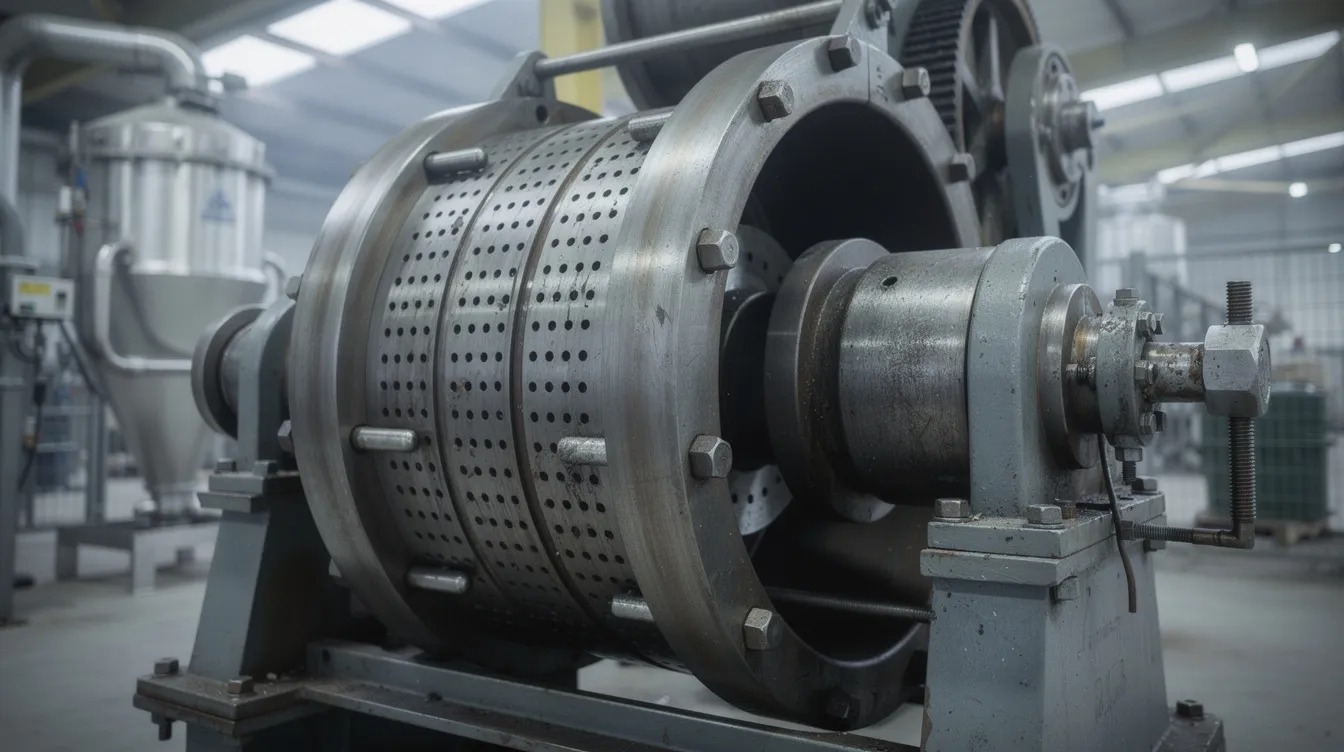
Grinding section: Cattle feed grinder machines crush feed raw materials to a target particle size. Hammer mills range from 15 to 200 HP. For poultry feed, particle size below 700 microns is typical. Aspiration systems, dust collection and explosion vents are critical for safety and fire protection.
Batching and dosing: Automatic batching bins with screw/slide gates, load-cell-based weigh hoppers, micro-dosing systems for vitamins and mineral premixes, and PLC-based recipe management. Accuracy targets are typically ±0.5–1% for macro ingredients, tighter for micro-dosing.
Mixing: Feed mixers ensure uniformity in feed mixtures for animals. Ribbon mixers and paddle mixers with batch sizes of 500–2,000 kg achieve the required coefficient of variation (CV should be below ±5% for quality feed). Liquid addition points for fat and molasses are common.
Conditioning and pelletisation: Steam conditioners heat and moisten the mash before the ring-die pellet press. Pellet machines extrude feed into small pellets for livestock. Machine motor power for pellet mills ranges from 100 HP (1 TPH) to 300+ HP (5 TPH and above). The moisture content for smooth pelletizing should be between 12% to 18%.
Cooling and crumbling: Counterflow coolers sized to match pellet flow, pellet crumblers with adjustable gap for chick-size crumble, vibrating screens for fines and oversize removal, and recirculation of fines back to the pellet mill.
Finished product and packaging: Surge bins, automatic bagging machines (10–50 kg bags), electronic weighers, bag closers, conveyors and palletisers. Bulk truck loading arrangements apply for larger dispatch volumes.
Utilities: Boiler or steam generator, air compressors, MCC panels with VFDs, LT substation, DG set, SCADA/PLC hardware, dust extraction systems, fire detection and suppression, and QA/QC lab equipment.
| Machinery | Function | Capacity Selection Basis | Automation Level | Cost Drivers | Technical Considerations |
|---|---|---|---|---|---|
| Hammer mill | Grinding maize, soybean meal, etc. | Target TPH, particle size | Medium–High | Motor kW, screen type | Energy consumption, dust control |
| Feed mixer | Uniform blending of ingredients | Batch size, cycle time | High | Drive power, material of construction | CV target, cleanout for recipe change |
| Ring-die pellet mill | Pelleting conditioned mash | TPH at given formula | High | Die metallurgy, motor power | Die life, compression ratio, steam quality |
| Counterflow cooler | Cooling hot pellets | TPH of pellet flow | Medium | Airflow, fan sizing | Outlet temp vs ambient, moisture removal |
| Automatic bagger | Filling and sealing bags | Bags per hour | High | Weighing accuracy, speed | Bag size range, integration with conveyor |
| Boiler | Steam for conditioning | Max simultaneous demand | Medium | Fuel type, capacity | Water treatment, pressure, efficiency |
Automatic Animal Feed Manufacturing Process Flow
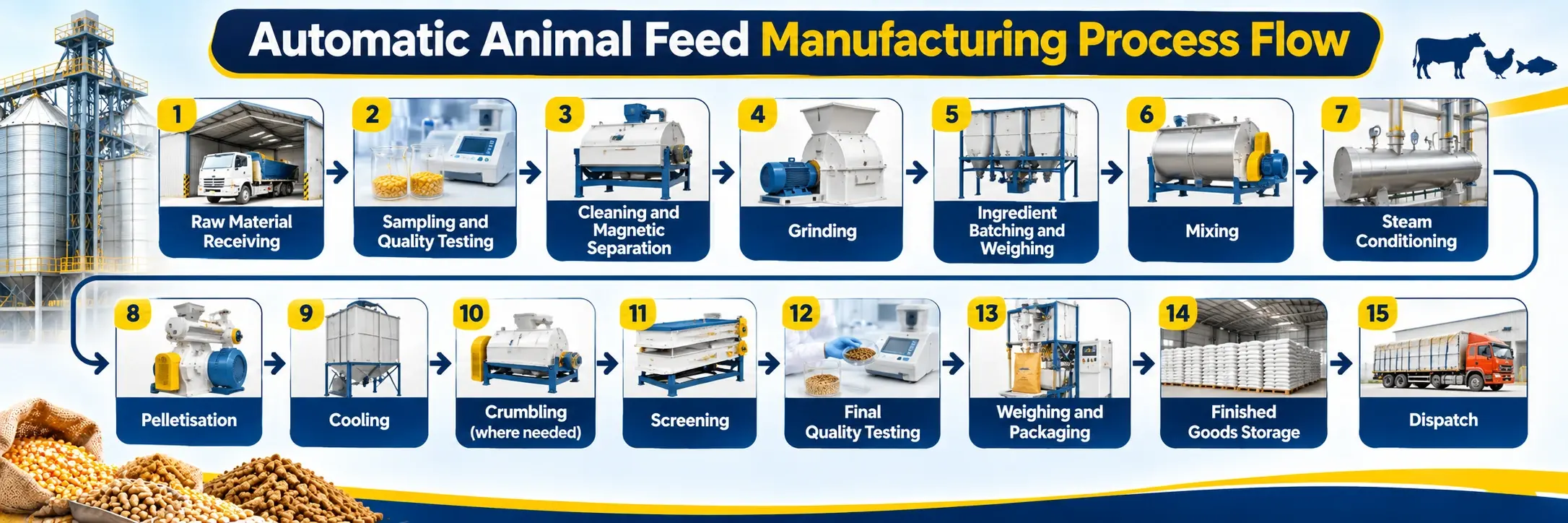
The full processing chain follows this sequence: Raw Material Receiving → Sampling and Quality Testing → Cleaning and Magnetic Separation → Grinding → Ingredient Batching and Weighing → Mixing → Steam Conditioning → Pelletisation → Cooling → Crumbling (where needed) → Screening → Final Quality Testing → Weighing and Packaging → Finished Goods Storage → Dispatch.
For simple mash cattle feed, the process bypasses steam conditioning, pelletisation, cooling and crumbling, reducing machinery requirements, power load and animal feed mill plant setup cost substantially.
Material handling uses bucket elevators, gravity spouts and conveyors to ensure forward movement and minimal cross-contamination between recipes. Quality assurance steps include raw material sampling, online moisture checks, mixer uniformity verification, pellet durability index (PDI) tests and finished feed lab analysis against applicable Indian Standards.
Key efficiency drivers include grinding energy per tonne (typically 9–11 kWh/tonne for efficient ring-die pellet mills operating at higher capacities, per NDDB operational guidelines), mixer batch cycle time, steam quality and conditioning temperature, pellet mill load versus rated capacity, and cooler airflow relative to ambient conditions. These variables directly translate into operating cost per tonne.
Capacity-Wise Automatic Animal Feed Mill Machinery Selection
Common industrial capacity bands in India span from 2 TPH to above 20 TPH. Workable production scales for poultry feed mills range from 100 kg to 1,000 kg per hour at the smaller end, while automatic cattle feed plants can produce 2 tons per hour and above. Production capacity should align with livestock type and daily output goals.
2–5 TPH: Single hammer mill, one mixer, one pellet line, simple raw material storage, semi-automatic bagging, limited automation. A mix of compact equipment is suitable for small-scale feed production at this band. Suited for regional cattle feed and poultry feed brands.
5–10 TPH: Higher silo capacity, possibly two grinding lines or one larger hammer mill with surge bins, automatic batching, PLC-based recipe control and higher-speed bagging machines to avoid dispatch bottlenecks.
10–20 TPH: Multiple production lines, separate grinding for poultry and cattle feed, robust dust control, provision for bulk loading. Animal feed plants require larger equipment for higher outputs, with significant scaling in power and steam systems.
Above 20 TPH: Vertical layouts, gravity-based material flow, large bulk silos, advanced SCADA, rail or port logistics for raw materials, and continuous multi-shift operation.
Annual production calculation example: Effective annual production = Rated TPH × effective operating hours per day × working days per year × realistic utilisation (70–80%) minus planned downtime. Each section’s equipment must be balanced – oversized pellet mills paired with undersized grinders create chronic bottlenecks.
| Capacity Band | Typical Configuration | No. of Lines | Electrical Load Trend | Steam Requirement | Manpower Profile | Typical Customer |
|---|---|---|---|---|---|---|
| 2–5 TPH | Single line, basic automation | 1 | 200–400 kW | Low–Moderate | 15–25 | Regional brands |
| 5–10 TPH | Single/dual grind, PLC batching | 1–2 | 400–800 kW | Moderate | 25–40 | State-level brands |
| 10–20 TPH | Multiple lines, advanced control | 2–3 | 800–1,500 kW | High | 40–60 | Integrators, cooperatives |
| >20 TPH | Multi-line, vertical, SCADA | 3+ | 1,500+ kW | Very High | 60+ | Corporates, large cooperatives |
Automatic Feed Mill Equipment – Technical Specifications and Selection Criteria
For serious investors, model numbers matter less than understanding key specification parameters: kW rating, TPH at a given formula, achievable particle size, mixing CV, conditioning time and automation features. Raw material factors – typical moisture range for maize, bran and oilseed cakes – directly influence grinder type, screen size, energy consumption and pellet quality.
Pellet mill selection hinges on installed kW per expected TPH, die hole size, L/D compression ratio, feeder design, steam injection points, and conditioning temperature and time needed for good pellet durability with minimal fines. Pellet durability index (PDI) should ideally exceed 95–97% for commercial feed streams.
Automation architecture – central PLC, distributed I/O, SCADA, remote monitoring, recipe management and batch reporting – affects both CAPEX and running cost. The importance of vendor-guaranteed performance data (TPH at specific formula, kWh/tonne, steam consumption per tonne) cannot be overstated. Project Report Bank uses such data when building financial models and sensitivity scenarios for DPRs.
Animal Feed Mill Plant Layout – Industrial Planning and Space Requirements
The animal feed mill plant layout determines material flow efficiency, safety, expansion flexibility and civil cost per tonne. Poor layout leads to excessive conveying, higher power consumption, cross-contamination risks and operational congestion.
External logistics planning covers truck entry, weighbridge, unloading areas and separation of raw material and finished goods traffic. Internal zones include raw material silos and warehouses, pre-cleaning and grinding sections, batching and mixing floors, pelletisation and cooling towers, bagging halls, boiler house, compressor room, DG yard, water storage and QC laboratory.
Vertical (multi-storey tower) layouts leverage gravity flow and are common in larger, more automatic plants. Horizontal (spread-out, low-rise) layouts are simpler but require more conveyors. Environmental and safety design includes dust extraction ducting, bag filters at transfer points, explosion relief panels near hammer mills, fire-fighting ring mains and emergency vehicle access.
Actual land size and building area must be designed case by case based on capacity, silo philosophy, utilities, local zoning and engineering design. A 5 TPH plant and a 20 TPH plant differ by orders of magnitude in land and infrastructure requirements.
| Zone | Main Functions | Key Layout Considerations |
|---|---|---|
| Raw material intake | Truck unloading, weighbridge | Vehicle circulation, pre-cleaning dust |
| Silo farm / warehouse | Grain, cake, additive storage | Bulk density, turnover, fumigation access |
| Grinding and batching | Size reduction, weighing | Noise, dust, explosion protection |
| Mixing and conditioning | Blending, steam treatment | Elevation for gravity to pellet mill |
| Pelletisation and cooling | Pelleting, cooling, screening | Heat exhaust, fines recirculation |
| Bagging and dispatch | Packing, palletising, truck loading | Traffic flow, weather protection |
| Utilities | Boiler, compressor, DG, electrical | Access for fuel, maintenance, noise buffer |
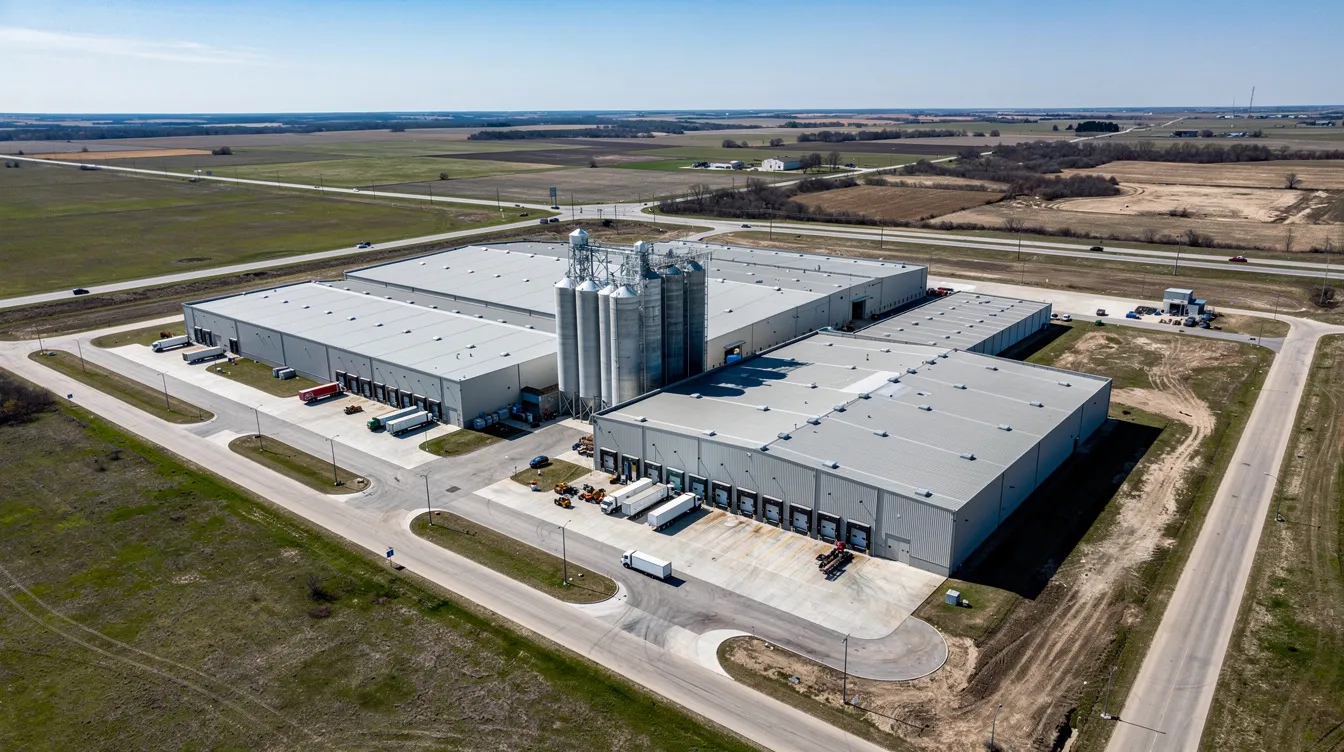
Animal Feed Mill Plant Setup Cost in India
Animal feed production costs include land, equipment and labor – and machinery cost alone is never the full picture. Land and construction costs significantly affect animal feed plant expenses. Equipment costs for animal feed plants vary by type and automation level. Production capacity affects investment costs significantly.
Animal feed manufacturing plant costs range from $10,000 to $850,000 depending on scale and automation. Establishing a 1 ton per hour poultry feed production line costs about $14,000 to $15,000, while a 2–3 ton per hour poultry feed production plant costs approximately $65,000. At the Indian domestic level, a 2 ton per hour cattle feed plant costs approximately ₹999,999, a 500 kg per hour poultry feed plant is available for approximately ₹16,00,000, and a 5 TPH cattle feed plant costs around ₹65,00,000 – these are equipment price benchmarks and do not represent total installed project cost.
Total project cost includes fixed assets plus working capital margin, contingencies and pre-operative expenses (interest during construction, establishment charges, loan processing fees and technical consultancy). Serious promoters should always obtain current vendor quotations and civil cost estimates based on local rates and site conditions.
| CAPEX Component | 2–5 TPH (% Share) | 5–10 TPH (% Share) | 10–20 TPH (% Share) |
|---|---|---|---|
| Process and packaging machinery | 35–45% | 35–45% | 35–50% |
| Civil works and buildings | 20–30% | 18–25% | 15–22% |
| Utilities (boiler, compressor, etc.) | 6–10% | 6–10% | 5–10% |
| Electricals and automation | 8–12% | 8–14% | 10–15% |
| Material handling and silos | 8–12% | 10–15% | 10–18% |
| Pre-operative, contingency, misc. | 8–15% | 8–12% | 8–12% |
Project Report Bank uses vendor quotes, recent executed project benchmarks and item-wise costing to build realistic project budgets for bankable DPRs, not generic thumb rules. For a detailed pellet-specific cost assessment, see the Automatic Feed Pellet Manufacturing Plant Project Report.
Animal Feed Mill EPC Cost in India – Turnkey Project Execution
Engineering, Procurement and Construction (EPC) for an animal feed mill means a single principal contractor takes responsibility for design, engineering, procurement of automatic feed mill equipment, erection, commissioning and performance trials. EPC scope typically covers basic engineering (process flow, mass balance), detailed engineering, civil and structural works, mechanical erection, electrical and instrumentation, automation programming, commissioning, trial production and operator training.
Typical project duration for a 5–10 TPH plant is 12–16 months from requirement definition through commissioning. Risks of delay include late regulatory approvals, vendor slippage and civil work holdups.
| Approach | Cost Transparency | Coordination Effort | Schedule Risk | Performance Guarantee | Promoter Involvement |
|---|---|---|---|---|---|
| Full turnkey EPC (LSTK) | Moderate – fixed price but exclusions apply | Low for promoter | Lower (single responsibility) | Single-point guarantee | Lower |
| Multiple specialist suppliers | Higher – item-wise pricing | Very high for promoter | Higher (interface risks) | Split across vendors | Very high |
| Hybrid (OEM machinery + local EPC) | Moderate | Moderate | Moderate | Split but manageable | Moderate |
Animal feed mill EPC cost in India for a 10 TPH fully automatic poultry feed mill (equipment only) can range from USD 1.2–2.5 million; total EPC project cost with buildings, silos and handling systems is often nearly double the equipment cost. Project Report Bank helps promoters evaluate EPC proposals, understand exclusions and assess the financial impact of alternative structures on DSCR and IRR.
Machinery Supplier and EPC Contractor Selection in India
Selecting machinery suppliers and EPC partners for automatic animal feed mill machinery requires focus on proven industrial references rather than lowest quotes alone. Key evaluation criteria include number and scale of similar running plants in India, client references in cattle feed and poultry feed, in-house process engineering capability, local service team availability and track record of on-time completion. A leading manufacturer should be able to demonstrate guaranteed throughput, power and steam consumption per tonne, PDI targets and maximum dust emission levels.
Contractual aspects to negotiate include payment milestones linked to engineering, dispatch, erection and performance testing, warranty duration, spare parts stocking and operator training. Project Report Bank assists by preparing structured technical RFQs, consolidating offers and comparing total delivered and installed cost rather than just ex-works equipment price.
Power, Steam, Water and Utility Requirements
Utilities must be engineered from the selected process configuration, not guessed. Major power consumers include hammer mills, pellet mills (where machine motor power can range from 110 kW to 355 kW per unit), mixers, coolers, conveyors, compressors and boiler auxiliaries. Connected load, maximum demand and energy consumption (kWh per tonne) are estimated from machinery data sheets and diversity factors. Transformer and DG sizing must match.
Steam serves conditioning and pelleting. Boiler capacity is sized on maximum simultaneous demand, operating pressure (typically 3–4 bar) and feed water quality. Water requirements cover boiler feed, equipment washing, dust suppression, domestic use and firefighting storage. Electricity tariffs and reliability vary by state; power factor correction and VFDs on large motors can deliver meaningful energy savings. Project Report Bank uses vendor-stated utility consumption figures in financial models to compute realistic power and fuel expenses.
Factory Approvals, Feed Quality Standards and Regulatory Requirements
Compliance requirements differ by state and product profile. Typical approvals include factory registration under the Factories Act, building plan and fire NOC, State Pollution Control Board consent, boiler registration (where applicable) and electrical safety permissions.
Feed quality and safety standards include BIS specifications such as IS 2052 for compounded cattle feed, IS 1374 for poultry feed, IS 1664 for mineral mixtures and IS 5470 for feed-grade dicalcium phosphate. The Animal Feeds and Feed Ingredients (Quality Control) Order, 2026 mandates BIS certification for mineral mixtures and certain feed ingredients from April–October 2027 depending on unit size.
FSSAI licensing may not be mandatory for every category of animal feed – the Delhi High Court ruled in April 2026 that animal feed is not food under FSSA. Promoters must verify current product-specific and jurisdiction-specific rules. Labour and occupational safety regulations covering machinery guarding, dust explosion protection and emergency provisions also apply.
Operating Costs and Production Economics of Automatic Feed Mills
Feed plants are raw-material intensive. The cost of raw materials affects animal feed production expenses, with maize, broken rice, soybean meal, bran and oilseed cakes forming 80–90% of total cost per kilogram. Variable cost heads per tonne include raw materials, vitamins and mineral premixes, packaging materials, power (kWh per tonne), fuel for boiler, water and production labour.
Fixed and semi-fixed costs – managerial salaries, insurance, repairs and maintenance, QA/QC lab costs, depreciation and interest – spread per tonne based on actual utilisation, making higher capacity utilisation a direct lever for low production cost.
Feed formulation cost is calculated from inclusion rates of each ingredient and current market prices. Gross manufacturing margin (ex-factory selling price minus variable production cost) differs from EBITDA margin (after fixed operating costs) and net profit. Profitability is highly market- and efficiency-dependent, and Project Report Bank models scenarios with fluctuating maize and soy prices through sensitivity analysis.
Financial Feasibility, Bank Loan and DPR Requirements
A technically sound feed plant can still fail financially if capacity, debt level, selling price assumptions or working capital are misjudged. Project feasibility studies evaluate the economic viability of proposed projects before capital is committed. Detailed Project Reports are essential for securing bank loans and investor funding, and financial modelling is crucial for determining project feasibility and profitability. Financial projections vary based on production scale and equipment type.
Core DPR components for an automatic animal feed mill include project description, market analysis, technical configuration, project cost estimates, means of finance and implementation schedule. Financial projections cover P&L, balance sheet and cash flow for 7–10 years with assumptions on capacity ramp-up (for example, 50–70–80% utilisation), selling prices, raw material cost trends, conversion cost and overheads.
| Financial Parameter | Description |
|---|---|
| Project Cost | Total fixed investment + pre-operative expenses + working capital margin |
| Means of Finance | Promoter equity contribution + term loan + any subsidy or grant |
| Debt–Equity Ratio | Typically 1.5:1 to 2:1, depending on lender norms |
| DSCR (Year-wise) | Cash available for debt service ÷ debt obligations; target >1.25–1.50 |
| Project IRR / Equity IRR | Internal rate of return on total investment and on equity |
| Break-even Capacity | Utilisation at which revenue covers all costs |
| Sensitivity Analysis | Impact of raw material price change, sales shortfall, interest rate change |
| Payback Period | Time to recover initial investment from net cash flow |
CMA data preparation, drawing power calculations on stocks and receivables, and compliance with Indian bank appraisal formats are integral to the financing process. For a cattle feed–specific Cattle Feed Project Report, promoters can explore dedicated advisory from Project Report Bank.
Planning a feed mill project? Share your basic details – location, capacity band, product mix, estimated investment and financing requirement – with Project Report Bank for a customised DPR and bank loan proposal.
Common Mistakes in Automatic Animal Feed Mill Project Planning
Many issues encountered in bank appraisals are not due to poor machinery but due to weak planning, unbalanced assumptions and underestimation of working capital and utilities.
Machinery-related mistakes: Buying oversized or undersized pellet mills without full line balancing, ignoring dust control and explosion safety, over-automation beyond economic justification for the chosen market size, and under-investing in quality control labs.
Layout and infrastructure mistakes: Poor separation of clean and dusty zones, cramped warehouses, no clear truck circulation, no provision for expansion, or under-sized boiler and transformer.
Financial planning errors: Assuming unrealistic sales volumes, underestimating working capital for raw materials and receivables, and relying on optimistic selling prices without accounting for competition and integrator contract pricing pressures.
Execution mistakes: Awarding EPC contracts without structured technical RFQs, not clarifying exclusions, ordering machinery before bank sanction, and failing to maintain contingency for cost overruns or delays.
The commercial consequences include higher unit cost, quality complaints, cash-flow stress, difficulty in servicing loans and inability to meet performance guarantees. A rigorous DPR and feasibility analysis helps avoid these pitfalls.
How ProjectReportBank.com Supports Industrial Feed Mill Investments
Project Report Bank is a Chartered Accountant–led specialist in industrial DPRs, financial modelling and feasibility for automatic animal feed mills, with specific experience across cattle feed, poultry feed and feed concentrate projects.
Advisory services include customised DPR preparation, techno-economic feasibility studies, capacity planning, animal feed mill plant setup cost assessment, item-wise project costing based on vendor inputs, multi-scenario financial projections, DSCR and IRR analysis, sensitivity testing, working capital assessment, loan structuring, CMA data preparation, bankable term loan proposals and investor-ready documentation.
Project Report Bank is independent of machinery brands and EPC contractors and does not sell automatic animal feed mill machinery. This independence helps in objective comparison of competing technical and commercial offers. For related upstream investment opportunities, see the Maize Feed Ingredient Processing Plant Project Report and the Grain-Based DDGS Processing Plant Project Report.

Frequently Asked Questions
What machinery is required for an automatic animal feed mill?
A complete automatic feed mill requires raw material intake and handling systems, hammer mills for grinding, automatic batching and dosing equipment, ribbon or paddle mixers, steam conditioners, ring-die pellet presses, counterflow coolers, crumblers (optional), vibratory screens, automatic bagging machines, boilers, compressed air systems, electrical panels and PLC/SCADA-based automation. The exact configuration depends on feed type, product form and plant capacity.
What is the cost of setting up an automatic animal feed mill in India?
Animal feed manufacturing plant costs range from $10,000 to $850,000 for equipment alone, depending on scale and automation. Total project cost – including land, civil works, utilities, automation, installation, pre-operative expenses and working capital – can range from approximately ₹5 crore for a small 2–5 TPH unit to ₹50–100 crore for large integrated facilities. Actual cost depends entirely on project-specific engineering, location and vendor selection.
How does machinery cost change between 5 TPH and 10 TPH plants?
A 10 TPH feed production plant is typically not double the cost of a 5 TPH plant. Economies of scale reduce the per-tonne share of civil works, utilities and automation. However, higher-capacity plants require proportionally larger pellet mills, storage, electrical infrastructure and steam systems, so the cost advantage is partial, not linear.
How much working capital is required for an industrial feed mill?
Feed mills are raw-material intensive with significant working capital needs. Maize, soybean meal and other ingredients must be stocked before output is sold. Credit periods to dealers or integrators can stretch 30–90 days. Working capital assessment in a DPR should be based on realistic inventory holding periods, receivable days, creditor terms and operating expenses – not a flat percentage of sales.
Why is a feasibility study important before ordering machinery?
A feasibility study evaluates whether the proposed capacity, location, product mix and financing structure can deliver adequate returns and debt-servicing capacity. Ordering machinery before this analysis risks mismatched capacity, under-funded projects, unviable economics or loan rejection. A professionally prepared DPR ensures that technical choices and financial projections are aligned and defensible before large commitments are made.
Conclusion – Planning an Automatic Animal Feed Mill with Technical and Financial Discipline
The success of an automatic animal feed mill depends on correct machinery configuration, balanced plant capacity, efficient animal feed mill plant layout, realistic animal feed mill EPC cost in India, disciplined operating cost management and bankable financial planning. None of these elements operate in isolation. A well-specified pellet mill paired with an undersized grinder, or a strong technical setup funded by an unrealistic debt structure, can both lead to the same outcome – a project that underperforms.
Upfront DPR and feasibility work helps promoters select appropriate capacity, balance equipment, verify total project cost including working capital, and test sensitivities before signing large cheques with machinery suppliers or EPC contractors.
Planning an Automatic Animal Feed Mill Project in India?
Contact ProjectReportBank.com for an industrial DPR, project cost assessment, financial projections, techno-economic feasibility study and project finance documentation. Share your planned capacity, project location, product mix, approximate investment and financing requirement through WhatsApp for a preliminary discussion.
Project Report Bank sits on the promoter’s side of the table – independent of machinery supply and EPC contracts, focused entirely on helping you make a sound investment decision. India’s growing organised livestock and poultry sectors present a genuine opportunity, and professionally planned automatic feed mills are well positioned to capture it responsibly and profitably.
CA Manish Gugliya FCA, DISA (ICAI) More than 20 years of professional experience in project reports, financial projections, CMA data, project finance and business advisory.