
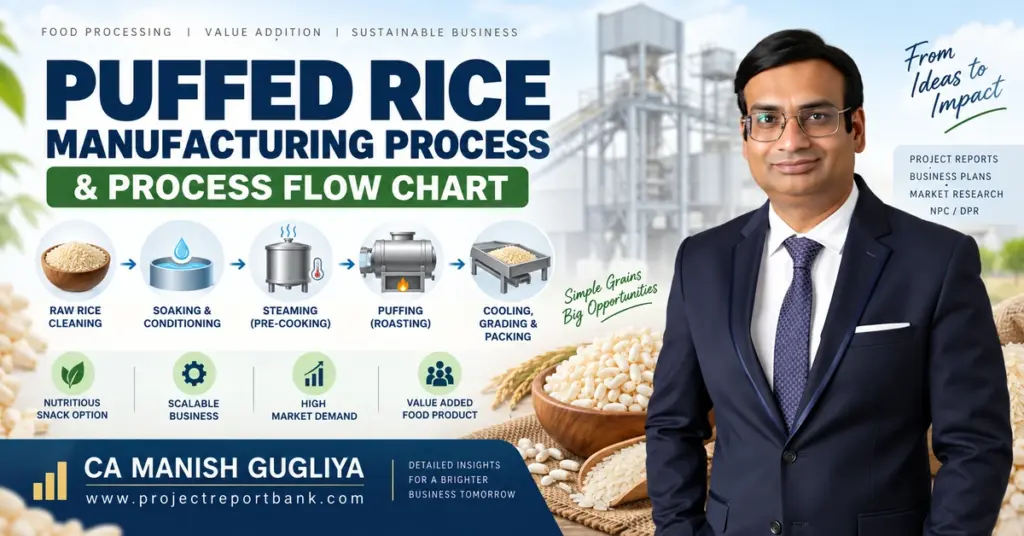
Key Takeaways
- Commercial puffed rice (murmura) is manufactured from specially conditioned parboiled rice or paddy, where moisture control and rapid heating form the core of the puffed rice manufacturing process.
- Two main industrial routes exist in India – starting from raw paddy (with in-house parboiling and milling) or from already milled rice – and the choice directly affects machinery, layout and project cost.
- Each process stage – cleaning, soaking, parboiling, drying, roasting, puffing, cooling, grading and packaging – has specific equipment, critical control points and typical losses that must be understood before preparing a DPR.
- A clear process flow chart for both paddy-based and rice-based plants helps entrepreneurs and bankers quickly understand the complete manufacturing sequence.
- Plant capacity, power and fuel requirement, yields, recovery percentage and finished product quality must be validated with actual trials or supplier guarantees before finalising the project report.
Overview of Puffed Rice Manufacturing Process in India
Puffed rice – known as murmura in Hindi and mamra in Gujarati – is a low-density, ready to eat product obtained by the rapid expansion of conditioned rice kernels. The grain is heated so quickly that its internal moisture converts to steam, building pressure within the starch structure and causing it to expand into a crisp, lightweight product. Across the Indian subcontinent and in parts of South Asia and Southeast Asia, puffed rice is a staple food in states like Bihar, Odisha and West Bengal, consumed daily as a breakfast cereal, as street food in bhel puri and other chaat preparations, and offered as prasad in temples. Its popularity as an Indian traditional food extends beyond India – in Taiwan, puffed rice gained popularity in the 1950s and 1960s as a widely consumed snack.
The puffed rice manufacturing process in India is a sequence of controlled operations: raw material preparation, moisture conditioning, hydrothermal treatment (where adopted), drying, roasting and puffing, cooling, grading and packaging. The production methods for puffed rice vary from traditional cottage industries to industrial plants. Commercial murmura manufacturing differs from the traditional small-batch approach – where a vendor roasts rice in hot sand or hot salt on a pan – by introducing process control, higher throughput, better hygiene and consistent product quality.
Two broad raw-material routes are followed across Indian plants. Some units start with raw paddy and integrate parboiling plus milling within the same facility, while others buy suitable parboiled rice from rice mills and handle only final conditioning, puffing and packaging. The choice between these routes depends on raw material availability, investment appetite, technology preference and target market. This article covers the technical process details that promoters, bankers and consultants require before preparing a puffed rice plant DPR.
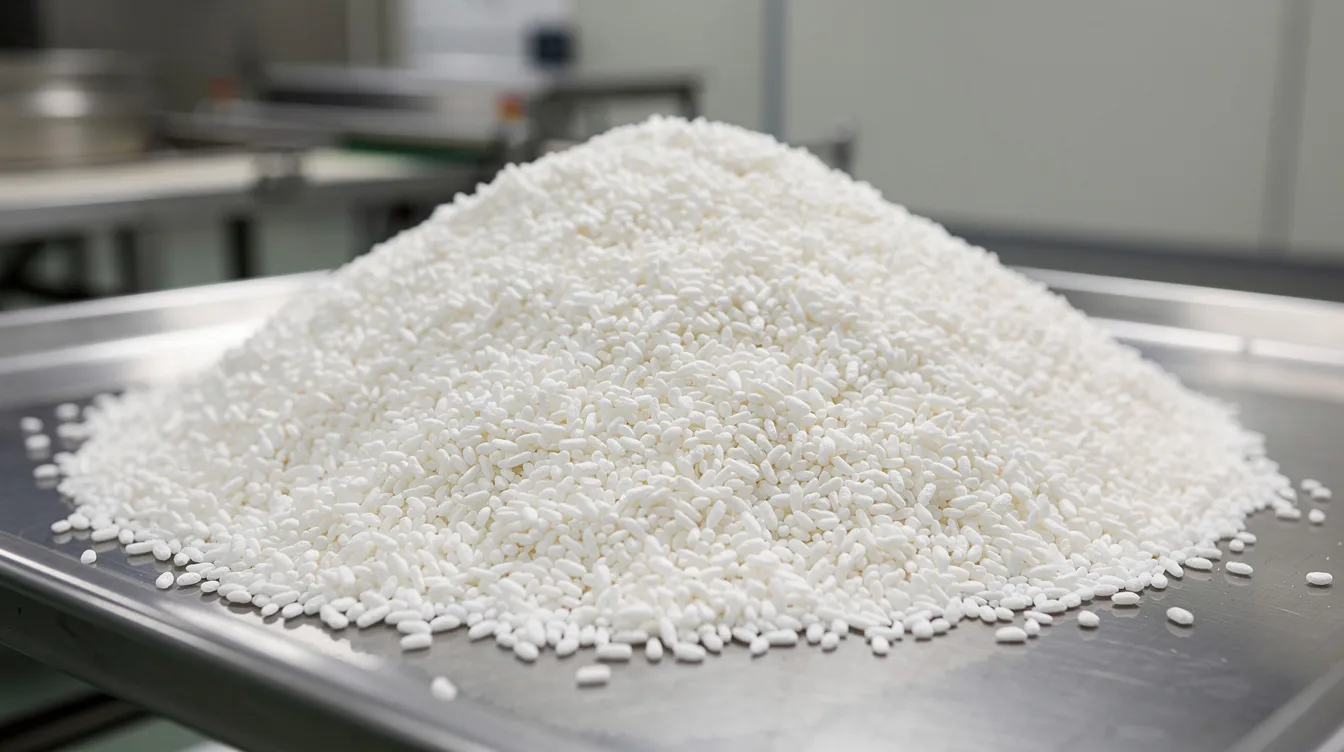
Raw Material for Puffed Rice / Murmura Manufacturing
Puffed rice is made from parboiled rice in most commercial systems. The unit may either procure raw paddy and convert it into parboiled rice in-house, or buy suitable parboiled or raw rice from nearby rice mills. Parboiled rice is preferred because its pre-gelatinised starch structure supports better expansion and kernel integrity during the high temperature puffing step. In fact, parboiled rice is also considered best for home frying due to this same pre-gelatinised starch characteristic.
Desirable rice characteristics for puffing include medium to long slender grain with uniform size, sound kernels, a low percentage of chalky grains and minimal broken rice. Studies indicate that varieties with an amylose content of approximately 27–30% and moderate starch viscosity tend to produce better expansion ratios. Regular rice with high breakage, weather damage, mould or insect infestation should be rejected – such stocks affect puffing behaviour and compromise food safety.
The moisture content of incoming rice typically falls in the low teens (around 13–15% wet basis), though the exact requirement varies by variety and puffing technology. Consistent moisture across the lot is more important than hitting a single target number, because variation within a batch causes some grains to under-puff while others burn.
Auxiliary materials depend on the puffing technology adopted. Traditional roasting systems use clean sand or salt as a heat-transfer medium, while some units use hot oil for specific product variants. Seasoning materials – salt, spices, sugar and edible oil – are relevant only if value-added flavoured products are planned. Essential packaging materials include food-grade LDPE/PP or laminated pouches for retail packs, HDPE bags or liners for bulk murmura, and cartons or BOPP tape for secondary packaging. Promoters should align their raw-material plan with the chosen rice puffing technology and may find useful parallels in paddy procurement planning for poha plants.
Raw Material Receipt, Inspection, Cleaning and Grading
Upon receipt, paddy or rice is weighed on a weighbridge or platform scale, visually inspected and sampled for moisture measurement. Samples are checked for husk, stones, foreign seeds and insect damage. Moisture is typically verified using an oven method or a calibrated grain moisture meter.
Pre-cleaning uses rotary or vibratory cleaners to remove dust, husk pieces, chaff and light impurities. Gravity destoners then separate stones, glass and heavy foreign materials that can damage downstream machinery and contaminate the finished product. In-line magnets are installed where metallic contamination risk exists, particularly before milling, roasting and puffing machines.
Grading by length and thickness – using rotary or plan-sifter-type graders – produces a uniform grain-size fraction. Uniform size is a prerequisite for uniform puffing; mixed sizes lead to some grains burning while others remain hard. Higher levels of broken rice increase fines, burnt specks and dust in puffed rice, directly lowering marketable yield and price realisation.
Paddy-Based Route vs Rice-Based Route in Puffed Rice Production
Some Indian puffed rice plants start with raw paddy and integrate parboiling plus milling, while many MSME units buy suitable parboiled rice and focus only on conditioning, puffing and packaging.
A paddy-based plant includes additional steps: paddy soaking, partial cooking or parboiling, drying, dehusking, polishing and grading before the rice is ready for puffing. This route gives the manufacturer control over rice quality and generates by-products (husk, bran) but requires more capital and machinery.
The rice-based route is simpler: cleaning, grading, moisture conditioning, tempering, roasting/puffing and packaging. It reduces investment and complexity but relies entirely on the supplier for rice quality.
The decision hinges on investment level, local availability of parboiled rice, desired control over quality and operational complexity. Understanding rice processing at a broader level helps promoters coordinate with their suppliers – the rice milling process flow chart provides useful context. Subsequent sections describe unit operations present in either or both routes; each DPR must clearly define which route is adopted.
Soaking and Moisture Conditioning of Rice for Puffed Rice
The purpose of soaking and moisture conditioning is straightforward: allowing water to penetrate into the rice kernel so that internal moisture later converts to steam and drives the rapid expansion during puffing. Without adequate internal moisture, the grain simply chars on the surface without expanding.
Industrial practice involves soaking in tanks or conditioning bins. The duration, water temperature and whether a salt solution is used vary by rice variety, initial moisture and the puffing technology planned. Some studies at CFTRI show that salt brine soaking can raise kernel moisture to around 17%, shifting the optimum puffing window and improving expansion. The rice kernels need to achieve a moisture content of 11–14% before puffing in extrusion-based systems, while sand roasting methods may work best at slightly higher levels.
Moisture must not only wet the surface but diffuse uniformly into the endosperm – this is the concept of moisture equilibrium. Inadequate conditioning gives hard, under-puffed grains. Over-soaking causes weak kernels, surface cracks, sticking, risk of microbial growth and a higher drying load later.
After soaking, a tempering or resting stage allows the soaked rice to rest in bins for internal moisture equalisation. This stage is a major critical control point in the murmura making process because incorrect moisture directly affects expansion ratio, bulk density and production yield.
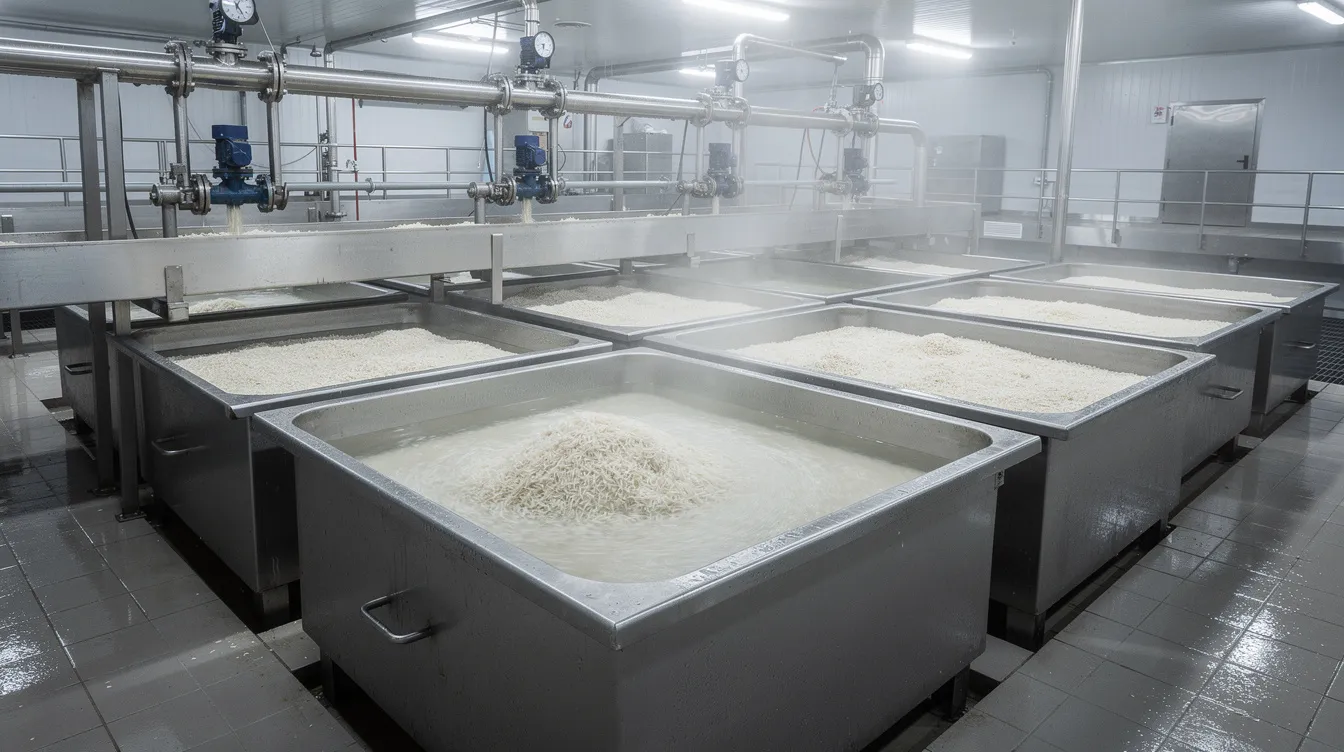
Parboiling or Hydrothermal Heat Treatment (Where Applicable)
Many Indian murmura manufacturers either buy parboiled rice or carry out a simplified parboiling process in-house. Pre-conditioning of rice involves parboiling and adjusting moisture to optimal levels before the puffing stage.
During parboiling, soaked paddy or rice is exposed to steam or boiling water, causing partial gelatinisation of starch and hardening of the grain structure upon cooling and drying. This treatment reduces grain breakage during milling, improves shelf life and changes the colour and texture of the finished murmura.
Equipment ranges from simple steeping tanks and steam-jacketed kettles for small units to pressure steamers and continuous parboiling systems for larger plants. Not every puffed rice processing plant includes full-scale paddy parboiling – some units depend on nearby integrated rice mills, while others run only a targeted hydrothermal treatment aimed at improving puffing performance.
Drying and Tempering Before Puffing
Material coming out of soaking or parboiling carries excess moisture and must be dried to a suitable range before roasting and puffing. Too wet leads to charring and sticking; too dry gives poor expansion and many unpuffed grains.
Drying options include sun drying on clean floors for small units and batch or continuous mechanical dryers (fluidised-bed or cross-flow type) for larger plants. Gradual, uniform drying avoids surface hardening and internal stresses that cause cracks – sometimes multiple drying passes with intermediate resting periods are needed.
Tempering after drying involves holding partially dried grains in bins so that internal moisture redistributes evenly. This stage links directly to puffed rice quality because the moisture level of the kernel just before roasting is one of the most critical variables in the entire process.
Milling and Dehusking When Starting from Paddy
In a paddy-based puffed rice plant, dried and tempered parboiled paddy is sent to a rice mill section. Dehusking is done with rubber roll shellers; husk is separated by aspiration. Bran layers are removed in a whitener or polisher where required, and head rice is separated from brokens using graders.
Husk and bran are by-products that can be sold as fuel or cattle feed. Proper recovery of head rice matters for both rice manufacturing economics and puffed rice yield. If the plant buys ready parboiled rice, this entire milling section is eliminated.
Preheating and Roasting Prior to Puffing
Cleaned and properly conditioned rice is preheated or roasted before the actual puffing step. The objective is to bring the entire grain uniformly close to the temperature at which internal steam generation and expansion begin.
In traditional sand roasting, a rotating drum or pan is loaded with heated, clean sand. Rice is introduced in small batches, stirred and then quickly separated once kernels reach the target temperature. Puffed rice is produced by heating rice in hot salt or sand at temperatures that vary by system design.
Modern alternatives include mechanical roasters using hot air or heated metal surfaces, continuous roasters with screw conveyors or rotary drums, and indirect heating systems that avoid sand or salt entirely. Some automatic puffed rice manufacturing processes integrate preheating and puffing in one continuous process machine.
Variables to control at this stage include fuel setting, bed temperature, residence time and feed rate – all of which affect final puffing behaviour, colour and the proportion of burnt or under-puffed grains.
Puffing Process of Rice – Core Murmura Manufacturing Step
The puffing process is the heart of murmura production. When rice is heated rapidly, internal moisture turns into steam, pressure builds within the gelatinised starch matrix and sudden release of this pressure causes the grain to rupture and expand – puffed rice production involves this rapid expansion of internal moisture into steam. The result is a porous, lightweight, crisp grain with a greater volume than the original kernel.
Operationally, conditioned rice is fed into a hot sand roasting pan or a mechanical puffed rice roasting machine where grains are exposed to high temperature for a very short duration. The puffing process can be achieved by sand roasting using temperatures between 220–250°C with residence times often in the range of 8–18 seconds. Puffed rice production can be achieved using high-temperature, short-time processes – this principle applies across most commercial technologies.
Critical factors governing puffing quality include kernel moisture, grain variety and size, intensity of heat, exposure time, mixing uniformity and the rate at which grains are discharged. Typical defects and their likely causes include:
- Under-puffing and hard kernels – too low temperature or insufficient internal moisture
- Burnt or dark grains – excessive heating or extended residence time
- High proportion of unpuffed rice – poor conditioning or uneven heating
- High breakage and fines – over-dried or brittle grains
Each plant must establish its own optimal puffing conditions through trial runs with its specific rice source and puffed rice roasting machine.
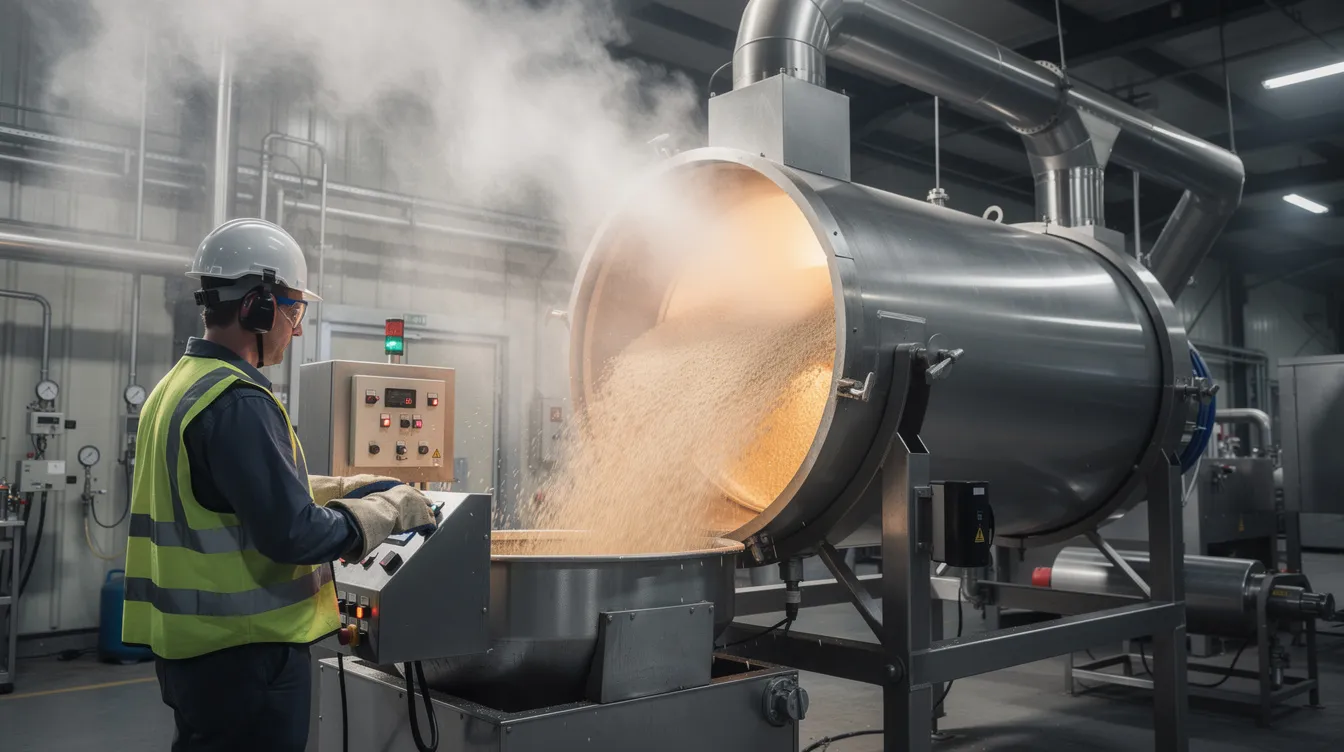
Industrial Puffing Technologies and Puffed Rice Plant Configurations
Commercially, several puffing technologies are used:
- Traditional batch sand or salt roasting – low capital, manual operation, variable quality, suitable for local markets
- Continuous sand or salt roasting lines – automated feeding and separation, higher throughput, better consistency
- Hot air puffing and fluidised-bed systems – air at 240–270°C with residence times around 7–10 seconds, expansion ratios up to 9.7, no sand contamination risk
- Gun puffing – involves pressurizing rice at 200 psi inside a sealed pressure chamber heated to 200°C, then releasing pressure rapidly for instantaneous expansion; used for specific products like puffed rice cakes and certain cereals
- Extrusion puffing – considered the modern standard for puffed rice production, starting from rice flour or dough rather than whole grain; extrusion puffing can produce 200 to 500 kg of puffed rice per hour in larger installations
Different puffing methods – including sand roasting, hot air popping and extrusion – suit different product lines and scales. Gun puffing and extrusion are more relevant for expanded rice snack foods, puffed rice cakes and breakfast cereal products, while whole-grain murmura manufacturing in India largely relies on sand or hot-air roasting.
Promoters should match technology choice with target markets (plain murmura vs flavoured snacks), capacity requirements, fuel availability and finance – considerations similar to those discussed in poha plant capacity planning.
Separation of Sand or Processing Medium (Where Used)
In traditional and semi-automatic sand-based systems, separation of puffed rice from sand or other heating agents is necessary immediately after puffing to prevent contamination and overheating. Common separation equipment includes inclined vibrating screens, rotary sieves or perforated drums that discharge puffed rice while returning sand to the heating zone for reuse.
Hygiene considerations include using clean, food-contact-safe sand, regular sieving and replacement, and prevention of foreign matter. Modern automatic puffed rice processing lines increasingly avoid sand by using hot-air or metal-surface heating, simplifying this stage entirely.
Cooling of Puffed Rice After Puffing
Cooling of puffed rice prevents moisture absorption and maintains crispness. Immediately after puffing, puffed rice grains are very hot and still contain residual heat. Rapid but controlled cooling is necessary to stop further cooking and prevent steam condensation that would soften the product.
Typical arrangements include perforated cooling conveyors with ambient or filtered air, vibrating cooling trays, or simple spreading in thin layers. Excessive handling at this stage increases broken percentage and fines. Proper cooling before packing also reduces the risk of moisture migration into the packaging headspace.
Cleaning, Sieving and Grading of Finished Puffed Rice
Post-puffing cleaning uses vibrating sieves or graders to remove unpuffed or partially puffed grains, burnt kernels, sand traces and fines. Grading separates puffed rice by size and bulk density – premium large puffs, regular grade and small fragments – each targeting separate market segments and pricing.
Aspirators or air classifiers remove light dust and chaff, improving appearance and packaging cleanliness. Effective grading improves murmura quality and brand positioning, while off-grade material can be utilised in lower-value snack mixes.
Optional Seasoning, Value Addition and Puffed Rice Cakes
The basic puffed rice manufacturing process ends with plain, unflavoured murmura. Puffed rice can be coated with flavorings after puffing to enhance taste – salted murmura with oil and spices, masala puffed rice, chivda and namkeen mixes are popular snacks across India. Some manufacturers produce chocolate-coated puffed rice or compressed puffed rice cakes using forming presses.
From a nutritional standpoint, plain puffed rice has fewer calories compared to many other snack foods – one cup of puffed rice provides 56 calories, 0.9g of protein, 12.6g of total carbohydrates, less than 1g of saturated fat and 25% of the daily value of iron. This makes it a relatively light base for a range of rice based products, from simple popped rice eaten with milk to elaborate preparations with vegetables, corn or wheat-based accompaniments.
Additional equipment for value addition includes seasoning drums, oil sprays, blending mixers and forming presses. Each additional processing step influences moisture, shelf life, labelling requirements and cost of production.
Puffed Rice Packaging Process and Shelf-Life Considerations
Puffed rice has very low bulk density and is highly sensitive to ambient moisture, so packaging must minimise oxygen and moisture ingress to maintain crispness. Typical packaging materials include LDPE/PP bags for bulk and laminated pouches for retail packs; some brands use nitrogen flushing.
The packaging line typically includes: puffed rice feeding to a hopper, weighing (manual or automatic weigh fillers), filling into pouches, sealing using impulse or band sealers, batch and date coding, and placement into secondary cartons or HDPE bags.
Warehouse practices include stacking on pallets, avoiding damp floors and walls, controlling rodents and pests, and practising FIFO to prevent quality deterioration. Because of low density, storage and transport are volume-driven; DPRs must consider adequate godown space, similar to considerations discussed for poha plant layout requirements.
Puffed Rice Manufacturing Process Flow Chart (Text-Based)
Below are text-based process flow charts for the two main manufacturing routes. These serve as a reference for the puffed rice manufacturing process with flow chart documentation in a DPR.
Paddy-Based Route – Puffed Rice Process Flow Chart:
Paddy Receipt → Weighment & Inspection → Cleaning & Destoning → Paddy Grading → Soaking / Conditioning → Hydrothermal Treatment / Parboiling (if adopted) → Drying → Tempering → Dehusking & Milling → Rice Grading → Moisture Conditioning → Preheating / Roasting → Puffing → Separation of Sand / Medium (if applicable) → Cooling → Cleaning & Sieving → Grading → Quality Inspection → Packaging → Finished Goods Storage
Rice-Based Route – Murmura Process Flow Chart:
Rice Receipt → Cleaning & Destoning → Rice Grading → Moisture Conditioning & Tempering → Preheating / Roasting → Puffing → Cooling → Sieving & Grading → Quality Inspection → Packaging → Finished Product Dispatch
The actual puffed rice processing flow diagram may integrate or split some steps depending on selected technology, machinery supplier and plant layout, but the logical processing sequence remains similar across most commercial setups.
Stage-Wise Process Table and Critical Control Points
| Process Stage | Purpose | Typical Equipment | Critical Control Point |
|---|---|---|---|
| Raw Material Receipt | Verify quality, moisture, variety | Weighbridge, moisture meter | Moisture level, foreign matter, broken % |
| Cleaning & Grading | Remove impurities, grade by size | Vibratory cleaner, destoner, grader | Uniform grain size, absence of stones |
| Soaking / Conditioning | Increase internal kernel moisture | Soaking tanks, conditioning bins | Soaking duration, moisture uniformity |
| Parboiling / Heat Treatment | Gelatinise starch, strengthen kernel | Steamer, parboiling tank | Steam temperature, treatment duration |
| Drying | Reduce moisture to puffing-ready level | Sun drying yard, mechanical dryer | Drying rate, end-point moisture |
| Milling / Dehusking (paddy route) | Remove husk and bran, obtain head rice | Rubber roll sheller, whitener, grader | Breakage, head rice recovery |
| Preheating / Roasting | Bring grain close to puffing temperature | Sand bath, mechanical roaster | Medium temperature, residence time |
| Puffing | Rapid thermal expansion of grain | Puffing machine, roasting drum | Puffing temperature, feed rate, time |
| Separation (if sand used) | Remove sand from puffed rice | Vibrating screen, rotary sieve | Absence of sand in product |
| Cooling | Stop cooking, prevent condensation | Cooling conveyor, vibrating tray | Cooling speed, avoid moisture pickup |
| Sieving & Grading | Remove defects, grade by size | Vibratory sieve, aspirator | Unpuffed %, burnt %, fines level |
| Packaging | Protect product from moisture | Weigh filler, sealer, coder | Seal integrity, moisture barrier, labelling |
Quality control parameters include monitoring moisture, puffing temperature and residence time at each critical stage.
Machinery Used in Puffed Rice Processing Plant
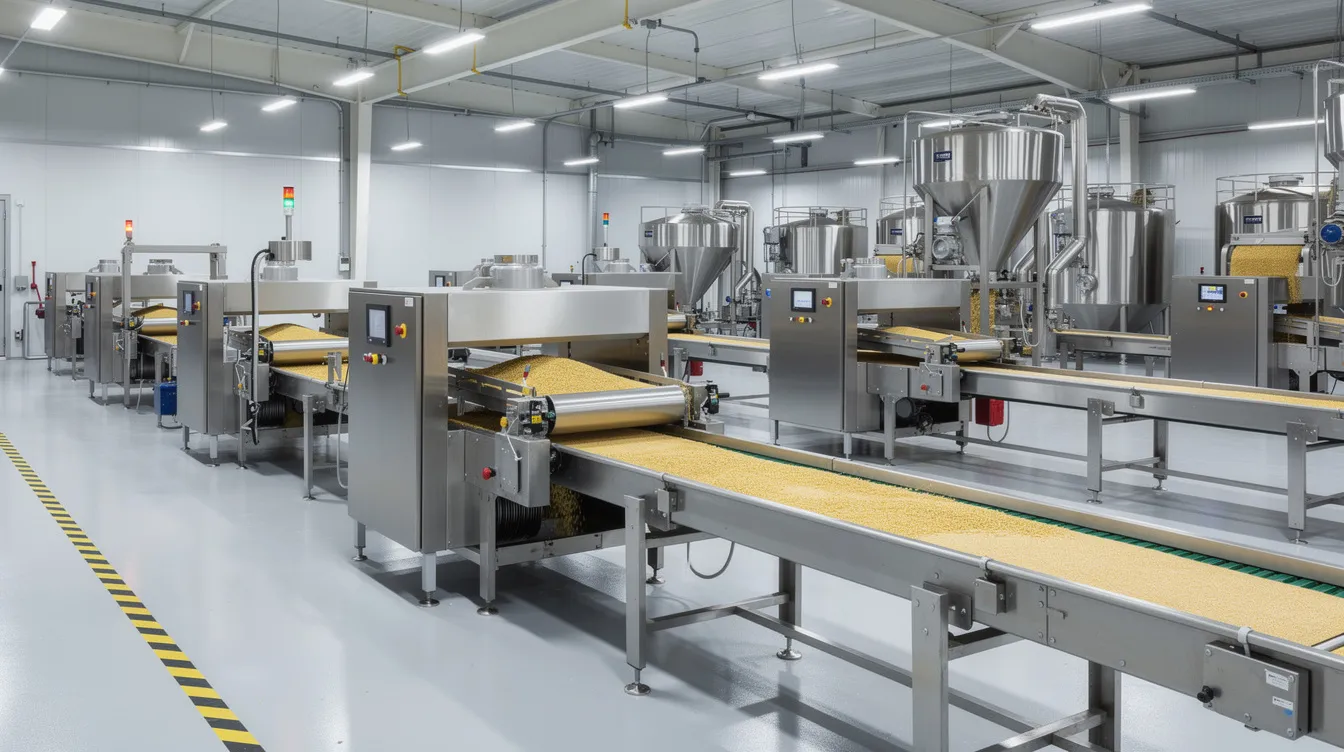
Machinery selection depends on whether the unit processes paddy or buys milled rice, and whether it uses batch or continuous puffing technology.
Paddy-based murmura plant typically requires: raw-material cleaner, destoner, paddy grader, soaking and conditioning tanks, parboiling or steaming system, mechanical dryer, paddy dehusker, paddy separator, rice whitener or polisher, rice grader and broken separator.
Core puffing-line equipment (both routes): rice cleaner, moisture-conditioning bins, preheating or roasting machine, murmura making machine (puffing unit), sand separator (if sand roasting is used), cooling conveyor or tray system, vibrating sieve, final grader and inspection conveyor.
Downstream and utility equipment: bucket elevators and conveyors, storage bins, weighing and bagging machines, sealing machines, dust-control systems, boiler or heat generators, blowers and control panels.
Promoters should choose machines not on price alone but on fuel efficiency, ease of cleaning, spares availability and proven performance – an approach similar to what is outlined for poha plant machinery and equipment.
Critical Process Parameters and Their Influence on Murmura Quality
The key variables that must be monitored include rice variety, pre-treatment level, grain size, initial moisture, soaking time, drying end-point, roasting temperature, puffing temperature, residence time, feed rate and cooling rate.
Higher moisture within the optimal range supports better expansion, while excessive surface moisture leads to sticking and dark colour. Higher temperature intensifies puffing but increases the risk of producing burnt grains. No single parameter can be optimised in isolation – the process window for each plant is a combination that must be established through repeated trial runs and recorded in standard operating procedures.
Production Yield, Recovery Percentage and Material Balance
A material balance for the puffed rice manufacturing process tracks how input paddy or rice plus added water is transformed into puffed rice, by-products (husk, bran, brokens) and process losses (dust, fines, moisture loss, handling losses). Since moisture is added during soaking and removed during drying and puffing, the relationship between input weight and output weight is not straightforward.
Murmura recovery percentage depends on variety, broken percentage, milling quality, roasting and puffing efficiency and post-puffing grading. Published machine evaluations report puffing efficiencies of up to 98% for well-controlled continuous machines, but overall plant yield from paddy to packed murmura will be lower once milling recovery and all losses are considered.
Promoters should obtain realistic yield data from trial runs or existing plants of similar configuration. Optimistic assumptions distort cost of production and profitability – a principle discussed in detail in poha plant operating cost analysis.
Factors Affecting Puffed Rice Expansion, Texture and Appearance
Raw-material-related factors include rice variety (amylose content and starch characteristics), grain maturity, degree of parboiling, degree of polishing and broken percentage. Process-related factors include uniformity of moisture conditioning, drying intensity, preheating level, roasting temperature profile and the specific puffing technique adopted.
These factors collectively impact whiteness vs creamish colour, surface smoothness, porosity, taste and susceptibility to moisture pick-up during storage. Plants targeting premium low-bulk-density, large-puff segments may need tighter raw-material specifications and closer process control compared with plants producing for low-cost bulk markets.
Quality-Control Parameters in Commercial Puffed Rice Manufacturing
Essential parameters to monitor in finished puffed rice include:
- Appearance – uniformity of size and shape
- Colour – absence of black or brown burnt grains
- Crispness, aroma and taste
- Bulk density and moisture content (target well below 5% for crispness)
- Percentage of unpuffed, partially puffed or burnt grains
- Extraneous matter and sand traces (ideally nil)
- Microbiological safety – total plate count, absence of visible moulds or insects
- Packaging-integrity tests – seal strength, leakage, shelf life trials
A basic quality manual and sampling plan should be prepared as part of setting up a commercial murmura plant, especially where bank finance and brand building are involved.
Food Safety, Hygiene and Regulatory Compliance
Good manufacturing practices include clean raw-material storage, segregation of paddy or rice and finished product areas, pest-control measures, and regular cleaning of floors, silos and machines. Potable or suitably treated water is required for soaking and steam generation. Worker hygiene practices – caps, gloves, hand-washing stations – are essential for food safety.
Applicable Indian regulations include FSSAI registration or licensing, packaging and labelling rules, and local pollution-control requirements for boilers, dust and solid waste. Promoters should consult their technical and legal advisors for site-specific compliance requirements.
Utilities and Support Infrastructure for Puffed Rice Processing Plant
Main utilities include electrical power for motors, blowers and packaging equipment; thermal energy from furnace, gas burner or boiler for drying and roasting; water for soaking, steam generation and cleaning; and compressed air where pneumatically operated equipment is used. Utility demand varies significantly depending on whether the plant runs full paddy parboiling and mechanical drying or only a rice-based puffing line. Adequate ventilation and dust collection in roasting and puffing areas are essential. Promoters may find the utility planning approach discussed in poha plant utilities and manpower requirements a useful reference framework.
Traditional vs Modern Puffed Rice Manufacturing
The traditional puffing process takes about 6 days to complete when the entire cycle from paddy soaking to final puffing is considered. Traditional puffed rice production typically involves processing rice in small batches on a heated pan, with manual feeding and limited process control.
| Parameter | Traditional Batch Units | Modern Semi-Auto / Continuous Plants |
|---|---|---|
| Batch Size | Small batches, 2–5 kg per round | Continuous process, 50–500+ kg/hr |
| Automation | Manual feeding, stirring, separation | Automated feeding, roasting, separation |
| Process Control | Operator judgment | Temperature controllers, timers, sensors |
| Labour Intensity | High | Moderate to low per kg |
| Product Consistency | Variable | High |
| Hygiene | Difficult to maintain | Easier with enclosed systems |
| Fuel Efficiency | Lower | Higher with heat recovery |
| Packaging Integration | Separate, manual | Integrated weighing and sealing lines |
| Traceability | Limited | Batch-coded, logged |
| Suitability for Bank Finance | Difficult to document | Suited for MSME project financing |
Automation is not always the cheapest option – economic viability depends on planned capacity, market reach, and ability to consistently utilise installed capacity.
Common Manufacturing Problems and Process-Correction Approach
| Manufacturing Problem | Possible Cause | Process Area to Check |
|---|---|---|
| Low puffing percentage / many hard grains | Insufficient moisture conditioning; too low roasting temperature | Soaking, conditioning, roasting temperature |
| Burnt or dark grains | Excess heat; extended residence time; sand too hot | Roasting temperature, time, sand management |
| High broken percentage / fines | Over-dried or brittle kernels; rough handling | Drying end-point, cooling, conveyor handling |
| Uneven expansion | Non-uniform grain size; uneven moisture penetration | Grading, soaking uniformity, tempering |
| Colour variation or off-taste | Overheating; impurities in sand; poor raw material | Raw material inspection, roasting, sand quality |
| Loss of crispness in storage | High final moisture; poor packaging; humid storage | Cooling, packaging material, storage conditions |
Systematic recording of problems and corrective actions helps stabilise the puffed rice production process and improve productivity over time.
Difference Between Poha and Puffed Rice Processes
Poha (flaked rice) and puffed rice (murmura) are distinct products with different end uses and manufacturing technologies, even though both originate from paddy or rice. Poha is produced by conditioning rice or paddy followed by flattening between rollers to form flakes – readers can refer to the poha manufacturing process and process flow chart for a detailed understanding.
In contrast, puffed rice is produced by subjecting conditioned rice to rapid heating, steam-driven expansion and puffing without any flattening. The structural change in puffed rice is expansion, not compression. While some upstream operations like paddy cleaning, soaking and partial heat treatment may overlap conceptually, the finishing machinery and product properties differ completely.
A poha plant is not automatically suitable for puffed rice manufacturing, and each project should have its own technical and financial evaluation.
Process Considerations for DPR and Project-Finance Planning
Before finalising a puffed rice plant DPR, the following process-related decisions must be frozen: choice of paddy-based vs rice-based route, selected puffing technology (sand, hot air or continuous roasting), plant capacity (kg/hr and operating hours), planned product line mix (plain vs value-added) and level of automation.
Realistic assumptions are needed for production yield and recovery percentage, process losses at each stage, power and fuel consumption per tonne, labour requirement, packaging cost per kg, and maintenance overheads. These technical assumptions directly influence cost of production, contribution margin, working-capital cycle, break-even volume, DSCR and loan repayment capacity.
Entrepreneurs should validate their process assumptions through pilot trials with machinery suppliers or visits to similar operating plants before locking their bankable project report.
FAQ – Puffed Rice Manufacturing Process and Plant Planning
What is the basic puffed rice manufacturing process in a commercial plant?
Commercially, puffed rice is produced by receiving and cleaning paddy or rice, conditioning it with water and heat (soaking and sometimes parboiling), drying and tempering to appropriate moisture, milling if starting from paddy, then roasting or puffing in sand, salt, or mechanical roasters at high temperature for a short duration, followed by cooling, sieving, grading and moisture-proof packaging.
Is puffed rice made from paddy or from rice in industrial units?
Both approaches are used in India. Some units start from paddy and integrate parboiling plus milling to control quality and generate by-products, while many MSME units buy suitable parboiled rice from nearby rice mills and handle only conditioning, puffing and packaging, which reduces investment and complexity.
Why is soaking or moisture conditioning necessary before puffing rice?
Soaking allows water to penetrate evenly into the rice kernel. This internal moisture later converts to steam during rapid heating, providing the driving force for expansion. Without proper conditioning, grains either remain hard and under-puffed or burn on the surface without expanding properly.
What process information is essential while preparing a puffed rice plant DPR?
The DPR should clearly define: the selected raw-material route (paddy or rice), planned plant capacity and operating days, a detailed process flow chart, machinery list and layout, realistic yield and loss percentages at each stage, power and fuel requirements, labour pattern, packaging assumptions, quality-control plan and projected selling prices for different grades of puffed rice.
Is a poha plant the same as a puffed rice plant?
No. Poha (flattened rice) is produced by conditioning rice and then flattening it between rollers to create flakes. Puffed rice is produced by rapidly heating conditioned rice to cause steam-driven expansion. The finishing machinery, the physical transformation and the product properties are entirely different. Each project requires its own separate technical and financial evaluation.
Conclusion – Process Understanding Before Project Investment
Successful puffed rice manufacturing depends on correct raw-material selection, uniform moisture conditioning, appropriate hydrothermal treatment where adopted, well-controlled roasting and puffing, efficient cooling and grading, and moisture-barrier packaging. Each of these stages has process variables that must be balanced against the chosen rice variety, equipment design and target product quality.
There is no single universal murmura manufacturing process. Each plant must finalise a technically suitable process route and puffing technology before freezing machinery size, utilities, layout and project cost. The process flow chart and stage-wise control points presented in this article are intended to give promoters and bankers a working framework – not a substitute for machinery-supplier trials and actual plant validation.
Entrepreneurs planning a commercial puffed rice manufacturing business in India should base their DPRs and bank-finance proposals on validated technical parameters and realistic yields, supported by supplier guarantees or trial data, rather than generic assumptions. Getting the process right is the first step toward getting the numbers right.
CA Manish Gugliya, FCA, DISA (ICAI) Project Report, DPR, CMA Data, MSME & Project Finance Consultant ProjectReportBank.com