Key Takeaways
- Industrial solvent extraction using hexane can recover 95–99% of oil from prepared oilseed material, far exceeding mechanical pressing. Machinery configuration directly determines oil yield, hexane loss, steam consumption and long-term operating cost.
- A complete solvent extraction plant machinery list spans raw material handling, cleaning, preparation, continuous extractor, DTDC, miscella distillation, solvent recovery, utilities, automation and safety systems – each requiring careful specification for the target feedstock and capacity.
- The solvent extraction process flow moves from raw material preparation through countercurrent solid–liquid extraction, miscella distillation and meal desolventisation, with solvent recovery completing the loop. Heat and mass balance across these stages governs boiler, cooling tower and condenser sizing.
- Capacity planning from 500 to 5,000 TPD must account for equipment redundancy, utility complexity, raw material availability and realistic ramp-up assumptions that feed into DSCR and IRR projections.
- From a Chartered Accountant’s perspective, machinery selection is inseparable from DPR quality – extraction efficiency, solvent consumption and energy use directly shape operating cost, contribution margin, break-even and bankability.
Introduction: Why Solvent Extraction Plant Machinery Matters
The choice of solvent extraction plant machinery is not merely a procurement decision. It determines how much oil a plant actually recovers from every tonne of prepared seed, how much hexane is lost in the process, how much steam and power the operation consumes, and ultimately how the project performs against its financial projections. In a sector where solvent extraction is widely used in vegetable oil processing, even modest differences in residual oil, solvent loss or energy efficiency translate into substantial revenue and cost variations over a full operating year.
This article focuses on industrial oilseed solvent extraction plants processing soybean, rice bran, rapeseed, sunflower and similar oil seeds at capacities typically ranging from 500 to 5,000 TPD. It does not address small scale domestic oil mills or laboratory-scale liquid liquid extraction equipment.
Hexane is the most commonly used solvent in extraction because of its selectivity for oil, favourable boiling point and recyclability. Food-grade hexane maximizes oil recovery from oilseeds, making hexane-based extraction the global standard for efficient oil extraction at industrial scale, clearly differentiated from mechanical pressing which typically leaves 6–20% residual oil in the cake.
From my perspective as a Chartered Accountant, realistic DPRs, DSCR calculations, IRR estimates and payback period projections depend heavily on selecting proven process technology and obtaining reliable machinery specifications. Integrated projects such as an Integrated Soybean Crushing, Oil Extraction and Refining Plant DPR require coordinated choices across preparation, extraction, distillation and refining equipment to produce defensible financial assumptions.
Understanding Industrial Solvent Extraction Plant Technology
The solvent extraction process is fundamentally a solid–liquid extraction operation. Prepared raw material – flaked seeds, expanded collets or pre-pressed oil cakes – is contacted with hexane in a continuous extractor. The process involves mixing raw materials with solvents to dissolve oils, forming a solution called miscella. Miscella is the mixture of solvent and oil after extraction. The de-oiled meal, still carrying residual solvent, passes through a desolventizer-toaster-dryer-cooler for hexane removal, while the miscella is distilled to recover crude oil and recycle the solvent.
Properly prepared seeds are essential to achieving low residual oil in meal. Flake thickness, moisture content and cell-wall disruption all influence how effectively hexane can penetrate the material. Without adequate preparation – adjusting moisture content, conditioning temperature and achieving thin, uniform flakes – residual oil in meal may rise well above target levels, and energy demand in desolventising increases.
Hexane is preferred globally because it is the most economical solvent for extraction processes: it offers high selectivity for triglycerides, a boiling range of approximately 63–69°C, low latent heat of vaporisation and efficient recyclability. While ethanol is also used for extracting essential oils and bioactive compounds, and researchers continue to explore green solvents derived from crops, hexane remains the standard for edible oil plants processing various seeds. Solvents like ethanol ensure safe extraction of bioactive compounds in pharmaceutical and specialty applications, but for high-volume oilseed processing, hexane’s economics remain unmatched.
It is important to differentiate between direct solvent extraction and extraction of pre-pressed oil cakes. Direct extraction suits low-oil-content materials like rice bran, where the entire prepared material enters the extractor. For high-oil seeds such as soybean and sunflower, pre-pressed oil cakes from mechanical expellers are commonly extracted to recover the final traces of oil remaining after pressing. Solvent extraction can recover oil from materials with residual content below 1%, making it exceptionally thorough.
Modern industrial plants at 500–5,000 TPD operate as continuous process lines. Continuous solvent extraction plants process oilseeds like soybean and sunflower around the clock, with batch systems limited to R&D, specialty products or very small scale operations.
Upstream, the plant integrates seed cleaning, dehulling, flaking or expansion, and sometimes mechanical pre-pressing. Downstream, the miscella enters the distillation section for solvent recovery, and crude oil moves to storage or an optional refining line.
Complete Solvent Extraction Plant Machinery List
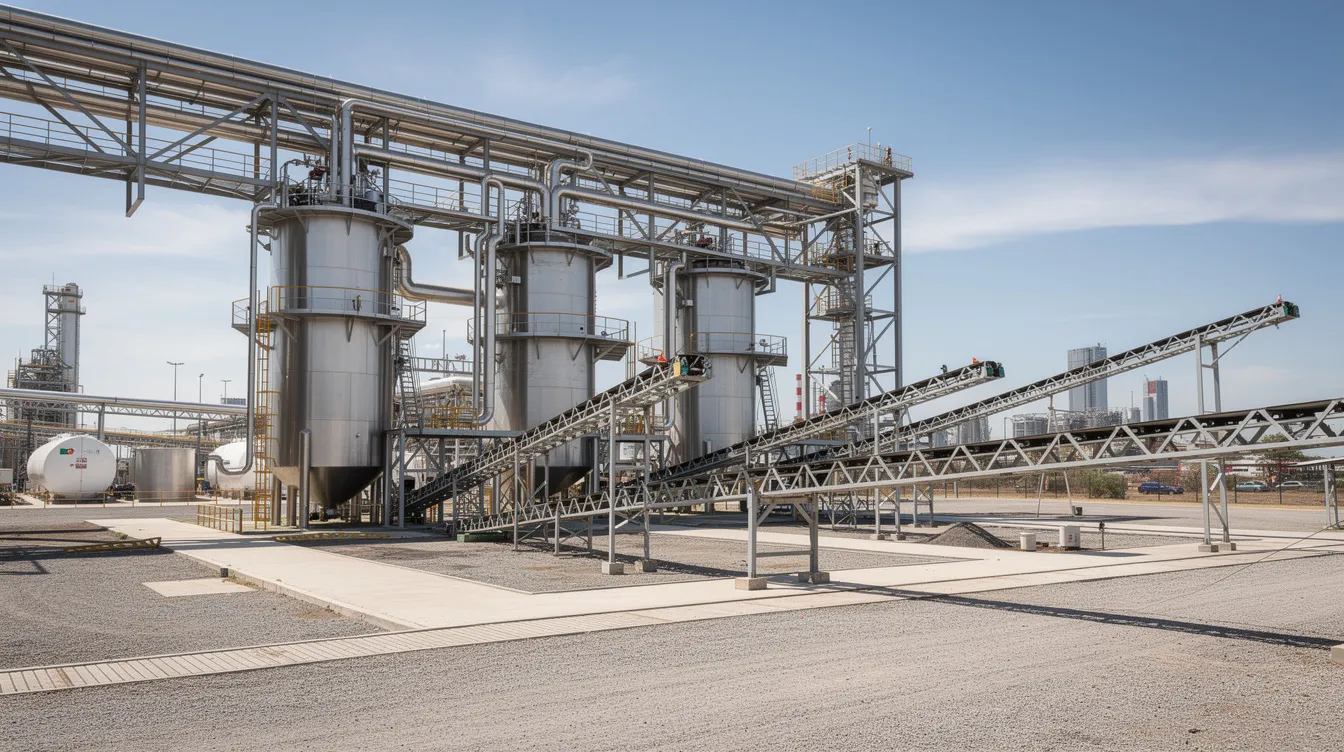
The exact solvent extraction plant machinery list varies with raw materials, capacity and project-specific process requirements. The following table provides a practical machinery roadmap for a typical edible oil solvent extraction plant. Extraction equipment can be customized for various capacities and materials, so specification details must be confirmed with vendors against the specific feedstock and throughput.
| Equipment Group | Typical Items | Main Function | Key Specification Considerations |
|---|---|---|---|
| Raw material receiving & handling | Truck unloading pits, silos, belt conveyors, bucket elevators, magnetic separators | Receive, store and transfer seed/cake to preparation section | Silo capacity matched to feedstock availability; vapour-sealed conveyors in solvent-contact zones |
| Cleaning & grading | Rotary/vibratory screen cleaners, destoners, aspiration systems, magnetic separators | Remove stones, sand, trash and metal to protect downstream equipment | Cleaning efficiency directly affects flaking roll life and extractor performance |
| Dehulling & preparation | Dehullers, hull separators, hull aspiration systems | Remove hulls (soybean, sunflower) to improve flake porosity | Hull content affects extractor drainage and meal protein content |
| Seed cracking & flaking | Cracking mills, flaking rolls with cooling, feeders | Produce thin uniform flakes (~0.6–1.0 mm) for solvent penetration | Roll cooling prevents overheating; flake thickness uniformity is critical |
| Conditioning & cooking | Vertical/horizontal conditioners, stack cookers | Heat and moisture-adjust prepared seeds to optimise cell-wall disruption | Temperature typically 60–70°C; residence time 20–40 minutes |
| Expanders/extruders | High-shear expander units | Produce porous collets for better drainage, especially for soybean and rice bran | Improves extraction kinetics and reduces solvent retention in wet meal |
| Continuous solvent extractor | Belt-type or rotary cell extractor, feed distribution system | Extract oil from prepared material using countercurrent hexane contact | Bed depth, residence time, number of wash stages, drainage design |
| Miscella filtration & distillation | Miscella filters, pre-heaters, falling/rising film evaporators, vacuum stripping column | Remove solids from miscella; progressively evaporate hexane to recover crude oil | Number of effects (2–3), vacuum levels, residual solvent in oil |
| DTDC | Multi-tray vessel with pre-desolventiser, toaster, dryer, cooler sections | Strip hexane from extracted material, toast meal, dry and cool to storage temperature | Number of trays (5–8), direct/indirect steam, meal moisture after cooling ~10–12% |
| Solvent evaporation & recovery | Evaporators, stripping columns, economisers, vacuum pumps/steam ejectors | Recover hexane from miscella vapours and DTDC vapours for reuse | Steam consumption, heat recovery from DTDC vapours, vacuum stability |
| Condensers & solvent–water separation | Shell-and-tube condensers, vent condensers, solvent–water separators, decanters | Condense hexane vapours, separate hexane from water, recover solvent from vent air | Cooling water temperature approach, solvent carryover in water |
| Meal cooling, handling & packaging | Meal cooler, conveyors, bucket elevators, hammer mill/sizer, bagging station | Cool de-oiled meal to safe storage temperature and dispatch | Dust control, moisture monitoring, bulk or bag loading |
| Pumps, conveyors & transfer systems | Miscella pumps, solvent pumps, screw conveyors, drag chain conveyors | Move solvent, miscella and solids throughout the plant | Vapour-tight sealing, material compatibility, capacity matched to flow rates |
| Boilers & heating systems | Steam boilers, thermic fluid heaters, fuel handling systems | Supply steam for evaporation, DTDC and process heating | Sized for combined miscella distillation and DTDC steam demand (often 6–12 bar) |
| Cooling towers & water systems | Cooling tower cells, circulation pumps, softening/RO units | Provide cooling water for condensers and process cooling | Capacity matched to condenser duty; water treatment for boiler feed |
| Electrical, instrumentation & automation | MCCs, PCCs, VFDs, PLC panels, SCADA, field instruments | Control, monitor and automate entire process | Flameproof fittings in hazardous zones; solvent vapour detectors |
| Fire protection & solvent safety | Foam fire systems, hydrants, detectors, flameproof fittings, emergency shutdown | Prevent and respond to fire/explosion risk from hexane vapour | PESO compliance for solvent storage; HAZOP studies; nitrogen blanketing where specified |
| Pollution control | Dust collection, effluent handling, VOC control systems | Meet environmental norms for dust, wastewater and volatile organic compounds | SPCB/NPCB compliance; boiler and cooling tower blowdown treatment |
Readers evaluating upstream oilseed preparation equipment in detail can study Soybean Processing Plant Machinery and Equipment Selection for a complementary perspective on crushing and preparation machinery.
Solvent Extraction Plant Process Flow and Technology
The entire process follows a defined sequence:
Raw Material Receiving → Cleaning → Dehulling/Preparation → Conditioning → Flaking/Expansion → Solvent Extraction → Miscella Distillation & Solvent Recovery → Crude Oil Storage → Meal Desolventisation, Drying & Cooling → Meal Storage/Dispatch
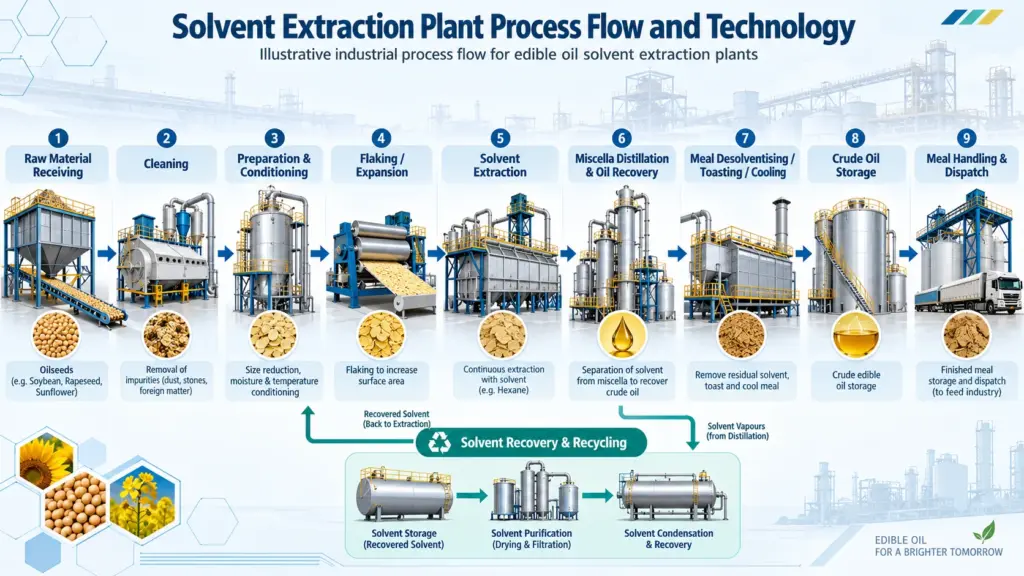
The extraction process begins with raw material preparation. Properly cleaned and graded raw material reduces equipment breakdowns and ensures consistent oil extraction. Conditioning adjusts temperature and moisture to optimise flaking – too wet causes poor solvent penetration; too dry causes dust and mechanical breakage. Flaking produces thin flakes for direct extraction, while expansion creates porous collets favoured for rice bran and certain soybean applications.
The core extraction method uses continuous countercurrent circulation of fresh solvent through a bed of prepared material. A continuous counter-current extraction cycle maximizes solvent efficiency: the freshest hexane contacts the most-exhausted material last, and miscella concentration increases along the flow path. Solvent extraction plants can recover up to 98% oil concentration from prepared oilseed material, ensuring high yield and purity of the extracted crude oil. Continuous solvent extraction maximizes oil recovery from oilseeds at industrial scale.
The miscella route involves primary filtration to remove fines, preheating via economisers using vapours from the DTDC, and multi-stage evaporation under vacuum. The extracted oil is separated from the solvent through distillation – typically in two or three effects – with a final stripping column to remove the final traces of hexane. Vendor specifications for well-designed multi-effect vacuum systems indicate steam consumption of approximately 150–250 kg per tonne of oil and cooling water demand of 12–25 m³ per tonne of oil.
The meal route takes solvent-laden wet meal from the extractor discharge into the DTDC, where multiple trays provide indirect steam stripping followed by direct steam toasting. Toasting is particularly important for soybean to deactivate anti-nutritional factors. Meal exits at controlled moisture (~10–12%) and temperature suitable for safe storage and dispatch as de-oiled meal.
Heat and mass balance across the plant is interconnected: vapours from the DTDC can feed pre-evaporators, reducing fresh steam demand. This interaction governs boiler, condenser and cooling tower sizing and overall energy consumption.
Key sources of extraction losses include residual oil in meal (target below 1%, with best plants achieving ~0.5%), hexane loss in meal, vent gases and wastewater – with well-managed plants achieving approximately 1–3 kg hexane loss per tonne of prepared material – and mechanical losses through fines, spillage and filter cake. Utility consumption for processing includes considerations like hexane makeup requirements, where roughly 1 kg of hexane per m³ of effluent handled represents a typical reference point. Oil extraction efficiency can also vary significantly by feedstock; for instance, research has shown extraction efficiencies of 20–25% from palm oil mill effluent using solvent-based methods, illustrating the versatility of the extraction method across different oil-bearing materials. These loss parameters feed directly into efficiency assumptions used in DPRs.
Major Solvent Extraction Equipment Specifications
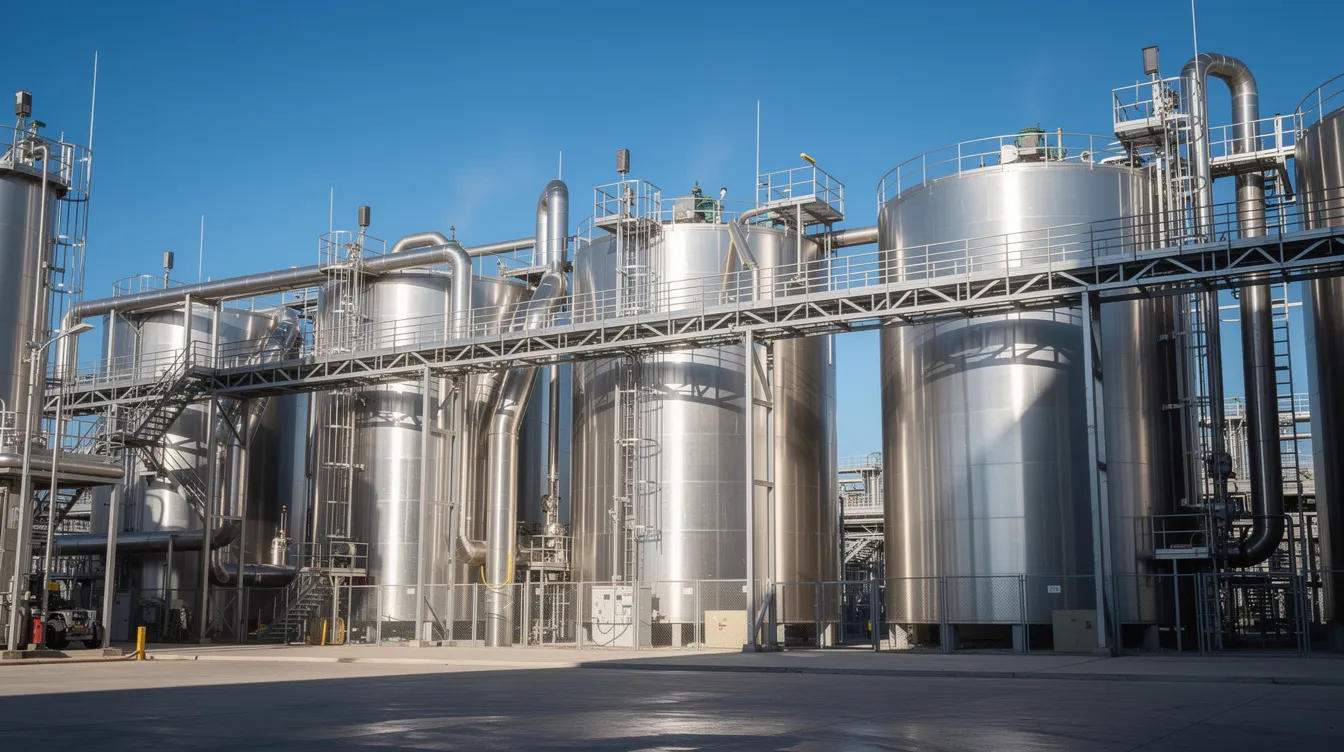
This section provides a high-level specification guide for key solvent extraction equipment rather than a vendor catalogue. Final figures must always come from supplier datasheets and technical offers.
| Equipment | Main Function | Key Technical Parameters | Material of Construction | Utility & Automation Notes |
|---|---|---|---|---|
| Continuous solvent extractor | Extract oil from prepared material | Bed depth (0.9–3 m by type), 5–9 extraction stages, residence time (30–80 min), solvent ratio (~0.6–1.2:1) | Carbon steel body with SS contact surfaces | Temperature control below hexane boiling point; vapour-tight seals; negative pressure operation |
| DTDC | Strip solvent from meal, toast, dry, cool | 5–8 trays/layers, direct + indirect steam, meal moisture after cooling ~10–12% | Carbon steel with SS trays where required | Temperature gradient control across zones; automated steam regulation |
| Miscella evaporators & stripper | Remove hexane from miscella | 2–3 effects, operating vacuum (illustrative: 0.04–0.08 MPa abs), heat recovery from DTDC vapours | SS304/SS316 for contact surfaces | Vacuum pumps or steam ejectors; stable vacuum critical for efficient extraction |
| Condensers & solvent–water separator | Condense hexane vapour; separate from water | Cooling water approach temperature, vent condenser + mineral oil absorber for non-condensables | CS shells, SS tubes | Cooling water temperature control; solvent carryover monitoring |
| Solvent storage & handling | Store and transfer hexane safely | Tank design pressure, vapour space, secondary containment, leak detection | CS with appropriate fittings | Nitrogen blanketing where specified; PESO-compliant venting; rotary valve for controlled feed |
All temperatures, pressures, residual hexane levels and extraction efficiencies quoted in a DPR must be explicitly labelled as either illustrative engineering planning assumptions or vendor-guaranteed performance parameters backed by technical offers and contracts. This distinction is critical for bankability.
Materials of construction deserve attention: carbon steel is standard for most structural components, while stainless steel (SS304 or SS316) is used in miscella-contact areas, critical pipelines and pumps where product quality or corrosion resistance demands it. All motors and electrical fittings in hazardous zones must be flameproof rated.
Continuous Solvent Extraction Technology and Equipment Selection
Continuous solvent extractors are the heart of any industrial extraction plant. Moving Bed Extractors are widely used for oil extraction across the industry, alongside rotary cell configurations. The selection depends on throughput, raw material type and desired operating philosophy.
Horizontal belt extractors move flakes on a perforated belt through countercurrent solvent washes. They suit uniform flakes, provide shallower bed depths (typically 0.9–1.8 m) and offer simpler maintenance. Rotary cell (rotocel) extractors use rotating baskets through extraction stages with deeper beds (up to 3 m), offering high extraction efficiency and good residual oil control but requiring robust sealing and structural integrity. The choice between deep bed and shallow bed designs depends on feed material characteristics, drainage behaviour and extraction kinetics.
Key design concepts include residence time of solids, number of countercurrent wash stages (5–9 in modern extractors), bed height control and feed distribution to avoid channelling. For better extraction results, vendors must demonstrate how their designs handle the specific feed – soybean pre-pressed cake flows differently from rice bran collets or sunflower flakes.
Operating and commercial considerations include the trade-off between extraction efficiency and complexity: more stages and deeper beds raise efficiency but increase capital cost and start-up time. Indian operating conditions – power fluctuations, dust, variation in raw material moisture and quality – demand equipment that allows easy cleaning, adjustment of bed height or speed, and reliable spare-part support for trouble free operation. For capacities above 1,000 TPD, promoters should request case references and proven installations from vendors in comparable conditions.
Solvent Recovery, Distillation and Safety Systems
Miscella distillation, solvent recovery and plant safety are as critical as extraction efficiency for regulatory acceptance and project viability. Solvent recovery is essential for reducing operational costs and environmental emissions – it is not optional but integral to the process design.
The miscella distillation section progressively evaporates hexane from miscella using flashers and multiple-effect evaporators under vacuum. Heat integration plays an important role: use of DTDC vapours to feed the first-effect pre-evaporator can recover significant energy. A well-designed heat recovery system reduces fresh steam demand substantially. The final stripping column reduces remaining hexane in crude oil to acceptable levels – target residual solvent content typically below 50 ppm in well-operated plants, and below 5 ppm in refined solvent-extracted oils as per FSSAI norms.
Condenser systems recycle and recover solvent vapor during the extraction process. Surface condensers, vent condensers and mineral oil absorbers handle non-condensable gases. Minimising cooling water inlet temperature (targeting ~30°C) significantly reduces hexane losses through exhaust. Solvent–water separation ensures recovered hexane is clean and dry for reuse, completing the solvent recovery loop. Hexane loss in well-managed plants targets below 1.5 kg per tonne of raw seed; older or poorly designed plants may lose 6–8 kg per tonne.
Essential safety systems include vapour containment through negative-pressure operation in extractors, DTDC and distillation sections; leak detection and gas monitoring; flameproof electrical fittings in all solvent handling areas; and foam-based fire fighting systems with emergency shutdown capability. Indian regulatory requirements include alignment with PESO/CCOE norms for flammable solvent storage, compliance with SPCB environmental norms for VOCs and effluent, and FSSAI licensing for edible oil production. Hazard and Operability (HAZOP) studies by qualified safety engineers are essential. Hexane-based extraction inherently involves flammable solvent and demands disciplined operation – it should never be presented as risk-free. Various solvents have different risk profiles, but hexane’s flammability requires the most rigorous safety infrastructure in edible oil plants.
Machinery Capacity Planning – 500 TPD to 5,000 TPD
For solvent extraction plants, capacity is usually expressed as tonnes per day of prepared material or pre-pressed cake entering the extractor, not raw seed received at gate. Pre-treatment causes weight loss through hull removal and moisture adjustments. A solvent extraction plant can process up to 1,000 tons per day on a single line; larger capacities typically require multiple parallel lines.
| Parameter | 500 TPD | 1,000 TPD | 2,000 TPD | 5,000 TPD |
|---|---|---|---|---|
| Typical promoter scale | Regional processor, integrated agro player | Medium to large processor | Large integrated oilseed company | Multi-line, high-investment corporate |
| Operating hours/day | 22–24 | 22–24 | 22–24 | 22–24 |
| Equipment redundancy | Limited | Moderate | Higher (parallel lines) | Essential across all critical systems |
| Utilities complexity | Moderate | Significant | High, with heat integration emphasis | Very high; advanced energy optimisation |
| Capital intensity | Moderate | High | Very high | Extremely capital-intensive |
| Automation level | Standard PLC-based | Enhanced PLC/SCADA | Full SCADA/DCS | Advanced DCS with predictive analytics |
A realistic ramp-up curve – for example, 60–75% capacity utilisation in Year 1, stabilising at 85–95% by Year 2–3 – is normally assumed in financial projections. Oversizing a plant without assured raw material availability directly hurts DSCR and IRR, a recurring issue in Indian oilseed projects.
For a detailed capacity-planning framework that complements this machinery-focused discussion, readers may refer to Soybean Crushing Plant Capacity Planning – 500 to 5,000 TPD. Additionally, for land, building and infrastructure considerations that affect machinery layout and installation, Soybean Crushing Plant Land, Building and Utility Requirements provides a useful companion resource.
Automation, Instrumentation and Modern Processing Technology
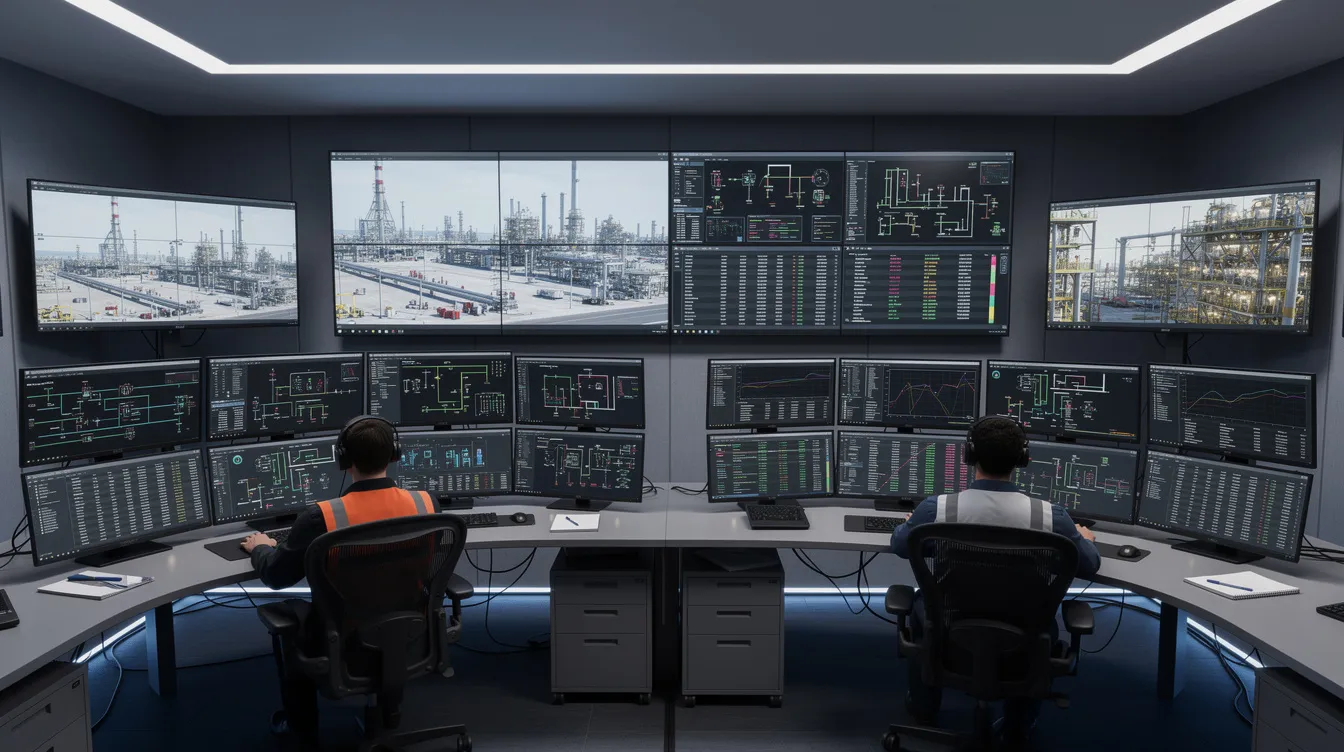
PLC- and SCADA-based automation is now standard in modern solvent extraction plant machinery, especially above 500 TPD. Automation delivers optimum level control, high performance consistency, reduced manpower per tonne and improved energy efficiency through better control of steam and cooling water – all contributing to cost effective operation.
The main automation layers include:
- Field instruments: temperature, pressure, flow and level transmitters, online solvent vapour detectors, oxygen sensors in solvent atmospheres, and moisture sensors.
- PLC control: interlocks for safety (e.g., shutting solvent supply if vapour concentration exceeds threshold), control of extractor feed rate, DTDC steam temperatures and evaporator vacuum levels.
- SCADA or DCS: real-time visualisation, alarm management, historical trend logging, energy consumption tracking and daily KPIs for oil yield, hexane loss and utility usage.
Specific control loops cover temperature control in conditioners and DTDC trays, level and pressure control in the extractor and evaporators, and safety interlocks for emergency stops. Advanced technology trends include integration of production data with ERP systems for cost tracking, predictive maintenance using vibration and bearing temperature monitoring for critical rotating machinery, and remote monitoring options where OEMs assist plants in fine-tuning parameters. These capabilities support an environmentally friendly process with lower energy consumption and minimal hexane losses – combining low maintenance with high efficiency.
Machinery Selection Criteria for Indian Industrial Projects
Selecting solvent extraction equipment for Indian projects requires evaluating vendors on technical, commercial and contractual dimensions. The following checklist provides a practical framework:
Technical evaluation:
- Proven reference installations in similar capacities and raw material types within India
- Demonstrated extraction efficiency and achievable residual oil in meal, supported by data from running plants, not marketing brochures
- Hexane loss figures expressed as realistic ranges, verified against actual plant performance for better quality outcomes
Commercial and lifecycle evaluation:
- Capital cost versus lifecycle cost encompassing energy use, spares, labour and solvent loss
- Availability and pricing of critical spare parts in India, especially for imported machinery components
- Vendor capacity to supervise erection, commissioning and operator training – essential for a leading manufacturer claim
Contractual aspects:
- Clear performance guarantees for capacity, oil recovery and solvent recovery efficiency within defined raw material quality bands
- Defined timelines for supply, erection and commissioning with liquidated damages clauses
- Warranty durations covering major rotating equipment, screen wires, chains and control systems
Local context:
- Ability to handle fluctuations in raw material quality and moisture content across seasons
- Support for local-language training and documentation
- Responsive after-sales service with realistic service-level commitments for turnkey solutions
These criteria should be applied systematically during vendor evaluation to ensure that the selected machinery delivers maximum oil yield and efficient extraction over the project’s operating life, not just the lowest initial quotation.
Machinery Cost and Capital Investment Considerations
Solvent extraction plant machinery cost is usually the single largest component of fixed capital investment, especially for capacities above 500 TPD. The core extraction line – extractor, DTDC, miscella distillation and solvent recovery system – typically accounts for 40–50% of total plant capital expenditure.
Major machinery-related cost heads include:
- Core extraction and distillation equipment
- Oilseed preparation systems (cleaning, flaking, conditioning, expansion) and meal handling
- Solvent storage, fire protection and safety systems
- Utilities (boilers, thermic fluid heaters, cooling towers, water treatment, power distribution)
- Instrumentation, PLC/SCADA and automation
- Erection, commissioning, insulation and painting
- Freight, insurance, statutory taxes and import duties where applicable
- Civil and structural works linked to machinery (foundations, pipe racks, support structures)
- Engineering, project management and contingency provisions
From a DPR perspective, machinery cost feeds directly into depreciation calculations, interest during construction, debt–equity structure and the repayment schedule. For a comprehensive treatment of investment components and cost modelling, readers may refer to Solvent Extraction Plant Setup Cost and Investment, which focuses specifically on project cost estimation.
Technical and Financial Feasibility of Solvent Extraction Machinery
As a practising Chartered Accountant preparing DPRs for industrial projects, I look at solvent extraction machinery not only as a technical system but as the primary driver of operating economics. Financial modelling aids in assessing project profitability and capital requirements – and the quality of that modelling depends directly on how accurately machinery performance is represented.
Key assumptions that connect machinery to financial projections include oil recovery percentage, residual oil in meal, hexane loss per tonne of raw material, and steam and power consumption per tonne. A small shortfall in extraction efficiency – say 1% lower oil recovery – on a 2,000 TPD plant translates into hundreds of tonnes of lost oil annually, directly eroding EBITDA. Similarly, excess hexane loss or steam consumption can make a plant uncompetitive even if its machinery was cheaper initially. The payback period for solvent extraction projects typically ranges from 1 to 3 years for well-structured investments, but this depends entirely on realistic operating assumptions.
Key considerations for project finance include cost assessment and working capital analysis. A project feasibility study evaluates the practicality of proposed projects by testing whether machinery performance, capacity utilisation and raw material availability can sustain the proposed investment and borrowing. I incorporate sensitivity analysis in every DPR, testing variations in raw material prices, crude oil and DOC realisations, and deviations from promised solvent recovery or power consumption.
For a detailed analysis of how extraction efficiency and yield affect profitability, readers can review Soybean Oil and Meal Recovery, Yield and Profitability. For understanding how these technical assumptions translate into CMA Data and bank finance discussions, Soybean Oil Processing Plant Financial Projections, CMA Data and DSCR illustrates the connection. Promoters interested in ROI, IRR and sensitivity modelling can study Soybean Crushing Plant Feasibility Study, ROI and IRR for a more detailed financial framework.
A technically strong plant with poor financial structuring can struggle, just as an over-leveraged project cannot survive even with energy efficient, high performance machinery. Both dimensions must be addressed together.
Common Mistakes in Solvent Extraction Plant Machinery Selection
Several recurring issues are observed in Indian solvent extraction projects:
- Selecting on lowest quotation alone without evaluating extraction efficiency, solvent consumption or vendor credibility. Cheaper machinery that leaks more hexane or consumes more steam will cost more over its lifetime.
- Under-investing in seed preparation equipment – skimping on cleaners, dehullers and conditioners leads to poor flake quality, higher residual oil in meal and reduced plant performance.
- Ignoring integration between sections: mismatched capacities between preparation, extraction and distillation create bottlenecks. If the DTDC cannot handle the extractor’s meal output, the entire line slows down.
- Underestimating solvent safety requirements by skipping vent absorbers, loose-flanging equipment or avoiding flameproof fittings to save initial cost.
- Overestimating capacity utilisation – assuming 330+ operating days at near-full load without accounting for maintenance shutdowns, raw material shortages or monsoon disruptions.
- Neglecting utilities and off-sites, resulting in undersized boilers, cooling towers or electrical systems that constrain plant throughput.
- Failing to plan for future expansion, leading to costly retrofits when the promoter wants to add capacity or integrate a refinery.
These mistakes directly affect bankability. Lenders and experienced appraisers question projections when technical assumptions appear inconsistent with the proposed machinery configuration. A credible DPR requires alignment between what the machinery can deliver and what the financial model assumes.
Role of a Chartered Accountant in Solvent Extraction Project Planning
My role as a Chartered Accountant in solvent extraction project planning is focused on financial structuring, feasibility analysis and documentation – not on mechanical design or process engineering.
Through Project Report Bank, I provide:
- Preparation of detailed, bankable DPRs for solvent extraction plants, incorporating vendor quotations and realistic technical assumptions
- Financial projections – profit and loss, balance sheet, cash flow – aligned with machinery performance data from suppliers
- CMA Data preparation and bank loan proposal documentation for term loan and working capital finance
- DSCR calculation under multiple scenarios, break-even analysis, ROI and IRR assessment incorporating equipment cost, depreciation and finance cost
- Sensitivity analysis for key variables including raw material prices, product realisations and operating cost deviations
Project Report Bank provides customized financial and project documentation services. Industry-specific educational content on this platform supports project planning and execution for entrepreneurs evaluating solvent extraction investments.
I coordinate with mechanical and process consultants to obtain the technical parameters – extraction efficiencies, solvent consumption norms, power and steam requirements – that underpin the financial model. Specialised functions such as detailed engineering design, plant layout, statutory safety approvals, HAZOP studies and PESO clearances remain the responsibility of qualified technical professionals and vendors.
Frequently Asked Questions
What machinery is required for a typical edible oil solvent extraction plant?
A complete plant requires raw material handling, cleaning and grading, dehulling and preparation, flaking and conditioning, a continuous solvent extractor, DTDC, miscella distillation and stripping, solvent recovery condensers and separators, utilities (boilers, cooling towers, water treatment), PLC/SCADA automation, fire protection and pollution control systems. The specific configuration depends on feedstock type, capacity and whether the plant includes upstream crushing or downstream refining.
How long does it typically take to implement a solvent extraction plant project?
Project implementation schedules vary from 8 to 12 months from zero date to commercial operation for medium scale plants, and may extend to 14–16 months for larger capacities above 2,000 TPD. Actual timelines depend on land readiness, statutory approvals, machinery manufacturing lead times, monsoon conditions and the complexity of civil and structural work. Overly optimistic timelines can increase interest during construction and delay revenue generation.
Can solvent extraction machinery be integrated with an existing refinery or crushing plant?
Many projects integrate new extraction units with existing expellers or refineries, creating an environmentally friendly process chain that maximises value from raw material. However, this requires careful capacity balancing between the crushing, extraction and refining sections, adequate intermediate storage and coordinated utility planning. Such integration is explicitly addressed during DPR preparation to ensure financial projections reflect the combined operation accurately.
What factors influence solvent extraction plant machinery costs in India?
Major cost drivers include plant capacity, level of automation, extent of imported content versus indigenous machinery, complexity of the solvent recovery and safety systems, and site-specific civil and structural requirements. Machinery for a medium scale plant (500 TPD) will have a very different cost profile compared to a 2,000+ TPD multi-line installation. Current vendor quotations are essential for fixing realistic project cost in any DPR.
Why are vendor machinery quotations important for bank finance DPRs?
Up-to-date quotations help establish realistic project cost, depreciation schedules, interest during construction and term-loan requirements. They give bankers confidence that capacity and technology choices are grounded in actual offers rather than generic estimates. Performance guarantees embedded in vendor offers also support the extraction efficiency and solvent loss assumptions used in DSCR and profitability projections, making the project report more credible and bankable.
Conclusion
Appropriate solvent extraction plant machinery, robust process technology and well-defined equipment specifications together underpin extraction efficiency, solvent recovery, energy consumption and plant safety. Every equipment choice – from the type of continuous extractor to the number of effects in the miscella evaporation system – has measurable consequences for oil recovery, hexane loss, steam demand and operating cost.
From a Chartered Accountant’s perspective, machinery decisions directly influence DPR quality, DSCR, IRR, payback period and overall financial viability for capacities ranging from 500 to 5,000 TPD. Optimal extraction is achieved not just through advanced technology but through disciplined integration of technical specifications with sound financial structuring.
Planning a Solvent Extraction Plant?
CA Manish Gugliya, FCA, DISA (ICAI), provides professional assistance with Detailed Project Reports, financial projections, CMA Data, feasibility studies and bank finance proposals for industrial manufacturing projects. For project-report preparation and financial advisory enquiries, connect through ProjectReportBank.com, preferably via WhatsApp.