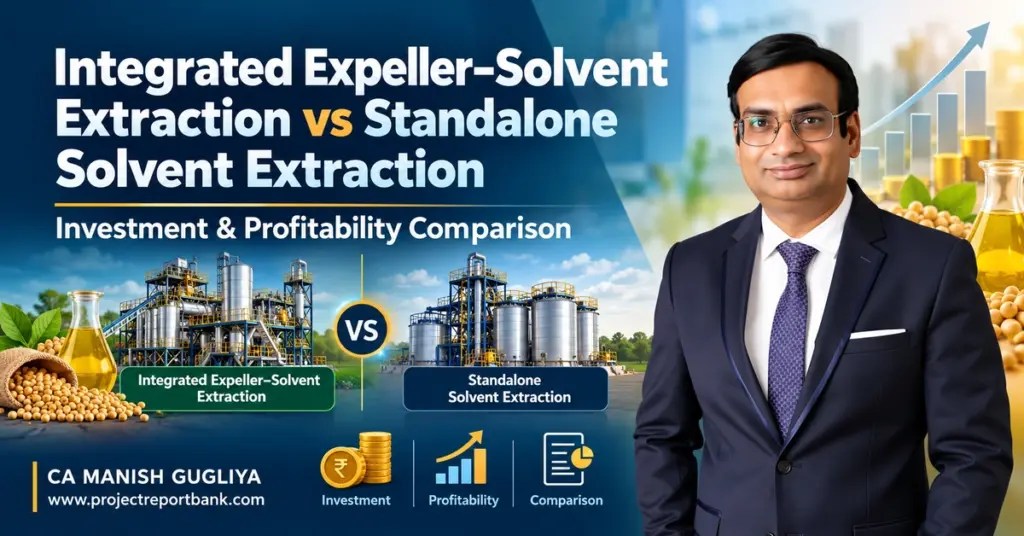
Choosing between an integrated expeller–solvent extraction plant and a standalone solvent extraction plant is fundamentally a decision about where your processing margin originates, how much capital you deploy, and what level of feedstock risk you are willing to carry. For most Indian investors processing high oil seeds such as mustard, sunflower or groundnut at 200–600 TPD, an integrated pre press and solvent extraction configuration generally delivers superior oil recovery, a stronger crushing margin per tonne and better long-term return on investment – provided the promoter can secure consistent seed supply and manage the operational complexity. For soybean processors or rice bran extractors working with low- to medium-oil content raw materials, a standalone direct solvent extraction plant often makes more financial sense, with lower machinery investment and a well-proven production process at scale.
Before any meaningful comparison, it is essential to distinguish three models:
- Model A – Integrated Expeller–Solvent Extraction: A single facility that combines seed preparation, mechanical pressing (expeller press or screw press) and solvent extraction of press cake to extract oil in two stages.
- Model B – Standalone Cake-Based Solvent Extraction: A plant that purchases expeller cake or oil cakes from external millers and uses the solvent extraction method to recover residual oil – no on-site seed crushing.
- Model C – Direct Solvent Extraction of Seeds: A facility processing prepared seeds (typically soybean or rice bran) through direct solvent extraction without a mechanical pre press stage.
The choice of model directly affects:
- Total project cost, working capital and bank finance structure – integrated plants carry higher CAPEX but may generate stronger cash flows, while cake-based plants are asset-light but margin-thin.
- Oil recovery efficiency and processing margin per tonne – integrated systems can lead to higher overall oil recovery efficiency than standalone systems, and solvent extraction plants achieve oil recovery rates of 95–99%.
- Exposure to raw material and product price volatility – seed-based models face commodity price swings on procurement, while cake-based models depend on external crushers for feedstock quality and continuity.
The short answer: An integrated expeller–solvent extraction plant typically offers better ROI and IRR when processing high oil content seeds at scale (≥200 TPD) with reliable seed procurement. A standalone solvent extraction plant – whether cake-based or direct extraction – is more sensible for rice bran, soybean clusters or situations where abundant cake supply exists locally and the promoter prefers lower upfront investment. In every case, a customised Detailed Project Report (DPR) with project-specific assumptions is essential before committing capital.
What Is an Integrated Expeller–Solvent Extraction Plant? (Model A)
An integrated expeller–solvent extraction plant combines seed preparation, mechanical pressing and solvent extraction within a single continuous facility. Integrated Expeller-Solvent Extraction combines mechanical pressing and solvent extraction, capturing value at both stages and offering flexibility across multiple oilseed types.
The process flow at a high level proceeds as follows:
- Seed cleaning and preparation: Removal of stones, foreign material, de-hulling where required, followed by conditioning, cracking and flaking to increase surface area and soften the seed material.
- Mechanical pre-pressing: Prepared seeds pass through an expeller press or screw press. Mechanical pressing can remove 60% to 80% of the oil from seeds initially, producing press oil and a residual oil cake.
- Solvent extraction of press cake: The press cake enters the solvent extractor, where food-grade n-hexane – the most commonly used solvent in the edible oil processing industry – dissolves the remaining oil. Hexane dissolves residual oil efficiently due to its low boiling point, forming a miscella (oil-solvent mixture).
- Desolventisation, toasting and meal processing: The extracted meal passes through the DTDC (Desolventiser-Toaster-Dryer-Cooler) to remove remaining solvent and produce finished de-oiled meal.
- Distillation and solvent recovery: Miscella is distilled to separate crude oil from hexane. A well-maintained plant can achieve hexane recovery rates above 99.5%, with hexane vapours condensed and recycled.
Key equipment blocks include the seed preparation line, expeller section with filtration, solvent extractor, DTDC, distillation columns, condensers and solvent recovery systems, plus utilities such as boilers, cooling towers and power distribution.
Typical outputs and product streams:
- Crude oil from both the expeller and the extraction process – these can be blended or managed separately. Integrated systems allow for separate management of mechanically extracted and solvent-extracted oils, which can be advantageous for product quality differentiation.
- De-oiled meal suitable for animal feed or export markets.
- Hulls or other by-products depending on seed type.
Main advantages:
- Better use of installed capacity and flexibility across different oilseeds with higher oil content (mustard, groundnut, sunflower). Integrated systems are suitable for high-oil content seeds.
- Lower solvent load per tonne because pre-pressing minimizes solvent consumption in extraction – mechanically removing the bulk of the oil before hexane extraction reduces the volume of extraction solvent required.
- Potentially higher overall crushing margin since value is captured from both expelling and extraction stages, maximizing yield from each tonne of seed.
Key limitations and complexities:
- Higher CAPEX due to the additional expeller section, seed handling equipment, filtration and upstream civil infrastructure. Integrated expeller systems generally require higher initial investment than standalone systems.
- More complex operations and maintenance; requires trained technical manpower to synchronise preparation, pressing and extraction.
- Higher base-load for utilities (steam, power, cooling) and stricter safety compliance due to hexane handling, explosion proof equipment requirements and PESO approvals.
What Is a Standalone Solvent Extraction Plant? (Models B & C)
“Standalone solvent extraction” covers two distinct business configurations that must not be mixed for financial comparison. The extraction process, equipment and safety infrastructure overlap substantially, but the raw materials, revenue model and risk profile differ significantly.
Model B – Cake-Based Standalone Extraction (Purchased Oilcake)
This model involves procuring expeller cake or other high-oil residue from third-party oil millers and then using the solvent extraction method to recover residual oil. There is no seed crushing or expeller section on-site. The revenue model is built around the extraction margin – the difference between the cost of purchased cake and the combined value of recovered oil plus de-oiled meal.
Standalone Solvent Extraction skips mechanical pressing and uses direct solvent application to extract oil from purchased cake. The business boundary runs from cake procurement to extracted products, and margins depend heavily on residual oil content in the incoming cake, moisture levels and supply agreements.
Model C – Direct Solvent Extraction of Seeds (No Expeller Pre-Press)
Here, appropriately prepared low-oil-content seeds or oil bearing materials – most commonly soybean (~18–20% oil content) or rice bran – enter the solvent extractor directly after cleaning, flaking and conditioning. Unlike mechanical pressing approaches, the entire oil content is extracted via the solvent route. This is standard practice for soybean in India and globally, where direct solvent extraction achieves oil yields over 95%.
Equipment includes seed preparation machinery, flaking rolls or expanders, the solvent extractor, DTDC, distillation and solvent recovery systems. Standalone systems require careful raw material preparation for efficient solvent extraction – flake thickness, moisture content and temperature control are critical to extraction efficiency.
Shared features of both standalone models:
- Capital is concentrated in the solvent extraction section, distillation, solvent recovery and associated utilities – the expeller machinery cost is absent.
- High dependence on reliable supply of suitable feedstock at competitive prices.
- Close alignment with typical large scale solvent extraction facilities operating across India’s oilseed processing belts.
Major pros:
- Lower machinery investment compared to fully integrated plants (no expellers, press oil filtration or upstream seed handling).
- Ability to locate near rice mills, oil mills or soybean clusters where cake or bran is abundantly available – reducing logistics costs.
- Standalone systems are optimized for low- to medium-oil content seeds, delivering cost effective extraction when feedstock characteristics match the process design.
Major cons:
- Higher sensitivity to processing margin per tonne – margins tend to be thinner, especially in Model B where the purchased cake already has most oil removed.
- Less control over feedstock quality and continuity; contractual security with suppliers becomes a critical success factor.
- Direct solvent extraction may cause operational difficulties with high-oil seeds – high oil content materials can create issues with solvent circulation and extractor performance if not pre-pressed.
Integrated Expeller–Solvent Extraction vs Standalone Solvent Extraction – At a Glance
The following comparison snapshot summarises the key differences across all three models for investors evaluating their options before diving into detailed analysis.
| Factor | Model A – Integrated Expeller + Solvent Extraction | Model B – Cake-Based Standalone Extraction | Model C – Direct Solvent Extraction of Seeds |
|---|---|---|---|
| Best suited for | Investors with seed procurement capability processing high oil seeds at scale | Processors near clusters of expeller mills with abundant cake supply | Large scale soybean, rice bran processors focused on volume |
| Typical raw materials | Mustard, sunflower, groundnut, soybean, cottonseed | Purchased expeller cake, groundnut cake, rice bran cake | Soybean seed, rice bran, other low-oil materials |
| Minimum viable capacity (India) | ~200 TPD | ~100 TPD | ~100–200 TPD |
| Indicative CAPEX level | Higher (expeller + extraction + full utilities) | Moderate (extraction section + utilities only) | Moderate to high (preparation + extraction) |
| Oil recovery profile | High – 95–99% of total oil via combined method works | Moderate – limited by residual oil in incoming cake | High – 95–99% via direct extraction |
| Residual oil in meal | 0.5–1.5% | 0.5–1.0% (from cake starting point) | 0.5–1.0% |
| Dependence on external suppliers | Low (procures seed directly) | High (entirely dependent on cake suppliers) | Low to moderate (procures seed or bran) |
| Working capital intensity | High (seasonal seed procurement) | Moderate (cake bought in smaller lots) | Moderate to high (seed stocks) |
| Typical EBITDA margin potential | Higher (captures full crushing + extraction margin) | Lower (extraction margin only) | Moderate (full extraction but lower oil content) |
| Key risk drivers | Seed price volatility, operational complexity, utilisation | Cake price and quality, supplier dependence | Seed price, commodity cycles, utilisation |
Headline takeaways:
- Model A generally yields the highest integrated margin per tonne for high oil seeds when capacity utilisation exceeds 80% and seed procurement is secured.
- Model B is the most asset-light and easiest entry point but is more exposed to feedstock pricing and offers thinner margins – many processors choose this route when starting out or when local cake availability is strong.
- Model C is most appropriate for soybean and rice bran clusters focused on large scale production and thin but consistent margins, and is the standard method for edible oil extraction process in the Indian soybean belt.
- Both processing methods aim to maximize oil recovery, but the economics differ substantially based on feedstock oil content and procurement model.
Decisive Factor 1 – Raw Material Strategy and Market Dependence
Raw material strategy is often the single biggest determinant of profitability and risk in oilseed extraction projects. The cost of seeds or cake typically represents 75–85% of total operating costs, meaning even small shifts in procurement pricing or quality can swing margins dramatically.
Model A (Integrated): Requires direct seed procurement infrastructure – grading, storage, seasonal bulk buying and often forward contracts. The promoter benefits from full control over raw material quality and can potentially arbitrage seasonal price movements. However, this demands significant working capital and storage facilities for seeds, especially during harvest months.
Model B (Cake-Based Standalone): Entirely reliant on external oil millers for cake supply. The processor has less control over quality (residual oil percentage, moisture, free fatty acids levels) and pricing. Residual oil levels in the expeller cake are typically around 1% to 5%, depending on the source. If local expellers reduce crushing or shift to other buyers, feedstock continuity is at risk.
Model C (Direct Extraction): Similar to Model A for seed sourcing but typically focused on more standardised raw materials like soybean or rice bran. Soybean procurement in India follows well-established mandi and commission agent channels, though price volatility remains significant.
Location considerations are equally important – integrated plants benefit from proximity to major oilseed producing belts (Madhya Pradesh and Rajasthan for soybean and mustard respectively), while cake-based plants work best near clusters of expeller mills or rice mills.
Winner: Model A – for raw material control, quality assurance and procurement flexibility. However, Model B remains attractive where abundant, reliable cake supply exists at stable prices, and the promoter prefers to avoid the capital and complexity of seed procurement infrastructure.
Decisive Factor 2 – Oil Recovery, Extraction Efficiency and Processing Margin
Minor differences in oil recovery – even 0.5% change in residual oil in meal – can significantly shift annual EBITDA when processing 200–1,000 TPD. At 300 TPD running 300 days per year, a 0.5% improvement in recovery translates to meaningful additional revenue.
Model A: Oil is split between pre-press oil and extraction oil. Pre-press solvent extraction reduces residual oil to 6–8% in the cake exiting the expeller, and subsequent solvent extraction brings the final residual oil in meal to 0.5–1.5%. The combined extraction efficiency across both stages achieves high oil yield with moderate solvent load. Cost and energy consumption can be lower in integrated systems due to reduced solvent load per tonne of seed processed.
Model B: Value creation depends on the oil content of purchased cake. If incoming cake contains 5% residual oil, the extraction margin is built on recovering that 5% minus the 0.5–1.0% left in de-oiled meal. The absolute quantity of more oil recovered per tonne is smaller than in seed-based processing, which limits the margin envelope. Standalone solvent extraction can achieve residual oil contents below 1%.
Model C: Direct extraction of soybean (~18–20% oil) or similar materials processes the full oil content through the solvent route. Direct solvent extraction achieves oil yields over 95%, and solvent extraction reduces residual oil in meal to 0.5–1%. However, higher solvent circulation volumes are required compared to extracting pre-pressed cake, and direct solvent extraction requires complex equipment for safety given the larger volumes of chemical solvent in circulation.
The processing margin per tonne must be calculated at the correct boundary – seed to products for Models A and C versus cake to products for Model B. A few hundred rupees per tonne swing in the spread between raw material cost and product realisation can change DSCR meaningfully. For detailed yield and recovery calculations for soybean, the mass balance must account for moisture loss, extraction losses and meal quality specifications.
Winner: Model A for high-oil seeds – capturing more oil per tonne at lower marginal cost through the combined extraction method. For low-oil seeds like soybean, Model C is technically and economically equivalent or slightly superior, since pre-pressing adds cost without proportionate benefit. Research confirms that solvent extraction achieves oil production of approximately 43–44 kg per 100 kg of rapeseed/sunflower seed versus ~39–40 kg via mechanical pressing alone.
Decisive Factor 3 – Capital Investment, Complexity and Scalability
Investors must balance higher CAPEX and complexity against long-term margin potential and the ability to scale or diversify.
Model A: Requires the full suite of machinery – seed preparation, expellers, filtration, solvent extractor, DTDC, distillation, solvent recovery – plus comprehensive utilities and safety infrastructure. The minimum economically viable capacity for integrated plants is generally ~200 TPD to justify the additional pre-pressing investment. However, integrated plants offer superior scalability: they can later integrate oil refining, specialty meal lines, packing or even biodiesel units.
Model B: The simplest to implement – no expeller section, simpler seed preparation. Minimum capacity for financial viability is 100 TPD, making it accessible at smaller investment levels. Operating costs increase significantly below 100 TPD capacity. However, scalability is constrained by cake availability, and adding an expeller section later may require significant layout changes.
Model C: Requires thorough seed preparation (flaking, conditioning, possibly expanding) and the full extraction and solvent recovery train. At 200+ TPD, this method works efficiently for large scale operations in soybean processing. Scalability is good within the soybean and rice bran segments.
How lenders view complexity: More complex integrated plants attract higher appraisal scrutiny from banks but can demonstrate potentially stronger economics when well-structured with adequate sensitivity analysis. Simpler cake-based plants are easier to evaluate but draw more questions about feedstock contracts and off-take agreements. For detailed capacity planning considerations for 300–2,000 TPD plants, scale economics play a decisive role.
Winner on CAPEX simplicity: Model B. Winner on long-term scalability and diversification: Model A – provided the promoter has the capital capacity and operational bandwidth.
Capital Investment and Project Cost Comparison
The figures below are illustrative, based on typical 2026 Indian conditions. Actual costs will vary by capacity, location, technology supplier and site-specific requirements. A 100 TPD solvent extraction plant costs INR 5–12 crore for core machinery and process equipment, while total project costs including civil works, utilities and working capital are substantially higher.
Main cost heads:
- Land and site development: Industrial zoning, approach roads, compound wall; area requirement varies by model and capacity.
- Civil construction: Process building, tank farm, utilities block, warehouse, administration and worker facilities.
- Plant and machinery:
- Integrated (Model A): Seed preparation, expellers, filtration, extractors, DTDC, distillation, solvent recovery – the expeller section adds 15–25% to machinery cost over standalone.
- Standalone (Models B & C): Preparation as needed, extractors, DTDC, distillation, solvent recovery – no expeller machinery.
- Utilities: Boiler or thermic fluid heater, cooling towers, power distribution, water treatment.
- Storage and handling: Hexane storage tanks (bunded, PESO-compliant), seed/cake silos, oil tanks, meal godowns.
- Safety and compliance: Explosion proof equipment, fire detection and suppression systems, hexane LEL monitoring, effluent treatment.
- Pre-operative expenses, contingencies, interest during construction and margin for working capital.
Illustrative CAPEX Comparison (300 TPD Soybean Plant)
| Cost Head | Model A (Integrated) | Model B (Cake-Based) | Model C (Direct Extraction) |
|---|---|---|---|
| Land & site development | Moderate–Higher | Moderate | Moderate |
| Civil construction | Higher (larger footprint) | Lower | Moderate |
| Plant & machinery | ₹12–18 crore range | ₹8–13 crore range | ₹9–14.5 crore range |
| Utilities (boiler, cooling, power) | Higher (dual-section load) | Moderate | Moderate |
| Storage, tanks, handling | Higher (seed + hexane) | Moderate (cake + hexane) | Moderate–Higher |
| Safety, pollution control, PESO | Similar across all | Similar across all | Similar across all |
| Pre-operative & contingencies | Higher | Moderate | Moderate |
| Total indicative project cost | ₹30–55 crore | ₹22–38 crore | ₹26–45 crore |
Note: Ranges are broad bands for general guidance. Actual costs require project-specific quotations and a detailed techno-economic evaluation.
Machinery and equipment typically represent ~40–50% of total CAPEX in solvent extraction plants, while civil work and utilities together can approach a similar share. Hidden costs – land development, PESO-related infrastructure, pollution control systems, fire NOC compliance – can together equal or exceed the machinery cost in large projects. For a deeper breakdown of solvent extraction plant cost in India, each cost head must be evaluated against site-specific conditions.
As a practising CA preparing bankable DPRs, I assess project cost reasonableness by cross-referencing equipment quotations, verifying civil cost estimates against current construction indices, and ensuring that no material cost head is omitted – especially utilities and safety infrastructure, which are frequently underestimated by first-time promoters.
Machinery, Production Capacity and Plant Infrastructure
Matching machinery capacity across all sections – preparation, pressing (where applicable), extraction and solvent recovery – is critical to avoid bottlenecks and under-utilisation. An oversized extractor paired with an undersized preparation line, or vice versa, directly erodes operational efficiency and financial returns.
Capacity planning:
- Determine TPD based on expected raw material availability over at least 300 working days per year. Indian oilseed processing plants often run at only 30–40% utilisation due to seasonal and fragmented supply, which dramatically raises per-unit fixed costs. Target utilisation of ≥80% is essential for healthy financial returns.
- For integrated plants, the expeller and extractor must be synchronised – for example, a 300 TPD seed preparation line feeding a 300 TPD expeller section and a matched extraction capacity for the resulting press cake.
- For standalone models, rectify extractor size to expected cake or seed supply, with some allowance for processing multiple feedstocks where feasible.
Key machinery considerations:
- Integrated plants require coordination between seed preparation (cleaners, de-stoners, crackers, conditioners, flaking rolls), the expeller or screw press section, and the downstream solvent extraction machinery – each section must be sized to avoid starving or overloading the next.
- Standalone plants focus on optimising the solvent extractor (rotary or horizontal belt type), DTDC, distillation columns and solvent recovery condensers.
Land and layout:
- Integrated plants require larger land parcels due to separate preparation, pressing and extraction zones, plus raw seed storage.
- All models require strict separation of hazardous solvent areas from non-hazardous zones per PESO norms and compliance requirements. Hexane is highly flammable with a flash point of −22°C and forms explosive vapour-air mixtures at 1.1–7.5% concentration – making layout planning a safety imperative, not merely a regulatory formality.
- Fire safety systems, explosion proof equipment, LEL sensors and bunded hexane storage must be incorporated from the design stage.
Oil Recovery, Yield and Extraction Efficiency
Small changes in recovery percentages shift the topline substantially at scale. For a 300 TPD plant operating 300 days annually, even a 0.5% improvement in residual oil in meal can add several crores to annual revenue.
Typical oil contents and yields (illustrative assumptions):
- Soybean: 18–20% oil content in seed. Direct solvent extraction (Model C) achieves residual oil in meal of 0.5–1.0%. Mechanical pressing yields only 60–70% of oil from seeds, making direct extraction the preferred method for this low-oil seed.
- Mustard / rapeseed: 35–40% oil content. Pre press + solvent extraction (Model A) is strongly favoured because the expeller recovers the bulk of oil mechanically, and subsequent extraction recovers nearly all remaining oil with reduced solvent load. Solvent extraction achieves oil recovery rates of 95–99% overall.
- Sunflower and groundnut: High oil content (35–45%) – generally favour pre press + extraction at scale, with special attention to product quality considerations (cold-pressed premium, FFA management).
- Rice bran: More suited to direct solvent extraction (Model C) or cake-based extraction (Model B) depending on sourcing logistics near rice mills.
Illustrative Mass Balance – 1 Tonne of Soybean Seed
| Stage | Model A (Integrated) | Model C (Direct Extraction) |
|---|---|---|
| Seed input | 1,000 kg (19% oil) | 1,000 kg (19% oil) |
| Oil from pre-press | ~110–120 kg | – |
| Oil from solvent extraction | ~65–75 kg | ~180–185 kg |
| Total crude oil recovered | ~180–185 kg | ~180–185 kg |
| Residual oil in meal | ~7–10 kg (~0.8–1.2%) | ~5–8 kg (~0.5–1.0%) |
| De-oiled meal produced | ~780–790 kg | ~780–790 kg |
For soybean, Models A and C deliver similar total recovery because the oil content is low enough that direct extraction is highly efficient. The integrated model adds unnecessary complexity for this seed.
Illustrative Mass Balance – 1 Tonne of Purchased Soybean Expeller Cake (Model B)
| Parameter | Model B |
|---|---|
| Cake input | 1,000 kg (~5% residual oil) |
| Oil recovered via solvent extraction | ~40–45 kg |
| Residual oil in de-oiled meal | ~5–8 kg (~0.5–0.8%) |
| De-oiled meal produced | ~940–950 kg |
The absolute oil recovered per tonne is much lower in Model B because most oil was already removed by the external expeller. The margin comes from the spread between cake cost and the combined value of extracted oil plus de-oiled meal.
Technical aspects affecting efficiency:
- Seed moisture (optimal: 10–12% depending on seed), flake thickness, extraction temperature (higher temperatures improve extraction efficiency significantly), and residence time in the extractor all affect recovery rates.
- Hexane consumption is typically 1–3 litres per tonne processed in a well-run plant. For soybean oil yield and profitability calculations, these consumption norms directly impact operating cost.
- Hexane has a maximum residue limit of 1 mg/kg in final oil, requiring efficient distillation and minimal waste in the recovery circuit.
Operating Cost and Processing Margin per Tonne
Operating cost and margin must be calculated at the correct boundary for each model:
- Models A and C: From purchased oilseed to crude oil + meal (integrated crushing margin).
- Model B: From purchased cake to extracted oil + de-oiled meal (extraction margin only).
Major operating cost components:
- Raw material or cake cost per tonne (typically 75–85% of total cost for seed-based models).
- Steam consumption: higher for integrated plants running both expeller and extraction sections.
- Power consumption: approximately 15–25 kWh per tonne for soybean extraction configurations.
- Hexane consumption is 1–3 litres per tonne processed – a direct operating cost item. Hexane recovery rates can exceed 99.5% in well-maintained plants, keeping consumption near the lower end.
- Labour, maintenance, consumables, packing (if applicable), transportation.
- Interest on working capital and bank charges.
Illustrative Per-Tonne Processing Margin – 300 TPD Soybean
| Parameter | Model A (Integrated) | Model B (Cake-Based) | Model C (Direct Extraction) |
|---|---|---|---|
| Raw material cost (seed or cake) | ₹40,000–45,000/T seed | ₹30,000–35,000/T cake | ₹40,000–45,000/T seed |
| Total product realisation (oil + meal) | ₹43,000–48,000/T seed eq. | ₹31,500–37,000/T cake eq. | ₹43,000–48,000/T seed eq. |
| Gross processing spread | ₹3,000–4,500/T | ₹1,500–2,500/T | ₹3,000–4,500/T |
| Less: Operating costs (utilities, hexane, labour, maintenance) | ₹1,200–1,800/T | ₹800–1,200/T | ₹1,000–1,500/T |
| Net processing margin (approx.) | ₹1,500–3,000/T | ₹500–1,500/T | ₹1,800–3,200/T |
These figures are illustrative and based on assumed commodity prices. Actual margins depend on prevailing seed, oil and meal prices, regional procurement costs and operational efficiency. Do not treat these as guaranteed outcomes.
Margin sensitivity: The processing margin is highly sensitive to:
- Spread between oilseed cost and oil + meal realisation for Models A/C – a ₹500/T adverse shift in seed price without a corresponding product price increase can halve the margin.
- Spread between purchased cake price and extracted product value for Model B – thinner to begin with, leaving less buffer.
Revenue Model and EBITDA Profitability Comparison
Revenue streams under each model:
- Model A: Crude oil from expeller + extraction (combined or sold separately), de-oiled meal for animal feed or export, possibly hulls and by-product income.
- Model B: Extracted crude oil and de-oiled meal from purchased cake; potential toll-extraction contracts with local millers.
- Model C: Crude oil and de-oiled meal from seed – similar to Model A but without the split between press oil and extraction oil.
Illustrative Annual EBITDA – 300 TPD Soybean, 270 Operating Days, 85% Utilisation
| Parameter | Model A (Integrated) | Model B (Cake-Based) | Model C (Direct Extraction) |
|---|---|---|---|
| Annual throughput | ~68,850 T seed | ~68,850 T cake | ~68,850 T seed |
| Gross revenue (oil + meal) | ~₹300–330 crore | ~₹220–255 crore | ~₹300–330 crore |
| Total operating costs | ~₹285–310 crore | ~₹210–245 crore | ~₹282–305 crore |
| Indicative EBITDA | ₹12–22 crore | ₹6–12 crore | ₹14–25 crore |
| EBITDA margin % | ~4–7% | ~3–5% | ~5–8% |
All figures are rounded estimates for educational purposes only. Revenue and cost assumptions are hypothetical. Payback period for a 100 TPD plant is 3–5 years under favourable conditions; larger plants can achieve faster payback if utilisation is high.
Key observations:
- Model C tends to show higher EBITDA per tonne for soybean because it avoids the extra expeller-related OPEX without sacrificing recovery for this low-oil seed.
- Model A demonstrates its advantage when applied to high oil seeds like mustard or groundnut, where the expeller captures more oil economically than direct extraction.
- Model B shows greater volatility in EBITDA due to dependence on external cake pricing and narrower margins.
- Model A and C offer better potential for later integrating refining, edible oil production packing lines and value-added products. For a comprehensive feasibility, ROI and IRR analysis framework, all revenue streams and cost heads must be modelled at the project-specific level.
Working Capital, Inventory and Cash Credit Requirements
Oilseed and cake businesses are inventory-heavy. Working capital requirements significantly impact total project cost and bank cash-credit limits.
Working capital components:
- Raw material inventory: Integrated seed-based plants (Models A and C) generally hold larger seed stocks seasonally – often 30–60 days of stock during and immediately after harvest, declining to 15–20 days off-season. Cake-based plants (Model B) may operate with smaller absolute inventory (10–20 days) but face higher price risk on contracted cake.
- Finished goods inventory: Crude oil is typically held 7–15 days; meal 10–20 days depending on dispatch schedules and market conditions.
- Debtors / receivables: Edible oils are often sold on 15–30 day credit; meal sales may carry 7–21 day credit terms.
- Creditors: Seed purchases are often cash or short-credit; cake purchases may have 7–15 day credit.
Illustrative Working Capital – 300 TPD Plant
| Component | Model A/C (Seed-Based) | Model B (Cake-Based) |
|---|---|---|
| Raw material stock (30 days) | ₹35–40 crore | ₹27–32 crore |
| Finished goods stock (15 days) | ₹12–15 crore | ₹9–12 crore |
| Debtors (21 days) | ₹18–22 crore | ₹14–17 crore |
| Less: Creditors (10 days) | ₹(12–14) crore | ₹(9–11) crore |
| Net working capital requirement | ₹55–65 crore | ₹42–50 crore |
These figures highlight why working capital can rival or exceed fixed capital investment in oilseed processing. Bank cash-credit limits are typically sanctioned at 60–75% of stock and receivable value.
Higher working capital increases the interest burden, which directly affects DSCR. For CMA Data preparation and bank finance structuring, accurate estimation of stock holding periods and receivable cycles is essential.
Financial Feasibility – ROI, IRR, DSCR and Payback Period
It is important to distinguish between:
- Accounting ROI: Profit after tax ÷ total investment – a simple snapshot of annual return.
- Project IRR: Internal rate of return on total project cash flows before financing structure – measures the project’s intrinsic viability.
- Equity IRR: Return on promoter’s cash flows after servicing the term loan – what the investor actually earns.
Comparative Financial Framework (Illustrative – 300 TPD Soybean)
| Assumption / Metric | Model A (Integrated) | Model B (Cake-Based) | Model C (Direct Extraction) |
|---|---|---|---|
| Total project cost | ₹42–55 crore | ₹30–40 crore | ₹35–48 crore |
| Promoter contribution (30%) | ₹13–17 crore | ₹9–12 crore | ₹11–14 crore |
| Term loan (70%) | ₹29–38 crore | ₹21–28 crore | ₹25–34 crore |
| Interest rate (assumed) | 10.5–11.5% | 10.5–11.5% | 10.5–11.5% |
| Loan tenure | 7 years | 7 years | 7 years |
| Indicative EBITDA | ₹12–22 crore/year | ₹6–12 crore/year | ₹14–25 crore/year |
| DSCR (target range) | 1.5–2.0x | 1.25–1.6x | 1.5–2.2x |
| Payback period | 4–6 years | 4–7 years | 3–5 years |
Note: These are sample assumptions for comparison only. Proper financial modelling requires project-specific CMA Data, actual quotations, verified market prices and realistic utilisation assumptions. IRR and DSCR should never be quoted without a supporting cash-flow model.
How IRR and DSCR typically behave:
- Integrated plants (Model A) for high oil seeds can show equity IRR of 18–28% at full utilisation but are more sensitive to seed price volatility and underutilisation.
- Standalone cake-based plants (Model B) may show more stable but lower returns – thinner margins mean less downside risk but also less upside.
- Direct extraction of soybean (Model C) delivers competitive IRR when scale is adequate and utilisation is high, with somewhat lower volatility than Model A because soybean processing margins tend to be more stable.
Proper financial modelling and CMA Data preparation by a qualified professional is essential before committing to any bank loan or investment decision. As a practising Chartered Accountant, I stress that lenders will scrutinise the reasonableness of every assumption – and rightly so.
Sensitivity Analysis and Downside Risk Scenarios
Sensitivity analysis is a mandatory component of bankable DPRs and bank appraisals. It reveals how robust the project is to adverse movements in key variables.
Key variables to stress-test across all three models:
- Oilseed / cake purchase price increase (+5%, +10%, +15%)
- Drop in crude oil or meal selling price (−5%, −10%)
- Change in extraction efficiency (residual oil rising from 0.8% to 1.5%)
- Change in utilisation (from 85% to 70% or 60%)
- Increase in energy costs or interest rate (+1–2 percentage points)
Example downside scenarios:
- Seed prices rise but product prices don’t follow: A ₹2,000/T increase in soybean seed cost without corresponding oil/meal price increase can reduce EBITDA by ₹12–15 crore annually for a 300 TPD plant – potentially pushing DSCR below the lender’s minimum threshold.
- Cake prices increase faster than product prices: For Model B, a ₹1,000/T increase in cake cost with flat oil and meal prices can eliminate the entire processing margin, turning the operation cash-negative.
- Lower plant utilisation due to raw material shortage: If utilisation drops from 85% to 60%, fixed costs are spread across fewer tonnes. For all models, this can reduce EBITDA by 30–40% and stretch payback by 2–3 additional years.
Indian plants face particular utilisation risk – average capacity utilisation across the sector is frequently only 30–40% due to seasonal supply and fragmented procurement. Lenders insist on such sensitivity checks, and at Project Report Bank, we incorporate multiple downside scenarios into all detailed financial models.
Which Technology Is More Suitable for Different Oilseeds?
Technology choice must always be aligned with feedstock characteristics, volumes and market positioning. Direct extraction is not universally superior, nor is integrated pressing. The decision matrix below guides the selection:
| Oilseed / Material | Recommended Model | Rationale |
|---|---|---|
| Soybean | Model C (Direct Extraction) or Model A where crushing + refining are combined | Low oil content (~18–20%) makes direct extraction the standard; pre-pressing adds cost without proportionate recovery gain. |
| Mustard / Rapeseed | Model A (Integrated Pre-Press + Extraction) | High oil content (~35–40%) means the expeller recovers large volumes mechanically, reducing solvent load and maximising crushing margin. |
| Sunflower | Model A (Integrated) at scale | High oil content (~38–45%) favours pre-pressing; special quality considerations for high-oleic varieties. |
| Groundnut | Model A (Integrated) or expeller-only for premium markets | Oil content ~42–48%; pre-pressing essential. Cold-pressed premium market exists but is small scale. |
| Rice Bran | Model C (Direct Extraction) or Model B (Cake-Based) | Low oil content (~15–22%); sourcing near rice mills is key; direct extraction or cake-based models are most appropriate. |
Decision bullets for investors:
- Multi-seed flexibility is achievable in integrated plants but requires careful machinery selection and preparation line design – dedicated lines are preferable for maximising product quality when processing volumes justify the investment.
- High free fatty acids levels in certain materials (rice bran, stored seeds) affect plant design, refining cost and final product realisation – assess FFA risk before finalising technology.
- Export-oriented meal markets (soybean DOC for animal feed) demand consistent quality, moisture and protein specifications – plants that reliably deliver high-quality meals command better margins.
- For a concrete example of Model A/C applied to soybean, refer to our Integrated Soybean Crushing, Extraction & Refining DPR.
Bank Finance and DPR Requirements in India
Indian banks typically require the following for sanctioning term loans and working capital to oilseed extraction projects:
- Bankable Detailed Project Report (DPR): Clear technology choice and capacity justification, with 5–7 year financial projections including IRR, DSCR and sensitivity analysis.
- CMA Data: For working capital assessment, including projected stock levels, debtor cycles and creditor periods by product.
- Machinery quotations: From reputable suppliers, with specifications matching the proposed capacity.
- Technical feasibility: Process flow, mass balance, utility requirements and compliance roadmap.
Key DPR elements I focus on as a practising CA:
- Realistic project cost and means of finance – over-optimistic cost estimates lead to cost overruns and under-financing during construction.
- Reasoned assumptions on processing margin per tonne, backed by industry references and current commodity price data – not aspirational figures.
- Alignment between raw material availability, plant capacity and marketing strategy – a 500 TPD plant in an area with only 200 TPD of available seed supply will never achieve target utilisation.
Requirements differ by model:
- Integrated plants (Model A) face higher technical appraisal complexity – lenders will scrutinise the synchronisation of pressing and extraction, utility sizing and operational capability.
- Cake-based plants (Model B) attract greater focus on feedstock contracts, supplier reliability and off-take agreements.
Professional support for DPR and CMA Data preparation is strongly recommended to avoid delays, rejection or under-financing. Safety and environmental regulations are crucial for both extraction methods due to volatile solvents – incomplete compliance documentation is a common reason for bank appraisal delays.
Investment Risks, Environmental Compliance and Operational Controls
Major risk categories:
- Commodity price volatility and margin compression: Edible oils and vegetable oil prices are subject to global commodity cycles, import duty changes and currency movements. The solvent extraction process delivers high yield but cannot compensate for adverse price spreads.
- Supply chain disruptions: Seeds and cake logistics, storage losses, quality degradation during transport – all affect profitability.
- Operational risks: Breakdowns, extraction efficiency loss, safety incidents involving hexane. There is pressure to replace hexane with greener alternatives, but food-grade n-hexane remains the primary solvent used in extraction across the industry.
Environmental and regulatory compliance in India:
- State Pollution Control Board consents for air emissions, water discharge and hazardous waste management.
- PESO approvals for storage and use of hexane – the organic solvent requires bunded storage, vapour monitoring and explosion-proof infrastructure. Hexane forms explosive vapour-air mixtures at 1.1–7.5% concentration, necessitating rigorous safety protocols.
- Fire NOC, Factory licence, FSSAI registration for edible oil production, and local building/industrial approvals.
Operational controls affecting financial performance:
- Hexane loss control and solvent recovery efficiency – the difference between 1.0 and 3.0 litres per tonne directly impacts per-tonne operating costs and presents an environmental hazard if uncontrolled.
- Boiler and energy efficiency, steam balance – integrated plants have higher utility loads and must optimise steam distribution between pressing and extraction sections.
- Maintenance schedules to minimise downtime and protect DSCR – unplanned shutdowns during peak processing season are particularly costly.
For a deeper dive into investment risks and profitability for soybean crushing plants, risk mitigation strategies should be documented at the DPR stage and reviewed annually.
Final Investment Decision – Integrated or Standalone?
There is no universal winner. The correct model depends on feedstock type and availability, scale of operations, investor’s capital capacity, proximity to raw materials and end markets, risk appetite and ability to manage operational complexity.
Choose an integrated expeller–solvent extraction plant if:
- You are processing high oil content seeds (mustard, sunflower, groundnut) at ≥200 TPD.
- You have secured or secureable seed procurement from major producing regions.
- You can manage the higher CAPEX and operational complexity with experienced technical staff.
- You seek the highest per-tonne margin and long-term scalability, including potential refining and packing integration.
- Your target utilisation is ≥80% and you have assessed downside scenarios in your DPR.
Choose a standalone cake-based solvent extraction plant (Model B) if:
- Abundant, reliable supply of suitable oil cakes exists near your proposed location.
- You prefer lower upfront investment and simpler operations.
- You have strong contractual relationships with local expellers or mills.
- You accept thinner but potentially more predictable margins in exchange for lower capital risk.
Choose direct solvent extraction for seeds (Model C) if:
- Your primary feedstock is soybean, rice bran or other low- to medium-oil content materials.
- You are operating at ≥200 TPD in a region with strong seed availability (e.g., soybean belt in Madhya Pradesh, Maharashtra, Rajasthan).
- You want a streamlined large scale production process focused on volume and consistent recovery rates.
In every case, a project-specific feasibility analysis and professional financial modelling – incorporating realistic commodity prices, utilisation assumptions and sensitivity analysis – is essential before finalising technology and capacity.
Need a Bankable DPR or Feasibility Study for an Oilseed Extraction Project?
I am CA Manish Gugliya, FCA, DISA (ICAI), and I have spent over 20 years preparing Detailed Project Reports, financial models and CMA Data for industrial projects including edible oil extraction plants, solvent oil extraction plants and integrated oilseed processing facilities. If you are evaluating whether an integrated expeller–solvent extraction plant or a standalone solvent extraction model is right for your specific location, capacity and feedstock mix, I can help you build a bankable financial case.
Services I offer:
- Customised Detailed Project Reports (DPR) for oilseed extraction plants – covering all three models discussed in this article.
- Financial projections, ROI and IRR analysis, and DSCR computation aligned with Indian bank appraisal requirements.
- CMA Data preparation and bank loan proposal support for term loan and working capital facilities.
- Feasibility studies and sensitivity analysis to support informed investment decisions.
Reach out via the Project Report Bank website or WhatsApp for a professional consultation.
Frequently Asked Questions
These FAQs address practical queries investors usually raise when choosing between integrated expeller–solvent extraction vs standalone solvent extraction.
What is the minimum viable capacity for an economically feasible solvent extraction plant in India?
For standalone solvent extraction (cake-based or direct seed-based), the minimum capacity for financial viability is 100 TPD. Operating costs increase significantly below 100 TPD capacity because fixed costs – utilities, safety systems, staffing – cannot be adequately absorbed. For integrated expeller–solvent extraction plants, the practical minimum is ~200 TPD to justify the additional pre-pressing investment. Smaller integrated units may be viable only where feedstock is hyper-local and secured.
How does the setup cost differ between integrated and standalone solvent extraction models?
Integrated plants carry 15–25% higher machinery costs than standalone extraction models due to the expeller section, seed handling and oil filtration equipment. A 100 TPD solvent extraction plant costs INR 5–12 crore for machinery alone; total project costs for a 300 TPD integrated plant can range from ₹30–55 crore versus ₹22–45 crore for standalone models. The extra cost comes from expellers, upstream preparation, larger civil structures and higher utility installations. Detailed costs always require project-specific quotations.
Which model offers better oil recovery and processing margin per tonne?
For high-oil seeds (mustard, sunflower, groundnut), integrated pre press + solvent extraction offers superior net recovery and higher margin per tonne – the expeller captures the bulk of oil at lower cost, and extraction recovers residual oil to below 1%. For low-oil seeds like soybean, direct solvent extraction (Model C) achieves equivalent recovery without the added cost of pressing. Solvent extraction plants achieve oil recovery rates of 95–99% in either configuration when well-operated.
What profit margins can I realistically expect from a solvent extraction plant?
EBITDA margins in well-run solvent extraction plants typically range from 3–8% of gross revenue, depending on model, feedstock and commodity cycles. Processing margins of ₹1,500–3,000 per tonne are achievable for seed-based models under normal market conditions, while cake-based models may yield ₹500–1,500 per tonne. Key factors that compress or expand margins include commodity price spreads, plant utilisation, extraction efficiency and energy costs.
How much working capital is required relative to project cost?
Working capital requirements typically equal 60–120% of fixed capital investment in oilseed extraction projects, reflecting the high value of raw material inventory. Banks structure cash-credit limits at 60–75% of eligible stock and receivable value. Seed-based models require larger seasonal working capital; cake-based models require less absolute working capital but face tighter margins.
Can I start with a standalone solvent extraction plant and later add an expeller section?
This staged approach is technically feasible but requires advance planning during the initial layout design – space must be reserved for the expeller building, utility connections and material handling routes. From a banker’s perspective, this phased approach is viewed cautiously; lenders prefer clear Phase 1 economics without dependence on Phase 2 expansion. The retrofit cost may also be higher than building integrated from the outset.
Is direct solvent extraction of soybean better than pre-press + extraction?
For soybean (18–20% oil content), direct solvent extraction is the standard and generally more cost effective approach in India and globally. Pre-pressing adds machinery and operating cost without proportionate benefit because the oil content is too low to justify mechanical extraction first. However, some integrated soybean processing facilities combine extraction with downstream refining and value-added products, where the integrated model serves a broader business purpose.
How do banks evaluate IRR, DSCR and break-even for oilseed extraction projects?
Indian banks typically require Project IRR of 15–20%+ and minimum DSCR of 1.3–1.5x over the loan tenure. Break-even utilisation should ideally be below 60% of installed capacity. Lenders examine projected cash flows, sensitivity analysis under adverse scenarios, and the reasonableness of assumptions on margin, utilisation and commodity prices. Realistic assumptions and thorough sensitivity analysis – prepared by a qualified professional – are more persuasive than optimistic projections.
What are the main regulatory approvals required before commissioning?
Key Indian approvals include: PESO approval for hexane storage and handling, State Pollution Control Board consent to establish and operate, Fire NOC from the local fire department, Factory licence, FSSAI registration for edible oil production, and local building/industrial area approvals. Timelines for these approvals can range from 3–12 months and may affect project cash flows and payback period if delayed. Safety and environmental regulations are crucial for both extraction methods due to volatile solvents used in the process.
How can Project Report Bank help me choose between integrated and standalone models?
Through tailored DPR preparation, financial modelling and advisory, we help investors evaluate which configuration – integrated expeller–solvent extraction, cake-based standalone or direct seed extraction – delivers better risk-adjusted returns for their specific feedstock, location, capacity and financial structure. Our analysis includes project cost estimation, revenue modelling, sensitivity analysis, CMA Data preparation and bank proposal support.
Author: CA Manish Gugliya, FCA, DISA (ICAI) | Project Report Bank