Key Takeaways
- A solvent extraction plant feasibility study must rigorously examine processing margins per tonne, total capital investment, working capital cycles, and sensitivity to oilseed and product prices before committing capital that can exceed ₹100 crore for larger facilities.
- Commercial-scale solvent extraction plants (300–2,000 TPD) in India are financially viable only when crude oil and de-oiled meal recoveries, capacity utilisation and risk-adjusted ROI and IRR are realistically modelled-not assumed from industry thumb rules.
- Investors must differentiate between project IRR and equity IRR; lenders focus on DSCR, break-even utilisation and cash-flow stability rather than optimistic margin estimates.
- Processing margin analysis for a defined oil bearing material (soybean, rice bran or other feedstock) is the backbone of any solvent extraction plant financial feasibility, supported by detailed DPR-level numbers.
- Project Report Bank, led by CA Manish Gugliya, prepares customised, bankable feasibility studies, DPRs, financial models and CMA Data specifically for solvent extraction and edible oil projects across India.
Introduction – Why Financial Feasibility Matters Before Investing
A feasibility study for a solvent extraction plant requires a systematic evaluation of multiple factors-technical, commercial, financial and regulatory-before an entrepreneur commits ₹80 lakh to ₹150 crore or more. Small changes in processing margin per tonne or capacity utilisation can convert an apparently lucrative manufacturing venture into a loss-making one.
A typical 500–1,000 TPD extraction plant handling raw materials such as soybean, cottonseed, sunflower, mustard or rice bran processes daily throughput often exceeding ₹1–2 crore in commodity value. Hexane is highly flammable and toxic to humans, making safety standards critical. Safety standards should address the use of volatile organic compounds and the corresponding flammability risks inherent in any hexane extraction facility. Technical feasibility alone-availability of extraction process know-how, oil extraction machinery-is not sufficient. An economic feasibility analysis covering working capital, bankability, and environmental impact assessments accounting for emissions, wastewater treatment and waste management ultimately decides whether banks and investors support the project.
Key risk drivers include volatile crude oil prices, de-oiled meal demand cycles, free fatty acids affecting refining loss, power and steam costs, and fluctuations in oil yield. A robust feasibility study identifies risks associated with raw material supply, pricing and regulatory compliance, and quantifies them over a 7–10 year projection horizon. A comprehensive financial model should project return on investment, payback period and sensitivity analysis across realistic scenarios.
Understanding the Business Economics of a Solvent Extraction Plant
The core business model involves purchasing oil bearing materials, processing them through preparation and hexane extraction, and selling crude oil plus de-oiled meal as two primary revenue streams. The production process includes seed preparation, extraction and distillation stages. Solvent extraction is preferred for large-scale oil production because it achieves 90 to 98% oil recovery rates, far exceeding what mechanical pressing alone can deliver.
The economics differ significantly depending on configuration. For high oil seeds like rapeseed or sunflower (35–45% oil content), processors typically use pre pressing followed by solvent extraction of the mechanically pressed cake. For lower-oil feedstocks like soybean flakes and rice bran, direct solvent extraction is more economical since mechanical pressing is not viable at those oil content levels. To understand how the solvent extraction plant process flow and solvent recovery system affects oil loss and financial performance, investors should study the detailed mass balance linking oil, moisture, solids and hexane through each stage.
Integrated units combining seed preparation, pre-press, solvent extraction and refining capture more value but require significantly higher capital investment. Standalone plants that purchase oil cakes operate with lower capex but narrower margins. Some plants operate on job-work or tolling basis, earning a fixed processing margin per tonne without commodity price exposure, while merchant plants carry full price risk. Market demand analysis should address both primary outputs and valuable by-products such as lecithin and soybean hulls. Understanding the revenue split between oil production and extracted meal is the starting point for any solvent extraction plant feasibility study.
Key Components of a Solvent Extraction Plant Feasibility Study
A proper feasibility study encompasses technical, commercial, financial and regulatory dimensions. Key factors include market demand, technical design, financial viability and regulatory compliance. Investors should assess raw material availability by evaluating local supply, seasonal patterns and procurement costs within a 200–300 km catchment area. Location assessment must consider proximity to mandis, rail sidings, ports, and solvent suppliers.
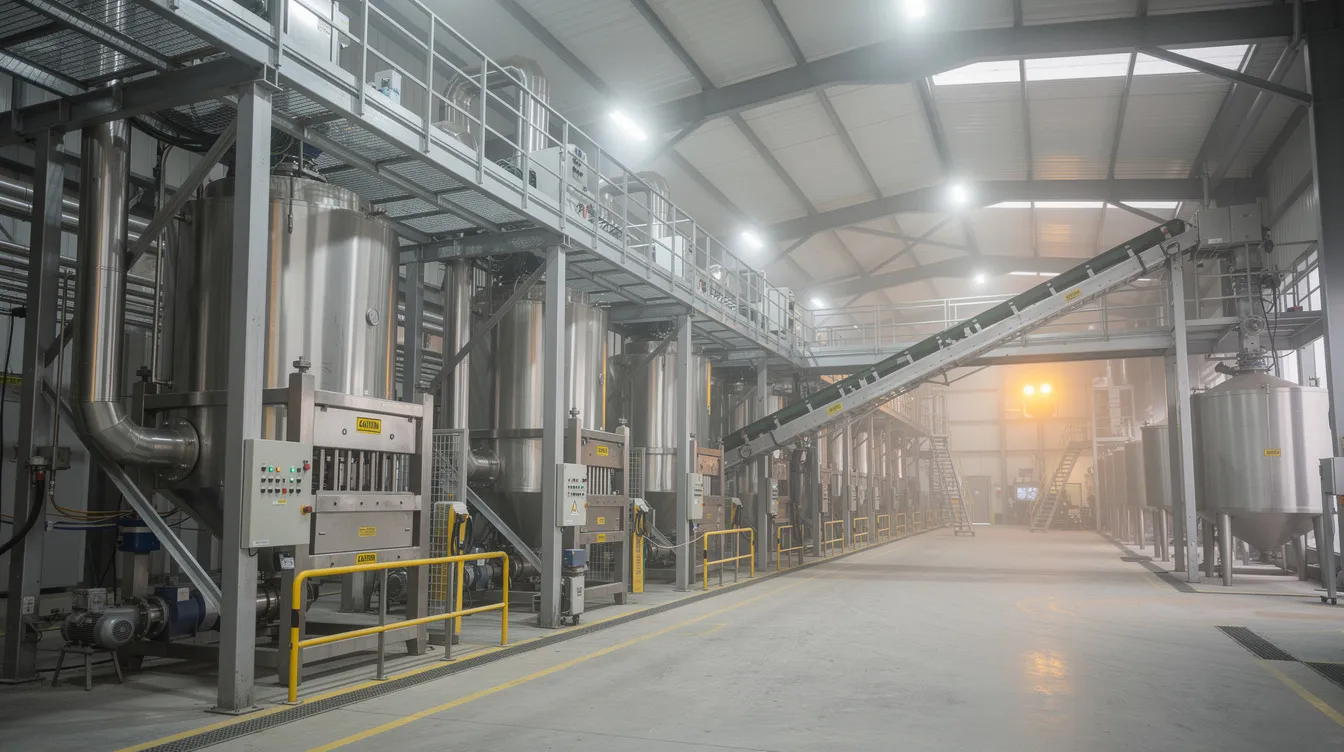
Capacity and configuration choices-300, 500, 1,000 or 2,000 TPD, single versus multi-oilseed-drive both capex and operating complexity. Technology selection covering extractor type (continuous loop extractors are major types used in large-scale operations), desolventizer-toaster-cooler (DTDC) and solvent recovery units should be validated against solvent extraction plant machinery and process technology benchmarks. Operating parameters such as hexane consumption (~0.46 kg/tonne), steam consumption (≤150 kg/tonne), power requirement (≤5 kWh/tonne) and extraction efficiency must be documented.
Adequate infrastructure is crucial for successful plant operations, including utilities, transportation and site suitability. Environmental and safety compliance-solvent vapour emissions, ETP, explosion-proof electricals, PESO licensing-adds both cost and regulatory complexity. Working capital requirements for oilseed inventory (15–30 days), crude oil, de-oiled meal and hexane stocks must feed directly into cash credit and interest cost assumptions. Readers evaluating land and infrastructure needs should review solvent extraction plant land, factory layout and utility requirements.
Capital Investment and Project Cost Assessment
Solvent extraction plants are capital-intensive. A 500 TPD multi-oilseed unit can require total project cost of ₹41–70 crore including machinery, civil work, utilities, approvals and working capital margin. Capital expenditure estimates must include equipment costs, civil works and installation expenses-each validated by current quotations, not outdated benchmarks. For detailed cost breakdowns, refer to solvent extraction plant setup cost and capital investment.
Major investment heads include land and site development, civil construction (godowns, extraction building, boiler house, tank farm, storage tanks), plant and machinery (seed preparatory equipment, percolation extractor, DTDC, distillation and solvent recovery), electrical and instrumentation systems including explosion-proof equipment, boiler and cooling infrastructure, fire-fighting and environmental protection systems. A DPR must clearly distinguish fixed capital investment from margin money for working capital and total capital investment, because each flows differently into depreciation, interest, break-even and ROI calculations. Realistic contingency (5–10%) and pre-operative expenses must be modelled explicitly.
Solvent Extraction Plant Processing Margin Analysis
Processing margin analysis per tonne is the heart of any solvent extraction plant feasibility study. For illustration, consider soybean flakes processed via the solvent extraction method using commercial hexane (extraction grade hexane contains 50–90% n-hexane by volume) as the most commonly used solvent. Hexane is the most commonly used solvent in extraction plants globally for soybean oil production.
Illustrative Per-Tonne Margin (Soybean – Hypothetical):
| Component | Value |
|---|---|
| Raw material cost (soybeans, delivered) | ₹60,000/tonne |
| Oil content of prepared seeds | 18% |
| Oil recovery (99% of available oil) | ~178 kg |
| Crude oil realisation (₹1,31,000/tonne) | ₹23,318 |
| De-oiled meal recovery (~780 kg, residual oil ~0.8%) | 780 kg |
| Meal realisation (₹43,872/tonne) | ₹34,220 |
| Gross output value | ₹57,538 |
| Gross processing margin | −₹2,462 |
This illustrative negative margin reflects recent market conditions where soybean crush margins turned negative at around −₹790/tonne. When oil and meal prices improve, the margin can swing to ₹1,000–₹3,000/tonne positive. Variable processing costs-hexane consumption, power, steam, fuel, labor costs, maintenance-typically add ₹1,500–₹2,500/tonne, making cost efficiency critical.
Solvent extraction can yield over 95% oil from seeds, and a well-run soybean oil extraction process can push residual oil below 1% in de-oiled meal. Hexane extraction can leave less than 0.5% residual oil cake in optimally configured plants. Soybean meal can contain 44–48% protein, adding significant revenue potential as animal feed. The extraction process must be efficient to minimize solvent losses and maximize yield, because the solvent recovery rate directly impacts operating costs and environmental compliance.
Key distinctions: the commodity spread is the difference between output value and seed cost. Contribution per tonne deducts variable processing costs. EBITDA per tonne further deducts allocated fixed overheads. Net profit after depreciation and interest feeds ROI but is not the same as cash available for debt service. For soybean oil manufacturing project report details with feedstock-specific economics, investors should review dedicated analyses.
ROI Calculation for a Solvent Extraction Plant
Simple Return on Investment serves as an initial filter. ROI (%) = Average Annual Profit After Tax ÷ Average Capital Employed × 100. For a hypothetical 1,000 TPD plant with total capital investment of ₹120 crore, equity of ₹40 crore, term loan of ₹80 crore and stabilised-year PAT of ₹8 crore, ROI on equity would be approximately 20%.
However, ROI ignores cash flow timing, does not distinguish project from equity cash flows, and does not incorporate cost of capital. Operational expenditure calculations covering raw materials, labor, energy and maintenance costs significantly influence the profit figure underpinning any ROI estimate. ROI must be supplemented by IRR, NPV and break-even analysis.
Project IRR, Equity IRR and NPV Analysis
For capital-intensive edible oil processing facilities, project IRR and NPV provide more rigorous investment evaluation. Project IRR is the discount rate at which NPV of unlevered free cash flows equals zero. Equity IRR measures returns to shareholders after interest and principal repayment. NPV = Σ (Free Cash Flow in Year t ÷ (1 + r)^t) − Initial Investment, where r reflects cost of capital.
Project IRR should exceed the blended cost of funds. Equity IRR is often higher than project IRR when leverage is favourable, but debt amplifies downside risk equally. IRR cannot be back-calculated from accounting profit-it requires explicit year-wise cash flow estimation including capex timing, working capital changes, tax, loan drawdown and repayment. Global vegetable oil production grew from 90.5 million to 207.5 million metric tonnes from 2000 to 2020, supporting long-term demand; however, annual soybean oil production margins remain cyclical and must be modelled conservatively.
Capacity-Wise Financial Feasibility – 300 to 2,000 TPD
Plants in India typically range from 300 TPD (entry-level) to 2,000 TPD (requiring robust procurement and risk management). At 300 operating days per year, a 500 TPD plant processes 150,000 tonnes at full utilisation-but if actual utilisation is 70%, throughput drops to 105,000 tonnes, fundamentally altering per-tonne fixed cost allocation. India’s solvent extraction sector operates at roughly 30% average capacity utilisation, making process efficiency and plant capacity planning critical.
Larger plants benefit from lower specific power and steam consumption, better solvent recovery and improved energy efficiency per tonne, yet face disproportionate risk if utilisation falls. For detailed capacity comparisons, see solvent extraction plant capacity planning from 300 to 2,000 TPD.
Break-Even Analysis and Minimum Viable Utilisation
Break-Even Volume (tonnes/year) = Annual Fixed Costs ÷ Contribution per Tonne. If annual fixed costs are ₹30 crore and contribution is ₹1,500/tonne, break-even requires 200,000 tonnes-or 133% utilisation for a 500 TPD plant (clearly unviable at that scale) but only 67% for a 1,000 TPD plant. Operating 10–15 percentage points below break-even rapidly erodes net worth and breaches bank covenants. The margin of safety between actual and break-even utilisation is a key comfort metric for lenders evaluating solvent extraction plant financial feasibility.
Sensitivity Analysis – What Happens When Margins Decline?
Sensitivity analysis assesses how changes in key assumptions affect project viability and profitability. Oilseed processing profitability is acutely sensitive to small commodity price shifts.
| Scenario | EBITDA/Tonne | Annual EBITDA (1,000 TPD) | DSCR |
|---|---|---|---|
| Base case | ₹1,500 | ₹37.5 Cr | 1.6 |
| Downside 1 (margin −₹500) | ₹1,000 | ₹25.0 Cr | 1.1 |
| Downside 2 (severe) | ₹400 | ₹10.0 Cr | 0.5 |
| Upside | ₹2,200 | ₹55.0 Cr | 2.2 |
A 2–3% reduction in crude oil or de-oiled meal price can compress EBITDA by a much larger percentage. Higher residual oil in meal from poor process control directly reduces oil extraction revenue. Sensitivity must also vary raw material price, capacity utilisation, power and fuel costs, and interest rates. While alternative solvents like ethanol can reduce toxicity risks, they currently involve higher material costs. Other solvents and green solvents remain under research for commercial-scale edible oil production.
Working Capital and Bank Finance Assessment
Even technically efficient processing plants can fail from inadequate working capital. Typical oilseed inventory of 15–30 days, crude oil holding of 5–10 days, plus hexane stocks and receivable cycles tie up significant funds. For a 500 TPD plant, working capital can exceed ₹15–25 crore depending on commodity prices.
DSCR = Cash Available for Debt Service ÷ (Interest + Principal Repayment). Banks generally require average DSCR above 1.5 for solvent extraction projects, with worst-year DSCR stress-tested to at least 1.1–1.25. Structured CMA Data linking sales, costs, working capital and ratio analysis is essential. For detailed multi-oilseed solvent extraction plant financial projections, CMA Data and DSCR guidance, refer to our dedicated resource. Seasonal procurement and commodity price cycles require careful modelling of cash credit limits and interest costs across the year.
Major Investment Risks and Risk Mitigation
Solvent extraction plant investments involve market, operational, financial and regulatory risks. Raw material supply risk includes crop failure and competition from other processors. Crushing margin volatility-where spreads between seed, crude oil and de-oiled meal prices can narrow sharply-is a critical factor. Solvent extraction can generate significant environmental pollution, making environmental compliance non-negotiable.
Proper ventilation systems are essential in solvent extraction plants handling flammable hexane. Hexane vapor management, explosion-proof electricals and strict safety protocols protect against fire risk. A well-designed extraction process minimizes residual oil in the meal below 1%, but poor process control raises residual oil and directly reduces revenue. High leverage amplifies downside when margins fall, causing DSCR shortfalls. Mitigation strategies include multi-oilseed flexibility, conservative leverage, adequate working capital buffers, preventive maintenance and structured procurement contracts. For soybean crushing plant investment risks and profitability specifics, see our detailed analysis.
When Is a Solvent Extraction Plant Financially Viable?
A solvent extraction plant is viable when processing margins, capacity utilisation and financing terms combine to deliver acceptable returns with manageable risk. Investors should verify that project IRR exceeds realistic cost of capital, DSCR remains above 1.5 under base-case and above 1.1 under stress, break-even utilisation sits well below planned operating levels, and the promoter team has proven commodity procurement and marketing capability. Maximizing yield while maintaining operational efficiency and maximum efficiency in the oil solvent mixture separation and solvent recovery stages is essential to improve oil yield and sustain margins. If these criteria are not met, the feasibility study should recommend deferring or restructuring rather than proceeding on optimistic assumptions.
Importance of a Bankable DPR and Independent Financial Feasibility Study
Indian banks insist on professionally prepared DPRs for industrial operation projects of this scale. A bankable DPR must include detailed oil extraction process flow, hexane extraction specifications, plant layout with prepared seeds handling, machinery quotations, raw material and utility norms, 7–10 year financial projections, CMA Data, DSCR, break-even, ROI, project IRR, equity IRR and NPV-all with clearly disclosed assumptions. Solvent extraction plants typically achieve 90–98% oil recovery rates when properly designed, and the techno economic analysis must validate these yields against actual equipment specifications.
CA Manish Gugliya and Project Report Bank provide customised solvent extraction plant feasibility studies, investor-ready DPRs and financial models with the analytical rigour that banks and investors expect, covering everything from dissolving oil recovery mechanics to thin flakes preparation economics to the physical properties of commercial hexane.
Frequently Asked Questions
How long does it take to complete a solvent extraction plant feasibility study and DPR?
A serious feasibility study for a 300–1,000 TPD plant typically requires 4–8 weeks, depending on availability of project-specific inputs-land details, technology selection, machinery quotations and promoter background. The process includes data collection, technical validation, financial modelling covering processing margins, ROI, IRR and DSCR, scenario analysis and preparation of bankable documentation including CMA Data. Multi-oilseed plants approaching 2,000 TPD may require additional iteration time with suppliers and lenders. Professional advisors like Project Report Bank can help refine price, yield and financing assumptions using current market data.
Is a multi-oilseed solvent extraction plant more profitable than a single-oilseed plant?
Multi-oilseed configuration provides flexibility to process different feedstocks-soybean, rapeseed, sunflower, rice bran-depending on seasonal availability and relative crushing margins, which can reduce raw material supply risk. However, multi-oilseed plants generally require higher capital investment, more complex preparation lines and stronger technical management. Profitability depends on whether the feasibility study demonstrates that additional flexibility justifies the extra capex and operating complexity based on realistic procurement plans. Minimal waste and high oil yield across different feedstocks must be validated for each specific configuration.
What promoter equity contribution do banks expect for solvent extraction projects?
Indian banks typically prefer a debt–equity ratio of 2:1 to 1.5:1 for medium and large industrial projects, translating to promoter equity of approximately 30–40% of total project cost. A well-prepared solvent extraction plant project report in India, supported by strong processing margin analysis and DSCR projections, can support better financing terms. However, promoters should avoid planning with unrealistically low equity-adequate equity keeps the project financially resilient under stress scenarios where edible oil and vegetable oils markets move adversely.
Conclusion – Evaluate Processing Margins Before Committing Capital
Solvent extraction plant feasibility in India ultimately depends on robust processing margin analysis per tonne, realistic capacity utilisation, disciplined capital investment and prudent financing. Investors should insist on detailed mass and energy balance, clear per-tonne margin calculations, and comprehensive ROI, IRR, NPV, break-even and DSCR analysis under base and stress scenarios before committing to land purchase, ordering machinery or signing contracts.
CA Manish Gugliya, FCA, DISA (ICAI) Manish Gugliya & Company, Chartered Accountants Ratlam, Madhya Pradesh | Online Advisory Services Across India Website: www.projectreportbank.com
Serious project promoters and investors planning solvent extraction or edible oil processing facilities are welcome to connect via WhatsApp or through the website to initiate a structured discussion on customised DPRs, financial models and CMA Data preparation.
When solvent extraction projects are planned on sound financial and technical foundations-with realistic risk assessment, validated extraction efficiency assumptions and disciplined execution-they can become stable, long-term contributors to India’s edible oil and protein feed value chain, serving both domestic consumption and global agriculture markets.