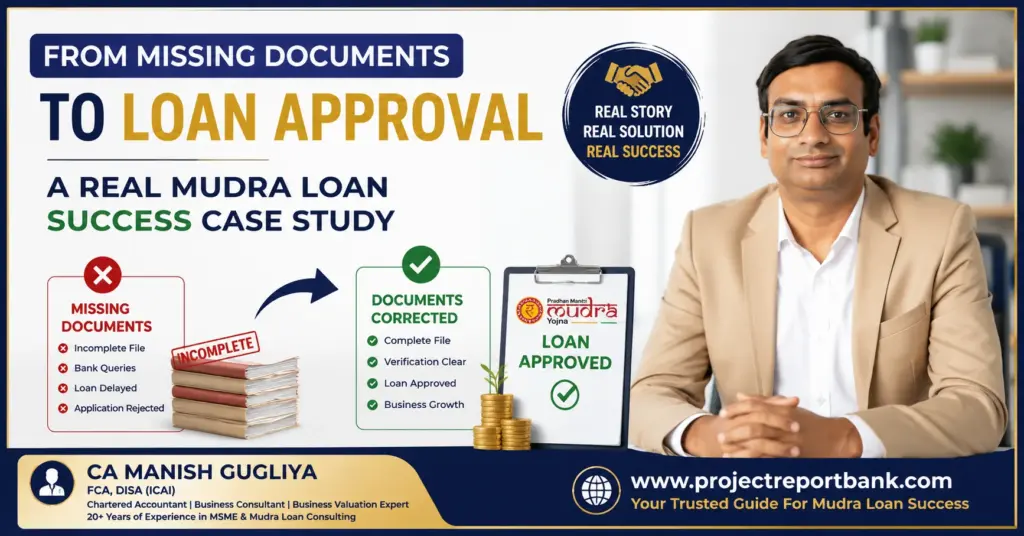
Key Takeaways
- This case study is based on my (CA Manish Gugliya’s) real consulting experience. Some identity and city details have been partially changed to protect client privacy.
- A small garment retailer’s mudra loan application was delayed for weeks because of incomplete KYC, weak business proof, and a missing project report – not because her business was bad or the mudra yojana scheme itself was the issue.
- After correcting a PAN–Aadhaar mismatch, updating bank statements for the last six months, preparing a clear business plan, and adding proper business registration proof, the same bank approved the mudra loan.
- Incomplete or mismatched documents are the single most common reason for mudra loan applications getting stuck or rejected across India.
- Proper documentation is the foundation – not an afterthought – of every successful loan application.
Introduction – How Missing Documents Stall a Mudra Loan
In 2024–2025, thousands of promising mudra loan applications never reached a credit officer’s desk. The reason was not a weak business or poor eligibility criteria – it was missing documents. Simple gaps like a name mismatch on a pan card, an outdated address proof, or a missing project report can stall an application for weeks.
Pradhan Mantri Mudra Yojana provides loans to micro-entrepreneurs in India through collateral-free institutional credit. MUDRA loans are generally collateral-free for eligible borrowers. The scheme covers four categories: Shishu loans provide up to ₹50,000 for new businesses, Kishore loans offer funding from ₹50,000 to ₹5 lakh, Tarun loans range from ₹5 lakh to ₹10 lakh for established businesses, and the newer Tarun Plus loans provide up to ₹20 lakh for repeat borrowers. The lending institution – whether public sector banks, regional rural banks, or NBFCs – decides approval, not MUDRA directly.
This article walks you through a real case study of a garment shop owner from Jaipur whose file was stuck due to missing documents mudra loan issues, and how she got her Kishore category loan approved after systematic document correction. You will learn common documentation mistakes, how banks verify documents, the exact corrections we made, and a practical checklist for your own file.
Table of Contents
Why Documentation Matters So Much in Mudra Loans
Under PMMY, mudra loans are unsecured. Since there is no collateral, banks rely almost entirely on documents to assess identity, business activity, and repayment capacity. Here is what banks verify and why each layer matters:
- KYC verification: Banks cross-check your aadhaar card, pan card, photographs, date of birth, and address against the CKYC database and cibil report. Even a minor spelling difference between Aadhaar and PAN can trigger an automatic flag.
- Business verification: Banks look for business registration like udyam registration, GST, or Shop & Establishment licence, along with a rental agreement, invoices, and business photos to confirm that your business unit actually operates.
- Address verification: Consistent residential and business address proof is essential. If your Aadhaar shows a different address from your shop’s utility bill or rent agreement, the file gets marked as “deficient documents.”
- Financial verification: Most lenders require recent bank statements for the last 6 to 12 months. Banks match deposits against declared turnover, check transaction history, and assess whether you can handle EMIs on the requested loan amount.
- Compliance requirements: Signature matching, self-attestation, recent documents (not older than 3 months for bank statements), and correct formats all matter. Missing initials or unsigned pages cause unnecessary delays.
According to MSMEGyan, incomplete or mismatched documents cause most mudra loan rejections across India.
Applicant Background – A Garment Shop Owner Seeking a Kishore Mudra Loan
The applicant was a 32-year-old woman entrepreneur running a small ladies’ garment shop in Jaipur since 2021. Her business activity was retail sale of readymade garments – sarees, kurtis, and kidswear – from a rented 150 sq. ft. shop in a local market. Sales spiked during festivals and wedding season.
She needed a Kishore category mudra loan of ₹4.50 lakh to purchase display racks, initial inventory, and shift to a slightly bigger adjoining shop. She approached a public sector bank branch (similar to Canara Bank or SBI) where she already had a savings account but no previous business loans or personal loan history.
She applied as a proprietorship with udyam registration taken recently. However, she had no formal project report, no current account for the business, and only a basic understanding of what documents banks need. She assumed the process would be straightforward.

Initial Problems Faced – The “Missing Documents” Mudra Loan Stage
The first mudra loan application in early 2024 seemed simple to the applicant. Within days, it got stuck because of several document gaps:
- PAN–Aadhaar mismatch: Her surname was spelled differently on PAN vs Aadhaar, and PAN carried an old village address. The bank system flagged this during KYC check. Businesses not registered consistently across documents face immediate scrutiny. Learn more about how this specific issue creates problems in PAN-Aadhaar name mismatch cases for Mudra loans.
- Address proof issue: Aadhaar and ration card showed different localities. The shop’s rental agreement was in her husband’s name with no addendum naming her as proprietor. No electricity bill or property tax receipt was provided for the business address proof.
- Missing business proof: No Shop & Establishment licence existed. Her udyam registration listed a very generic activity description (“retail trade”) and was unsupported by any purchase bills, invoices, or proof of business operations.
- Incomplete quotations: She submitted one handwritten quotation for racks. No GST-compliant invoice for inventory purchase was provided, making the project cost look unstructured.
- Bank statement problems: Only 3 months’ savings account statement was given, with heavy cash deposits and no clear link to business sales. No separate current account existed for the business.
- Missing project report: Lack of a clear business plan results in loan application denial. Her application mentioned “stock purchase and shop renovation” with no sales projection, cost breakup, or repayment plan. A detailed project report is required for Kishore and Tarun loans to outline technical and economic viability.
How the Bank Responded – File on Hold Due to Deficient Documents
Banks rarely issue an immediate rejection on the first pass. Instead, they mark the file as “documents pending” or “kept in abeyance.” If documents are missing, the standard approach is to communicate with the bank to rectify the issue and gather necessary items.
Within 7–10 days, the loan officer verbally informed her that KYC and business proof were incomplete. Processing could not begin. The bank asked for:
- Updated PAN with correct name and address
- Proper address proof matching Aadhaar
- 6 months’ bank statements (minimum)
- Business registration proof (Shop licence, invoices)
- A simple business plan or project report
The file was not logged on the bank’s Mudra portal as “sanctioned” or “rejected.” It sat in a physical pending tray, causing weeks of delay with no SMS update. The applicant believed her mudra loan was rejected due to missing documents, but technically the bank had only kept it pending until compliance was completed.
This is the stage at which she reached out to me (CA Manish Gugliya) after a friend’s reference. Many applicants face this same confusion – and it is exactly the right time to seek professional clarity. A comprehensive guide on preparing your Mudra loan document file can help avoid reaching this stage.
Professional Review – How a CA Re-Structured the Mudra Loan Application
In my first meeting, I reviewed the acknowledgement slip, document bundle, and the bank’s informal deficiency list. Here is what the review covered:
- Document verification: Step-by-step checking of Aadhaar, PAN, photographs, Udyam certificate, rent agreement, driving licence (used as secondary ID), existing licences, previous loan history, and pulling the cibil report (with consent). Applicants must not be defaulters to any bank or financial institution – her record was clean, which was a positive.
- Financial review: Analysing 12 months’ bank statements, studying seasonality of deposits, cash withdrawals, and assessing realistic EMI capacity for a ₹4.5 lakh mudra loan. The bank passbook confirmed irregular but genuine business deposits.
- Business profiling: Structuring details like shop size, location, competition, average daily bill value, and customer profile to be reflected in the business plan. This would demonstrate business viability to the credit officer.
- Compliance check: Confirming that retail garments is a PMMY-eligible business activity, and that there was no previous loan default anywhere in the cibil report. A cibil score above 700 improves loan approval chances – hers was 720, so credit history was not a concern.
- File restructuring: Converting loose papers into a neat, indexed file with a covering letter, updated KYC set, business proof, financials, and a 3-year projection-based project report. Kishore and Tarun loans need a business plan and financial statements – this was the most critical missing piece.
Documents Corrected and Updated – From Deficiency to Compliance
The biggest turning point in this mudra loan success case study was systematically correcting every single document issue. Here is what changed:
| Problem | Correction Made | Result at Bank Level |
|---|---|---|
| PAN–Aadhaar name and address mismatch | Updated PAN online via NSDL, printed e-PAN with correct spelling and address, attached self-declaration | KYC flag removed, verification passed |
| Weak business proof | Obtained Shop & Establishment licence from Jaipur Nagar Nigam, corrected Udyam Registration NIC code, added rent agreement addendum naming the proprietor, attached recent purchase bills | Bank accepted business as operational and eligible |
| Insufficient financial trail | Submitted 12 months’ bank statements, opened a current account for daily shop sales, shifted deposits from cash to bank | Clearer turnover pattern, better EMI servicing comfort |
| No project report or business plan | Prepared a 5–6 page project report with cost breakup, sales projections, profit estimate, and DSCR calculation (≥1.25) | Credit officer could justify loan amount within Mudra Kishore norms |
Additional Improvements – Strengthening the Mudra Loan File Beyond Minimum Requirements
In my experience, files that just meet minimum required documents often remain weak. Stronger files give credit officers confidence to recommend loan approval. Here is what we added beyond the basics:
- Refined basic business plan: Detailed the product mix (sarees, kurtis, kidswear), expected festival season sales, basic marketing steps, and simple monthly cash-flow projections showing income vs expenses.
- Better quotations: Collected 2–3 GST-compliant quotations for racks, counters, and initial stock from different wholesalers in Jaipur, with GST numbers and payment terms clearly mentioned. This replaced the old handwritten quotation.
- Improved bank statements: Advised the applicant to route daily sales through her bank for 4–6 weeks before resubmission. This reduced large cash-in-hand entries and showed regular transactions and stable monthly turnover.
- Formalised business registration: Updated Udyam portal details (address, phone, business name, activity description) to match KYC and added the fresh printout to the file.
- Risk explanation: Included a short note in the project report about competition in the local market and her plan to differentiate via quality fabrics and festival offers. This impressed the bank officer reviewing the file.
Final Loan Approval – Timeline, Sanction Terms, and Outcome
Here is how the timeline played out: initial application in February 2024, professional review and corrections in March, resubmission to the same branch in early April, and sanction in about 18–20 working days after the file was marked complete.
The bank sanctioned a Mudra Kishore loan of ₹4.00 lakh. The bank reduced the loan amount slightly from ₹4.5 lakh based on cash-flow analysis – applying for an unjustified loan amount can lead to rejection, so this adjustment actually protected the file. Tenure was 4 years with EMI starting after one month. Interest rate was approximately 11–12% p.a. as per the bank’s Mudra card rate.
No collateral security or third-party guarantor was taken – only a simple hypothecation of stock and shop fixtures under standard PM Mudra Yojana norms. The amount was credited to her current account, with partial direct payment to the rack supplier and garment wholesaler through NEFT.
Six to nine months later, the results were clear: higher display capacity, stronger festival sales, average monthly turnover increase of nearly 40%, and EMIs being paid on time. The mudra loan approved outcome turned a stalled application into a genuine business growth story. Similar experiences are documented in other Mudra loan approval after initial rejection case studies.

Key Lessons and Checklist for Every Mudra Loan Applicant
This section converts the case study into a practical action checklist for any entrepreneur planning to apply online or at a branch in 2026. Create a clear business plan for loans above ₹50,000 – this is non-negotiable for Kishore and Tarun category loans.
- KYC discipline: Ensure Aadhaar, PAN, and bank records carry the same spelling, date of birth, and current address. The aadhaar card acts as both identity and address proof for mudra loan applications. Correct mismatches before submitting.
- Business proof: Keep at least one strong business registration (Udyam, Shop & Establishment, GST if applicable) plus a rental agreement or ownership proof and 2–3 recent purchase or sales bills as proof of business.
- Financial documents: Arrange 6–12 months’ bank statements, recent ITR as income proof if available, and ensure declared turnover and bank deposits broadly match. Review your current financial year data.
- Project report: Prepare a solid business plan to substitute for missing financial records when applying for Kishore or Tarun loans. Include cost breakup, expected sales, expenses, working capital needs, and a repayment plan.
- Organisation: Submit an indexed file with self-attested copies, signatures on all pages, and a cover letter. Register your business on the Udyam portal to enhance credibility.
- Response to bank queries: Treat every “deficiency list” as a roadmap. Respond within days, keep written acknowledgement of every submission, and follow up weekly after submitting your loan application.
Common Documentation Mistakes in Mudra Loan Applications
After reviewing hundreds of Mudra files, I see the same errors repeating. Most can be fixed before submission with a little attention:
- Incomplete KYC set: Missing PAN or Aadhaar, expired ID proofs like voter ID or driving licence, or not providing photographs. Common documents for mudra loan application include identity proof, address proof, and business proof – skipping any one stalls the file. Shishu loans require documents like Aadhaar and business proof at minimum.
- Address proof issues: Aadhaar with old village address, a rental agreement missing full details, or utility bill and electricity bill not in the applicant’s or business name. Learn more about address proof issues causing Mudra loan rejections.
- Weak business evidence: Applying for business loans but providing only personal documents. No invoices, licences, or Udyam/GST registration to prove actual business activity in service sectors or retail.
- Outdated bank statements: Giving statements older than 3 months, screenshots instead of authenticated statements, or statements without bank logo and IFSC details. Most banks require statements covering the last six months minimum.
- Copy-paste project reports: Downloading generic reports that do not match actual business size, city, or loan amount. Banks immediately doubt seriousness when years balance sheets and projections don’t align with the applicant’s scale.
- Signature and form mistakes: Unsigned application pages, mismatched documents with bank records, overwriting on forms, and missing initials – these create avoidable friction.
Mudra Loan Document Checklist – Practical Guide for 2026 Applicants
Use this checklist before submitting any mudra loan application – whether Shishu, Kishore, or Tarun – in 2026. Documentation requirements for Mudra loans vary by lender and loan amount, but this covers the essentials.
Personal KYC:
- Aadhaar card (serves as both identity and address proof)
- Pan card (note: a PAN card is not mandatory for all mudra loan applications, especially small shishu category loans, but strongly recommended)
- Recent passport-size photographs
- One additional address proof if needed (voter ID, utility bill, driving licence)
Business Registration & Activity:
- Udyam Registration printout with correct NIC code and business name
- GST registration (if turnover or business type requires it)
- Shop & Establishment licence
- Rental agreement or property papers for business premises
- Proof of business: 2–3 recent purchase or sales invoices
Financials:
- 6–12 months’ bank statements (savings and current account)
- Last 2 years ITR (if filed) for income proof
- Latest GST returns summary (if registered)
- Existing loan statements or scheme information from your existing banker
Project-Specific Documents:
- Quotations for machinery, equipment, or stock
- Simple business plan or project report with cost and revenue estimates
Declarations & Miscellaneous:
- Self-declaration about not being a defaulter to any financial institution
- Consent for CIBIL check
- Prescribed Mudra application formats of the bank
Banks may ask for other documents depending on internal policy, but if this checklist is fully covered, the chances of missing documents mudra loan problems become very low. Applications can be submitted through the Udyamimitra portal or directly to banks.
Expert Tips from CA Manish Gugliya for Smooth Mudra Loan Approval
These tips come from 20+ years of MSME finance consulting and real mudra loan case work:
- Prepare early: Start updating PAN, Aadhaar, and business registrations at least 3–4 weeks before you plan to submit. Rushing corrections after bank queries wastes weeks.
- Choose loan amount wisely: Align your requested amount with last 6–12 months’ bank turnover and realistic profit. Applying for an unjustified loan amount can lead to rejection. Just because Mudra allows up to ₹10–20 lakh doesn’t mean you should ask for the maximum.
- Check your CIBIL and credit history: A cibil score below 650 often leads to rejection. If errors or old settled accounts are reducing your score, plan a correction strategy before applying. A cibil score above 700 significantly improves your chances.
- Maintain clean banking habits: Avoid frequent cheque bounces, high cash withdrawals, or negative balances. Banks read bank statements very carefully for unsecured loans. Regular transactions and stable deposits matter more than large one-time entries.
- Consider professional help: For first-time entrepreneurs or anyone whose mudra loan was rejected earlier, getting your file reviewed by a CA or consultant who understands bank credit appraisal can make the difference. A successful reapplication often starts with a fresh professional review.
- Follow up politely: Visit or call the branch periodically, ask for written deficiency lists instead of only verbal remarks, and maintain a record of all submission dates.
Frequently Asked Questions (FAQs)
These FAQs address practical questions that readers often ask after facing document-related mudra loan issues. Answers are based on general banking practice up to July 2026; exact policies may vary by bank.
Can a Mudra loan be approved if some documents are submitted later?
Many banks initially accept the mudra loan form with basic KYC and then issue a deficiency list. The file usually progresses only after all key documents are in. Minor pending items like one extra quotation or a latest utility bill can sometimes be accepted later, but core KYC and business proof must be complete for sanction. Always ask the bank whether your application is “logged in the system” or only “kept pending for documents.”
If my Mudra loan was rejected due to missing documents, can I reapply to the same bank?
Yes. Reapplication to the same bank is normally allowed once all reasons are fully rectified. Banks often treat it as a fresh file. Attach a brief cover letter explaining improvements made – updated KYC, new project report, better bank statements. Some applicants also compare offers from another bank or financial institution after strengthening documents, but avoid multiple simultaneous applications. Lenders may accept alternatives for missing documents based on their policy and requirements.
Does every bank ask for income tax returns for Mudra loans?
For small shishu loans (up to ₹50,000), ITR is usually not demanded. For Kishore and Tarun loans, most banks prefer ITRs if the business is older than 2–3 years. When ITR is not available (very small or new business), banks rely more on bank statements, business proof, and a strong project report to judge repayment capacity. Prepare a solid business plan to substitute for missing financial records.
Can a CA’s project report really improve my Mudra loan approval chances?
There is no guarantee of loan approval, but a professionally prepared, realistic project report helps the credit officer understand the business, loan amount, and repayment plan quickly. Based on my experience, structured reports with consistent documents often convert a borderline or pending file into a sanction – as demonstrated in this case study.
How long does it usually take to get Mudra loan approval after document correction?
Typical timelines: 7–10 working days for shishu loans and 2–4 weeks for Kishore and Tarun loans after the file is marked “complete in all respects.” Timelines vary depending on bank workload and verification steps. Keep follow-up notes and politely remind the branch if there is no update beyond 3–4 weeks.
Conclusion – Turning Documentation Problems into a Mudra Loan Success Story
This case study followed a clear arc: initial mudra loan delay due to missing documents, professional review of the complete file, systematic corrections of every deficiency, and eventual sanction of ₹4 lakh from the same bank branch. The applicant’s business was never the problem – her paperwork was.
Most “mudra loan rejected due to missing documents” situations are preventable. Submit complete and accurate documentation to avoid rejection. Proper KYC, up-to-date business registration, clean bank statements, and a realistic simple business plan form the backbone of any strong loan application.
If you are planning to apply – or reapply – treat documentation as the foundation, not a formality. Where needed, take expert help before submitting. With correct preparation, many small entrepreneurs can convert documentation mistakes into their own mudra loan success case study. The scheme information and support exist; your job is to present a file that makes it easy for the bank to say yes.
- Can Bank Reduce Mudra Loan Amount Without Your Consent? Complete Practical Guide (2026)


- What to Do If You Cannot Pay Your Mudra Loan EMI (2026 Guide)

- Can a Bank Refuse a Mudra Loan Because the Target Is Completed? Complete Guide (2026)

- Bank Refused My Mudra Loan Application – What Are My Rights?

- Mudra Loan for Used Vehicles (2026): Eligibility, Documents, Bank Rules & Complete Guide

- Rejected Mudra Loan – What to Do Next? Appeal Process Explained (2026)

- Mudra Loan Project Report Madhya Pradesh – Bank-Ready DPR & CMA Guide

- Project Report for Mudra Loan Maharashtra: Complete Guide for MSMEs, Startups and Small Businesses (2026)

- Mudra Loan Uttar Pradesh: Complete Guide for MSMEs, Startups and Small Businesses (2026)